What does the Bible say about Guardian
Angels and can you call on them?
We have more questions about angels and demons than we have
answers. Many times we have to make guesses and assumptions
based on a few biblical facts. Angels are essentially spiritual beings
without bodies. Hebrews 1:14 calls them ministering spirits. When
they appear to people, they normally are seen with bodies. Sometimes
they appear as ordinary men (Hebrews 13:2) or incredibly glorious
men (Daniel 10:16) and sometimes as fantastic creatures (Isaiah 6:2;
Ezekiel 1:4–14).
However, since angels do not have bodies, these forms are only
manifestations in material/visible form. They do not represent what
the angel actually “looks like” because a spirit is essentially invisible,
at least to the physical eye.
Tony Mariot Guardian Angels 1
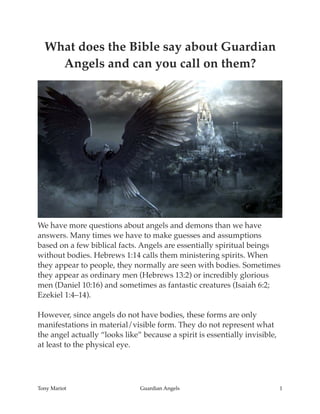
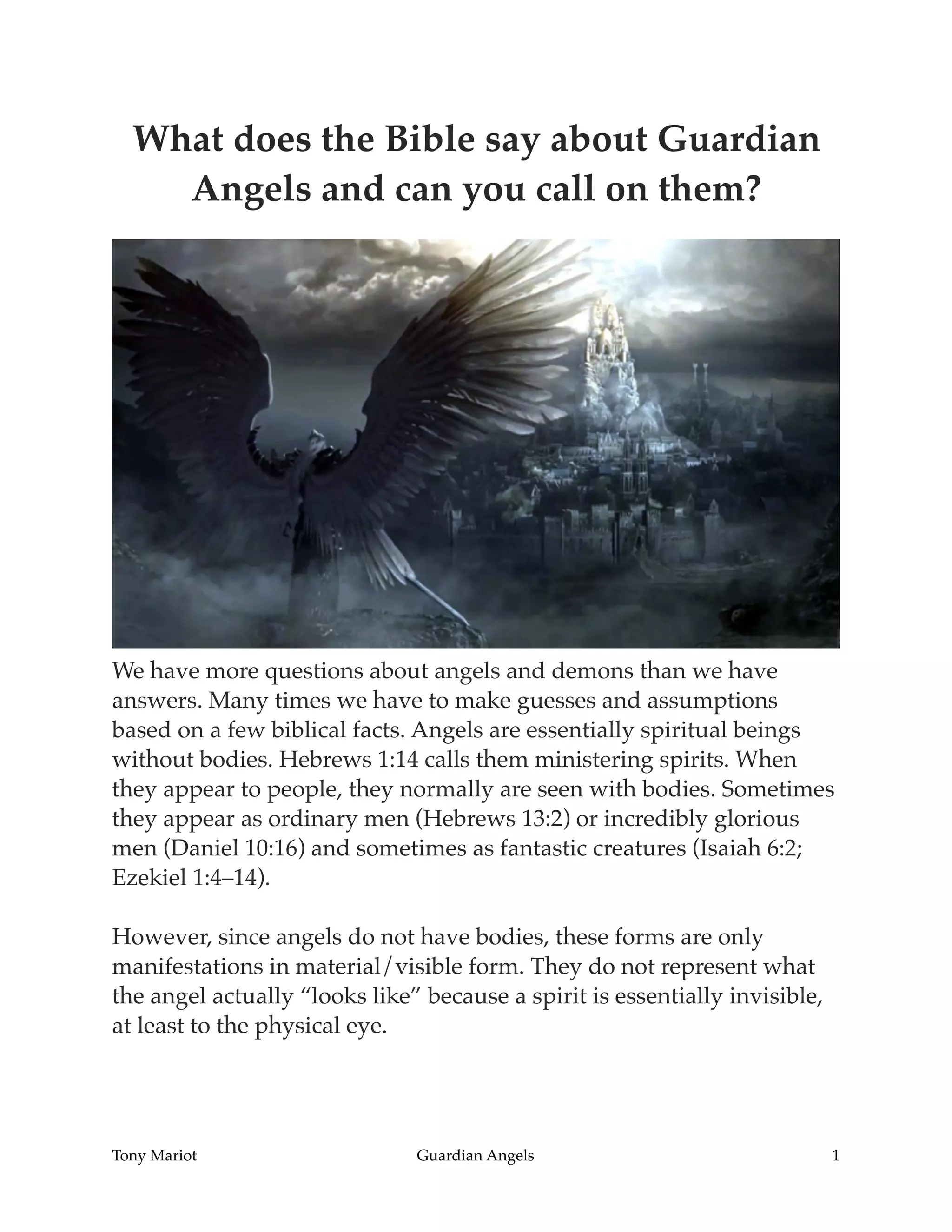
Angels sometimes appear with wings in Scripture and are often
depicted with wings in art, but physical wings are used to move
physical bodies through physical air, and again, angels are spirit
beings.
Since angels do not have physical bodies, they cannot be hurt in the
sense of suffering physical harm in the same way a human being with
a body could be hurt. Likewise, angels cannot die in that sense, either.
Physical death is something that humans experience when their
bodies cease working and their spirits depart from their bodies. Since
angels do not have physical bodies, they cannot experience physical
death.
It is possible that angels do encounter some perils in the spiritual
world, perils that are beyond our normal experience or
comprehension. The Angel Gabriel was sent with an answer to
Daniel’s prayer but was detained by “the Prince of Persia” (a fallen
angel/demon) and prevented him from coming to Daniel for 21 days
(Daniel 10:12–13). Even though they are spirits, angels are not
omnipresent, so they do have some kind of localized existence that
apparently can be contained. When angels “fight” with demons, do
they get injured by each other? Perhaps, but we are simply not told
what this type of fighting entails. When we are in battle with spiritual
forces, we do not use physical weapons but the armor of God detailed
in Ephesians 6:10–18, which is a spiritual faith based weapon.
If demons are fallen angels, then we know that angels can suffer.
When Jesus cast demons out, they sometimes feared that Jesus was
going to torture or torment them (Matthew 8:29; Luke 8:28). Legion
begged Jesus not to send them into the Abyss, a holding place for
fallen angels/demons (Luke 8:21). If they feared going there, they
must be able to suffer in some way. At the final judgment, all of the
fallen angels will be cast into the lake of fire (Matthew 25:41), which is
the “second death” (Revelation 20:14).
Tony Mariot Guardian Angels 2
There, fallen angels will experience spiritual death, which is defined
as separation from God. How can a spiritual being be tormented by
flames of fire? We don’t know. As spiritual beings who were meant to
enjoy fellowship with God, isolation from God will result in the worst
kind of torture.
“Take heed that ye despise not one of these little ones; for I say unto you, That
in heaven their angels do always behold the face of my Father which is in
heaven.” Matthew 18:10
In the context, “these little ones” applies to those who believe in Him
(v. 6) and it refers to little children (vs. 3-5). This is the key passage
regarding guardian angels. There is no doubt that good angels help
protect (Daniel 6:20-23; 2 Kings 6:13-17), reveal information (Acts
7:52-53; Luke 1:11-20), guide (Matthew 1:20-21; Acts 8:26), provide for
(Genesis 21:17-20; 1 Kings 19:5-7), and minister to believers in general
(Hebrews 1:14).
The question is whether each person—or each believer—has an angel
assigned to him/her. In the Old Testament, the nation of Israel had the
archangel (Michael) assigned to it (Daniel 10:21; 12:1), but Scripture
nowhere states that an angel is “assigned” to an individual (angels
were sometimes sent to individuals, but there is no mention of
permanent assignment). The Jews fully developed the belief in
guardian angels during the time between the Old and New Testament
periods. Some early church fathers believed that each person had not
only a good angel assigned to him/her, but a demon as well. The
belief in guardian angels has been around for a long time, but there is
no explicit scriptural basis for it.
The word “their” in Matthew 18:10 is a collective pronoun in the
Greek and refers to the fact that believers are served by angels in
general.
Tony Mariot Guardian Angels 3
These angels are pictured as “always” watching the face of God so as
to hear His command to them to help a believer when it is needed.
The angels in this passage do not seem to be guarding a person so
much as being attentive to the Father in heaven. The active duty or
oversight comes from God then from the angels, because God alone is
omniscient. He sees every believer at every moment, and He alone
knows when one of us needs the intervention of an angel. Because
they are continually seeing His face, the angels are at His disposal to
help one of His “little ones.”
It cannot be emphatically answered from Scripture whether or not
each believer has a guardian angel assigned to him/her, although
angels do record our lives for the day of judgment. God does use
angels in ministering to us. It is scriptural to say that He uses them as
He uses us; that is, He in no way needs us or them to accomplish His
purposes, but chooses to use us and them nevertheless (Hebrews 1:7).
In the end, whether or not we have an angel assigned to protect us, we
have an even greater assurance from God: if we are His children
through faith in Christ, He works all things together for our good
(Romans 8:28-30), and Christ will never leave us or forsake us
(Hebrews 13:5-6). If we have an omniscient, omnipotent, all-loving
God with us, it does not really matter whether or not there is a finite
guardian angel protecting us.
Tony Mariot Guardian Angels 4

Guardian Angels

  • 1.
    What does theBible say about Guardian Angels and can you call on them? We have more questions about angels and demons than we have answers. Many times we have to make guesses and assumptions based on a few biblical facts. Angels are essentially spiritual beings without bodies. Hebrews 1:14 calls them ministering spirits. When they appear to people, they normally are seen with bodies. Sometimes they appear as ordinary men (Hebrews 13:2) or incredibly glorious men (Daniel 10:16) and sometimes as fantastic creatures (Isaiah 6:2; Ezekiel 1:4–14). However, since angels do not have bodies, these forms are only manifestations in material/visible form. They do not represent what the angel actually “looks like” because a spirit is essentially invisible, at least to the physical eye. Tony Mariot Guardian Angels 1
  • 2.
    Angels sometimes appearwith wings in Scripture and are often depicted with wings in art, but physical wings are used to move physical bodies through physical air, and again, angels are spirit beings. Since angels do not have physical bodies, they cannot be hurt in the sense of suffering physical harm in the same way a human being with a body could be hurt. Likewise, angels cannot die in that sense, either. Physical death is something that humans experience when their bodies cease working and their spirits depart from their bodies. Since angels do not have physical bodies, they cannot experience physical death. It is possible that angels do encounter some perils in the spiritual world, perils that are beyond our normal experience or comprehension. The Angel Gabriel was sent with an answer to Daniel’s prayer but was detained by “the Prince of Persia” (a fallen angel/demon) and prevented him from coming to Daniel for 21 days (Daniel 10:12–13). Even though they are spirits, angels are not omnipresent, so they do have some kind of localized existence that apparently can be contained. When angels “fight” with demons, do they get injured by each other? Perhaps, but we are simply not told what this type of fighting entails. When we are in battle with spiritual forces, we do not use physical weapons but the armor of God detailed in Ephesians 6:10–18, which is a spiritual faith based weapon. If demons are fallen angels, then we know that angels can suffer. When Jesus cast demons out, they sometimes feared that Jesus was going to torture or torment them (Matthew 8:29; Luke 8:28). Legion begged Jesus not to send them into the Abyss, a holding place for fallen angels/demons (Luke 8:21). If they feared going there, they must be able to suffer in some way. At the final judgment, all of the fallen angels will be cast into the lake of fire (Matthew 25:41), which is the “second death” (Revelation 20:14). Tony Mariot Guardian Angels 2
  • 3.
    There, fallen angelswill experience spiritual death, which is defined as separation from God. How can a spiritual being be tormented by flames of fire? We don’t know. As spiritual beings who were meant to enjoy fellowship with God, isolation from God will result in the worst kind of torture. “Take heed that ye despise not one of these little ones; for I say unto you, That in heaven their angels do always behold the face of my Father which is in heaven.” Matthew 18:10 In the context, “these little ones” applies to those who believe in Him (v. 6) and it refers to little children (vs. 3-5). This is the key passage regarding guardian angels. There is no doubt that good angels help protect (Daniel 6:20-23; 2 Kings 6:13-17), reveal information (Acts 7:52-53; Luke 1:11-20), guide (Matthew 1:20-21; Acts 8:26), provide for (Genesis 21:17-20; 1 Kings 19:5-7), and minister to believers in general (Hebrews 1:14). The question is whether each person—or each believer—has an angel assigned to him/her. In the Old Testament, the nation of Israel had the archangel (Michael) assigned to it (Daniel 10:21; 12:1), but Scripture nowhere states that an angel is “assigned” to an individual (angels were sometimes sent to individuals, but there is no mention of permanent assignment). The Jews fully developed the belief in guardian angels during the time between the Old and New Testament periods. Some early church fathers believed that each person had not only a good angel assigned to him/her, but a demon as well. The belief in guardian angels has been around for a long time, but there is no explicit scriptural basis for it. The word “their” in Matthew 18:10 is a collective pronoun in the Greek and refers to the fact that believers are served by angels in general. Tony Mariot Guardian Angels 3
  • 4.
    These angels arepictured as “always” watching the face of God so as to hear His command to them to help a believer when it is needed. The angels in this passage do not seem to be guarding a person so much as being attentive to the Father in heaven. The active duty or oversight comes from God then from the angels, because God alone is omniscient. He sees every believer at every moment, and He alone knows when one of us needs the intervention of an angel. Because they are continually seeing His face, the angels are at His disposal to help one of His “little ones.” It cannot be emphatically answered from Scripture whether or not each believer has a guardian angel assigned to him/her, although angels do record our lives for the day of judgment. God does use angels in ministering to us. It is scriptural to say that He uses them as He uses us; that is, He in no way needs us or them to accomplish His purposes, but chooses to use us and them nevertheless (Hebrews 1:7). In the end, whether or not we have an angel assigned to protect us, we have an even greater assurance from God: if we are His children through faith in Christ, He works all things together for our good (Romans 8:28-30), and Christ will never leave us or forsake us (Hebrews 13:5-6). If we have an omniscient, omnipotent, all-loving God with us, it does not really matter whether or not there is a finite guardian angel protecting us. Tony Mariot Guardian Angels 4