pragmatic persona - why?

Pragmatic persona
Putting a Face on your user needs
pragmatic persona - why?

“You are Not Your User”

It’s easy to ask ourselves what we would like when making
choices about features, but "Self-substitution" is the most
common trap we fall into when making functionality and
UI decisions.
pragmatic persona - why?

Asking users what features they want and
building them is also risky

This ends with users’ getting what they asked for
and still not being satisfied with the site.
pragmatic persona - why?

Usability

“The extent to which a product can be used by
specified users to achieve specified goals with
effectiveness, efficiency, and satisfaction in a
specified context of use.”
pragmatic persona - why?

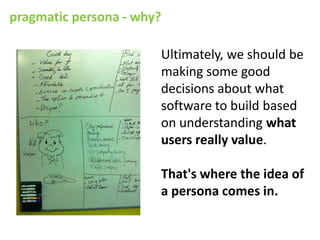
                       Ultimately, we should be
                       making some good
                       decisions about what
                       software to build based
                       on understanding what
                       users really value.

                       That's where the idea of
                       a persona comes in.
pragmatic persona - why?

A persona is an example of a specific user that we
can refer to when we evaluate decisions about
functionality, navigation and design.
pragmatic persona - why?

It's not based on one user, but a combination of
information about many users. So, even though a
persona may look like it’s describing a real person,
that person is fictitious.
Having this fictitious person helps us not get hung
up on any single user's opinions.
pragmatic persona - why?

It's a neutral "design target"—the person we're
trying to satisfy. The hope is that making this
persona happy will result in making all people like
the persona happy.
pragmatic persona - why?

Avoids subjective design decisions, and allows us to
judge effectiveness based on how well the
interface supports the users behaviour and goals
pragmatic persona - why?

Why do we encourage the whole team and all
stakeholders to be involved?

With a shared of understanding of who we’re
designing for and their needs, we can build a more
effective tool.

pragmatic personas - Why?

  • 1.
    pragmatic persona -why? Pragmatic persona Putting a Face on your user needs
  • 2.
    pragmatic persona -why? “You are Not Your User” It’s easy to ask ourselves what we would like when making choices about features, but "Self-substitution" is the most common trap we fall into when making functionality and UI decisions.
  • 3.
    pragmatic persona -why? Asking users what features they want and building them is also risky This ends with users’ getting what they asked for and still not being satisfied with the site.
  • 4.
    pragmatic persona -why? Usability “The extent to which a product can be used by specified users to achieve specified goals with effectiveness, efficiency, and satisfaction in a specified context of use.”
  • 5.
    pragmatic persona -why? Ultimately, we should be making some good decisions about what software to build based on understanding what users really value. That's where the idea of a persona comes in.
  • 6.
    pragmatic persona -why? A persona is an example of a specific user that we can refer to when we evaluate decisions about functionality, navigation and design.
  • 7.
    pragmatic persona -why? It's not based on one user, but a combination of information about many users. So, even though a persona may look like it’s describing a real person, that person is fictitious. Having this fictitious person helps us not get hung up on any single user's opinions.
  • 8.
    pragmatic persona -why? It's a neutral "design target"—the person we're trying to satisfy. The hope is that making this persona happy will result in making all people like the persona happy.
  • 9.
    pragmatic persona -why? Avoids subjective design decisions, and allows us to judge effectiveness based on how well the interface supports the users behaviour and goals
  • 10.
    pragmatic persona -why? Why do we encourage the whole team and all stakeholders to be involved? With a shared of understanding of who we’re designing for and their needs, we can build a more effective tool.