Practical SQL A Beginner s Guide to Storytelling
with Data 2nd Edition Anthony Debarros install
download
https://ebookmeta.com/product/practical-sql-a-beginner-s-guide-
to-storytelling-with-data-2nd-edition-anthony-debarros-2/
Download more ebook from https://ebookmeta.com
We believe these products will be a great fit for you. Click
the link to download now, or visit ebookmeta.com
to discover even more!
Practical SQL A Beginner s Guide to Storytelling with
Data 2nd Edition Anthony Debarros
https://ebookmeta.com/product/practical-sql-a-beginner-s-guide-
to-storytelling-with-data-2nd-edition-anthony-debarros/
Practical SQL: A Beginner's Guide to Storytelling with
Data, 2nd Edition Anthony Debarros
https://ebookmeta.com/product/practical-sql-a-beginners-guide-to-
storytelling-with-data-2nd-edition-anthony-debarros/
SQL QuickStart Guide The Simplified Beginner s Guide to
Managing Analyzing and Manipulating Data With SQL
Walter Shields
https://ebookmeta.com/product/sql-quickstart-guide-the-
simplified-beginner-s-guide-to-managing-analyzing-and-
manipulating-data-with-sql-walter-shields/
Nephilim Prince 2 A Men s Fantasy Series Dark Star
Series 1st Edition Troy Maverick
https://ebookmeta.com/product/nephilim-prince-2-a-men-s-fantasy-
series-dark-star-series-1st-edition-troy-maverick/
Take Control of iOS 15 and iPadOS 15 Josh Centers
https://ebookmeta.com/product/take-control-of-ios-15-and-
ipados-15-josh-centers/
Quantum Mechanics Mahesh C Jain
https://ebookmeta.com/product/quantum-mechanics-mahesh-c-jain/
Always Eli Forever Love 1 1st Edition Charlie Novak
https://ebookmeta.com/product/always-eli-forever-love-1-1st-
edition-charlie-novak/
The Godsfall Chronicles 1st Edition Cocooned Cow
https://ebookmeta.com/product/the-godsfall-chronicles-1st-
edition-cocooned-cow/
Marginal Urbanisms Informal and Formal Development in
Cities of Latin America 1st Edition Felipe Hernández
https://ebookmeta.com/product/marginal-urbanisms-informal-and-
formal-development-in-cities-of-latin-america-1st-edition-felipe-
hernandez/
The Eye of the Crown Routledge Research in Early Modern
History 1st Edition Kristin M.S. Bezio
https://ebookmeta.com/product/the-eye-of-the-crown-routledge-
research-in-early-modern-history-1st-edition-kristin-m-s-bezio/
CONTENTS IN DETAIL
TITLE PAGE
COPYRIGHT
ABOUT THE AUTHOR
PREFACE TO THE SECOND EDITION
ACKNOWLEDGMENTS
INTRODUCTION
What Is SQL?
Why SQL?
Who Is This Book For?
What You’ll Learn
CHAPTER 1: SETTING UP YOUR CODING ENVIRONMENT
Installing a Text Editor
Downloading Code and Data from GitHub
Installing PostgreSQL and pgAdmin
Windows Installation
macOS Installation
Linux Installation
Working with pgAdmin
Launching pgAdmin and Setting a Master Password
Connecting to the Default postgres Database
Exploring the Query Tool
Customizing pgAdmin
Alternatives to pgAdmin
Wrapping Up
CHAPTER 2: CREATING YOUR FIRST DATABASE AND TABLE
Understanding Tables
Creating a Database
Executing SQL in pgAdmin
Connecting to the analysis Database
Creating a Table
Using the CREATE TABLE Statement
Making the teachers Table
Inserting Rows into a Table
Using the INSERT Statement
Viewing the Data
Getting Help When Code Goes Bad
Formatting SQL for Readability
Wrapping Up
CHAPTER 3: BEGINNING DATA EXPLORATION WITH SELECT
Basic SELECT Syntax
Querying a Subset of Columns
Sorting Data with ORDER BY
Using DISTINCT to Find Unique Values
Filtering Rows with WHERE
Using LIKE and ILIKE with WHERE
Combining Operators with AND and OR
Putting It All Together
Wrapping Up
CHAPTER 4: UNDERSTANDING DATA TYPES
Understanding Characters
Understanding Numbers
Using Integers
Auto-Incrementing Integers
Using Decimal Numbers
Choosing Your Number Data Type
Understanding Dates and Times
Using the interval Data Type in Calculations
Understanding JSON and JSONB
Using Miscellaneous Types
Transforming Values from One Type to Another with CAST
Using CAST Shortcut Notation
Wrapping Up
CHAPTER 5: IMPORTING AND EXPORTING DATA
Working with Delimited Text Files
Handling Header Rows
Quoting Columns That Contain Delimiters
Using COPY to Import Data
Importing Census Data Describing Counties
Creating the us_counties_pop_est_2019 Table
Understanding Census Columns and Data Types
Performing the Census Import with COPY
Inspecting the Import
Importing a Subset of Columns with COPY
Importing a Subset of Rows with COPY
Adding a Value to a Column During Import
Using COPY to Export Data
Exporting All Data
Exporting Particular Columns
Exporting Query Results
Importing and Exporting Through pgAdmin
Wrapping Up
CHAPTER 6: BASIC MATH AND STATS WITH SQL
Understanding Math Operators and Functions
Understanding Math and Data Types
Adding, Subtracting, and Multiplying
Performing Division and Modulo
Using Exponents, Roots, and Factorials
Minding the Order of Operations
Doing Math Across Census Table Columns
Adding and Subtracting Columns
Finding Percentages of the Whole
Tracking Percent Change
Using Aggregate Functions for Averages and Sums
Finding the Median
Finding the Median with Percentile Functions
Finding Median and Percentiles with Census Data
Finding Other Quantiles with Percentile Functions
Finding the Mode
Wrapping Up
CHAPTER 7: JOINING TABLES IN A RELATIONAL DATABASE
Linking Tables Using JOIN
Relating Tables with Key Columns
Querying Multiple Tables Using JOIN
Understanding JOIN Types
JOIN
LEFT JOIN and RIGHT JOIN
FULL OUTER JOIN
CROSS JOIN
Using NULL to Find Rows with Missing Values
Understanding the Three Types of Table Relationships
One-to-One Relationship
One-to-Many Relationship
Many-to-Many Relationship
Selecting Specific Columns in a Join
Simplifying JOIN Syntax with Table Aliases
Joining Multiple Tables
Combining Query Results with Set Operators
UNION and UNION ALL
INTERSECT and EXCEPT
Performing Math on Joined Table Columns
Wrapping Up
CHAPTER 8: TABLE DESIGN THAT WORKS FOR YOU
Following Naming Conventions
Quoting Identifiers Enables Mixed Case
Pitfalls with Quoting Identifiers
Guidelines for Naming Identifiers
Controlling Column Values with Constraints
Primary Keys: Natural vs. Surrogate
Foreign Keys
How to Automatically Delete Related Records with CASCADE
The CHECK Constraint
The UNIQUE Constraint
The NOT NULL Constraint
How to Remove Constraints or Add Them Later
Speeding Up Queries with Indexes
B-Tree: PostgreSQL’s Default Index
Considerations When Using Indexes
Wrapping Up
CHAPTER 9: EXTRACTING INFORMATION BY GROUPING
AND SUMMARIZING
Creating the Library Survey Tables
Creating the 2018 Library Data Table
Creating the 2017 and 2016 Library Data Tables
Exploring the Library Data Using Aggregate Functions
Counting Rows and Values Using count()
Finding Maximum and Minimum Values Using max() and min()
Aggregating Data Using GROUP BY
Wrapping Up
CHAPTER 10: INSPECTING AND MODIFYING DATA
Importing Data on Meat, Poultry, and Egg Producers
Interviewing the Dataset
Checking for Missing Values
Checking for Inconsistent Data Values
Checking for Malformed Values Using length()
Modifying Tables, Columns, and Data
Modifying Tables with ALTER TABLE
Modifying Values with UPDATE
Viewing Modified Data with RETURNING
Creating Backup Tables
Restoring Missing Column Values
Updating Values for Consistency
Repairing ZIP Codes Using Concatenation
Updating Values Across Tables
Deleting Unneeded Data
Deleting Rows from a Table
Deleting a Column from a Table
Deleting a Table from a Database
Using Transactions to Save or Revert Changes
Improving Performance When Updating Large Tables
Wrapping Up
CHAPTER 11: STATISTICAL FUNCTIONS IN SQL
Creating a Census Stats Table
Measuring Correlation with corr(Y, X)
Checking Additional Correlations
Predicting Values with Regression Analysis
Finding the Effect of an Independent Variable with r-Squared
Finding Variance and Standard Deviation
Creating Rankings with SQL
Ranking with rank() and dense_rank()
Ranking Within Subgroups with PARTITION BY
Calculating Rates for Meaningful Comparisons
Finding Rates of Tourism-Related Businesses
Smoothing Uneven Data
Wrapping Up
CHAPTER 12: WORKING WITH DATES AND TIMES
Understanding Data Types and Functions for Dates and Times
Manipulating Dates and Times
Extracting the Components of a timestamp Value
Creating Datetime Values from timestamp Components
Retrieving the Current Date and Time
Working with Time Zones
Finding Your Time Zone Setting
Setting the Time Zone
Performing Calculations with Dates and Times
Finding Patterns in New York City Taxi Data
Finding Patterns in Amtrak Data
Wrapping Up
CHAPTER 13: ADVANCED QUERY TECHNIQUES
Using Subqueries
Filtering with Subqueries in a WHERE Clause
Creating Derived Tables with Subqueries
Joining Derived Tables
Generating Columns with Subqueries
Understanding Subquery Expressions
Using Subqueries with LATERAL
Using Common Table Expressions
Performing Cross Tabulations
Installing the crosstab() Function
Tabulating Survey Results
Tabulating City Temperature Readings
Reclassifying Values with CASE
Using CASE in a Common Table Expression
Wrapping Up
CHAPTER 14: MINING TEXT TO FIND MEANINGFUL DATA
Formatting Text Using String Functions
Case Formatting
Character Information
Removing Characters
Extracting and Replacing Characters
Matching Text Patterns with Regular Expressions
Regular Expression Notation
Using Regular Expressions with WHERE
Regular Expression Functions to Replace or Split Text
Turning Text to Data with Regular Expression Functions
Full-Text Search in PostgreSQL
Text Search Data Types
Creating a Table for Full-Text Search
Searching Speech Text
Ranking Query Matches by Relevance
Wrapping Up
CHAPTER 15: ANALYZING SPATIAL DATA WITH POSTGIS
Enabling PostGIS and Creating a Spatial Database
Understanding the Building Blocks of Spatial Data
Understanding Two-Dimensional Geometries
Well-Known Text Formats
Projections and Coordinate Systems
Spatial Reference System Identifier
Understanding PostGIS Data Types
Creating Spatial Objects with PostGIS Functions
Creating a Geometry Type from Well-Known Text
Creating a Geography Type from Well-Known Text
Using Point Functions
Using LineString Functions
Using Polygon Functions
Analyzing Farmers’ Markets Data
Creating and Filling a Geography Column
Adding a Spatial Index
Finding Geographies Within a Given Distance
Finding the Distance Between Geographies
Finding the Nearest Geographies
Working with Census Shapefiles
Understanding the Contents of a Shapefile
Loading Shapefiles
Exploring the Census 2019 Counties Shapefile
Examining Demographics Within a Distance
Performing Spatial Joins
Exploring Roads and Waterways Data
Joining the Census Roads and Water Tables
Finding the Location Where Objects Intersect
Wrapping Up
CHAPTER 16: WORKING WITH JSON DATA
Understanding JSON Structure
Considering When to Use JSON with SQL
Using json and jsonb Data Types
Importing and Indexing JSON Data
Using json and jsonb Extraction Operators
Key Value Extraction
Array Element Extraction
Path Extraction
Containment and Existence
Analyzing Earthquake Data
Exploring and Loading the Earthquake Data
Working with Earthquake Times
Finding the Largest and Most-Reported Earthquakes
Converting Earthquake JSON to Spatial Data
Generating and Manipulating JSON
Turning Query Results into JSON
Adding, Updating, and Deleting Keys and Values
Using JSON Processing Functions
Finding the Length of an Array
Returning Array Elements as Rows
Wrapping Up
CHAPTER 17: SAVING TIME WITH VIEWS, FUNCTIONS, AND
TRIGGERS
Using Views to Simplify Queries
Creating and Querying Views
Creating and Refreshing a Materialized View
Inserting, Updating, and Deleting Data Using a View
Creating Your Own Functions and Procedures
Creating the percent_change() Function
Using the percent_change() Function
Updating Data with a Procedure
Using the Python Language in a Function
Automating Database Actions with Triggers
Logging Grade Updates to a Table
Automatically Classifying Temperatures
Wrapping Up
CHAPTER 18: USING POSTGRESQL FROM THE COMMAND
LINE
Setting Up the Command Line for psql
Windows psql Setup
macOS psql Setup
Linux psql Setup
Working with psql
Launching psql and Connecting to a Database
Running SQL Queries on psql
Navigating and Formatting Results
Meta-Commands for Database Information
Importing, Exporting, and Using Files
Additional Command Line Utilities to Expedite Tasks
Adding a Database with createdb
Loading Shapefiles with shp2pgsql
Wrapping Up
CHAPTER 19: MAINTAINING YOUR DATABASE
Recovering Unused Space with VACUUM
Tracking Table Size
Monitoring the Autovacuum Process
Running VACUUM Manually
Reducing Table Size with VACUUM FULL
Changing Server Settings
Locating and Editing postgresql.conf
Reloading Settings with pg_ctl
Backing Up and Restoring Your Database
Using pg_dump to Export a Database or Table
Restoring a Database Export with pg_restore
Exploring Additional Backup and Restore Options
Wrapping Up
CHAPTER 20: TELLING YOUR DATA’S STORY
Start with a Question
Document Your Process
Gather Your Data
No Data? Build Your Own Database
Assess the Data’s Origins
Interview the Data with Queries
Consult the Data’s Owner
Identify Key Indicators and Trends over Time
Ask Why
Communicate Your Findings
Wrapping Up
APPENDIX: ADDITIONAL POSTGRESQL RESOURCES
PostgreSQL Development Environments
PostgreSQL Utilities, Tools, and Extensions
PostgreSQL News and Community
Documentation
INDEX
PRACTICAL SQL
2nd Edition
A Beginner’s Guide to Storytelling
with Data
by Anthony DeBarros
PRACTICAL SQL, 2ND EDITION. Copyright © 2022 by Anthony DeBarros.
All rights reserved. No part of this work may be reproduced or transmitted in any
form or by any means, electronic or mechanical, including photocopying,
recording, or by any information storage or retrieval system, without the prior
written permission of the copyright owner and the publisher.
Printed in the United States of America
First printing
25 24 23 22 21 1 2 3 4 5 6 7 8 9
ISBN-13: 978-1-7185-0106-5 (print)
ISBN-13: 978-1-7185-0107-2 (ebook)
Publisher: William Pollock
Managing Editor: Jill Franklin
Production Manager: Rachel Monaghan
Production Editors: Jennifer Kepler and Paula Williamson
Developmental Editor: Liz Chadwick
Cover Illustrator: Josh Ellingson
Interior Design: Octopod Studios
Technical Reviewer: Stephen Frost
Copyeditor: Kim Wimpsett
Compositor: Maureen Forys, Happenstance Type-O-Rama
Proofreader: Liz Wheeler
For information on book distributors or translations, please contact No Starch
Press, Inc. directly:
No Starch Press, Inc.
245 8th Street, San Francisco, CA 94103
phone: 1.415.863.9900; info@nostarch.com
www.nostarch.com
The Library of Congress has catalogued the first edition as follows:
Names: DeBarros, Anthony, author.
Title: Practical SQL : a beginner's guide to storytelling with data /
Anthony DeBarros.
Description: San Francisco : No Starch Press, 2018. | Includes index.
Identifiers: LCCN 2018000030 (print) | LCCN 2017043947 (ebook) | ISBN
9781593278458 (epub) | ISBN
1593278454 (epub) | ISBN 9781593278274 (paperback) | ISBN 1593278276
(paperback) | ISBN 9781593278458
(ebook)
Subjects: LCSH: SQL (Computer program language) | Database design. | BISAC:
COMPUTERS / Programming
Languages / SQL. | COMPUTERS / Database Management / General. | COMPUTERS
/ Database Management
/ Data Mining.
Classification: LCC QA76.73.S67 (print) | LCC QA76.73.S67 D44 2018 (ebook) |
DDC 005.75/6--dc23
LC record available at https://lccn.loc.gov/2018000030
No Starch Press and the No Starch Press logo are registered trademarks of No
Starch Press, Inc. Other product and company names mentioned herein may be
the trademarks of their respective owners. Rather than use a trademark symbol
with every occurrence of a trademarked name, we are using the names only in an
editorial fashion and to the benefit of the trademark owner, with no intention of
infringement of the trademark.
The information in this book is distributed on an “As Is” basis, without warranty.
While every precaution has been taken in the preparation of this work, neither the
author nor No Starch Press, Inc. shall have any liability to any person or entity
with respect to any loss or damage caused or alleged to be caused directly or
indirectly by the information contained in it.
About the Author
Anthony DeBarros is a longtime journalist and early adopter of “data
journalism,” the use of spreadsheets, databases, and code to find
news in data. He’s currently a data editor for the Wall Street Journal,
where he covers topics including the economy, trade, demographics,
and the Covid-19 pandemic. Previously, he worked for the Gannett
company at USA Today and the Poughkeepsie Journal and held
product development and content strategy roles for Questex and
DocumentCloud.
About the Technical Reviewer
Stephen Frost is the chief technology officer at Crunchy Data. He has
been working with PostgreSQL since 2003 and general database
technology since before then. Stephen began contributing to
PostgreSQL development in 2004 and has been involved in the
development of the role system, column-level privileges, row-level
security, GSSAPI encryption, and the predefined roles system. He
has also served on the board of the United States PostgreSQL
Association and Software in the Public Interest, regularly speaks at
PostgreSQL Community conferences and events, and works as a
member of various PostgreSQL community teams.
PREFACE TO THE SECOND EDITION
Since the publication of the first edition of Practical
SQL, I’ve received kind notes about the book from
readers around the world. One happy reader said it
helped him ace SQL questions on a job interview.
Another, a teacher, wrote to say that his students
remarked favorably about having the book assigned
for class. Others just wanted to say thanks because
they found the book helpful and a good read, two
pieces of feedback that will warm the heart of most
any author.
I also sometimes heard from readers who hit a roadblock while
working through an exercise or who had trouble with software or
data files. I paid close attention to those emails, especially when the
same question seemed to crop up more than once. Meanwhile,
during my own journey of learning SQL—I use it every day at work—
I’d often discover a technique and wish that I’d included it in the
book.
With all that in mind, I approached the team at No Starch Press with
the idea of updating and expanding Practical SQL into a second
edition. I’m thankful they said yes. This new version of the book is
more complete, offers stronger guidance for readers related to
software and code, and clarifies information that wasn’t as clear or
presented as accurately as it could have been. The book has been
thoroughly enjoyable to revisit, and I’ve learned much along the
way.
This second edition includes numerous updates, expansions, and
clarifications in every chapter. Throughout, I’ve been careful to note
when code syntax adheres to the SQL standard—meaning you can
generally use it across database systems—or when the syntax is
specific to the database used in the book, PostgreSQL.
The following are among the most substantial changes:
Two chapters are new. Chapter 1, “Setting Up Your Coding
Environment,” details how to install PostgreSQL, pgAdmin, and
additional PostgreSQL components on multiple operating systems. It
also shows how to obtain the code listings and data from GitHub. In
the first edition, this information was located in the introduction and
occasionally missed by readers. Chapter 16, “Working with JSON
Data,” covers PostgreSQL’s support for the JavaScript Object
Notation data format, using datasets about movies and earthquakes.
In Chapter 4 on data types, I’ve added a section on IDENTITY, the
ANSI SQL standard implementation for auto-incrementing integer
columns. Throughout the book, IDENTITY replaces the PostgreSQL-
specific serial auto-incrementing integer type so that code
examples more closely reflect the SQL standard.
Chapter 5 on importing and exporting data now includes a section
about using the WHERE keyword with the COPY command to filter
which rows are imported from a source file to a table.
I’ve removed the user-created median() function from Chapter 6 on
basic math in favor of focusing exclusively on the SQL standard
percentile_cont() function for calculating medians.
In Chapter 7 on table joins, I’ve added a section covering the set
operators UNION, UNION ALL, INTERSECT, and EXCEPT. Additionally, I’ve
added a section covering the USING clause in joins to reduce
redundant output and simplify query syntax.
Chapter 10 on inspecting and modifying data includes a new section
on using the RETURNING keyword in an UPDATE statement to display
the data that the statement modified. I’ve also added a section that
describes how to use the TRUNCATE command to remove all rows
from a table and restart an IDENTITY sequence.
In Chapter 11 on statistical functions, a new section demonstrates
how to create a rolling average to smooth uneven data to get a
better sense of trends over time. I’ve also added information on
functions for calculating standard deviation and variance.
Chapter 13 on advanced query techniques now shows how to use
the LATERAL keyword with subqueries. One benefit is that, by
combining LATERAL with JOIN, you get functionality similar to a for
loop in a programming language.
In Chapter 15 on analyzing spatial data, I demonstrate how to use
the Geometry Viewer in pgAdmin to see geographies placed on a
map. This feature was added to pgAdmin after publication of the
first edition.
In Chapter 17 on views, functions, and triggers, I’ve added
information about materialized views and showed how their behavior
differs from standard views. I also cover procedures, which
PostgreSQL now supports in addition to functions.
Finally, where practical, datasets have been updated to the most
recent available at the time of writing. This primarily applies to US
Census population statistics but also includes the text of presidential
speeches and library usage statistics.
Thank you for reading Practical SQL! If you have any questions or
feedback, please get in touch by emailing
practicalsqlbook@gmail.com.
ACKNOWLEDGMENTS
This second edition of Practical SQL is the work of many hands. My
thanks, first, go to the team at No Starch Press. Thanks to Bill
Pollock for capturing the vision and sharpening the initial concept for
the book—and for agreeing to let me have another go at it. Special
thanks and appreciation to senior editor Liz Chadwick, who improved
each chapter with her insightful suggestions and deft editing, and to
copyeditor Kim Wimpsett and the production team of Paula
Williamson and Jennifer Kepler.
Stephen Frost, chief technology officer at Crunchy Data and longtime
contributor to the PostgreSQL community, served as the technical
reviewer for this edition. I deeply appreciate the time Stephen took
to explain the inner workings of PostgreSQL and SQL concepts. This
book is better, more thorough, and more accurate thanks to his
detailed eye. I’d also like to acknowledge Josh Berkus, whose many
contributions as technical reviewer for the first edition persist in this
new version.
Thank you to Investigative Reporters and Editors (IRE) and its
members and staff past and present for training journalists to find
stories in data. IRE is where I got my start with SQL and data
journalism.
Many of my colleagues have not only imparted memorable lessons
on data analysis, they’ve also made my workdays brighter. Special
thanks to Paul Overberg for sharing his vast knowledge of
demographics and the US Census, to Lou Schilling for many
technical lessons, to Christopher Schnaars for his SQL expertise, to
Peter Matseykanets for his encouragement, and to Chad Day, John
West, and Maureen Linke and the WSJ DC visuals team for continual
inspiration.
My deepest appreciation goes to my dear wife, Elizabeth, and our
sons. You are the brightest lights in my day. As we are fond of
saying, “To the journey . . .”
INTRODUCTION
Shortly after joining the staff of USA
Today, I received a dataset that I would
analyze almost every week for the next
decade. It was the weekly Best-Selling
Books list, which ranked the nation’s
top-selling titles based on confidential sales data. Not
only did the list produce an endless stream of story
ideas to pitch, it also captured the zeitgeist of
America in a singular way.
Did you know that cookbooks sell a bit more during the week of
Mother’s Day or that Oprah Winfrey turned many obscure writers
into number-one best-selling authors just by having them on her
show? Every week, the book list editor and I pored over the sales
figures and book genres, ranking the data in search of a new
headline. Rarely did we come up empty: we chronicled everything
from the rocket-rise of the blockbuster Harry Potter series to the fact
that Oh, the Places You’ll Go! by Dr. Seuss had become a perennial
gift for new graduates.
My technical companion in that time was the database programming
language SQL (for Structured Query Language). Early on, I
convinced USA Today’s IT department to grant me access to the
SQL-based database system that powered our book list application.
Using SQL, I was able to discover the stories hidden in the database,
which contained sales data related to titles, authors, genres, and the
codes that defined the publishing world.
SQL has been useful to me ever since, whether my role was in
product development, in content strategy, or, lately, as a data editor
for the Wall Street Journal. In each case, SQL has helped me find
interesting stories in data—and that’s exactly what you’ll learn to do
using this book.
What Is SQL?
SQL is a widely used programming language for managing data and
database systems. Whether you’re a marketing analyst, a journalist,
or a researcher mapping neurons in the brain of a fruit fly, you’ll
benefit from using SQL to collect, modify, explore, and summarize
data.
Because SQL is a mature language that’s been around for decades,
it’s ingrained in many modern systems. A pair of IBM researchers
first outlined the syntax for SQL (then called SEQUEL) in a 1974
paper, building on the theoretical work of the British computer
scientist Edgar F. Codd. In 1979, a precursor to the database
company Oracle (then called Relational Software) became the first to
use the language in a commercial product. Today, SQL still ranks as
one of the most-used computer languages in the world, and that’s
unlikely to change soon.
Each database system, such as PostgreSQL, MySQL or Microsoft SQL
Server, implements its own variant of SQL, so you’ll notice subtle—or
sometimes significant—differences in syntax if you jump from one
system to another. There are several reasons behind this. The
American National Standards Institute (ANSI) adopted a standard for
SQL in 1986, followed by the International Organization for
Standardization (ISO) in 1987. But the standard doesn’t cover all
aspects of SQL that are required for a database implementation—for
example, it has no entry for creating indexes. That leaves each
database system maker to choose how to implement features the
standard doesn’t cover—and no database maker currently claims to
conform to the entire standard.
Meanwhile, business considerations can lead commercial database
vendors to create nonstandard SQL features for both competitive
advantage and as a way to keep users in their ecosystem. For
example, Microsoft’s SQL Server uses the proprietary Transact-SQL
(T-SQL) that includes a number of features not in the SQL standard,
such as its syntax for declaring local variables. Migrating code
written using T-SQL to another database system may not be trivial,
therefore.
In this book, the examples and code use the PostgreSQL database
system. PostgreSQL, or simply Postgres, is a robust application that
can handle large amounts of data. Here are some reasons
PostgreSQL is a great choice to use with this book:
It’s free.
It’s available for Windows, macOS, and Linux operating systems.
Its SQL implementation aims to closely follow the SQL standard.
It’s widely used, so finding help online is easy.
Its geospatial extension, PostGIS, lets you analyze geometric data
and perform mapping functions and is often used with mapping
software such as QGIS.
It’s available in cloud computing environments such as Amazon Web
Services and Google Cloud.
It’s a common choice as a data store for web applications, including
those powered by the popular web framework Django.
The good news is that the fundamental concepts and much of the
core SQL syntactical conventions of PostgreSQL will work across
databases. So, if you’re using MySQL at work, you can employ much
of what you learn here—or easily find parallel code concepts. When
syntax is PostgreSQL-specific, I make sure to point that out. If you
need to learn the SQL syntax of a system with features that deviate
from the standard, such as Microsoft SQL Server’s T-SQL, you may
want to further explore a resource focusing on that system.
Why SQL?
SQL certainly isn’t the only option for crunching data. Many people
start with Microsoft Excel spreadsheets and their assortment of
analytic functions. After working with Excel, they might graduate to
Access, the database system built into some versions of Microsoft
Office, which has a graphical query interface that makes it easy to
get work done. So why learn SQL?
One reason is that Excel and Access have their limits. Excel currently
allows 1,048,576 rows maximum per worksheet. Access limits
database size to two gigabytes and limits columns to 255 per table.
It’s not uncommon for datasets to surpass those limits. The last
obstacle you want to discover while facing a deadline is that your
database system doesn’t have the capacity to get the job done.
Using a robust SQL database system allows you to work with
terabytes of data, multiple related tables, and thousands of columns.
It gives you fine-grained control over the structure of your data,
leading to efficiency, speed, and—most important—accuracy.
SQL is also an excellent adjunct to programming languages used in
the data sciences, such as R and Python. If you use either language,
you can connect to SQL databases and, in some cases, even
incorporate SQL syntax directly into the language. For people with
no background in programming languages, SQL often serves as an
easy-to-understand introduction into concepts related to data
structures and programming logic.
Finally, SQL is useful beyond data analysis. If you delve into building
online applications, you’ll find that databases provide the backend
power for many common web frameworks, interactive maps, and
content management systems. When you need to dig beneath the
surface of these applications, the ability to manage data and
databases with SQL will come in very handy.
Who Is This Book For?
Practical SQL is for people who encounter data in their everyday
lives and want to learn how to analyze, manage, and transform it.
With that in mind, we cover real-world data and scenarios, such as
US Census demographics, crime reports, and data about taxi rides in
New York City. We aim to understand not only how SQL works but
how we can use it to find valuable insights.
This book was written with people new to programming in mind, so
the early chapters cover key basics about databases, data, and SQL
syntax. Readers with some SQL experience should benefit from later
chapters that cover more advanced topics, such as Geographical
Information Systems (GIS). I assume that you know your way
around your computer, including how to install programs, navigate
your hard drive, and download files from the internet, but I don’t
assume you have any experience with programming or data analysis.
What You’ll Learn
Practical SQL starts with a chapter on setting up your system and
getting the code and data examples and then moves through the
basics of databases, queries, tables, and data that are common to
SQL across many database systems. Chapters 14 to 19 cover topics
more specific to PostgreSQL, such as full-text search, functions, and
GIS. Although many chapters in this book can stand alone, you
should work through the book sequentially to build on the
fundamentals. Datasets presented in early chapters often reappear
later, so following the book in order will help you stay on track.
The following summary provides more detail about each chapter:
Chapter 1: Setting Up Your Coding Environment walks through
setting up PostgreSQL, the pgAdmin user interface, and a text editor,
plus how to download example code and data.
Chapter 2: Creating Your First Database and Table provides
step-by-step instructions for the process of loading a simple dataset
about teachers into a new database.
Chapter 3: Beginning Data Exploration with SELECT explores
basic SQL query syntax, including how to sort and filter data.
Chapter 4: Understanding Data Types explains the definitions
for setting columns in a table to hold specific types of data, from
text to dates to various forms of numbers.
Chapter 5: Importing and Exporting Data explains how to use
SQL commands to load data from external files and then export it.
You’ll load a table of US Census population data that you’ll use
throughout the book.
Chapter 6: Basic Math and Stats with SQL covers arithmetic
operations and introduces aggregate functions for finding sums,
averages, and medians.
Chapter 7: Joining Tables in a Relational Database explains
how to query multiple, related tables by joining them on key
columns. You’ll learn how and when to use different types of joins.
Chapter 8: Table Design that Works for You covers how to set
up tables to improve the organization and integrity of your data as
well as how to speed up queries using indexes.
Chapter 9: Extracting Information by Grouping and
Summarizing explains how to use aggregate functions to find
trends in US library usage based on annual surveys.
Chapter 10: Inspecting and Modifying Data explores how to
find and fix incomplete or inaccurate data using a collection of
records about meat, egg, and poultry producers as an example.
Chapter 11: Statistical Functions in SQL introduces correlation,
regression, ranking, and other functions to help you derive more
meaning from datasets.
Chapter 12: Working with Dates and Times explains how to
create, manipulate, and query dates and times in your database,
including working with time zones and with data about New York
City taxi trips and Amtrak train schedules.
Chapter 13: Advanced Query Techniques explains how to use
more complex SQL operations such as subqueries and cross
tabulations, plus the CASE statement, to reclassify values in a dataset
on temperature readings.
Chapter 14: Mining Text to Find Meaningful Data covers how
to use PostgreSQL’s full-text search engine and regular expressions
to extract data from unstructured text, using police reports and a
collection of speeches by US presidents as examples.
Chapter 15: Analyzing Spatial Data with PostGIS introduces
data types and queries related to spatial objects, which will let you
analyze geographical features such as counties, roads, and rivers.
Chapter 16: Working with JSON Data introduces the JavaScript
Object Notation (JSON) data format and uses data about movies and
earthquakes to explore PostgreSQL JSON support.
Chapter 17: Saving Time with Views, Functions, and
Triggers explains how to automate database tasks so you can avoid
repeating routine work.
Chapter 18: Using PostgreSQL from the Command Line
covers how to use text commands at your computer’s command
prompt to connect to your database and run queries.
Chapter 19: Maintaining Your Database provides tips and
procedures for tracking the size of your database, customizing
settings, and backing up data.
Chapter 20: Telling Your Data’s Story provides guidelines for
generating ideas for analysis, vetting data, drawing sound
conclusions, and presenting your findings clearly.
Appendix: Additional PostgreSQL Resources lists software and
documentation to help you grow your skills.
Each chapter ends with a “Try It Yourself” section that contains
exercises to help you reinforce the topics you learned.
Ready? Let’s begin with Chapter 1, “Setting Up Your Coding
Environment.”
1
SETTING UP YOUR CODING
ENVIRONMENT
Let’s begin by installing the resources
you’ll need to complete the exercises in
the book. In this chapter, you’ll install a
text editor, download the example code
and data, and then install the
PostgreSQL database system and its companion
graphical user interface, pgAdmin. I’ll also tell you
how to get help if you need it. When you’re finished,
your computer will have a robust environment for
you to learn how to analyze data with SQL.
Avoid the temptation to skip ahead to the next chapter. My high
school teacher (clearly a fan of alliteration) used to tell us that
“proper planning prevents poor performance.” If you follow all the
steps in this chapter, you’ll avoid headaches later.
Our first task is to set up a text editor suitable for working with data.
Installing a Text Editor
The source data you’ll add to a SQL database is typically stored in
multiple text files, often in a format called comma-separated values
(CSV). You’ll learn more about the CSV format in Chapter 5, in the
section “Working with Delimited Text Files,” but for now let’s make
sure you have a text editor that will let you open those files without
inadvertently harming the data.
Common business applications—word processors and spreadsheet
programs—tend to introduce styles or hidden characters into files
without asking, and that makes using them for data work
problematic, as data software expects data in precise formats. For
example, if you open a CSV file with Microsoft Excel, the program
will automatically alter some data to make it more human-readable;
it will assume, for example, that an item code of 3-09 is a date and
format it as 9-Mar. Text editors deal exclusively with plain text with
no embellishments such as formatting, and for that reason
programmers use them to edit files that hold source code, data, and
software configurations—all cases where you want your text to be
treated as text, and nothing more.
Any text editor should work for the book’s purposes, so if you have a
favorite, feel free to use it. Here are some I have used and
recommend. Except where noted, they are free and available for
macOS, Windows, and Linux.
Visual Studio Code by Microsoft: https://code.visualstudio.com/
Atom by GitHub: https://atom.io/
Sublime Text by Sublime HQ (free to evaluate but requires purchase
for continued use): https://www.sublimetext.com/
Notepad++ by author Don Ho (Windows only): https://notepad-
plus-plus.org/ (note that this is a different application than
Notepad.exe, which comes with Windows)
More advanced users who prefer to work in the command line may
want to use one of these two text editors, which are installed by
default in macOS and Linux:
vim by author Bram Moolenaar and the open source community:
https://www.vim.org/
GNU nano by author Chris Allegretta and the open source
community: https://www.nano-editor.org/
If you don’t have a text editor, download and install one and get
familiar with the basics of opening folders and working with files.
Next, let’s get the book’s example code and data.
Downloading Code and Data from GitHub
All of the code and data you’ll need for working through the book’s
exercises are available for download. To get it, follow these steps:
Visit the book’s page on the No Starch Press website at
https://nostarch.com/practical-sql-2nd-edition/.
On the page, click Download the code from GitHub to visit the
repository on https://github.com/ that holds the material.
On the Practical SQL 2nd Edition page at GitHub, you should see a
Code button. Click it, and then select Download ZIP to save the
ZIP file to your computer. Place it in a location where you can easily
find it, such as your desktop. (If you’re a GitHub user, you can also
clone or fork the repository.)
Unzip the file. You should then see a folder named practical-sql-2-
master that contains the various files and subfolders for the book.
Again, place this folder where you can easily find it.
NOTE
Windows users will need to provide permission for the
PostgreSQL database you will install to read and write to the
contents of the practical-sql-2-master folder. To do so, right-
click the folder, click Properties, and click the Security tab.
Click Edit and then Add. Type the name Everyone into the
object names box and click OK. Highlight Everyone in the
user list, select all boxes under Allow, and then click Apply
and OK.
Inside the practical-sql-2-master folder, for each chapter you’ll find a
subfolder named Chapter_XX (XX is the chapter number). Inside
subfolders, each chapter that includes code examples will also have
a file named Chapter_XX that ends with a .sql extension. This is a
SQL code file that you can open with your text editor or with the
PostgreSQL administrative tool you’ll install later in this chapter. Note
that in the book several code examples are truncated to save space,
but you’ll need the full listing from the .sql file to complete the
exercise. You’ll know an example is truncated when you see --snip-
- in the listing.
The chapter folders also contain the public data you’ll use in the
exercises, stored in CSV and other text-based files. As noted, it’s fine
to view CSV files with a true text editor, but don’t open these files
with Excel or a word processor.
Now, with the prerequisites complete, let’s load the database
software.
Installing PostgreSQL and pgAdmin
In this section, you’ll install both the PostgreSQL database system
and a companion graphical administrative tool, pgAdmin. Think of
pgAdmin as a helpful visual workspace for managing your
PostgreSQL database. Its interface lets you see your database
objects, manage settings, import and export data, and write queries,
which is the code that retrieves data from your database.
One benefit of using PostgreSQL is that the open source community
has provided excellent guidelines that make it easy to get
PostgreSQL up and running. The following sections outline
installation for Windows, macOS, and Linux as of this writing, but
the steps might change as new versions of the software or operating
systems are released. Check the documentation noted in each
section as well as the GitHub repository with the book’s resources;
I’ll maintain files there with updates and answers to frequently asked
questions.
NOTE
I recommend you install the latest available version of
PostgreSQL for your operating system to ensure that it’s up-
to-date on security patches and new features. For this book,
I’ll assume you’re using version 11.0 or later.
Windows Installation
For Windows, I recommend using the installer provided by the
company EDB (formerly EnterpriseDB), which offers support and
services for PostgreSQL users. When you download the PostgreSQL
package bundle from EDB, you also get pgAdmin and Stack Builder,
which includes a few other tools you’ll use in this book and
throughout your SQL career.
To get the software, visit
https://www.postgresql.org/download/windows/ and click
Download the installer in the EDB section. This should lead to a
downloads page on the EDB site. Select the latest available 64-bit
Windows version of PostgreSQL unless you’re using an older PC with
32-bit Windows.
NOTE
The following section covers installation for Windows 10. If
you’re using Windows 11, please check the GitHub repository
with the book’s resources for notes about any adjustments to
these instructions.
After you download the installer, follow these steps to install
PostgreSQL, pgAdmin, and additional components:
Right-click the installer and select Run as administrator. Answer
Yes to the question about allowing the program to make changes to
your computer. The program will perform a setup task and then
present an initial welcome screen. Click through it.
Choose your installation directory, accepting the default.
On the Select Components screen, select the boxes to install
PostgreSQL Server, the pgAdmin tool, Stack Builder, and the
command line tools.
Choose the location to store data. You can choose the default, which
is in a data subdirectory in the PostgreSQL directory.
Choose a password. PostgreSQL is robust with security and
permissions. This password is for the default initial database
superuser account, which is called postgres.
Select the default port number where the server will listen. Unless
you have another database or application using it, use the default,
which should be 5432. You can substitute 5433 or another number if
you already have an application using the default port.
Select your locale. Using the default is fine. Then click through the
summary screen to begin the installation, which will take several
minutes.
When the installation is done, you’ll be asked whether you want to
launch EnterpriseDB’s Stack Builder to obtain additional packages.
Make sure the box is checked and click Finish.
When Stack Builder launches, choose the PostgreSQL installation on
the drop-down menu and click Next. A list of additional applications
should download.
Expand the Spatial Extensions menu and select the PostGIS Bundle
for the version of PostgreSQL you installed. You may see more than
one listed; if so, choose the newest version. Also, expand the Add-
ons, tools and utilities menu and select EDB Language Pack,
which installs support for programming languages including Python.
Click through several times; you’ll need to wait while the installer
downloads the additional components.
When installation files have been downloaded, click Next to install
the language and PostGIS components. For PostGIS, you’ll need to
agree to the license terms; click through until you’re asked to
Choose Components. Make sure PostGIS and Create spatial database
are selected. Click Next, accept the default install location, and click
Next again.
Enter your database password when prompted and continue through
the prompts to install PostGIS.
Answer Yes when asked to register the PROJ_LIB and GDAL_DATA
environment variables. Also, answer Yes to the questions about
setting POSTGIS_ENABLED_DRIVERS and enabling the
POSTGIS_ENABLE_OUTDB_RASTERS environment variable. Finally, click
through the final Finish steps to complete the installation and exit
the installers. Depending on the version, you may be prompted to
restart your computer.
When finished, you should have two new folders in your Windows
Start menu: one for PostgreSQL and another for PostGIS.
If you’d like to get started right away, you can skip ahead to the
section “Working with pgAdmin.” Otherwise, follow the steps in the
next section to set environment variables for optional Python
language support. We cover using Python with PostgreSQL in
Chapter 17; you can wait until then to set up Python if you’d like to
move ahead now.
Configuring Python Language Support
In Chapter 17, you’ll learn how to use the Python programming
language with PostgreSQL. In the previous section, you installed the
EDB Language Pack, which provides Python support. Follow these
steps to add the location of the Language Pack files to your
Windows system’s environment variables:
Open the Windows Control Panel by clicking the Search icon on the
Windows taskbar, entering Control Panel, and then clicking the
Control Panel icon.
In the Control Panel app, enter Environment in the search box. In
the list of search results displayed, click Edit the System
Environment Variables. A System Properties dialog will appear.
In the System Properties dialog, on the Advanced tab, click
Environment Variables. The dialog that opens has two sections:
User variables and System variables. In the System variables section,
if you don’t see a PATH variable, continue to step a to create a new
one. If you do see an existing PATH variable, continue to step b to
modify it.
If you don’t see PATH in the System variables section, click New to
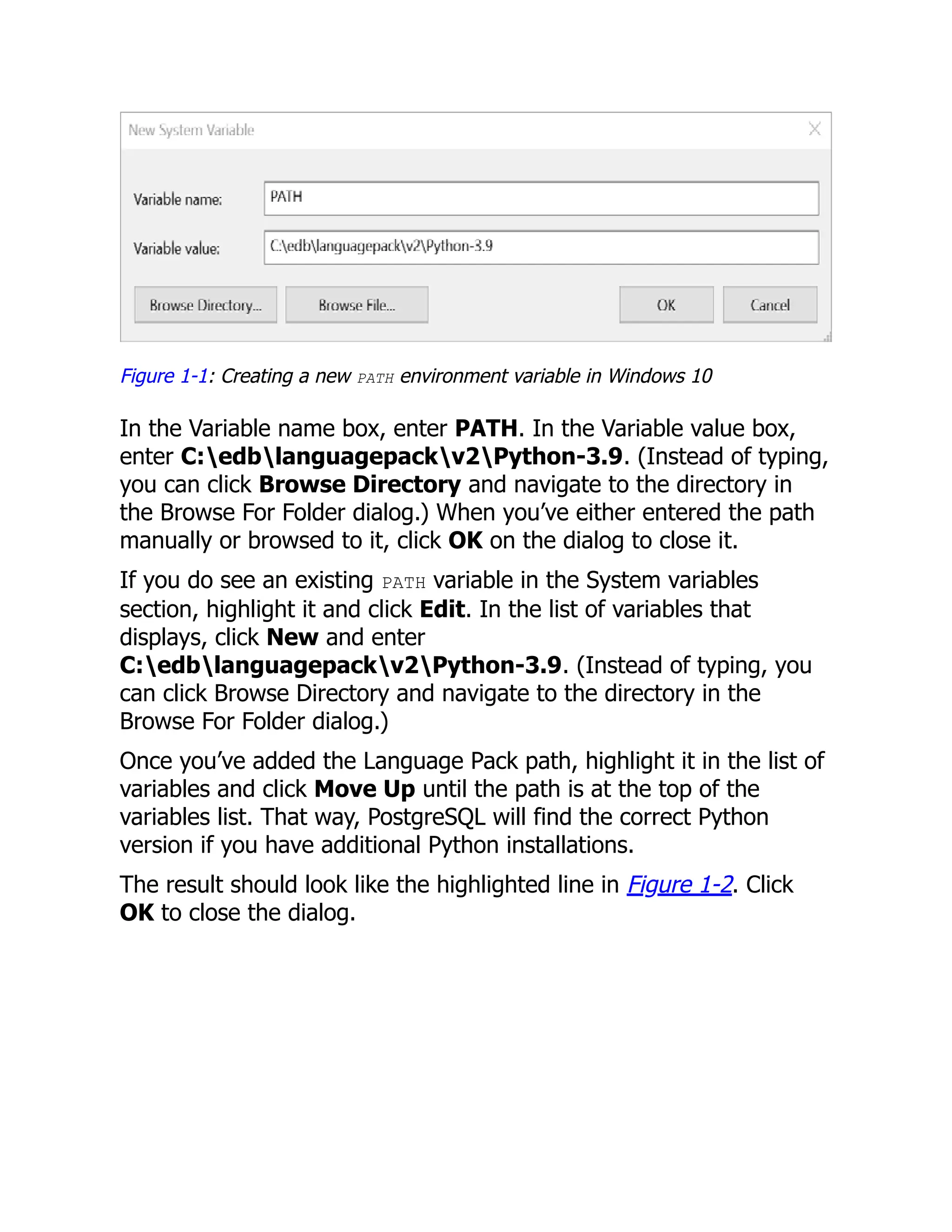
open a New System Variable dialog, shown in Figure 1-1.
Figure 1-1: Creating a new PATH environment variable in Windows 10
In the Variable name box, enter PATH. In the Variable value box,
enter C:edblanguagepackv2Python-3.9. (Instead of typing,
you can click Browse Directory and navigate to the directory in
the Browse For Folder dialog.) When you’ve either entered the path
manually or browsed to it, click OK on the dialog to close it.
If you do see an existing PATH variable in the System variables
section, highlight it and click Edit. In the list of variables that
displays, click New and enter
C:edblanguagepackv2Python-3.9. (Instead of typing, you
can click Browse Directory and navigate to the directory in the
Browse For Folder dialog.)
Once you’ve added the Language Pack path, highlight it in the list of
variables and click Move Up until the path is at the top of the
variables list. That way, PostgreSQL will find the correct Python
version if you have additional Python installations.
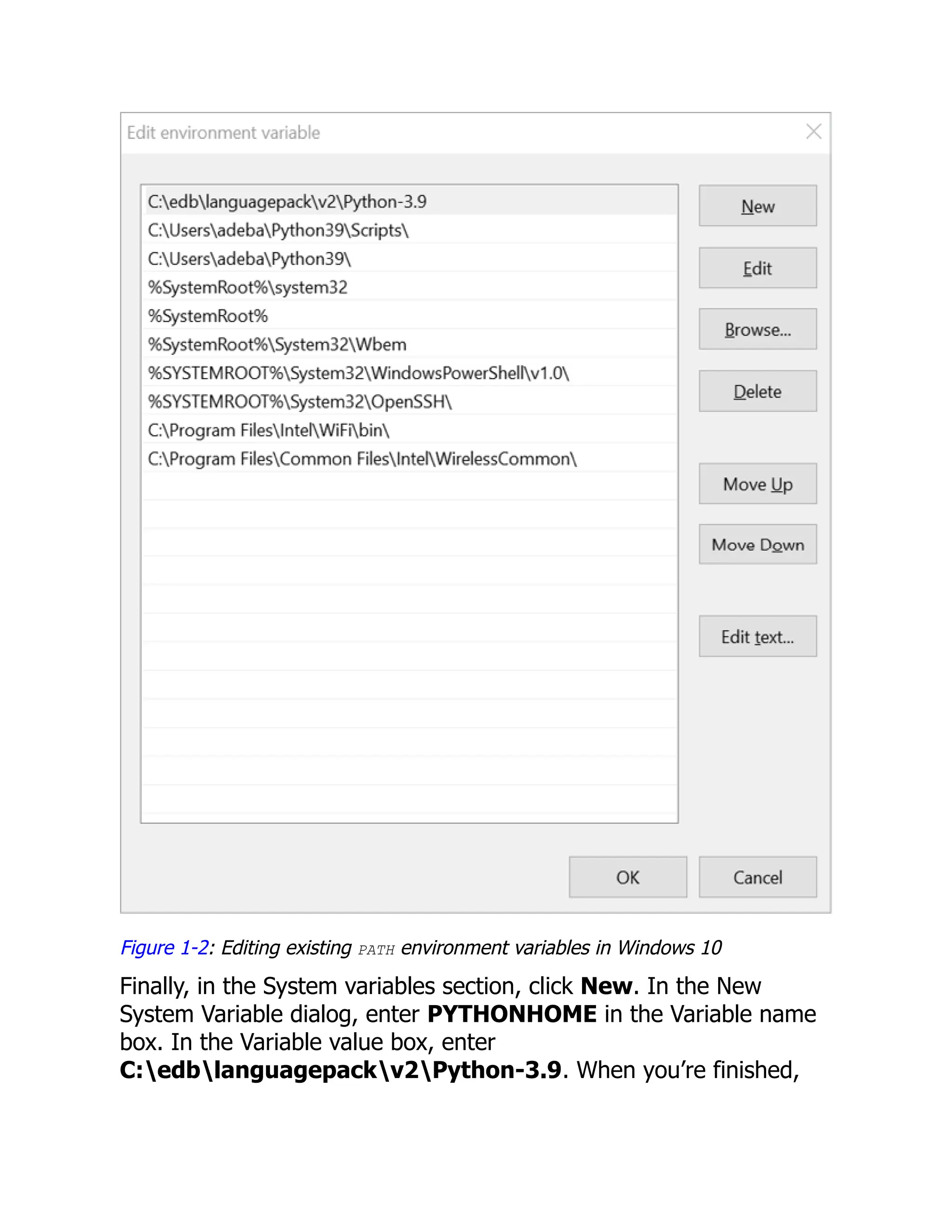
The result should look like the highlighted line in Figure 1-2. Click
OK to close the dialog.
Figure 1-2: Editing existing PATH environment variables in Windows 10
Finally, in the System variables section, click New. In the New
System Variable dialog, enter PYTHONHOME in the Variable name
box. In the Variable value box, enter
C:edblanguagepackv2Python-3.9. When you’re finished,
click OK in all dialogs to close them. Note that these Python path
settings will take effect the next time you restart your system.
If you experience any hiccups during the PostgreSQL install, check
the resources for the book, where I will note changes that occur as
the software is developed and can also answer questions. If you’re
unable to install PostGIS via Stack Builder, try downloading a
separate installer from the PostGIS site at
https://postgis.net/windows_downloads/ and consult the guides at
https://postgis.net/documentation/.
Now, you can move ahead to the section “Working with pgAdmin.”
macOS Installation
For macOS users, I recommend obtaining Postgres.app, an open
source macOS application that includes PostgreSQL as well as the
PostGIS extension and a few other goodies. Separately, you’ll need
to install the pgAdmin GUI and the Python language for use in
functions.
Installing Postgres.app and pgAdmin
Follow these steps:
Visit https://postgresapp.com/ and download the latest release of
the app. This will be a Disk Image file that ends in .dmg.
Double-click the .dmg file to open it, and then drag and drop the
app icon into your Applications folder.
In your Applications folder, double-click the app icon to launch
Postgres.app. (If you see a dialog that says the app cannot be
opened because the developer cannot be verified, click Cancel.
Then right-click the app icon and choose Open.) When Postgres.app
opens, click Initialize to create and start a PostgreSQL database
server.
A small elephant icon will appear in your menu bar to indicate that
you now have a database running. To set up the included
PostgreSQL command line tools so you’re able to use them in future,
open your Terminal application and run the following single line of
code at the prompt (you can copy the code as a single line from the
Postgres.app site at
https://postgresapp.com/documentation/install.html):
sudo mkdir -p /etc/paths.d &&
echo /Applications/Postgres.app/Contents/Versions/latest/bin
| sudo tee /etc/paths.d/postgresapp
You may be prompted for the password you use to log in to your
Mac. Enter that. The commands should execute without providing
any output.
Next, because Postgres.app doesn’t include pgAdmin, follow these
steps to install pgAdmin:
Visit the pgAdmin site’s page for macOS downloads at
https://www.pgadmin.org/download/pgadmin-4-macos/.
Select the latest version and download the installer (look for a Disk
Image file that ends in .dmg).
Double-click the .dmg file, click through the prompt to accept the
terms, and then drag pgAdmin’s elephant app icon into your
Applications folder.
Installation on macOS is relatively simple, but if you encounter any
issues, review the documentation for Postgres.app at
https://postgresapp.com/documentation/ and for pgAdmin at
https://www.pgadmin.org/docs/.
Installing Python
In Chapter 17, you’ll learn how to use the Python programming
language with PostgreSQL. To use Python with Postgres.app, you
must install a specific version of the language even though macOS
Discovering Diverse Content Through
Random Scribd Documents
moisture, and the outlook was infinitely dreary. She could have cried
at the idea of living amidst such desolation; but her courage was too
high, and her pride too great, to admit of her indulging in such futile
lamentation before the cold-eyed usurer.
Durban, always sympathetic and watchful, was quick to see her
grief, although she tried to conceal it, and at once began to suggest
interesting work, so that she should have the less time to eat her
heart out in the wilderness. He deftly pointed out how she and he
could make the place a paradise, and how Nature could solace the
sorrow of the girl for the loss of her guardian. Having obtained
unwilling consent from Alpenny, the kind-hearted servant painted
and repaired the ruined carriages, and turning one into a dainty
bedroom, made the remaining two into a parlour and dining-room.
In some way sufficient money was extorted from Alpenny to admit
of cheap furnishing, and Beatrice, more contented, came to take up
her abode in the strange locality. She was now twenty-five, and for
three years had dwelt in this hermitage.
The garden afforded her endless delight and occupation: Durban
was the fairy who procured the seeds, and who turned up the
coarse, weedy ground for the planting of the same; Durban had dug
the pond, and had conducted the water thereto through cunningly
contrived pipes; and Durban had planned the paradise with her aid.
The smooth lawn, the beds of brilliant blossoms, the pond with its
magnificent water-lilies, the many winding paths, and the mossy
nooks which afforded cool retreats on hot days, were all the work of
herself and Durban. No millionaire could have created a more
delightful spot than had these two by their indefatigable industry
and eye for the picturesque. A portion of the wood Beatrice left to
Nature, so that its uncultured look might enhance the civilised
appearance of the blossoms; and the contrast was really charming.
But that Jarvis Alpenny jealously kept the gates closed, The Camp
would have become a show place, as everyone in the neighbourhood
had heard of its rare floral beauties; and not a few young men had
heard of another beauty still more rare and desirable.
It was at this point that Beatrice began to think of Vivian and his
sister, who were the only friends she possessed. Jerry certainly
might be included, seeing that he was a constant visitor at Convent
Grange, and the future husband of Dinah Paslow; but there was no
one else in the parish of Hurstable with whom she cared to
exchange a friendly word. She had met Mr. and Mrs. Snow once or
twice; but although the vicar was willing enough to speak with so
pretty a girl, the vicar's wife objected. She was the tyrant of the
place, and ruled her husband, her son, "her" parish---as she called
it--and her friends with a rod of iron. But for this aggressive
despotism, Mr. Snow might have called at The Camp; but the
vicaress ordered her vicar not to waste his time in visiting a girl who
rarely came to church, and who occupied what the lady described as
"a degraded position." On the several occasions upon which Mrs.
Snow had met the usurer's daughter, she had behaved disagreeably,
and had never said a kind word. Yet Mrs. Snow called herself a
religious woman; but like many a self-styled Christian, she read her
own meaning into the Gospel commandments, and declined to obey
them when they clashed with her own snobbish, sordid nature.
Beatrice Hedge, according to Mrs. Snow, was beyond the social pale,
seeing that her father was a money-lender; so she paid no attention
to her, and many of "her" parishioners followed her example. It is to
be feared that the lady and her followers quite forgot that one of the
apostles was a tax-gatherer and a publican.
Beatrice cared very little for this boycotting; she was accustomed to
a lonely life, and, indeed, preferred it, for she found the conversation
of Mrs. Snow and her friends extremely wearisome--as it was bound
to be, from its aggressive egotism and self-laudation. She had books
to read, the garden to tend, Vivian to think of, and sometimes could
indulge in a visit to Convent Grange, the home of the Paslows. Dinah
she liked; Vivian she loved, and she was certain in her own mind
that Vivian loved her; but of this, strange to say, she could not be
sure, by reason of his attitude. It was a dubious attitude: at times he
would pay her marked attentions, and frequently seemed to be on
the verge of a proposal; then he would draw back, shun her society,
and turn as chilly as an Arctic winter, for no known reason. Beatrice
fancied that it might be her relationship to Alpenny that caused this
young gentleman of old descent to draw back; and then, again, she
felt sure that he was above such a mean spirit. Moreover--and this
might be his excuse--Vivian was but an impoverished country squire,
and might hesitate to conduct a wife to the half-ruinous Grange. Had
he only known how gladly Beatrice would have shared his bread and
cheese when sweetened by kisses, surely, as she often thought, he
would have proposed. But something kept him silent, and seeing
how he changed from hot to cold in his wooing--if it could be called
so--she had too much pride to inveigle him into making a plain
statement, such as her heart and her ears longed to hear. The
position was odd and uncomfortable. Both the man and the woman
could not mistake each other's feelings, yet the man, who could
have arranged matters on a reasonable basis, refused to open his
mouth; and it was not the woman's right to usurp the privilege of
the stronger sex, by breaking the ice.
The appointed meeting for this night puzzled her more than ever.
Never before had she met him save at the Grange or at The Camp,
and more often than not in the presence of Dinah. Now he asked
her to talk with him in a lonely spot, and under an ill-omened tree,
where, it was locally reported, the witches of old days had held their
Satanic revels. In answer to his request she had nodded, being
taken by surprise; but now she began to question the propriety of
her proposed action. She was a modest girl, and occupied a difficult
position, so it was scarcely the thing to meet a young gentleman on
a romantic summer night, and under a romantic tree. But her
curiosity was extremely strong. She wished to know why Alpenny
had grown so white and had appeared so terrified when Paslow
pronounced four mysterious words. What was the "Black Patch"?
and why did it produce such an effect on the usurer, who, as a rule,
feared nothing but the loss of money? Vivian could explain, since he
had brought about the miser's terror, therefore did Beatrice make up
her mind to keep the appointment; but she smiled to think what
Mrs. Snow would say did that severe lady know of the bold step she
was taking.
"Some more coffee?" said a voice at the door, and she looked up to
see the smiling servant.
"No thank you, Durban," she replied absently, and setting down the
empty cup; then, seeing that he was about to withdraw, she recalled
her scattered thoughts and made him pause, with a question. "What
is the Black Patch?" asked Beatrice, facing round to observe the
man's dark face.
Durban spread out his hands in quite a foreign way, and banished all
emotion from his dark features. "I do not know."
"My father appeared to be startled by the words."
"He did, missy, he did!"
"Do you know the reason?"
"I am not in your father's confidence, missy."
"That is strange, seeing that you have been with him for over twenty
years, Durban."
"For twenty-four years, missy."
"You never told me the exact time before, Durban."
The man shrugged his shoulders. "You never asked me, missy."
"That is true." Beatrice leaned back again in her chair, and
remembered that she and Durban had talked but little about the
past. "I should like to know about my mother," she said after a
pause.
"There is nothing to know, missy. She married master--and died."
"I was then about a year old?"
"Yes, missy."
"I am twenty-five now, and you have been with Mr. Alpenny for four-
and-twenty years; so it seems, Durban, that you first came here with
my mother, and remained in Mr. Alpenny's service."
"It is so, missy; I remained for your sake."
"Then you were my mother's servant?"
Durban's face might have been that of a wax doll for all the
expression it showed. "I was, missy."
"And you know all about my parents?"
"What there is to know, missy, which is very little. You have never
asked about them before; why do you question me now?"
Beatrice mused. "I hardly know," she confessed. "I suppose Mr.
Paslow's remark about the Black Patch, whatever that may be, made
me ask now. Mr. Alpenny was afraid when Mr. Paslow spoke."
"So you said before, missy; and, as I replied, I do not know the
reason at all. I am simply a servant."
"And my friend," said Beatrice, extending her hand.
Durban's face lighted up with passionate devotion, and his dark eyes
blazed with light. Falling on one knee he imprinted a reverential kiss
on the small white hand: "I love you with all my heart, missy. I love
you as a father--as a mother; as the Great God Himself, do I love
you, my dear mistress."
"Then you will help me?"
"You have but to ask, and I obey," said Durban simply, and rose to
his feet with a light bound, strangely out of keeping with his stout
person. "What would you have?"
"The key of the little gate."
Durban stared, for Beatrice was making a very serious request.
There were two gates to The Camp, a large one opening on to the
lane, and a smaller one hidden in a corner of the wall, through
which admittance could be gained to a narrow woodland path, which
arrived, after devious windings, at the cross-roads. Alpenny's clients
usually entered from the lane, but were always dismissed through
the--so to speak--secret path. The miser kept the key of this small
gate, and, indeed, of the larger one also, so that if any one had to
go out, or come in, Alpenny had to be applied to. It was therefore
no easy matter for Durban to oblige his young mistress.
"Why do you want the key, missy?"
Beatrice did not answer at once. It suddenly crossed her mind that if
she acknowledged how she intended to question Vivian about the
Black Patch, that Durban would make some difficulty over obtaining
the key. After his admission that he knew nothing, she had no
reason to think that he would raise any objections; but the thought
came uninvited, and she obeyed it. Wishing to tell the truth, and yet
keep Durban in the dark as to her real errand, she determined to go
to the Grange and see Dinah; then she could meet Vivian there, and
could question him at her leisure. "Miss Paslow is engaged," she said
suddenly.
Durban nodded and grinned. "To young Mr. Snow," he replied. "I
saw."
"Well, I want to go to Convent Grange this evening at six, to see
Miss Paslow, and talk over the matter."
Durban shook his head. "Master is angry with Mr. Paslow for some
reason, and will not let you go. Besides, at night----" Durban shook
his head again very sagely.
"That's just it," said Beatrice, rising; "I know that my father would
object, therefore I wish to slip out of the small gate secretly, and
return about nine; he will never know."
"He will never know, certainly, missy; but the way to Convent
Grange is dark and lonely."
"Not on a summer night; the moon is out, and there will be plenty of
people on the road."
"Would you like me to come, missy?"
"If you will," assented Beatrice carelessly. She would rather have
gone alone, but since the Grange was now her goal, and not the
Witch Oak, Durban's presence did not matter. "But there is no need."
"Oh, I think so; there will be a storm to-night, and then it will grow
dark. Besides, people may not be about, and the path to Convent
Grange is lonely. I shall come also."
"Very good; and the key----
"I can get it. Master keeps it hanging up in the counting-house, but I
can get it." Durban grinned and nodded, and then was about to go
away, when he suddenly stopped, and his dark face grew serious.
"One thing tell me, missy, and do not be angry."
"I could never be angry with you, Durban. What is it?"
"Do you love Mr. Paslow, missy?"
"Yes," replied Beatrice without hesitation. She knew that whatever
she said to her faithful servant would never be repeated by him.
"And does he love you?"
This time she coloured. "I think so--I am not sure," was her faint
reply, as she cast down her eyes.
Durban came a step nearer. "Does he love any one else?" he asked.
Beatrice raised her head sharply, and sent a flaming glance towards
the questioner. "What do you mean?"
"If he doesn't love you, does he love any one else?" persisted
Durban.
Beatrice twisted her hands. "I am sure he loves me, and no one
else!" she cried passionately. "I can see it in his eyes--I can read it in
his face. Yet he--yet he--oh!" she broke off, unwilling to remark upon
Paslow's strange, wavering wooing, to a servant, even though that
servant was one who would readily have died to save her a
moment's pain. "Do you think he loves any one else?" she asked
evasively.
"No." Durban's eyes were fixed on her face. "I have no reason to
think so. If he loves my missy, he can never be fond of other
women; but if he plays you false, missy "--Durban's face grew grim
and darker than ever--"you have a dog who can bite."
"No! no!" said Beatrice, alarmed--since Durban could make himself
unpleasant on occasions, and, from the look on his face, she feared
for Vivian--"he loves me, and me only; I am sure of that!"
The man's face cleared. "Then we will go to the Grange this evening,
and you can see him."
"But if my stepfather hates him, Durban, he will place some obstacle
in the way, should Mr. Paslow ask me to marry him."
"If he asks you to be his wife, you shall marry him, missy."
"But my father----"
"He will say nothing."
"Are you sure? When Mr. Alpenny takes an idea into his head----"
"He will take no idea of stopping your marriage, missy. You shall be
happy. I promised him that."
"Promised who?"
"Your real father," said Durban, and departed without another word.
It would seem as though he were unwilling to be questioned.
Beatrice began to think that there was some mystery connected with
her parents, which Durban knew, but which Durban would not
reveal.
CHAPTER III
MR. ALPENNY'S PROPOSAL
Shortly after Durban resumed work, Beatrice received a surprise
which rather pleased her. This was none other than an invitation to
enter the counting-house. She had always desired to do so, being
filled with that curiosity which led her grandmother Eve to eat
apples, but hitherto Alpenny had declined to admit her. Now the
door of the dungeon was open, and Alpenny, standing before it,
beckoned that she should come in. In the bright sunshine he looked
more decrepit and wicked than usual. He could not have been less
than eighty years of age, and his spare figure was bowed with Time.
That same Time had also robbed him of every hair on his head, and
had even taken away eyebrows and eyelashes. As the old man was
clean shaven, his gleaming head and hairless yellow wrinkled face
looked rather repulsive. Nor did his dress tend to improve his
appearance, for it was a shepherd's-plaid suit cut in the style of the
early fifties, when he had been young, and presumably something of
a dandy. In spite of the antiquity of the clothes, there was a
suggestion of juvenility about them which matched badly with his
Methuselah looks. Like an aged ghost he beckoned in the sunshine,
and the white-painted erection behind him assumed, in the eyes of
Beatrice, the look of a tomb.
Wondering that she should be invited into Mammon's Shrine, the girl
walked across the lawn. In her white dress, with her beautiful face
shaded by a coarse straw hat, she appeared the embodiment of
youth and grace, contrasting markedly with the senile old villain,
who croaked out his orders.
"Come in," said Alpenny testily, and with the screech of a peacock,
as he pointed to the open door. "I wish to speak to you seriously."
Beatrice, ever sparing of words with crabbed age, nodded and
entered the counting-house, glancing comprehensively around to
take in her surroundings--as a woman always does--with a single
look. The space naturally was limited. All the windows had been
boarded up save one, which opened immediately over a rather large
desk of mahogany which was piled with papers. The walls were
hung with faded red rep. In one corner stood a large green-painted
safe; in another stood a pile of tin boxes which reached quite to the
roof. A paraffin lamp dangled by brass chains from a somewhat
smoky ceiling; and at the far end of the carriage, in front of a
dilapidated bookcase, was an oil stove, crudely set on a sheet of
galvanised tin. A ragged carpet, disorderly in colour and much faded,
covered the floor; and there were only two chairs, one before the
desk, and another beside it, probably for the use of clients. The one
window was barred, but not covered with any curtain; the others
were sheathed in iron and barred strongly outside. From without, as
has been said, the carriage looked like a dungeon: within, its
appearance suggested the home of a recluse, who cared very little
for the pomps and vanities of civilisation. This barren room
represented very fairly the bare mind of the miser, who cared more
for money itself, than for what money could do.
Motioning Beatrice to the client's chair, Alpenny seated himself
before his desk, and from habit presumably, began to fiddle with
some legal looking documents. Apparently he had got over the shock
caused by Vivian's strange speech, and looked much the same as he
always did--cold, unsympathetic, and cunning as an old monkey. In
the dungeon Beatrice bloomed like a rose, while Alpenny resembled
a cold, clammy toad, uncanny and repulsive. He began to speak
almost immediately, and his first words amazed the girl. They were
the last she expected to hear from the lips of one who had always
treated her with indifference, and almost with hostility.
"Have you ever thought of marriage?" asked the usurer, examining
his visitor's face with two small sharp eyes, chilly and grey.
"Marriage!" she gasped, doubting if she had heard aright.
"Yes, marriage. Young girls think of such things, do they not?"
Wishing to find out what he meant, Beatrice fenced. "I have no
chance of marrying, father," she observed, regaining her composure.
"I grant that, unless you have fallen in love with Jerry Snow; and I
credit you with too much sense, to think you could love a fool."
"Mr. Snow is to marry Miss Paslow," announced Beatrice coldly, and
kept her eyes on the wizen face before her.
"Oh," sneered Alpenny, "Hunger wedding Thirst. And how do they
intend to live, may I ask?"
"That is their business, and not ours."
"Paslow hasn't a penny to give to his giggling sister, and very soon
he won't have a roof over his head."
"What do you mean by that, father?"
"Mean!" The usurer stretched out a skinny hand, which resembled
the claw of a bird of preys as he looked like. "Why, I mean, my girl,
that I hold Vivian Paslow there," and he tapped his palm.
"Still I don't understand," said Beatrice, her blood running cold at
the malignant look on his face.
"There is no need you should," rejoined her stepfather coolly. "He is
not for you, and you are not for him. Do you understand that?"
It was unwise for Alpenny to meddle with a maiden's fancies, for the
girl's outraged womanhood revolted. "I understand that you mean to
be impertinent, Mr. Alpenny," she said, with a flaming colour.
"'Mr. Alpenny'? Why not 'father,' as usual?"
"Because you are no father of mine, and I thank God for it."
He gave her a vindictive look, and rubbed his hands together, with
the croak of a hungry raven. "I brought you up, I educated you, I
fed you, I housed you, I----"
Beatrice waved her hand impatiently. "I know well what you have
done," said she; "as little as you could."
"Here's gratitude!"
"And common sense, Mr. Alpenny. I know nothing, save that you
married my mother and promised to look after me when she died."
"I promised nothing," snapped Alpenny.
"Durban says that you did."
"Durban is, what he always was, a fool. I promised nothing to your
mother--at all events, concerning you. Why should I? You are not my
own flesh and blood."
"Anyone can tell that," said Beatrice disdainfully.
"No impertinence, miss. I have fed and clothed you, and educated
you, and housed you----"
"You said that before."
"All at my own expense," went on the miser imperturbably, "and out
of the kindness of my heart. This is the return you make, by giving
me sauce! But you had better take care," he went on menacingly,
and shaking a lean yellow finger, "I am not to be trifled with."
"Neither am I," retorted Beatrice, who felt in a fighting humour. "I
am sorry to have been a burden to you, and for what you have done
I thank you; but I am weary of stopping here. Give me a small sum
of money and let me go."
"Money!" screeched the miser, touched on his tenderest point.
"Money to waste?"
"Money to keep me in London until I can obtain a situation as a
governess or as a companion. Come, father," she went on coaxingly,
"you must be sick of seeing me about here. And I am so tired of this
life!"
"It's the wickedness in your blood, Beatrice. Just like your mother--
oh, dear me, how very like your mother!"
"Leave my mother's character alone!" said Beatrice impatiently, "she
is dead and buried."
"She is--in Hurstable churchyard, under a beautiful tomb I got
second-hand at a bargain. See how I loved her."
"You never loved anyone in your life, Mr. Alpenny," said the girl,
freezing again.
Alpenny's brow grew black, and he looked at her with glittering eyes.
"You are mistaken, child," he said, quietly. "I have loved and lost."
"My mother----?"
"Perhaps," said he enigmatically, and passed his hand over his bald
head in a weary manner. Then he burst out unexpectedly: "I wish I
had never set eyes on your mother. I wish she had been dead and
buried before she crossed my path!"
"She is dead, so----"
"Yes, she is dead, stone dead," he snarled, rising, much agitated,
"and don't think you'll ever see her again. If I----" He was about to
speak further; then seeing from the wondering look on the girl's face
that he was saying more than was wise, he halted, stuttered, and
sat down again abruptly, moving the papers with trembling hands.
"Leave the past alone," he said hoarsely. "I can't speak of it calmly.
It is the past that makes the future," he continued, drumming
feverishly on the table with his fingers, "the past that makes the
future."
Beatrice wondered what he meant, and noticed how weary and
worn and nervous he seemed. The man did not love her; he had not
treated her as he should have done; and between them there was
no feeling in common. Yet he was old, and, after all, had sheltered
her in his own grudging way, so Beatrice laid a light hand on his
arm. "Mr. Alpenny, you are not young----"
"Eighty and more, my dear."
The term startled her, and she began to think he must indeed be
near the borders of the next world when he spoke so gently.
"Well, then, why don't you go to church, and feed the hungry, and
clothe the naked? Remember, you have to answer for what you have
done, some day soon."
Alpenny rose vehemently and flung off her arm. "I don't ask you to
teach me my duty, girl," he said savagely. "What I have done is
done, and was rightly done. Everyone betrayed me, and money is
the only thing that did not. Money is power, money is love, money is
joy and life and hope and comfort to me. No! I keep my money until
I die, and then----" He cast a nervous look round, only to burst out
again with greater vehemence. "Why do you talk of death? I am
strong; I eat heartily. I drink little. I sleep well. I shall live for many a
long day yet. And even if I die," he snapped, "don't expect to benefit
by my death. You don't get that!" and he snapped his fingers within
an inch of her nose.
"I don't want your money," said Beatrice quietly; "Durban will look
after me. Still, you might let me have enough to keep me while I try
to find work."
"I won't!"
"But if you die, I'll be a pauper."
"Without a sixpence!" said Alpenny exultingly.
"Have I no relatives who will help me?"
"No. Your mother came from I know not where, and where she has
gone I don't exactly know. She married me and then died. I have
kept you----"
"Yes--yes. But if my mother was poor and came from where you
knew not, why did you marry her?"
"My kind heart----"
"You haven't got one; it's in your money-chest"
"It might be in a woman's keeping, which is a much worse place."
Beatrice grew weary of this futile conversation, and rose. "You asked
me to see you," she said, with a fatigued air; "what is it you have to
say?"
"Oh yes." He seemed to arouse himself from a fit of musing. "Yes! I
have found a husband for you."
Beatrice started. He announced this startling fact as though it were
the most natural thing in the world. "You--have--found--a--husband--
for--me?" she drawled slowly.
"Yes. You won't have my money, and I may die." He cast a look over
his shoulder nervously. "I don't want to, but I may: one never
knows, do they? You will be poor, so I think it best to get you
married and settled in life."
"Thank you," she returned icily. "It is very good of you to take so
much trouble. And my future husband?"
"Ruck! Major Ruck--Major Simon Ruck, a retired army officer, and a
handsome man of fifty, very well preserved, and with a fine fortune."
"How alluring! And suppose I refuse?"
"You can't--you daren't!" He grasped her arm entreatingly. "Don't be
a fool, my dear. Ruck is handsome and well off. He is coming down
on Saturday to see you. This is Wednesday, so you will have time to
think over the matter. You must marry him--you must, I tell you!"
and he shook her arm in his agitation.
Beatrice removed her arm in a flaming temper. "Must I indeed?" said
she, flashing up into righteous anger. "Then I won't!"
"Beatrice!"
"I won't. I have never seen the man, and I don't wish to see him.
You have no right to make any arrangements about my marriage
without consulting me. You are neither kith nor kin of mine, and I
am of age. I deny your right to arrange my future."
"Do you wish to be left to starve?"
"I shall not starve; but I would rather do so, than marry a man of
fifty, whom I have never set eyes on."
"If you don't marry Ruck, you'll be a pauper sooner than you expect,
my girl. Marry him for my sake?"
"No! You have done as little as you could for me: you have always
hated me. I decline."
Alpenny rose in his turn--Beatrice had already risen to her feet--and
faced her in a black fury, the more venomous for being quiet. "You
shall marry him!"
"I shall not."
They faced one another, both angry, both determined, both bent
upon gaining the victory. But if Alpenny had an iron will, Beatrice
had youth and outraged womanhood on her side, and in the end his
small cruel eyes fell before her flashing orbs.
"I want you to marry Ruck--really I do," he whimpered piteously.
"Why?"
"Because"---- he swallowed something, and told what was evidently
a lie, so glibly did it slip out. "Because I should be sorry to leave you
to starve."
"I shall not starve. I am well educated, and can teach. At the worst I
can become a nursery governess, or be a companion."
"Better marry Major Ruck."
"No. It is foolish of you to ask me."
"If you don't marry him I shall be ruined. I shall be killed. No"--he
broke off suddenly--"I don't mean that. Who would kill a poor old
man such as I am? But"--his voice leaped an octave--"you must
marry the husband I chose for you."
"I chose for myself."
"Ah!"--the miser was shaking with rage--"it's Vivian Paslow: no
denial--I can see he is the man; a penniless scoundrel, who is at my
mercy!"
"Don't dare to speak of him like that," flamed out Beatrice. "As to
marrying him--he has not asked me yet."
"And never will, if I can stop him. I know how to do so--oh yes, I do.
He will not dare to go against me. I can ruin him. He----" At this
moment there came a sharp rap at the door, which made Alpenny's
face turn white and his lips turn blue.
"Who is there?"
"A telegram," said the voice of Durban; and Alpenny, with a
smothered ejaculation of pleasure, went to open the door. As he did
so, Beatrice noticed on the wall near the desk two keys, one large
and one small. The little one she knew to be the key of the postern
gate, and without hesitation she took it down and slipped it into her
pocket. As Alpenny turned round with the telegram and no very
pleasant expression of countenance, she felt that she would at least
be able to see Vivian Paslow on that evening without arousing the
suspicions of her stepfather. It was unlikely that any one would come
that night, and he would not miss the key, which she could get
Durban to replace the next day. As this thought flashed into her
mind, she saw the face of the servant at the door. He looked
puzzled, but probably that was because he beheld her in the
sanctum of his master, hitherto forbidden ground both to him and to
her. The next moment Alpenny had closed the door, and Durban
went away.
"This telegram is from Major Ruck," said Alpenny. "He is coming
down on Saturday, so be ready to receive him."
"I shall leave the place if he comes."
"You won't: you'll wait and see him--and accept him also. If you
don't, I'll make things hot for Vivian Paslow."
This was, as Beatrice conceived, a game of bluff; so she replied
boldly enough, "Mr. Paslow is able to look after himself. I decline to
speak to Major Ruck, whosoever he may be, or even to see him."
"Saturday! Saturday!" said Alpenny coldly, and opened the door.
"Now you can go. If you leave The Camp, or if you refuse Ruck as
your husband, Vivian Paslow will reap the reward of his crimes." And
he pushed her out, locking the door after her with a sharp click.
Crimes! Beatrice stood in the sunlight, stunned and dazed. What did
Alpenny mean? What crimes could the man she loved have
committed? Almost before she could collect her thoughts she felt a
light touch on her shoulder, and turned to behold Durban.
"Wasn't master in his counting-house all this afternoon?" asked the
servant. "You should know, missy, as the parlour is opposite."
"Yes, he was," she replied with an effort. "I never saw him come
out."
Durban wrinkled his dark brows. "Then how did he send the
telegram, to which he has just now had an answer?" he demanded.
"How do you know that this wire is an answer, Durban?"
"The reply was prepaid, missy. How did master do it?"
Beatrice was equally puzzled. Alpenny had not been away from The
Camp all the afternoon, yet had contrived to send a telegram, and
prepay the reply.
CHAPTER IV
SEEN IN THE LIGHTNING
It was truly a mystery. So far as Beatrice knew, there were but two
ways of getting out of The Camp--by the large gate and the smaller
one. Yet she in the parlour-carriage, facing Alpenny's counting-
house, had not seen him emerge; nor had Durban, busy in the
kitchen, the door of which commanded a view of the postern, beheld
his master depart. The telegraph office was at the railway station
three miles away, and there was no one in The Camp save Durban
and his young mistress to send with a wire. Yet the wire had been
sent, and the reply had been received. Beatrice ventured an
explanation.
"Perhaps my father sent the telegram yesterday."
"No, missy. I took none, and master did not leave the place. No
telegram has been sent from here for the last month."
"Is there a third way out, Durban?"
"Not that I know of, missy, and yet----"
What Durban would have said in the way of explanation it is
impossible to say, for at this moment the querulous voice of Alpenny
was heard calling snappishly. Durban hastened to the door of the
counting-house, and it was opened so that he could speak with his
master. But he was not admitted within. Beatrice retired to her
bedroom-carriage, which was near the parlour, and had only been
there a few minutes when Durban came over with a crest-fallen
face.
"We must put off going to Convent Grange, missy," said he rapidly;
"master wishes me to go to town. He is writing a letter which I have
to take up at once. I shall catch the six train."
"Very well, Durban. We can wait."
The servant looked and hesitated, but before he could speak again
Mr. Alpenny interrupted. Appearing at the door of his dungeon he
waved a letter. "Come at once!" he cried; "don't lose time. What do
you mean by chattering there?"
Durban gave Beatrice a significant look and hastened away. In
another ten minutes he had left The Camp by the great gates and
was on his way to the railway station. Alpenny saw him off the
premises and then crossed over to his stepdaughter.
"What were you saying to Durban?" he asked suspiciously.
"You mean what was Durban saying to me?" she replied quietly;
"you can surely guess. He was saying that you wished him to go to
town."
"There was no need of him to tell you my business," grumbled the
miser, looking ill-tempered. "What are you doing this evening?"
Had he any suspicions of her intention? Beatrice thought not. The
question was put in a snarling way, and simply--as she judged--to
show his authority.
"I intend to read," she answered simply, "and perhaps I shall take a
walk"--in the grounds, she ostensibly meant.
"Better not," warned the usurer, looking up. "Clouds are gathering. I
am sure there will be a storm."
"Very well," was her indifferent reply, although she wondered if he
had missed the key of the smaller gate. "Will I come and say good-
night to you as usual at ten?"
Alpenny nodded in an absent way, and walked into his counting-
house with his hands behind him, and his form more bent than
usual. Beatrice watched him cross the smooth sward, and then went
to sit down in the parlour and meditate. In some way, which she
could scarcely define, she scented a mystery. The episode of the
telegram, the hasty departure of Durban, the proposal of marriage,
all these things hinted--as she thought--at schemes against her
peace of mind. And then, again, the words of Vivian Paslow. Those
were indeed mysterious, and she was anxious to know what they
meant. Finally, the hint that Alpenny had given as to Vivian having
committed crimes, alarmed the girl. She felt that Alpenny was trying
to inveigle Paslow into some trap, and from his words it was plain
that he would stop at nothing to prevent the young man declaring
the passion he felt for the girl. Also, from another hint, it would
seem that the miser held--as, indeed, he had plainly stated--"Vivian
in the hollow of his hand."
These thoughts made Beatrice very uncomfortable, the more so as
never before had any mystery come into her life. Hitherto it had
been serene and uneventful, one day being exactly the same as
another. But with the visit of Vivian on that afternoon everything had
changed, for since he had heard those mysterious words, Alpenny
had not been himself. In some queer way he had forwarded a
telegram, and in a hurry he had sent Durban to London, which he
had not done for months past. Undoubtedly something sinister was
in the wind, and Beatrice shivered with a vague apprehension of
dread.
It certainly might have been the weather which made her feel so ill
at ease, for the hot day had ended in an even hotter evening. The
air was close, the sky was clouded, and there was not a breath of
wind to stir the leaves of the surrounding trees. Ever and again a
flicker of lightning would leap across the sky--summer lightning
which portended storm and rain. Beatrice, trying to breathe freely in
the suffocating air, wished that the storm would come to clear the
atmosphere. There was electricity in the dry air, and she felt as
uncomfortable as a cat which has its hair smoothed the wrong way.
On some such night as this must Lady Macbeth have received
Duncan, and Nature hinted at a repetition of the storm which took
place when the guileless king was done to death in the shambles.
Beatrice could not rest within doors. She put on a hat, and draped a
long black cloak over her white dress. Attired thus, she walked up
and down on the dry grass, trying to compose herself. Around
gloomed the girdle of trees, without even a leaf stirring. The colours
of the flowers were vague in the hot twilight, and the white forms of
the seven railway carriages stood here and there like tombs in a
cemetery. As she lingered near the sundial, she cast a look upward
at the Downs, which rose vast and shadowy to be defined clearly
against a clear sky. The foot of them was but a stone-throw away
from The Camp, and almost it was in her mind to climb their heights
in order to get a breath of fresh air. Here in the hollow, embosomed
in woods, she felt stifling; but up there surely a sweet, fresh wind
must be blowing, full of moisture from the Channel. Then the
thought of a possible walk recalled her to a remembrance of her
appointment: she intended to keep it, even though Durban had gone
away. The key was in her pocket, and she could slip out of the small
gate for an hour, and get back again without Alpenny being any the
wiser. Already a light gleamed from the solitary window of the
dungeon, as it had gleamed ever since she could remember when
the darkness came on. Behind the discoloured blind the miser
laboured at his books, and counted his gains. So far as she knew all
his money was banked and invested, and he kept no gold in the
dungeon. Perhaps he feared robbery; and it really was remarkable
that, seeing he was supposed to be a millionaire, The Camp had
never been marked by the fraternity of London thieves. A visit there
would surely have proved successful, if all the tales of Alpenny were
to be believed. But perhaps the thieves had heard, as the miser had
vaguely hinted, of his cleverness in keeping no specie in his
retirement. But be this as it may, Alpenny, all these years, had never
hinted at a possible burglary.
After a glance at the Downs and at Alpenny's lighted window, behind
which he would sit until midnight, Beatrice entered one of the
winding paths in the little wood and took her way to the gate. The
large gates were locked, and Alpenny alone possessed the key; but
she could open the smaller gate, and now proceeded to do so.
The lock was freshly oiled, and the postern swung open noiselessly.
Standing on the threshold within The Camp, Beatrice paused for a
moment. Some feeling seemed to hold her back. Into her mind
flashed the sudden thought that if she went out, she would leave
behind her not only The Camp, but the old serene life. It was like
crossing the Rubicon; but with an impatient ejaculation at her own
weakness, she shook herself and passed out, leaving the gate locked
behind her. Then she stole through the glimmering wood, fully
committed to the adventure. As she did so, a distant growl of
thunder seemed to her agitated mind like the voice of the angel
thrusting her out of Paradise. Truly, she had never before felt in this
strange mood.
By a narrow path she gained the lane, and here the light was a trifle
stronger, although it was rapidly dying out of the hot, close sky. It
was close upon half-past six, so Beatrice knew that if she walked

Practical SQL A Beginner s Guide to Storytelling with Data 2nd Edition Anthony Debarros
  • 1.
    Practical SQL ABeginner s Guide to Storytelling with Data 2nd Edition Anthony Debarros install download https://ebookmeta.com/product/practical-sql-a-beginner-s-guide- to-storytelling-with-data-2nd-edition-anthony-debarros-2/ Download more ebook from https://ebookmeta.com

  • 2.
    We believe theseproducts will be a great fit for you. Click the link to download now, or visit ebookmeta.com to discover even more! Practical SQL A Beginner s Guide to Storytelling with Data 2nd Edition Anthony Debarros https://ebookmeta.com/product/practical-sql-a-beginner-s-guide- to-storytelling-with-data-2nd-edition-anthony-debarros/ Practical SQL: A Beginner's Guide to Storytelling with Data, 2nd Edition Anthony Debarros https://ebookmeta.com/product/practical-sql-a-beginners-guide-to- storytelling-with-data-2nd-edition-anthony-debarros/ SQL QuickStart Guide The Simplified Beginner s Guide to Managing Analyzing and Manipulating Data With SQL Walter Shields https://ebookmeta.com/product/sql-quickstart-guide-the- simplified-beginner-s-guide-to-managing-analyzing-and- manipulating-data-with-sql-walter-shields/ Nephilim Prince 2 A Men s Fantasy Series Dark Star Series 1st Edition Troy Maverick https://ebookmeta.com/product/nephilim-prince-2-a-men-s-fantasy- series-dark-star-series-1st-edition-troy-maverick/
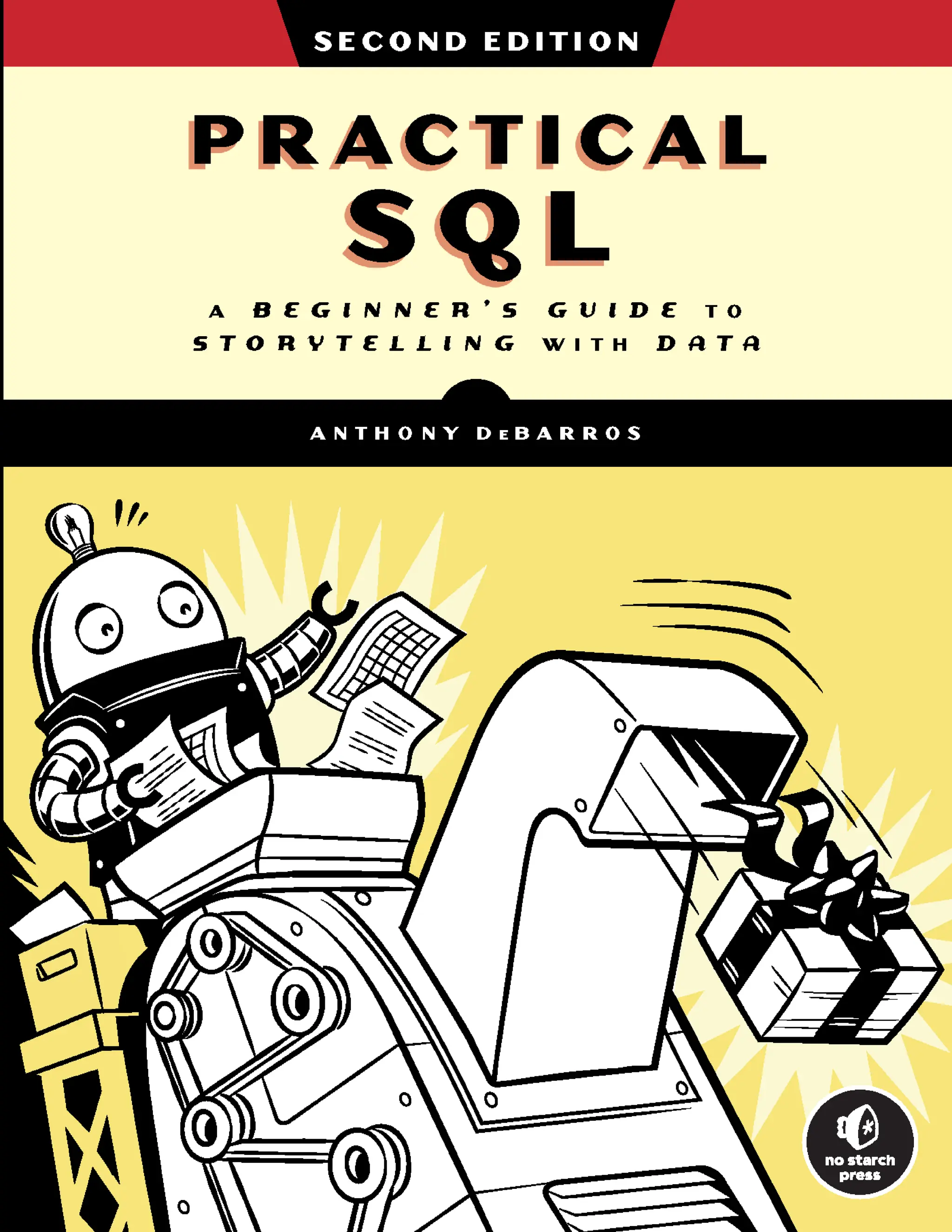
  • 3.
    Take Control ofiOS 15 and iPadOS 15 Josh Centers https://ebookmeta.com/product/take-control-of-ios-15-and- ipados-15-josh-centers/ Quantum Mechanics Mahesh C Jain https://ebookmeta.com/product/quantum-mechanics-mahesh-c-jain/ Always Eli Forever Love 1 1st Edition Charlie Novak https://ebookmeta.com/product/always-eli-forever-love-1-1st- edition-charlie-novak/ The Godsfall Chronicles 1st Edition Cocooned Cow https://ebookmeta.com/product/the-godsfall-chronicles-1st- edition-cocooned-cow/ Marginal Urbanisms Informal and Formal Development in Cities of Latin America 1st Edition Felipe Hernández https://ebookmeta.com/product/marginal-urbanisms-informal-and- formal-development-in-cities-of-latin-america-1st-edition-felipe- hernandez/
  • 4.
    The Eye ofthe Crown Routledge Research in Early Modern History 1st Edition Kristin M.S. Bezio https://ebookmeta.com/product/the-eye-of-the-crown-routledge- research-in-early-modern-history-1st-edition-kristin-m-s-bezio/
  • 6.
    CONTENTS IN DETAIL TITLEPAGE COPYRIGHT ABOUT THE AUTHOR PREFACE TO THE SECOND EDITION ACKNOWLEDGMENTS INTRODUCTION What Is SQL? Why SQL? Who Is This Book For? What You’ll Learn CHAPTER 1: SETTING UP YOUR CODING ENVIRONMENT Installing a Text Editor Downloading Code and Data from GitHub Installing PostgreSQL and pgAdmin Windows Installation macOS Installation Linux Installation Working with pgAdmin Launching pgAdmin and Setting a Master Password
  • 7.
    Connecting to theDefault postgres Database Exploring the Query Tool Customizing pgAdmin Alternatives to pgAdmin Wrapping Up CHAPTER 2: CREATING YOUR FIRST DATABASE AND TABLE Understanding Tables Creating a Database Executing SQL in pgAdmin Connecting to the analysis Database Creating a Table Using the CREATE TABLE Statement Making the teachers Table Inserting Rows into a Table Using the INSERT Statement Viewing the Data Getting Help When Code Goes Bad Formatting SQL for Readability Wrapping Up CHAPTER 3: BEGINNING DATA EXPLORATION WITH SELECT Basic SELECT Syntax Querying a Subset of Columns Sorting Data with ORDER BY Using DISTINCT to Find Unique Values Filtering Rows with WHERE Using LIKE and ILIKE with WHERE
  • 8.
    Combining Operators withAND and OR Putting It All Together Wrapping Up CHAPTER 4: UNDERSTANDING DATA TYPES Understanding Characters Understanding Numbers Using Integers Auto-Incrementing Integers Using Decimal Numbers Choosing Your Number Data Type Understanding Dates and Times Using the interval Data Type in Calculations Understanding JSON and JSONB Using Miscellaneous Types Transforming Values from One Type to Another with CAST Using CAST Shortcut Notation Wrapping Up CHAPTER 5: IMPORTING AND EXPORTING DATA Working with Delimited Text Files Handling Header Rows Quoting Columns That Contain Delimiters Using COPY to Import Data Importing Census Data Describing Counties Creating the us_counties_pop_est_2019 Table Understanding Census Columns and Data Types Performing the Census Import with COPY
  • 9.
    Inspecting the Import Importinga Subset of Columns with COPY Importing a Subset of Rows with COPY Adding a Value to a Column During Import Using COPY to Export Data Exporting All Data Exporting Particular Columns Exporting Query Results Importing and Exporting Through pgAdmin Wrapping Up CHAPTER 6: BASIC MATH AND STATS WITH SQL Understanding Math Operators and Functions Understanding Math and Data Types Adding, Subtracting, and Multiplying Performing Division and Modulo Using Exponents, Roots, and Factorials Minding the Order of Operations Doing Math Across Census Table Columns Adding and Subtracting Columns Finding Percentages of the Whole Tracking Percent Change Using Aggregate Functions for Averages and Sums Finding the Median Finding the Median with Percentile Functions Finding Median and Percentiles with Census Data Finding Other Quantiles with Percentile Functions Finding the Mode
  • 10.
    Wrapping Up CHAPTER 7:JOINING TABLES IN A RELATIONAL DATABASE Linking Tables Using JOIN Relating Tables with Key Columns Querying Multiple Tables Using JOIN Understanding JOIN Types JOIN LEFT JOIN and RIGHT JOIN FULL OUTER JOIN CROSS JOIN Using NULL to Find Rows with Missing Values Understanding the Three Types of Table Relationships One-to-One Relationship One-to-Many Relationship Many-to-Many Relationship Selecting Specific Columns in a Join Simplifying JOIN Syntax with Table Aliases Joining Multiple Tables Combining Query Results with Set Operators UNION and UNION ALL INTERSECT and EXCEPT Performing Math on Joined Table Columns Wrapping Up CHAPTER 8: TABLE DESIGN THAT WORKS FOR YOU Following Naming Conventions Quoting Identifiers Enables Mixed Case
  • 11.
    Pitfalls with QuotingIdentifiers Guidelines for Naming Identifiers Controlling Column Values with Constraints Primary Keys: Natural vs. Surrogate Foreign Keys How to Automatically Delete Related Records with CASCADE The CHECK Constraint The UNIQUE Constraint The NOT NULL Constraint How to Remove Constraints or Add Them Later Speeding Up Queries with Indexes B-Tree: PostgreSQL’s Default Index Considerations When Using Indexes Wrapping Up CHAPTER 9: EXTRACTING INFORMATION BY GROUPING AND SUMMARIZING Creating the Library Survey Tables Creating the 2018 Library Data Table Creating the 2017 and 2016 Library Data Tables Exploring the Library Data Using Aggregate Functions Counting Rows and Values Using count() Finding Maximum and Minimum Values Using max() and min() Aggregating Data Using GROUP BY Wrapping Up CHAPTER 10: INSPECTING AND MODIFYING DATA Importing Data on Meat, Poultry, and Egg Producers
  • 12.
    Interviewing the Dataset Checkingfor Missing Values Checking for Inconsistent Data Values Checking for Malformed Values Using length() Modifying Tables, Columns, and Data Modifying Tables with ALTER TABLE Modifying Values with UPDATE Viewing Modified Data with RETURNING Creating Backup Tables Restoring Missing Column Values Updating Values for Consistency Repairing ZIP Codes Using Concatenation Updating Values Across Tables Deleting Unneeded Data Deleting Rows from a Table Deleting a Column from a Table Deleting a Table from a Database Using Transactions to Save or Revert Changes Improving Performance When Updating Large Tables Wrapping Up CHAPTER 11: STATISTICAL FUNCTIONS IN SQL Creating a Census Stats Table Measuring Correlation with corr(Y, X) Checking Additional Correlations Predicting Values with Regression Analysis Finding the Effect of an Independent Variable with r-Squared Finding Variance and Standard Deviation
  • 13.
    Creating Rankings withSQL Ranking with rank() and dense_rank() Ranking Within Subgroups with PARTITION BY Calculating Rates for Meaningful Comparisons Finding Rates of Tourism-Related Businesses Smoothing Uneven Data Wrapping Up CHAPTER 12: WORKING WITH DATES AND TIMES Understanding Data Types and Functions for Dates and Times Manipulating Dates and Times Extracting the Components of a timestamp Value Creating Datetime Values from timestamp Components Retrieving the Current Date and Time Working with Time Zones Finding Your Time Zone Setting Setting the Time Zone Performing Calculations with Dates and Times Finding Patterns in New York City Taxi Data Finding Patterns in Amtrak Data Wrapping Up CHAPTER 13: ADVANCED QUERY TECHNIQUES Using Subqueries Filtering with Subqueries in a WHERE Clause Creating Derived Tables with Subqueries Joining Derived Tables Generating Columns with Subqueries
  • 14.
    Understanding Subquery Expressions UsingSubqueries with LATERAL Using Common Table Expressions Performing Cross Tabulations Installing the crosstab() Function Tabulating Survey Results Tabulating City Temperature Readings Reclassifying Values with CASE Using CASE in a Common Table Expression Wrapping Up CHAPTER 14: MINING TEXT TO FIND MEANINGFUL DATA Formatting Text Using String Functions Case Formatting Character Information Removing Characters Extracting and Replacing Characters Matching Text Patterns with Regular Expressions Regular Expression Notation Using Regular Expressions with WHERE Regular Expression Functions to Replace or Split Text Turning Text to Data with Regular Expression Functions Full-Text Search in PostgreSQL Text Search Data Types Creating a Table for Full-Text Search Searching Speech Text Ranking Query Matches by Relevance Wrapping Up
  • 15.
    CHAPTER 15: ANALYZINGSPATIAL DATA WITH POSTGIS Enabling PostGIS and Creating a Spatial Database Understanding the Building Blocks of Spatial Data Understanding Two-Dimensional Geometries Well-Known Text Formats Projections and Coordinate Systems Spatial Reference System Identifier Understanding PostGIS Data Types Creating Spatial Objects with PostGIS Functions Creating a Geometry Type from Well-Known Text Creating a Geography Type from Well-Known Text Using Point Functions Using LineString Functions Using Polygon Functions Analyzing Farmers’ Markets Data Creating and Filling a Geography Column Adding a Spatial Index Finding Geographies Within a Given Distance Finding the Distance Between Geographies Finding the Nearest Geographies Working with Census Shapefiles Understanding the Contents of a Shapefile Loading Shapefiles Exploring the Census 2019 Counties Shapefile Examining Demographics Within a Distance Performing Spatial Joins Exploring Roads and Waterways Data
  • 16.
    Joining the CensusRoads and Water Tables Finding the Location Where Objects Intersect Wrapping Up CHAPTER 16: WORKING WITH JSON DATA Understanding JSON Structure Considering When to Use JSON with SQL Using json and jsonb Data Types Importing and Indexing JSON Data Using json and jsonb Extraction Operators Key Value Extraction Array Element Extraction Path Extraction Containment and Existence Analyzing Earthquake Data Exploring and Loading the Earthquake Data Working with Earthquake Times Finding the Largest and Most-Reported Earthquakes Converting Earthquake JSON to Spatial Data Generating and Manipulating JSON Turning Query Results into JSON Adding, Updating, and Deleting Keys and Values Using JSON Processing Functions Finding the Length of an Array Returning Array Elements as Rows Wrapping Up
  • 17.
    CHAPTER 17: SAVINGTIME WITH VIEWS, FUNCTIONS, AND TRIGGERS Using Views to Simplify Queries Creating and Querying Views Creating and Refreshing a Materialized View Inserting, Updating, and Deleting Data Using a View Creating Your Own Functions and Procedures Creating the percent_change() Function Using the percent_change() Function Updating Data with a Procedure Using the Python Language in a Function Automating Database Actions with Triggers Logging Grade Updates to a Table Automatically Classifying Temperatures Wrapping Up CHAPTER 18: USING POSTGRESQL FROM THE COMMAND LINE Setting Up the Command Line for psql Windows psql Setup macOS psql Setup Linux psql Setup Working with psql Launching psql and Connecting to a Database Running SQL Queries on psql Navigating and Formatting Results Meta-Commands for Database Information Importing, Exporting, and Using Files
  • 18.
    Additional Command LineUtilities to Expedite Tasks Adding a Database with createdb Loading Shapefiles with shp2pgsql Wrapping Up CHAPTER 19: MAINTAINING YOUR DATABASE Recovering Unused Space with VACUUM Tracking Table Size Monitoring the Autovacuum Process Running VACUUM Manually Reducing Table Size with VACUUM FULL Changing Server Settings Locating and Editing postgresql.conf Reloading Settings with pg_ctl Backing Up and Restoring Your Database Using pg_dump to Export a Database or Table Restoring a Database Export with pg_restore Exploring Additional Backup and Restore Options Wrapping Up CHAPTER 20: TELLING YOUR DATA’S STORY Start with a Question Document Your Process Gather Your Data No Data? Build Your Own Database Assess the Data’s Origins Interview the Data with Queries Consult the Data’s Owner
  • 19.
    Identify Key Indicatorsand Trends over Time Ask Why Communicate Your Findings Wrapping Up APPENDIX: ADDITIONAL POSTGRESQL RESOURCES PostgreSQL Development Environments PostgreSQL Utilities, Tools, and Extensions PostgreSQL News and Community Documentation INDEX
  • 20.
    PRACTICAL SQL 2nd Edition ABeginner’s Guide to Storytelling with Data by Anthony DeBarros
  • 21.
    PRACTICAL SQL, 2NDEDITION. Copyright © 2022 by Anthony DeBarros. All rights reserved. No part of this work may be reproduced or transmitted in any form or by any means, electronic or mechanical, including photocopying, recording, or by any information storage or retrieval system, without the prior written permission of the copyright owner and the publisher. Printed in the United States of America First printing 25 24 23 22 21 1 2 3 4 5 6 7 8 9 ISBN-13: 978-1-7185-0106-5 (print) ISBN-13: 978-1-7185-0107-2 (ebook) Publisher: William Pollock Managing Editor: Jill Franklin Production Manager: Rachel Monaghan Production Editors: Jennifer Kepler and Paula Williamson Developmental Editor: Liz Chadwick Cover Illustrator: Josh Ellingson Interior Design: Octopod Studios Technical Reviewer: Stephen Frost Copyeditor: Kim Wimpsett Compositor: Maureen Forys, Happenstance Type-O-Rama Proofreader: Liz Wheeler For information on book distributors or translations, please contact No Starch Press, Inc. directly: No Starch Press, Inc. 245 8th Street, San Francisco, CA 94103 phone: 1.415.863.9900; info@nostarch.com www.nostarch.com The Library of Congress has catalogued the first edition as follows: Names: DeBarros, Anthony, author. Title: Practical SQL : a beginner's guide to storytelling with data / Anthony DeBarros. Description: San Francisco : No Starch Press, 2018. | Includes index. Identifiers: LCCN 2018000030 (print) | LCCN 2017043947 (ebook) | ISBN 9781593278458 (epub) | ISBN 1593278454 (epub) | ISBN 9781593278274 (paperback) | ISBN 1593278276 (paperback) | ISBN 9781593278458 (ebook) Subjects: LCSH: SQL (Computer program language) | Database design. | BISAC: COMPUTERS / Programming Languages / SQL. | COMPUTERS / Database Management / General. | COMPUTERS / Database Management / Data Mining.
  • 22.
    Classification: LCC QA76.73.S67(print) | LCC QA76.73.S67 D44 2018 (ebook) | DDC 005.75/6--dc23 LC record available at https://lccn.loc.gov/2018000030 No Starch Press and the No Starch Press logo are registered trademarks of No Starch Press, Inc. Other product and company names mentioned herein may be the trademarks of their respective owners. Rather than use a trademark symbol with every occurrence of a trademarked name, we are using the names only in an editorial fashion and to the benefit of the trademark owner, with no intention of infringement of the trademark. The information in this book is distributed on an “As Is” basis, without warranty. While every precaution has been taken in the preparation of this work, neither the author nor No Starch Press, Inc. shall have any liability to any person or entity with respect to any loss or damage caused or alleged to be caused directly or indirectly by the information contained in it.
  • 23.
    About the Author AnthonyDeBarros is a longtime journalist and early adopter of “data journalism,” the use of spreadsheets, databases, and code to find news in data. He’s currently a data editor for the Wall Street Journal, where he covers topics including the economy, trade, demographics, and the Covid-19 pandemic. Previously, he worked for the Gannett company at USA Today and the Poughkeepsie Journal and held product development and content strategy roles for Questex and DocumentCloud. About the Technical Reviewer Stephen Frost is the chief technology officer at Crunchy Data. He has been working with PostgreSQL since 2003 and general database technology since before then. Stephen began contributing to PostgreSQL development in 2004 and has been involved in the development of the role system, column-level privileges, row-level security, GSSAPI encryption, and the predefined roles system. He has also served on the board of the United States PostgreSQL Association and Software in the Public Interest, regularly speaks at PostgreSQL Community conferences and events, and works as a member of various PostgreSQL community teams.
  • 24.
    PREFACE TO THESECOND EDITION Since the publication of the first edition of Practical SQL, I’ve received kind notes about the book from readers around the world. One happy reader said it helped him ace SQL questions on a job interview. Another, a teacher, wrote to say that his students remarked favorably about having the book assigned for class. Others just wanted to say thanks because they found the book helpful and a good read, two pieces of feedback that will warm the heart of most any author. I also sometimes heard from readers who hit a roadblock while working through an exercise or who had trouble with software or data files. I paid close attention to those emails, especially when the same question seemed to crop up more than once. Meanwhile, during my own journey of learning SQL—I use it every day at work— I’d often discover a technique and wish that I’d included it in the book. With all that in mind, I approached the team at No Starch Press with the idea of updating and expanding Practical SQL into a second edition. I’m thankful they said yes. This new version of the book is more complete, offers stronger guidance for readers related to software and code, and clarifies information that wasn’t as clear or presented as accurately as it could have been. The book has been
  • 25.
    thoroughly enjoyable torevisit, and I’ve learned much along the way. This second edition includes numerous updates, expansions, and clarifications in every chapter. Throughout, I’ve been careful to note when code syntax adheres to the SQL standard—meaning you can generally use it across database systems—or when the syntax is specific to the database used in the book, PostgreSQL. The following are among the most substantial changes: Two chapters are new. Chapter 1, “Setting Up Your Coding Environment,” details how to install PostgreSQL, pgAdmin, and additional PostgreSQL components on multiple operating systems. It also shows how to obtain the code listings and data from GitHub. In the first edition, this information was located in the introduction and occasionally missed by readers. Chapter 16, “Working with JSON Data,” covers PostgreSQL’s support for the JavaScript Object Notation data format, using datasets about movies and earthquakes. In Chapter 4 on data types, I’ve added a section on IDENTITY, the ANSI SQL standard implementation for auto-incrementing integer columns. Throughout the book, IDENTITY replaces the PostgreSQL- specific serial auto-incrementing integer type so that code examples more closely reflect the SQL standard. Chapter 5 on importing and exporting data now includes a section about using the WHERE keyword with the COPY command to filter which rows are imported from a source file to a table. I’ve removed the user-created median() function from Chapter 6 on basic math in favor of focusing exclusively on the SQL standard percentile_cont() function for calculating medians. In Chapter 7 on table joins, I’ve added a section covering the set operators UNION, UNION ALL, INTERSECT, and EXCEPT. Additionally, I’ve added a section covering the USING clause in joins to reduce redundant output and simplify query syntax.
  • 26.
    Chapter 10 oninspecting and modifying data includes a new section on using the RETURNING keyword in an UPDATE statement to display the data that the statement modified. I’ve also added a section that describes how to use the TRUNCATE command to remove all rows from a table and restart an IDENTITY sequence. In Chapter 11 on statistical functions, a new section demonstrates how to create a rolling average to smooth uneven data to get a better sense of trends over time. I’ve also added information on functions for calculating standard deviation and variance. Chapter 13 on advanced query techniques now shows how to use the LATERAL keyword with subqueries. One benefit is that, by combining LATERAL with JOIN, you get functionality similar to a for loop in a programming language. In Chapter 15 on analyzing spatial data, I demonstrate how to use the Geometry Viewer in pgAdmin to see geographies placed on a map. This feature was added to pgAdmin after publication of the first edition. In Chapter 17 on views, functions, and triggers, I’ve added information about materialized views and showed how their behavior differs from standard views. I also cover procedures, which PostgreSQL now supports in addition to functions. Finally, where practical, datasets have been updated to the most recent available at the time of writing. This primarily applies to US Census population statistics but also includes the text of presidential speeches and library usage statistics. Thank you for reading Practical SQL! If you have any questions or feedback, please get in touch by emailing practicalsqlbook@gmail.com.
  • 27.
    ACKNOWLEDGMENTS This second editionof Practical SQL is the work of many hands. My thanks, first, go to the team at No Starch Press. Thanks to Bill Pollock for capturing the vision and sharpening the initial concept for the book—and for agreeing to let me have another go at it. Special thanks and appreciation to senior editor Liz Chadwick, who improved each chapter with her insightful suggestions and deft editing, and to copyeditor Kim Wimpsett and the production team of Paula Williamson and Jennifer Kepler. Stephen Frost, chief technology officer at Crunchy Data and longtime contributor to the PostgreSQL community, served as the technical reviewer for this edition. I deeply appreciate the time Stephen took to explain the inner workings of PostgreSQL and SQL concepts. This book is better, more thorough, and more accurate thanks to his detailed eye. I’d also like to acknowledge Josh Berkus, whose many contributions as technical reviewer for the first edition persist in this new version. Thank you to Investigative Reporters and Editors (IRE) and its members and staff past and present for training journalists to find stories in data. IRE is where I got my start with SQL and data journalism. Many of my colleagues have not only imparted memorable lessons on data analysis, they’ve also made my workdays brighter. Special thanks to Paul Overberg for sharing his vast knowledge of demographics and the US Census, to Lou Schilling for many technical lessons, to Christopher Schnaars for his SQL expertise, to Peter Matseykanets for his encouragement, and to Chad Day, John
  • 28.
    West, and MaureenLinke and the WSJ DC visuals team for continual inspiration. My deepest appreciation goes to my dear wife, Elizabeth, and our sons. You are the brightest lights in my day. As we are fond of saying, “To the journey . . .”
  • 29.
    INTRODUCTION Shortly after joiningthe staff of USA Today, I received a dataset that I would analyze almost every week for the next decade. It was the weekly Best-Selling Books list, which ranked the nation’s top-selling titles based on confidential sales data. Not only did the list produce an endless stream of story ideas to pitch, it also captured the zeitgeist of America in a singular way. Did you know that cookbooks sell a bit more during the week of Mother’s Day or that Oprah Winfrey turned many obscure writers into number-one best-selling authors just by having them on her show? Every week, the book list editor and I pored over the sales figures and book genres, ranking the data in search of a new headline. Rarely did we come up empty: we chronicled everything from the rocket-rise of the blockbuster Harry Potter series to the fact that Oh, the Places You’ll Go! by Dr. Seuss had become a perennial gift for new graduates. My technical companion in that time was the database programming language SQL (for Structured Query Language). Early on, I convinced USA Today’s IT department to grant me access to the SQL-based database system that powered our book list application. Using SQL, I was able to discover the stories hidden in the database,
  • 30.
    which contained salesdata related to titles, authors, genres, and the codes that defined the publishing world. SQL has been useful to me ever since, whether my role was in product development, in content strategy, or, lately, as a data editor for the Wall Street Journal. In each case, SQL has helped me find interesting stories in data—and that’s exactly what you’ll learn to do using this book. What Is SQL? SQL is a widely used programming language for managing data and database systems. Whether you’re a marketing analyst, a journalist, or a researcher mapping neurons in the brain of a fruit fly, you’ll benefit from using SQL to collect, modify, explore, and summarize data. Because SQL is a mature language that’s been around for decades, it’s ingrained in many modern systems. A pair of IBM researchers first outlined the syntax for SQL (then called SEQUEL) in a 1974 paper, building on the theoretical work of the British computer scientist Edgar F. Codd. In 1979, a precursor to the database company Oracle (then called Relational Software) became the first to use the language in a commercial product. Today, SQL still ranks as one of the most-used computer languages in the world, and that’s unlikely to change soon. Each database system, such as PostgreSQL, MySQL or Microsoft SQL Server, implements its own variant of SQL, so you’ll notice subtle—or sometimes significant—differences in syntax if you jump from one system to another. There are several reasons behind this. The American National Standards Institute (ANSI) adopted a standard for SQL in 1986, followed by the International Organization for Standardization (ISO) in 1987. But the standard doesn’t cover all aspects of SQL that are required for a database implementation—for example, it has no entry for creating indexes. That leaves each database system maker to choose how to implement features the
  • 31.
    standard doesn’t cover—andno database maker currently claims to conform to the entire standard. Meanwhile, business considerations can lead commercial database vendors to create nonstandard SQL features for both competitive advantage and as a way to keep users in their ecosystem. For example, Microsoft’s SQL Server uses the proprietary Transact-SQL (T-SQL) that includes a number of features not in the SQL standard, such as its syntax for declaring local variables. Migrating code written using T-SQL to another database system may not be trivial, therefore. In this book, the examples and code use the PostgreSQL database system. PostgreSQL, or simply Postgres, is a robust application that can handle large amounts of data. Here are some reasons PostgreSQL is a great choice to use with this book: It’s free. It’s available for Windows, macOS, and Linux operating systems. Its SQL implementation aims to closely follow the SQL standard. It’s widely used, so finding help online is easy. Its geospatial extension, PostGIS, lets you analyze geometric data and perform mapping functions and is often used with mapping software such as QGIS. It’s available in cloud computing environments such as Amazon Web Services and Google Cloud. It’s a common choice as a data store for web applications, including those powered by the popular web framework Django. The good news is that the fundamental concepts and much of the core SQL syntactical conventions of PostgreSQL will work across databases. So, if you’re using MySQL at work, you can employ much of what you learn here—or easily find parallel code concepts. When syntax is PostgreSQL-specific, I make sure to point that out. If you need to learn the SQL syntax of a system with features that deviate
  • 32.
    from the standard,such as Microsoft SQL Server’s T-SQL, you may want to further explore a resource focusing on that system. Why SQL? SQL certainly isn’t the only option for crunching data. Many people start with Microsoft Excel spreadsheets and their assortment of analytic functions. After working with Excel, they might graduate to Access, the database system built into some versions of Microsoft Office, which has a graphical query interface that makes it easy to get work done. So why learn SQL? One reason is that Excel and Access have their limits. Excel currently allows 1,048,576 rows maximum per worksheet. Access limits database size to two gigabytes and limits columns to 255 per table. It’s not uncommon for datasets to surpass those limits. The last obstacle you want to discover while facing a deadline is that your database system doesn’t have the capacity to get the job done. Using a robust SQL database system allows you to work with terabytes of data, multiple related tables, and thousands of columns. It gives you fine-grained control over the structure of your data, leading to efficiency, speed, and—most important—accuracy. SQL is also an excellent adjunct to programming languages used in the data sciences, such as R and Python. If you use either language, you can connect to SQL databases and, in some cases, even incorporate SQL syntax directly into the language. For people with no background in programming languages, SQL often serves as an easy-to-understand introduction into concepts related to data structures and programming logic. Finally, SQL is useful beyond data analysis. If you delve into building online applications, you’ll find that databases provide the backend power for many common web frameworks, interactive maps, and content management systems. When you need to dig beneath the surface of these applications, the ability to manage data and databases with SQL will come in very handy.
  • 34.
    Who Is ThisBook For? Practical SQL is for people who encounter data in their everyday lives and want to learn how to analyze, manage, and transform it. With that in mind, we cover real-world data and scenarios, such as US Census demographics, crime reports, and data about taxi rides in New York City. We aim to understand not only how SQL works but how we can use it to find valuable insights. This book was written with people new to programming in mind, so the early chapters cover key basics about databases, data, and SQL syntax. Readers with some SQL experience should benefit from later chapters that cover more advanced topics, such as Geographical Information Systems (GIS). I assume that you know your way around your computer, including how to install programs, navigate your hard drive, and download files from the internet, but I don’t assume you have any experience with programming or data analysis. What You’ll Learn Practical SQL starts with a chapter on setting up your system and getting the code and data examples and then moves through the basics of databases, queries, tables, and data that are common to SQL across many database systems. Chapters 14 to 19 cover topics more specific to PostgreSQL, such as full-text search, functions, and GIS. Although many chapters in this book can stand alone, you should work through the book sequentially to build on the fundamentals. Datasets presented in early chapters often reappear later, so following the book in order will help you stay on track. The following summary provides more detail about each chapter: Chapter 1: Setting Up Your Coding Environment walks through setting up PostgreSQL, the pgAdmin user interface, and a text editor, plus how to download example code and data.
  • 35.
    Chapter 2: CreatingYour First Database and Table provides step-by-step instructions for the process of loading a simple dataset about teachers into a new database. Chapter 3: Beginning Data Exploration with SELECT explores basic SQL query syntax, including how to sort and filter data. Chapter 4: Understanding Data Types explains the definitions for setting columns in a table to hold specific types of data, from text to dates to various forms of numbers. Chapter 5: Importing and Exporting Data explains how to use SQL commands to load data from external files and then export it. You’ll load a table of US Census population data that you’ll use throughout the book. Chapter 6: Basic Math and Stats with SQL covers arithmetic operations and introduces aggregate functions for finding sums, averages, and medians. Chapter 7: Joining Tables in a Relational Database explains how to query multiple, related tables by joining them on key columns. You’ll learn how and when to use different types of joins. Chapter 8: Table Design that Works for You covers how to set up tables to improve the organization and integrity of your data as well as how to speed up queries using indexes. Chapter 9: Extracting Information by Grouping and Summarizing explains how to use aggregate functions to find trends in US library usage based on annual surveys. Chapter 10: Inspecting and Modifying Data explores how to find and fix incomplete or inaccurate data using a collection of records about meat, egg, and poultry producers as an example. Chapter 11: Statistical Functions in SQL introduces correlation, regression, ranking, and other functions to help you derive more meaning from datasets.
  • 36.
    Chapter 12: Workingwith Dates and Times explains how to create, manipulate, and query dates and times in your database, including working with time zones and with data about New York City taxi trips and Amtrak train schedules. Chapter 13: Advanced Query Techniques explains how to use more complex SQL operations such as subqueries and cross tabulations, plus the CASE statement, to reclassify values in a dataset on temperature readings. Chapter 14: Mining Text to Find Meaningful Data covers how to use PostgreSQL’s full-text search engine and regular expressions to extract data from unstructured text, using police reports and a collection of speeches by US presidents as examples. Chapter 15: Analyzing Spatial Data with PostGIS introduces data types and queries related to spatial objects, which will let you analyze geographical features such as counties, roads, and rivers. Chapter 16: Working with JSON Data introduces the JavaScript Object Notation (JSON) data format and uses data about movies and earthquakes to explore PostgreSQL JSON support. Chapter 17: Saving Time with Views, Functions, and Triggers explains how to automate database tasks so you can avoid repeating routine work. Chapter 18: Using PostgreSQL from the Command Line covers how to use text commands at your computer’s command prompt to connect to your database and run queries. Chapter 19: Maintaining Your Database provides tips and procedures for tracking the size of your database, customizing settings, and backing up data. Chapter 20: Telling Your Data’s Story provides guidelines for generating ideas for analysis, vetting data, drawing sound conclusions, and presenting your findings clearly. Appendix: Additional PostgreSQL Resources lists software and documentation to help you grow your skills.
  • 37.
    Each chapter endswith a “Try It Yourself” section that contains exercises to help you reinforce the topics you learned. Ready? Let’s begin with Chapter 1, “Setting Up Your Coding Environment.”
  • 38.
    1 SETTING UP YOURCODING ENVIRONMENT Let’s begin by installing the resources you’ll need to complete the exercises in the book. In this chapter, you’ll install a text editor, download the example code and data, and then install the PostgreSQL database system and its companion graphical user interface, pgAdmin. I’ll also tell you how to get help if you need it. When you’re finished, your computer will have a robust environment for you to learn how to analyze data with SQL. Avoid the temptation to skip ahead to the next chapter. My high school teacher (clearly a fan of alliteration) used to tell us that “proper planning prevents poor performance.” If you follow all the steps in this chapter, you’ll avoid headaches later. Our first task is to set up a text editor suitable for working with data.
  • 39.
    Installing a TextEditor The source data you’ll add to a SQL database is typically stored in multiple text files, often in a format called comma-separated values (CSV). You’ll learn more about the CSV format in Chapter 5, in the section “Working with Delimited Text Files,” but for now let’s make sure you have a text editor that will let you open those files without inadvertently harming the data. Common business applications—word processors and spreadsheet programs—tend to introduce styles or hidden characters into files without asking, and that makes using them for data work problematic, as data software expects data in precise formats. For example, if you open a CSV file with Microsoft Excel, the program will automatically alter some data to make it more human-readable; it will assume, for example, that an item code of 3-09 is a date and format it as 9-Mar. Text editors deal exclusively with plain text with no embellishments such as formatting, and for that reason programmers use them to edit files that hold source code, data, and software configurations—all cases where you want your text to be treated as text, and nothing more. Any text editor should work for the book’s purposes, so if you have a favorite, feel free to use it. Here are some I have used and recommend. Except where noted, they are free and available for macOS, Windows, and Linux. Visual Studio Code by Microsoft: https://code.visualstudio.com/ Atom by GitHub: https://atom.io/ Sublime Text by Sublime HQ (free to evaluate but requires purchase for continued use): https://www.sublimetext.com/ Notepad++ by author Don Ho (Windows only): https://notepad- plus-plus.org/ (note that this is a different application than Notepad.exe, which comes with Windows) More advanced users who prefer to work in the command line may want to use one of these two text editors, which are installed by
  • 40.
    default in macOSand Linux: vim by author Bram Moolenaar and the open source community: https://www.vim.org/ GNU nano by author Chris Allegretta and the open source community: https://www.nano-editor.org/ If you don’t have a text editor, download and install one and get familiar with the basics of opening folders and working with files. Next, let’s get the book’s example code and data. Downloading Code and Data from GitHub All of the code and data you’ll need for working through the book’s exercises are available for download. To get it, follow these steps: Visit the book’s page on the No Starch Press website at https://nostarch.com/practical-sql-2nd-edition/. On the page, click Download the code from GitHub to visit the repository on https://github.com/ that holds the material. On the Practical SQL 2nd Edition page at GitHub, you should see a Code button. Click it, and then select Download ZIP to save the ZIP file to your computer. Place it in a location where you can easily find it, such as your desktop. (If you’re a GitHub user, you can also clone or fork the repository.) Unzip the file. You should then see a folder named practical-sql-2- master that contains the various files and subfolders for the book. Again, place this folder where you can easily find it.
  • 41.
    NOTE Windows users willneed to provide permission for the PostgreSQL database you will install to read and write to the contents of the practical-sql-2-master folder. To do so, right- click the folder, click Properties, and click the Security tab. Click Edit and then Add. Type the name Everyone into the object names box and click OK. Highlight Everyone in the user list, select all boxes under Allow, and then click Apply and OK. Inside the practical-sql-2-master folder, for each chapter you’ll find a subfolder named Chapter_XX (XX is the chapter number). Inside subfolders, each chapter that includes code examples will also have a file named Chapter_XX that ends with a .sql extension. This is a SQL code file that you can open with your text editor or with the PostgreSQL administrative tool you’ll install later in this chapter. Note that in the book several code examples are truncated to save space, but you’ll need the full listing from the .sql file to complete the exercise. You’ll know an example is truncated when you see --snip- - in the listing. The chapter folders also contain the public data you’ll use in the exercises, stored in CSV and other text-based files. As noted, it’s fine to view CSV files with a true text editor, but don’t open these files with Excel or a word processor. Now, with the prerequisites complete, let’s load the database software. Installing PostgreSQL and pgAdmin In this section, you’ll install both the PostgreSQL database system and a companion graphical administrative tool, pgAdmin. Think of pgAdmin as a helpful visual workspace for managing your PostgreSQL database. Its interface lets you see your database
  • 42.
    objects, manage settings,import and export data, and write queries, which is the code that retrieves data from your database. One benefit of using PostgreSQL is that the open source community has provided excellent guidelines that make it easy to get PostgreSQL up and running. The following sections outline installation for Windows, macOS, and Linux as of this writing, but the steps might change as new versions of the software or operating systems are released. Check the documentation noted in each section as well as the GitHub repository with the book’s resources; I’ll maintain files there with updates and answers to frequently asked questions. NOTE I recommend you install the latest available version of PostgreSQL for your operating system to ensure that it’s up- to-date on security patches and new features. For this book, I’ll assume you’re using version 11.0 or later. Windows Installation For Windows, I recommend using the installer provided by the company EDB (formerly EnterpriseDB), which offers support and services for PostgreSQL users. When you download the PostgreSQL package bundle from EDB, you also get pgAdmin and Stack Builder, which includes a few other tools you’ll use in this book and throughout your SQL career. To get the software, visit https://www.postgresql.org/download/windows/ and click Download the installer in the EDB section. This should lead to a downloads page on the EDB site. Select the latest available 64-bit Windows version of PostgreSQL unless you’re using an older PC with 32-bit Windows.
  • 43.
    NOTE The following sectioncovers installation for Windows 10. If you’re using Windows 11, please check the GitHub repository with the book’s resources for notes about any adjustments to these instructions. After you download the installer, follow these steps to install PostgreSQL, pgAdmin, and additional components: Right-click the installer and select Run as administrator. Answer Yes to the question about allowing the program to make changes to your computer. The program will perform a setup task and then present an initial welcome screen. Click through it. Choose your installation directory, accepting the default. On the Select Components screen, select the boxes to install PostgreSQL Server, the pgAdmin tool, Stack Builder, and the command line tools. Choose the location to store data. You can choose the default, which is in a data subdirectory in the PostgreSQL directory. Choose a password. PostgreSQL is robust with security and permissions. This password is for the default initial database superuser account, which is called postgres. Select the default port number where the server will listen. Unless you have another database or application using it, use the default, which should be 5432. You can substitute 5433 or another number if you already have an application using the default port. Select your locale. Using the default is fine. Then click through the summary screen to begin the installation, which will take several minutes. When the installation is done, you’ll be asked whether you want to launch EnterpriseDB’s Stack Builder to obtain additional packages.
  • 44.
    Make sure thebox is checked and click Finish. When Stack Builder launches, choose the PostgreSQL installation on the drop-down menu and click Next. A list of additional applications should download. Expand the Spatial Extensions menu and select the PostGIS Bundle for the version of PostgreSQL you installed. You may see more than one listed; if so, choose the newest version. Also, expand the Add- ons, tools and utilities menu and select EDB Language Pack, which installs support for programming languages including Python. Click through several times; you’ll need to wait while the installer downloads the additional components. When installation files have been downloaded, click Next to install the language and PostGIS components. For PostGIS, you’ll need to agree to the license terms; click through until you’re asked to Choose Components. Make sure PostGIS and Create spatial database are selected. Click Next, accept the default install location, and click Next again. Enter your database password when prompted and continue through the prompts to install PostGIS. Answer Yes when asked to register the PROJ_LIB and GDAL_DATA environment variables. Also, answer Yes to the questions about setting POSTGIS_ENABLED_DRIVERS and enabling the POSTGIS_ENABLE_OUTDB_RASTERS environment variable. Finally, click through the final Finish steps to complete the installation and exit the installers. Depending on the version, you may be prompted to restart your computer. When finished, you should have two new folders in your Windows Start menu: one for PostgreSQL and another for PostGIS. If you’d like to get started right away, you can skip ahead to the section “Working with pgAdmin.” Otherwise, follow the steps in the next section to set environment variables for optional Python language support. We cover using Python with PostgreSQL in
  • 45.
    Chapter 17; youcan wait until then to set up Python if you’d like to move ahead now. Configuring Python Language Support In Chapter 17, you’ll learn how to use the Python programming language with PostgreSQL. In the previous section, you installed the EDB Language Pack, which provides Python support. Follow these steps to add the location of the Language Pack files to your Windows system’s environment variables: Open the Windows Control Panel by clicking the Search icon on the Windows taskbar, entering Control Panel, and then clicking the Control Panel icon. In the Control Panel app, enter Environment in the search box. In the list of search results displayed, click Edit the System Environment Variables. A System Properties dialog will appear. In the System Properties dialog, on the Advanced tab, click Environment Variables. The dialog that opens has two sections: User variables and System variables. In the System variables section, if you don’t see a PATH variable, continue to step a to create a new one. If you do see an existing PATH variable, continue to step b to modify it. If you don’t see PATH in the System variables section, click New to open a New System Variable dialog, shown in Figure 1-1.
  • 46.
    Figure 1-1: Creatinga new PATH environment variable in Windows 10 In the Variable name box, enter PATH. In the Variable value box, enter C:edblanguagepackv2Python-3.9. (Instead of typing, you can click Browse Directory and navigate to the directory in the Browse For Folder dialog.) When you’ve either entered the path manually or browsed to it, click OK on the dialog to close it. If you do see an existing PATH variable in the System variables section, highlight it and click Edit. In the list of variables that displays, click New and enter C:edblanguagepackv2Python-3.9. (Instead of typing, you can click Browse Directory and navigate to the directory in the Browse For Folder dialog.) Once you’ve added the Language Pack path, highlight it in the list of variables and click Move Up until the path is at the top of the variables list. That way, PostgreSQL will find the correct Python version if you have additional Python installations. The result should look like the highlighted line in Figure 1-2. Click OK to close the dialog.
  • 47.
    Figure 1-2: Editingexisting PATH environment variables in Windows 10 Finally, in the System variables section, click New. In the New System Variable dialog, enter PYTHONHOME in the Variable name box. In the Variable value box, enter C:edblanguagepackv2Python-3.9. When you’re finished,
  • 48.
    click OK inall dialogs to close them. Note that these Python path settings will take effect the next time you restart your system. If you experience any hiccups during the PostgreSQL install, check the resources for the book, where I will note changes that occur as the software is developed and can also answer questions. If you’re unable to install PostGIS via Stack Builder, try downloading a separate installer from the PostGIS site at https://postgis.net/windows_downloads/ and consult the guides at https://postgis.net/documentation/. Now, you can move ahead to the section “Working with pgAdmin.” macOS Installation For macOS users, I recommend obtaining Postgres.app, an open source macOS application that includes PostgreSQL as well as the PostGIS extension and a few other goodies. Separately, you’ll need to install the pgAdmin GUI and the Python language for use in functions. Installing Postgres.app and pgAdmin Follow these steps: Visit https://postgresapp.com/ and download the latest release of the app. This will be a Disk Image file that ends in .dmg. Double-click the .dmg file to open it, and then drag and drop the app icon into your Applications folder. In your Applications folder, double-click the app icon to launch Postgres.app. (If you see a dialog that says the app cannot be opened because the developer cannot be verified, click Cancel. Then right-click the app icon and choose Open.) When Postgres.app opens, click Initialize to create and start a PostgreSQL database server.
  • 49.
    A small elephanticon will appear in your menu bar to indicate that you now have a database running. To set up the included PostgreSQL command line tools so you’re able to use them in future, open your Terminal application and run the following single line of code at the prompt (you can copy the code as a single line from the Postgres.app site at https://postgresapp.com/documentation/install.html): sudo mkdir -p /etc/paths.d && echo /Applications/Postgres.app/Contents/Versions/latest/bin | sudo tee /etc/paths.d/postgresapp You may be prompted for the password you use to log in to your Mac. Enter that. The commands should execute without providing any output. Next, because Postgres.app doesn’t include pgAdmin, follow these steps to install pgAdmin: Visit the pgAdmin site’s page for macOS downloads at https://www.pgadmin.org/download/pgadmin-4-macos/. Select the latest version and download the installer (look for a Disk Image file that ends in .dmg). Double-click the .dmg file, click through the prompt to accept the terms, and then drag pgAdmin’s elephant app icon into your Applications folder. Installation on macOS is relatively simple, but if you encounter any issues, review the documentation for Postgres.app at https://postgresapp.com/documentation/ and for pgAdmin at https://www.pgadmin.org/docs/. Installing Python In Chapter 17, you’ll learn how to use the Python programming language with PostgreSQL. To use Python with Postgres.app, you must install a specific version of the language even though macOS
  • 50.
    Discovering Diverse ContentThrough Random Scribd Documents
  • 51.
    moisture, and theoutlook was infinitely dreary. She could have cried at the idea of living amidst such desolation; but her courage was too high, and her pride too great, to admit of her indulging in such futile lamentation before the cold-eyed usurer. Durban, always sympathetic and watchful, was quick to see her grief, although she tried to conceal it, and at once began to suggest interesting work, so that she should have the less time to eat her heart out in the wilderness. He deftly pointed out how she and he could make the place a paradise, and how Nature could solace the sorrow of the girl for the loss of her guardian. Having obtained unwilling consent from Alpenny, the kind-hearted servant painted and repaired the ruined carriages, and turning one into a dainty bedroom, made the remaining two into a parlour and dining-room. In some way sufficient money was extorted from Alpenny to admit of cheap furnishing, and Beatrice, more contented, came to take up her abode in the strange locality. She was now twenty-five, and for three years had dwelt in this hermitage. The garden afforded her endless delight and occupation: Durban was the fairy who procured the seeds, and who turned up the coarse, weedy ground for the planting of the same; Durban had dug the pond, and had conducted the water thereto through cunningly contrived pipes; and Durban had planned the paradise with her aid. The smooth lawn, the beds of brilliant blossoms, the pond with its magnificent water-lilies, the many winding paths, and the mossy nooks which afforded cool retreats on hot days, were all the work of herself and Durban. No millionaire could have created a more delightful spot than had these two by their indefatigable industry and eye for the picturesque. A portion of the wood Beatrice left to Nature, so that its uncultured look might enhance the civilised appearance of the blossoms; and the contrast was really charming. But that Jarvis Alpenny jealously kept the gates closed, The Camp would have become a show place, as everyone in the neighbourhood had heard of its rare floral beauties; and not a few young men had heard of another beauty still more rare and desirable.
  • 52.
    It was atthis point that Beatrice began to think of Vivian and his sister, who were the only friends she possessed. Jerry certainly might be included, seeing that he was a constant visitor at Convent Grange, and the future husband of Dinah Paslow; but there was no one else in the parish of Hurstable with whom she cared to exchange a friendly word. She had met Mr. and Mrs. Snow once or twice; but although the vicar was willing enough to speak with so pretty a girl, the vicar's wife objected. She was the tyrant of the place, and ruled her husband, her son, "her" parish---as she called it--and her friends with a rod of iron. But for this aggressive despotism, Mr. Snow might have called at The Camp; but the vicaress ordered her vicar not to waste his time in visiting a girl who rarely came to church, and who occupied what the lady described as "a degraded position." On the several occasions upon which Mrs. Snow had met the usurer's daughter, she had behaved disagreeably, and had never said a kind word. Yet Mrs. Snow called herself a religious woman; but like many a self-styled Christian, she read her own meaning into the Gospel commandments, and declined to obey them when they clashed with her own snobbish, sordid nature. Beatrice Hedge, according to Mrs. Snow, was beyond the social pale, seeing that her father was a money-lender; so she paid no attention to her, and many of "her" parishioners followed her example. It is to be feared that the lady and her followers quite forgot that one of the apostles was a tax-gatherer and a publican. Beatrice cared very little for this boycotting; she was accustomed to a lonely life, and, indeed, preferred it, for she found the conversation of Mrs. Snow and her friends extremely wearisome--as it was bound to be, from its aggressive egotism and self-laudation. She had books to read, the garden to tend, Vivian to think of, and sometimes could indulge in a visit to Convent Grange, the home of the Paslows. Dinah she liked; Vivian she loved, and she was certain in her own mind that Vivian loved her; but of this, strange to say, she could not be sure, by reason of his attitude. It was a dubious attitude: at times he would pay her marked attentions, and frequently seemed to be on the verge of a proposal; then he would draw back, shun her society,
  • 53.
    and turn aschilly as an Arctic winter, for no known reason. Beatrice fancied that it might be her relationship to Alpenny that caused this young gentleman of old descent to draw back; and then, again, she felt sure that he was above such a mean spirit. Moreover--and this might be his excuse--Vivian was but an impoverished country squire, and might hesitate to conduct a wife to the half-ruinous Grange. Had he only known how gladly Beatrice would have shared his bread and cheese when sweetened by kisses, surely, as she often thought, he would have proposed. But something kept him silent, and seeing how he changed from hot to cold in his wooing--if it could be called so--she had too much pride to inveigle him into making a plain statement, such as her heart and her ears longed to hear. The position was odd and uncomfortable. Both the man and the woman could not mistake each other's feelings, yet the man, who could have arranged matters on a reasonable basis, refused to open his mouth; and it was not the woman's right to usurp the privilege of the stronger sex, by breaking the ice. The appointed meeting for this night puzzled her more than ever. Never before had she met him save at the Grange or at The Camp, and more often than not in the presence of Dinah. Now he asked her to talk with him in a lonely spot, and under an ill-omened tree, where, it was locally reported, the witches of old days had held their Satanic revels. In answer to his request she had nodded, being taken by surprise; but now she began to question the propriety of her proposed action. She was a modest girl, and occupied a difficult position, so it was scarcely the thing to meet a young gentleman on a romantic summer night, and under a romantic tree. But her curiosity was extremely strong. She wished to know why Alpenny had grown so white and had appeared so terrified when Paslow pronounced four mysterious words. What was the "Black Patch"? and why did it produce such an effect on the usurer, who, as a rule, feared nothing but the loss of money? Vivian could explain, since he had brought about the miser's terror, therefore did Beatrice make up her mind to keep the appointment; but she smiled to think what
  • 54.
    Mrs. Snow wouldsay did that severe lady know of the bold step she was taking. "Some more coffee?" said a voice at the door, and she looked up to see the smiling servant. "No thank you, Durban," she replied absently, and setting down the empty cup; then, seeing that he was about to withdraw, she recalled her scattered thoughts and made him pause, with a question. "What is the Black Patch?" asked Beatrice, facing round to observe the man's dark face. Durban spread out his hands in quite a foreign way, and banished all emotion from his dark features. "I do not know." "My father appeared to be startled by the words." "He did, missy, he did!" "Do you know the reason?" "I am not in your father's confidence, missy." "That is strange, seeing that you have been with him for over twenty years, Durban." "For twenty-four years, missy." "You never told me the exact time before, Durban." The man shrugged his shoulders. "You never asked me, missy." "That is true." Beatrice leaned back again in her chair, and remembered that she and Durban had talked but little about the past. "I should like to know about my mother," she said after a pause. "There is nothing to know, missy. She married master--and died."
  • 55.
    "I was thenabout a year old?" "Yes, missy." "I am twenty-five now, and you have been with Mr. Alpenny for four- and-twenty years; so it seems, Durban, that you first came here with my mother, and remained in Mr. Alpenny's service." "It is so, missy; I remained for your sake." "Then you were my mother's servant?" Durban's face might have been that of a wax doll for all the expression it showed. "I was, missy." "And you know all about my parents?" "What there is to know, missy, which is very little. You have never asked about them before; why do you question me now?" Beatrice mused. "I hardly know," she confessed. "I suppose Mr. Paslow's remark about the Black Patch, whatever that may be, made me ask now. Mr. Alpenny was afraid when Mr. Paslow spoke." "So you said before, missy; and, as I replied, I do not know the reason at all. I am simply a servant." "And my friend," said Beatrice, extending her hand. Durban's face lighted up with passionate devotion, and his dark eyes blazed with light. Falling on one knee he imprinted a reverential kiss on the small white hand: "I love you with all my heart, missy. I love you as a father--as a mother; as the Great God Himself, do I love you, my dear mistress." "Then you will help me?"
  • 56.
    "You have butto ask, and I obey," said Durban simply, and rose to his feet with a light bound, strangely out of keeping with his stout person. "What would you have?" "The key of the little gate." Durban stared, for Beatrice was making a very serious request. There were two gates to The Camp, a large one opening on to the lane, and a smaller one hidden in a corner of the wall, through which admittance could be gained to a narrow woodland path, which arrived, after devious windings, at the cross-roads. Alpenny's clients usually entered from the lane, but were always dismissed through the--so to speak--secret path. The miser kept the key of this small gate, and, indeed, of the larger one also, so that if any one had to go out, or come in, Alpenny had to be applied to. It was therefore no easy matter for Durban to oblige his young mistress. "Why do you want the key, missy?" Beatrice did not answer at once. It suddenly crossed her mind that if she acknowledged how she intended to question Vivian about the Black Patch, that Durban would make some difficulty over obtaining the key. After his admission that he knew nothing, she had no reason to think that he would raise any objections; but the thought came uninvited, and she obeyed it. Wishing to tell the truth, and yet keep Durban in the dark as to her real errand, she determined to go to the Grange and see Dinah; then she could meet Vivian there, and could question him at her leisure. "Miss Paslow is engaged," she said suddenly. Durban nodded and grinned. "To young Mr. Snow," he replied. "I saw." "Well, I want to go to Convent Grange this evening at six, to see Miss Paslow, and talk over the matter."
  • 57.
    Durban shook hishead. "Master is angry with Mr. Paslow for some reason, and will not let you go. Besides, at night----" Durban shook his head again very sagely. "That's just it," said Beatrice, rising; "I know that my father would object, therefore I wish to slip out of the small gate secretly, and return about nine; he will never know." "He will never know, certainly, missy; but the way to Convent Grange is dark and lonely." "Not on a summer night; the moon is out, and there will be plenty of people on the road." "Would you like me to come, missy?" "If you will," assented Beatrice carelessly. She would rather have gone alone, but since the Grange was now her goal, and not the Witch Oak, Durban's presence did not matter. "But there is no need." "Oh, I think so; there will be a storm to-night, and then it will grow dark. Besides, people may not be about, and the path to Convent Grange is lonely. I shall come also." "Very good; and the key---- "I can get it. Master keeps it hanging up in the counting-house, but I can get it." Durban grinned and nodded, and then was about to go away, when he suddenly stopped, and his dark face grew serious. "One thing tell me, missy, and do not be angry." "I could never be angry with you, Durban. What is it?" "Do you love Mr. Paslow, missy?" "Yes," replied Beatrice without hesitation. She knew that whatever she said to her faithful servant would never be repeated by him.
  • 58.
    "And does helove you?" This time she coloured. "I think so--I am not sure," was her faint reply, as she cast down her eyes. Durban came a step nearer. "Does he love any one else?" he asked. Beatrice raised her head sharply, and sent a flaming glance towards the questioner. "What do you mean?" "If he doesn't love you, does he love any one else?" persisted Durban. Beatrice twisted her hands. "I am sure he loves me, and no one else!" she cried passionately. "I can see it in his eyes--I can read it in his face. Yet he--yet he--oh!" she broke off, unwilling to remark upon Paslow's strange, wavering wooing, to a servant, even though that servant was one who would readily have died to save her a moment's pain. "Do you think he loves any one else?" she asked evasively. "No." Durban's eyes were fixed on her face. "I have no reason to think so. If he loves my missy, he can never be fond of other women; but if he plays you false, missy "--Durban's face grew grim and darker than ever--"you have a dog who can bite." "No! no!" said Beatrice, alarmed--since Durban could make himself unpleasant on occasions, and, from the look on his face, she feared for Vivian--"he loves me, and me only; I am sure of that!" The man's face cleared. "Then we will go to the Grange this evening, and you can see him." "But if my stepfather hates him, Durban, he will place some obstacle in the way, should Mr. Paslow ask me to marry him." "If he asks you to be his wife, you shall marry him, missy."
  • 59.
    "But my father----" "Hewill say nothing." "Are you sure? When Mr. Alpenny takes an idea into his head----" "He will take no idea of stopping your marriage, missy. You shall be happy. I promised him that." "Promised who?" "Your real father," said Durban, and departed without another word. It would seem as though he were unwilling to be questioned. Beatrice began to think that there was some mystery connected with her parents, which Durban knew, but which Durban would not reveal. CHAPTER III MR. ALPENNY'S PROPOSAL Shortly after Durban resumed work, Beatrice received a surprise which rather pleased her. This was none other than an invitation to enter the counting-house. She had always desired to do so, being filled with that curiosity which led her grandmother Eve to eat apples, but hitherto Alpenny had declined to admit her. Now the door of the dungeon was open, and Alpenny, standing before it, beckoned that she should come in. In the bright sunshine he looked more decrepit and wicked than usual. He could not have been less than eighty years of age, and his spare figure was bowed with Time.
  • 60.
    That same Timehad also robbed him of every hair on his head, and had even taken away eyebrows and eyelashes. As the old man was clean shaven, his gleaming head and hairless yellow wrinkled face looked rather repulsive. Nor did his dress tend to improve his appearance, for it was a shepherd's-plaid suit cut in the style of the early fifties, when he had been young, and presumably something of a dandy. In spite of the antiquity of the clothes, there was a suggestion of juvenility about them which matched badly with his Methuselah looks. Like an aged ghost he beckoned in the sunshine, and the white-painted erection behind him assumed, in the eyes of Beatrice, the look of a tomb. Wondering that she should be invited into Mammon's Shrine, the girl walked across the lawn. In her white dress, with her beautiful face shaded by a coarse straw hat, she appeared the embodiment of youth and grace, contrasting markedly with the senile old villain, who croaked out his orders. "Come in," said Alpenny testily, and with the screech of a peacock, as he pointed to the open door. "I wish to speak to you seriously." Beatrice, ever sparing of words with crabbed age, nodded and entered the counting-house, glancing comprehensively around to take in her surroundings--as a woman always does--with a single look. The space naturally was limited. All the windows had been boarded up save one, which opened immediately over a rather large desk of mahogany which was piled with papers. The walls were hung with faded red rep. In one corner stood a large green-painted safe; in another stood a pile of tin boxes which reached quite to the roof. A paraffin lamp dangled by brass chains from a somewhat smoky ceiling; and at the far end of the carriage, in front of a dilapidated bookcase, was an oil stove, crudely set on a sheet of galvanised tin. A ragged carpet, disorderly in colour and much faded, covered the floor; and there were only two chairs, one before the desk, and another beside it, probably for the use of clients. The one window was barred, but not covered with any curtain; the others
  • 61.
    were sheathed iniron and barred strongly outside. From without, as has been said, the carriage looked like a dungeon: within, its appearance suggested the home of a recluse, who cared very little for the pomps and vanities of civilisation. This barren room represented very fairly the bare mind of the miser, who cared more for money itself, than for what money could do. Motioning Beatrice to the client's chair, Alpenny seated himself before his desk, and from habit presumably, began to fiddle with some legal looking documents. Apparently he had got over the shock caused by Vivian's strange speech, and looked much the same as he always did--cold, unsympathetic, and cunning as an old monkey. In the dungeon Beatrice bloomed like a rose, while Alpenny resembled a cold, clammy toad, uncanny and repulsive. He began to speak almost immediately, and his first words amazed the girl. They were the last she expected to hear from the lips of one who had always treated her with indifference, and almost with hostility. "Have you ever thought of marriage?" asked the usurer, examining his visitor's face with two small sharp eyes, chilly and grey. "Marriage!" she gasped, doubting if she had heard aright. "Yes, marriage. Young girls think of such things, do they not?" Wishing to find out what he meant, Beatrice fenced. "I have no chance of marrying, father," she observed, regaining her composure. "I grant that, unless you have fallen in love with Jerry Snow; and I credit you with too much sense, to think you could love a fool." "Mr. Snow is to marry Miss Paslow," announced Beatrice coldly, and kept her eyes on the wizen face before her. "Oh," sneered Alpenny, "Hunger wedding Thirst. And how do they intend to live, may I ask?"
  • 62.
    "That is theirbusiness, and not ours." "Paslow hasn't a penny to give to his giggling sister, and very soon he won't have a roof over his head." "What do you mean by that, father?" "Mean!" The usurer stretched out a skinny hand, which resembled the claw of a bird of preys as he looked like. "Why, I mean, my girl, that I hold Vivian Paslow there," and he tapped his palm. "Still I don't understand," said Beatrice, her blood running cold at the malignant look on his face. "There is no need you should," rejoined her stepfather coolly. "He is not for you, and you are not for him. Do you understand that?" It was unwise for Alpenny to meddle with a maiden's fancies, for the girl's outraged womanhood revolted. "I understand that you mean to be impertinent, Mr. Alpenny," she said, with a flaming colour. "'Mr. Alpenny'? Why not 'father,' as usual?" "Because you are no father of mine, and I thank God for it." He gave her a vindictive look, and rubbed his hands together, with the croak of a hungry raven. "I brought you up, I educated you, I fed you, I housed you, I----" Beatrice waved her hand impatiently. "I know well what you have done," said she; "as little as you could." "Here's gratitude!" "And common sense, Mr. Alpenny. I know nothing, save that you married my mother and promised to look after me when she died." "I promised nothing," snapped Alpenny.
  • 63.
    "Durban says thatyou did." "Durban is, what he always was, a fool. I promised nothing to your mother--at all events, concerning you. Why should I? You are not my own flesh and blood." "Anyone can tell that," said Beatrice disdainfully. "No impertinence, miss. I have fed and clothed you, and educated you, and housed you----" "You said that before." "All at my own expense," went on the miser imperturbably, "and out of the kindness of my heart. This is the return you make, by giving me sauce! But you had better take care," he went on menacingly, and shaking a lean yellow finger, "I am not to be trifled with." "Neither am I," retorted Beatrice, who felt in a fighting humour. "I am sorry to have been a burden to you, and for what you have done I thank you; but I am weary of stopping here. Give me a small sum of money and let me go." "Money!" screeched the miser, touched on his tenderest point. "Money to waste?" "Money to keep me in London until I can obtain a situation as a governess or as a companion. Come, father," she went on coaxingly, "you must be sick of seeing me about here. And I am so tired of this life!" "It's the wickedness in your blood, Beatrice. Just like your mother-- oh, dear me, how very like your mother!" "Leave my mother's character alone!" said Beatrice impatiently, "she is dead and buried."
  • 64.
    "She is--in Hurstablechurchyard, under a beautiful tomb I got second-hand at a bargain. See how I loved her." "You never loved anyone in your life, Mr. Alpenny," said the girl, freezing again. Alpenny's brow grew black, and he looked at her with glittering eyes. "You are mistaken, child," he said, quietly. "I have loved and lost." "My mother----?" "Perhaps," said he enigmatically, and passed his hand over his bald head in a weary manner. Then he burst out unexpectedly: "I wish I had never set eyes on your mother. I wish she had been dead and buried before she crossed my path!" "She is dead, so----" "Yes, she is dead, stone dead," he snarled, rising, much agitated, "and don't think you'll ever see her again. If I----" He was about to speak further; then seeing from the wondering look on the girl's face that he was saying more than was wise, he halted, stuttered, and sat down again abruptly, moving the papers with trembling hands. "Leave the past alone," he said hoarsely. "I can't speak of it calmly. It is the past that makes the future," he continued, drumming feverishly on the table with his fingers, "the past that makes the future." Beatrice wondered what he meant, and noticed how weary and worn and nervous he seemed. The man did not love her; he had not treated her as he should have done; and between them there was no feeling in common. Yet he was old, and, after all, had sheltered her in his own grudging way, so Beatrice laid a light hand on his arm. "Mr. Alpenny, you are not young----" "Eighty and more, my dear."
  • 65.
    The term startledher, and she began to think he must indeed be near the borders of the next world when he spoke so gently. "Well, then, why don't you go to church, and feed the hungry, and clothe the naked? Remember, you have to answer for what you have done, some day soon." Alpenny rose vehemently and flung off her arm. "I don't ask you to teach me my duty, girl," he said savagely. "What I have done is done, and was rightly done. Everyone betrayed me, and money is the only thing that did not. Money is power, money is love, money is joy and life and hope and comfort to me. No! I keep my money until I die, and then----" He cast a nervous look round, only to burst out again with greater vehemence. "Why do you talk of death? I am strong; I eat heartily. I drink little. I sleep well. I shall live for many a long day yet. And even if I die," he snapped, "don't expect to benefit by my death. You don't get that!" and he snapped his fingers within an inch of her nose. "I don't want your money," said Beatrice quietly; "Durban will look after me. Still, you might let me have enough to keep me while I try to find work." "I won't!" "But if you die, I'll be a pauper." "Without a sixpence!" said Alpenny exultingly. "Have I no relatives who will help me?" "No. Your mother came from I know not where, and where she has gone I don't exactly know. She married me and then died. I have kept you----" "Yes--yes. But if my mother was poor and came from where you knew not, why did you marry her?"
  • 66.
    "My kind heart----" "Youhaven't got one; it's in your money-chest" "It might be in a woman's keeping, which is a much worse place." Beatrice grew weary of this futile conversation, and rose. "You asked me to see you," she said, with a fatigued air; "what is it you have to say?" "Oh yes." He seemed to arouse himself from a fit of musing. "Yes! I have found a husband for you." Beatrice started. He announced this startling fact as though it were the most natural thing in the world. "You--have--found--a--husband-- for--me?" she drawled slowly. "Yes. You won't have my money, and I may die." He cast a look over his shoulder nervously. "I don't want to, but I may: one never knows, do they? You will be poor, so I think it best to get you married and settled in life." "Thank you," she returned icily. "It is very good of you to take so much trouble. And my future husband?" "Ruck! Major Ruck--Major Simon Ruck, a retired army officer, and a handsome man of fifty, very well preserved, and with a fine fortune." "How alluring! And suppose I refuse?" "You can't--you daren't!" He grasped her arm entreatingly. "Don't be a fool, my dear. Ruck is handsome and well off. He is coming down on Saturday to see you. This is Wednesday, so you will have time to think over the matter. You must marry him--you must, I tell you!" and he shook her arm in his agitation.
  • 67.
    Beatrice removed herarm in a flaming temper. "Must I indeed?" said she, flashing up into righteous anger. "Then I won't!" "Beatrice!" "I won't. I have never seen the man, and I don't wish to see him. You have no right to make any arrangements about my marriage without consulting me. You are neither kith nor kin of mine, and I am of age. I deny your right to arrange my future." "Do you wish to be left to starve?" "I shall not starve; but I would rather do so, than marry a man of fifty, whom I have never set eyes on." "If you don't marry Ruck, you'll be a pauper sooner than you expect, my girl. Marry him for my sake?" "No! You have done as little as you could for me: you have always hated me. I decline." Alpenny rose in his turn--Beatrice had already risen to her feet--and faced her in a black fury, the more venomous for being quiet. "You shall marry him!" "I shall not." They faced one another, both angry, both determined, both bent upon gaining the victory. But if Alpenny had an iron will, Beatrice had youth and outraged womanhood on her side, and in the end his small cruel eyes fell before her flashing orbs. "I want you to marry Ruck--really I do," he whimpered piteously. "Why?" "Because"---- he swallowed something, and told what was evidently a lie, so glibly did it slip out. "Because I should be sorry to leave you
  • 68.
    to starve." "I shallnot starve. I am well educated, and can teach. At the worst I can become a nursery governess, or be a companion." "Better marry Major Ruck." "No. It is foolish of you to ask me." "If you don't marry him I shall be ruined. I shall be killed. No"--he broke off suddenly--"I don't mean that. Who would kill a poor old man such as I am? But"--his voice leaped an octave--"you must marry the husband I chose for you." "I chose for myself." "Ah!"--the miser was shaking with rage--"it's Vivian Paslow: no denial--I can see he is the man; a penniless scoundrel, who is at my mercy!" "Don't dare to speak of him like that," flamed out Beatrice. "As to marrying him--he has not asked me yet." "And never will, if I can stop him. I know how to do so--oh yes, I do. He will not dare to go against me. I can ruin him. He----" At this moment there came a sharp rap at the door, which made Alpenny's face turn white and his lips turn blue. "Who is there?" "A telegram," said the voice of Durban; and Alpenny, with a smothered ejaculation of pleasure, went to open the door. As he did so, Beatrice noticed on the wall near the desk two keys, one large and one small. The little one she knew to be the key of the postern gate, and without hesitation she took it down and slipped it into her pocket. As Alpenny turned round with the telegram and no very pleasant expression of countenance, she felt that she would at least
  • 69.
    be able tosee Vivian Paslow on that evening without arousing the suspicions of her stepfather. It was unlikely that any one would come that night, and he would not miss the key, which she could get Durban to replace the next day. As this thought flashed into her mind, she saw the face of the servant at the door. He looked puzzled, but probably that was because he beheld her in the sanctum of his master, hitherto forbidden ground both to him and to her. The next moment Alpenny had closed the door, and Durban went away. "This telegram is from Major Ruck," said Alpenny. "He is coming down on Saturday, so be ready to receive him." "I shall leave the place if he comes." "You won't: you'll wait and see him--and accept him also. If you don't, I'll make things hot for Vivian Paslow." This was, as Beatrice conceived, a game of bluff; so she replied boldly enough, "Mr. Paslow is able to look after himself. I decline to speak to Major Ruck, whosoever he may be, or even to see him." "Saturday! Saturday!" said Alpenny coldly, and opened the door. "Now you can go. If you leave The Camp, or if you refuse Ruck as your husband, Vivian Paslow will reap the reward of his crimes." And he pushed her out, locking the door after her with a sharp click. Crimes! Beatrice stood in the sunlight, stunned and dazed. What did Alpenny mean? What crimes could the man she loved have committed? Almost before she could collect her thoughts she felt a light touch on her shoulder, and turned to behold Durban. "Wasn't master in his counting-house all this afternoon?" asked the servant. "You should know, missy, as the parlour is opposite." "Yes, he was," she replied with an effort. "I never saw him come out."
  • 70.
    Durban wrinkled hisdark brows. "Then how did he send the telegram, to which he has just now had an answer?" he demanded. "How do you know that this wire is an answer, Durban?" "The reply was prepaid, missy. How did master do it?" Beatrice was equally puzzled. Alpenny had not been away from The Camp all the afternoon, yet had contrived to send a telegram, and prepay the reply. CHAPTER IV SEEN IN THE LIGHTNING It was truly a mystery. So far as Beatrice knew, there were but two ways of getting out of The Camp--by the large gate and the smaller one. Yet she in the parlour-carriage, facing Alpenny's counting- house, had not seen him emerge; nor had Durban, busy in the kitchen, the door of which commanded a view of the postern, beheld his master depart. The telegraph office was at the railway station three miles away, and there was no one in The Camp save Durban and his young mistress to send with a wire. Yet the wire had been sent, and the reply had been received. Beatrice ventured an explanation. "Perhaps my father sent the telegram yesterday." "No, missy. I took none, and master did not leave the place. No telegram has been sent from here for the last month."
  • 71.
    "Is there athird way out, Durban?" "Not that I know of, missy, and yet----" What Durban would have said in the way of explanation it is impossible to say, for at this moment the querulous voice of Alpenny was heard calling snappishly. Durban hastened to the door of the counting-house, and it was opened so that he could speak with his master. But he was not admitted within. Beatrice retired to her bedroom-carriage, which was near the parlour, and had only been there a few minutes when Durban came over with a crest-fallen face. "We must put off going to Convent Grange, missy," said he rapidly; "master wishes me to go to town. He is writing a letter which I have to take up at once. I shall catch the six train." "Very well, Durban. We can wait." The servant looked and hesitated, but before he could speak again Mr. Alpenny interrupted. Appearing at the door of his dungeon he waved a letter. "Come at once!" he cried; "don't lose time. What do you mean by chattering there?" Durban gave Beatrice a significant look and hastened away. In another ten minutes he had left The Camp by the great gates and was on his way to the railway station. Alpenny saw him off the premises and then crossed over to his stepdaughter. "What were you saying to Durban?" he asked suspiciously. "You mean what was Durban saying to me?" she replied quietly; "you can surely guess. He was saying that you wished him to go to town." "There was no need of him to tell you my business," grumbled the miser, looking ill-tempered. "What are you doing this evening?"
  • 72.
    Had he anysuspicions of her intention? Beatrice thought not. The question was put in a snarling way, and simply--as she judged--to show his authority. "I intend to read," she answered simply, "and perhaps I shall take a walk"--in the grounds, she ostensibly meant. "Better not," warned the usurer, looking up. "Clouds are gathering. I am sure there will be a storm." "Very well," was her indifferent reply, although she wondered if he had missed the key of the smaller gate. "Will I come and say good- night to you as usual at ten?" Alpenny nodded in an absent way, and walked into his counting- house with his hands behind him, and his form more bent than usual. Beatrice watched him cross the smooth sward, and then went to sit down in the parlour and meditate. In some way, which she could scarcely define, she scented a mystery. The episode of the telegram, the hasty departure of Durban, the proposal of marriage, all these things hinted--as she thought--at schemes against her peace of mind. And then, again, the words of Vivian Paslow. Those were indeed mysterious, and she was anxious to know what they meant. Finally, the hint that Alpenny had given as to Vivian having committed crimes, alarmed the girl. She felt that Alpenny was trying to inveigle Paslow into some trap, and from his words it was plain that he would stop at nothing to prevent the young man declaring the passion he felt for the girl. Also, from another hint, it would seem that the miser held--as, indeed, he had plainly stated--"Vivian in the hollow of his hand." These thoughts made Beatrice very uncomfortable, the more so as never before had any mystery come into her life. Hitherto it had been serene and uneventful, one day being exactly the same as another. But with the visit of Vivian on that afternoon everything had changed, for since he had heard those mysterious words, Alpenny
  • 73.
    had not beenhimself. In some queer way he had forwarded a telegram, and in a hurry he had sent Durban to London, which he had not done for months past. Undoubtedly something sinister was in the wind, and Beatrice shivered with a vague apprehension of dread. It certainly might have been the weather which made her feel so ill at ease, for the hot day had ended in an even hotter evening. The air was close, the sky was clouded, and there was not a breath of wind to stir the leaves of the surrounding trees. Ever and again a flicker of lightning would leap across the sky--summer lightning which portended storm and rain. Beatrice, trying to breathe freely in the suffocating air, wished that the storm would come to clear the atmosphere. There was electricity in the dry air, and she felt as uncomfortable as a cat which has its hair smoothed the wrong way. On some such night as this must Lady Macbeth have received Duncan, and Nature hinted at a repetition of the storm which took place when the guileless king was done to death in the shambles. Beatrice could not rest within doors. She put on a hat, and draped a long black cloak over her white dress. Attired thus, she walked up and down on the dry grass, trying to compose herself. Around gloomed the girdle of trees, without even a leaf stirring. The colours of the flowers were vague in the hot twilight, and the white forms of the seven railway carriages stood here and there like tombs in a cemetery. As she lingered near the sundial, she cast a look upward at the Downs, which rose vast and shadowy to be defined clearly against a clear sky. The foot of them was but a stone-throw away from The Camp, and almost it was in her mind to climb their heights in order to get a breath of fresh air. Here in the hollow, embosomed in woods, she felt stifling; but up there surely a sweet, fresh wind must be blowing, full of moisture from the Channel. Then the thought of a possible walk recalled her to a remembrance of her appointment: she intended to keep it, even though Durban had gone away. The key was in her pocket, and she could slip out of the small gate for an hour, and get back again without Alpenny being any the
  • 74.
    wiser. Already alight gleamed from the solitary window of the dungeon, as it had gleamed ever since she could remember when the darkness came on. Behind the discoloured blind the miser laboured at his books, and counted his gains. So far as she knew all his money was banked and invested, and he kept no gold in the dungeon. Perhaps he feared robbery; and it really was remarkable that, seeing he was supposed to be a millionaire, The Camp had never been marked by the fraternity of London thieves. A visit there would surely have proved successful, if all the tales of Alpenny were to be believed. But perhaps the thieves had heard, as the miser had vaguely hinted, of his cleverness in keeping no specie in his retirement. But be this as it may, Alpenny, all these years, had never hinted at a possible burglary. After a glance at the Downs and at Alpenny's lighted window, behind which he would sit until midnight, Beatrice entered one of the winding paths in the little wood and took her way to the gate. The large gates were locked, and Alpenny alone possessed the key; but she could open the smaller gate, and now proceeded to do so. The lock was freshly oiled, and the postern swung open noiselessly. Standing on the threshold within The Camp, Beatrice paused for a moment. Some feeling seemed to hold her back. Into her mind flashed the sudden thought that if she went out, she would leave behind her not only The Camp, but the old serene life. It was like crossing the Rubicon; but with an impatient ejaculation at her own weakness, she shook herself and passed out, leaving the gate locked behind her. Then she stole through the glimmering wood, fully committed to the adventure. As she did so, a distant growl of thunder seemed to her agitated mind like the voice of the angel thrusting her out of Paradise. Truly, she had never before felt in this strange mood. By a narrow path she gained the lane, and here the light was a trifle stronger, although it was rapidly dying out of the hot, close sky. It was close upon half-past six, so Beatrice knew that if she walked