APT-PR2-I-12
PRACTICAL RESEARCH 2
KRISTINE T. GONZALES, LPT
Subject Teacher
Quantitative Research;
Its characteristics,
importance, and kinds
WEEK 1
Reproduction and distribution without written notice is prohibited.
©West Philippines Institute 2021
At the end of the discussion, students should
be able to discuss the basics of quantitative
research
LEARNING TARGET:
Reproduction and distribution without written notice is prohibited.
©West Philippines Institute 2021
LESSON 1 :
Research
and
Quantitative Research
Reproduction and distribution without written notice is prohibited.
©West Philippines Institute 2021
Research
The word “RESEARCH” was coined from the
French word “CERHIER” which means seek. The
prefix “re” means to repeat. Literally, research is to
repeat looking for something. Research signifies
finding the truth again about ideas and problems
which were in existence before in different
perspectives.
Reproduction and distribution without written notice is prohibited.
©West Philippines Institute 2021
Reproduction and distribution without written notice is prohibited.
©West Philippines Institute 2021
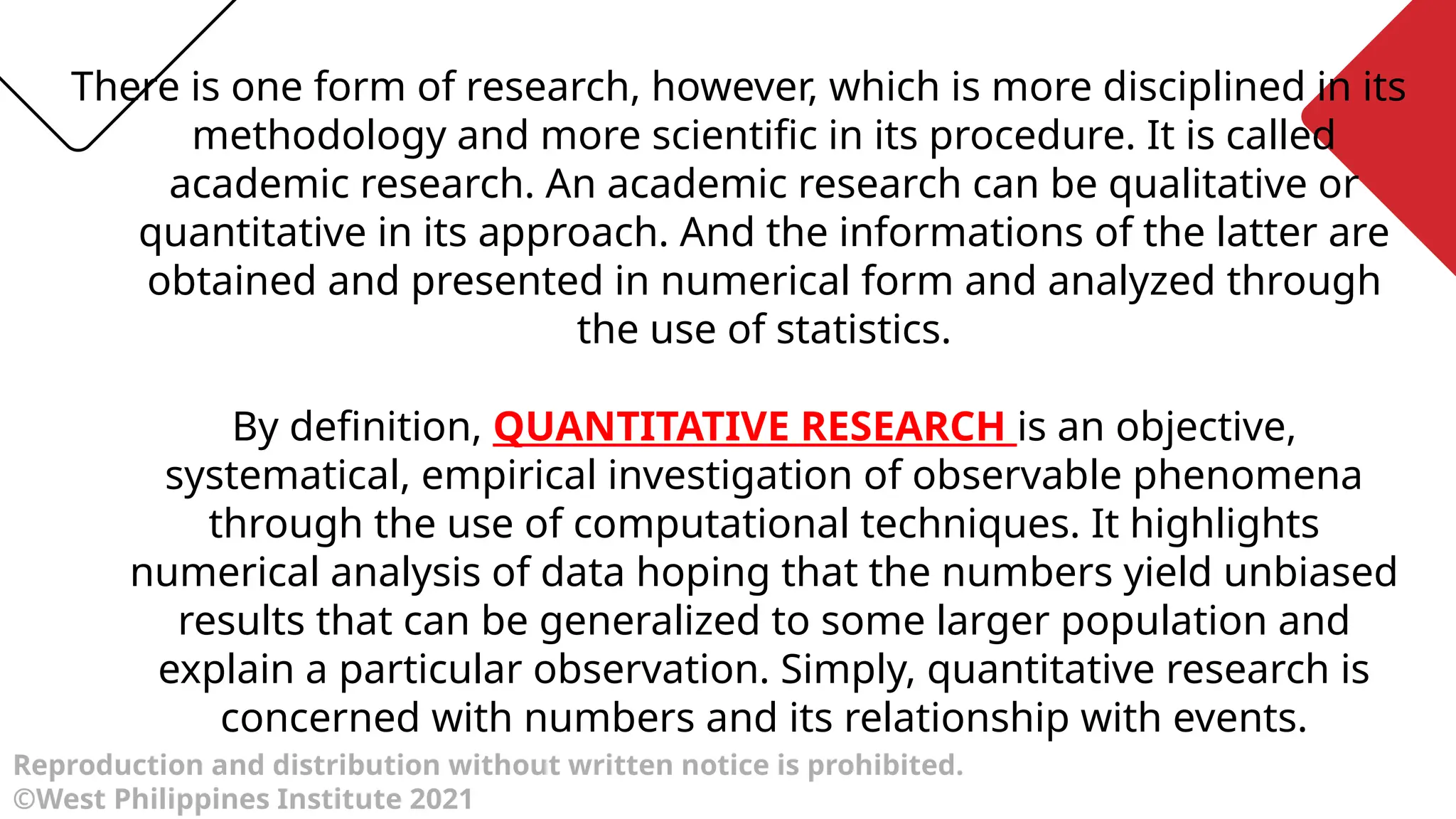
There is one form of research, however, which is more disciplined in its
methodology and more scientific in its procedure. It is called
academic research. An academic research can be qualitative or
quantitative in its approach. And the informations of the latter are
obtained and presented in numerical form and analyzed through
the use of statistics.
By definition, QUANTITATIVE RESEARCH is an objective,
systematical, empirical investigation of observable phenomena
through the use of computational techniques. It highlights
numerical analysis of data hoping that the numbers yield unbiased
results that can be generalized to some larger population and
explain a particular observation. Simply, quantitative research is
concerned with numbers and its relationship with events.
LESSON 2 :
Characteristics of
Quantitative Research
Reproduction and distribution without written notice is prohibited.
©West Philippines Institute 2021
WHAT ARE THE
CHARACTERISTICS OF
QUANTITATIVE RESEARCH?
Reproduction and distribution without written notice is prohibited.
©West Philippines Institute 2021
CHARACTERISTICS OF
QUANTITATIVE RESEARCH
Reproduction and distribution without written notice is prohibited.
©West Philippines Institute 2021
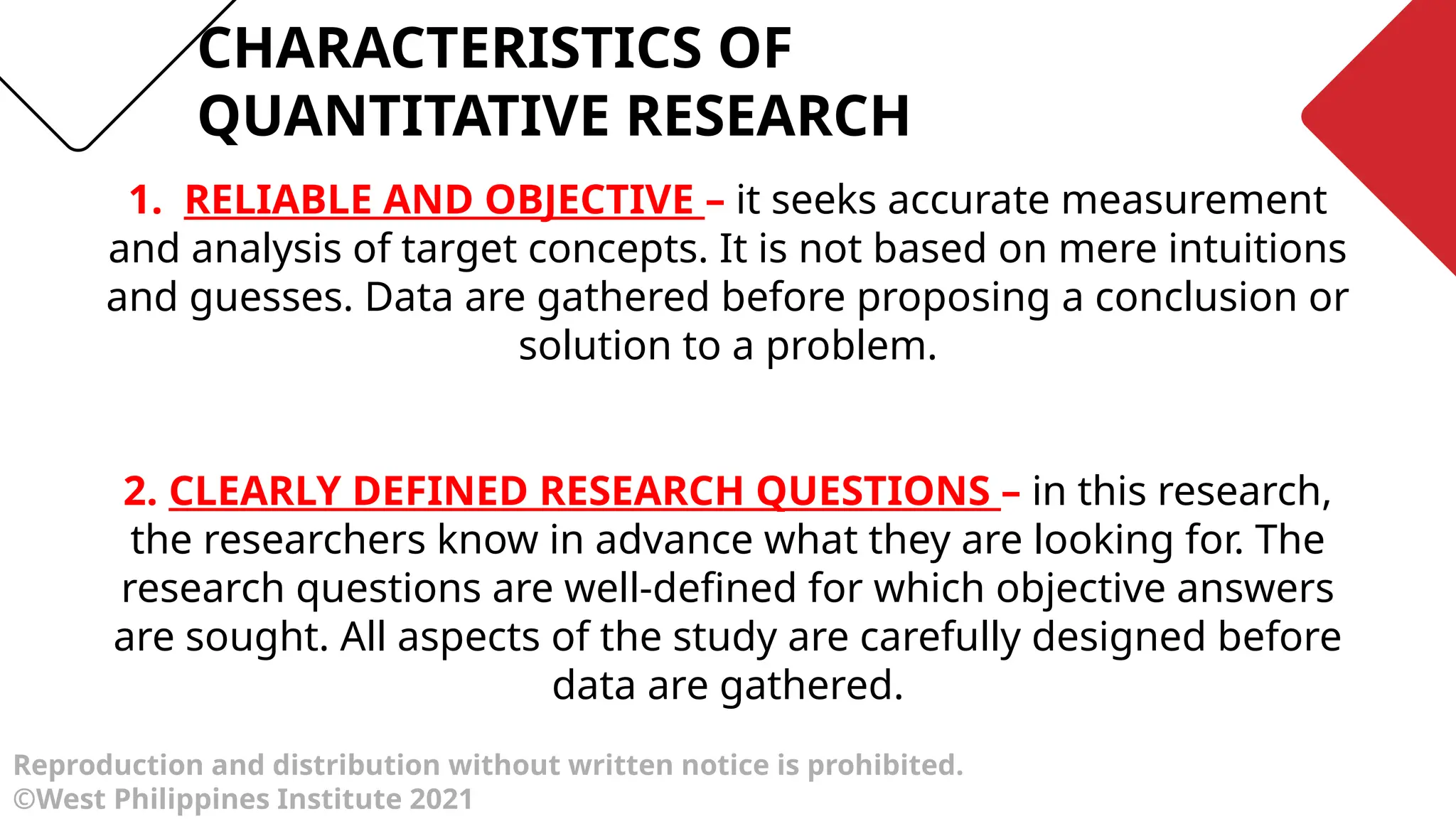
1. RELIABLE AND OBJECTIVE – it seeks accurate measurement
and analysis of target concepts. It is not based on mere intuitions
and guesses. Data are gathered before proposing a conclusion or
solution to a problem.
2. CLEARLY DEFINED RESEARCH QUESTIONS – in this research,
the researchers know in advance what they are looking for. The
research questions are well-defined for which objective answers
are sought. All aspects of the study are carefully designed before
data are gathered.
Reproduction and distribution without written notice is prohibited.
©West Philippines Institute 2021
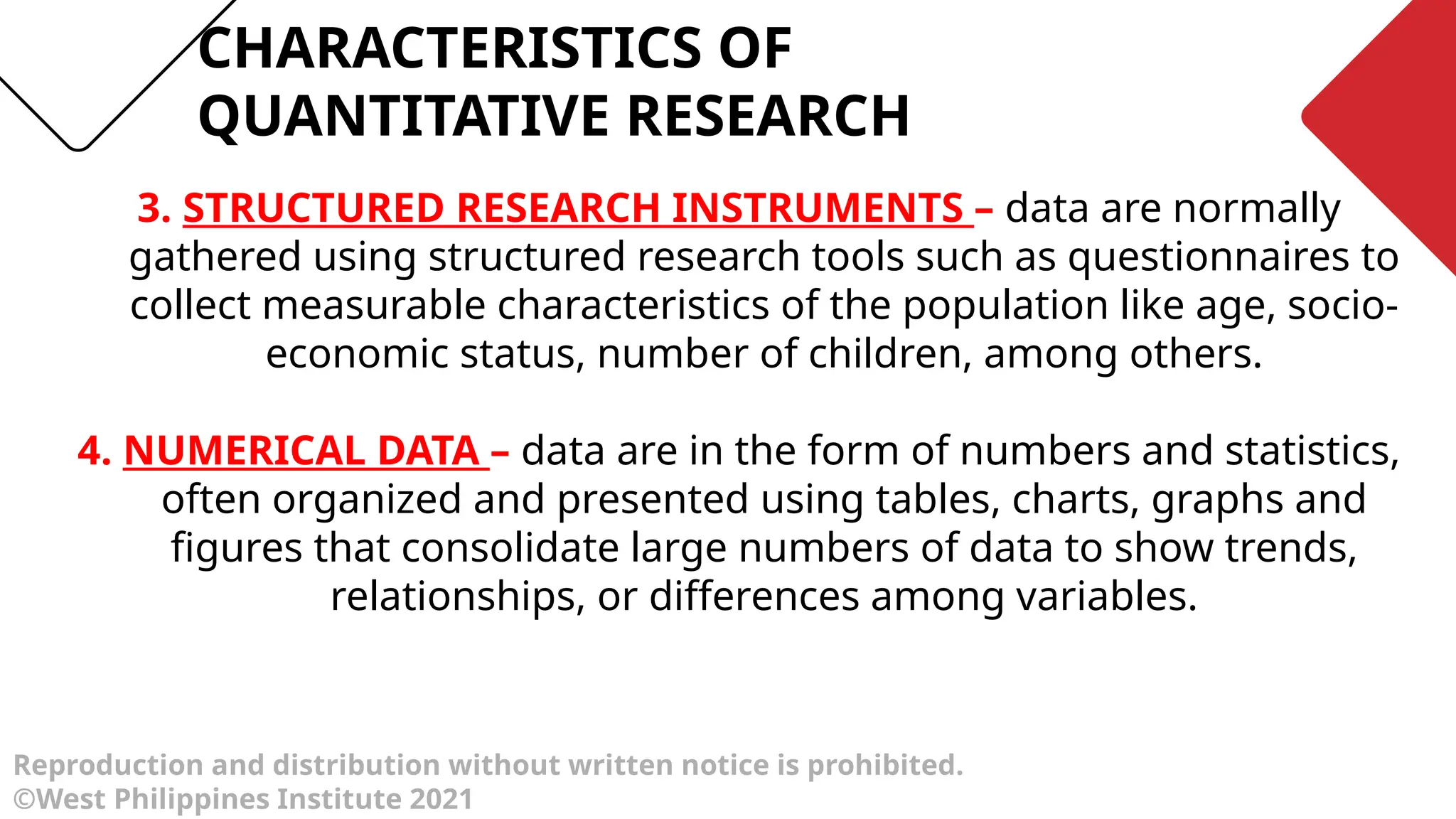
3. STRUCTURED RESEARCH INSTRUMENTS – data are normally
gathered using structured research tools such as questionnaires to
collect measurable characteristics of the population like age, socio-
economic status, number of children, among others.
4. NUMERICAL DATA – data are in the form of numbers and statistics,
often organized and presented using tables, charts, graphs and
figures that consolidate large numbers of data to show trends,
relationships, or differences among variables.
CHARACTERISTICS OF
QUANTITATIVE RESEARCH
Reproduction and distribution without written notice is prohibited.
©West Philippines Institute 2021
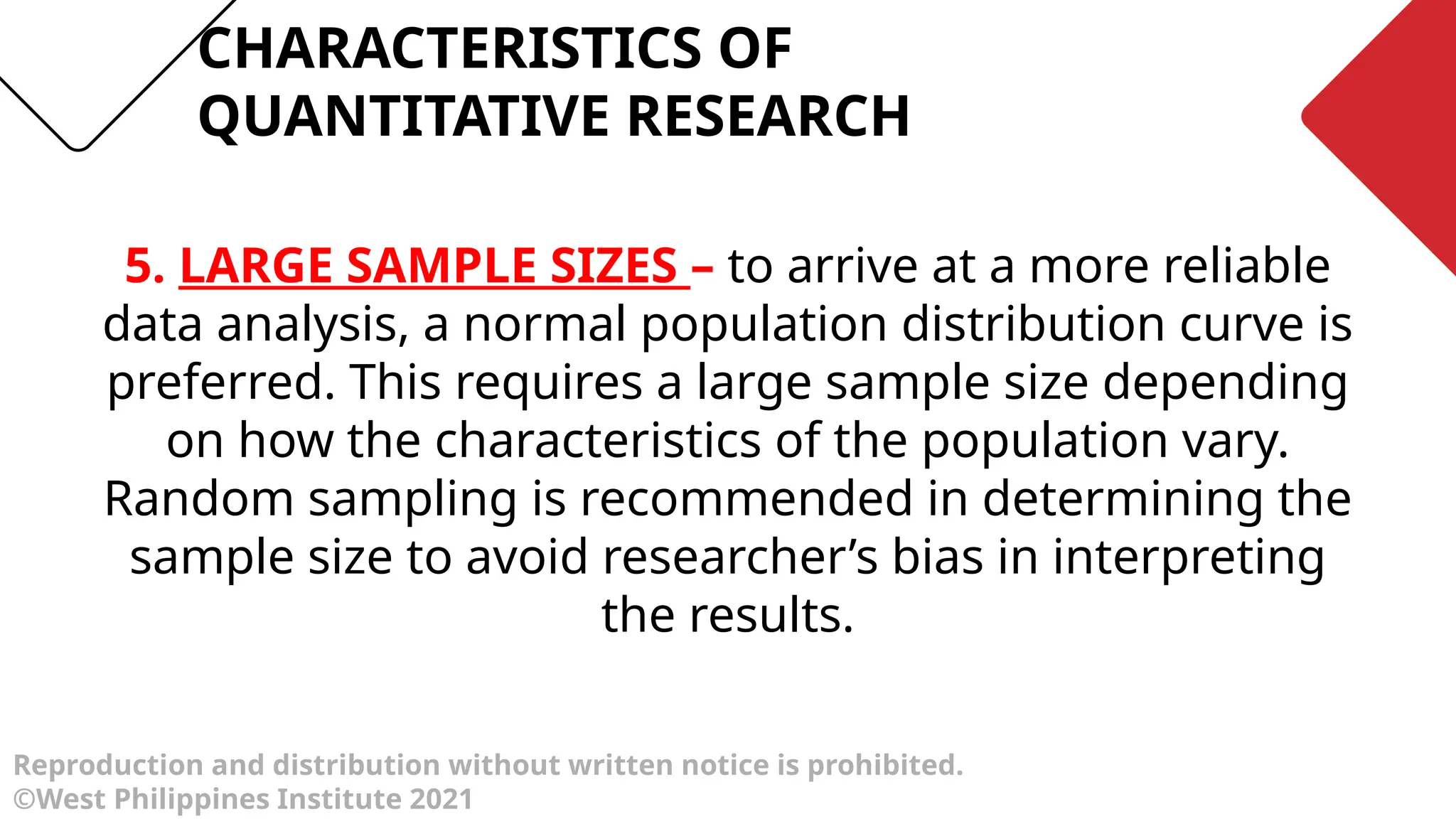
5. LARGE SAMPLE SIZES – to arrive at a more reliable
data analysis, a normal population distribution curve is
preferred. This requires a large sample size depending
on how the characteristics of the population vary.
Random sampling is recommended in determining the
sample size to avoid researcher’s bias in interpreting
the results.
CHARACTERISTICS OF
QUANTITATIVE RESEARCH
Reproduction and distribution without written notice is prohibited.
©West Philippines Institute 2021
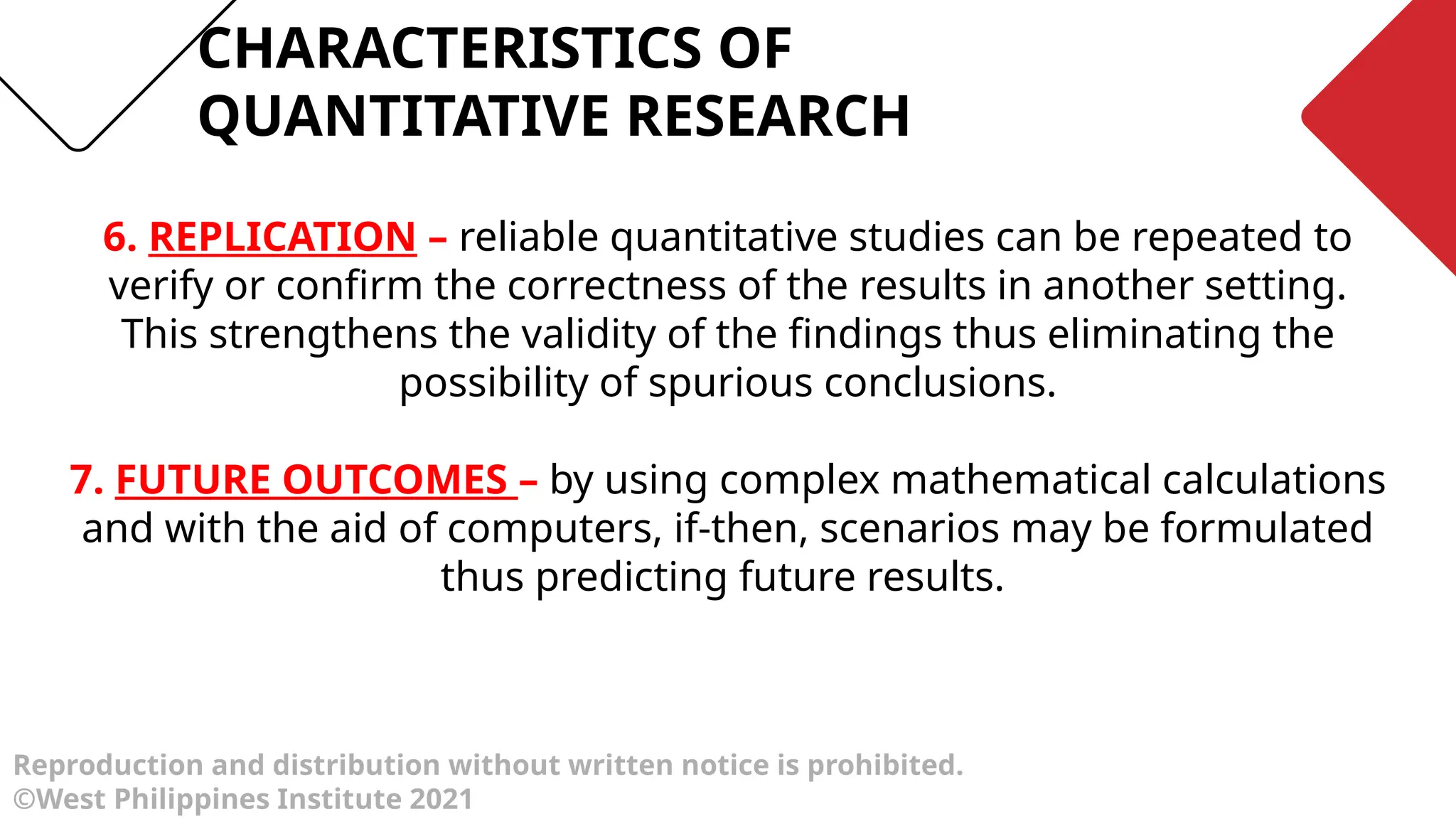
6. REPLICATION – reliable quantitative studies can be repeated to
verify or confirm the correctness of the results in another setting.
This strengthens the validity of the findings thus eliminating the
possibility of spurious conclusions.
7. FUTURE OUTCOMES – by using complex mathematical calculations
and with the aid of computers, if-then, scenarios may be formulated
thus predicting future results.
CHARACTERISTICS OF
QUANTITATIVE RESEARCH
LESSON 3 :
Importance of
Quantitative Research
Reproduction and distribution without written notice is prohibited.
©West Philippines Institute 2021
Reproduction and distribution without written notice is prohibited.
©West Philippines Institute 2021
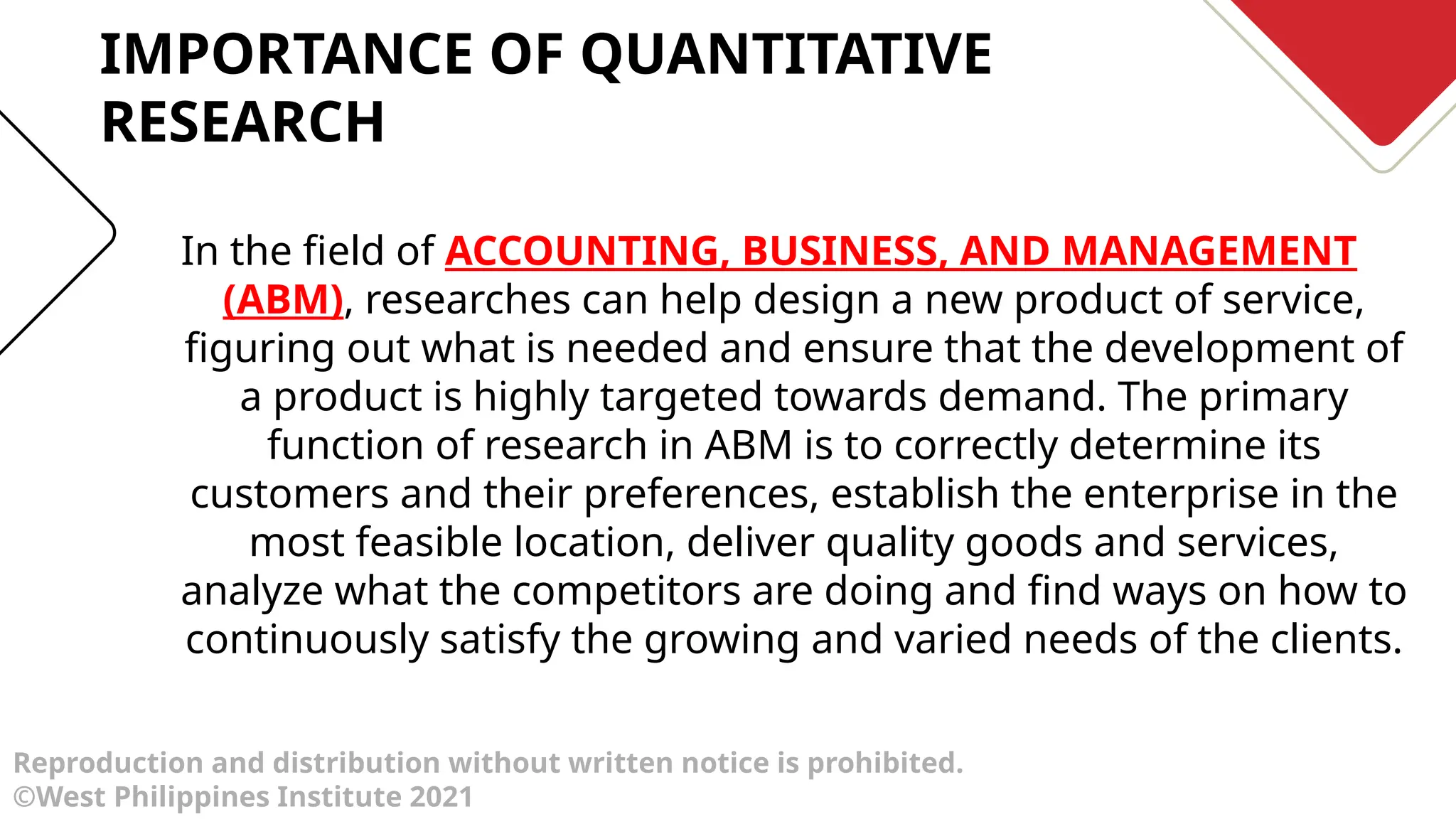
In the field of ACCOUNTING, BUSINESS, AND MANAGEMENT
(ABM), researches can help design a new product of service,
figuring out what is needed and ensure that the development of
a product is highly targeted towards demand. The primary
function of research in ABM is to correctly determine its
customers and their preferences, establish the enterprise in the
most feasible location, deliver quality goods and services,
analyze what the competitors are doing and find ways on how to
continuously satisfy the growing and varied needs of the clients.
IMPORTANCE OF QUANTITATIVE
RESEARCH
Reproduction and distribution without written notice is prohibited.
©West Philippines Institute 2021
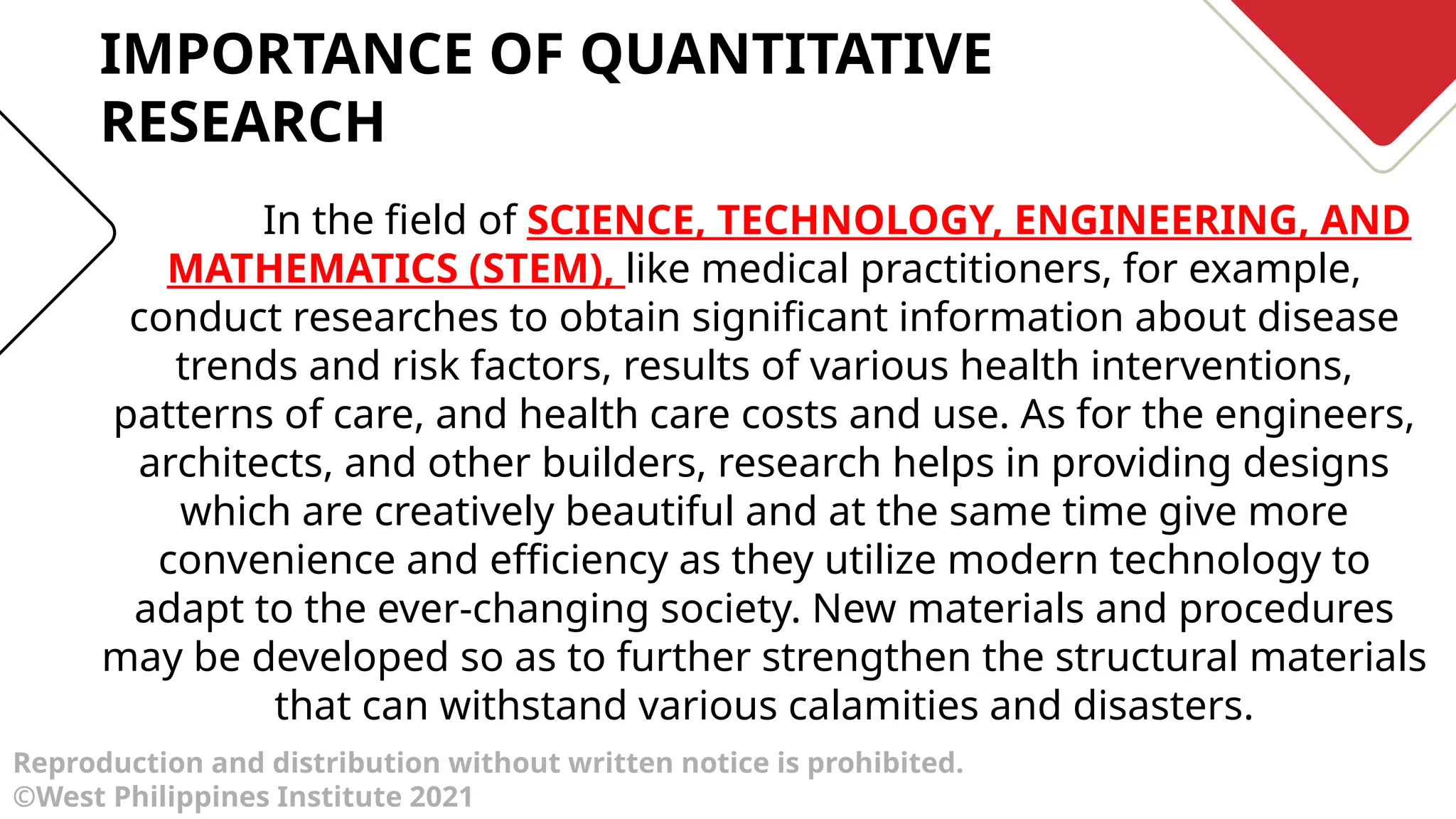
In the field of SCIENCE, TECHNOLOGY, ENGINEERING, AND
MATHEMATICS (STEM), like medical practitioners, for example,
conduct researches to obtain significant information about disease
trends and risk factors, results of various health interventions,
patterns of care, and health care costs and use. As for the engineers,
architects, and other builders, research helps in providing designs
which are creatively beautiful and at the same time give more
convenience and efficiency as they utilize modern technology to
adapt to the ever-changing society. New materials and procedures
may be developed so as to further strengthen the structural materials
that can withstand various calamities and disasters.
IMPORTANCE OF QUANTITATIVE
RESEARCH
Reproduction and distribution without written notice is prohibited.
©West Philippines Institute 2021
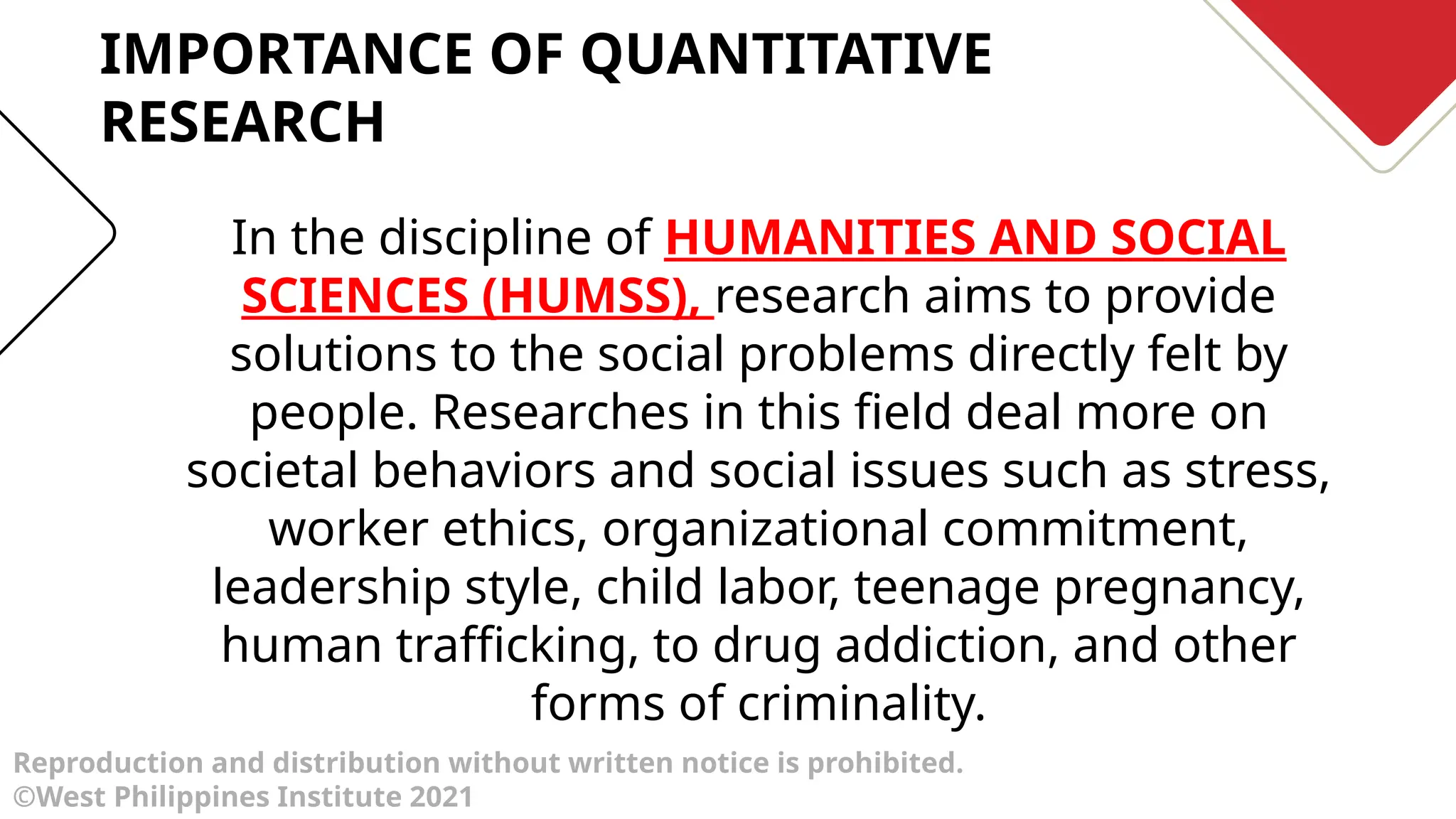
In the discipline of HUMANITIES AND SOCIAL
SCIENCES (HUMSS), research aims to provide
solutions to the social problems directly felt by
people. Researches in this field deal more on
societal behaviors and social issues such as stress,
worker ethics, organizational commitment,
leadership style, child labor, teenage pregnancy,
human trafficking, to drug addiction, and other
forms of criminality.
IMPORTANCE OF QUANTITATIVE
RESEARCH
Reproduction and distribution without written notice is prohibited.
©West Philippines Institute 2021
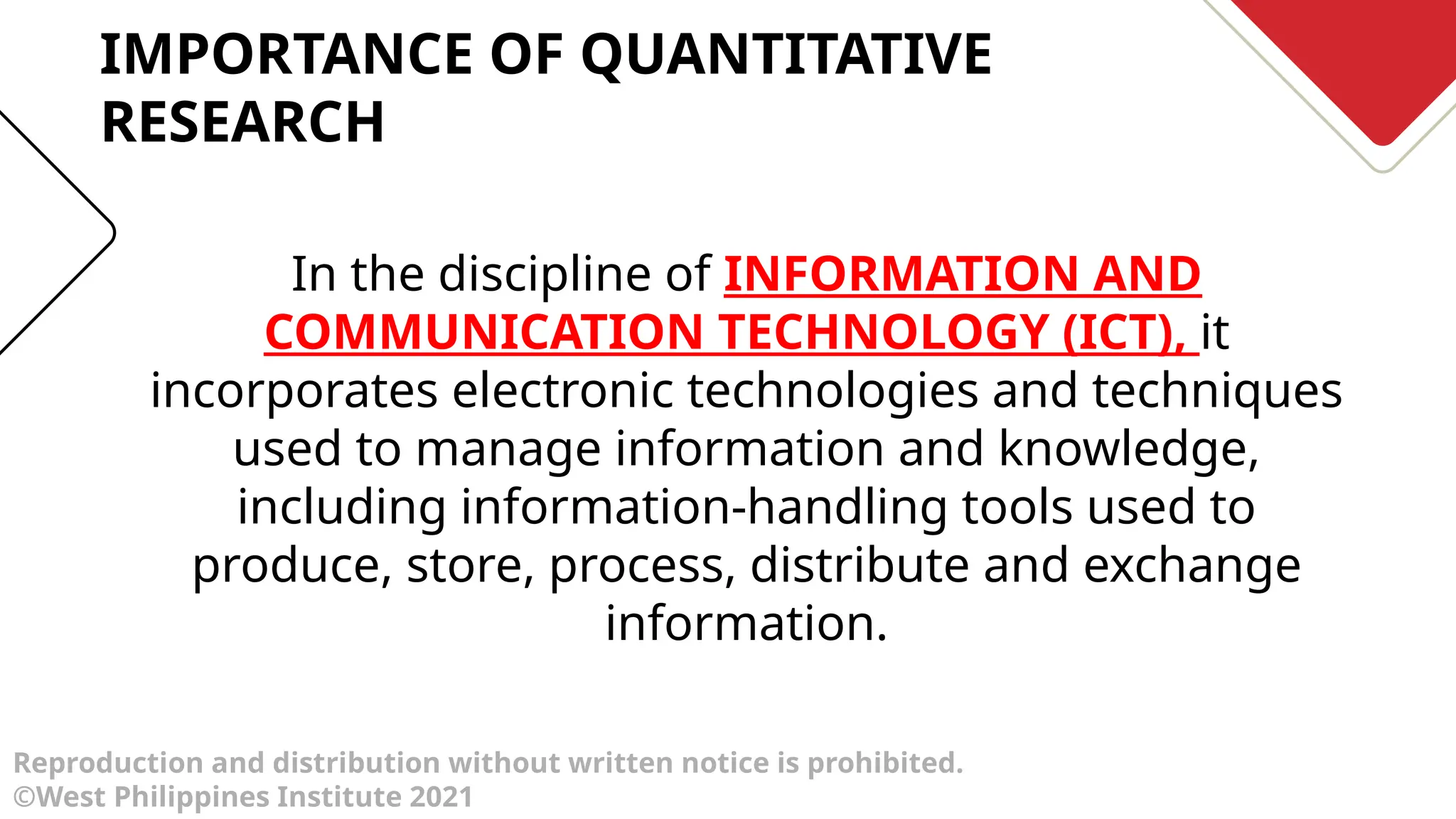
In the discipline of INFORMATION AND
COMMUNICATION TECHNOLOGY (ICT), it
incorporates electronic technologies and techniques
used to manage information and knowledge,
including information-handling tools used to
produce, store, process, distribute and exchange
information.
IMPORTANCE OF QUANTITATIVE
RESEARCH
Reproduction and distribution without written notice is prohibited.
©West Philippines Institute 2021
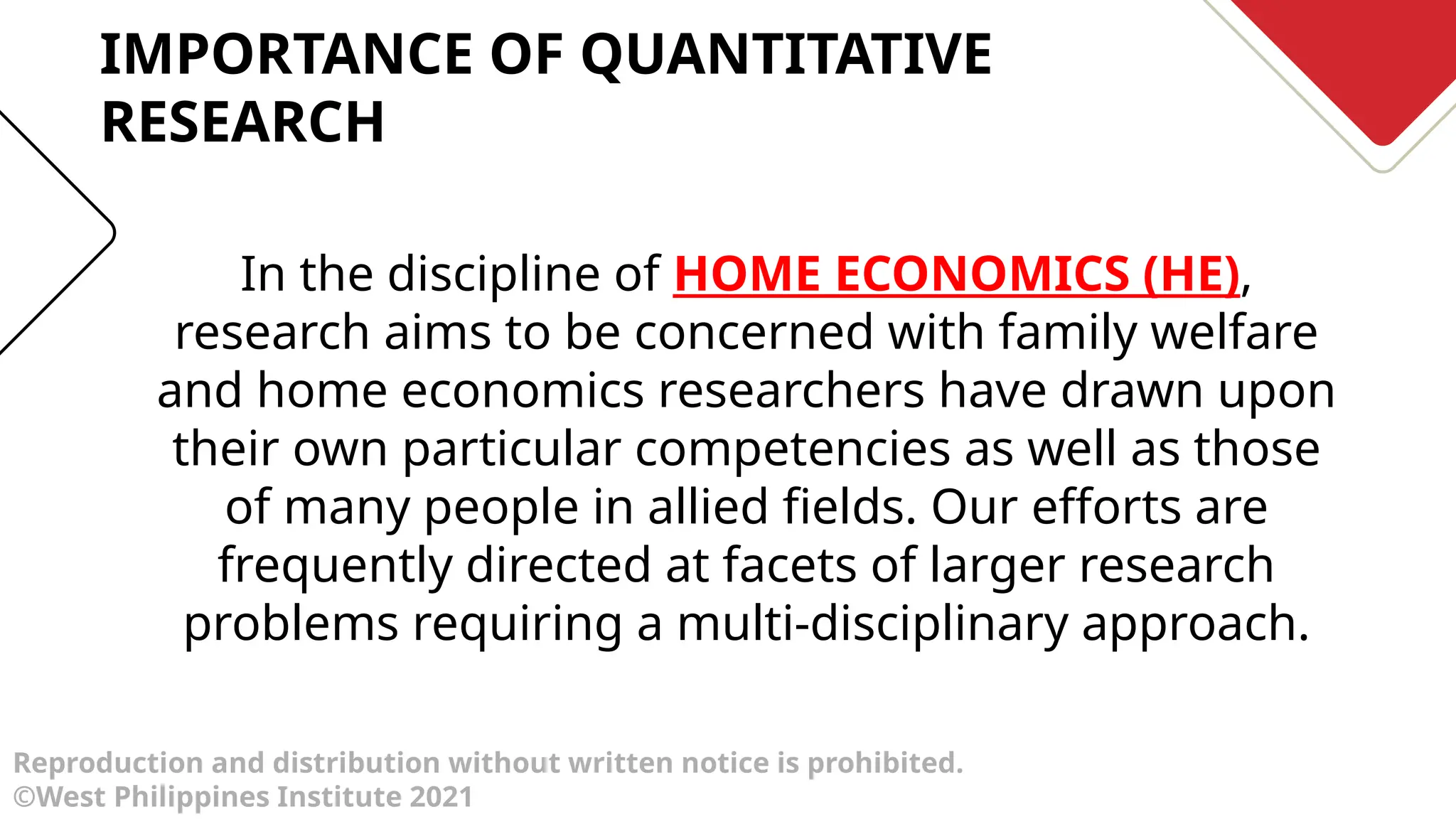
In the discipline of HOME ECONOMICS (HE),
research aims to be concerned with family welfare
and home economics researchers have drawn upon
their own particular competencies as well as those
of many people in allied fields. Our efforts are
frequently directed at facets of larger research
problems requiring a multi-disciplinary approach.
IMPORTANCE OF QUANTITATIVE
RESEARCH
Reproduction and distribution without written notice is prohibited.
©West Philippines Institute 2021
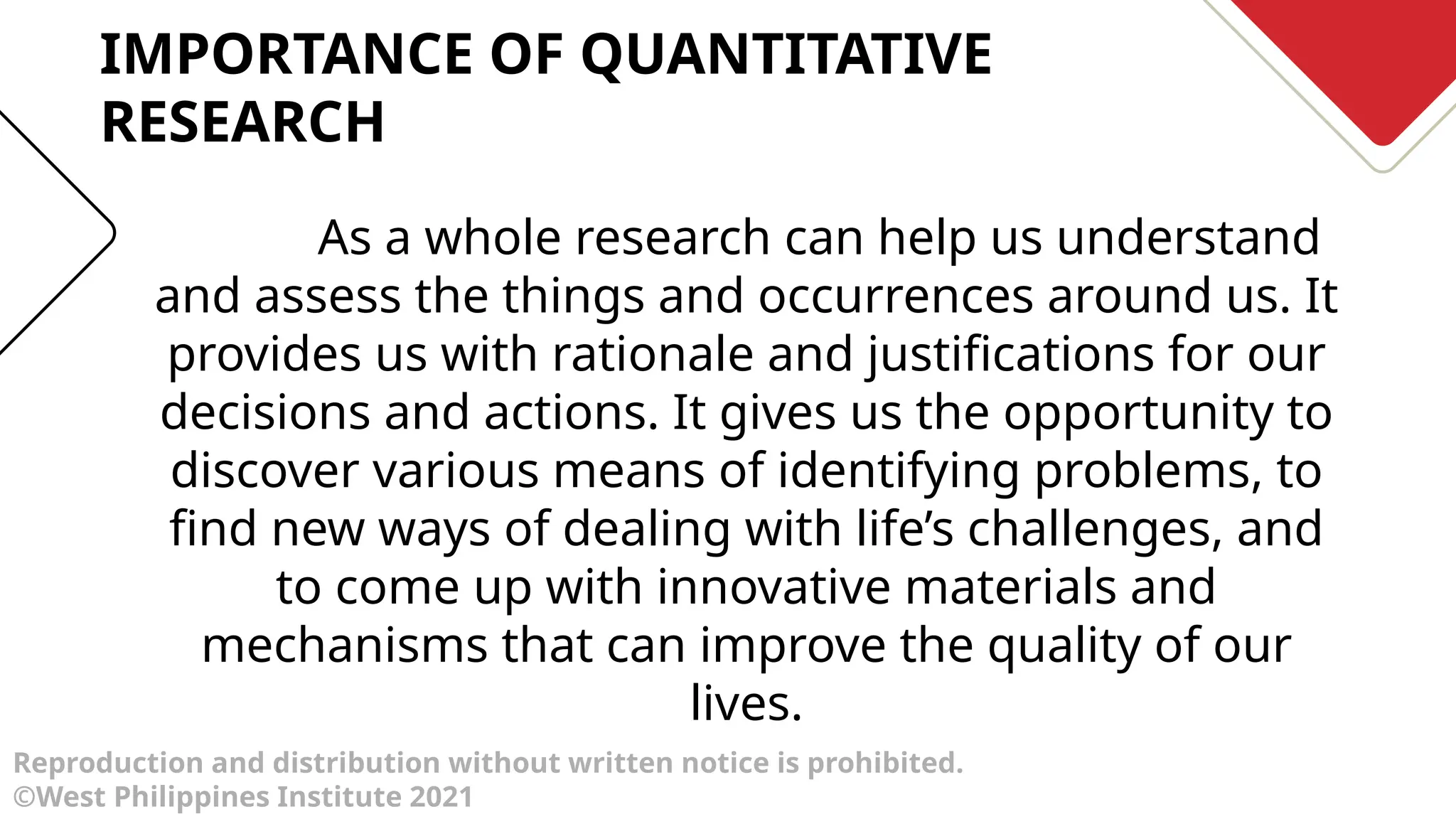
As a whole research can help us understand
and assess the things and occurrences around us. It
provides us with rationale and justifications for our
decisions and actions. It gives us the opportunity to
discover various means of identifying problems, to
find new ways of dealing with life’s challenges, and
to come up with innovative materials and
mechanisms that can improve the quality of our
lives.
IMPORTANCE OF QUANTITATIVE
RESEARCH
LESSON 4 :
Kinds of Quantitative
Research
Reproduction and distribution without written notice is prohibited.
©West Philippines Institute 2021
KINDS OF QUANTITATIVE
RESEARCH
Reproduction and distribution without written notice is prohibited.
©West Philippines Institute 2021
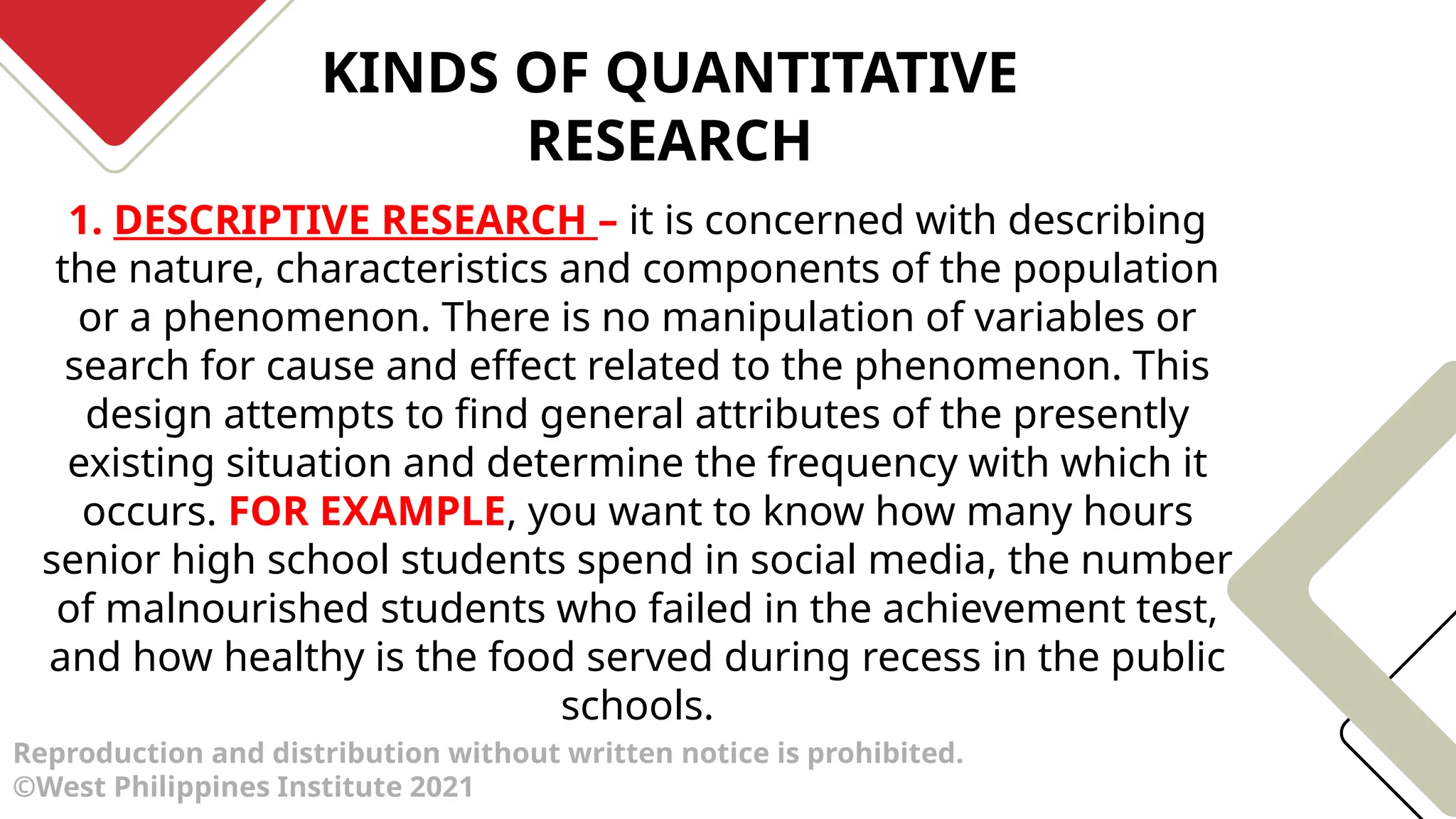
1. DESCRIPTIVE RESEARCH – it is concerned with describing
the nature, characteristics and components of the population
or a phenomenon. There is no manipulation of variables or
search for cause and effect related to the phenomenon. This
design attempts to find general attributes of the presently
existing situation and determine the frequency with which it
occurs. FOR EXAMPLE, you want to know how many hours
senior high school students spend in social media, the number
of malnourished students who failed in the achievement test,
and how healthy is the food served during recess in the public
schools.
KINDS OF QUANTITATIVE
RESEARCH
Reproduction and distribution without written notice is prohibited.
©West Philippines Institute 2021
2. CORRELATIONAL RESEARCH – it is the systematic
investigation of the nature of relationships, or associations
between and among variables without necessarily investigating
into causal reasons underlying them. It is also concerned with
the extent relationships that exists between or among the
variables. FOR EXAMPLE, if pre-board examination results can be
used to predict performance in the Licensure Examination for
Teachers (LET), then the higher the pre-board grade, the higher
most likely be the score in the LET. Correlational research is
employed if you like to know, for example, if the following factors
are related to each other: sex and mathematical ability, marriage
and cancer recovery, occupation and life span.
KINDS OF QUANTITATIVE
RESEARCH
Reproduction and distribution without written notice is prohibited.
©West Philippines Institute 2021
3. EVALUATION RESEARCH – it aims to assess the
effects, impacts, or outcomes of practices, policies,
or programs. FOR EXAMPLE, assessing the
implementation of nursing care in a hospital and
determining the impact of a new treatment
procedures for patients.
KINDS OF QUANTITATIVE
RESEARCH
Reproduction and distribution without written notice is prohibited.
©West Philippines Institute 2021
4. SURVEY RESEARCH – is used to gather information from groups of people
be selecting and studying samples chosen from a population. It may be done
in various ways like face-to-face, phone, mail, and online. A survey research
may be cross-sectional if the information is collected from a sample in just
single point in time just like the child-bearing practices of single parents, and
population control practices of unmarried couples.
A survey research is considered longitudinal if the researcher collects
information on the same subjects over a period of time, sometimes lasting
many years in order to study the changes through the years. Longitudinal
survey is utilized, FOR EXAMPLE, to determine the growth of rice yield in the
country and the rate of promotion of doctorate degree holders five years after
earning the degree.
KINDS OF QUANTITATIVE
RESEARCH
Reproduction and distribution without written notice is prohibited.
©West Philippines Institute 2021
5. CAUSAL-COMPARATIVE RESEARCH – it is also known as ex
post facto (after the fact) research. This kind of research
derives conclusion from observations and manifestations that
already occurred in the past and now compared to some
dependent variables. It discusses why and how a phenomenon
occurs.
FOR EXAMPLE, a researcher is interested in how weight
influences stress-coping level of adults. Here, the subjects
would be separated into different groups (underweight,
normal weight, overweight) and their stress-coping levels
measured. This is an ex post facto design because a pre-
existing characteristic (weight) was used to form the groups.
KINDS OF QUANTITATIVE
RESEARCH
Reproduction and distribution without written notice is prohibited.
©West Philippines Institute 2021
6. EXPERIMENTAL RESEARCH – it utilizes scientific method to test
cause-and-effect relationships under conditions controlled by the
researcher. In this case, an effort is made to determine and impose
control over all other variables except one. An independent variable is
manipulated to determine the effects on the dependent variables. FOR
EXAMPLE, a teacher would like to know if a new teaching strategy is
effective or not so he/she teaches one section using the new strategy
and teaches another comparable section without the new strategy, then
an achievement test was given to the two sections. The manipulated
independent variable is the new teaching strategy which is being tested
if it has an effect on the dependent variable which is the achievement of
the students. Notice that the sections are comparable with one another
meaning all other variables are controlled by the teacher.
THANK
YOU!
Email: kristine@westphilippinesinstitute.net
Facebook: gonzaleskristine45@yahoo.com
*Please be reminded that the queries will be
entertained from 8:00 AM – 5:00 PM ONLY.
If you have any question send me an email at:

Practical Research 2 LECTURE - WEEK 1 lesson 1

  • 1.
    APT-PR2-I-12 PRACTICAL RESEARCH 2 KRISTINET. GONZALES, LPT Subject Teacher
  • 2.
    Quantitative Research; Its characteristics, importance,and kinds WEEK 1 Reproduction and distribution without written notice is prohibited. ©West Philippines Institute 2021
  • 3.
    At the endof the discussion, students should be able to discuss the basics of quantitative research LEARNING TARGET: Reproduction and distribution without written notice is prohibited. ©West Philippines Institute 2021
  • 4.
    LESSON 1 : Research and QuantitativeResearch Reproduction and distribution without written notice is prohibited. ©West Philippines Institute 2021
  • 5.
    Research The word “RESEARCH”was coined from the French word “CERHIER” which means seek. The prefix “re” means to repeat. Literally, research is to repeat looking for something. Research signifies finding the truth again about ideas and problems which were in existence before in different perspectives. Reproduction and distribution without written notice is prohibited. ©West Philippines Institute 2021
  • 6.
    Reproduction and distributionwithout written notice is prohibited. ©West Philippines Institute 2021 There is one form of research, however, which is more disciplined in its methodology and more scientific in its procedure. It is called academic research. An academic research can be qualitative or quantitative in its approach. And the informations of the latter are obtained and presented in numerical form and analyzed through the use of statistics. By definition, QUANTITATIVE RESEARCH is an objective, systematical, empirical investigation of observable phenomena through the use of computational techniques. It highlights numerical analysis of data hoping that the numbers yield unbiased results that can be generalized to some larger population and explain a particular observation. Simply, quantitative research is concerned with numbers and its relationship with events.
  • 7.
    LESSON 2 : Characteristicsof Quantitative Research Reproduction and distribution without written notice is prohibited. ©West Philippines Institute 2021
  • 8.
    WHAT ARE THE CHARACTERISTICSOF QUANTITATIVE RESEARCH? Reproduction and distribution without written notice is prohibited. ©West Philippines Institute 2021
  • 9.
    CHARACTERISTICS OF QUANTITATIVE RESEARCH Reproductionand distribution without written notice is prohibited. ©West Philippines Institute 2021 1. RELIABLE AND OBJECTIVE – it seeks accurate measurement and analysis of target concepts. It is not based on mere intuitions and guesses. Data are gathered before proposing a conclusion or solution to a problem. 2. CLEARLY DEFINED RESEARCH QUESTIONS – in this research, the researchers know in advance what they are looking for. The research questions are well-defined for which objective answers are sought. All aspects of the study are carefully designed before data are gathered.
  • 10.
    Reproduction and distributionwithout written notice is prohibited. ©West Philippines Institute 2021 3. STRUCTURED RESEARCH INSTRUMENTS – data are normally gathered using structured research tools such as questionnaires to collect measurable characteristics of the population like age, socio- economic status, number of children, among others. 4. NUMERICAL DATA – data are in the form of numbers and statistics, often organized and presented using tables, charts, graphs and figures that consolidate large numbers of data to show trends, relationships, or differences among variables. CHARACTERISTICS OF QUANTITATIVE RESEARCH
  • 11.
    Reproduction and distributionwithout written notice is prohibited. ©West Philippines Institute 2021 5. LARGE SAMPLE SIZES – to arrive at a more reliable data analysis, a normal population distribution curve is preferred. This requires a large sample size depending on how the characteristics of the population vary. Random sampling is recommended in determining the sample size to avoid researcher’s bias in interpreting the results. CHARACTERISTICS OF QUANTITATIVE RESEARCH
  • 12.
    Reproduction and distributionwithout written notice is prohibited. ©West Philippines Institute 2021 6. REPLICATION – reliable quantitative studies can be repeated to verify or confirm the correctness of the results in another setting. This strengthens the validity of the findings thus eliminating the possibility of spurious conclusions. 7. FUTURE OUTCOMES – by using complex mathematical calculations and with the aid of computers, if-then, scenarios may be formulated thus predicting future results. CHARACTERISTICS OF QUANTITATIVE RESEARCH
  • 13.
    LESSON 3 : Importanceof Quantitative Research Reproduction and distribution without written notice is prohibited. ©West Philippines Institute 2021
  • 14.
    Reproduction and distributionwithout written notice is prohibited. ©West Philippines Institute 2021 In the field of ACCOUNTING, BUSINESS, AND MANAGEMENT (ABM), researches can help design a new product of service, figuring out what is needed and ensure that the development of a product is highly targeted towards demand. The primary function of research in ABM is to correctly determine its customers and their preferences, establish the enterprise in the most feasible location, deliver quality goods and services, analyze what the competitors are doing and find ways on how to continuously satisfy the growing and varied needs of the clients. IMPORTANCE OF QUANTITATIVE RESEARCH
  • 15.
    Reproduction and distributionwithout written notice is prohibited. ©West Philippines Institute 2021 In the field of SCIENCE, TECHNOLOGY, ENGINEERING, AND MATHEMATICS (STEM), like medical practitioners, for example, conduct researches to obtain significant information about disease trends and risk factors, results of various health interventions, patterns of care, and health care costs and use. As for the engineers, architects, and other builders, research helps in providing designs which are creatively beautiful and at the same time give more convenience and efficiency as they utilize modern technology to adapt to the ever-changing society. New materials and procedures may be developed so as to further strengthen the structural materials that can withstand various calamities and disasters. IMPORTANCE OF QUANTITATIVE RESEARCH
  • 16.
    Reproduction and distributionwithout written notice is prohibited. ©West Philippines Institute 2021 In the discipline of HUMANITIES AND SOCIAL SCIENCES (HUMSS), research aims to provide solutions to the social problems directly felt by people. Researches in this field deal more on societal behaviors and social issues such as stress, worker ethics, organizational commitment, leadership style, child labor, teenage pregnancy, human trafficking, to drug addiction, and other forms of criminality. IMPORTANCE OF QUANTITATIVE RESEARCH
  • 17.
    Reproduction and distributionwithout written notice is prohibited. ©West Philippines Institute 2021 In the discipline of INFORMATION AND COMMUNICATION TECHNOLOGY (ICT), it incorporates electronic technologies and techniques used to manage information and knowledge, including information-handling tools used to produce, store, process, distribute and exchange information. IMPORTANCE OF QUANTITATIVE RESEARCH
  • 18.
    Reproduction and distributionwithout written notice is prohibited. ©West Philippines Institute 2021 In the discipline of HOME ECONOMICS (HE), research aims to be concerned with family welfare and home economics researchers have drawn upon their own particular competencies as well as those of many people in allied fields. Our efforts are frequently directed at facets of larger research problems requiring a multi-disciplinary approach. IMPORTANCE OF QUANTITATIVE RESEARCH
  • 19.
    Reproduction and distributionwithout written notice is prohibited. ©West Philippines Institute 2021 As a whole research can help us understand and assess the things and occurrences around us. It provides us with rationale and justifications for our decisions and actions. It gives us the opportunity to discover various means of identifying problems, to find new ways of dealing with life’s challenges, and to come up with innovative materials and mechanisms that can improve the quality of our lives. IMPORTANCE OF QUANTITATIVE RESEARCH
  • 20.
    LESSON 4 : Kindsof Quantitative Research Reproduction and distribution without written notice is prohibited. ©West Philippines Institute 2021
  • 21.
    KINDS OF QUANTITATIVE RESEARCH Reproductionand distribution without written notice is prohibited. ©West Philippines Institute 2021 1. DESCRIPTIVE RESEARCH – it is concerned with describing the nature, characteristics and components of the population or a phenomenon. There is no manipulation of variables or search for cause and effect related to the phenomenon. This design attempts to find general attributes of the presently existing situation and determine the frequency with which it occurs. FOR EXAMPLE, you want to know how many hours senior high school students spend in social media, the number of malnourished students who failed in the achievement test, and how healthy is the food served during recess in the public schools.
  • 22.
    KINDS OF QUANTITATIVE RESEARCH Reproductionand distribution without written notice is prohibited. ©West Philippines Institute 2021 2. CORRELATIONAL RESEARCH – it is the systematic investigation of the nature of relationships, or associations between and among variables without necessarily investigating into causal reasons underlying them. It is also concerned with the extent relationships that exists between or among the variables. FOR EXAMPLE, if pre-board examination results can be used to predict performance in the Licensure Examination for Teachers (LET), then the higher the pre-board grade, the higher most likely be the score in the LET. Correlational research is employed if you like to know, for example, if the following factors are related to each other: sex and mathematical ability, marriage and cancer recovery, occupation and life span.
  • 23.
    KINDS OF QUANTITATIVE RESEARCH Reproductionand distribution without written notice is prohibited. ©West Philippines Institute 2021 3. EVALUATION RESEARCH – it aims to assess the effects, impacts, or outcomes of practices, policies, or programs. FOR EXAMPLE, assessing the implementation of nursing care in a hospital and determining the impact of a new treatment procedures for patients.
  • 24.
    KINDS OF QUANTITATIVE RESEARCH Reproductionand distribution without written notice is prohibited. ©West Philippines Institute 2021 4. SURVEY RESEARCH – is used to gather information from groups of people be selecting and studying samples chosen from a population. It may be done in various ways like face-to-face, phone, mail, and online. A survey research may be cross-sectional if the information is collected from a sample in just single point in time just like the child-bearing practices of single parents, and population control practices of unmarried couples. A survey research is considered longitudinal if the researcher collects information on the same subjects over a period of time, sometimes lasting many years in order to study the changes through the years. Longitudinal survey is utilized, FOR EXAMPLE, to determine the growth of rice yield in the country and the rate of promotion of doctorate degree holders five years after earning the degree.
  • 25.
    KINDS OF QUANTITATIVE RESEARCH Reproductionand distribution without written notice is prohibited. ©West Philippines Institute 2021 5. CAUSAL-COMPARATIVE RESEARCH – it is also known as ex post facto (after the fact) research. This kind of research derives conclusion from observations and manifestations that already occurred in the past and now compared to some dependent variables. It discusses why and how a phenomenon occurs. FOR EXAMPLE, a researcher is interested in how weight influences stress-coping level of adults. Here, the subjects would be separated into different groups (underweight, normal weight, overweight) and their stress-coping levels measured. This is an ex post facto design because a pre- existing characteristic (weight) was used to form the groups.
  • 26.
    KINDS OF QUANTITATIVE RESEARCH Reproductionand distribution without written notice is prohibited. ©West Philippines Institute 2021 6. EXPERIMENTAL RESEARCH – it utilizes scientific method to test cause-and-effect relationships under conditions controlled by the researcher. In this case, an effort is made to determine and impose control over all other variables except one. An independent variable is manipulated to determine the effects on the dependent variables. FOR EXAMPLE, a teacher would like to know if a new teaching strategy is effective or not so he/she teaches one section using the new strategy and teaches another comparable section without the new strategy, then an achievement test was given to the two sections. The manipulated independent variable is the new teaching strategy which is being tested if it has an effect on the dependent variable which is the achievement of the students. Notice that the sections are comparable with one another meaning all other variables are controlled by the teacher.
  • 27.
    THANK YOU! Email: kristine@westphilippinesinstitute.net Facebook: gonzaleskristine45@yahoo.com *Pleasebe reminded that the queries will be entertained from 8:00 AM – 5:00 PM ONLY. If you have any question send me an email at: