Practical Radio Resource Management In Wireless Systems Sofoklis A Kyriazakos
Practical Radio Resource Management In Wireless Systems Sofoklis A Kyriazakos
Practical Radio Resource Management In Wireless Systems Sofoklis A Kyriazakos
Practical Radio Resource Management In Wireless Systems Sofoklis A Kyriazakos
Practical Radio Resource Management In Wireless Systems Sofoklis A Kyriazakos
1.
Practical Radio ResourceManagement In Wireless
Systems Sofoklis A Kyriazakos download
https://ebookbell.com/product/practical-radio-resource-
management-in-wireless-systems-sofoklis-a-kyriazakos-4430676
Explore and download more ebooks at ebookbell.com
2.
Here are somerecommended products that we believe you will be
interested in. You can click the link to download.
Practical Radio Frequency Test And Measurement A Technicians Handbook
Carr
https://ebookbell.com/product/practical-radio-frequency-test-and-
measurement-a-technicians-handbook-carr-4321984
Practical Radio Engineering And Telemetry For Industry 1st Edition
David Bailey Beng
https://ebookbell.com/product/practical-radio-engineering-and-
telemetry-for-industry-1st-edition-david-bailey-beng-1188200
Making Radio A Practical Guide To Working In Radio Steve Ahern
https://ebookbell.com/product/making-radio-a-practical-guide-to-
working-in-radio-steve-ahern-2177458
Indoor Radio Planning A Practical Guide For Gsm Dcs Umts Hspa And Lte
Second Edition Morten Tolstrupauth
https://ebookbell.com/product/indoor-radio-planning-a-practical-guide-
for-gsm-dcs-umts-hspa-and-lte-second-edition-morten-
tolstrupauth-4306326
3.
Practical Guide ToThe Mimo Radio Channel With Matlab Examples Tim
Brown
https://ebookbell.com/product/practical-guide-to-the-mimo-radio-
channel-with-matlab-examples-tim-brown-4310414
Indoor Radio Planning A Practical Guide For 2g 3g And 4g 3rd Edition
Morten Tolstrup
https://ebookbell.com/product/indoor-radio-planning-a-practical-guide-
for-2g-3g-and-4g-3rd-edition-morten-tolstrup-5084276
Indoor Radio Planning A Practical Guide For Gsm Dcs Umts And Hspa
Morten Tolstrup
https://ebookbell.com/product/indoor-radio-planning-a-practical-guide-
for-gsm-dcs-umts-and-hspa-morten-tolstrup-1409922
Making Radio And Podcasts A Practical Guide To Working In Todays Radio
And Audio Industries 4th Edition Steve Ahern Editor
https://ebookbell.com/product/making-radio-and-podcasts-a-practical-
guide-to-working-in-todays-radio-and-audio-industries-4th-edition-
steve-ahern-editor-47202644
Ultrawideband Radio Propagation Channels A Practical Approach Pascal
Pagani
https://ebookbell.com/product/ultrawideband-radio-propagation-
channels-a-practical-approach-pascal-pagani-4313576
The Artech HouseUniversal Personal
Communications Series
Ramjee Prasad, Series Editor
CDMA for Wireless Personal Communications, Ramjee Prasad
IP/ATM Mobile Satellite Networks, John Farserotu and Ramjee Prasad
Multicarrier Techniques for 4G Mobile Communications, Shinsuke Hara and
Ramjee Prasad
OFDM for Wireless Multimedia Communications, Richard van Nee and Ramjee Prasad
Practical Radio Resource Management in Wireless Systems, Sofoklis A. Kyriazakos and
George T. Karetsos
Radio over Fiber Technologies for Mobile Communications Networks,
Hamed Al-Raweshidy and Shozo Komaki, editors
Simulation and Software Radio for Mobile Communications, Hiroshi Harada and
Ramjee Prasad
TDD-CDMA for Wireless Communications, Riaz Esmailzadeh and Masao Nakagawa
Technology Trends in Wireless Communications, Ramjee Prasad and Marina Ruggieri
Third Generation Mobile Communication Systems, Ramjee Prasad, Werner Mohr, and
Walter Konhäuser, editors
Towards a Global 3G System: Advanced Mobile Communications in Europe, Volume 1,
Ramjee Prasad, editor
Towards a Global 3G System: Advanced Mobile Communications in Europe, Volume 2,
Ramjee Prasad, editor
Universal Wireless Personal Communications, Ramjee Prasad
WCDMA: Towards IP Mobility and Mobile Internet, Tero Ojanperä and
Ramjee Prasad, editors
Wideband CDMA for Third Generation Mobile Communications, Tero Ojanperä and
Ramjee Prasad, editors
Wireless IP and Building the Mobile Internet, Sudhir Dixit and Ramjee Prasad, editors
WLAN Systems and Wireless IP for Next Generation Communications, Neeli Prasad and
Anand Prasad, editors
WLANs and WPANs towards 4G Wireless, Ramjee Prasad and Luis Muñoz
For a listing of recent titles in the Artech House Mobile Communications Library,
turn to the back of this book.
7.
Practical Radio ResourceManagement
in Wireless Systems
Sofoklis A. Kyriazakos
George T. Karetsos
Artech House, Inc.
Boston • London
www.artechhouse.com
Contents
Preface ix
CHAPTER 1
WhyResource Management? 1
1.1 Enhancing Radio Planning 2
1.2 Enhancing Network Planning 3
1.3 Adaptively Managing the System 3
1.4 Conclusions 3
Reference 4
CHAPTER 2
Resource Management in 2G Wireless Systems 5
2.1 Architecture of 2G Systems 5
2.1.1 Functional Architecture of GSM 7
2.1.2 Radio Subsystem 8
2.1.3 Air Interface 8
2.1.4 BSS 12
2.1.5 Network and Switching Subsystem 13
2.1.6 The Operation Subsystem 13
2.1.7 Interfaces of the GSM System 14
2.2 Network Performance Evaluation of 2G Systems 15
2.2.1 Cellular Network Reporting 15
2.2.2 Statistical Evaluation in GSM 16
2.2.3 Evaluation of Operational Data in Traffic Overload Situations 19
2.3 Traffic Modeling 35
2.3.1 Modeling Approach 36
2.4 Traffic-Load Scenarios 37
2.4.1 Busy Hours 37
2.4.2 Holiday Resorts 37
2.4.3 Bank Holidays 38
2.4.4 Sporting Events 39
2.4.5 Cultural Events and Demonstrations 39
2.4.6 Network Shortcomings 40
2.4.7 Catastrophes 41
2.4.8 Accidents 42
v
10.
2.5 Resource ManagementTechniques and Guidelines for Implementation 43
2.5.1 Half-Rate and Full-Rate Usage 43
2.5.2 Forced Handover 45
2.5.3 Dynamic Allocation of Signaling Resources 47
2.5.4 Prioritizing a TRX in TCH Allocation 50
2.5.5 Dynamic Cell Resizing with the Use of C2 Values 52
2.5.6 Bandwidth Reservation 59
2.5.7 Location Update 61
2.5.8 Time-Limited Calls 63
2.5.9 FACCH Call Set Up Due to SDCCH Congestion 65
2.5.10 Adjusting the Rx Level 66
2.5.11 Modifying BCCH Frequency List Due to Traffic Congestion 67
2.5.12 Other Resource Management Techniques 69
2.5.13 Evaluation Criteria for the Resource Management Techniques
2.5.13 Selection 72
References 74
CHAPTER 3
Resource Management in GSM Phase 2+ Wireless Systems 77
3.1 Architecture of GSM Phase 2+ Systems 77
3.1.1 Introduction to GPRS 77
3.1.2 GPRS System Architecture 78
3.1.3 Air Interface of GPRS 79
3.1.4 HSCSD 80
3.1.5 EDGE Technology 81
3.2 Network Dimensioning and Performance Analysis of 2+G Wireless
3.2 Systems 82
3.2.1 Radio Coverage Planning 82
3.2.2 System Frequency Planning 83
3.2.3 Network Capacity Planning 84
3.2.4 System Parameter Planning 87
3.2.5 GPRS Performance Monitoring 88
3.3 Resource Management Techniques and Guidelines for Implementation 95
3.3.1 Dynamic Cell Resizing with the Use of C2 Values 96
3.3.2 Adjusting the Rx Level 97
3.3.3 Modifying the BCCH Frequency List Due to Traffic Congestion 97
3.3.4 Exploiting the Radio Resources of Adjacent Cells 97
3.3.5 Modified Earliest Deadline 98
3.3.6 Minimum Laxity Threshold 101
3.3.7 Virtual Clock 103
3.3.8 Modified Advanced Time 105
3.3.9 First-Come First-Served (FCFS) 106
3.3.10 Round Robin 107
3.3.11 Least Bits Left First Served 109
3.3.12 Least Time Left First Served 110
References 111
vi Contents
11.
CHAPTER 4
Resource Managementin 3G Wireless Systems 113
4.1 Architecture of 3G Systems 113
4.1.1 Introduction 113
4.1.2 UMTS Cell Structure and Spectrum Usage 116
4.1.3 UMTS Network Architecture 119
4.1.4 Evolution of GSM Toward UMTS 129
4.2 UMTS Dimensioning 131
4.2.1 Planning Guidelines 131
4.2.2 Dimensioning Example 132
4.3 Resource Management Techniques and Guidelines for Implementation 140
4.3.1 Issues Affecting Resource Management in UMTS 141
4.3.2 Power Control 144
4.3.3 Handover 148
4.3.4 Admission Control 154
4.3.5 Load Control 159
4.3.6 Scheduling 162
4.3.7 Miscellaneous Techniques 165
4.3.8 TDD-Mode RMTs 167
4.3.9 UMTS-GSM/GPRS RMTs 169
4.3.10 Summary and Guidelines for Implementation 170
References 171
CHAPTER 5
Resource Management in Systems Beyond 3G 177
5.1 Definition of Systems Beyond 3G: Vision and Requirements 177
5.1.1 The Way Towards 4G Systems 178
5.1.2 General Architecture 180
5.1.3 Visions About 4G 182
5.1.4 Standardization Bodies and Forums 182
5.1.5 Network and Device Manufacturers 184
5.2 Initiatives and Research Activities Toward Systems Beyond 3G 186
5.2.1 The IST Project CAUTION++ 186
5.2.2 The IST Project MONASIDRE 187
5.2.3 The IST Project COMCAR 187
5.2.4 The IST Project Dynamic Radio for IP Services in Vehicular
5.2.4 Environments (DRIVE) 188
5.2.5 The IST Project OVERDRIVE 189
5.2.6 The IST Project Broadband Radio Access for IP-Based
5.2.6 Networks (BRAIN) 189
5.2.7 The IST Project Mobile IP-Based Network Developments
5.2.7 (MIND) 190
5.2.8 The IST Project Configurable Radio with Advanced Software
5.2.8 Technology (CAST) 191
5.2.9 The Next Generation Wireless Internet Project 192
5.2.10 The 4G Mobile Network Architecture and Protocols Project 192
Contents vii
12.
5.3 Radio ResourceManagement in Systems Beyond 3G 192
5.3.1 Monitoring Requirements 193
5.3.2 Radio Resource Management Requirements 195
5.3.3 Other Requirements 197
5.3.3 Concluding Remarks 198
References 198
CHAPTER 6
Business Models for Wireless Systems Resource Management 201
6.1 The Challenge of Resource Management in Wireless
6.1 Telecommunications Systems 201
6.2 Business Model Driving Criteria for Resource Management in Wireless
6.1 Networks 203
6.2.1 Subscribers’ Perspectives 204
6.2.2 Network Operators’ Perspectives 205
6.3 Value-Based Business Models 206
6.3.1 An Example of a Value-Based Business Model for the Radio
6.4.1 Resource Management Decision-Making 209
6.3.2 Operational Deployment of Value-Based Business Models 211
6.4 Stochastic Business Models 213
6.4.1 An Example of the Stochastic Business Model for the Dynamic
6.4.1 SDCCH Allocation Technique 214
6.4.2 Operational Deployment of Stochastic Business Models 216
6.5 Conclusions 217
References 219
CHAPTER 7
Conclusions 221
List of Acronyms 225
About the Authors 231
Index 233
viii Contents
13.
Preface
Radio resource management(RRM) in wireless telecommunication systems is of
prime importance for current and future mobile network operators. Efficient
resource management is strongly related to increased network performance, which
is, in turn, linked with customer satisfaction and operator revenue.
In the early 1990s, when second generation (2G) cellular systems were intro-
duced, the global system for mobile communications (GSM) was criticized as over-
specified, since a large number of its features were thought to be redundant for the
limited number of subscribers at the time. After more than 10 years of operation, it
is now clear that almost all of the offered GSM capabilities are heavily utilized. Fur-
thermore, with the introduction of new services many more features are being
requested—along with more bandwidth—to accommodate efficiently all the emerg-
ing needs. The above developments paved the way for the introduction of the third
generation (3G) of wireless telecommunication systems whose main characteristics
are an increased capacity in the wireless links and an emphasis on the provision of
efficient data communications. At the same time research is already under way for
the definition and specification of the fourth generation (4G) of wireless telecom-
munications, although the primary characteristics of this generation have yet to be
determined. Mobile communication networks are continuously expanding in size as
traffic volumes and supported services also increase. However, the rapid evolution
of wireless technologies does not guarantee that the respective systems will perform
in the way their designers intended. This problem has been experienced repeatedly
in the past with shortcomings appearing often and unexpectedly.
Congestion and its consequences on wireless communication networks is one of
the hottest issues—of nightmarish proportions—for mobile network operators.
Despite the efforts to deal with this problem, undertaken so far both by the industry
and the research community, congestion continues to appear especially in critical
situations like floods, earthquakes, or accidents, when communication is most
needed.
Driven by these facts, in 1999 we initiated a set of research activities and studies
that received a warm welcome from the cellular wireless networking community.
This book details the results of these four years of work. We present and analyze
how resource management mechanisms can increase the efficiency of cellular net-
works, especially during periods of overload. The techniques presented here are
practical in the sense that most of them can easily be applied on operational net-
works. The resource management techniques are compared by focusing on key per-
formance indicators (KPIs), such as call blocking probability, call set up success
rate, and other relevant measures that can be monitored directly by cellular
ix
14.
operators and indirectlyby the subscribers, defining user satisfaction. Additionally,
we present system architectures that are capable of effectively accommodating and
supporting these congestion management techniques for present and future-
generation wireless telecommunication systems.
The book is organized as follows. Chapter 1 introduces resource management
and analyzes the importance of RRM. The arguments are presented both from the
side of cellular network operators as well as from the side of mobile users. A brief
description of possible network shortcomings is presented in preparation for the in-
depth analysis of the subsequent chapters of the book. Chapter 2 analyzes RRM for
2G wireless systems. First, we give an architectural description of the envisaged sys-
tem, which enhances GSM with dynamic resource management capabilities. Then,
we provide an extensive statistical evaluation based on real measurements per-
formed to develop a network management platform that represents well-configured
cellular systems. The statistical evaluation highlights the limitations of GSM sys-
tems, and characteristic traffic load scenarios are extracted and modeled. Subse-
quently, Chapter 2 presents RRM techniques and implementation guidelines for
cellular operators. The resource management techniques are validated through
measurements on a real GSM network even when the nature of the technique does
not allow for the use of simulators.
Chapter 3 presents RRM for 2.5 generation (2.5G) wireless systems. At the
beginning we introduce this technology followed by an evaluation its network per-
formance. This evaluation focuses on characteristic diagrams that point to the possi-
ble network shortcomings that we would like to tackle. Since traffic volume is
expected to become worse due to the increase in data services, innovative resource
management solutions are presented for 2.5G.
Chapter 4 deals with the congestion problem of 3G wireless systems, first pre-
senting an architectural overview of universal mobile telecommunications system
(UMTS). Since no previous experience in UMTS exists, statistical evaluation is not
possible. Therefore, only extensive studies regarding network congestion and possi-
ble associated shortcomings will be presented. Since RRM in UMTS is a key topic,
techniques and implementation guidelines will be presented.
Chapter 5 introduces wireless systems beyond 3G as well as prospective
resource management techniques. The definition of a beyond-3G system is still not
clear, although several proposals have been discussed for candidate 4G networks.
The most possible roadmap is the seamless interoperability between heterogeneous
wireless networks as the transition of UMTS to 4G. Thus, we focus on diversified
radio environments consisting of cellular networks, wireless local area networks
(WLANs) and broadcasting systems for fixed wireless access as candidates for inte-
gration into a wide 4G system. RRM is also very important in an environment where
different networks have to cooperate and adapt their capabilities efficiently. Accord-
ingly, we also discuss a set of scalable architectures.
Chapter 6 focuses on the business models that can be applied for the implemen-
tations presented in the previous chapters. To develop these models, we present KPIs
for wireless systems as well as the results of their evaluation. Particularly in compos-
ite radio environments of the 4G, business models are expected to play a significant
role, first for the selection of the suitable network segments and subsequently for
resource management.
x Preface
15.
Our intention hereis not only to analyze resource management from a technical
point of view, but also to present the business opportunities that may arise when
such provisions exist. The final outcome is, we hope, a practical book that can be
used by researchers, network operators, and high-level management people in the
area of wireless telecommunications.
Finally, we would like to acknowledge the CAUTION and CAUTION++ proj-
ects, which were partially funded by the European Commission. Some of the studies
presented in this book were performed under the framework of the research and
development activities of these projects. In addition we would like to acknowledge
the following colleagues for contributions to individual sections:
• Evangelos Gkroustiotis (Chapters 2–5);
• Kostas Vlahodmitropoulos (Chapters 2–4);
• Dimitris Nikitopoulos and Nikos Papaoulakis (Chapters 2 and 3);
• Charis Kechagias (Chapter 2);
• Sami Nousiainen and Krzystof Kordybach (Chapter 4);
• Antonis Markopoulos (Chapter 5);
• Ivan Mura (Chapter 6).
We would also like to thank the publisher of the book and everyone who sup-
ported our work.
Preface xi
C H AP T E R 1
Why Resource Management?
In recent years, we have witnessed the “wireless revolution.” This has engendered
an unimaginable increase in the number of mobile subscribers, which sometimes
even surpasses the number of users of fixed networks. At the same time, the services
available to mobile users have evolved rapidly, and it would appear that multimedia
communication while on the move is not such a distant goal. However, these devel-
opments require new prerequisites from the underlying networking infrastructure
where radio resources are scarce and already overexploited and the existing archi-
tectures lack the flexibility that would allow the easy and efficient introduction of
emerging services.
The inherent characteristics of wireless networks make the maintenance of a
consistent network performance one of the most important issues for the respective
operators, whose main concern is to satisfy their subscribers by providing the qual-
ity of service (QoS) requested. To adequately provide for their networks, operators
usually estimate future needs based, principally, on the increase in the number of
subscribers and, subsequently, on restructuring the system by adding more
resources where needed. Thus, it is apparent that the planning activity of a mobile
network operator is a continuous process and has been performed until recently by
focusing on the long-term needs of network users. However, under this approach
operators are unable to accommodate a sudden and transient increase in traffic.
Traffic overload arises every day, and, to some extent, it is predictable; therefore,
the operator knows that the demand for communication increases during rush
hours in specific places. On the other hand, there are several unpredictable traffic
load scenarios such as accidents, strikes, demonstrations, and catastrophes when
the demand for communication resources is considerably higher than it is during
normal operation. In this case the inability of the operators to serve their subscribers
has been strongly criticized. Whenever operators wish to increase the maximum
accommodated traffic, they must consider the optimum trade-off between equip-
ment and installation costs, as well as depreciation period and user satisfaction. Of
these parameters, the latter one is the most important and least easily quantified
with respect to call minutes or revenues.
In the following chapters, extensive studies, based on real measurements, will
clearly show that the maximum traffic that can be accommodated is not a constant
value, since it varies according to the traffic load scenario. It appears that in most of
the congestion scenarios, radio networks remain underutilized but do not allow
subscribers to set up calls, while, at the same time, the operators are unable to serve
a large number of requests, despite the fact that network resources are still available.
1
18.
The dimensioning ofthese networks is usually based on rough estimates rather
than accurate models, and this can lead to inefficient system configuration and
deployment [1]. These facts prove that planning based on a simplistic provisioning of
resources of predictions of future demands has failed to effectively meet the expecta-
tions of the subscribers—although they ensure that networks remain operational.
Until now we have seen that the efforts for improving the QoS in cellular net-
works have focused mainly on the physical resources whereas the efficient manage-
ment, dimensioning, and usage of the logical resources available within these
systems are rarely considered. In our work we focus on how to manage efficiently
the resources of operational cellular networks by enhancing and fine-tuning the
already installed network management system (NMS). Additionally, we propose
innovative mechanisms, promising enhanced capacity management, especially in
critical situations.
There are three ways for operators to enhance their system and increase network
performance. The first one is to improve radio planning, either by adding new base
stations, or by modifying the parameters and transmitters in the existing sites. The
second solution to achieve increased network performance is the static reconfigura-
tion of the network parameters. Finally, the third way is for operators to introduce
adaptive resource management techniques, supported by enhanced monitoring of
the network and intelligent decision making; this would enable a dynamic system
reconfiguration. In the following sections of this chapter, these mechanisms are fur-
ther analyzed.
1.1 Enhancing Radio Planning
Enhancing radio planning is the most common mechanism to increase the system’s
performance. The operator monitors the system performance constantly and stores
the data in the network data warehouse (DW). The data can be postprocessed and
shows on a daily, weekly, or monthly basis the behavior of the KPIs of the network.
In case KPIs fall below predefined satisfaction thresholds in a physical area, network
resources can be reallocated in a way that supports traffic demand. This can be
achieved in systems based on frequency division multiple access (FDMA), such as
GSM, by adding transceivers (TRXs) in the existing sites, thereby offering additional
communication channels. The procedure requires that additional pairs of frequen-
cies in the same area coexist without causing any interference. In the event that this
cannot be avoided, the operator can even change the frequency allocation of the
adjacent cells. If the problem is not only an increased demand for traffic, but also
insufficient coverage, then additional base stations might need to be placed, or exist-
ing ones should be modified. This can also be done to increase the maximum traffic
that can be accommodated, requiring additional equipment and effort. The comple-
tion of this procedure requires monitoring of the area to detect whether network
performance is increased and to check that it does not cause any shortcomings to the
neighbor cells.
To summarize, this procedure is costly and the depreciation period can even be a
full calendar year, while a small alteration in the area (i.e., the appearance of new
shops and offices) can result in a new demand from the planning activity.
2 Why Resource Management?
19.
1.2 Enhancing NetworkPlanning
Radio planning is one of the main means available to the cellular network operator
to enhance its system’s performance and to confront network shortcomings. The
adjustment of network parameters, which should sometimes be performed before
radio planning, is another process that improves the network’s performance. Cellu-
lar systems support a large number of mechanisms that allow the success of wireless
digital communications. Handover, power control, reselection hysterisis, and
admission control are four typical procedures in wireless systems, most recently
integrated into the UMTS architecture’s protocols. Proper configuration of these
parameters is essential. For example, the ping-pong effect often observed in cellular
systems during handovers can lead to an increase in call dropping and congestion
and low communication quality.
Therefore, network planning and optimization, without any additional installa-
tion of equipment, can be a low-cost solution for network improvement. As a result,
reconfiguring the network parameters cannot solely guarantee increased perform-
ance, as the network does not always respond positively to all traffic overload
situations.
1.3 Adaptively Managing the System
The approach for optimizing the system is based mainly on the preceding process
(described in Section 1.2), and it is not related to radio planning. It requires a high-
performance, real-time network monitoring system that observes a set of KPIs and
enables intelligent decision-making with respect to the network’s current state. It
must be able to detect all possible traffic overload situations and determines how
network parameters can be reconfigured spontaneously as needed. In the GSM sys-
tem, mobile terminals in idle mode continuously listen to broadcast messages that
provide information that can be used to select the appropriate cell for a call set up.
By changing these broadcast messages, a mobile terminal can consider the cell to be
larger or smaller. If the cell appears to be smaller, the terminal will actually transmit
with the same power as before, and therefore, fewer users will attempt to set up a
call or attach to the cell; this effectively reduces the possibility of congestion. There-
fore, the classification of congestion situations according to the size, duration, and
impact on radio resources (as described in the following chapters) shows that differ-
ent scenarios require different cell sizes, when the cell-breathing resource manage-
ment technique is applied.
1.4 Conclusions
This chapter briefly presented the reasons why resource management is important
for wireless systems for the present and future generations. In addition, we dis-
cussed the three principal methods of enhancing the performance of wireless sys-
tems. Cellular operators are currently using the first two methods to achieve
improved network performance. Our approach is more practical and adaptive,
1.2 Enhancing Network Planning 3
20.
since it decreasescosts by not requiring continuous network planning, and it is based
on a self-trained intelligent system. As a result, this method reconfigures network
parameters and improves the stability of the network. This scalable approach is an
evolution in system’s dynamic reconfiguration. In the following chapters we will
present resource management techniques as well as their implementation in a novel
system that supports both monitoring and decision-making. It should be mentioned
that, despite this evolutionary approach, each resource management technique is
also independent from this system and can be applied manually. This, in fact, is the
procedure currently followed by network operators.
Reference
[1] Uskola, J., Strategic Network Planning Process in Transition from GSM to UMTS Technol-
ogy, Master’s Thesis, Helsinki University of Technology, Espoo, Finland, 2000.
4 Why Resource Management?
21.
C H AP T E R 2
Resource Management in 2G Wireless
Systems
This chapter deals with the issue of radio resource management in 2G wireless sys-
tems. Section 2.1 briefly presents the structure of a 2G network, focusing on the air
interface, since the management techniques aim to solve the traffic congestion prob-
lem in the wireless part of the network. Furthermore, we present an in-depth per-
formance evaluation study of a GSM system, based on measurements performed in
a real networking environment. This is followed by a classification of congestion
situations in traffic load scenarios, so that any time this occurs, we follow a prede-
fined procedure to solve it. Finally, a number of resource management techniques
are presented and analyzed.
2.1 Architecture of 2G Systems
The GSM system as we know it today, started as an effort to develop a standardized
Pan-European mobile radio network that would replace the various incompatible
systems that were already under operation in the early 1980s in many European
countries. This important decision was taken in 1982 during a meeting of the
Conférence Européene des Postes et des Télécommunications (CEPT) which formed
a study group called the Groupe Spécial Mobile (GSM1
). It was also agreed that the
new system should be compatible with the wireline networks [integrated services
digital network (ISDN) and International Standards Organization (ISO)/open sys-
tems interconnection (OSI) reference model] but there was no decision for the trans-
mission type—whether it would be analog or digital [1, 2].
Today the GSM standards number over 8,000 pages, and their development and
maintenance is the responsibility of the European Telecommunications Standards
Institute (ETSI). The transition from CEPT to ETSI occurred in 1989, and from 1991
to 1999 GSM standardization was the responsibility of the Special Mobile Group
(SMG) within ETSI. Since 1999, GSM specifications have been combined with the 3G
specifications under the auspices of the 3G Partnership Project (3GPP) [3].
3GPP is a collaboration agreement that was established in December 1998. The
original scope of 3GPP was to produce globally applicable technical specifications
and technical reports (TRs) for a 3G mobile system based on evolved GSM core net-
works and the radio access technologies that they support [i.e., UMTS terrestrial
radio access (UTRA) both frequency division duplex (FDD) and time division
duplex (TDD) modes]. The scope was subsequently amended to include the mainte-
nance and development of the GSM technical specifications and TRs including
5
1. This was the original meaning of GSM.
22.
evolved radio accesstechnologies [e.g., general packet radio service (GPRS) and
enhanced data rates for GSM evolution (EDGE)].
Five technical specification groups (TSGs), namely the services and system aspects
(SA), core network (CN), terminals (T), radio access network (RAN), and GSM
EDGE RAN (GERAN) groups, carry out the technical work. The main groups within
3GPP together with their subgroups; their specific tasks are depicted in Figure 2.1.
The combined 3G and GSM specifications are divided into 15 series as indicated
in Table 2.1. They have a 3GPP specification number consisting of four or five digits
(e.g., 01.01 or 21.001). The first two digits define the series as listed in Table 2.1,
and they are followed by two further digits for the 01 to 13 series (GSM only) or
three further digits for the 21 to 55 series (3G and GSM) that define the version of
the respective specification.
A specification in the 21 to 35 series may apply either to 3G only or to GSM and
3G. This can be determined by the third digit, where a “0” indicates that it applies to
both systems. For example, 21.001 applies to 3G and GSM systems, whereas 21.101
and 21.201 apply only to 3G.
The 3GPP specifications are evolving continuously, and new features are sup-
ported to meet emerging market requirements. To provide developers with a stable
platform for implementation while at the same time allowing for the addition of new
6 Resource Management in 2G Wireless Systems
TSG CN
Core network
TSG GERAN
GSM EDGE
Radio access network
TSG RAN
Radio access network
TSG SA
Services and system
aspects
TSG T
Terminals
Project coordination (PCG)
TSG organization
CN WG1
MM/CC/SM (lu)
CN WG2
CAMEL
CN WG3
Interworking with
external networks
CN WG4
MAP/GTP/BCH/SS
CN WG5
OSA (open service
architecture)
GERAN WG1
Radio aspects
GERAN WG2
Protocol aspects
GERAN WG3
Base station
Testing and O&M
GERAN WG4
terminal testing
radio aspects
—
GERAN WG5
terminal testing—
aspects
protocol
RAN WG1
Radio layer 1
specification
RAN WG2
Radio layer2 spec
and radio layer3
RR spec
RAN WG3
lub spec. lur spec
lu spec and UTRAN
O&M requirements
RAN WG4
Radio performance
and
protocol aspects
SA WG1
Services
SA WG2
Architecture
SA WG3
Security
SA WG4
Codec
SA WG5
management
Telecom
T WG1
Mobile
conformance
testing
terminal
T WG2
Mobile terminal
services and
capabilities
T WG3
Universal
subscriber identity
module (USIM)
Figure 2.1 The organization of the technical specification groups of 3GPP.
23.
features, the 3GPPuses a system of parallel “releases,” all of which are listed in
Table 2.2. The list of specifications needed for each 3G and GSM release is listed in
the TRs, which are also mentioned in Table 2.2.
The full title, specification number, and latest version number for every specifi-
cation can be found in the status list [4], and more information about the specifica-
tion releases can be found on the releases and phases Web page [5].
The remainder of this chapter deals only with GSM specifications and in par-
ticular with Release 4, which is considered to be the most widely implemented today
(early 2003).
2.1.1 Functional Architecture of GSM
The GSM system is one of the most complex systems that humans have devised, and
this justifies the approximately 10 years of time that was needed to successfully put
2.1 Architecture of 2G Systems 7
Table 2.1 Number and Subject of the 3GPP Specifications
Subject of Specification Series
3G/GSM R99
and Later
GSM Only
(Rel-4 and Later)
GSM Only
(Before Rel-4)
Requirements 21 series 41 series 01 series
Service aspects 22 series 42 series 02 series
Technical realization 23 series 43 series 03 series
Signaling protocols (user equipment to network) 24 series 44 series 04 series
Radio aspects 25 series 45 series 05 series
CODECs 26 series 46 series 06 series
Data 27 series 47 series 07 series
Signaling protocols (RSS-CN) 28 series 48 series 08 series
Signaling protocols (intrafixed-network) 29 series 49 series 09 series
Program management 30 series 50 series 10 series
User identity module (SIM/USIM) 31 series 51 series 11 series
O&M 32 series 52 series 12 series
Access requirements and test specifications — 13 series 13 series
Security aspects 33 series — —
Test specifications 34 series — 11 series
Security algorithms 35 series 55 series —
Table 2.2 3GPP Specifications as of March 2003
GSM/EDGE Release 3G Release Abbreviated
Name
Phase 2+ Release 6 (TR 41.104) Release 6 (TR 21.104) Rel-6
Phase 2+ Release 5 (TR 41.103) Release 5 (TR 21.103) Rel-5
Phase 2+ Release 4 (TR 41.102) Release 4 (TR 21.102) Rel-4
— Release 2000 R00
Phase 2+ Release 2000 —
— Release 1999 (TR 21.101) R99
Phase 2+ Release 1999 (TR 01.01) —
Phase 2+ Release 1998 — R98
Phase 2+ Release 1997 — R97
Phase 2+ Release 1996 — R96
Phase 2 — Ph2
Phase 1 — Ph1
24.
it into operation.It consists of several functional entities or subsystems that exten-
sively exploit advanced computer and communications technologies. The GSM sub-
systems are grouped together into three main entities, namely the radio subsystem,
the network and switching subsystem, and the operation and maintenance subsys-
tem, which communicate, over specific interfaces. Figure 2.2 depicts the structure of
each subsystem as well as the interfaces through which communication is
accomplished.
2.1.2 Radio Subsystem
The main entities within the radio subsystem are the air interface and base station
subsystem (BSS). The BSS consists of the base transceiver stations (BTSs) and of the
base station controller (BSC). The next sections detail the structure and functionali-
ties of each one of the main parts of the radio subsystem.
2.1.3 Air Interface
The air interface (or radio interface) is positioned physically between the MS and the
BTS. The reference point corresponding to this interface is called Um
. This section
briefly describes concepts related to the radio aspects corresponding to this interface.
The core of the specifications for the air interface are provided in series 45 (radio
aspects) of the GSM specifications. This series consists of 11 different documents as
described in Table 2.3. They specify how the mobile stations (MSs) communicate
with the BTS.
The MS is the means through which the user accesses the services offered by the
available cellular networks. The MS as a device consists of two parts. The first part
corresponds to the hardware and software components that enable binding to the
air interface, while the second part corresponds to the hardware and software com-
ponents that handle and maintain the user’s personal data and preferences.
8 Resource Management in 2G Wireless Systems
BSC
BSC
MSC
MSC
VLR
VLR
HLR
EIR
OMC
AUC
GMSC
Signaling
PSTN
BSS
Abis A O
BTS
BTS
Figure 2.2 The GSM functional architecture.
25.
The radio subsystemprovides a certain number of logical channels that can be
separated into two categories, the traffic channels (TCHs) and the control channels.
The structure of these channels is defined in [6].
Traffic channels carry two types of user information streams: encoded speech
and data. The following types of traffic channels are defined: Bm
or full-rate
(TCH/F), Lm
or half-rate (TCH/H), and the cell broadcast channel (CBCH). The
gross rate for TCH/F is 22.8 Kbps while the gross rate for the TCH/H is 11.4 Kbps.
These types of channels can appear in various forms depending on the applications’
requirements or the infrastructure’s constraints. For example the full-rate data TCH
can appear in forms that can accommodate traffic from 4.8 Kbps up to 43.2 Kbps
and is distinguished when mentioned using different lettering (e.g., TCH/F4.8 and
TCH/F9.6). The set of traffic channels that are defined for speech and for data
according to Release 4 of the GSM specifications are given in Table 2.4. Packet data
traffic channels are not listed since they are out of the scope of this chapter.
Control channels are intended to carry signaling or synchronization data. Con-
trol channels are subdivided into broadcast control channel (BCCH), common con-
trol channel (CCCH), stand-alone dedicated control channel (SDCCH), and
associated control channel (ACCH). An ACCH is always allocated in conjunction
with either a TCH or an SDCCH. Two types of ACCHs for circuit-switched
2.1 Architecture of 2G Systems 9
Table 2.3 Contents of the 45 Series Specifications Defining the GSM Air Interface
45.001 “Physical Layer on the Radio Path (General Description)”
45.002 “Multiplexing and Multiple Access on the Radio Path”
45.003 “Channel Coding”
45.004 “Modulation”
45.005 “Radio Transmission and Reception”
45.008 “Radio Subsystem Link Control”
45.009 “Link Adaptation”
45.010 “Radio Subsystem Synchronization”
45.022 “Radio Link Management in Hierarchical Networks”
45.050 “Background for RF Requirements”
45.056 “CTS-FP Radio Subsystem”
Table 2.4 Traffic Channels as Defined in Release 4 of GSM Technical Specification
Traffic Channel Name Codeword Used
Full-rate traffic channel for speech TCH/FS
Half-rate traffic channel for speech TCH/HS
Enhanced full-rate traffic channel for speech TCH/EFS
Adaptive full rate traffic channel for speech TCH/AFS
Adaptive half-rate traffic channel for speech TCH/AHS
Full-rate traffic channel for 9.6-Kbps user data TCH/F9.6
Full-rate traffic channel for 4.8-Kbps user data TCH/F4.8
Half-rate traffic channel for 4.8-Kbps user data TCH/H4.8
Half-rate traffic channel for 2.4-Kbps user data TCH/H2.4
Full-rate traffic channel for 2,4-Kbps user data TCH/F2.4
Full-rate traffic channel for 14.4-Kbps user data (TCH/F14.4); TCH/F14.4
Enhanced circuit-switched full-rate traffic channel for 28.8-Kbps user data E-TCH/F28.8
Enhanced circuit-switched full-rate traffic channel for 32.0-Kbps user data E-TCH/F32.0
Enhanced circuit-switched full-rate traffic channel for 43.2-Kbps user data E-TCH/F43.2
Cell broadcast channel CBCH
26.
connections are defined:continuous stream (slow ACCH) and burst stealing mode
(fast ACCH). As in the traffic channels, control channels appear also in various
forms depending on the applications’ requirements or the infrastructure’s con-
straints. In Release 4 of the GSM technical specifications, four categories of control
channels were defined:
• BCCHs;
• CCCHs;
• Dedicated control channels;
• Cordless telephony system (CTS) control channels.
The set of control channels that are defined for speech and for data according to
Release 4 of GSM specifications are given in Table 2.5. Packet control channels and
CTS control channels are not listed since they are out of the scope of this chapter.
The BCCH is used to transmit information from the base stations to the mobile
stations regarding the status of the network and the frequencies being used as well as
regarding the existence of certain features like frequency hopping.
The FCCH is used to inform the mobile station about the frequency being used
from the BTS for the MS to correct its transmitting frequency if such an action is
required.
The SCH transmits synchronization bursts to the MS to help it to be aligned in
time with the transmission from the BTS.
The PCH is used to find and address the MS when a call is initiated. It exists only
in the direction from the BTS to the MS.
The RACH is used from the MS to request channel capacity from the BTS. For
that purpose a slotted ALOHA access protocol is being used.
10 Resource Management in 2G Wireless Systems
Table 2.5 Control Channels as Defined in Release 4 of the GSM Technical Specification
Category Control Channel Name
Codeword
Used
BCCHs BCCH BCCH
Frequency correction channel FCCH
Synchronization channel SCH
Common control channels Paging channel PCH
Random access channel RACH
Access grant channel AGCH
Notification channel NCH
Dedicated control channels Slow, TCH/F, or E-TCH/F-associated, control channel SACCH/TF
Fast, TCH/F-associated, control channel FACCH/F
Slow, TCH/H-associated, control channel SACCH/TH
Fast, TCH/H-associated, control channel FACCH/H
SDCCH SDCCH/8
Slow, SDCCH/8 associated, control channel SACCH/C8
SDCCH, combined with CCCH SDCCH/4
Slow, SDCCH/4 associated, control channel SACCH/C4
Slow, TCH/F or E-TCH/F associated, control channel
for multislot configurations
SACCH/M
Fast, E-TCH/F associated, control channel E-FACCH/F
Inband, E-TCH/F associated, control channel E-IACCH/F
27.
The AGCH isused to respond to an incoming request over the RACH with the
allocation of an SDCCH or a TCH.
The SDCCH is used for the transmission of control information like registration
and location update. It is a two-way channel between the MS and the BTS and is
always used when a traffic channel has not been assigned.
The SACCH is always allocated in parallel with an SDCCH or a TCH and is
used for the transfer of parameters that help to assess the communication quality.
Finally, the FACCH is used when a TCH is existent and is usually used when a
handover process is going to happen to ensure a transition that is as smooth as
possible.
Logical channels are mapped into physical channels as also defined in [6]. The
available radio spectrum is partitioned in both frequency and time. Frequency is
partitioned into 200-KHz bandwidth channels, and each one of them is further
divided into eight physical TDM channels, which consist of eight timeslots of a
0.577-ms duration. Eight timeslots form a TDMA frame with a duration of 4.62
ms, which corresponds to the basic multiplexing structure in GSM. Thus a physical
channel is characterized by both its carrier frequency and the timeslot available to it,
which appears every 4.62 ms. Over the time -slots data is transmitted in the form of
bursts that have a length of 148 bits. If a message is longer than 148 bits it has to be
split up into several bursts before transmission.
For each logical channel a specific coding and interleaving scheme has been
defined for achieving maximum efficiency. Thus different channel coding methods
are applied on the various channels for the different services. However, special
attention was paid to the coding and interleaving procedures to organize them in
such a way to allow a homogeneous decoder structure.
The following sequence of actions takes place for each channel before
transmission:
• The bits of information are coded with a systematic block code resulting in
words of information plus parity bits;
• This information plus parity bits are encoded with a convolutional code
resulting in the coded bits;
• The coded bits are reordered and interleaved, and with the addition of a steal-
ing flag we acquire the interleaved bits.
These actions are always performed over a block of bits, which is different from
channel to channel and has a minimum value of 36 coded bits and a maximum value
of 456 coded bits, which is the most common size used for a block.
The modulation format that is used by the standard GSM systems is a digital
Gaussian minimum-shift keying (GMSK). EDGE systems are using the phase shift
keying (8PSK) modulation to achieve higher data rates [7].
Frequency bands and channel arrangement, transmitter and receiver character-
istics, as well as transmitter and receiver performance are described in detail in [8].
Other details regarding the radio link such us power control, adaptation and syn-
chronization are provided in [9–11]. Their study is out of the scope of this book, and
the same applies for the speech coding techniques. However, readers who would
2.1 Architecture of 2G Systems 11
28.
like to learnmore about these issues can visit the 3GPP Web site and the associated
ftp server where they can download all the latest documentation.
The remainder of this section focuses on the signaling related to the radio inter-
face that is required for the realization of the MS-BSS communication. The MS-BSS
interface from the signaling point of view is specified in the 44-series of the 3GPP
technical specifications.
For the accomplishment of signaling functions on the MS-BSS interface three
layers are required as depicted in Figure 2.3 according to the OSI model as it is given
in ITU-T recommendation X.200 [12].
The physical layer is the lowest layer, and its role is to support the transfer of bit
streams over the radio medium. It includes error detection and correction functions
as well as encryption to support an error-free and secure transmission. The specific
services that this layer offers to the MS are: (1) establishment of dedicated physical
channels, (2) establishment of packet data physical channels, and (3) cell/PLMN
selection in idle mode or in packet mode. The functions and protocols of the physical
layer are defined in a technical specification [13].
The data link layer defines the frame structure and the procedures for peer-to-
peer communication. The functions and protocols of the data link layer are defined
in technical specifications [14, 15].
Layer 3 is responsible for a number of very important functions that make
mobile telephony a reality. Particularly this layer is responsible mainly for support-
ing RRM, for mobility management (MM), and for the connection management
(CM) functions. The functions and protocols of layer 3 of GSM are defined in tech-
nical specifications [16, 17].
2.1.4 BSS
As we have already mentioned, the BSS is comprised of the BTS and the BSC. The
BSS incorporates all the radio-related capabilities and characteristics that were
described in the previous section. The mobile stations communicate with the rest of
the GSM network through the BTS part of the BSS via the air interface. The two
main elements of the BSS communicate with each other over the standardized Abis
interface.
The main parts of the BTS are the transmitting and receiving equipment and the
facilities that handle the signaling over the air interface. Other important elements
that are contained in the BTS are the TRAU, speech coding and decoding compo-
nents, as well as rate adaptation mechanisms for data transmission. Depending on
the type of the antenna used a BTS may support one or several cells.
The BSC is responsible for the management of the radio resources for one or
more BTSs. It handles the reservation and release of radio channels and manages
12 Resource Management in 2G Wireless Systems
Layer 3
Data link layer
Physical layer
Figure 2.3 Layering on the MS-BSS interface.
29.
handovers. The BSSis connected to the GSM fixed network over the so-called
A-interface, which connects the BSC with the mobile switching center (MSC).
2.1.5 Network and Switching Subsystem
All the network-related functions and the packet switching are carried out by the
network and switching subsystem (NSS), which forms the gateway between the
radio network and the associated fixed network [e.g., public switched telephone
network (PSTN) and ISDN]. The main components of the NSS are the MSC, the
home location register (HLR) and the visitor location register (VLR).
The MSC is responsible for handling the connection to and from the fixed net-
works. It operates like a normal switching node of the associated PSTN or ISDN
network, and it is responsible for all the signaling required for setting up, maintain-
ing, and terminating connections, in accordance with common channel signaling
system no. 7 (SS7). Each MSC is usually allocated several BSCs and provides all the
functionality needed to handle a mobile subscriber, such as registration, authentica-
tion, location updating, handover management, and call routing to a roaming sub-
scriber. Other tasks of the MSC include the well-known ISDN supplementary
services like call forwarding, call baring, conference calling, and call charging to the
user called.
The HLR contains all the administrative information such as telephone
number, MS identification number, equipment type, subscription basis and supple-
mentary services, access priorities, and authentication code for each subscriber reg-
istered in the corresponding GSM network. All this data is referred to as
quasi-permanent static data. The current location of the MS and the mobile station
roaming number (MSRN), which is also necessary for setting up a connection, is
called temporary subscriber data and is also stored in the HLR. This information is
immediately updated whenever the mobile subscriber changes location area (LA).
Each mobile subscriber’s data is registered in only one HLR where billing and other
administrative tasks are performed. There is usually one HLR per GSM network,
although it is often implemented as a distributed database.
The role of the VLR is to manage the subscribers who are currently roaming,
and it thus contains selected administrative information from the HLR, necessary
for call control and provision of the subscribed services, for each mobile currently
located in the geographical area controlled by the VLR. A VLR is always under the
control of an MSC, and that is why many times they are manufactured as a single
functional entity. If the mobile user traverses several of the MSC’s location areas,
the VLR data that is related to this subscriber should be updated and the same hap-
pens in the event of an MSC change.
2.1.6 The Operation Subsystem
All the operation and maintenance functions are performed by the operation sub-
system, which consists of three main elements: (1) the operation and maintenance
center (OMC), (2) the authentication center, and (3) the equipment identity register.
The OMC monitors and controls the rest of the network elements over the stan-
dardized O-interface and guarantees the best possible service quality for the user.
2.1 Architecture of 2G Systems 13
30.
The management functionsof the OMC include administration of subscribers and
equipment, generation and processing of statistical data, billing, and alert handling
whenever unexpected events occur.
In the operation subsystem (OSS) there are also two databases that are used for
authentication and security purposes: the equipment identity register (EIR) and the
authentication center (AuC). The EIR is a database that contains a list of all valid
mobile equipment on the network, where each MS is identified by its international
mobile equipment identity (IMEI). An IMEI is marked as invalid if it has been
reported stolen or is not type-approved. The AuC is a protected database that stores
a copy of the secret key stored in each subscriber’s SIM card, which is used for
authentication and encryption over the radio channel.
The functions of the OSS are subdivided into three areas, listed as follows:
1. Subscription management;
2. Mobile equipment management;
3. Network operation and maintenance.
Subscription management is responsible for authenticating the mobile subscrib-
ers from the data that are stored in the HLR and for service billing. The billing loca-
tion can be the MSC in which the mobile user is currently active or a gateway MSC
(GMSC). The GMSC is the interface between the cellular network and the PSTN.
The PSTN sends all calls to the GMSC, which finds the right MSC, which connects
to the mobile.
Mobile equipment management is responsible for storing and handling informa-
tion regarding the owner of mobile equipment together with its associated identity.
Network operation and maintenance concerns the control of the network ele-
ments based on the TMN management concepts as they have been developed by the
ITU-T. The TMN functions are divided into four categories: (1) business manage-
ment, (2) service management, (3) network management, and (4) network element
management.
2.1.7 Interfaces of the GSM System
Except for the radio interface, which was explained in detail in the previous sections,
the following important interfaces exist in the GSM systems:
• The BTS-BSC interface at reference point Abis,
which is at the physical layer a
PCM link at 2,048 Kbps with a frame structure of 32 × 64-Kbps time slots.
The Abis
interface has two types of communication channels: traffic channels at
8, 16, or 64 Kbps carrying speech or data of one radio traffic channel (full-rate
or half-rate), signaling channels at 16, 32, or 64 Kbps, carrying signaling infor-
mation 3GPP TS 48.051 [18] and 3GPP TS 48.052 [19].
• The BSS-MSC interface at reference point A, which at the physical layer con-
sists of one or more PCM links at 2,048 Kbps based on CCITT Rec. G703
3GPP TS 48.001 [20] and 3GPP TS 48.002 [21].
• The BSC/MSC-OMC interface at reference point O, which is based on recom-
mendation X.25 of ITU-T [22].
14 Resource Management in 2G Wireless Systems
31.
2.2 Network PerformanceEvaluation of 2G Systems
This section presents an in-depth performance evaluation study performed in the
network of a cellular operator. This study is important since it highlights the conges-
tion problems on the air interface of 2G wireless systems. For that purpose we
briefly present the reporting mechanism in GSM, since the performance evaluation
is based on this kind of measurement. Subsequently, network behavior in normal
situations is presented, and finally, traffic overload scenarios are discussed. At this
point it has to be mentioned that the information and diagrams presented in the fol-
lowing sections are not selected randomly, but from BSC areas that suffer the most
from traffic congestion. However, they clearly describe the behavior of a GSM sys-
tem, in terms of performance degradation independently from the cellular operator.
2.2.1 Cellular Network Reporting
The performance of cellular networks is the most important issue for the operators,
from a technical point of view. Their main goal is to keep the subscribers satisfied with
the QoS they provide. To achieve the best performance, they have to monitor and opti-
mize their network continuously. A NMS with an on-line database is responsible for
the collection of every report generated in the network, in a raw data form. For greater
effectiveness, operators install systems that do more than collect and store (e.g., they
organize data in event counters and generate Web reports). In Section 2.2.1.1 such a
data warehouse system, which has been studied for its historical data, is presented.
2.2.1.1 DW
The DW is deployed to assist the optimization the performance of telecommunica-
tion networks. It collects, stores, manages, and presents data on a long-term basis.
The DW is a combined data collection and data handling system comprised of sev-
eral individual servers. DW servers are responsible for data collection and storage,
preprocessing tasks, report generation, data analysis, and report publishing via the
operator’s intranet. The cellular operator can utilize the DW to automatically gener-
ate Web page–based reports that are created from scratch and reports requested
according to given parameters [23].
The DW stores data for longer periods of time as opposed to the NMS on-line
database. For that reason part of DW is located on a separate database server that
allows storing performance measurements, alarms, and radio planning network
parameters for a long period of time. It can store this data for several years. Raw
performance measurement (PM) data, alarm/fault management (FM) data, and
radio network parameter (RNW) data is extracted from the operational NMS data-
base and stored periodically in the DW. Data is processed according to the different
types. Figure 2.4 shows the procedure of collecting and processing data in DW.
2.2.1.2 Optimizing NMS with DW
The load on the network management system depends on the size of the network
and the frequency and effectiveness of measurements. By keeping daily on-line
2.2 Network Performance Evaluation of 2G Systems 15
32.
processing separated fromthe off-line analysis of long-term data, DW ensures an
improved overall performance of the NMS. Summarizing raw PM data in DW, leads
to the reduction of the load of the NMS, as well as to storing measurement data for
substantially longer periods of time. Stored data can be used in DW to help forecast-
ing of future events and trends concerning the traffic in the network. In the DW, FM,
PM, and RNW data is reorganized and combined together in such a way to be easier
to generate trend data reports that are as useful as possible.
Long-term data in DW can be extracted and processed with NMS post-
processing tools designed for PC environments. These tools enable the presentation
of long-term data in various reports, which show trends in the functioning of the
network, the behavior of end users, as well as relations between the performance
measurements data, alarm data, and radio network parameter data.
2.2.2 Statistical Evaluation in GSM
This section of the document deals with the presentation of the measurements per-
formed in a cellular network. The most reliable and representative performance
indicators have been chosen throughout the analysis of operational data. To identify
a congestion situation, this section refers to patterns of a normal day, while the fol-
lowing section refers to congestion situations. The performance indicators presented
are traffic, call set up success rate (CSSR), handover success rate (HOSR), SDCCH
blocking rate (BR), and TCH BR [23–25].
Traffic is chosen to estimate the demand for services and channels in actual
numbers. CSSR and HOSR are chosen to appreciate the impact of congestion in the
two most important procedures during a call attempt, regarding the QoS offered to
the subscribers. Finally, SDCCH and TCH BRs are chosen to analyze how logical
channels are affected when congestion appears, since the representative channels are
the most affected in a congestion situation.
16 Resource Management in 2G Wireless Systems
On-line database
Topology DB
NMS PM DB
NMS FM DB
RNW DB
Data
warehouse
Postprocessing
analysis tools
Template
Network
analysis
report
Figure 2.4 Collecting and processing data in DW.
33.
In this sectionwe present a number of diagrams that show the network’s per-
formance in a normal situation in order to use them as patterns for the expected net-
work’s behavior. Traffic, CSSR, HOSR, SDCCH BR, and TCH BR are the
indicators used. On a normal day their behavior is examined by averaging the meas-
urements on BSC level every hour of the day. It must be noted that days that include
high congestion events are excluded from the averaging process, as they do not com-
ply with the normal day pattern. In addition, these data may vary from operator to
operator, or even from area to area. In addition, the data are selected from a BSC
that represents the average performance of a cellular GSM network.
The particular pattern of traffic in Figure 2.5 presents two peaks: a lower one
around 1 P.M. and a higher one around 7 P.M. Usually, busy hour is considered to be
at noon, but our data analysis showed higher values in the afternoon peak. In addi-
tion, traffic reaches minimum values of below 100 Erlang during the night (for a
singe BSC area), until the early morning hours. This pattern repeats itself every day
with a slight variation on weekends (and especially on Sundays) where the noon
peak is much lower than the usual.
In Figure 2.6 the CSSR pattern shows an inverted link with the one of the traffic.
CSSR reaches minimum points at the exact time that traffic reaches its peaks, show-
ing that the increase of traffic degrades this particular success rate. The difference
between the two charts is during the night, where CSSR also reaches minimum
values.
The HOSR pattern in Figure 2.7 is an exact duplicate of the traffic pattern, but
also inverted. It shows the lowest values when traffic is at its highest ones, while the
minimum HOSR coincides with the traffic peak, thus showing the existence of a
chain effect phenomenon.
The SDCCH BR pattern in Figure 2.8 is also similar to the traffic pattern pre-
senting the same peaks at 1 P.M. and 7 P.M. and minimums at night, showing that
increased traffic increases blocking too.
2.2 Network Performance Evaluation of 2G Systems 17
Figure 2.5 Average daily traffic pattern.
34.
The TCH BRpattern in Figure 2.9 is exactly the same pattern as the traffic one.
One can notice the two peaks of the TCH BR during the same period with the
accommodated traffic in Erlang.
Looking carefully at Figures 2.5–2.9, it is obvious that all indicators depend on
traffic, which affects their behavior and those of all the procedures that these coun-
ters represent. This so-called chain effect phenomenon is more clearly perceived in
Section 2.2.3, where congestion charts are presented.
18 Resource Management in 2G Wireless Systems
90
95
100
Time
00:00
02
00
:
04
00
:
06
00
:
10
00
:
08
00
:
12
00
:
14
00
:
16
00
:
18
00
:
20
00
:
22
00
:
HOSR
(%)
Figure 2.7 HOSR pattern.
90
95
100
Time
00:00
02
00
:
04
00
:
06
00
:
10
00
:
08
00
:
12
00
:
14
00
:
16
00
:
18
00
:
20
00
:
22
00
:
CSSR
(%)
Figure 2.6 Daily CSSR pattern.
35.
2.2.3 Evaluation ofOperational Data in Traffic Overload Situations
Throughout the whole procedure of data processing and analysis, the chain effect
phenomenon was encountered in every possible congestion situation. As the study
focused on the most important performance indicators, a strong relation between
them was observed in every case we examined. The CSSR, HOSR, TCH BR, and
SDCCH BR were studied with the help of the traffic counter. These indicators and
counters are properly defined and graphically presented in Figures 2.10–2.14.
2.2 Network Performance Evaluation of 2G Systems 19
Figure 2.8 Daily SDCCH BR pattern.
Figure 2.9 TCH BR pattern.
36.
As the datawas thoroughly analyzed, both at a network and BSC level and for
large- as well as low-scale events, we observe that these counters were following one
another; in other words, one was triggering the other. A rapid increase of traffic
caused a serious increase in the TCH and SDCCH BRs, thus triggering dramatic deg-
radation of CSSR and HOSR. As the study was extended to other counters and indi-
cators, it was observed that they followed the same pattern.
20 Resource Management in 2G Wireless Systems
Figure 2.10 Traffic in a high congestive situation.
Figure 2.11 CSSR in a high congestive situation.
37.
2.2.3.1 Large-Scale Event
Underlarge-scale events we focus on high-congestion situations with a relatively
long duration and generally a large geographical size (e.g., New Year’s Eve). Figures
2.10–2.14 depict such a congestion situation, where a large part of the network was
affected.
A predictable and expected event, such as the New Year’s Eve situation, is
depicted in Figure 2.10. Traffic increased about 220% over a busy hour (BH) and
2.2 Network Performance Evaluation of 2G Systems 21
Figure 2.12 HOSR in a high congestive situation.
Figure 2.13 SDCCH BR in a high congestive situation.
38.
about 400% overthe same hour of a normal day. The event was perceived by a large
part of the entire network.
On the network level, the TCH BR responds to the congestion situation reach-
ing the value of 15%, while on a normal day BH is around 2%. SDCCH BR also per-
ceives the heavy load of traffic as it climbs to 25%, while in normal situations it is
about 2% (up to 5% in extremely loaded cells). As described above, the CSSR is
degraded to 70% from the usual 95 to 98% that is observed. At the same time, the
handover procedure is also affected, as the HOSR falls to 72%, while in normal
cases it reaches values over 90%. On a BSC level, as all BSCs of the network contrib-
ute to the congestion situation on New Year’s Eve, the chain effect has, more or less,
a similar behavior.
2.2.3.2 Low-Scale Event
Under low-scale events we classify all congestion situations that are not severe, com-
pared to the ones presented in the previous section. The affected cells are less, and
the duration is most of the time shorter.
In Figure 2.15 a congestion event is perceived by only a part of the network (geo-
graphically limited), and it is neither predicted nor expected (local earthquake; only
few BSCs participate). Traffic increases by around 10% on a network level during
such events.
The congestion situation that is presented in Figures 2.16–2.19 has occurred due
to a small earthquake in the corresponding area and was strongly linked to an
increased number of incoming and outgoing call requests. On a network level, TCH
BR reaches 7.5%, while the day before and the day after, at the same time, it was
2.4%, and the usual rate is 3.25% during a typical BH. On a BSC level, BSCs that do
not have cells near the epicenter of the earthquake do not perceive the phenomenon,
22 Resource Management in 2G Wireless Systems
Figure 2.14 TCH BR in a high congestive situation.
39.
while BSCs nearthe epicenter reach rates of 15 to 24%. SDCCH BR climbs to 16%
on a network level, many times higher than the usual rate, but in the limits of a nor-
mal busy hour. On the BSC level, only BSCs near the epicenter are affected, climbing
to rates of 3% up to 5%. As described above, the CSSR is triggered, and a degrada-
tion from 97% to 92% occurs on the day before and the day after. On the BSC level,
only BSCs near the epicenter are affected, climbing to rates of 70 to 85%. At the
same time, the handover procedure is also affected, as the HOSR falls to 83%, while
in normal cases it reaches values between 90% and 98% (as it was the day before
2.2 Network Performance Evaluation of 2G Systems 23
Figure 2.15 Traffic in a low congestive situation.
Figure 2.16 CSSR in low congestive situation.
40.
and the dayafter, at the same time). Moreover, on the BSC level, the results are even
more persuasive for the chain effect phenomenon. Randomly chosen BSCs with
excellent behavior in one of the KPIs present excellent behavior in the other KPIs
too. Randomly chosen BSCs with average behavior in one of the KPIs present the
same results in the other KPIs too. The same thing happens to BSCs with bad behav-
ior respectively. There are of course exceptions in that particular analysis, which are
due mostly to other external reasons.
24 Resource Management in 2G Wireless Systems
Figure 2.17 HOSR in low congestive situation.
Figure 2.18 SDCCH BR in low congestive situation.
41.
2.2.3.3 Radio NetworkPerformance in a Congestion Situation
Apart from the basic performance indicators, the study was extended to different
counters to achieve a better overview of the network’s behavior. Measurements
from the Abis
interface show that a heavy traffic load, though it can be handled by the
air interface, presents a bottleneck in the Abis
point, concerning mostly SDCCH BR,
paging procedure, handover performance, and less TCH BRs. A look at handover-
related counters confirm that fact, as directed retry handovers climb to 13% in a
large-scale situation and 7% in a low-scale case, while in normal cases they reach
only 2%. That shows how the lack of resources affects the handover procedure to a
greater extent than the HOSR. Congestion duration in both TCH and SDCCH was
also investigated. Measurements show that SDCCH congestion duration was lower
than 30 sec on normal days, while it reached 1–4 min to the BSCs affected by the
earthquake that day and climbed to 4–7 min in the large-scale event. TCH conges-
tion duration followed the same trend with lower rates, but in the earthquake event
this did not decline from the usual rates. Therefore, only SDCCH encountered prob-
lems that day and not the traffic channels. Finally, occupation time of the SDCCH
was analyzed and compared to SDCCH BR, for all the above situations, on the BSC
level. The results show that the increase of the BR is followed by a respective
increase of the SDCCH occupation time, no matter which channel is used, no matter
what the situation is. Figure 2.20 shows exactly this for a randomly chosen BSC.
Therefore, the delay observed in successfully sending an SMS during a conges-
tion situation occurs due to the heavy congestion, and this delay makes the problem
even worse, since it occupies the channel for a longer period of time. Obviously this
delay is observed by all users trying to set up a call or send an SMS message, some-
thing that dramatically increases the congestion of the SDCCH.
Finally, after careful processing and analyzing the operational data given and
evaluating the results produced, the most important conclusion is that the
2.2 Network Performance Evaluation of 2G Systems 25
Figure 2.19 TCH BR in low congestive situation.
42.
congestion problem affectsa greater part of the network, even if it is low-scaled or
locally placed. It cannot be limited to one network element or to one procedure, but,
as shown above, it causes traffic overload in the air- and the Abis
interface, in most of
the logical channels used, in the call set up and the handover procedures by a chain
effect phenomenon. Though SDCCH encounters most problems—not only in the air
interface but also in the Abis
and therefore should be carefully treated—the conges-
tion problem should be dynamically confronted in a way that allows solutions to
apply to the network level.
2.2.3.4 System Performance at the BSC Level
Figure 2.21 presents one of the major observations during our studies. The analysis
has been focused on cells of a BSC, which handled an increased traffic volume of a
specific traffic load scenario. The requested traffic in the area during the event
caused serious performance degradation of the network. The black line indicates the
SDCCH BR, while the gray bars indicate the SDDCH requests. One can clearly see
that the system responds quite well in all situations, no matter the amount of
SDCCH requests and that the BR is almost constant and close to 0%. Once the sys-
tem reaches a specific threshold, the SDCCH BR increases dramatically and is close
to 35%.
This is another proof that shortcomings of the SDCCH due to Abis
failures con-
tribute to the extended reservation time of the SDCCH channels, affect the overall
resource availability, and increase further the BR.
In Figure 2.22, the network performance during the same event is depicted. Dur-
ing this time the drop call rate (DCR) is shown with a red line, while the blue bars indi-
cate the SDCCH requests. Again, the system performance is very good, as long as a
threshold is reached. After that the DCR increases dramatically and gets close to 90%!
26 Resource Management in 2G Wireless Systems
Figure 2.20 Occupation time versus SDCCH BR.
43.
Figure 2.23 depictsthe TCH blocking according to the call requests. Once again
the system can accommodate the offered traffic, as long as the requests do not reach
the instability threshold. After the system reaches that, the BR increases dramati-
cally and is more than 30%.
In Figure 2.24, the increase of DCR is depicted, while call requests reach
the threshold. This can be observed in all congestion situations, where the block-
ing probability and all other (chain) effects are increasing rapidly after a specific
value.
2.2 Network Performance Evaluation of 2G Systems 27
Figure 2.21 SDCCH blocking chart.
Figure 2.22 SDCCH DCR.
44.
Finally, the HOSR,as depicted in Figure 2.25, shows that the chain effect influ-
ences the handover performance, since handover requests cannot be handled due to
the traffic overload in the target cell. This observation is very important, since it dic-
tates that there should be a mechanism to avoid the handover in an already con-
gested cell.
2.2.3.5 System Performance at the BTS Level
This section extends the study to the BTS level. In that way, the evaluation of opera-
tional data is performed on a deeper level, reaching the fundamental network ele-
ment, the cell. The situation analyzed is an event that is considered as a predictable,
28 Resource Management in 2G Wireless Systems
Figure 2.23 TCH blocking—TCH call requests.
Figure 2.24 DCR according to the TCH seizures.
45.
high congestive one,on a cell basis, though at a network level is a low congestive
one or not even perceived by the network.
The event was a very popular football match, held in a stadium of high capacity,
located inside an urban area. The area is mainly served by three cells (STD_A, B, and
C). The event gathered about 70,000 people in the stadium. The percentage of this
figure that is subscribed to the specific cellular operator shows exactly the extra load
that the three cells had to serve, in addition to the normal traffic. The study focuses
on the most representative performance indicators: CSSR, HOSR, SDCCH BR,
TCH BR, and traffic that are used in most of the situations presented in this chapter.
Data is analyzed not only for the date of the event, but for the day before and the
day after, to compare the results. Table 2.6 provides all the data mentioned above,
with the daily column referring to the mean values for the day.
It should be noted that the situation started at 8 P.M. and lasted until 12:30 A.M.
That affected the definition of busy hour of each day. On the day of the event, the
busy hour is defined at 8 P.M., while the day after, it is 12 A.M. (the first hour of the
2.2 Network Performance Evaluation of 2G Systems 29
Figure 2.25 Handover success performance.
Table 2.6 BTS Statistics
Cell ID Date
CSSR (%) HOSR (%) SDCCH BL(%) TCH BL (%) Traffic (Erl)
Daily BH Daily BH Daily BH Daily BH Daily BH
STD_A Day before 92.9 100 95.8 100 0 0 0 0 0.222 1.626
Event day 32.7 12.7 46.6 36.4 26.6 27.1 48.9 71.9 4.509 27.34
Day after 96.1 98.2 66.8 60.7 0.29 0.31 0 0 0.172 3.417
STD_B Day before 94.7 95.5 96.2 95.5 0 0 0.06 0.11 7.778 16.02
Event day 91.3 68.7 84.5 66.1 0.58 0.91 3.51 18.8 9.413 25.33
Day after 90.4 49.4 85.1 42.9 1.48 7.56 9.47 50.7 8.547 15.78
STD_C Day before 96.1 97.4 97.1 97.4 0 0 0 0 1.668 4.244
Event day 59.7 23.2 57.3 44.4 25.2 32.8 28.4 58.2 4.284 19.61
Day after 88.2 61.4 75.3 43.9 6.02 12.3 12.6 32.1 1.794 10.63
46.
day, which coincidedwith the time that the spectators left the stadium). It also
affected all the daily values for the next day of the event, by significantly increasing
them. The day before the event is not affected, so it sets the normal values with
which the congestive ones should be compared.
The cell STD_A covers mostly the area of the stadium itself, as understood by
the values of the indicators: Actual traffic is present only at event hours; CSSR
degrades to 32% that day and nearly disappears (12%) at the event’s peak (busy
hour of the event day). BR and HOSR present the same behavior. After the event, all
indicators return to normal values, except the HOSR, thus making it clear that the
crowd is moving to neighboring cells (actually leaving the stadium) and that STD_A
covers mostly the stadium itself.
The cell STD_B mostly covers neighboring areas to the stadium, as increased
blocking and call failures were observed when the crowd moved from the stadium
(measured in the day after values). The highest values of blocking and failures
appear the day after the event, thus making it obvious that STD_B covers areas out-
side the stadium mostly. Even in that case, the situation is clearly better than the one
encountered in STD_A.
Finally, cell STD_C is between the two situations described above. It covers part
of the stadium area and part of the areas around it. In that way, it presents values
below average not only on the day of the event (especially during the busy hour, val-
ues reach the lowest points), but also in the day after the event (where HOSR reaches
its lowest level).
It is very interesting to estimate what is the loss for the operator, during such
congestion situations, apart from the decreased user satisfaction. Estimating the
extra traffic produced by the event in Erlang, an amount of around 250 additional
Erlang is requested only in the busy hour of the event. Supposing that the event
lasted at least four hours (but traffic was lower for the nonbusy hours), at least 600
additional Erlang were requested during the event (optimistic estimation). The
measurements show that the three cells served about 200 Erlang at the most (also an
optimistic estimation). The result is that 400 Erlang were not served and thus were
lost for the operator. The traffic that could not be accommodated is easily translated
into profit loss, taking into account the cost of a call minute. It is obvious that cellu-
lar operators lose a huge amount of profit during such sport events due to the not-
served calls, still not considering user satisfaction, which is difficult to estimate but
can lead to various problems for the operator. Later in the book user satisfaction
will be considered in proposed business models for cellular operators.
2.2.3.6 Handover Performance
Handover can be caused by many different reasons. Each mobile terminal attempts
to use the radio channel that will provide the best connection quality [i.e., the best
carrier-to-interference ratio (C/I)]. Cochannel interference is a factor that cannot be
avoided because of multiple use of the same time and frequency channels due to
existing cell layouts, and consequently quality can be low (i.e., a high bit-error ratio)
despite a high signal level. A usual cause of interference to other mobile stations may
be the connection of a mobile terminal to the base stations, even if it is a high-quality
one. The interference can be minimized if the interfered station changes to a different
30 Resource Management in 2G Wireless Systems
47.
radio channel. Itis also possible for mobile users to have the same good reception
quality from more than one cell. The service quality of the network can then be opti-
mized if mobile users are equally distributed over the available cells.
A connection is continuously being measured and evaluated by the respective
base station and the mobile. Handover execution is based upon this evaluation. The
decision algorithm mainly contributes to the spectral efficiency of the radio network
and the service quality as seen by the mobile subscriber. A mobile subscriber leaving
the coverage area of a base station must receive coverage from a neighboring base
station to keep a connection intact. Connection cut off or “call drop” is not accept-
able to the mobile user during conversation. When the traffic volume of a cell peri-
odically reaches too high a level or when neighboring cells are being underutilized,
the network itself can also initiate handovers. The main reason for a handover
request is the uplink/downlink level, while power budget is the second most impor-
tant reason for handover initiations. Other reasons are downlink quality,
umbrella-cell handover, interference, directed retry, and OMC shortcomings.
The HOSR is strongly linked with the location of the two cells. Obviously the
BSC-controlled handovers are easier to be handle; therefore, the success rate is
higher. Another conclusion is that the performance of MSC-controlled handovers is
significantly worse, since more network elements participate in this procedure, and
therefore, the failure can occur in more places.
2.2.3.7 Other Types of Congestion
This part analyzes other types of channel blocking during a congestion situation,
where most interfaces are overloaded, something that can influence the overall per-
formance of the network.
2.2.3.7.1 Paging
This part of the study is focused on the paging shortcoming during congestion. Pag-
ing is most of the time not considered as a major problem, since it is not easily
detected by the subscribers. Obviously, only mobile-terminated calls (MTC) and the
terminated short message service (SMS) are considered. When a call request reaches
the MSC, it is forwarded to the BSC that serves the LA of the user. In most of the
cases, a BSC serves one LA. In any other case, the MSC will send this command to
all the BSC under the same LA. Subsequently, the BSC distributes the paging request
to all BTSs belonging to that LA. If traffic congestion is detected, the number of pag-
ing messages is dramatically increased, and this can cause problems. Once again the
bottleneck is the Abis
interface that carries all the messages between the BTS and the
BSC. An average value considering the length of a paging message is that a 16-Kbps
Abis
link can handle around 100,000 paging requests per hour.
2.2.3.7.2 Congestion in the RACH
The shortcomings that are related to RACH are very difficult to measure, since the
call request is often blocked at this early stage. On the other hand overload of BSC
against high load in the RACH can be detected, and blocking itself does not take
place in the RACH, but in the capacity of the BSC to answer all of the RACH
retrieved by all of the BTS.
2.2 Network Performance Evaluation of 2G Systems 31
48.
For that purposewe only consider mobile-originated calls (MOCs). Due to traf-
fic conditions of the area, the number of RACHs listened to by the BTSs can be quite
large, because the originated SMS attempts can be added to the mobile originated
calls. The channel request messages sent to the BSC are equal to the number of
RACHs received by the BTS. There is a protection in the BSC against this high
RACH load that enables the processor to delete or omit some RACHs. All channel
request messages received by the BSC should be answered with the messages that are
subtracted from it. In any other case the BSC would have omitted the RACH due to
traffic overload.
Note that when the BSC sends the immediate assignment rejection to the MS,
one of the reasons could be that the Abis
interface has no internal resources to handle
the request. In this case, inside the message there will be a message “wait indica-
tion,” which defines the wait period for the MS.
2.2.3.7.3 Congestion in the AGCH
Once the network has reserved one SDCCH for the MS, the BTS has to send back
information noting which channel it has reserved for it, the timing advance, and
whether it uses frequency hopping. All this information is sent in the message
“immediate assignment.” It is directed in the logical channel AGCH. Hence another
possible source of blocking in high traffic conditions could be AGCH blocking.
To calculate AGCH blocking, BSC measurements are used. The BSC sends to
the BTS the immediate assignment or immediate assignment rejected commands. In
the BTS there is one AGCH buffer that permits the BTS to store some of those com-
mands coming from the BSC. In case the buffer is full, the BTS will respond with a
delete indication. Thus, the ratio of delete indication to the sum of those commands
describes the blocking of AGCH.
2.2.3.8 Summarizing Congestion Diagrams
Before any attempt is made to characterize the traffic load scenarios, based on a
piece of predictable information, such as occurrence time, congestion localization,
duration of the event, and amount of traffic observed during the congestion, it must
be clear how the information from the DW should be interpreted to summarize con-
gestion diagrams. Therefore, utilization and blocking of certain channels should be
corresponded to performance indicators such as BR, success rate, and throughput of
the respective channels.
Quantitatively corresponding the abovementioned indicators is a difficult task
with doubtful results that would add overhead to the whole process. Thus, a qualita-
tive relation is attempted instead. For that reason, three charts are generated, depict-
ing the network’s reaction in congestion situations for the utilization of the
channels. The basic aspects of the chart are explained in Figure 2.26.
Low congestion means that only a few BSCs are affected and probably is geo-
graphically limited; medium congestion means that a respective percent of BSCs par-
ticipate in the crisis; and high congestion means that almost the entire network is
affected. The above classification of situations is also based on the results on the net-
work level.
At first, traffic can also be considered as the throughput of the network. As seen
in the diagram, it increases beyond the threshold of the low congestion situation but
32 Resource Management in 2G Wireless Systems
49.
reaches a limitbeyond the threshold of the medium congestion conditions. This
limit represents exactly how much traffic the network can handle (or the maximum
throughput the network can achieve). After the threshold of the high congestion,
traffic is slightly degrading, as the conditions are worsening and the signaling
resources required for a service (mostly SDCCH) are dramatically decreased.
As far as SDCCH blocking is concerned, it is clearly marked on the diagram that
it is increasing proportionally to the augmentation of the congestion level. This is
normal, because the demand for establishment resources increases, while resources
are static and limited. In that way, blocking is increased proportionally to the
demand. The importance of SDCCH blocking in the whole study is that all proce-
dures are SDCCH-dependent.
TCH blocking also increases as traffic (or demand) increases, beyond the low
congestion threshold, and reaches a peak at medium congestion, according to the
traffic. As high congestion situations approach, TCH blocking is clearly reduced.
This is also SDCCH-dependent, and it occurs because the network has run out of
signaling resources (SDCCH mostly), traffic is reduced, and there are TCHs avail-
able. It must be noted that, in cellular networks, TCHs outnumber SDCCHs in
every single TRX.
Finally, handover failure rate follows the curve of TCH blocking (the same
applies for call setup failure rate, which is 1-CSSR). It is also SDCCH-dependent,
reaches its peak when TCH blocking is at its highest point, and diminishes at high
congestion conditions, because services cannot be established at this point.
According to the above facts, the utilization diagrams have the same behavior.
It is very important, at this exact point of the analysis, to clarify that the following
charts slightly precede the one above in terms of time and network monitoring. In
other words, monitoring a channel, one will first perceive a change in utilization,
followed by a change in blocking/success rates. A graphical explanation of this
situation is shown in Figure 2.27.
2.2 Network Performance Evaluation of 2G Systems 33
Low Medium High
Congestion
SDCCH blocking
Handover failures
TCH blocking
Traffic throughput
0
Figure 2.26 Network’s behavior in congestion situations for performance indicators.
50.
As shown above,TCH suffers the most from the congestion situation, followed
by the SDCCH. The utilization of the two channels is similar in both low and
medium congestion situations. When SDCCH gets highly congested, TCH utiliza-
tion degrades, as there cannot be any more TCH assignments (lack of setup
resources). If the traffic load is even higher, the situation worsens; RACH and PCH
overcome the highest level of utilization, and SDCCH utilization starts to degrade
too, as call setup attempts are now not perceived at all by the network.
In Figure 2.28, the behavior of RACH, PCH, and AGCH utilization is depicted.
These channels follow a smoother increase of their utilization, as there are usually
enough resources to handle the attempts made. AGCH, especially, rarely encounters
blocking or utilization problems. The most common phenomenon, though, as far as
34 Resource Management in 2G Wireless Systems
Figure 2.27 Network’s reaction in congestion situations for utilization of SDCCH and TCH.
Figure 2.28 Network’s reaction in congestion situations for utilization of RACH, PCH, and AGCH.
51.
RACH and PCHare concerned, is that problems are encountered in the Abis
inter-
face (air interface resources are usually adequate to handle most situations) [26],
causing congestion situations. Usually, all three channels (PCH, RACH, AGCH)
remain at medium or low congestion levels.
Combining the information from the three aforementioned charts, it is feasible
to relate utilization and BR, reported by the monitoring tools, to congestion and,
therefore, to characterize the scenarios. Utilization is the key indicator that will
characterize a congestive scenario, as it is more representative of what is really hap-
pening and more independent from the situation itself than blocking. On the other
side, blocking will provide additional information and, thus, extra help in the char-
acterization of the scenario. BR depends on certain network parameters, such as
radio coverage of the selected area, overlapping of the cells, and the use of directed
retry [27, 28]. This “drawback” can be used in favor of the method, as it will offer
extra characteristics to the situation. For instance, in a congestion situation where
utilization reaches high values, it is very possible for blocking to remain at a low
level because of good cell overlapping and proper use of the directed retry feature.
Another possibility is that, while utilization decreases to very low values giving the
impression that everything works fine, BR reaches very high values, raising in that
way the alarm that channels are not used because of congestion. The use of utiliza-
tion in combination with channel blocking will be obvious in the construction of the
characterization rule for each scenario.
A further significant point of this analysis is that most of the events are scaling
events, meaning that the increase will pass through all the congestion levels, on the
road to the highest peak, and that must be taken into consideration on the selection
of the appropriate scenario.
2.3 Traffic Modeling
Traffic engineering and modeling in communication networks is very important
since it allows us to better understand the network’s behavior under various condi-
tions and thus to better organize its operational deployment and usage—or in other
words to match the demand for traffic with what the network offers. A the same
time traffic engineering and modeling in mobile communication networks apart
from being important it is also a very complex and difficult procedure because of the
nature of wireless communications. Thus it does not come as a surprise that ITU-T
has developed a complete set of recommendations—the so-called E.750 series—to
tackle this issue [29, 30].
Traffic engineering in mobile networks is important, as has been shown in the
previous sections of this chapter, both for traffic channels and signaling channels
and has distinct differences from the methods corresponding to fixed networks. In
particular in mobile networks we have the following facts:
• Bandwidth is limited and the probability for the occurrence of transmission
errors is rather high.
• A small number of active users can absorb most of the traffic capacity avail-
able in a cell.
2.3 Traffic Modeling 35
52.
• The main“bottleneck” is the radio interface at the edge of network (i.e., the
availability of physical channels).
User mobility in particular affects signaling traffic, and for that reason models
that predict the handover rate are required, usually called mobility models, to accu-
rately dimension the signaling traffic that is generated from this process. Accurate
mobility modeling is one of the big challenges in mobile networks. A big number of
mobility models has been devised by the research community; a categorization of
these is given in [31, 32].
According to recommendation E.751 of ITU-T [33] there exist two interfaces at
which traffic demand has to be modeled to achieve more efficient traffic dimension-
ing and control. The first one corresponds to the radio interface while the other one
is related with the modeling of the traffic that originates from the mobiles and is sub-
sequently inserted in the fixed network.
The main input that we have to estimate the traffic demand is the size of the
population that is going to be served by the cellular network, together with the
year-on-year user penetration forecast and the average traffic intensity per sub-
scriber. To be more accurate we have to partition the users into specific geographic
areas, since other demands and behavior have the people in rural areas and other in
urban ones. In recommendation E.760 of ITU-T [34] specific methodologies for esti-
mating traffic demand in mobile cellular networks in general and in relation to the
radio interface are introduced.
2.3.1 Modeling Approach
To effectively model traffic in mobile cellular networks the usual procedure is to
develop three different models: a topology model, a call model, and a mobility
model [32].
The topology model describes the geographical area in which the cellular net-
work is deployed and consists of cells and the associated base stations and a dynamic
set of mobile hosts.
The call model is responsible for describing the calling behavior of the mobile
user with a set of representative parameters and their associated distributions. Such
parameters include call duration and call initiation interarrival time in a specific cell.
The call model may include also transmission and reception of short messages as
well as other types of service usage like WAP and GPRS. In general, calls are gener-
ated according to a Poisson process, which is automatically satisfied when the user
population is large enough and when users place their calls independently.
Finally the mobility model describes the effects of a mobile user’s movement on
traffic and signaling channels. The basic procedures that are included in the mobility
model are location update and handover.
Apart from the models accurate reference loads are important to acquire a cor-
rect insight into the network’s behavior. Reference loads can be extracted either from
measurements of operational cellular networks, or they can be formulated using ana-
lytical methods. One important difference in mobile networks in relation to the fixed
ones is that a big portion of signaling traffic is independent of call attempts and con-
nection establishments (e.g., due to periodical location updates) [35].
36 Resource Management in 2G Wireless Systems
53.
2.4 Traffic-Load Scenarios
Section2.2 presented the analysis of DW data from a cellular operator, focusing on
the behavior of the network during congestion situations. The conclusion of the
studies is that logical channel utilizations combined with BRs can characterize in a
unique way each traffic-load scenario. In the following sections a number of traffic-
load scenarios are presented and characterized, based on the outcome of the statisti-
cal evaluation [36].
2.4.1 Busy Hours
In telecommunication systems a BH is defined, as the sliding 60-minute period dur-
ing which the maximum total traffic load in a given 24-hour period occurs. Since
BH is a periodical situation, the time occurrence, traffic overload, and location of
the event are predictable with a good confidence degree. In particular, the parame-
ters presented in the following paragraphs are estimated based on the statistical
analysis of the observed events.
The cellular operator can either define the BH of the day for the whole network,
averaging all available data, or even define a BH for each MSC or BSC area. The
starting time of the congestion event, as well as its duration, are statistically predict-
able. Depending on the area and time of the year, three different BHs can be defined.
First, in a metropolitan area, during winter, BH occurs around the 12- to 1-P.M.
time window. In the rest of the country, during winter, BH occurs in the 8- to 9-P.M.
time window. Finally, during summer, BH occurs in the 8- to 9-P.M. time window
almost everywhere. It should be mentioned that there are deviations from these peri-
ods that are related with the mentality and behavior of the subscribers from differ-
ent countries.
The channels subject to congestion are mainly the TCH and the SDCCH. TCH
utilization can overcome 80% during the BH, while SDCCH utilization reaches val-
ues up to 70%. The channel that first gets congested is the TCH, while SDCCH fol-
lows. It should be noted that in certain cells of a metropolitan area, utilization can
reach 100%. As far as the other channels are concerned, PCH, RACH, and AGCH
remain in the low congestion utilization range. BRs in this scenario are 1 to 10% for
the TCH and 1 to 5% for other channels. Of course, as mentioned before, blocking
depends highly on the area, radio coverage, and other network parameters, and
these values are averaged estimations to help the identification process.
The cells taking part in the BH events are also predictable. A list of such cells can
be provided, depending on the specific geographic area involved in the BHs. As
mentioned above, the cells mostly affected are the ones serving urban areas, espe-
cially if they are highly populated. This fact means that only a few cells in the entire
network encounter high congestion on BHs.
2.4.2 Holiday Resorts
We consider holiday resorts the places where a considerable number of people
spend their holidays (e.g., the seaside, islands, mountains, and lakes). Even if the
number of tourists in a given location can vary over the years in a rather
2.4 Traffic-Load Scenarios 37
54.
unpredictable way, thetraffic overload can be estimated fairly based on statistical
analysis of the data collected in previous years.
In very simple words, what can be expected during the tourist period in a spe-
cific location is a “scaling” effect, which multiplies the time-dependent utilization
factor of the network resources proportionally to the amount of users in the area
affected by the tourist flow. Thus, areas in which the local BHs do not generate any
network congestion during nontourist periods may be daily affected by an excessive
degradation of network performances in those periods, during which the number of
wireless users is multiplied by a factor of two, five, and even ten.
Congestion characteristics of an event belonging to the traffic load scenario
should be quite similar to that of the BH presented above. Slight differences are
observed in the utilization factors of certain channels (which are slightly increased),
in the starting times of the traffic peaks, and the scenario’s predicted duration. The
cells mostly affected in this scenario are the ones serving tourist destinations that are
easily located.
The channels subject to congestion are mainly TCH and SDCCH. Both TCH
and SDCCH utilization can overcome 80% during the BH of this traffic-load sce-
nario. The channel that first becomes congested is the TCH, while SDCCH follows.
As far as the other channels are concerned, both PCH and RACH climb to the
medium congestion utilization factor, while AGCH rests at the lowest level of con-
gestion. BRs in this scenario remain at 1 to 10% for the TCH and at 1 to 5% for the
other channels. Of course, as mentioned before, blocking depends highly on the
area, radio coverage, and other network parameters, and these values are averaged
estimations to help the identification process.
Both the starting time of the congestion event, as well as its duration, are statisti-
cally predictable. Regardless of which day of the week is considered or the area
affected, the traffic peak is most of the times reached between 8 P.M. and 9 P.M. as
people tend to move their acting hours later than usual.
The cells involved in this scenario event are predictable. A list of such cells can be
provided, depending on the specific geographic area where the tourist movements
are taking place.
2.4.3 Bank Holidays
We consider as bank holidays those public holidays such as New Year’s day, Easter,
Christmas, and federal holidays. In these particular days of the year people enjoy
contacting relatives and friends, thereby causing a huge growth of the traffic load in
a relatively short period of time. Such traffic overload periods (e.g., the minutes
around midnight on New Year’s Eve) are fairly easy to predict from previous statisti-
cal data.
All channels are affected in such a scenario, but AGCH reaches first the medium
utilization factor and then is increased to the highest level of utilization. Subse-
quently TCH becomes congested, followed by the SDCCH. When SDCCH gets
highly congested, TCH utilization degrades, as there cannot be any more TCH
assignments (lack of setup resources). If the traffic load is even higher, the situation
worsens, RACH and PCH overcome the highest level of utilization, and the user has
practically no cell phone. TCH BR usually overcomes the 10% threshold, while
38 Resource Management in 2G Wireless Systems
"Lost, stole, orstrayed on Tuesday night,
The finder tries to hide it—
A woman's heart—he has no right,
For there's a Love inside it.
"The owner fears 'twas snatched away,
But this is a reminder,
That she is quite prepared to pay
One half, with thanks, to finder."
Miss Blossom led me to the house. "You come right into the settin'-
room," says she, "and keep yo' tearing spurs off my new carpet."
I did my best about the spurs, but it would take an Indian scout to
find a safe trail across that parlour floor, the same being cluttered up
with little fool tables. These same tables were of different breeds,
three-legged, two-legged, one-legged, tumble-over, all-to-pieces,
trip-you-up, and smash-the-crockery, so it was a sure treat to watch
Miss Pansy curving around without the slightest accident. Her paws
were folded in front, her tail came swishing behind, her head came
pecking along hen-fashion, and her smile was sweet enough to give
me toothache.
"Oh," she bubbled, "I'm so glad you didn't get lynched by those
horrid men who never wash themselves, or think of serious things;
and it's so nice to see you looking so brown with that beautiful
cherry silk kerchief round yo' neck, and the wonderful leather
leggings, and that dreadful revolver, so picturesque, so——"
"You're making a fool of yo'self," says Miss Blossom, "and the man
wants feeding. Picturesque! Bosh! Shoo!" She chased Miss Pansy out
of the room.
As to Curly, she lay on the sofa kicking high with joy. "Chalkeye," she
howled, "you ole hoss-thief, keep yo' tearin' spurs off my new
cyarpet. You picturesque, beautiful, leather-faced, cock-eyed robber!
57.
'Ware tables, orthey'll bite yo' laigs! Oh, gimme yo' paw to shake,
and throw me a cigarette. Look out—that chair's goin' to buck!"
I sat on the edge of the chair, and grabbed her hand while she called
me all sorts of pet names. Then it seems that Miss Pansy broke
loose from Miss Blossom, and came surging back, for she heard the
pet names, and shrieked—
"Oh! oh! Stop! What frightful language! Oh, please, if you're a lady—
remember! Oh, Misteh Davies, you mustn't let her smoke!"
"Curly," says I, "you're shot, and you got to be good in a small voice,
or——"
"Good," says Curly; "I'm a wolf. I come from Bitter Creek. The higher
up, the worse the waters, and I'm from the source, and it's my night
to how-w-l. Yow-ow-ow!"
"Well," Miss Pansy shrieked, "I call it disgraceful, so there!"
"I don't care," says Curly. "I won't be good in a small voice, and I'll
call this dear ole hoss-thief all the names I please. Why, Chalkeye
and me punched cows at Holy Cross! Say, Chalkeye, d'you remember
when I stuck burrs in under yo' saddle, and you got pitched to glory?
Why, that's the very old hat I shot full of holes, and oh, I do enjoy to
see you so much, you dear ole villain!"
Then Miss Blossom dragged Miss Pansy away to cook supper, and
Curly settled down with her little paw in my fist.
"My habits," says she, "is a sure scandal, and I ain't got no more
manners nor a bear. My language ain't becoming to a young
gentlewoman, and my eating would disgrace a pinto hawss. They
cayn't refawm me a lil' bit, and when I tries to set up on my tail, and
look pretty, they tell me rebukes for crossin' my laigs like a cowboy.
Oh, take me away, ole Chalkeye, take me away to the range and the
camps, to feel the night-frosts agin, to sleep with the stars, to see
the sun come up, to ride in the heat. This roof sets down on me at
night. I cayn't see for walls; I cayn't get air to breathe. These ladies
58.
has roped me,and thrown me, tied down for branding, ears in the
dust. Oh, take me away from this!"
"When that bandage is off yo' arm I'll take you, Curly."
"Not till then?"
She had scarcely strength yet to travel, and yet if she fretted like this
at being shut up in a house, would she ever get well at all?
When I reflect what Curly looked like then it makes me wonder what
sort of raging lunatic I had been to leave her in that house. By way
of disguise she had a wig all sideways, and female clothes which
she'd never learned to wear. They made her look like a man. Her
skin had the desert tan; she moved and talked like a cowboy. But
most of all, her eyes gave her dead away—the steel-blue eyes of a
scout, more used to gun-fights than to needlework, which bored
right through me. Only a frontiersman has eyes like that; only the
outlaw has the haunted look which comes with slaying of men, and
Curly was branded that way beyond mistake.
This poor child was wanted as McCalmont's son, hunted like a wild
beast, with a price on her head for murder and for robbery under
arms. And yet she was a woman!
"Say, Curly," I asked, "what has these ladies done to account for yo'
being here in theyr home?"
She reached to a table, and gave me cuttings from the Weekly
Obituary. I fell to reading these:—
The burial of Buck Hennesy at La Soledad.
Dog-gone Hawkins' report of not finding robbers.
The rescue of McCalmont's prisoners out of the Jim Crow shaft, and
the story of the posse which tracked the robbers north until the
signs scattered out all over the country and every trace was lost.
59.
The attempt ofthe Stranglers to lynch a horse-thief at Las Salinas,
the same being me.
Then came a paragraph about a young lady staying at the home of
the Misses Jameson.
"We are informed that Miss Hilda Jameson, of Norfolk, Va.,
arrived last week on a visit to her aunts, the Misses Jameson.
We regret to hear that on her journey westward this young lady
met with an unfortunate accident, being severely bruised on the
arm by the fall of a valise out of an upper bunk in the sleeping-
car. This bruise has developed a formidable abscess, which the
Misses Jameson are treating by the peculiar methods of
Christian Science, of which craze they are well-known
exponents. For our part we would suggest the calling in of a
doctor; but as these ladies are way-up experts at nursing, we
trust that their efforts will be successful, and that in a few days
more we shall see the young lady around, enjoying all the
pleasures of Grave City society. In the meantime Miss Blossom
Jameson wishes us to say that the patient needs absolute quiet,
and friends are requested not to call at the house until further
notice."
"As to the pleasures of Grave City sassiety," says Curly, "I'm plumb
fed up already. 'Spose they dream that I'll go back to shoveling
manure in that stable?"
I asked her if there had been any visitors at the house.
"They came every day to inquire, and Miss Blossom insulted them
regular in the front yard. Now they've quit."
"But nobody saw these ladies meeting a guest at the train."
"No, but you should hear Miss Blossom telling lies out thar in the
yard! She's surely an artist."
60.
"Curly," says I,"pull that wig straight, and hide up that scar on yo'
brow. Cayn't you even pretend to act like a lady?"
"Like a woman, you mean."
"You're not safe—you'll be seen by some gossip through the window.
You'd ought to hole up in the bedroom."
"And choke? I'd as lief get choked with a rope."
"Think of the risk!"
"I reckon a little excitement keeps me from feelin' dull. Now don't
you look so solemn—with yo' eye like a poached aig, or I'll throw my
wig at you-all. Say, Chalkeye, d'you cal'late the Lawd made them two
old ladies vicious?"
"Why for?"
"Looks to me 'sif they was bawn broke in, and raised gentle, with lil'
lace caps on they'r haids, and mittens on they'r pasterns. I been
thinking fearful hard, tryin' to just imagine Miss Pansy bad; spose
she was to kick, or strike, or rair up, or buck, or pitch, or sunfish
around to kill! And Miss Blossom, she only makes-believe to be
dangerous to hide up her soft ole heart. Are real ladies all like that?"
"Well, usual they don't bite."
"I was raised wild"—Curly lay back tired—"my tribe are the young
wolves, and I reckon when the Lawd was serving out goodness, He
was sort of 'shamed lest we'd claim our share. He must be plumb
busy, too, with His own people telling Him they'r prayers. Why, these
two ladies requires whole heaps of attention. I allow theyr souls
must have got out of order a lot, 'cause they has to put in enough
supplications to save a whole cow camp entire. They're so plumb
talkative that a-way that I cayn't get a prayer in edgeways."
She was getting tired and sleepy, so I sat quiet, watching. Then
somebody came outside, hammering the front door, and I pulled my
CHAPTER XXIV
THE SAVINGOF CURLY
Miss Blossom was at the front door having great arguments with a
man.
"If you got baby carriages to sell," says she, "I claim to be a spinster,
and if it's lightning-rods, I don't hold with obstructing Providence. If
it's insurance, or books, or pianolas, or dress patterns, or mowing
machines, you'd better just go home. I'm proof against agents of all
sorts, I'm not at home to visitors, and I don't feed tramps. Thar
now, you just clear out."
"'Scuse me, ma'am, I——"
"No, you mayn't."
"Allow me to introduce——"
"No you don't. You come to the wrong house for that."
"Wall, I'm blessed if——"
"Yo're much more apt to get bit by my dawg, 'cause yo' breath
smells of liquor, and I'm engaged."
"Glad to hear it, ma'am. I congratulate the happy gentleman you've
chosen."
"Well, of all the impudence!"
"That's what my wife says—impudence. Will the dawg bite if I
inquire for Misteh Curly McCalmont?"
63.
My blood wentto ice, and I reckon Miss Blossom collapsed a whole
lot to judge by the bang where she lit.
"Wall, since yo're so kind, ma'am, I'll just step in."
I heard him step in.
"This way!" the lady was gasping for breath.
"The dining-room? Wall, now, this is shorely the purtiest room, and I
do just admire to see sech flowers!"
Miss Blossom came cat-foot to shut the parlour door, and I heard no
more.
Curly was changing the cartridges in her revolver, as she always did
every evening.
"Scared?" she inquired, sort of sarcastic about the nose.
"Shut yo' haid. D'you want to be captured?"
"It would be a sort of relief from being so lady-like."
Then a big gust of laughter shook the house, and I knew that Miss
Blossom's guest was the whitest man on the stock-range, Sheriff
Bryant. Naturally I had to go and see old Dick, so I told Curly to
keep good, quit the parlour, crossed the passage, and walked right
into the dining-room, one hand on my gun and the other thrown up
for peace.
Dick played up in the Indian sign talk: "Long time between drinks."
"Thirsty land," says my hand.
"Now may I inquire?" says Miss Blossom.
"Wall, ma'am"—old Dick cocked his grey eye sideways—"this
Chalkeye person remarked that he languished for some whisky, upon
which I rebuked him for projecting his drunken ambitions into a
lady's presence."
64.
The way hesubdued Miss Blossom was plenty wondrous, for she lit
out to find him the bottle.
"Sheriff," says I, as we shook hands, "yo' servant, seh."
"I left the sheriff part of me in my own pastures." Dick wrung my
hand limp. "I don't aim to ride herd on the local criminals heah, so
the hatchet is buried, and the chiefs get nose-paint. Miss Blossom,
ma'am, we only aspire to drink to the toast of beauty." He filled up
generous. "I look towards you, ma'am."
"I du despise a flatterer," says Miss Blossom, but I saw her blush.
"Wall, to resume," said Dick, "this lady's guest, Miss Hilda Jameson,
of Norfolk, in old Virginie, is entitled to her own habits. She is
wounded most unfortunate all day, but all night she's entitled to
bulge around in a free country studying moonlight effects."
"She's due to be whipped," says Miss Blossom, mighty wrathful.
"On scenes of domestic bliss it is not my purpose, ma'am, to intrude.
I only allude to the fact that this young lady was pervading Main
Street late last night, happy and innocent, in a gale of wind, which it
blew off her hat."
"Good gracious!"
"Yes, ma'am; and naturally the hat being pinned, her hair was blown
off too."
"It blew off!"
"Perhaps, ma'am, this ha'r doesn't fit, and the best thing would be to
shoot the party who made—the ornament. The young lady, of co'se,
was in no way to blame if it flew down the street and she after it. I
rise to observe that Deputy-Marshal Pedersen, being a modest man,
was shocked most dreadful, and——"
"Oh! Oh!" Miss Blossom went white as the tablecloth.
65.
"Go on," saidI, "let's know the worst at once."
"And he couldn't stay to help the young lady, 'cause he was running
to catch the midnight train."
"Thank goodness!"
"Yes, ma'am, he was due in Lordsburgh this mawning to collect a
hoss-thief."
"And nobody else saw the wig?"
"No, ma'am, only Pedersen. He came whirling down on me this
mawning at Lordsburgh with dreams and visions about a robber
chasing a wig, and a lady holed up in yo' home, and the same being
disguised as a woman, but really a man, and wanting two thousand
dollars daid or alive for the wig which its name was Curly. He
seemed a heap confused and unreliable."
"This Pedersen man," says Miss Blossom, "is coming here to arrest
her—I mean him! Oh, what's the use of talking! Speak, man!
Speak!"
"Deputy-Marshal Pedersen, ma'am, is now in prison."
"Arrested!"
"Why, sheriff," says I, "what has he done to get arrested?"
"I dunno." Dick shook his grey head mournful. "I forget. I had to
exceed my authority a whole lot, so the first thing I thought of was
'bigamy and confusion of mind.' I reckon I'll have to apologise, and
he's a low-flung crawler to beg pardon to."
"You'll have to let him out?"
"I shorely will; meanwhile he's thinking of all his sins, and he
certainly looks like a Mormon. He never combs his ha'r. But then,
you see, I had to keep his paws off these honourable ladies until I
66.
could bring somesort of warning heah. Besides if this pusson with a
wig is really pore Curly McCalmont, I feel that I done right."
"What makes you think that, Bryant?"
"Wall, I happen to know that them witnesses in the Ryan inquest
here was bribed to swear away the life of old Balshannon's son. The
hull blamed business stinks of perjury. I may be wrong, you one-
eyed fraud, but when Curly punched cows with you at Holy Crawss I
sort of hungered for him. You see, my missus and me couldn't
compass a son of our own, and we just wanted Curly. When he quit
out from you-all, we tried to catch him, but he broke away. Then
came the big shooting-match, six weeks ago, and it broke my ole
woman's heart. Thar was the lady gawn daid, and Balshannon quits
out in the gun smoke, and you and the two youngsters outlawed for
trying to save him. That's how I reads the signs on this big war-trail,
and being only a crazy old plainsman, I takes the weaker side."
He reached out his paw.
"Put her thar, you one-eyed hoss-thief, and you'll know that there's
one official in this hull corrupt and filthy outfit who cares for justice
more'n he cares for law."
With warrants out against me on various charges, and the Grave City
Stranglers yearning to make me a corpse, I had come on this visit
feeling plenty bashful, so it was good to have a genuine county
sheriff acting chaperon. The ladies gave us a great sufficiency of
supper, and then we made Curly swear faithfully not to go hunting
wigs in the moonlit streets. Afterwards the ladies went to roost, and
we two men, having tracked out to tend the horses, made down our
beds in the barn loft.
Next morning my natural modesty, and certain remarks from the
sheriff, made me hide up out of sight, but Bryant went to town and
did my shopping. He bought me an iron-grey gelding, which I'd
always longed to steal, because he was much too good for the
tenderfoot doctor who owned him. It shocked my frugal mind to pay
67.
a hundred dollarscash, but Bryant was liberal with my money, and
the horse was worth a hundred and fifty, anyhow. He got me a
second-handed saddle, snaffle, rope, blanket, a dandy pair of shaps
(leather armour for the legs), spurs, belt, shirt, overalls, boots,
sombrero, and all cowboy fixings. If I was to take young Curly back
to Robbers' Roost, she needed a proper trousseau, specially being
due to meet Jim.
I hate to put up dull particulars, but I ought to mention that Mutiny
Robertson had located a good showing of silver, the second east
extension of the Contention Mine, on my land at Las Salinas. That is
why for he put up six thousand dollars cash for my water-spring,
fencing, and adobe house, getting clear title to the land which held
his mineral rights. It grieves me to think of Mutiny grabbing all his
present wealth because I couldn't hold down that place without
being lynched. Such is the fruits of getting unpopular, and I might
preach a plenty improving sermon on the uncertainties of business,
the immorality of being found out, the depravity of things in general,
the cussedness of fate. Mutiny waited sly, while I plunged around
conspicuous, so now he's rich, setting a good example, while I'm as
poor as a fox.
What with my bank deposit and the sale of my home, Dick brought
me back nine thousand dollars in cash. Likewise I had in my
warbags the money which McCalmont had trusted to my care for
Curly's dowry. I gave Dick charge of all this wealth, taking only a
thousand dollars for present expenses, and stuffed the same in the
treasure-belt which I carry next my skin. These proceedings were a
comfort to me, for I'm here to remark, and ready to back my
statements with money, arguments, or guns, that the handling of
wealth is more encouraging to the heart than such lonesome games
as the pursuit of virtue.
Besides the plunder and Curly's trousseau, Dick brought me
chocolate creams, a new breed of rim-fire cigars just strong enough
to buck, a quart of pickles, and some medicine for our thirst. The old
68.
drunkard knows whatis good, and before supper we sat in the barn
with these comforts talking business.
It needs such surroundings of luxury to get my thoughts down to
any manner of business, for I hold that office work is adapted to
town sharps only, and not to men. Bryant and I had the misfortune
to be named in Lord Balshannon's will as his executors, to ride herd
on his Jim until such time as the colt could run alone. In this
business my co-robber had taken action already, annexing the
trainload of breeding cattle which had been stolen by Jabez Y. Stone.
These cattle were sold by auction, and Dick held the money,
swearing that nobody else but Jim should get so much as a smell.
With regard to Holy Cross, Dick, as sheriff, had seized the old
hacienda, and the same must be sold to pay Balshannon's debts to
the Ryan estate. It seems that Michael Ryan claimed this plunder,
and that Jim, the natural heir, had stolen Michael. "Thar it stands,"
says Dick, who has a legal mind, "until Jim skins his meat."
That set me thinking of Michael. He was not likely to be special fat
after his ride with the robbers.
"I doubt," says Bryant, "that so shorely as Jim does the skinning,
that Ryan duck ain't got a tail feather left."
With these remarks he slanted away back to town, having agreed to
sup with the City Marshal. As for me, I lay in the corn-shucks full of
dim wonderings about that Pedersen person cramped in the cooler
at Lordsburg on Bryant's charge of "bigamy and confusion of mind."
The question was, would he stay put? The arrangement made with
Pedersen was only temporary, not permanent like a proper funeral.
Moreover, in his place I should have felt mournful and ill used. I
should have put up objections and struggles to find my way out.
Suppose this person escaped, or got loosed by his lawyer, or sent
Curly's address to the Grave City police? I was afflicted with doubts
about said Pedersen, and my mind began to gloat on the joys of
absence. So I saddled the horses, got ready for the warpath, and
69.
watching until itwas dark enough, made a break for the back door
of the house, carrying Curly's outfit.
To judge by the clatter in the house, something had happened, and
when I broke in on the ladies, I found them having hysterics over
their copy of the Weekly Obituary. I slung the cowboy gear to Curly,
and bade her change herself quick because we must hit the trail. On
that the clatter got to a crisis, as it does in a hen-roost in the case of
fox. Miss Blossom called me all the names she could think of; Miss
Pansy sobbed at having to part with her little private robber; Miss
Curly whirled in telling the news in the paper. All of them wanted to
talk, so I surely played fox to that hen-roost, chasing Miss Pansy out
to pack us a lunch for the trail, grabbing the paper from Curly, and
scaring Miss Blossom with bad words until she got tame enough to
attend to business. She took Curly into the bedroom, and there was
a sort of lull, while I got my ears to work at the back door.
It's a true fact that I have a sort of sense which warns me if danger
is coming. It makes my hands tingle as if they were full of prickles,
and my heart beats loud, so I can scarcely hear. That minute I stood
at the back door felt like whole hours of waiting, so that I wanted to
howl. Close by me in the kitchen Miss Pansy was sobbing about the
bad words she had heard, and through the mosquito netting I could
hear Miss Blossom oppressing Curly while she changed her clothes. I
folded the newspaper and jammed it into my pocket, studied the lay
of the stable door to see how quick I could get the horses out, and
pulled my gun loose for war.
Away towards the town I could hear the rumble of wheels half a
mile, coming on rapid.
"Miss Pansy!" I called.
She quit crying.
"This Curly's in danger," says I. "Brace up; act brave, and when this
waggon stops at the door, meet the men who try to break in. Tell
them you're not to home, and give 'em some Christian Science."
70.
She went quitecool to wait by the front door, and now I could see
the dust of a waggon come up against the afterglow in the sky.
"Miss Blossom," I called, "roll Curly out through that window just as
she is. Quick!"
"Oh, but——"
"Curly," I shouted, "come out!"
"Coming!"
"Fix that bed, Miss Blossom; lay in it with Curly's wig, and prepare to
play daid!"
Curly came tumbling through the mosquito bar in the window,
dropped on her feet like a cat. "Horses!" I whispered, and she ran,
her spurs clattering outrageous along the gravel-path.
The waggon had pulled up to the front gate, somebody shouted, I
heard Miss Pansy screeching like a cougar, and a man came surging
past the side of the house, lifting his gun to draw a bead on Curly as
she ran. I jumped behind, felled him with my gun-butt, and bolted.
What with Miss Pansy's shrieks, and the shouting of men, the clatter
had got to be a whole disturbance, rousing a quiet neighborhood. As
I ran I could hear Miss Blossom calling, "Go 'way, you rude men!
Scat!"
It seemed to me that time was worth a million dollars a second while
I held the back gate by the stable, and Curly rode through with the
horses straight on to the open range. As I swung to the saddle, I
heard the house door battered in with a crash of breaking glass.
"Hold on," said Curly, reining in her horse, "I was forgettin'."
The searchers were swarming through the house, and for my part I
was full content to depart without telling them any good-bye.
"You're scart," says Curly. "You coward! You stay heah!"
71.
Then feeling forblood with her spurs, she sailed at full gallop along
the outer side of the garden fence. At the first shot from the yard
she ducked, throwing herself until she hung Indian fashion along the
off side of her horse. A bullet trimmed my back hair as I followed,
gun flames blazed from the back porch and the windows, as we shot
past the house. The bullets were singing all round us, our horses
were crazy with fright, but then we swung round the end of the
garden fence, running full tilt against the standing team of horses
which the police had left in the road. The shock stampeded them,
but Curly swerved clear of their rush, rolled back into the saddle,
raced abreast, and shot both horses down. A minute more, and the
firing died away behind us, for we were racing neck-and-neck across
the desert. Curly had left the police to follow afoot, but now she
began to weaken, for, because she had played the man, she broke
down and sobbed—a woman.
We had been running maybe two hours when we pulled up on the
top of a hill to rest our horses. Far down to southward the electric
lights in the city made a silver haze of small specks glistening as
though a scrap of sky had fallen there. High in the south Orion rode
guard upon the star herds, and the night was so still that we were
scared to speak. I wanted to smoke, but on a night like that the
striking of a match may be seen for miles around, so I took a bite at
my plug and ate tobacco instead. Then as Curly and I sat on a rock
together listening, I heard a bear cough because his nose got dusty,
grubbing for ants; a coyote was singing the hunger-song, and miles
away to the east a ranche dog answered him. Then Curly's horse
scrunched up a tuft of grass, and my beast pawing, startled a
rattlesnake. The little woman beside me whispered then—
"Shorely the Lawd makes His big medicine for us, for snakes and
robbers, wolves and b'ars. Only the folk down tha cayn't see Him,
'cause they got electric lights instead of stars."
"Which them two pore ladies," says I, "gets gun-flame by way of
lamps to cheer them up to-night."
72.
"I hate tothink how we-all stirred theyr peace. Still, Bryant has
stroked theyr fur by now," she sighed. "Them visitors rumpled me
too, and all my brussles is pointing the wrong way still."
"D'you reckon, Curly," I asked, "that the City Marshal is hoping to
trail us by starlight?"
"Not to hurt," she yawned, "'cept maybe he's got smell-dogs guidin'
his posse. Yes, I remember a while back the Marshal bought a team
of blood-hounds."
She didn't seem to take much interest, so I proposed that we roll our
tails.
"I see his lantern," said Curly; "thar it is agin. We got a ten-mile
start."
I saw the glimmer then. "Come on," said I.
"Poco tiempo," says Curly. "I'm fearful sorry for them pore ladies
yondeh."
I dragged her away, and we rode on, throwing the miles astern.
Every two hours or so Curly would give the horses a rest and a taste
of grass—a trick she had learned from Indians, which kept them
fresh for a trail.
The night was cold, with a little "lazy wind," as Curly called it, too
tired to go round, so it went right through us. Just before dawn we
crossed a clay flat holding a slough of mud, and found it hard with
frost.
"When water goes to sleep with cold," says Curly, "a smell-dog's
nose ain't goin' to guide his laigs. This frost is due to send the posse
home."
"At dawn they'll see our tracks."
Dawn broke, and we were rising a slope of sand-drift, with acres of
naked rock ahead of us.
73.
"Haw!" said Curly,leading me to the left until we entered the rock
field. "Gee," she called, and we crossed the rocks to the right.
"Follow the rocks—shy wide of any sand." I followed for a mile, until
a little hill shut off the route we had come by. "Dismount," she said,
and I stepped down by the edge of the sands. She made me take
the saddle blankets, the oilskin coats, and a serape (Mexican
blanket), and make a pathway of them across the sand, on which
she rode, leading my horse, while I renewed the track in front of her
for a couple of hundred feet. So we left horse sign on the sand
which looked a whole fortnight old. Then, gathering the clothes, I
mounted, and we curved away among sandhills for half an hour,
sailing along at a lope until we came to a patch of gramma grass.
"Let the hawsses graze," said Curly, and sat side-saddle, resting
while she smoked a cigarette. I did the same, and the tracks we left
now were those of grazing horses, not those of travellers. Then I
resaddled, and all set, we rode off again to the north. The frost had
spoiled our scent; the blanket play and grazing play had sure
discouraged trackers.
"Curly," says I, "you heap big Injun!"
"I lil' small robber," she answered, "givin' away trade secrets."
A few miles northward we circled up beyond a ridge of hills, to a
good look-out point. From there we could see the Marshal's posse
small as ants in the distance, ranging around on the rock flat, from
whence they presently crawled off south, looking a lot subdued.
Then I unsaddled, while Curly killed out a few centipedes, scorpions,
rattlers, and other local vermin, to make our sleep comfy under the
rocks.
At noon, when the heat awoke us, we rode on to Texas Bob's big
spring, reaching his camp by sundown. There we made up for lost
meals by taking in four at once. Mrs. Bob gave us jerked beef, spiced
bread and coffee; her wild range kids rubbed down our horses,
watered them and fed; the old gentleman himself poured in his best
advice until Curly crept off to sleep. As for me, I felt good, sitting
74.
there in thehut of cactus sticks watching the gold grass slowly
change to grey, and great big stars come out above the hills.
The long hair lay like silver around the old man's shoulders; the
white beard, pointed short, wagged over his deerskin shirt; his kind
eyes wrinkled with fun, and all his words were wisdom absolute. I
reckon he's the wisest man in all the southern desert, and when I
told him the things I ought not to have done, he showed me better
how to act in future.
"Stealin' a womern," says he, "is different from stealin' hawsses. You
can make the hawsses forget theyr home range in a month, but a
womern will sure break fences to quit back to the man she wants.
This Curly will run to her mate, and whar they graze there ain't room
for you in the pasture. The good Book says: 'No man shall put them
asunder,' and the rules of Right and Wrong ain't got exceptions.
Don't you try to steal Curly."
In all my life I never needed a friend so much as I did that night, but
when Curly and I hit the trail the old scout reached me his hand.
"Put her right thar, Chalkeye," says he; "it's mighty hard at times to
stick to the rules of the game. It's so easy to go crooked that it takes
a man to play straight—and you'll play straight. Adios!"
All night my mind was at ease, and when day broke again we were
into the Superstitious Mountains. So I led Curly down towards Echo
Spring, and gave the long yell to my boys where they lay in camp.
75.
CHAPTER XXV
A MILLIONDOLLARS RANSOM
In giving my own account of this unpleasantness which happened
between the Du Chesnay and Ryan families I've just grabbed Truth
by the tail and tried to stay right with her. But Truth runs swift, and
raises plenty dust of lies around her heels, so, maybe, whirling along
I missed good facts. Happens I've been poorly provided with one
eye and a lot of prejudice to see the trail ahead; likely I've not been
the only party interested. Anyways, outsiders could watch the
stampede without getting choked with dust.
Now these conclusions struck me abrupt like a bat in the eye when I
sat down to rest in camp at Echo Spring. Before leaving Grave City,
while thinking of other worries, I had caught a copy of a local paper,
stuffed the same in my rear pocket, and disremembered having such
possessions. I never thought of it until my tigers, hungering for
news, caught sight of the bulging paper and rushed my camp to
grab. Then I unfolded the Weekly Obituary to these boys, all setting
around on their tails and pointing their ears for instruction. I read to
them about a certain Chalkeye Davies, who seemed to be a most
astonishing outrageous villain, performing simultaneous crimes in
several places at once. My tigers purred for more.
Then came a whole page of revelations concerning "the kidnapped
Crœsus," otherwise styled "the stolen millionaire" and the "brigands'
prey." It was clearly proved that the Chalkeye villain, Jim du Chesnay
—described as "a broken-down swell"—and Captain McCalmont had
joined together in purloining Michael Ryan and hiding him up in a
cave, the place being well known to the authorities. This cave was
inaccessible by land and water, guarded with machine-guns, and
supplied with all modern conveniences, especially searchlights. "Our
76.
special representative" hadbeen there, "but declined to give
particulars for fear of driving the bandits to still more desperate
measures."
Then came the Weekly Obituary gallery of fine portraits. We knew
them all well, because they were served up frequent to represent
murderers, politicians, actresses, preachers, scandalous British
duchesses, and other notorious persons. Now they represented
McCalmont, Curly, Chalkeye, Jim, Michael Ryan, Mrs. Michael, and
old Mrs. Ryan. The Weekly Obituary said it was wishful with these
identifications to assist the ends of justice.
After this the next page was all quotations from leading papers
throughout the Republic, proving how plumb depraved the robbers
were, how wicked it was to purloin the rich and good out of their
private cars, and how the Federal Government ought to act in this
shocking catastrophe. The New York papers just burned themselves
with wrath because Michael's present engagements prevented him a
whole lot from attending to railroad business. His financial combine
was due to collapse complete unless he took hold at once.
Last came "our special supplement," with the very latest news. It
seems that Michael had written to his wife in New York; likewise that
somebody stole the letter from her and sold it to the New York
Megaphone. Then all the papers copied Michael's letter and laid the
blame on the Megaphone. Here is the letter:—
"September 8th,
1900.
"Dear Kathleen,
"On 28th ult. I was abducted at Grave City out of my car by
brigands and carried blindfold, lashed on to the back of a horse,
for several hundred miles through frightful country, arriving here
4th instant. When I got here I weighed ninety-eight pounds!
Indeed I was nearly dead; but now the robbers are feeding me
77.
up, so thatI'm gaining flesh, although I'm still kept prisoner in
close confinement.
"I don't know the whereabouts of this house, but it's a large
ranche building of logs in the middle of pine woods. At nights
I'm almost frozen, so it must be high up in some range of
mountains. The country looks flat from the window. A robber
told me once that the place is in California.
"Now, dearest, you will take this as my authority, and raise the
sum of one million dollars to pay my ransom, and save me from
being murdered. You know who to go to, and offer securities for
the loan, getting the best terms you can. This money must be
paid one-tenth in U. S. gold currency, and the balance in notes
of ($50) fifty dollars and under. Bring it to Flagstaff, in Arizona,
and ask for military escort. There you will charter a waggon,
and have the treasure delivered at the point where the Tuba
trail from Flagstaff crosses the Little Colorado River, right in the
middle of the Painted Desert. The waggon must then be
abandoned, and the escort to withdraw to Cañon Diablo, leaving
no spies behind. The chief of the robbers tells me that the man
he sends with a team to get this waggon will be a perfectly
innocent farmer, and that any parties attempting to molest, join,
or follow him will be killed so quick they'll never know what
struck them.
"I must earnestly warn you, as you value my life, to prevent any
attempt whatever to watch or track the waggon; or prior to my
release to permit any hostile movement against the robbers; or
to deliver any money short of the full ransom; or to mark any
coin or note for future identification. If the terms are not
absolutely complied with in every detail, within forty days from
date—that is, by noon of 18th October, I shall be murdered. If
the ransom is delivered as per instructions by 18th October and
found correct, the robbers will then disperse, and have no
further use for me. They promise then to deliver me at the
nearest ranche or farm on or before 1st November.
78.
"Private.—Now, dearest, ofmy own free will, and without
compulsion from the robbers, I want to ease my mind of a great
burden, by confessing to you as I shall to Holy Church if ever I
get the chance. Under this dreadful visitation I see things in
their true light which before were hid.
"I guess there's not the slightest doubt that Lord Balshannon
was one of the blackest scoundrels that ever disgraced this
earth. Apart from his odious crimes in Ireland, his later life was
steeped in villainy. For years at Holy Cross ranche he was in
open league with this gang of robbers who have captured me.
One of them, Chalkeye Davies, the notorious horse-thief, was
his foreman, and Captain McCalmont's son went there to get
educated in crime. Once Balshannon actually hired the gang to
rob my father of $75,000.
"Under such circumstances I am awed by the sublime courage
of my father in this single-handed war against Balshannon and
his outlaws. I stood at father's side in the last fight when
Balshannon murdered him; I fired first in the fusillade which
avenged the old man's death; and untrained as I am to such
wild warfare of the Frontier, I tried to be worthy of my blood.
"But when I think of Balshannon's son, I realize now that he
fought for his father as I fought for mine. Afterwards, blinded
with passion, I brought a charge against him, and swore that he
alone was guilty of my father's death. I had no right to do that;
the young chap was innocent, the charge was a put-up job. But
the evil one must have possessed me entirely, for when several
witnesses thought they could please me by swearing Jim's life
away, I was a party to their perjuries. More, I was induced to
help them with money to leave the country, and so escape
arrest.
"If I sinned, I am punished, for as the robbers were
Balshannon's partners, so they took sides with his son. Because
79.
I attacked thelad they abducted me. That is my punishment,
Kathleen, and it is just.
"In one thing I am puzzled, because I expected to find
Balshannon's son with the robbers. I have not seen him, and
McCalmont swears that Jim du Chesnay took no part in this
outrage.
"Kathleen, we've got to do right in this business. I want the
charge against James du Chesnay withdrawn right now. When I
am free I shall give him back his home and lands, all that father
seized, and ask him to forget that there was ever a quarrel
between our families.
"Dear love, it breaks my heart to think of your anxiety. As for
my business interests, I dare not think of what may be involved
by my long absence. Mavourneen, you must save me quick, or
worse will happen yet.
"Your distracted lover,
"Michael."
It made me sorry to think of that poor devil. You see, he tended
strict to business first, then strutted awhile to show himself off to his
woman, before he unfolded his crooked little soul in the part marked
"Private." His letter gave me plenty to think about.
Still, I had my own concerns to worry me, for Monte took me round
our herd, which had grown in surprising ways during my absence.
The mares, it seemed, had gotten more prolific than usual, giving
birth to full-grown horses, ready branded. On the whole I concluded
that if any of the neighbours happened around, my boys would find
that pasture unhealthy with symptoms of lead poisoning. I advised
them to quit, so they agreed to shift the herd along eastward, and
sell out in Texas. Meanwhile, I cut out Curly's buckskin mare, and a
few of my own pet runners who knew how to show their tails to any
pursuers. We took twelve good stayers from the herd, and a little
80.
wall-eyed pack mulewho had fallen dead in love with Curly's mare.
So Curly and I were ready for our march.
As to that young person, from the moment she hit the trail out of
Grave City the wound in her arm healed rapid, and she sure forgot
to be an invalid. Two days we fed and rested her, but then she
began to act warlike, oppressing me for sloth. On the third morning I
loaded the pack mule, told the boys good-bye, and trailed off with
Curly, pointing for Robbers' Roost.
When water won't cure thirst, but the juice in your mouth turns to
slime caking in lumps on your lips, when the skin dries up because
there's no more sweat, when your eyes ache and your brain mills
round—that's Arizona. The air shakes in waves like a mist of
cobwebs, and through that quiver the landscape goes all skeweye,
for some of the mountains float up clear of the land, and some turn
upside down standing on rows of pillars along the skyline. Then the
hollows of the land fill with blue mist—blue lakes and cactus bushes
change into waving palm trees by the waterside. How can a man
keep his head when the world goes raving crazy all round him? You
have just to keep on remembering that your eyes have quit being
responsible, that your nose is a liar, that your ears are fooled, then
keep a taut rein on yourself for fear your wits stampede, and your
legs go chasing visions down the trail to death.
That Valley of Central Arizona got me plumb bewildered; a country
of bare earth and mesquite brush like mist, with huge big trees of
cactus standing in one grove a hundred miles across. Then came a
hillside of black cinders lifting a hundred miles; but the top was a
level mesa, surely the first place I ever seen with good grass under
pine trees. I had never seen woods before, and this coconino forest
is the sort of pasture I'd want to go to after this present life. I
hunger none for golden pavements or any desert lay-out, nor am I
wishful for a harp—having a taste for guitars—nor for flopping
around on wings, nor a crown of glory—the same being ostentatious
a whole lot. Pasture like this, a horse, a camp, a spring—such
promises as them would lure me to being good.
81.
Welcome to ourwebsite – the perfect destination for book lovers and
knowledge seekers. We believe that every book holds a new world,
offering opportunities for learning, discovery, and personal growth.
That’s why we are dedicated to bringing you a diverse collection of
books, ranging from classic literature and specialized publications to
self-development guides and children's books.
More than just a book-buying platform, we strive to be a bridge
connecting you with timeless cultural and intellectual values. With an
elegant, user-friendly interface and a smart search system, you can
quickly find the books that best suit your interests. Additionally,
our special promotions and home delivery services help you save time
and fully enjoy the joy of reading.
Join us on a journey of knowledge exploration, passion nurturing, and
personal growth every day!
ebookbell.com









![The dimensioning of these networks is usually based on rough estimates rather
than accurate models, and this can lead to inefficient system configuration and
deployment [1]. These facts prove that planning based on a simplistic provisioning of
resources of predictions of future demands has failed to effectively meet the expecta-
tions of the subscribers—although they ensure that networks remain operational.
Until now we have seen that the efforts for improving the QoS in cellular net-
works have focused mainly on the physical resources whereas the efficient manage-
ment, dimensioning, and usage of the logical resources available within these
systems are rarely considered. In our work we focus on how to manage efficiently
the resources of operational cellular networks by enhancing and fine-tuning the
already installed network management system (NMS). Additionally, we propose
innovative mechanisms, promising enhanced capacity management, especially in
critical situations.
There are three ways for operators to enhance their system and increase network
performance. The first one is to improve radio planning, either by adding new base
stations, or by modifying the parameters and transmitters in the existing sites. The
second solution to achieve increased network performance is the static reconfigura-
tion of the network parameters. Finally, the third way is for operators to introduce
adaptive resource management techniques, supported by enhanced monitoring of
the network and intelligent decision making; this would enable a dynamic system
reconfiguration. In the following sections of this chapter, these mechanisms are fur-
ther analyzed.
1.1 Enhancing Radio Planning
Enhancing radio planning is the most common mechanism to increase the system’s
performance. The operator monitors the system performance constantly and stores
the data in the network data warehouse (DW). The data can be postprocessed and
shows on a daily, weekly, or monthly basis the behavior of the KPIs of the network.
In case KPIs fall below predefined satisfaction thresholds in a physical area, network
resources can be reallocated in a way that supports traffic demand. This can be
achieved in systems based on frequency division multiple access (FDMA), such as
GSM, by adding transceivers (TRXs) in the existing sites, thereby offering additional
communication channels. The procedure requires that additional pairs of frequen-
cies in the same area coexist without causing any interference. In the event that this
cannot be avoided, the operator can even change the frequency allocation of the
adjacent cells. If the problem is not only an increased demand for traffic, but also
insufficient coverage, then additional base stations might need to be placed, or exist-
ing ones should be modified. This can also be done to increase the maximum traffic
that can be accommodated, requiring additional equipment and effort. The comple-
tion of this procedure requires monitoring of the area to detect whether network
performance is increased and to check that it does not cause any shortcomings to the
neighbor cells.
To summarize, this procedure is costly and the depreciation period can even be a
full calendar year, while a small alteration in the area (i.e., the appearance of new
shops and offices) can result in a new demand from the planning activity.
2 Why Resource Management?](https://image.slidesharecdn.com/2215338-250610053330-29f2c24d/85/Practical-Radio-Resource-Management-In-Wireless-Systems-Sofoklis-A-Kyriazakos-18-320.jpg)
![since it decreases costs by not requiring continuous network planning, and it is based
on a self-trained intelligent system. As a result, this method reconfigures network
parameters and improves the stability of the network. This scalable approach is an
evolution in system’s dynamic reconfiguration. In the following chapters we will
present resource management techniques as well as their implementation in a novel
system that supports both monitoring and decision-making. It should be mentioned
that, despite this evolutionary approach, each resource management technique is
also independent from this system and can be applied manually. This, in fact, is the
procedure currently followed by network operators.
Reference
[1] Uskola, J., Strategic Network Planning Process in Transition from GSM to UMTS Technol-
ogy, Master’s Thesis, Helsinki University of Technology, Espoo, Finland, 2000.
4 Why Resource Management?](https://image.slidesharecdn.com/2215338-250610053330-29f2c24d/85/Practical-Radio-Resource-Management-In-Wireless-Systems-Sofoklis-A-Kyriazakos-20-320.jpg)
![C H A P T E R 2
Resource Management in 2G Wireless
Systems
This chapter deals with the issue of radio resource management in 2G wireless sys-
tems. Section 2.1 briefly presents the structure of a 2G network, focusing on the air
interface, since the management techniques aim to solve the traffic congestion prob-
lem in the wireless part of the network. Furthermore, we present an in-depth per-
formance evaluation study of a GSM system, based on measurements performed in
a real networking environment. This is followed by a classification of congestion
situations in traffic load scenarios, so that any time this occurs, we follow a prede-
fined procedure to solve it. Finally, a number of resource management techniques
are presented and analyzed.
2.1 Architecture of 2G Systems
The GSM system as we know it today, started as an effort to develop a standardized
Pan-European mobile radio network that would replace the various incompatible
systems that were already under operation in the early 1980s in many European
countries. This important decision was taken in 1982 during a meeting of the
Conférence Européene des Postes et des Télécommunications (CEPT) which formed
a study group called the Groupe Spécial Mobile (GSM1
). It was also agreed that the
new system should be compatible with the wireline networks [integrated services
digital network (ISDN) and International Standards Organization (ISO)/open sys-
tems interconnection (OSI) reference model] but there was no decision for the trans-
mission type—whether it would be analog or digital [1, 2].
Today the GSM standards number over 8,000 pages, and their development and
maintenance is the responsibility of the European Telecommunications Standards
Institute (ETSI). The transition from CEPT to ETSI occurred in 1989, and from 1991
to 1999 GSM standardization was the responsibility of the Special Mobile Group
(SMG) within ETSI. Since 1999, GSM specifications have been combined with the 3G
specifications under the auspices of the 3G Partnership Project (3GPP) [3].
3GPP is a collaboration agreement that was established in December 1998. The
original scope of 3GPP was to produce globally applicable technical specifications
and technical reports (TRs) for a 3G mobile system based on evolved GSM core net-
works and the radio access technologies that they support [i.e., UMTS terrestrial
radio access (UTRA) both frequency division duplex (FDD) and time division
duplex (TDD) modes]. The scope was subsequently amended to include the mainte-
nance and development of the GSM technical specifications and TRs including
5
1. This was the original meaning of GSM.](https://image.slidesharecdn.com/2215338-250610053330-29f2c24d/85/Practical-Radio-Resource-Management-In-Wireless-Systems-Sofoklis-A-Kyriazakos-21-320.jpg)
![evolved radio access technologies [e.g., general packet radio service (GPRS) and
enhanced data rates for GSM evolution (EDGE)].
Five technical specification groups (TSGs), namely the services and system aspects
(SA), core network (CN), terminals (T), radio access network (RAN), and GSM
EDGE RAN (GERAN) groups, carry out the technical work. The main groups within
3GPP together with their subgroups; their specific tasks are depicted in Figure 2.1.
The combined 3G and GSM specifications are divided into 15 series as indicated
in Table 2.1. They have a 3GPP specification number consisting of four or five digits
(e.g., 01.01 or 21.001). The first two digits define the series as listed in Table 2.1,
and they are followed by two further digits for the 01 to 13 series (GSM only) or
three further digits for the 21 to 55 series (3G and GSM) that define the version of
the respective specification.
A specification in the 21 to 35 series may apply either to 3G only or to GSM and
3G. This can be determined by the third digit, where a “0” indicates that it applies to
both systems. For example, 21.001 applies to 3G and GSM systems, whereas 21.101
and 21.201 apply only to 3G.
The 3GPP specifications are evolving continuously, and new features are sup-
ported to meet emerging market requirements. To provide developers with a stable
platform for implementation while at the same time allowing for the addition of new
6 Resource Management in 2G Wireless Systems
TSG CN
Core network
TSG GERAN
GSM EDGE
Radio access network
TSG RAN
Radio access network
TSG SA
Services and system
aspects
TSG T
Terminals
Project coordination (PCG)
TSG organization
CN WG1
MM/CC/SM (lu)
CN WG2
CAMEL
CN WG3
Interworking with
external networks
CN WG4
MAP/GTP/BCH/SS
CN WG5
OSA (open service
architecture)
GERAN WG1
Radio aspects
GERAN WG2
Protocol aspects
GERAN WG3
Base station
Testing and O&M
GERAN WG4
terminal testing
radio aspects
—
GERAN WG5
terminal testing—
aspects
protocol
RAN WG1
Radio layer 1
specification
RAN WG2
Radio layer2 spec
and radio layer3
RR spec
RAN WG3
lub spec. lur spec
lu spec and UTRAN
O&M requirements
RAN WG4
Radio performance
and
protocol aspects
SA WG1
Services
SA WG2
Architecture
SA WG3
Security
SA WG4
Codec
SA WG5
management
Telecom
T WG1
Mobile
conformance
testing
terminal
T WG2
Mobile terminal
services and
capabilities
T WG3
Universal
subscriber identity
module (USIM)
Figure 2.1 The organization of the technical specification groups of 3GPP.](https://image.slidesharecdn.com/2215338-250610053330-29f2c24d/85/Practical-Radio-Resource-Management-In-Wireless-Systems-Sofoklis-A-Kyriazakos-22-320.jpg)
![features, the 3GPP uses a system of parallel “releases,” all of which are listed in
Table 2.2. The list of specifications needed for each 3G and GSM release is listed in
the TRs, which are also mentioned in Table 2.2.
The full title, specification number, and latest version number for every specifi-
cation can be found in the status list [4], and more information about the specifica-
tion releases can be found on the releases and phases Web page [5].
The remainder of this chapter deals only with GSM specifications and in par-
ticular with Release 4, which is considered to be the most widely implemented today
(early 2003).
2.1.1 Functional Architecture of GSM
The GSM system is one of the most complex systems that humans have devised, and
this justifies the approximately 10 years of time that was needed to successfully put
2.1 Architecture of 2G Systems 7
Table 2.1 Number and Subject of the 3GPP Specifications
Subject of Specification Series
3G/GSM R99
and Later
GSM Only
(Rel-4 and Later)
GSM Only
(Before Rel-4)
Requirements 21 series 41 series 01 series
Service aspects 22 series 42 series 02 series
Technical realization 23 series 43 series 03 series
Signaling protocols (user equipment to network) 24 series 44 series 04 series
Radio aspects 25 series 45 series 05 series
CODECs 26 series 46 series 06 series
Data 27 series 47 series 07 series
Signaling protocols (RSS-CN) 28 series 48 series 08 series
Signaling protocols (intrafixed-network) 29 series 49 series 09 series
Program management 30 series 50 series 10 series
User identity module (SIM/USIM) 31 series 51 series 11 series
O&M 32 series 52 series 12 series
Access requirements and test specifications — 13 series 13 series
Security aspects 33 series — —
Test specifications 34 series — 11 series
Security algorithms 35 series 55 series —
Table 2.2 3GPP Specifications as of March 2003
GSM/EDGE Release 3G Release Abbreviated
Name
Phase 2+ Release 6 (TR 41.104) Release 6 (TR 21.104) Rel-6
Phase 2+ Release 5 (TR 41.103) Release 5 (TR 21.103) Rel-5
Phase 2+ Release 4 (TR 41.102) Release 4 (TR 21.102) Rel-4
— Release 2000 R00
Phase 2+ Release 2000 —
— Release 1999 (TR 21.101) R99
Phase 2+ Release 1999 (TR 01.01) —
Phase 2+ Release 1998 — R98
Phase 2+ Release 1997 — R97
Phase 2+ Release 1996 — R96
Phase 2 — Ph2
Phase 1 — Ph1](https://image.slidesharecdn.com/2215338-250610053330-29f2c24d/85/Practical-Radio-Resource-Management-In-Wireless-Systems-Sofoklis-A-Kyriazakos-23-320.jpg)
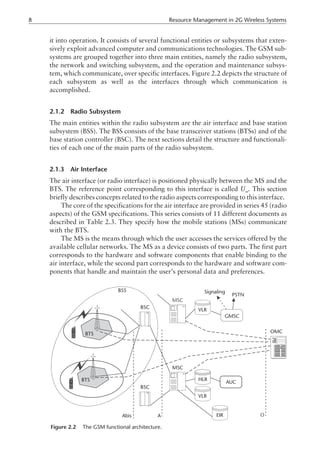
![The radio subsystem provides a certain number of logical channels that can be
separated into two categories, the traffic channels (TCHs) and the control channels.
The structure of these channels is defined in [6].
Traffic channels carry two types of user information streams: encoded speech
and data. The following types of traffic channels are defined: Bm
or full-rate
(TCH/F), Lm
or half-rate (TCH/H), and the cell broadcast channel (CBCH). The
gross rate for TCH/F is 22.8 Kbps while the gross rate for the TCH/H is 11.4 Kbps.
These types of channels can appear in various forms depending on the applications’
requirements or the infrastructure’s constraints. For example the full-rate data TCH
can appear in forms that can accommodate traffic from 4.8 Kbps up to 43.2 Kbps
and is distinguished when mentioned using different lettering (e.g., TCH/F4.8 and
TCH/F9.6). The set of traffic channels that are defined for speech and for data
according to Release 4 of the GSM specifications are given in Table 2.4. Packet data
traffic channels are not listed since they are out of the scope of this chapter.
Control channels are intended to carry signaling or synchronization data. Con-
trol channels are subdivided into broadcast control channel (BCCH), common con-
trol channel (CCCH), stand-alone dedicated control channel (SDCCH), and
associated control channel (ACCH). An ACCH is always allocated in conjunction
with either a TCH or an SDCCH. Two types of ACCHs for circuit-switched
2.1 Architecture of 2G Systems 9
Table 2.3 Contents of the 45 Series Specifications Defining the GSM Air Interface
45.001 “Physical Layer on the Radio Path (General Description)”
45.002 “Multiplexing and Multiple Access on the Radio Path”
45.003 “Channel Coding”
45.004 “Modulation”
45.005 “Radio Transmission and Reception”
45.008 “Radio Subsystem Link Control”
45.009 “Link Adaptation”
45.010 “Radio Subsystem Synchronization”
45.022 “Radio Link Management in Hierarchical Networks”
45.050 “Background for RF Requirements”
45.056 “CTS-FP Radio Subsystem”
Table 2.4 Traffic Channels as Defined in Release 4 of GSM Technical Specification
Traffic Channel Name Codeword Used
Full-rate traffic channel for speech TCH/FS
Half-rate traffic channel for speech TCH/HS
Enhanced full-rate traffic channel for speech TCH/EFS
Adaptive full rate traffic channel for speech TCH/AFS
Adaptive half-rate traffic channel for speech TCH/AHS
Full-rate traffic channel for 9.6-Kbps user data TCH/F9.6
Full-rate traffic channel for 4.8-Kbps user data TCH/F4.8
Half-rate traffic channel for 4.8-Kbps user data TCH/H4.8
Half-rate traffic channel for 2.4-Kbps user data TCH/H2.4
Full-rate traffic channel for 2,4-Kbps user data TCH/F2.4
Full-rate traffic channel for 14.4-Kbps user data (TCH/F14.4); TCH/F14.4
Enhanced circuit-switched full-rate traffic channel for 28.8-Kbps user data E-TCH/F28.8
Enhanced circuit-switched full-rate traffic channel for 32.0-Kbps user data E-TCH/F32.0
Enhanced circuit-switched full-rate traffic channel for 43.2-Kbps user data E-TCH/F43.2
Cell broadcast channel CBCH](https://image.slidesharecdn.com/2215338-250610053330-29f2c24d/85/Practical-Radio-Resource-Management-In-Wireless-Systems-Sofoklis-A-Kyriazakos-25-320.jpg)
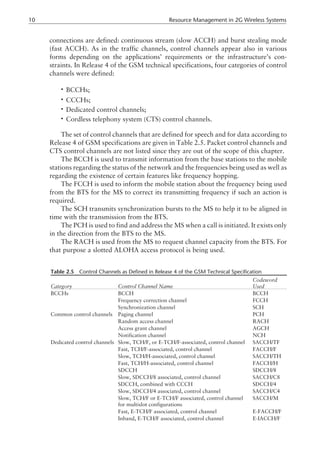
![The AGCH is used to respond to an incoming request over the RACH with the
allocation of an SDCCH or a TCH.
The SDCCH is used for the transmission of control information like registration
and location update. It is a two-way channel between the MS and the BTS and is
always used when a traffic channel has not been assigned.
The SACCH is always allocated in parallel with an SDCCH or a TCH and is
used for the transfer of parameters that help to assess the communication quality.
Finally, the FACCH is used when a TCH is existent and is usually used when a
handover process is going to happen to ensure a transition that is as smooth as
possible.
Logical channels are mapped into physical channels as also defined in [6]. The
available radio spectrum is partitioned in both frequency and time. Frequency is
partitioned into 200-KHz bandwidth channels, and each one of them is further
divided into eight physical TDM channels, which consist of eight timeslots of a
0.577-ms duration. Eight timeslots form a TDMA frame with a duration of 4.62
ms, which corresponds to the basic multiplexing structure in GSM. Thus a physical
channel is characterized by both its carrier frequency and the timeslot available to it,
which appears every 4.62 ms. Over the time -slots data is transmitted in the form of
bursts that have a length of 148 bits. If a message is longer than 148 bits it has to be
split up into several bursts before transmission.
For each logical channel a specific coding and interleaving scheme has been
defined for achieving maximum efficiency. Thus different channel coding methods
are applied on the various channels for the different services. However, special
attention was paid to the coding and interleaving procedures to organize them in
such a way to allow a homogeneous decoder structure.
The following sequence of actions takes place for each channel before
transmission:
• The bits of information are coded with a systematic block code resulting in
words of information plus parity bits;
• This information plus parity bits are encoded with a convolutional code
resulting in the coded bits;
• The coded bits are reordered and interleaved, and with the addition of a steal-
ing flag we acquire the interleaved bits.
These actions are always performed over a block of bits, which is different from
channel to channel and has a minimum value of 36 coded bits and a maximum value
of 456 coded bits, which is the most common size used for a block.
The modulation format that is used by the standard GSM systems is a digital
Gaussian minimum-shift keying (GMSK). EDGE systems are using the phase shift
keying (8PSK) modulation to achieve higher data rates [7].
Frequency bands and channel arrangement, transmitter and receiver character-
istics, as well as transmitter and receiver performance are described in detail in [8].
Other details regarding the radio link such us power control, adaptation and syn-
chronization are provided in [9–11]. Their study is out of the scope of this book, and
the same applies for the speech coding techniques. However, readers who would
2.1 Architecture of 2G Systems 11](https://image.slidesharecdn.com/2215338-250610053330-29f2c24d/85/Practical-Radio-Resource-Management-In-Wireless-Systems-Sofoklis-A-Kyriazakos-27-320.jpg)
![like to learn more about these issues can visit the 3GPP Web site and the associated
ftp server where they can download all the latest documentation.
The remainder of this section focuses on the signaling related to the radio inter-
face that is required for the realization of the MS-BSS communication. The MS-BSS
interface from the signaling point of view is specified in the 44-series of the 3GPP
technical specifications.
For the accomplishment of signaling functions on the MS-BSS interface three
layers are required as depicted in Figure 2.3 according to the OSI model as it is given
in ITU-T recommendation X.200 [12].
The physical layer is the lowest layer, and its role is to support the transfer of bit
streams over the radio medium. It includes error detection and correction functions
as well as encryption to support an error-free and secure transmission. The specific
services that this layer offers to the MS are: (1) establishment of dedicated physical
channels, (2) establishment of packet data physical channels, and (3) cell/PLMN
selection in idle mode or in packet mode. The functions and protocols of the physical
layer are defined in a technical specification [13].
The data link layer defines the frame structure and the procedures for peer-to-
peer communication. The functions and protocols of the data link layer are defined
in technical specifications [14, 15].
Layer 3 is responsible for a number of very important functions that make
mobile telephony a reality. Particularly this layer is responsible mainly for support-
ing RRM, for mobility management (MM), and for the connection management
(CM) functions. The functions and protocols of layer 3 of GSM are defined in tech-
nical specifications [16, 17].
2.1.4 BSS
As we have already mentioned, the BSS is comprised of the BTS and the BSC. The
BSS incorporates all the radio-related capabilities and characteristics that were
described in the previous section. The mobile stations communicate with the rest of
the GSM network through the BTS part of the BSS via the air interface. The two
main elements of the BSS communicate with each other over the standardized Abis
interface.
The main parts of the BTS are the transmitting and receiving equipment and the
facilities that handle the signaling over the air interface. Other important elements
that are contained in the BTS are the TRAU, speech coding and decoding compo-
nents, as well as rate adaptation mechanisms for data transmission. Depending on
the type of the antenna used a BTS may support one or several cells.
The BSC is responsible for the management of the radio resources for one or
more BTSs. It handles the reservation and release of radio channels and manages
12 Resource Management in 2G Wireless Systems
Layer 3
Data link layer
Physical layer
Figure 2.3 Layering on the MS-BSS interface.](https://image.slidesharecdn.com/2215338-250610053330-29f2c24d/85/Practical-Radio-Resource-Management-In-Wireless-Systems-Sofoklis-A-Kyriazakos-28-320.jpg)
![handovers. The BSS is connected to the GSM fixed network over the so-called
A-interface, which connects the BSC with the mobile switching center (MSC).
2.1.5 Network and Switching Subsystem
All the network-related functions and the packet switching are carried out by the
network and switching subsystem (NSS), which forms the gateway between the
radio network and the associated fixed network [e.g., public switched telephone
network (PSTN) and ISDN]. The main components of the NSS are the MSC, the
home location register (HLR) and the visitor location register (VLR).
The MSC is responsible for handling the connection to and from the fixed net-
works. It operates like a normal switching node of the associated PSTN or ISDN
network, and it is responsible for all the signaling required for setting up, maintain-
ing, and terminating connections, in accordance with common channel signaling
system no. 7 (SS7). Each MSC is usually allocated several BSCs and provides all the
functionality needed to handle a mobile subscriber, such as registration, authentica-
tion, location updating, handover management, and call routing to a roaming sub-
scriber. Other tasks of the MSC include the well-known ISDN supplementary
services like call forwarding, call baring, conference calling, and call charging to the
user called.
The HLR contains all the administrative information such as telephone
number, MS identification number, equipment type, subscription basis and supple-
mentary services, access priorities, and authentication code for each subscriber reg-
istered in the corresponding GSM network. All this data is referred to as
quasi-permanent static data. The current location of the MS and the mobile station
roaming number (MSRN), which is also necessary for setting up a connection, is
called temporary subscriber data and is also stored in the HLR. This information is
immediately updated whenever the mobile subscriber changes location area (LA).
Each mobile subscriber’s data is registered in only one HLR where billing and other
administrative tasks are performed. There is usually one HLR per GSM network,
although it is often implemented as a distributed database.
The role of the VLR is to manage the subscribers who are currently roaming,
and it thus contains selected administrative information from the HLR, necessary
for call control and provision of the subscribed services, for each mobile currently
located in the geographical area controlled by the VLR. A VLR is always under the
control of an MSC, and that is why many times they are manufactured as a single
functional entity. If the mobile user traverses several of the MSC’s location areas,
the VLR data that is related to this subscriber should be updated and the same hap-
pens in the event of an MSC change.
2.1.6 The Operation Subsystem
All the operation and maintenance functions are performed by the operation sub-
system, which consists of three main elements: (1) the operation and maintenance
center (OMC), (2) the authentication center, and (3) the equipment identity register.
The OMC monitors and controls the rest of the network elements over the stan-
dardized O-interface and guarantees the best possible service quality for the user.
2.1 Architecture of 2G Systems 13](https://image.slidesharecdn.com/2215338-250610053330-29f2c24d/85/Practical-Radio-Resource-Management-In-Wireless-Systems-Sofoklis-A-Kyriazakos-29-320.jpg)
![The management functions of the OMC include administration of subscribers and
equipment, generation and processing of statistical data, billing, and alert handling
whenever unexpected events occur.
In the operation subsystem (OSS) there are also two databases that are used for
authentication and security purposes: the equipment identity register (EIR) and the
authentication center (AuC). The EIR is a database that contains a list of all valid
mobile equipment on the network, where each MS is identified by its international
mobile equipment identity (IMEI). An IMEI is marked as invalid if it has been
reported stolen or is not type-approved. The AuC is a protected database that stores
a copy of the secret key stored in each subscriber’s SIM card, which is used for
authentication and encryption over the radio channel.
The functions of the OSS are subdivided into three areas, listed as follows:
1. Subscription management;
2. Mobile equipment management;
3. Network operation and maintenance.
Subscription management is responsible for authenticating the mobile subscrib-
ers from the data that are stored in the HLR and for service billing. The billing loca-
tion can be the MSC in which the mobile user is currently active or a gateway MSC
(GMSC). The GMSC is the interface between the cellular network and the PSTN.
The PSTN sends all calls to the GMSC, which finds the right MSC, which connects
to the mobile.
Mobile equipment management is responsible for storing and handling informa-
tion regarding the owner of mobile equipment together with its associated identity.
Network operation and maintenance concerns the control of the network ele-
ments based on the TMN management concepts as they have been developed by the
ITU-T. The TMN functions are divided into four categories: (1) business manage-
ment, (2) service management, (3) network management, and (4) network element
management.
2.1.7 Interfaces of the GSM System
Except for the radio interface, which was explained in detail in the previous sections,
the following important interfaces exist in the GSM systems:
• The BTS-BSC interface at reference point Abis,
which is at the physical layer a
PCM link at 2,048 Kbps with a frame structure of 32 × 64-Kbps time slots.
The Abis
interface has two types of communication channels: traffic channels at
8, 16, or 64 Kbps carrying speech or data of one radio traffic channel (full-rate
or half-rate), signaling channels at 16, 32, or 64 Kbps, carrying signaling infor-
mation 3GPP TS 48.051 [18] and 3GPP TS 48.052 [19].
• The BSS-MSC interface at reference point A, which at the physical layer con-
sists of one or more PCM links at 2,048 Kbps based on CCITT Rec. G703
3GPP TS 48.001 [20] and 3GPP TS 48.002 [21].
• The BSC/MSC-OMC interface at reference point O, which is based on recom-
mendation X.25 of ITU-T [22].
14 Resource Management in 2G Wireless Systems](https://image.slidesharecdn.com/2215338-250610053330-29f2c24d/85/Practical-Radio-Resource-Management-In-Wireless-Systems-Sofoklis-A-Kyriazakos-30-320.jpg)
![2.2 Network Performance Evaluation of 2G Systems
This section presents an in-depth performance evaluation study performed in the
network of a cellular operator. This study is important since it highlights the conges-
tion problems on the air interface of 2G wireless systems. For that purpose we
briefly present the reporting mechanism in GSM, since the performance evaluation
is based on this kind of measurement. Subsequently, network behavior in normal
situations is presented, and finally, traffic overload scenarios are discussed. At this
point it has to be mentioned that the information and diagrams presented in the fol-
lowing sections are not selected randomly, but from BSC areas that suffer the most
from traffic congestion. However, they clearly describe the behavior of a GSM sys-
tem, in terms of performance degradation independently from the cellular operator.
2.2.1 Cellular Network Reporting
The performance of cellular networks is the most important issue for the operators,
from a technical point of view. Their main goal is to keep the subscribers satisfied with
the QoS they provide. To achieve the best performance, they have to monitor and opti-
mize their network continuously. A NMS with an on-line database is responsible for
the collection of every report generated in the network, in a raw data form. For greater
effectiveness, operators install systems that do more than collect and store (e.g., they
organize data in event counters and generate Web reports). In Section 2.2.1.1 such a
data warehouse system, which has been studied for its historical data, is presented.
2.2.1.1 DW
The DW is deployed to assist the optimization the performance of telecommunica-
tion networks. It collects, stores, manages, and presents data on a long-term basis.
The DW is a combined data collection and data handling system comprised of sev-
eral individual servers. DW servers are responsible for data collection and storage,
preprocessing tasks, report generation, data analysis, and report publishing via the
operator’s intranet. The cellular operator can utilize the DW to automatically gener-
ate Web page–based reports that are created from scratch and reports requested
according to given parameters [23].
The DW stores data for longer periods of time as opposed to the NMS on-line
database. For that reason part of DW is located on a separate database server that
allows storing performance measurements, alarms, and radio planning network
parameters for a long period of time. It can store this data for several years. Raw
performance measurement (PM) data, alarm/fault management (FM) data, and
radio network parameter (RNW) data is extracted from the operational NMS data-
base and stored periodically in the DW. Data is processed according to the different
types. Figure 2.4 shows the procedure of collecting and processing data in DW.
2.2.1.2 Optimizing NMS with DW
The load on the network management system depends on the size of the network
and the frequency and effectiveness of measurements. By keeping daily on-line
2.2 Network Performance Evaluation of 2G Systems 15](https://image.slidesharecdn.com/2215338-250610053330-29f2c24d/85/Practical-Radio-Resource-Management-In-Wireless-Systems-Sofoklis-A-Kyriazakos-31-320.jpg)
![processing separated from the off-line analysis of long-term data, DW ensures an
improved overall performance of the NMS. Summarizing raw PM data in DW, leads
to the reduction of the load of the NMS, as well as to storing measurement data for
substantially longer periods of time. Stored data can be used in DW to help forecast-
ing of future events and trends concerning the traffic in the network. In the DW, FM,
PM, and RNW data is reorganized and combined together in such a way to be easier
to generate trend data reports that are as useful as possible.
Long-term data in DW can be extracted and processed with NMS post-
processing tools designed for PC environments. These tools enable the presentation
of long-term data in various reports, which show trends in the functioning of the
network, the behavior of end users, as well as relations between the performance
measurements data, alarm data, and radio network parameter data.
2.2.2 Statistical Evaluation in GSM
This section of the document deals with the presentation of the measurements per-
formed in a cellular network. The most reliable and representative performance
indicators have been chosen throughout the analysis of operational data. To identify
a congestion situation, this section refers to patterns of a normal day, while the fol-
lowing section refers to congestion situations. The performance indicators presented
are traffic, call set up success rate (CSSR), handover success rate (HOSR), SDCCH
blocking rate (BR), and TCH BR [23–25].
Traffic is chosen to estimate the demand for services and channels in actual
numbers. CSSR and HOSR are chosen to appreciate the impact of congestion in the
two most important procedures during a call attempt, regarding the QoS offered to
the subscribers. Finally, SDCCH and TCH BRs are chosen to analyze how logical
channels are affected when congestion appears, since the representative channels are
the most affected in a congestion situation.
16 Resource Management in 2G Wireless Systems
On-line database
Topology DB
NMS PM DB
NMS FM DB
RNW DB
Data
warehouse
Postprocessing
analysis tools
Template
Network
analysis
report
Figure 2.4 Collecting and processing data in DW.](https://image.slidesharecdn.com/2215338-250610053330-29f2c24d/85/Practical-Radio-Resource-Management-In-Wireless-Systems-Sofoklis-A-Kyriazakos-32-320.jpg)
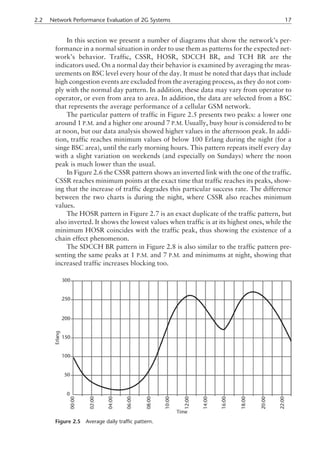
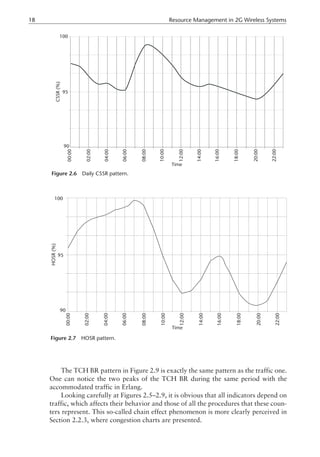
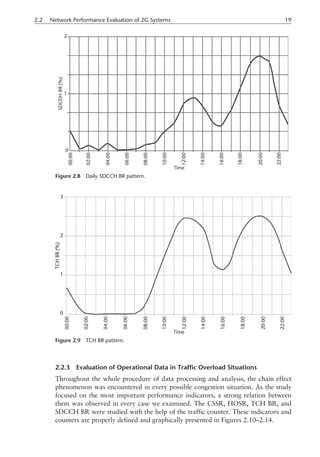
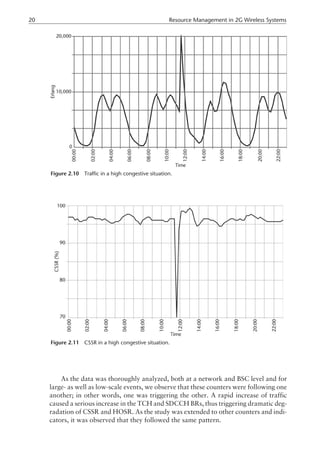
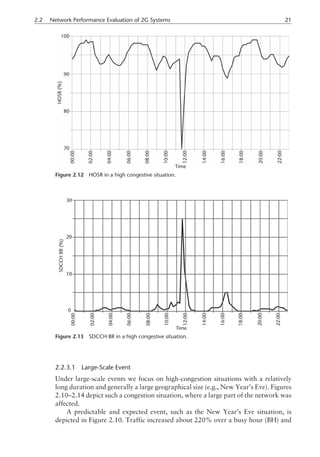
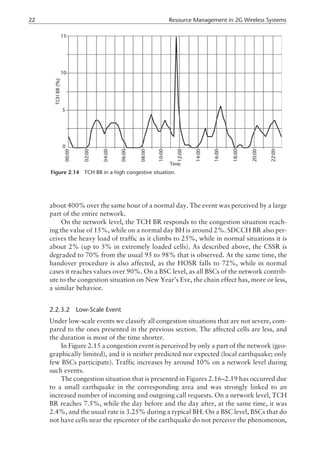
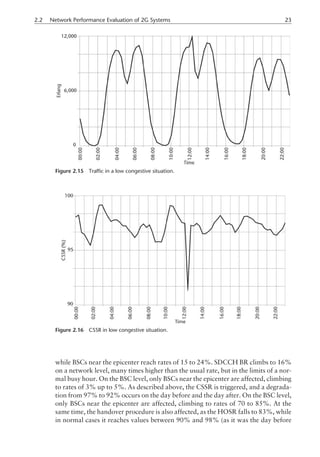
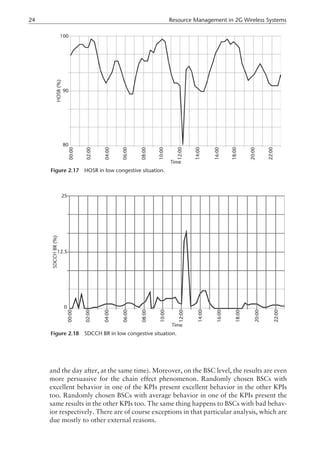
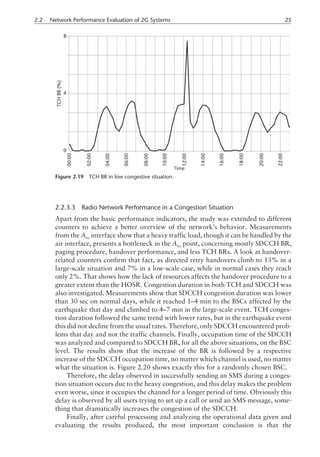
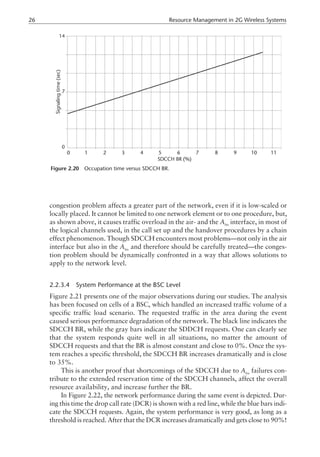
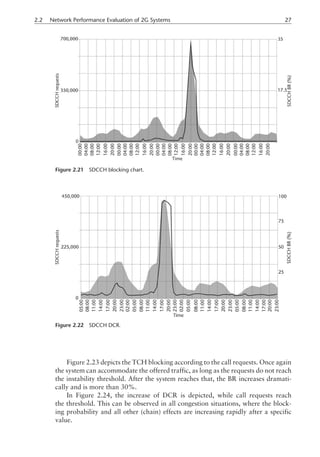
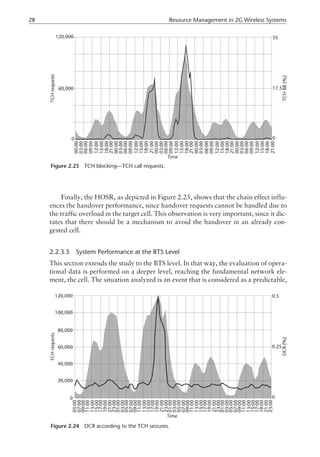
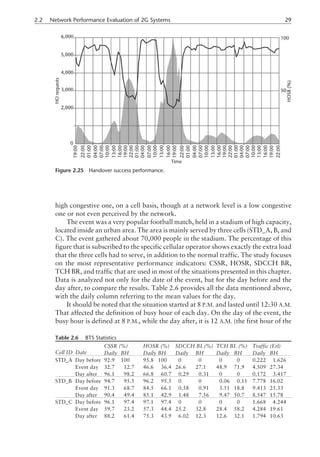
![day, which coincided with the time that the spectators left the stadium). It also
affected all the daily values for the next day of the event, by significantly increasing
them. The day before the event is not affected, so it sets the normal values with
which the congestive ones should be compared.
The cell STD_A covers mostly the area of the stadium itself, as understood by
the values of the indicators: Actual traffic is present only at event hours; CSSR
degrades to 32% that day and nearly disappears (12%) at the event’s peak (busy
hour of the event day). BR and HOSR present the same behavior. After the event, all
indicators return to normal values, except the HOSR, thus making it clear that the
crowd is moving to neighboring cells (actually leaving the stadium) and that STD_A
covers mostly the stadium itself.
The cell STD_B mostly covers neighboring areas to the stadium, as increased
blocking and call failures were observed when the crowd moved from the stadium
(measured in the day after values). The highest values of blocking and failures
appear the day after the event, thus making it obvious that STD_B covers areas out-
side the stadium mostly. Even in that case, the situation is clearly better than the one
encountered in STD_A.
Finally, cell STD_C is between the two situations described above. It covers part
of the stadium area and part of the areas around it. In that way, it presents values
below average not only on the day of the event (especially during the busy hour, val-
ues reach the lowest points), but also in the day after the event (where HOSR reaches
its lowest level).
It is very interesting to estimate what is the loss for the operator, during such
congestion situations, apart from the decreased user satisfaction. Estimating the
extra traffic produced by the event in Erlang, an amount of around 250 additional
Erlang is requested only in the busy hour of the event. Supposing that the event
lasted at least four hours (but traffic was lower for the nonbusy hours), at least 600
additional Erlang were requested during the event (optimistic estimation). The
measurements show that the three cells served about 200 Erlang at the most (also an
optimistic estimation). The result is that 400 Erlang were not served and thus were
lost for the operator. The traffic that could not be accommodated is easily translated
into profit loss, taking into account the cost of a call minute. It is obvious that cellu-
lar operators lose a huge amount of profit during such sport events due to the not-
served calls, still not considering user satisfaction, which is difficult to estimate but
can lead to various problems for the operator. Later in the book user satisfaction
will be considered in proposed business models for cellular operators.
2.2.3.6 Handover Performance
Handover can be caused by many different reasons. Each mobile terminal attempts
to use the radio channel that will provide the best connection quality [i.e., the best
carrier-to-interference ratio (C/I)]. Cochannel interference is a factor that cannot be
avoided because of multiple use of the same time and frequency channels due to
existing cell layouts, and consequently quality can be low (i.e., a high bit-error ratio)
despite a high signal level. A usual cause of interference to other mobile stations may
be the connection of a mobile terminal to the base stations, even if it is a high-quality
one. The interference can be minimized if the interfered station changes to a different
30 Resource Management in 2G Wireless Systems](https://image.slidesharecdn.com/2215338-250610053330-29f2c24d/85/Practical-Radio-Resource-Management-In-Wireless-Systems-Sofoklis-A-Kyriazakos-46-320.jpg)
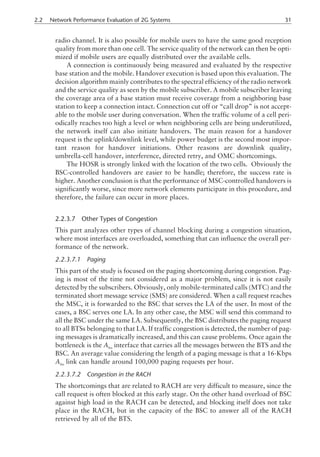
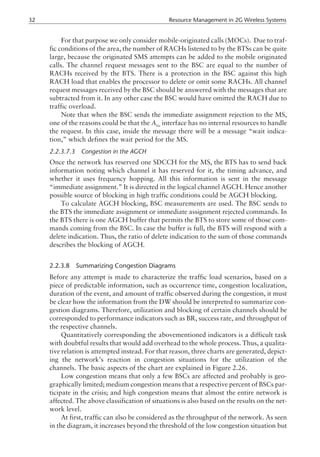
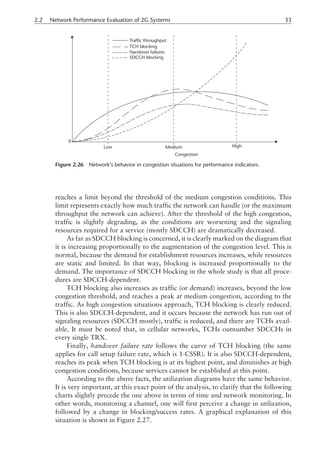
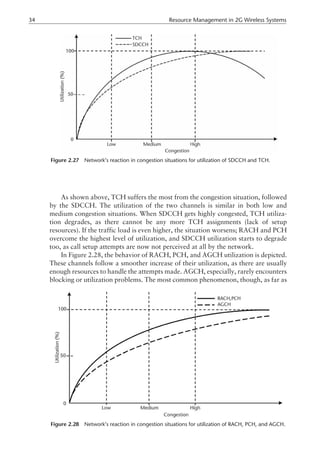
![RACH and PCH are concerned, is that problems are encountered in the Abis
inter-
face (air interface resources are usually adequate to handle most situations) [26],
causing congestion situations. Usually, all three channels (PCH, RACH, AGCH)
remain at medium or low congestion levels.
Combining the information from the three aforementioned charts, it is feasible
to relate utilization and BR, reported by the monitoring tools, to congestion and,
therefore, to characterize the scenarios. Utilization is the key indicator that will
characterize a congestive scenario, as it is more representative of what is really hap-
pening and more independent from the situation itself than blocking. On the other
side, blocking will provide additional information and, thus, extra help in the char-
acterization of the scenario. BR depends on certain network parameters, such as
radio coverage of the selected area, overlapping of the cells, and the use of directed
retry [27, 28]. This “drawback” can be used in favor of the method, as it will offer
extra characteristics to the situation. For instance, in a congestion situation where
utilization reaches high values, it is very possible for blocking to remain at a low
level because of good cell overlapping and proper use of the directed retry feature.
Another possibility is that, while utilization decreases to very low values giving the
impression that everything works fine, BR reaches very high values, raising in that
way the alarm that channels are not used because of congestion. The use of utiliza-
tion in combination with channel blocking will be obvious in the construction of the
characterization rule for each scenario.
A further significant point of this analysis is that most of the events are scaling
events, meaning that the increase will pass through all the congestion levels, on the
road to the highest peak, and that must be taken into consideration on the selection
of the appropriate scenario.
2.3 Traffic Modeling
Traffic engineering and modeling in communication networks is very important
since it allows us to better understand the network’s behavior under various condi-
tions and thus to better organize its operational deployment and usage—or in other
words to match the demand for traffic with what the network offers. A the same
time traffic engineering and modeling in mobile communication networks apart
from being important it is also a very complex and difficult procedure because of the
nature of wireless communications. Thus it does not come as a surprise that ITU-T
has developed a complete set of recommendations—the so-called E.750 series—to
tackle this issue [29, 30].
Traffic engineering in mobile networks is important, as has been shown in the
previous sections of this chapter, both for traffic channels and signaling channels
and has distinct differences from the methods corresponding to fixed networks. In
particular in mobile networks we have the following facts:
• Bandwidth is limited and the probability for the occurrence of transmission
errors is rather high.
• A small number of active users can absorb most of the traffic capacity avail-
able in a cell.
2.3 Traffic Modeling 35](https://image.slidesharecdn.com/2215338-250610053330-29f2c24d/85/Practical-Radio-Resource-Management-In-Wireless-Systems-Sofoklis-A-Kyriazakos-51-320.jpg)
![• The main “bottleneck” is the radio interface at the edge of network (i.e., the
availability of physical channels).
User mobility in particular affects signaling traffic, and for that reason models
that predict the handover rate are required, usually called mobility models, to accu-
rately dimension the signaling traffic that is generated from this process. Accurate
mobility modeling is one of the big challenges in mobile networks. A big number of
mobility models has been devised by the research community; a categorization of
these is given in [31, 32].
According to recommendation E.751 of ITU-T [33] there exist two interfaces at
which traffic demand has to be modeled to achieve more efficient traffic dimension-
ing and control. The first one corresponds to the radio interface while the other one
is related with the modeling of the traffic that originates from the mobiles and is sub-
sequently inserted in the fixed network.
The main input that we have to estimate the traffic demand is the size of the
population that is going to be served by the cellular network, together with the
year-on-year user penetration forecast and the average traffic intensity per sub-
scriber. To be more accurate we have to partition the users into specific geographic
areas, since other demands and behavior have the people in rural areas and other in
urban ones. In recommendation E.760 of ITU-T [34] specific methodologies for esti-
mating traffic demand in mobile cellular networks in general and in relation to the
radio interface are introduced.
2.3.1 Modeling Approach
To effectively model traffic in mobile cellular networks the usual procedure is to
develop three different models: a topology model, a call model, and a mobility
model [32].
The topology model describes the geographical area in which the cellular net-
work is deployed and consists of cells and the associated base stations and a dynamic
set of mobile hosts.
The call model is responsible for describing the calling behavior of the mobile
user with a set of representative parameters and their associated distributions. Such
parameters include call duration and call initiation interarrival time in a specific cell.
The call model may include also transmission and reception of short messages as
well as other types of service usage like WAP and GPRS. In general, calls are gener-
ated according to a Poisson process, which is automatically satisfied when the user
population is large enough and when users place their calls independently.
Finally the mobility model describes the effects of a mobile user’s movement on
traffic and signaling channels. The basic procedures that are included in the mobility
model are location update and handover.
Apart from the models accurate reference loads are important to acquire a cor-
rect insight into the network’s behavior. Reference loads can be extracted either from
measurements of operational cellular networks, or they can be formulated using ana-
lytical methods. One important difference in mobile networks in relation to the fixed
ones is that a big portion of signaling traffic is independent of call attempts and con-
nection establishments (e.g., due to periodical location updates) [35].
36 Resource Management in 2G Wireless Systems](https://image.slidesharecdn.com/2215338-250610053330-29f2c24d/85/Practical-Radio-Resource-Management-In-Wireless-Systems-Sofoklis-A-Kyriazakos-52-320.jpg)
![2.4 Traffic-Load Scenarios
Section 2.2 presented the analysis of DW data from a cellular operator, focusing on
the behavior of the network during congestion situations. The conclusion of the
studies is that logical channel utilizations combined with BRs can characterize in a
unique way each traffic-load scenario. In the following sections a number of traffic-
load scenarios are presented and characterized, based on the outcome of the statisti-
cal evaluation [36].
2.4.1 Busy Hours
In telecommunication systems a BH is defined, as the sliding 60-minute period dur-
ing which the maximum total traffic load in a given 24-hour period occurs. Since
BH is a periodical situation, the time occurrence, traffic overload, and location of
the event are predictable with a good confidence degree. In particular, the parame-
ters presented in the following paragraphs are estimated based on the statistical
analysis of the observed events.
The cellular operator can either define the BH of the day for the whole network,
averaging all available data, or even define a BH for each MSC or BSC area. The
starting time of the congestion event, as well as its duration, are statistically predict-
able. Depending on the area and time of the year, three different BHs can be defined.
First, in a metropolitan area, during winter, BH occurs around the 12- to 1-P.M.
time window. In the rest of the country, during winter, BH occurs in the 8- to 9-P.M.
time window. Finally, during summer, BH occurs in the 8- to 9-P.M. time window
almost everywhere. It should be mentioned that there are deviations from these peri-
ods that are related with the mentality and behavior of the subscribers from differ-
ent countries.
The channels subject to congestion are mainly the TCH and the SDCCH. TCH
utilization can overcome 80% during the BH, while SDCCH utilization reaches val-
ues up to 70%. The channel that first gets congested is the TCH, while SDCCH fol-
lows. It should be noted that in certain cells of a metropolitan area, utilization can
reach 100%. As far as the other channels are concerned, PCH, RACH, and AGCH
remain in the low congestion utilization range. BRs in this scenario are 1 to 10% for
the TCH and 1 to 5% for other channels. Of course, as mentioned before, blocking
depends highly on the area, radio coverage, and other network parameters, and
these values are averaged estimations to help the identification process.
The cells taking part in the BH events are also predictable. A list of such cells can
be provided, depending on the specific geographic area involved in the BHs. As
mentioned above, the cells mostly affected are the ones serving urban areas, espe-
cially if they are highly populated. This fact means that only a few cells in the entire
network encounter high congestion on BHs.
2.4.2 Holiday Resorts
We consider holiday resorts the places where a considerable number of people
spend their holidays (e.g., the seaside, islands, mountains, and lakes). Even if the
number of tourists in a given location can vary over the years in a rather
2.4 Traffic-Load Scenarios 37](https://image.slidesharecdn.com/2215338-250610053330-29f2c24d/85/Practical-Radio-Resource-Management-In-Wireless-Systems-Sofoklis-A-Kyriazakos-53-320.jpg)