Public Relations with Local
  Government Units
         By Ana Maria B. Raymundo
         Presented by David Daniel P. Pagulayan


April 1-5, 2013
Albergo Hotel,
Baguio City
Local Government Units are our
         external stakeholders.

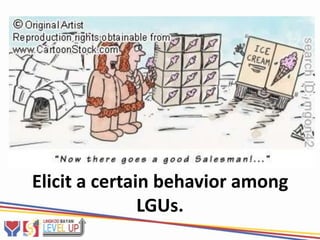
Stakeholder (noun)
   -a person with an interest or concern in
   something, esp. a business.
   -[ as modifier ] denoting a type of organization
   or system in which all the members or
   participants are seen as having an interest in
   its success: a stakeholder economy.
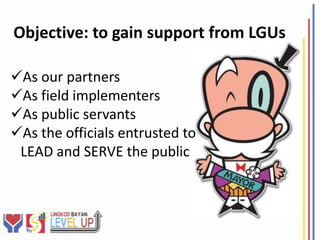
Objective: to gain support from LGUs

As our partners
As field implementers
As public servants
As the officials entrusted to
 LEAD and SERVE the public
PUBLIC RELATIONS as a strategy

Public Relations is a management function
designed to create and maintain good and
harmonious relationship between the
organization and its public.
DELIVERING THE
   MESSAGE:
  Pitching the
  Sustainable
   Livelihood
Program to LGUs
TRUTH:
   LGUs have their own set of
priorities and your program will
not always necessarily be one of
              them.
CHALLENGE:
To convince them that the DSWD
     shares a common goal of
 reducing poverty among their
    constituents and we do so
      through the Sustainable
        Livelihood Program
GOAL:
    To make the Sustainable
Livelihood Program one of their
         main priorities
PERCEPTION
         ATTITUDE
         BEHAVIOR


Elicit a certain behavior among
               LGUs.
PERCEPTION. ATTITUDE.
            BEHAVIOR.
Perception (noun)
• a way of regarding, understanding, or
  interpreting something; a mental impression
• intuitive understanding and insight
PERCEPTION. ATTITUDE.
            BEHAVIOR.
Attitude (noun)
• a settled way of thinking or feeling about
  someone or something, typically one that is
  reflected in a person's behavior
PERCEPTION. ATTITUDE.
            BEHAVIOR.
Behavior (noun)
• the way in which one acts or conducts
  oneself, esp. toward others
• the way in which an animal or person acts
  in response to a particular situation or
  stimulus
OUR VISION
• Poverty reduction with institutional support
  from the LGUs

               OUR PROMISE
• Uplift the standard of living and improve the
  quality of lives of their constituents
Focus on your goal.
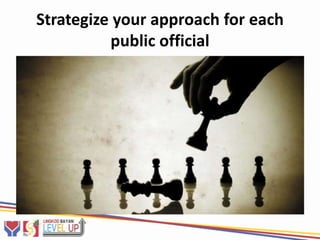
Strategize your approach for each
          public official
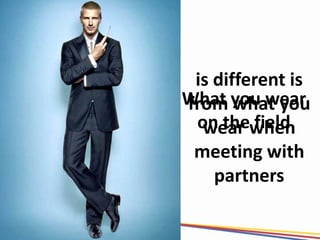
You are a reflection of the
institution you represent.
   Dress appropriately.
      Act accordingly.
is different is
What you wear
from what you
 on thewhen
  wear field
 meeting with
    partners
Prepare.
Master your program.
Know your partners.
LGUs as partners
– the LGU’s thrust and priorities
– image of the LGU
– existing communication efforts
– personal background of the LGU heads and staff
– the existing advocacies
Focus on the VALUE ADDED by
        the program.
Your promise is your argument.
Emphasize the importance of
their role and responsibility to
       their constituents.
Communicate
    the
  message
Go back to
 basics.
Be Direct.
Take an
experiential
 approach.
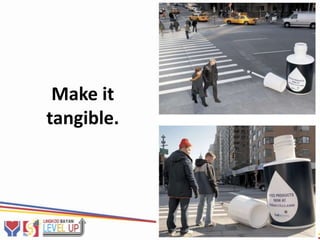
Make it
tangible.
Be Visual.
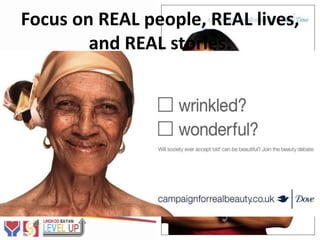
Focus on REAL people, REAL lives,
        and REAL stories.

  Humanize
the program.
Be HONEST.
We do not allow
the beneficiaries has a set of
      The DSWD
 to be used for
        NON-NEGOTIABLES
   POLITICAL institution.
         as an
 PROPAGANDA.
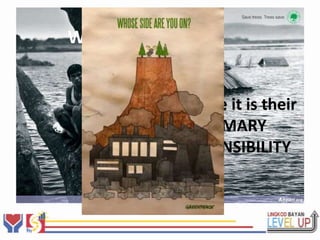
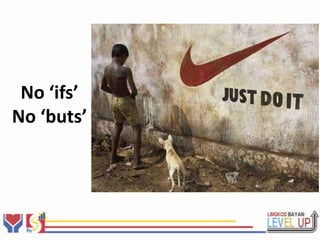
Why help?


            Because it is their
                PRIMARY
             RESPONSIBILITY
No ‘ifs’
No ‘buts’
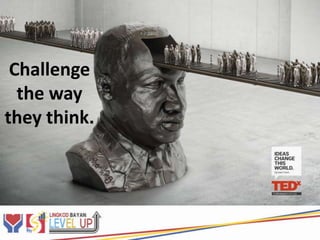
Challenge
  the way
they think.
Advertisements as a tool for public
            relations
Say more, talk less.
Try the elevator test.
In order to achieve a win-win situation, link your
 argument to the local official’s institutional
 objectives.
Ultimately, you do not have control
 over the local official’s decisions.
You can influence them or at least challenge the
 way they think.
Just do it: Present everything as best as you can.
Take note of the criticism and issues that emerge.
Always be PROACTIVE, not reactive
Sources:
Advertisements cited:        Cartoons cited:
Fedex                        Tom Fishburne cartoons
Adidas Muhammad Ali          cartoonstock.com
Nike Manny Pacquiao
Dubai Film Festival
Speedo Michael Phleps
Motorola David Beckham
Condomshop.ch
Peta Angela Simmons
Belo Jinkee Pacquiao
Levi’s
Fresh Life
Nicotinell
Australia Post
Bergmann funeral service
Fedex kinkos office supplies
Peta David Cross
WFF
Dove Real Women
Heinz
DSWD Bawal and Epal dito
Anvari
Greenpeace
Nike Just Do It
TedX
Nike

Pr for lg us 032813

  • 1.
    Public Relations withLocal Government Units By Ana Maria B. Raymundo Presented by David Daniel P. Pagulayan April 1-5, 2013 Albergo Hotel, Baguio City
  • 2.
    Local Government Unitsare our external stakeholders. Stakeholder (noun) -a person with an interest or concern in something, esp. a business. -[ as modifier ] denoting a type of organization or system in which all the members or participants are seen as having an interest in its success: a stakeholder economy.
  • 3.
    Objective: to gainsupport from LGUs As our partners As field implementers As public servants As the officials entrusted to LEAD and SERVE the public
  • 4.
    PUBLIC RELATIONS asa strategy Public Relations is a management function designed to create and maintain good and harmonious relationship between the organization and its public.
  • 5.
    DELIVERING THE MESSAGE: Pitching the Sustainable Livelihood Program to LGUs
  • 6.
    TRUTH: LGUs have their own set of priorities and your program will not always necessarily be one of them.
  • 7.
    CHALLENGE: To convince themthat the DSWD shares a common goal of reducing poverty among their constituents and we do so through the Sustainable Livelihood Program
  • 8.
    GOAL: To make the Sustainable Livelihood Program one of their main priorities
  • 9.
    PERCEPTION ATTITUDE BEHAVIOR Elicit a certain behavior among LGUs.
  • 10.
    PERCEPTION. ATTITUDE. BEHAVIOR. Perception (noun) • a way of regarding, understanding, or interpreting something; a mental impression • intuitive understanding and insight
  • 11.
    PERCEPTION. ATTITUDE. BEHAVIOR. Attitude (noun) • a settled way of thinking or feeling about someone or something, typically one that is reflected in a person's behavior
  • 12.
    PERCEPTION. ATTITUDE. BEHAVIOR. Behavior (noun) • the way in which one acts or conducts oneself, esp. toward others • the way in which an animal or person acts in response to a particular situation or stimulus
  • 13.
    OUR VISION • Povertyreduction with institutional support from the LGUs OUR PROMISE • Uplift the standard of living and improve the quality of lives of their constituents
  • 14.
  • 15.
    Strategize your approachfor each public official
  • 16.
    You are areflection of the institution you represent. Dress appropriately. Act accordingly.
  • 17.
    is different is Whatyou wear from what you on thewhen wear field meeting with partners
  • 18.
  • 19.
    LGUs as partners –the LGU’s thrust and priorities – image of the LGU – existing communication efforts – personal background of the LGU heads and staff – the existing advocacies
  • 20.
    Focus on theVALUE ADDED by the program.
  • 21.
    Your promise isyour argument.
  • 22.
    Emphasize the importanceof their role and responsibility to their constituents.
  • 24.
    Communicate the message
  • 25.
    Go back to basics.
  • 26.
  • 27.
  • 28.
  • 29.
  • 30.
    Focus on REALpeople, REAL lives, and REAL stories. Humanize the program.
  • 31.
  • 32.
    We do notallow the beneficiaries has a set of The DSWD to be used for NON-NEGOTIABLES POLITICAL institution. as an PROPAGANDA.
  • 33.
    Why help? Because it is their PRIMARY RESPONSIBILITY
  • 34.
  • 35.
    Challenge theway they think.
  • 36.
    Advertisements as atool for public relations Say more, talk less. Try the elevator test. In order to achieve a win-win situation, link your argument to the local official’s institutional objectives.
  • 37.
    Ultimately, you donot have control over the local official’s decisions. You can influence them or at least challenge the way they think. Just do it: Present everything as best as you can. Take note of the criticism and issues that emerge.
  • 38.
  • 39.
    Sources: Advertisements cited: Cartoons cited: Fedex Tom Fishburne cartoons Adidas Muhammad Ali cartoonstock.com Nike Manny Pacquiao Dubai Film Festival Speedo Michael Phleps Motorola David Beckham Condomshop.ch Peta Angela Simmons Belo Jinkee Pacquiao Levi’s Fresh Life Nicotinell Australia Post Bergmann funeral service Fedex kinkos office supplies Peta David Cross WFF Dove Real Women Heinz DSWD Bawal and Epal dito Anvari Greenpeace Nike Just Do It TedX Nike

Editor's Notes

  • #3 The LGUs are external to the organization. Although they are our PARTNERS in implementing the program, they are not intrinsic to the institution. They are stakeholders because our beneficiaries are their constituents. The main reason why they are in their current positions is precisely because of our constituents.
  • #5 Why public relations? We are both government branches –the executive and legislative; therefore we must create and maintain a harmonious relationship with the LGUs.
  • #7 Mayors, congressmen and women, governors, and other LGU officials all have their own agendas. The Sustainable Livelihood Program will not necessarily be one of them nor will be aligned to any of them. However, keep a positive and PROACTIVE approach when dealing with the officials. As you have experienced, dealing with LGUs is naturally challenging.
  • #8 Pare-pareholangnamantayonglayunin. We are all fighting for the same cause, one that many others before us have fought for as well.
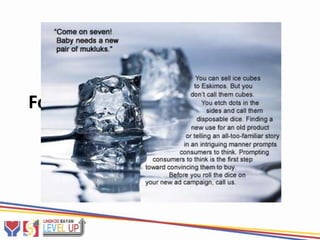
  • #10 How do you sell ice cream to Inuits (since Eskimo is a derogatory term)?We want to elicit a certain behavior among the LGUs, which is to support the Sustainable Livelihood Program –through ordinances, financial, programmatic support, etc.
  • #11 How do they understand the DSWD’s programs?Most likely, they will already have preconceived notions of the DSWD and what it does, especially from past programs. Each public official will see the DSWD and the programs differently.
  • #12 It is usually position regarding the the program or the department based on their perception. (i.e. Perception: The DSWD provides effective programs for street children. Attitude: I like the DSWD’s programs for street children because they are effective.)
  • #13 The actions they take based on their perception and attitude.(i.e. Perception: The DSWD provides effective programs for street children. Attitude: I like the DSWD’s programs for street children because they are effective. Behavior: I will create an ordinance that will institutionalize DSWD street children programs in my city.)
  • #15 Before meeting with mayor, governor, etc., have a goal in mind. By the end of the meeting, what do you want her/him to think or do? Identify the goal beforehand.
  • #16 Each public official will have a different set of beliefs and practices. Some will require that you meet with them in their office, others will be more approachable even during public events.
  • #17 (Referring to Mike Enriquez) Who is he? Is he a Kapuso or a Kapamilya?(Referring to Karen Davila) Who is she? Is she a Kapuso or a Kapamilya?Even without their TV station logos included in their pictures, we can already identify their profession and affiliations. The same is true for DSWD field staff. Always remember that when you meet with LGUs, you represent the DSWD and you are non-partisan, which means that you are neither for mayor nor against him; you are simply for the beneficiaries.
  • #18 What you wear when you meet with beneficiaries is different from what you wear when meeting with officials. You don’t necessarily have to wear a suit or an eveningdress but you do have to be more dressed for an office setting. Armedwithyourmastery of the program and a well-prepared attire, youallow the public officials to thinkthatyoumean business, you are professional, and thatyoutrulypreparedtmeetthem.
  • #19 The most important weapon you can carry with your is your mastery of the program. Likewise, you should also familiarize yourself with the LGU, the geography, and the demography. (Advertisement: Condomshop.ch –come prepared, always be ready: this includes a partner’s kit: brochure, program overview, and recent updates on the program within the area)
  • #20 Know the local official’s priorities and objectives.What does mayor/governor want the image of the city/town/province to be?How do they usually reach out to their constituents?What are the advocacies of mayor/governor/kapitan? Is it environment-related? Entrepreneurship? Angle your proposal based on the thrust and priorities, and the advocacies.Take an issue-based approach: localize and contextualize the program and show its flexibility.
  • #21 Again, it’s like selling ice to people in the arctic. Re-angle and repackage your program to provide that added value.
  • #22 You promise, which is to “Uplift the standard of living and improve the quality of lives of their constituents” is your argument. It is your reason for maintaining a good relationship with the LGUs. (PETA advertisement: argument: Eating meat is a sin; Belo advertisement: argument with a visual example—JinkeePacquiao’s makeover)
  • #23 Signing a memorandum of agreement means that you are equally responsible for the program, regardless of the task delegation.
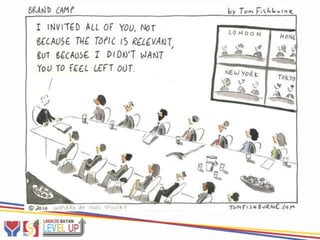
  • #24 When persuading the LGU to agree to a partnership with you, ensure that the key decision-makers are present. Other attendees who are not necessary should not be there. It will distract from your main objective.
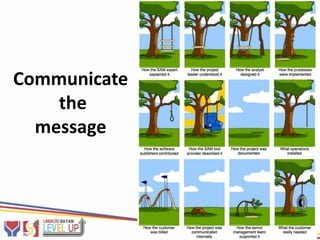
  • #25 (Project management cartoon: communicate the project clearly and thoroughly.)
  • #26 Only focus on what’s important; after all, it’s what the LGUs want to hear. Focus on the 5 W’s and 1 H (Who, What, Where, When, Why, How)
  • #27 Go straight to the point. What do you need them to commit?“Mayor, this is the program and this is what the program can do for your constituents.”
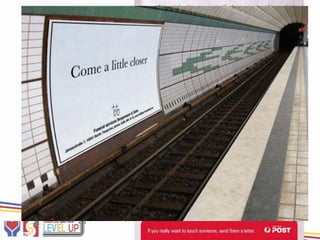
  • #28 Take them to the communities if you have to. Give them a taste of the program and its benefits. Use AVPs, success stories, bring products, allow beneficiaries to share their own stories. If the beneficiaries have food products, bring samples for the public officials to taste. (Australia post advertisement: write letters that will make the receiver feel your physical presence.)(Bergmann funeral service advertisement: If you come any closer, you’ll fall off platform and into the track. You’ll be hit by the train and die. You will finally get to avail of Bergmann funeral service.)
  • #29 Make it sensory. Give them something concrete: numbers, facts, figures. Make SMART goals with them. What can be accomplished by a certain time and with certain resources. Again, be CONCRETE.(FedexKinkos office supplies advertisement: something people can see, touch, and feel)
  • #30 Visual in 2 ways:Always prepare visual aidsShare a vision with them. (i.e. By October 2013, 60 beneficiaries will be employed by company X and 24 beneficiaries will have a freshwater pond for bangus production)Always go back to the local official’s thrust and priorities. (If beneficiary A earns N, then A can help the local economy through P.)(PETA advertisement: David Cross the comedian is generally a hairy man; WWF advertisement: visual presentation that climate change directly affects us)
  • #31 Cite success stories, anecdotes, and case studies. Aside from quantitative data, prepare qualitative data as well. (i.e. Tatay Pedro, a widower with 8 children was employed by the AgrikulturangPantawid Program in Samar. He can now send the 3 youngest ones to school.)Instead of celebrities, cite beneficiaries as talking heads and “image models.”(Dove advertisement: Campaign for Real Beauty –instead of models, choose ordinary people most of your target audience can identify with.)
  • #32 Be honest about the Sustainable Livelihood Program. It is apolitical –devoid of political affiliations, its provisions are limited, beneficiaries are pre-identified, etc.
  • #34 Why should they help the program if:Their supporters are not beneficiaries?The beneficiaries conversely did not support them during the election?IT IS THEIR PRIMARY RESPONSIBILITY AS PUBLIC OFFICIALS.(Anvari advertisement: Save trees. Trees save.: It’s an ecological responsibility –self-explanatory. Greenpeace advertisement: Whose side are you on? Throw back a provocative question or food for thought)
  • #38 Again,kanya-kanyang trip yan. Different strokes for different folks. Each local official will respond differently.
  • #39 If at the end of the negotiations with the LGU, your objective was not achieved:It does not mean that the program cannot be implemented anymore.It does not mean that you can never approach the LGU again. Look for a more opportune time and come back with better solutions to the concerns that came up.