Std. X Science Metals and Non-Metals 1
For best experience, please view the
PPT on a desktop/ laptop.
Std. X Science Metals and Non-Metals 2
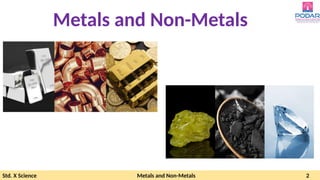
Metals and Non-Metals
Std. X Science Metals and Non-Metals 3
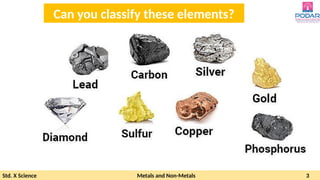
Can you classify these elements?
Std. X Science Metals and Non-Metals 4
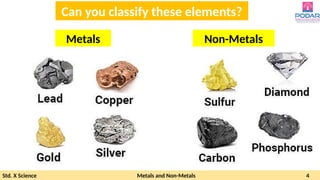
Can you classify these elements?
Metals Non-Metals
Std. X Science Metals and Non-Metals 5
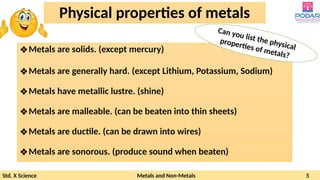
Physical properties of metals
❖Metals are solids. (except mercury)
❖Metals are generally hard. (except Lithium, Potassium, Sodium)
❖Metals have metallic lustre. (shine)
❖Metals are malleable. (can be beaten into thin sheets)
❖Metals are ductile. (can be drawn into wires)
❖Metals are sonorous. (produce sound when beaten)
Can you list the physical
properties of metals?
Std. X Science Metals and Non-Metals 6
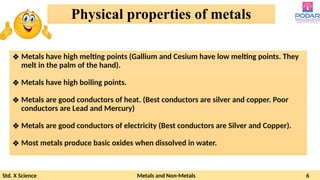
Physical properties of metals
❖ Metals have high melting points (Gallium and Cesium have low melting points. They
melt in the palm of the hand).
❖ Metals have high boiling points.
❖ Metals are good conductors of heat. (Best conductors are silver and copper. Poor
conductors are Lead and Mercury)
❖ Metals are good conductors of electricity (Best conductors are Silver and Copper).
❖ Most metals produce basic oxides when dissolved in water.
Std. X Science Metals and Non-Metals 7
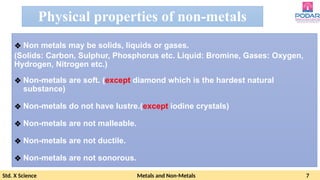
Physical properties of non-metals
❖ Non metals may be solids, liquids or gases.
(Solids: Carbon, Sulphur, Phosphorus etc. Liquid: Bromine, Gases: Oxygen,
Hydrogen, Nitrogen etc.)
❖ Non-metals are soft. (except diamond which is the hardest natural
substance)
❖ Non-metals do not have lustre.(except iodine crystals)
❖ Non-metals are not malleable.
❖ Non-metals are not ductile.
❖ Non-metals are not sonorous.
Std. X Science Metals and Non-Metals 8
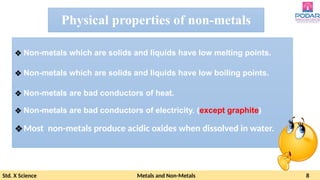
Physical properties of non-metals
❖ Non-metals which are solids and liquids have low melting points.
❖ Non-metals which are solids and liquids have low boiling points.
❖ Non-metals are bad conductors of heat.
❖ Non-metals are bad conductors of electricity. (except graphite)
❖Most non-metals produce acidic oxides when dissolved in water.
Std. X Science Metals and Non-Metals 9
Chemical properties of metals
Reaction with oxygen
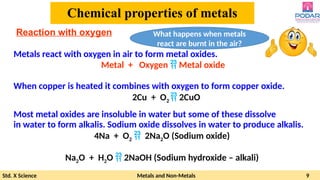
Metals react with oxygen in air to form metal oxides.
Metal + Oxygen  Metal oxide
When copper is heated it combines with oxygen to form copper oxide.
2Cu + O2  2CuO
Most metal oxides are insoluble in water but some of these dissolve
in water to form alkalis. Sodium oxide dissolves in water to produce alkalis.
4Na + O2  2Na2O (Sodium oxide)
Na2O + H2O  2NaOH (Sodium hydroxide – alkali)
What happens when metals
react are burnt in the air?
Std. X Science Metals and Non-Metals 10
Chemical properties of metals
Reaction with oxygen
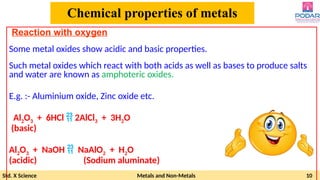
Some metal oxides show acidic and basic properties.
Such metal oxides which react with both acids as well as bases to produce salts
and water are known as amphoteric oxides.
E.g. :- Aluminium oxide, Zinc oxide etc.
Al2O3 + 6HCl  2AlCl3 + 3H2O
(basic)
Al2O3 + NaOH  NaAlO2 + H2O
(acidic) (Sodium aluminate)
Std. X Science Metals and Non-Metals 11
The reactivity of different metals with oxygen is different
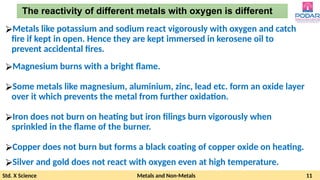
⮚Metals like potassium and sodium react vigorously with oxygen and catch
fire if kept in open. Hence they are kept immersed in kerosene oil to
prevent accidental fires.
⮚Magnesium burns with a bright flame.
⮚Some metals like magnesium, aluminium, zinc, lead etc. form an oxide layer
over it which prevents the metal from further oxidation.
⮚Iron does not burn on heating but iron filings burn vigorously when
sprinkled in the flame of the burner.
⮚Copper does not burn but forms a black coating of copper oxide on heating.
⮚Silver and gold does not react with oxygen even at high temperature.
Std. X Science Metals and Non-Metals 12
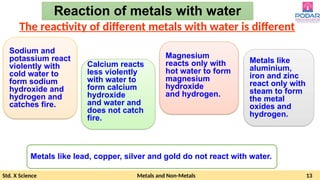
Reaction of metals with water
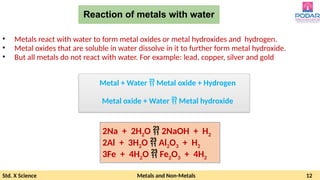
• Metals react with water to form metal oxides or metal hydroxides and hydrogen.
• Metal oxides that are soluble in water dissolve in it to further form metal hydroxide.
• But all metals do not react with water. For example: lead, copper, silver and gold
2Na + 2H2O  2NaOH + H2
2Al + 3H2O  Al2O3 + H2
3Fe + 4H2O  Fe2O3 + 4H2
Metal + Water  Metal oxide + Hydrogen
Metal oxide + Water  Metal hydroxide
Std. X Science Metals and Non-Metals 13
Reaction of metals with water
The reactivity of different metals with water is different
Sodium and
potassium react
violently with
cold water to
form sodium
hydroxide and
hydrogen and
catches fire.
Calcium reacts
less violently
with water to
form calcium
hydroxide
and water and
does not catch
fire.
Magnesium
reacts only with
hot water to form
magnesium
hydroxide
and hydrogen.
Metals like
aluminium,
iron and zinc
react only with
steam to form
the metal
oxides and
hydrogen.
Metals like lead, copper, silver and gold do not react with water.
Std. X Science Metals and Non-Metals 14
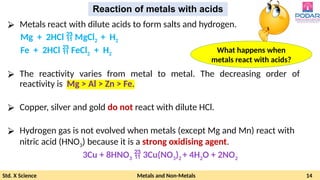
Reaction of metals with acids
⮚ Metals react with dilute acids to form salts and hydrogen.
Mg + 2HCl  MgCl2 + H2
Fe + 2HCl  FeCl2 + H2
⮚ The reactivity varies from metal to metal. The decreasing order of
reactivity is Mg > Al > Zn > Fe.
⮚ Copper, silver and gold do not react with dilute HCl.
⮚ Hydrogen gas is not evolved when metals (except Mg and Mn) react with
nitric acid (HNO3) because it is a strong oxidising agent.
3Cu + 8HNO3  3Cu(NO3)2 + 4H2O + 2NO2
What happens when
metals react with acids?
Std. X Science Metals and Non-Metals 15
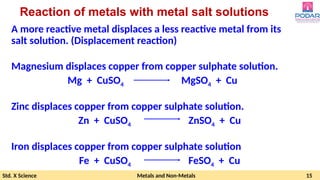
Reaction of metals with metal salt solutions
A more reactive metal displaces a less reactive metal from its
salt solution. (Displacement reaction)
Magnesium displaces copper from copper sulphate solution.
Mg + CuSO4 MgSO4 + Cu
Zinc displaces copper from copper sulphate solution.
Zn + CuSO4 ZnSO4 + Cu
Iron displaces copper from copper sulphate solution
Fe + CuSO4 FeSO4 + Cu
Std. X Science Metals and Non-Metals 16
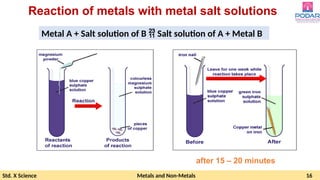
Reaction of metals with metal salt solutions
after 15 – 20 minutes
Metal A + Salt solution of B  Salt solution of A + Metal B
Std. X Science Metals and Non-Metals 17
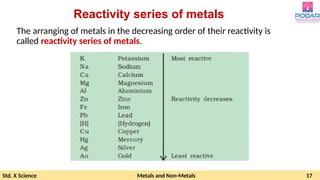
Reactivity series of metals
The arranging of metals in the decreasing order of their reactivity is
called reactivity series of metals.
Std. X Science Metals and Non-Metals 18
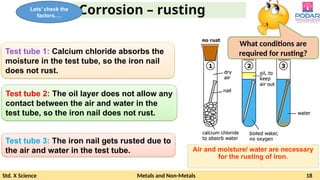
Corrosion – rusting
Air and moisture/ water are necessary
for the rusting of iron.
Test tube 1: Calcium chloride absorbs the
moisture in the test tube, so the iron nail
does not rust.
Test tube 2: The oil layer does not allow any
contact between the air and water in the
test tube, so the iron nail does not rust.
Test tube 3: The iron nail gets rusted due to
the air and water in the test tube.
What conditions are
required for rusting?
Lets’ check the
factors….
Std. X Science Metals and Non-Metals 19
Methods to prevent corrosion
Corrosion of metals can be prevented by :-
How can we prevent
corrosion?
• applying oil or grease.
• applying paint.
• by galvanisation (coating with zinc).
• by anodising.
• by chrome plating (coating a less reactive metal like chromium).
• by alloying (making alloys).
Std. X Science Metals and Non-Metals 20
Methods to prevent corrosion
Alloy - An alloy is a homogeneous mixture of a metal with other metals or
non-metal.
E.g. :-
 Steel – iron, carbon
 Stainless steel – iron, carbon, cobalt, nickel
 Brass – copper, zinc
 Bronze – copper, tin
 Solder – Lead, tin (used for welding electrical wires together)
If one of the metals in an alloy is mercury, it is called an amalgam.
Alloying is a very good method of improving the properties of a metal.

PPT1_CB_X_Sci_Metals and Non-Metals.ppsx

  • 1.
    Std. X ScienceMetals and Non-Metals 1 For best experience, please view the PPT on a desktop/ laptop.
  • 2.
    Std. X ScienceMetals and Non-Metals 2 Metals and Non-Metals
  • 3.
    Std. X ScienceMetals and Non-Metals 3 Can you classify these elements?
  • 4.
    Std. X ScienceMetals and Non-Metals 4 Can you classify these elements? Metals Non-Metals
  • 5.
    Std. X ScienceMetals and Non-Metals 5 Physical properties of metals ❖Metals are solids. (except mercury) ❖Metals are generally hard. (except Lithium, Potassium, Sodium) ❖Metals have metallic lustre. (shine) ❖Metals are malleable. (can be beaten into thin sheets) ❖Metals are ductile. (can be drawn into wires) ❖Metals are sonorous. (produce sound when beaten) Can you list the physical properties of metals?
  • 6.
    Std. X ScienceMetals and Non-Metals 6 Physical properties of metals ❖ Metals have high melting points (Gallium and Cesium have low melting points. They melt in the palm of the hand). ❖ Metals have high boiling points. ❖ Metals are good conductors of heat. (Best conductors are silver and copper. Poor conductors are Lead and Mercury) ❖ Metals are good conductors of electricity (Best conductors are Silver and Copper). ❖ Most metals produce basic oxides when dissolved in water.
  • 7.
    Std. X ScienceMetals and Non-Metals 7 Physical properties of non-metals ❖ Non metals may be solids, liquids or gases. (Solids: Carbon, Sulphur, Phosphorus etc. Liquid: Bromine, Gases: Oxygen, Hydrogen, Nitrogen etc.) ❖ Non-metals are soft. (except diamond which is the hardest natural substance) ❖ Non-metals do not have lustre.(except iodine crystals) ❖ Non-metals are not malleable. ❖ Non-metals are not ductile. ❖ Non-metals are not sonorous.
  • 8.
    Std. X ScienceMetals and Non-Metals 8 Physical properties of non-metals ❖ Non-metals which are solids and liquids have low melting points. ❖ Non-metals which are solids and liquids have low boiling points. ❖ Non-metals are bad conductors of heat. ❖ Non-metals are bad conductors of electricity. (except graphite) ❖Most non-metals produce acidic oxides when dissolved in water.
  • 9.
    Std. X ScienceMetals and Non-Metals 9 Chemical properties of metals Reaction with oxygen Metals react with oxygen in air to form metal oxides. Metal + Oxygen  Metal oxide When copper is heated it combines with oxygen to form copper oxide. 2Cu + O2  2CuO Most metal oxides are insoluble in water but some of these dissolve in water to form alkalis. Sodium oxide dissolves in water to produce alkalis. 4Na + O2  2Na2O (Sodium oxide) Na2O + H2O  2NaOH (Sodium hydroxide – alkali) What happens when metals react are burnt in the air?
  • 10.
    Std. X ScienceMetals and Non-Metals 10 Chemical properties of metals Reaction with oxygen Some metal oxides show acidic and basic properties. Such metal oxides which react with both acids as well as bases to produce salts and water are known as amphoteric oxides. E.g. :- Aluminium oxide, Zinc oxide etc. Al2O3 + 6HCl  2AlCl3 + 3H2O (basic) Al2O3 + NaOH  NaAlO2 + H2O (acidic) (Sodium aluminate)
  • 11.
    Std. X ScienceMetals and Non-Metals 11 The reactivity of different metals with oxygen is different ⮚Metals like potassium and sodium react vigorously with oxygen and catch fire if kept in open. Hence they are kept immersed in kerosene oil to prevent accidental fires. ⮚Magnesium burns with a bright flame. ⮚Some metals like magnesium, aluminium, zinc, lead etc. form an oxide layer over it which prevents the metal from further oxidation. ⮚Iron does not burn on heating but iron filings burn vigorously when sprinkled in the flame of the burner. ⮚Copper does not burn but forms a black coating of copper oxide on heating. ⮚Silver and gold does not react with oxygen even at high temperature.
  • 12.
    Std. X ScienceMetals and Non-Metals 12 Reaction of metals with water • Metals react with water to form metal oxides or metal hydroxides and hydrogen. • Metal oxides that are soluble in water dissolve in it to further form metal hydroxide. • But all metals do not react with water. For example: lead, copper, silver and gold 2Na + 2H2O  2NaOH + H2 2Al + 3H2O  Al2O3 + H2 3Fe + 4H2O  Fe2O3 + 4H2 Metal + Water  Metal oxide + Hydrogen Metal oxide + Water  Metal hydroxide
  • 13.
    Std. X ScienceMetals and Non-Metals 13 Reaction of metals with water The reactivity of different metals with water is different Sodium and potassium react violently with cold water to form sodium hydroxide and hydrogen and catches fire. Calcium reacts less violently with water to form calcium hydroxide and water and does not catch fire. Magnesium reacts only with hot water to form magnesium hydroxide and hydrogen. Metals like aluminium, iron and zinc react only with steam to form the metal oxides and hydrogen. Metals like lead, copper, silver and gold do not react with water.
  • 14.
    Std. X ScienceMetals and Non-Metals 14 Reaction of metals with acids ⮚ Metals react with dilute acids to form salts and hydrogen. Mg + 2HCl  MgCl2 + H2 Fe + 2HCl  FeCl2 + H2 ⮚ The reactivity varies from metal to metal. The decreasing order of reactivity is Mg > Al > Zn > Fe. ⮚ Copper, silver and gold do not react with dilute HCl. ⮚ Hydrogen gas is not evolved when metals (except Mg and Mn) react with nitric acid (HNO3) because it is a strong oxidising agent. 3Cu + 8HNO3  3Cu(NO3)2 + 4H2O + 2NO2 What happens when metals react with acids?
  • 15.
    Std. X ScienceMetals and Non-Metals 15 Reaction of metals with metal salt solutions A more reactive metal displaces a less reactive metal from its salt solution. (Displacement reaction) Magnesium displaces copper from copper sulphate solution. Mg + CuSO4 MgSO4 + Cu Zinc displaces copper from copper sulphate solution. Zn + CuSO4 ZnSO4 + Cu Iron displaces copper from copper sulphate solution Fe + CuSO4 FeSO4 + Cu
  • 16.
    Std. X ScienceMetals and Non-Metals 16 Reaction of metals with metal salt solutions after 15 – 20 minutes Metal A + Salt solution of B  Salt solution of A + Metal B
  • 17.
    Std. X ScienceMetals and Non-Metals 17 Reactivity series of metals The arranging of metals in the decreasing order of their reactivity is called reactivity series of metals.
  • 18.
    Std. X ScienceMetals and Non-Metals 18 Corrosion – rusting Air and moisture/ water are necessary for the rusting of iron. Test tube 1: Calcium chloride absorbs the moisture in the test tube, so the iron nail does not rust. Test tube 2: The oil layer does not allow any contact between the air and water in the test tube, so the iron nail does not rust. Test tube 3: The iron nail gets rusted due to the air and water in the test tube. What conditions are required for rusting? Lets’ check the factors….
  • 19.
    Std. X ScienceMetals and Non-Metals 19 Methods to prevent corrosion Corrosion of metals can be prevented by :- How can we prevent corrosion? • applying oil or grease. • applying paint. • by galvanisation (coating with zinc). • by anodising. • by chrome plating (coating a less reactive metal like chromium). • by alloying (making alloys).
  • 20.
    Std. X ScienceMetals and Non-Metals 20 Methods to prevent corrosion Alloy - An alloy is a homogeneous mixture of a metal with other metals or non-metal. E.g. :-  Steel – iron, carbon  Stainless steel – iron, carbon, cobalt, nickel  Brass – copper, zinc  Bronze – copper, tin  Solder – Lead, tin (used for welding electrical wires together) If one of the metals in an alloy is mercury, it is called an amalgam. Alloying is a very good method of improving the properties of a metal.