Grading System
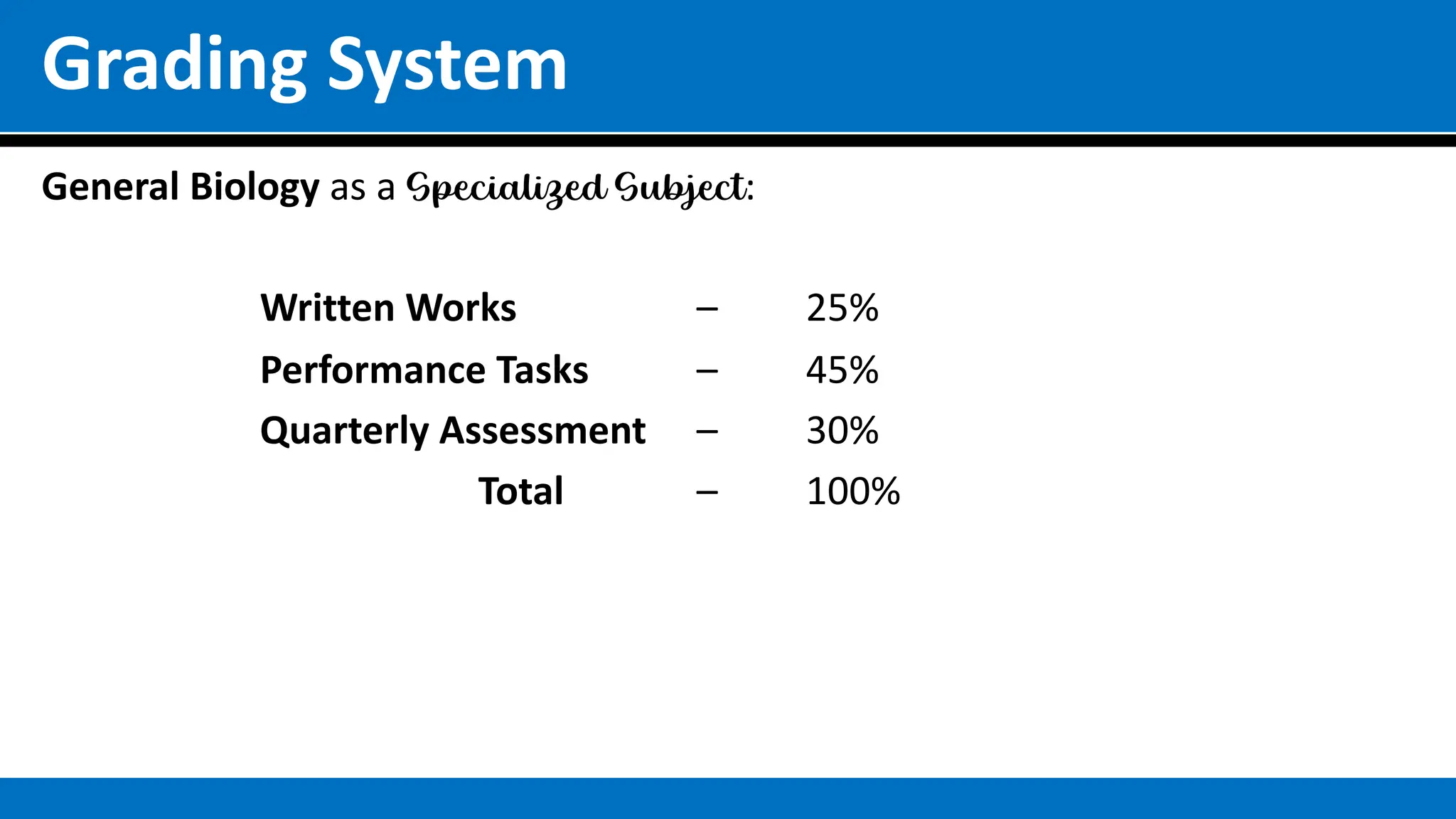
General Biology as a Specialized Subject:
Written Works – 25%
Performance Tasks – 45%
Quarterly Assessment – 30%
Total – 100%
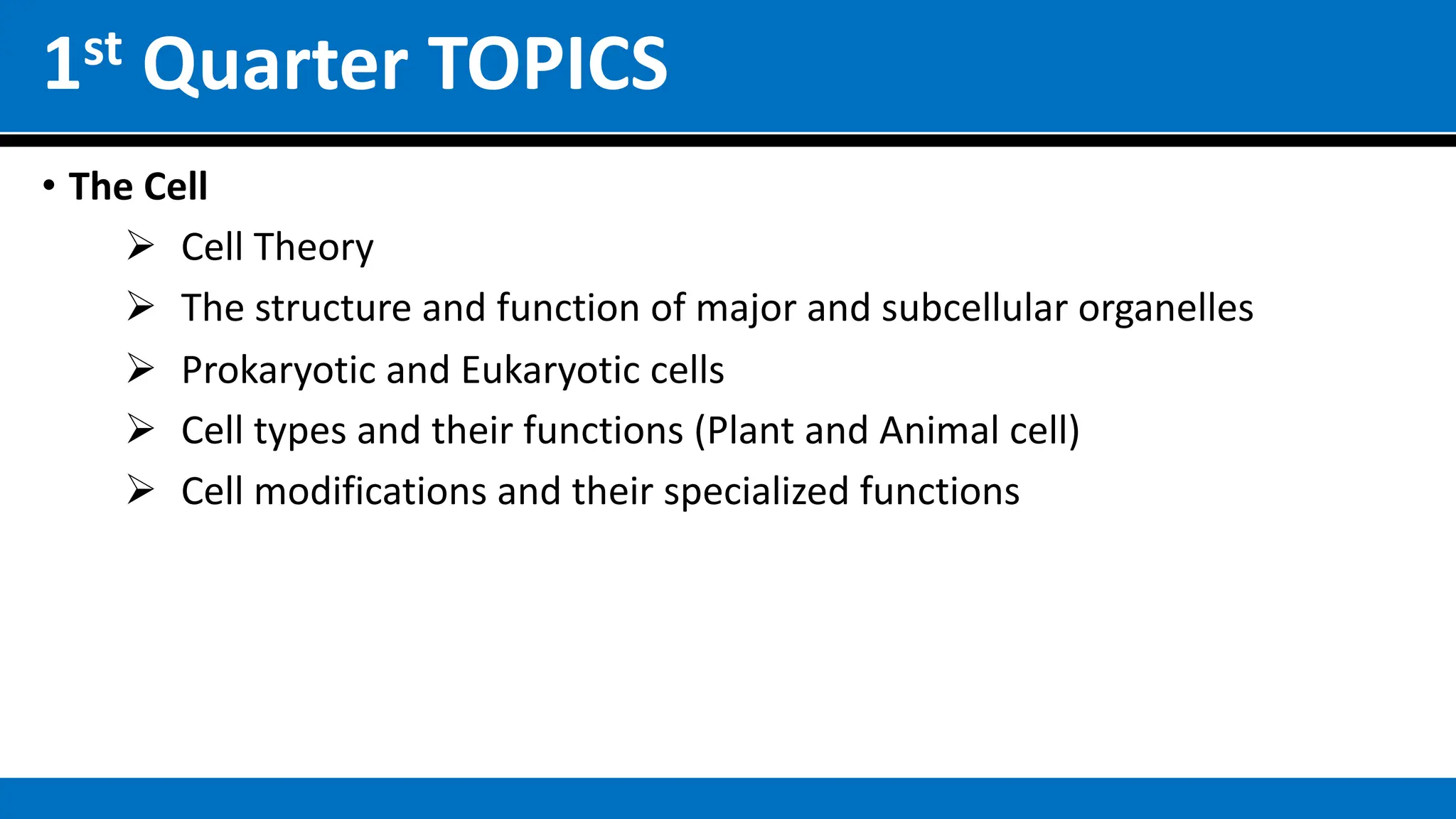
1st Quarter TOPICS
• The Cell
Ø Cell Theory
Ø The structure and function of major and subcellular organelles
Ø Prokaryotic and Eukaryotic cells
Ø Cell types and their functions (Plant and Animal cell)
Ø Cell modifications and their specialized functions
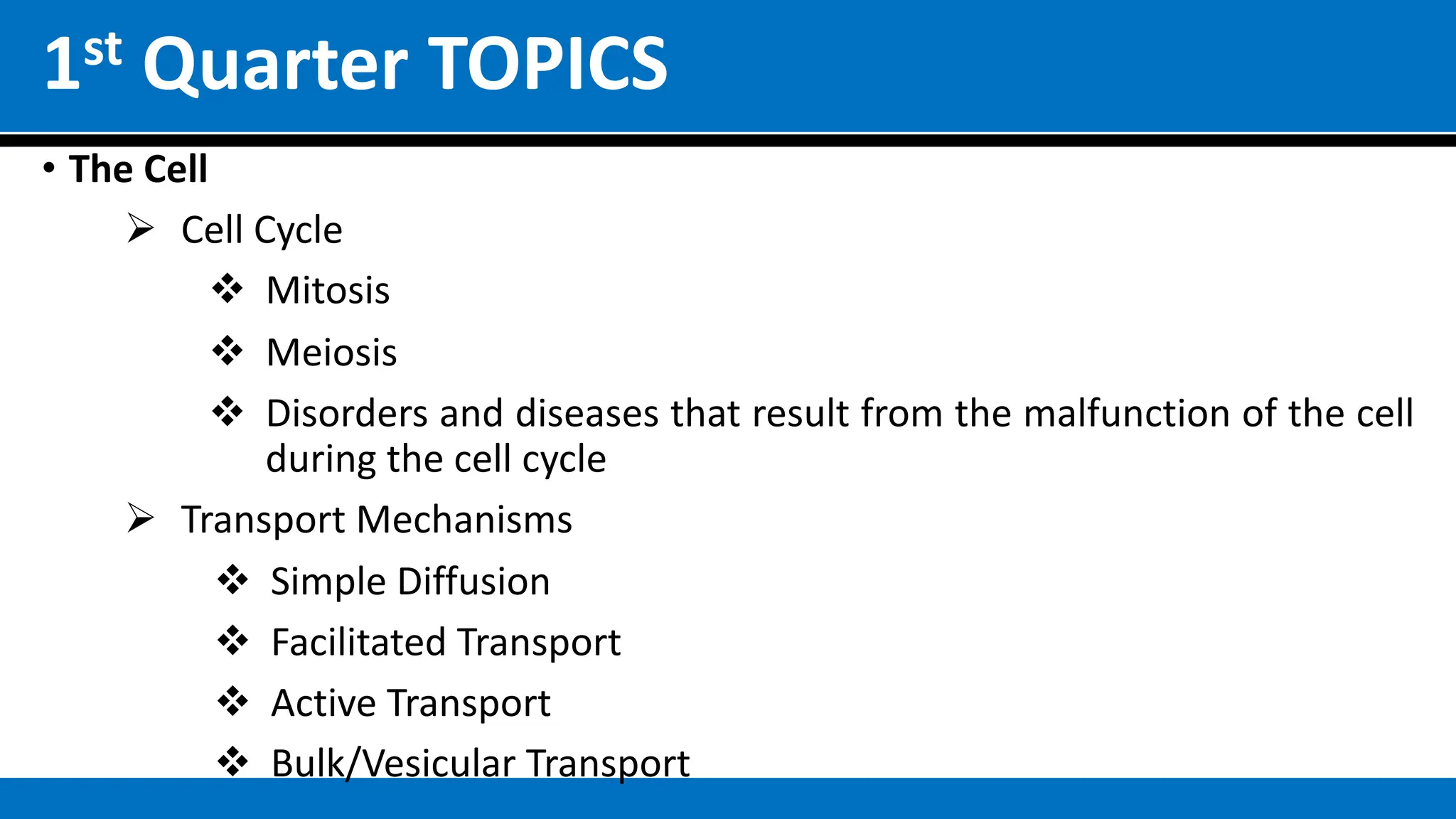
1st Quarter TOPICS
• The Cell
Ø Cell Cycle
v Mitosis
v Meiosis
v Disorders and diseases that result from the malfunction of the cell
during the cell cycle
Ø Transport Mechanisms
v Simple Diffusion
v Facilitated Transport
v Active Transport
v Bulk/Vesicular Transport
1st Quarter TOPICS
• Biological Molecules
Ø Structures and Functions of Biological Molecules
v Carbohydrates
v Lipids
v Proteins
v Enzymes
v Nucleic Acids
2nd Quarter TOPICS
• Energy Transformation
Ø ATP- ADP Cycle
Ø Photosynthesis
Ø Respiration
Subject Description
• Biology I is a Science, Technology, Engineering and Mathematics
(STEM) Specialized Subject taken in the first half of Grade 11.
• Learners go on a journey geared toward the deeper understanding
and appreciation of life processes at the cellular and molecular
levels previously introduced in Grades 7-10. They will also apply
basic chemistry and physics principles as they examine the
transformation of energy in organisms.
Let’s Revisit BIOLOGY as a subject
• Reflect upon your past experiences during your junior high school
years when you were exposed to lessons focused on biology.
• On a 1 whole yellow paper, compile a comprehensive list of the
biology topics that you can still recall from your junior high school
education.
CELL: THEORY, STRUCTURE AND FUNCTION
MELC’s
1. Explain the postulates of the cell theory. (STEM_BIO11/12-Ia-c-1)
2. Describe the structure and function of major and subcellular
organelles. (STEM_BIO11/12-Ia-c-2)
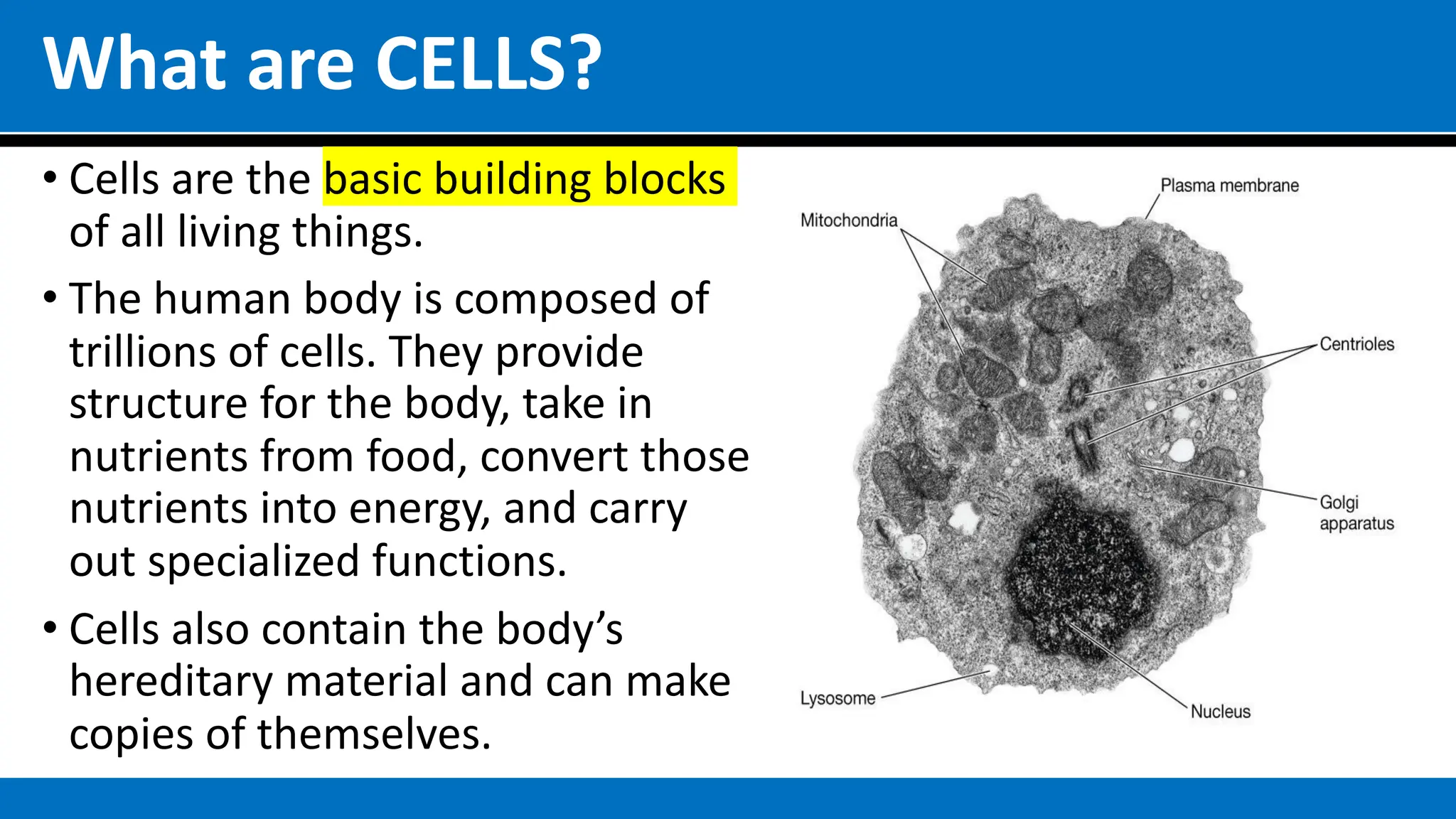
What are CELLS?
• Cells are the basic building blocks
of all living things.
• The human body is composed of
trillions of cells. They provide
structure for the body, take in
nutrients from food, convert those
nutrients into energy, and carry
out specialized functions.
• Cells also contain the body’s
hereditary material and can make
copies of themselves.
The CELL Theory
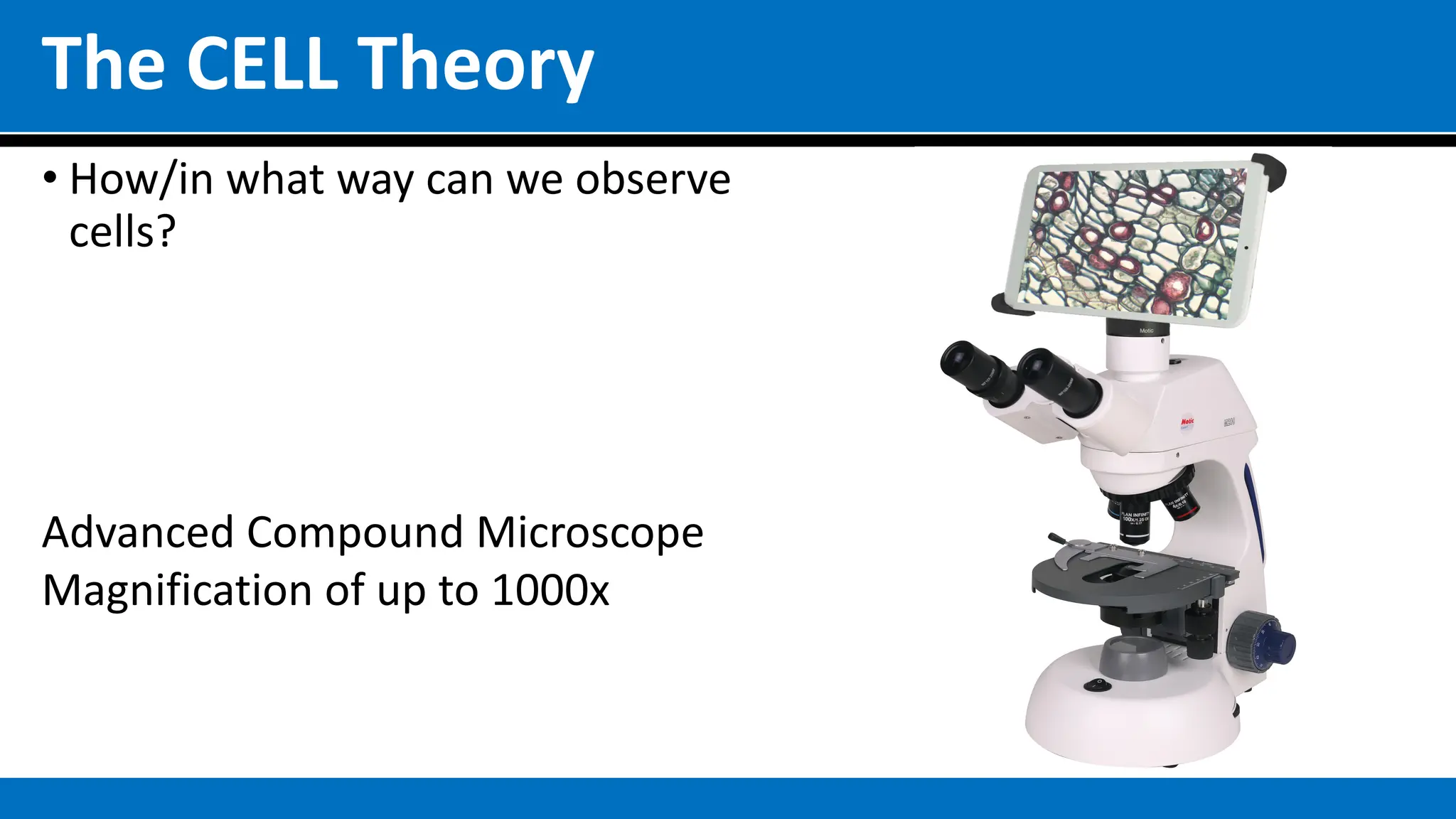
• How/in what way can we observe
cells?
Advanced Compound Microscope
Magnification of up to 1000x
The CELL Theory
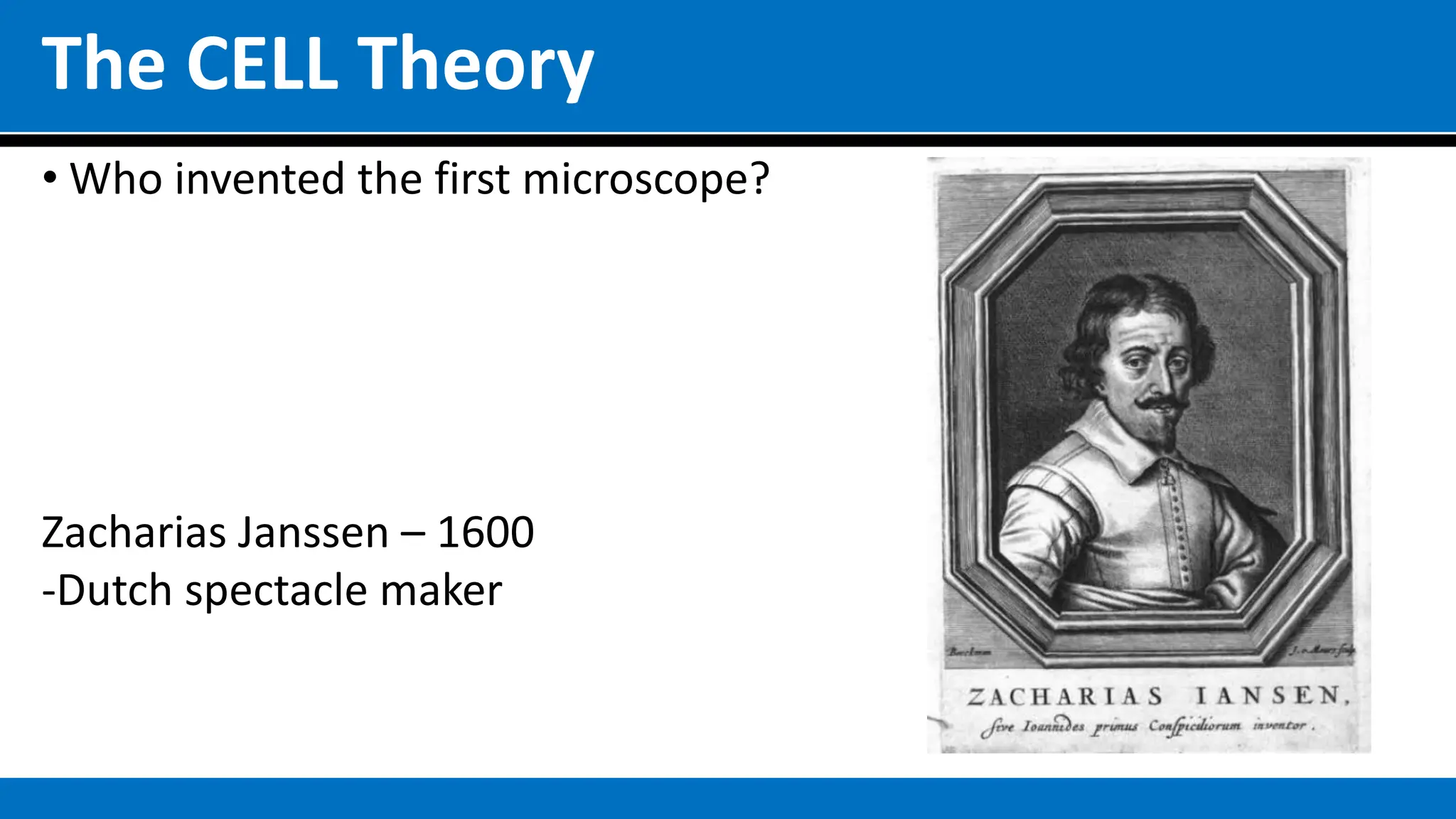
• Who invented the first microscope?
Zacharias Janssen – 1600
-Dutch spectacle maker
The Scientists behind the CELL Theory
• Robert Hooke
• Antonie van Leeuwenhoek
• Robert Brown
• Matthias Schleiden
• Theodor Schwann
• Rudolph Virchow
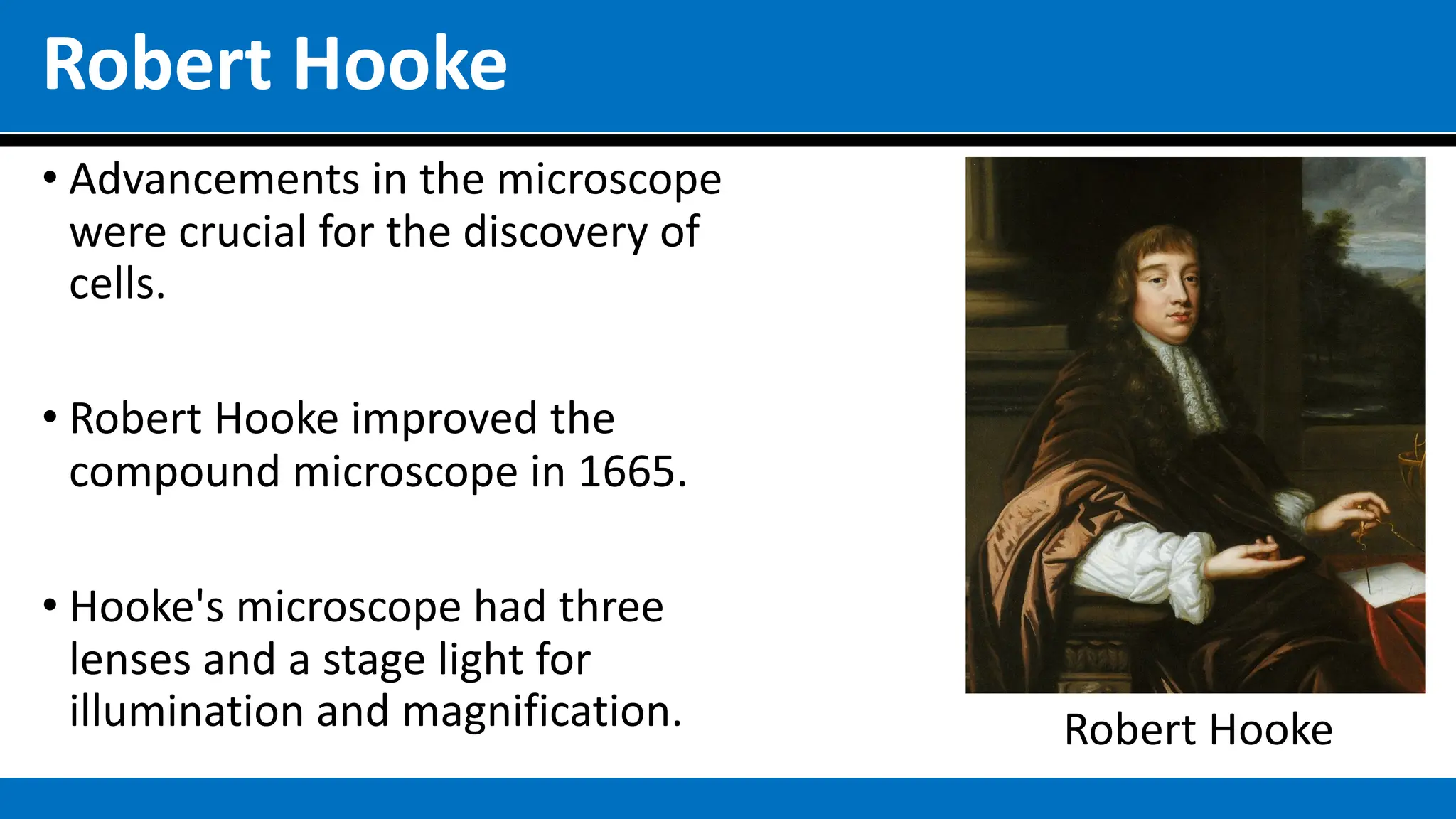
Robert Hooke
• Advancements in the microscope
were crucial for the discovery of
cells.
• Robert Hooke improved the
compound microscope in 1665.
• Hooke's microscope had three
lenses and a stage light for
illumination and magnification. Robert Hooke
Robert Hooke
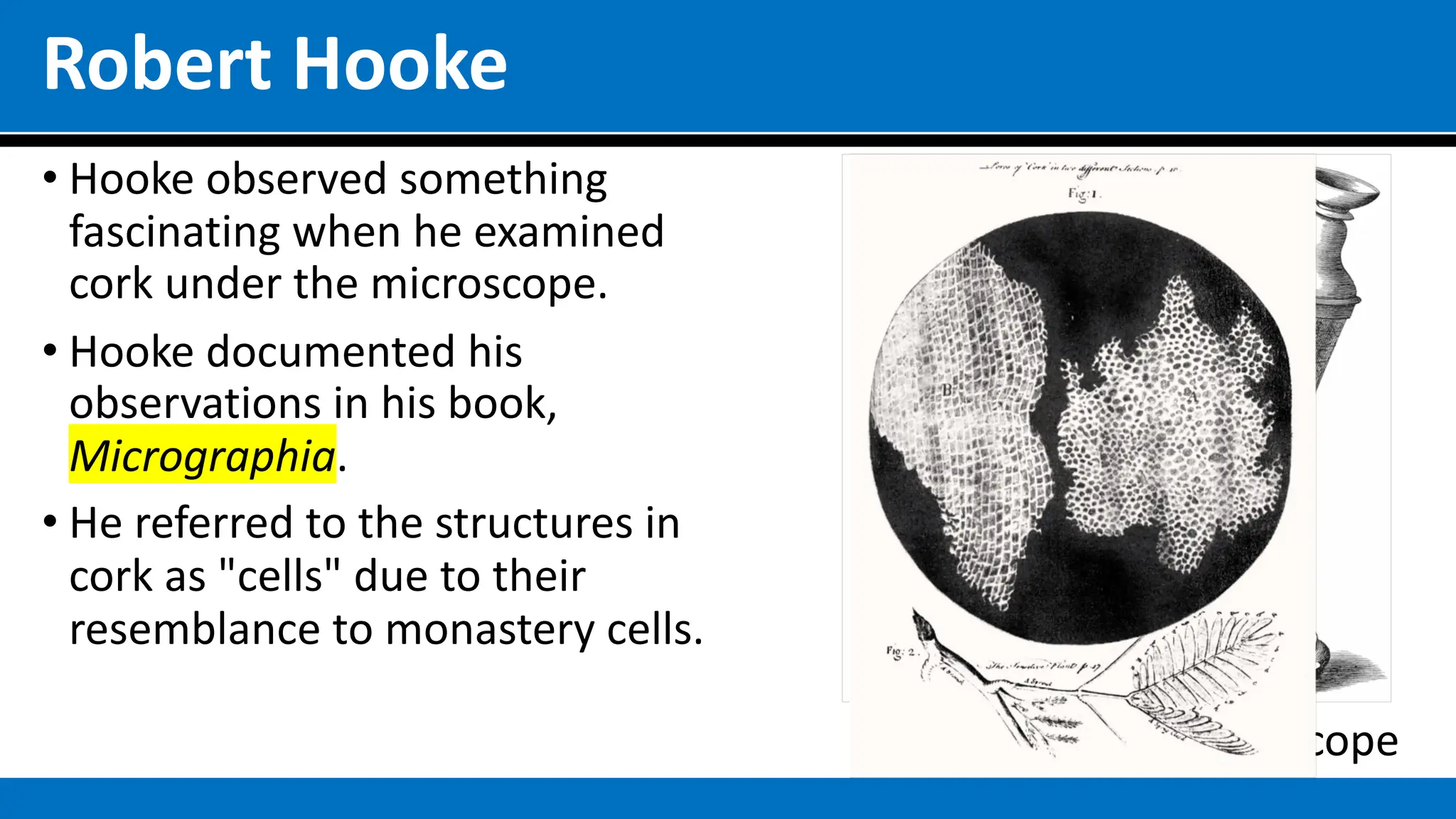
• Hooke observed something
fascinating when he examined
cork under the microscope.
• Hooke documented his
observations in his book,
Micrographia.
• He referred to the structures in
cork as "cells" due to their
resemblance to monastery cells.
Robert Hooke’s Microscope
Antonie van Leeuwenhoek
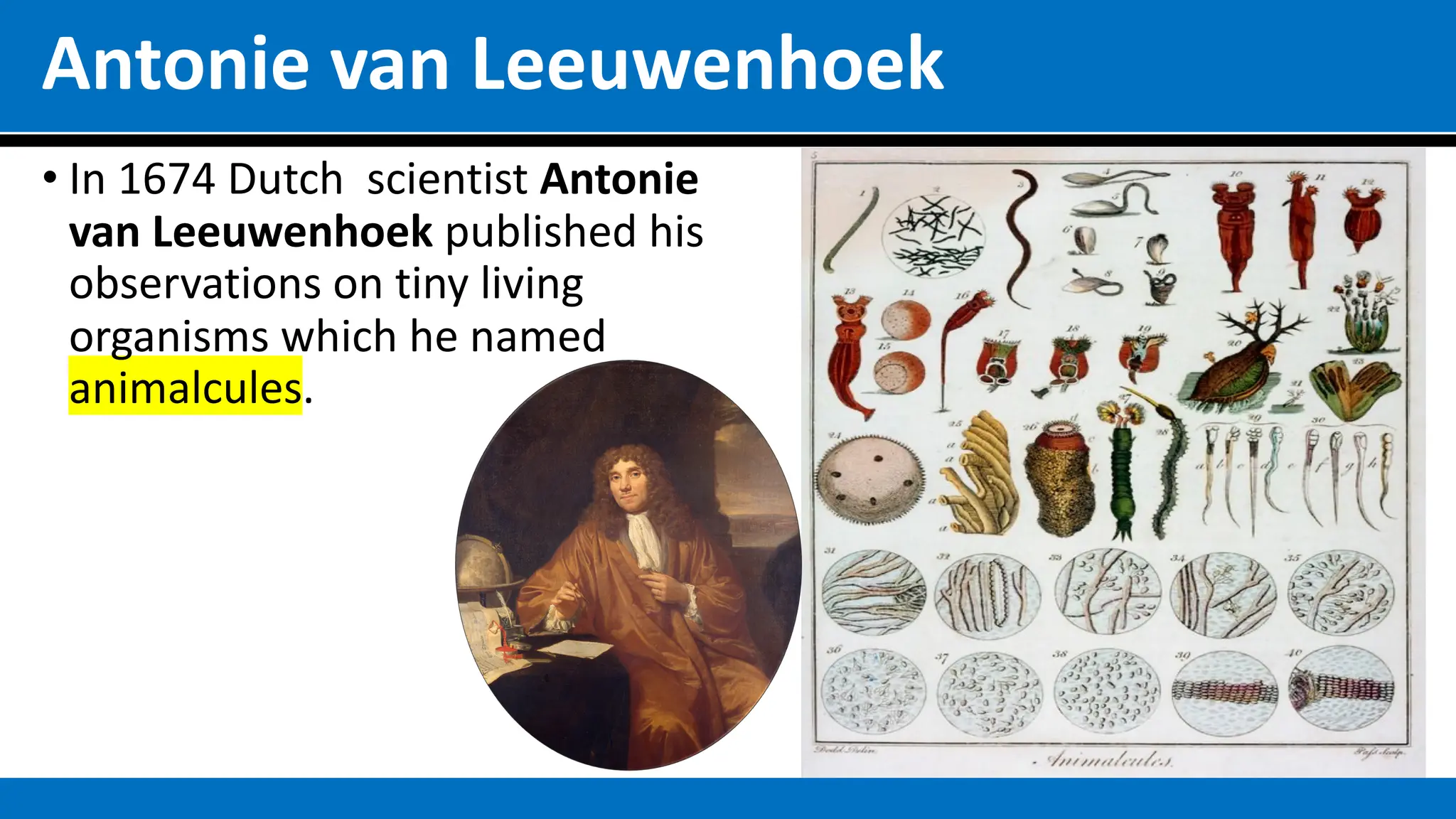
• In 1674 Dutch scientist Antonie
van Leeuwenhoek published his
observations on tiny living
organisms which he named
animalcules.
Antonie van Leeuwenhoek
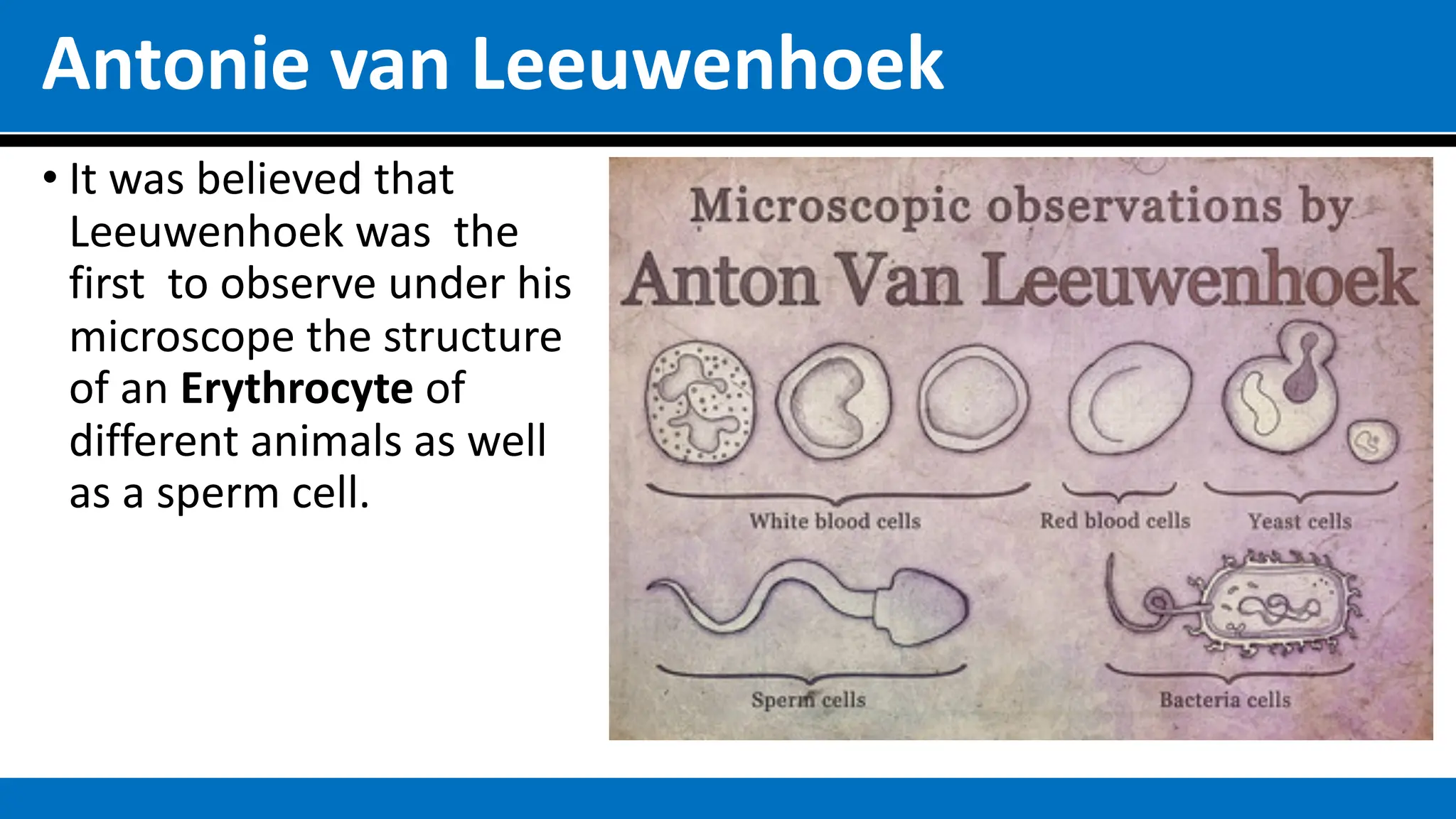
• It was believed that
Leeuwenhoek was the
first to observe under his
microscope the structure
of an Erythrocyte of
different animals as well
as a sperm cell.
Robert Brown
• One of the leading botanists in
his time, Robert Brown in 1831
was able to compare diverse
kinds of plant specimens under
the microscope.
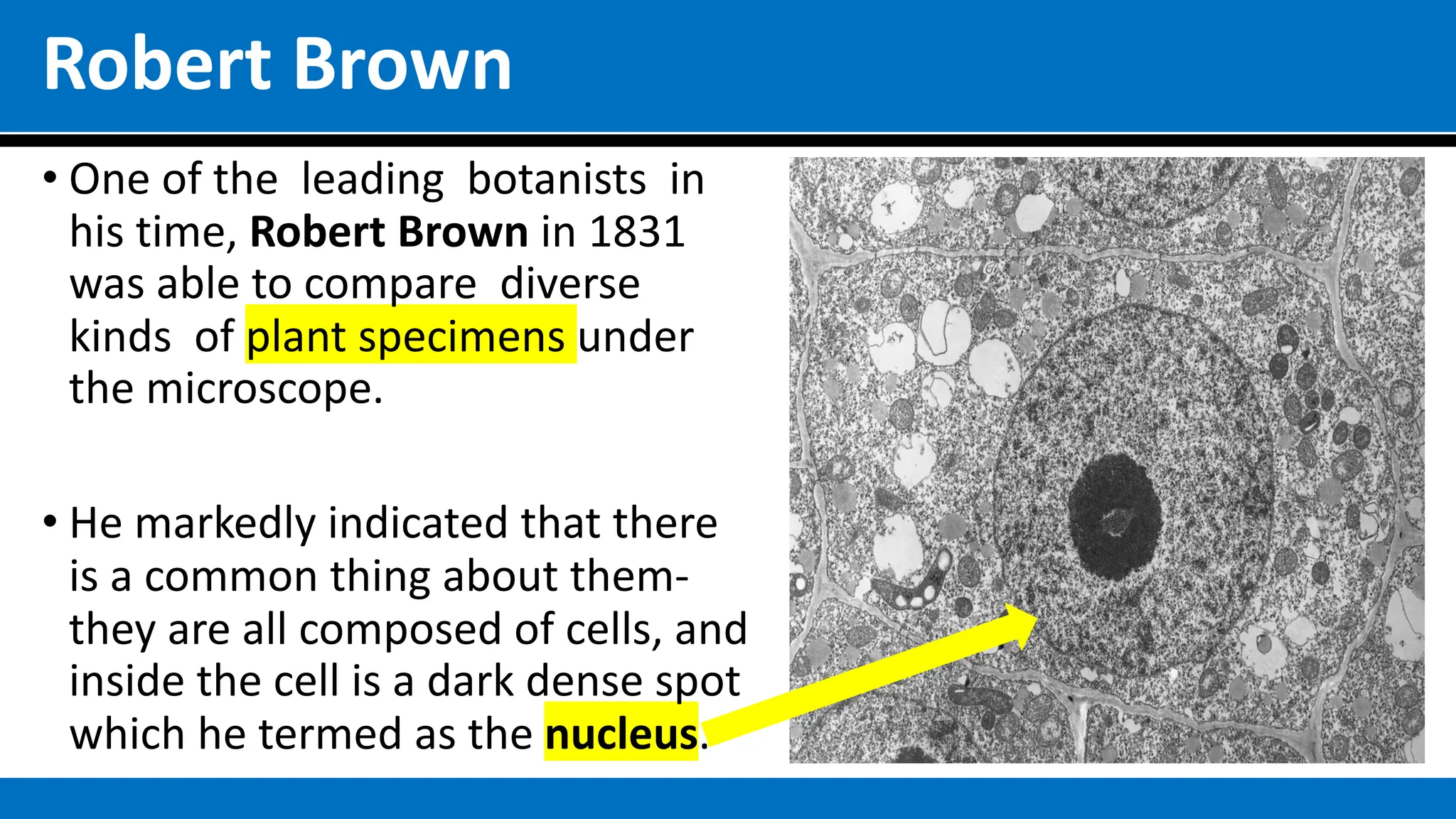
• He markedly indicated that there
is a common thing about them-
they are all composed of cells, and
inside the cell is a dark dense spot
which he termed as the nucleus.
Matthias Schleiden
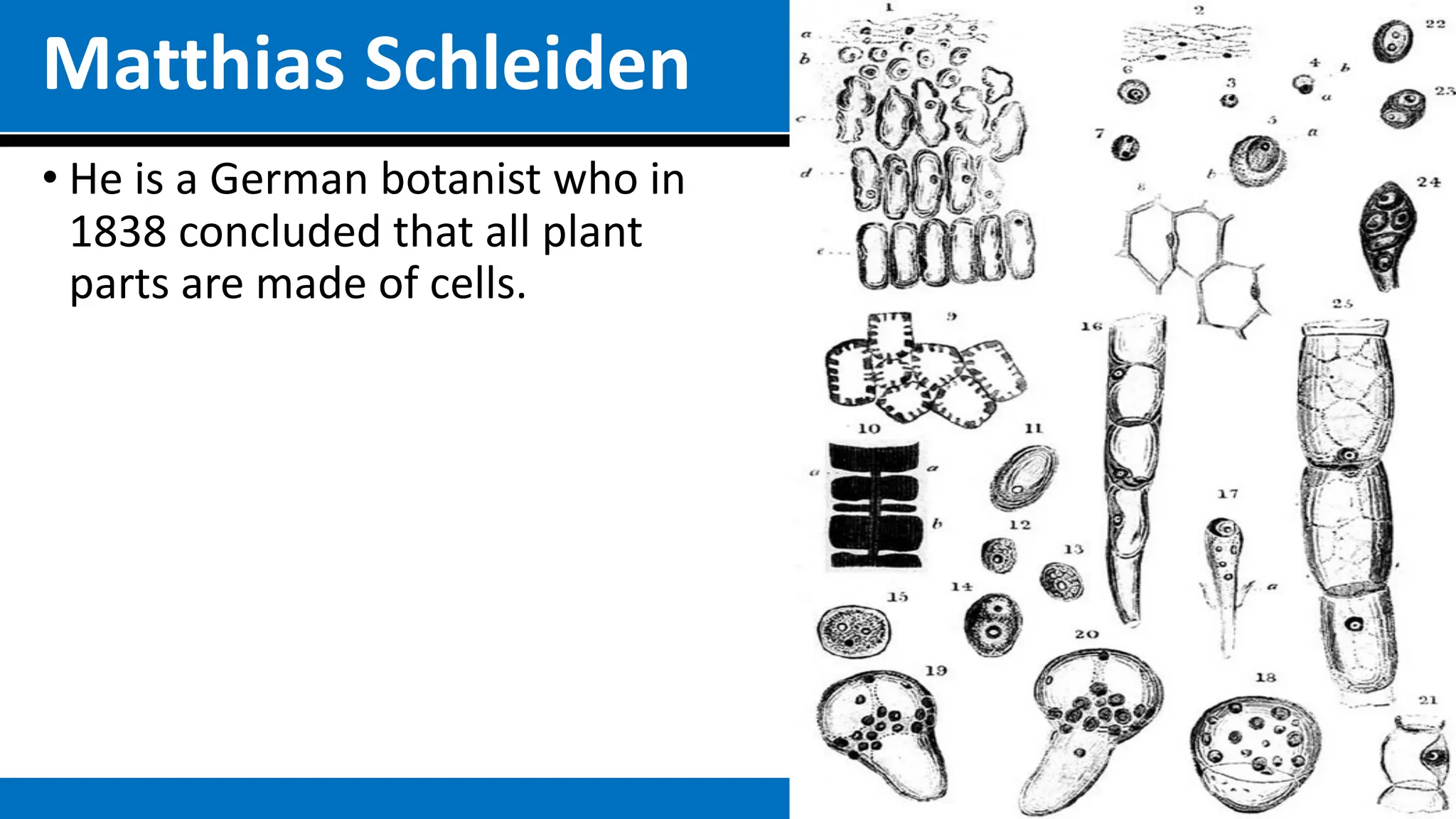
• He is a German botanist who in
1838 concluded that all plant
parts are made of cells.
Theodor Schwann
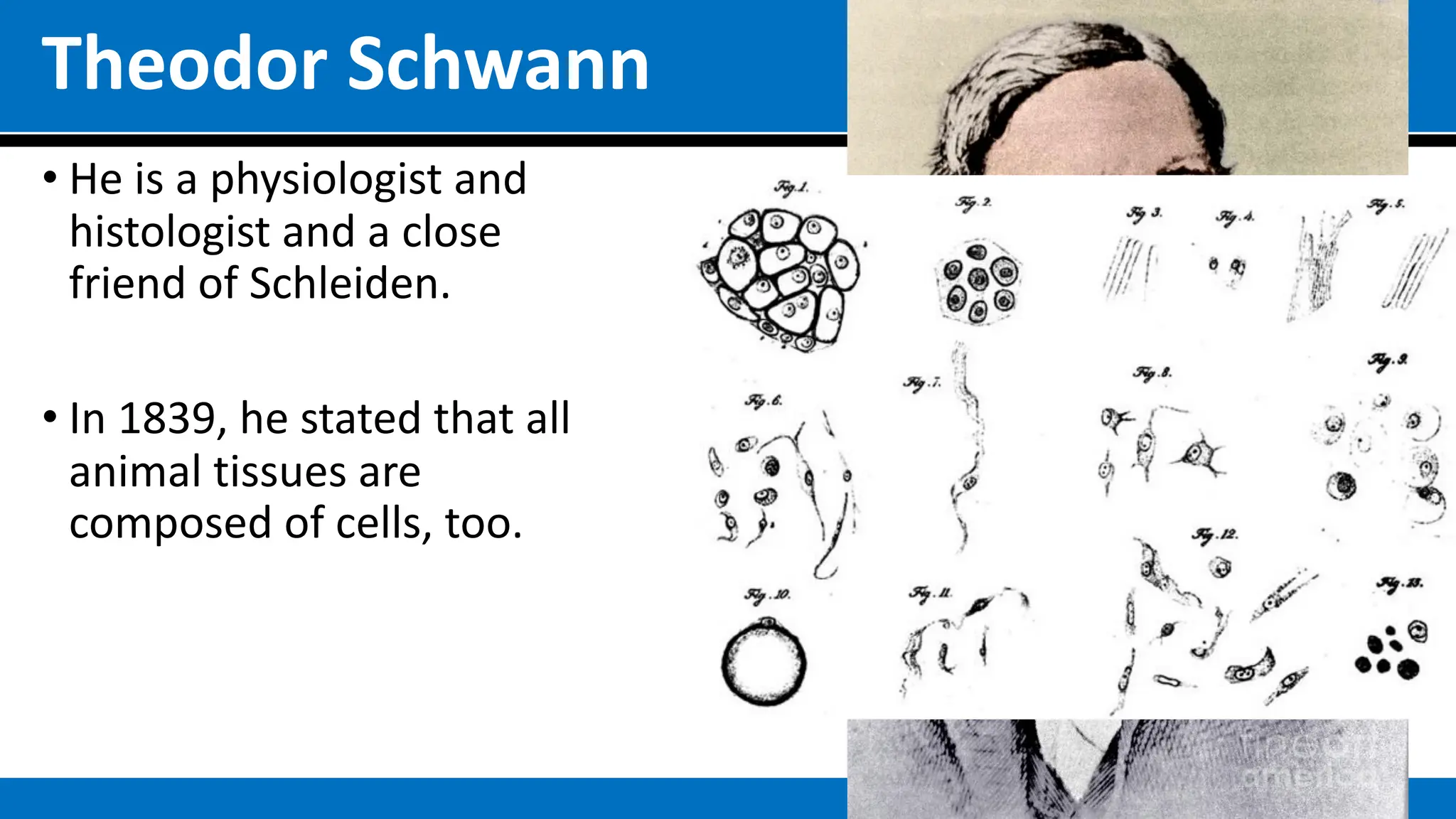
• He is a physiologist and
histologist and a close
friend of Schleiden.
• In 1839, he stated that all
animal tissues are
composed of cells, too.
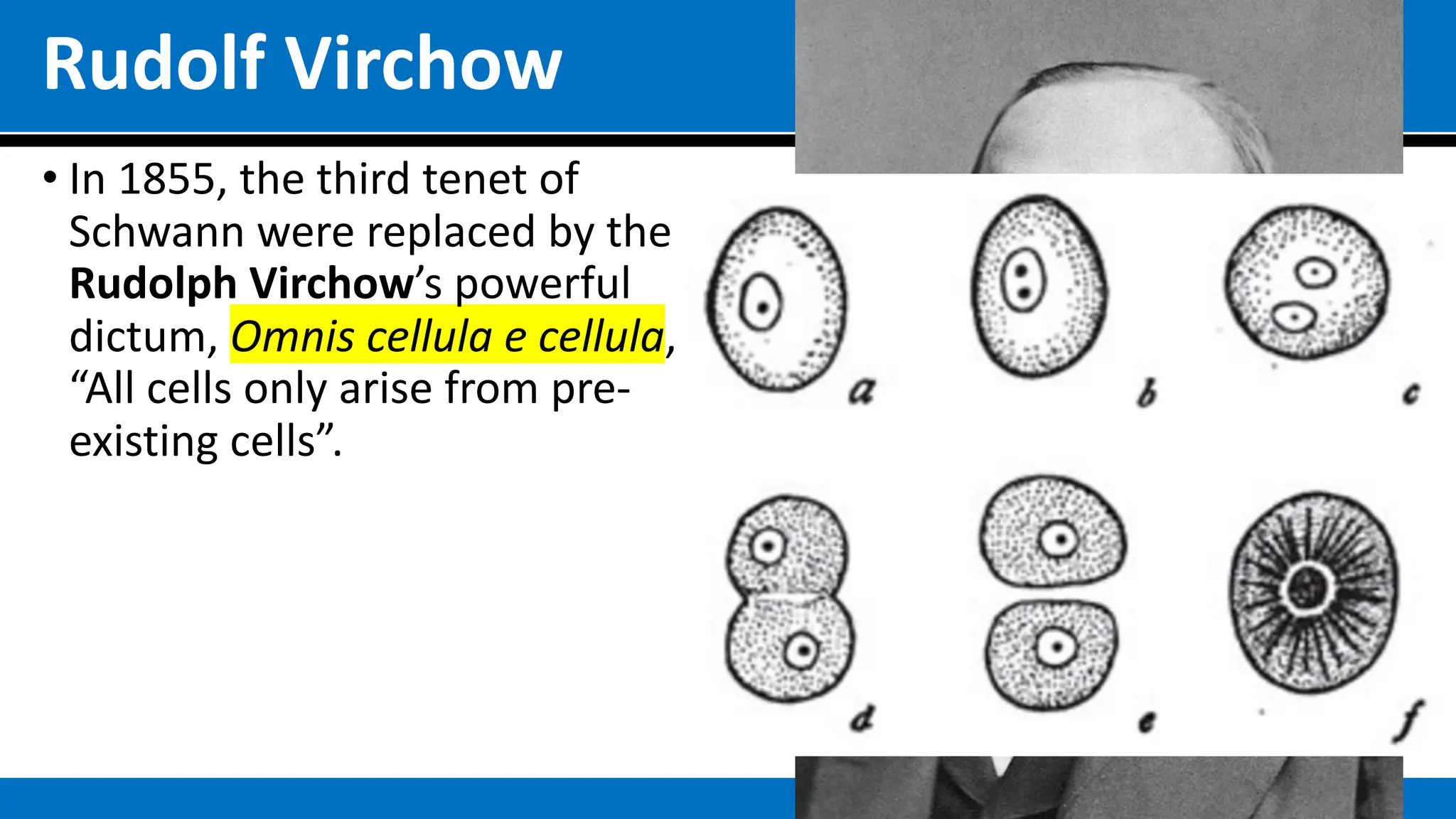
Rudolf Virchow
• In 1855, the third tenet of
Schwann were replaced by the
Rudolph Virchow’s powerful
dictum, Omnis cellula e cellula,
“All cells only arise from pre-
existing cells”.
The CELL Theory
• The discoveries made by Hooke, Leeuwenhoek, Schleiden,
Schwann, Virchow, and others led to the formulation of the cell
theory.
• This theory can be summed up into three basic components:
(1) all living things are composed of one or more cells;
(2) the cell is the basic unit of life; and
(3) all cells arise from preexisting cells.
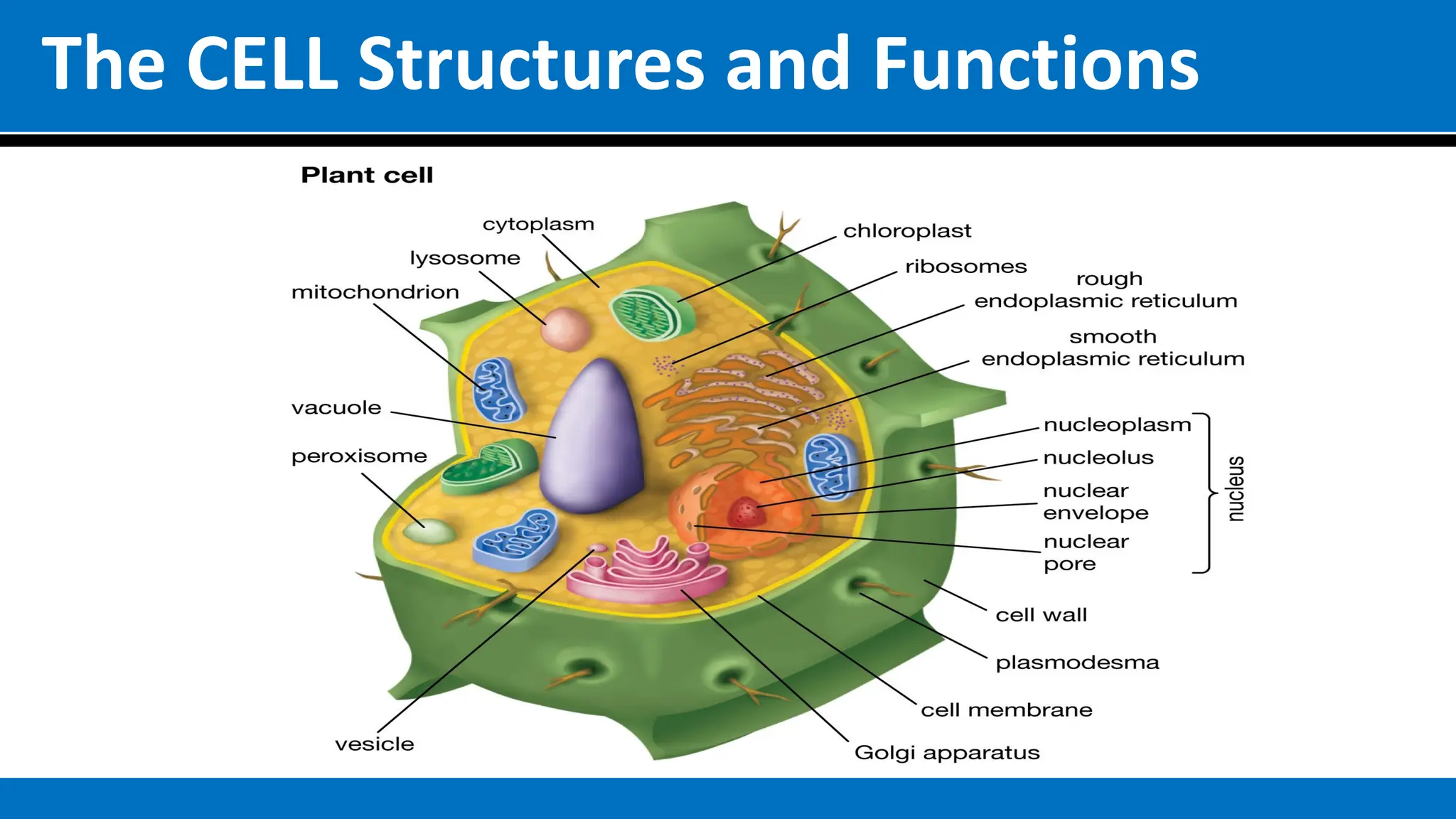
The CELL Structures and Functions
• The cells are the building blocks of life just as atoms are the
basic building blocks of all matter.
• Each cell contains materials that carry out basic life processes.
• Cell structures can only be observed under high magnification
electron microscope.
The CELL Structures and Functions
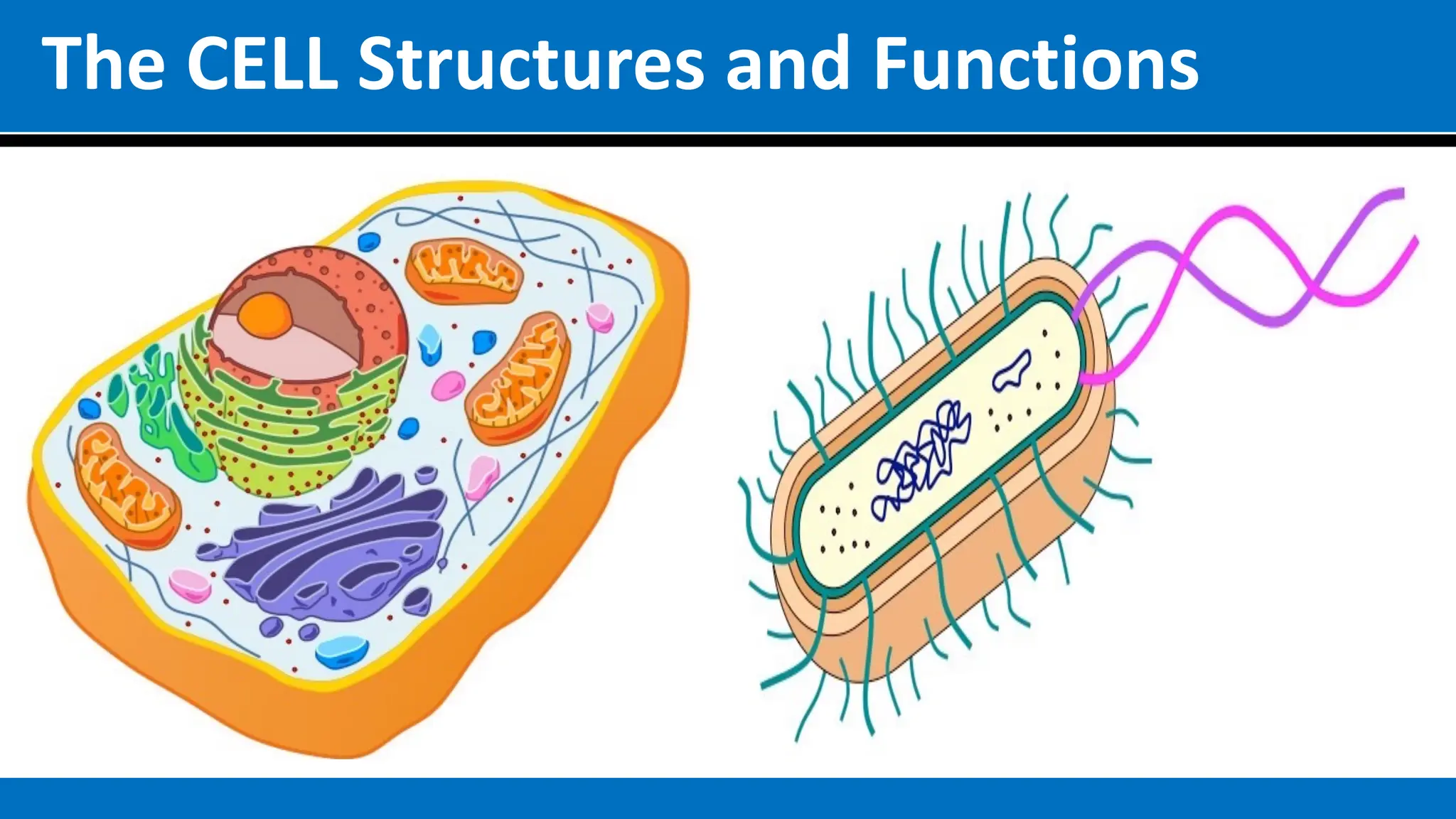
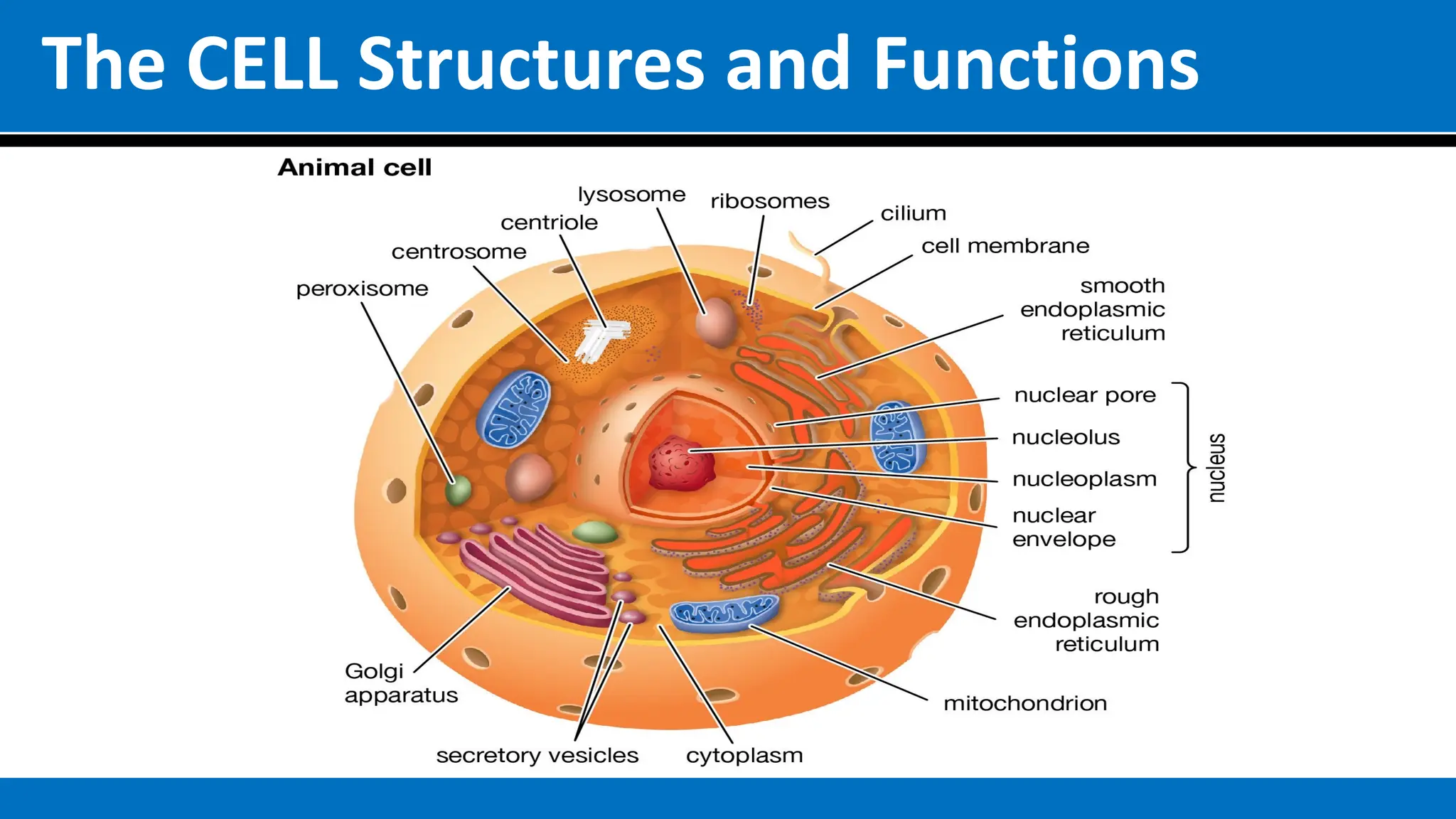
• A cell consists of three parts:
• the cell membrane,
• the nucleus, and, between the two,
• the cytoplasm.
• Within the cytoplasm lie intricate arrangements of fine fibers
and hundreds or even thousands of miniscule but distinct
structures called organelles.
The CELL Structures and Functions
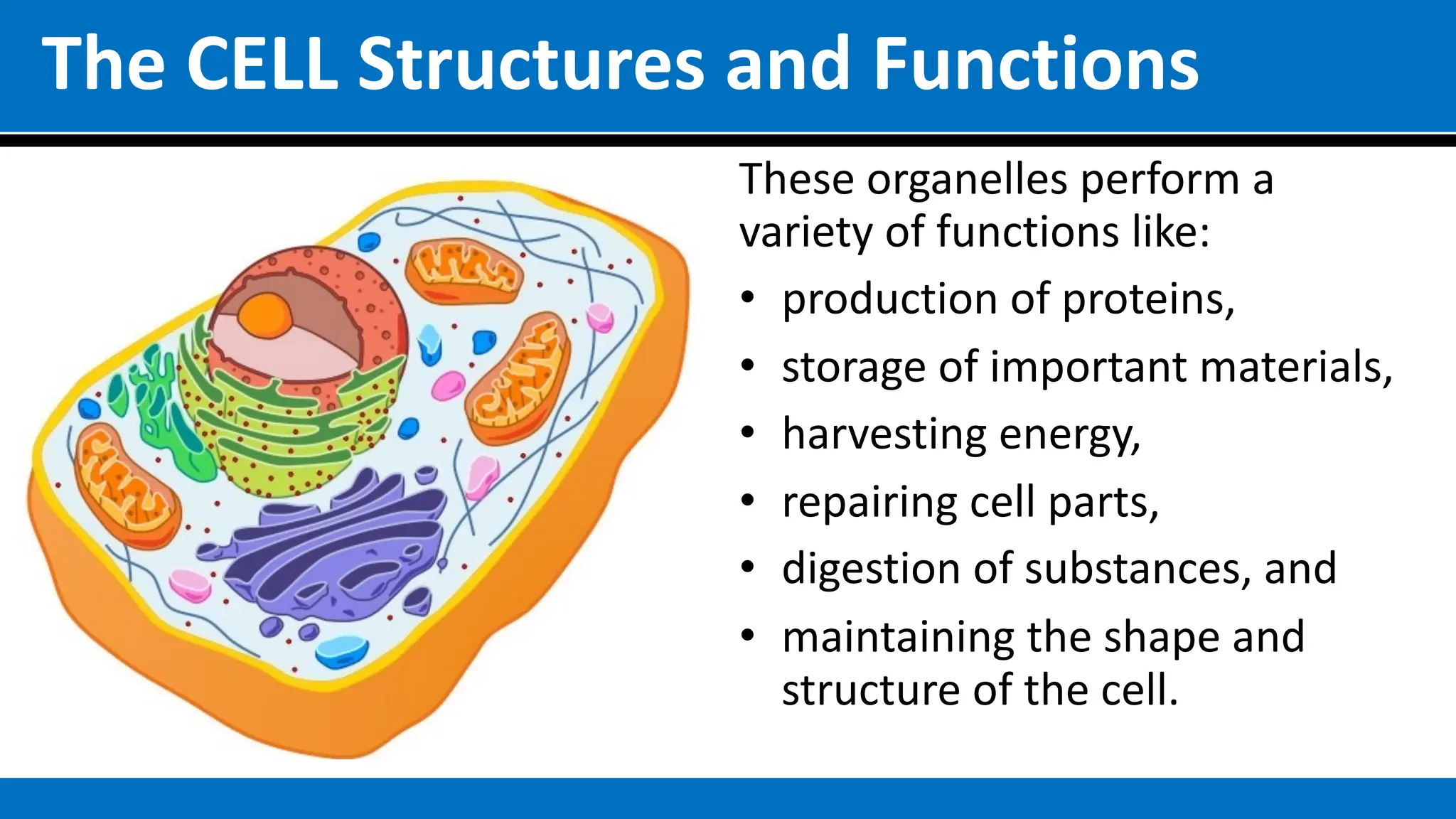
These organelles perform a
variety of functions like:
• production of proteins,
• storage of important materials,
• harvesting energy,
• repairing cell parts,
• digestion of substances, and
• maintaining the shape and
structure of the cell.
The CELL Structures and Functions
The structures and functions of the cell organelles are categorized
into four:
• Manufacturing
(Nucleus, Ribosome, Rough and Smooth ER, Golgi
apparatus)
• Breakdown (Lysosomes, Vacuoles, Peroxisomes)
• Energy Processing (Mitochondria, Chloroplasts)
• Structural Support, Movement, and Communication
(Cytoplasm, Cytoskeleton, Centrioles, Cell Membrane, Cell
Wall, Chromatin)
The CELL Structures and Functions
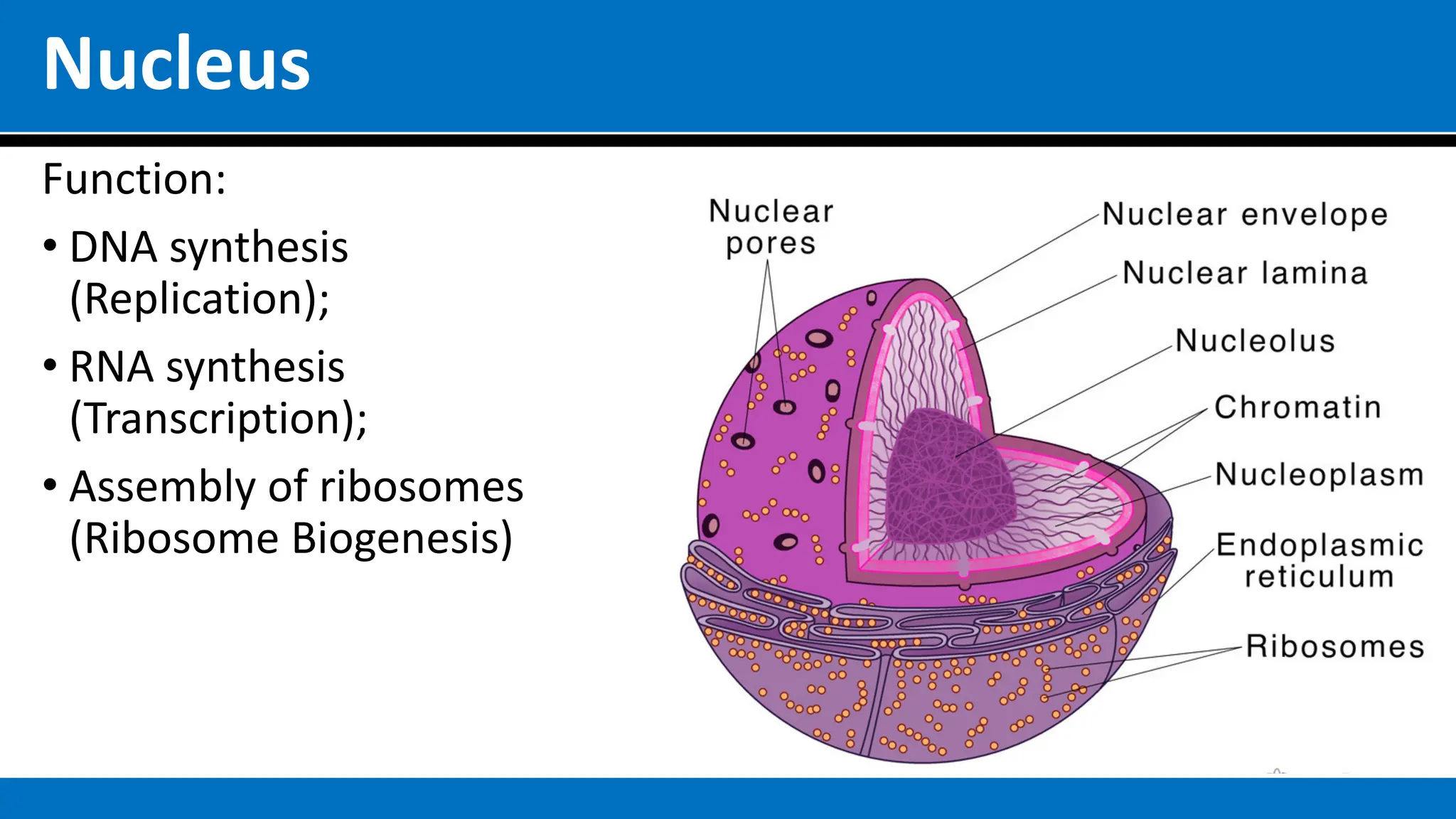
Nucleus
Function:
• DNA synthesis
(Replication);
• RNA synthesis
(Transcription);
• Assembly of ribosomes
(Ribosome Biogenesis)
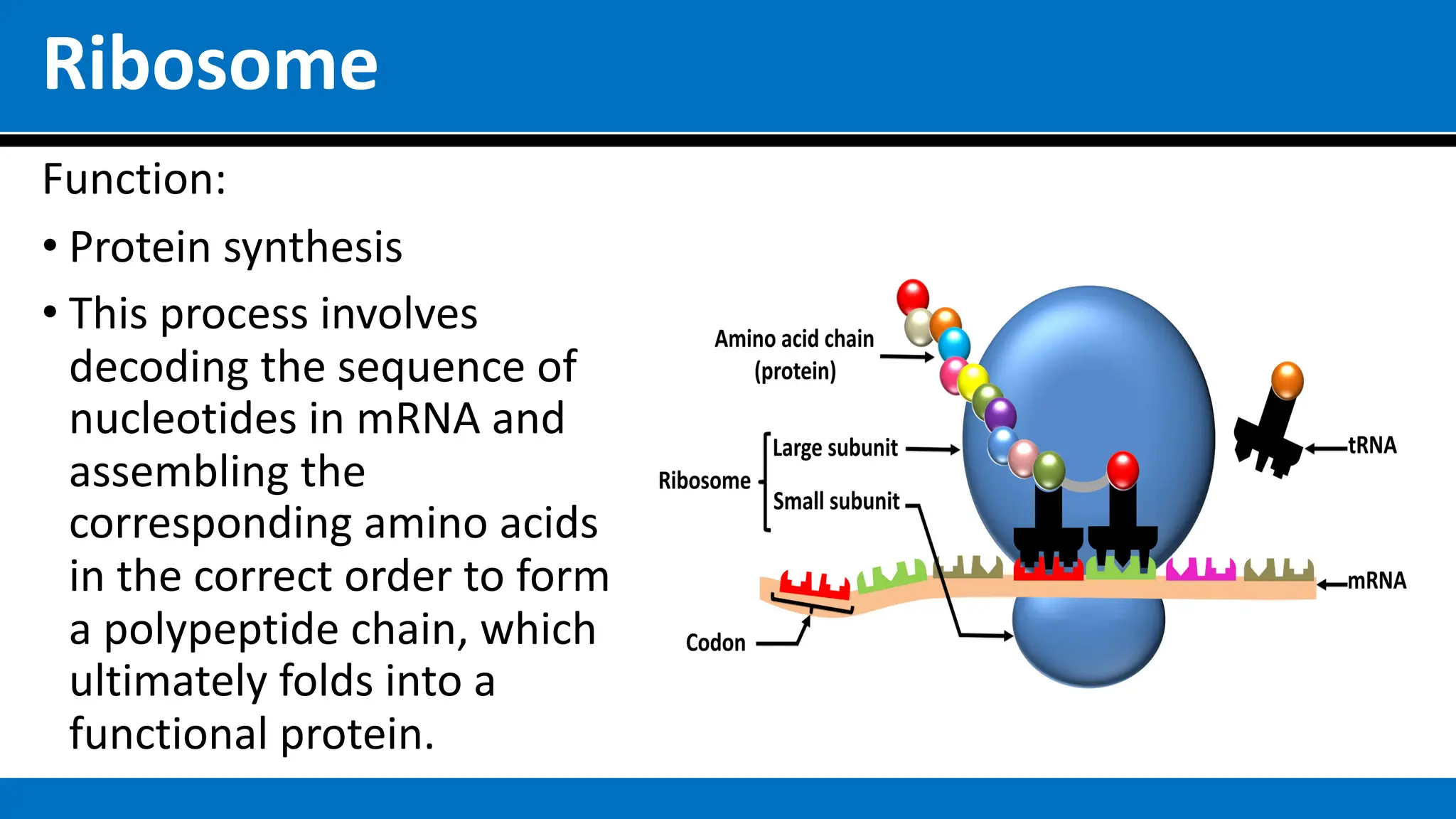
Ribosome
Function:
• Protein synthesis
• This process involves
decoding the sequence of
nucleotides in mRNA and
assembling the
corresponding amino acids
in the correct order to form
a polypeptide chain, which
ultimately folds into a
functional protein.
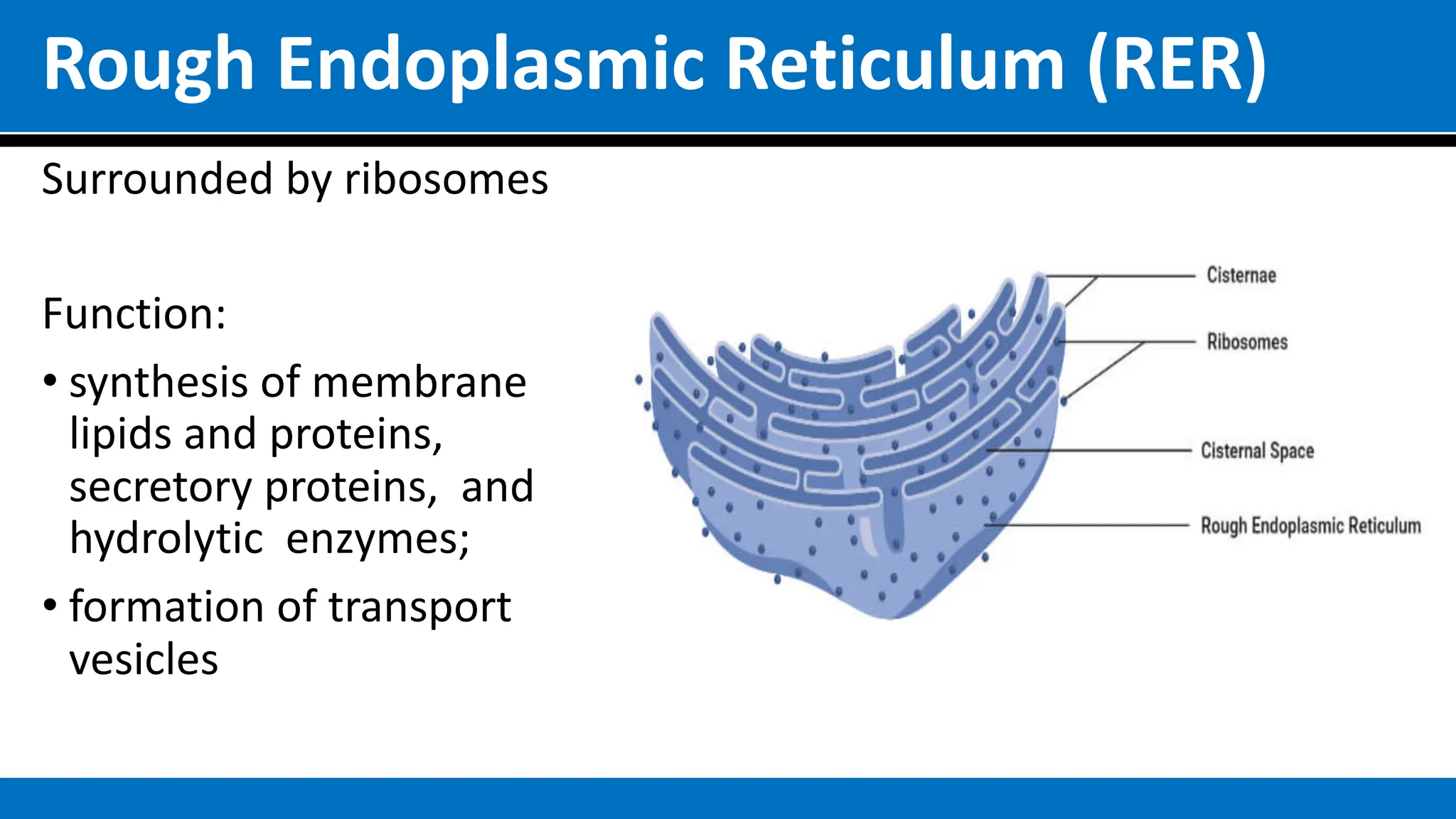
Rough Endoplasmic Reticulum (RER)
Surrounded by ribosomes
Function:
• synthesis of membrane
lipids and proteins,
secretory proteins, and
hydrolytic enzymes;
• formation of transport
vesicles
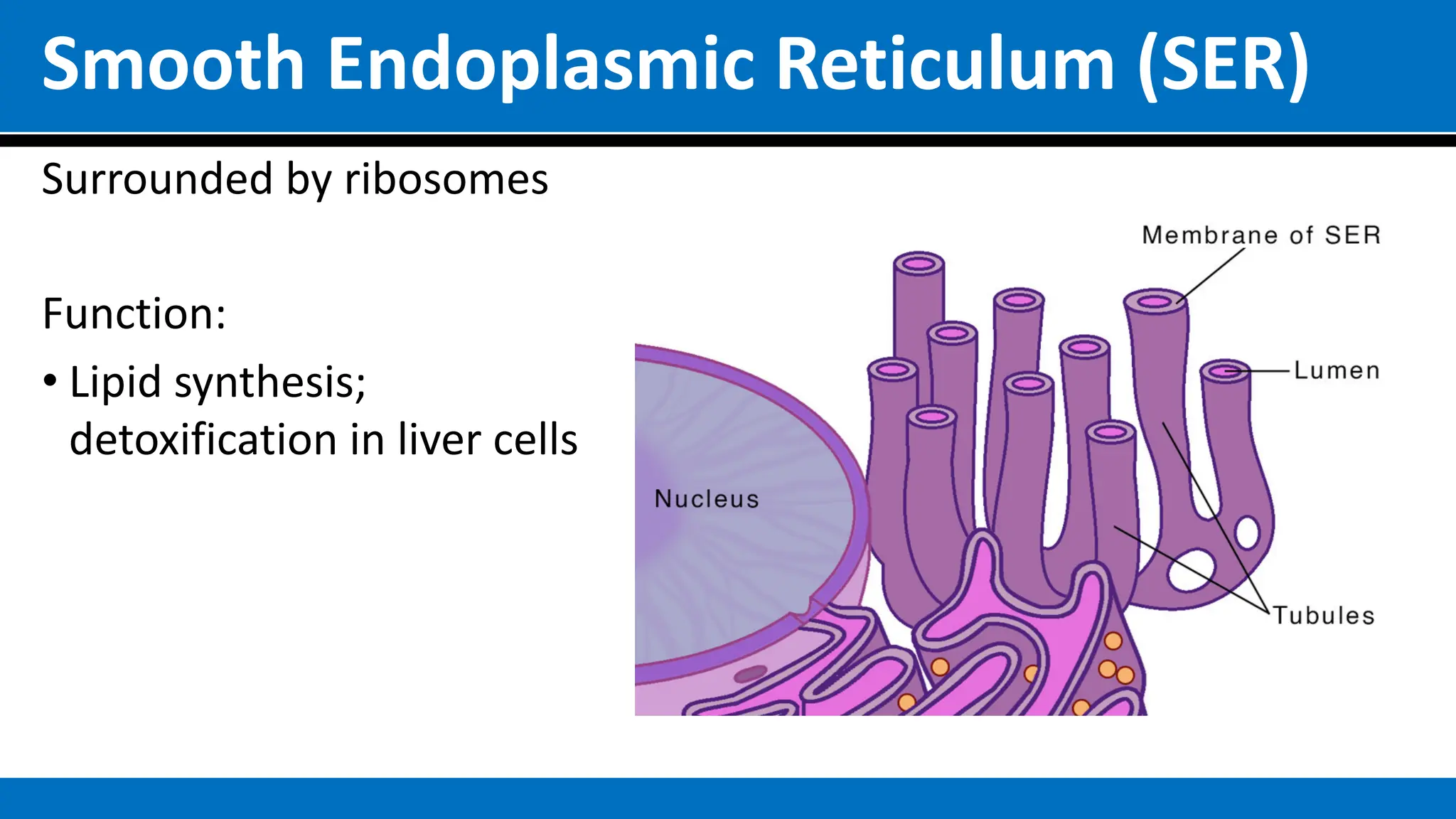
Smooth Endoplasmic Reticulum (SER)
Surrounded by ribosomes
Function:
• Lipid synthesis;
detoxification in liver cells
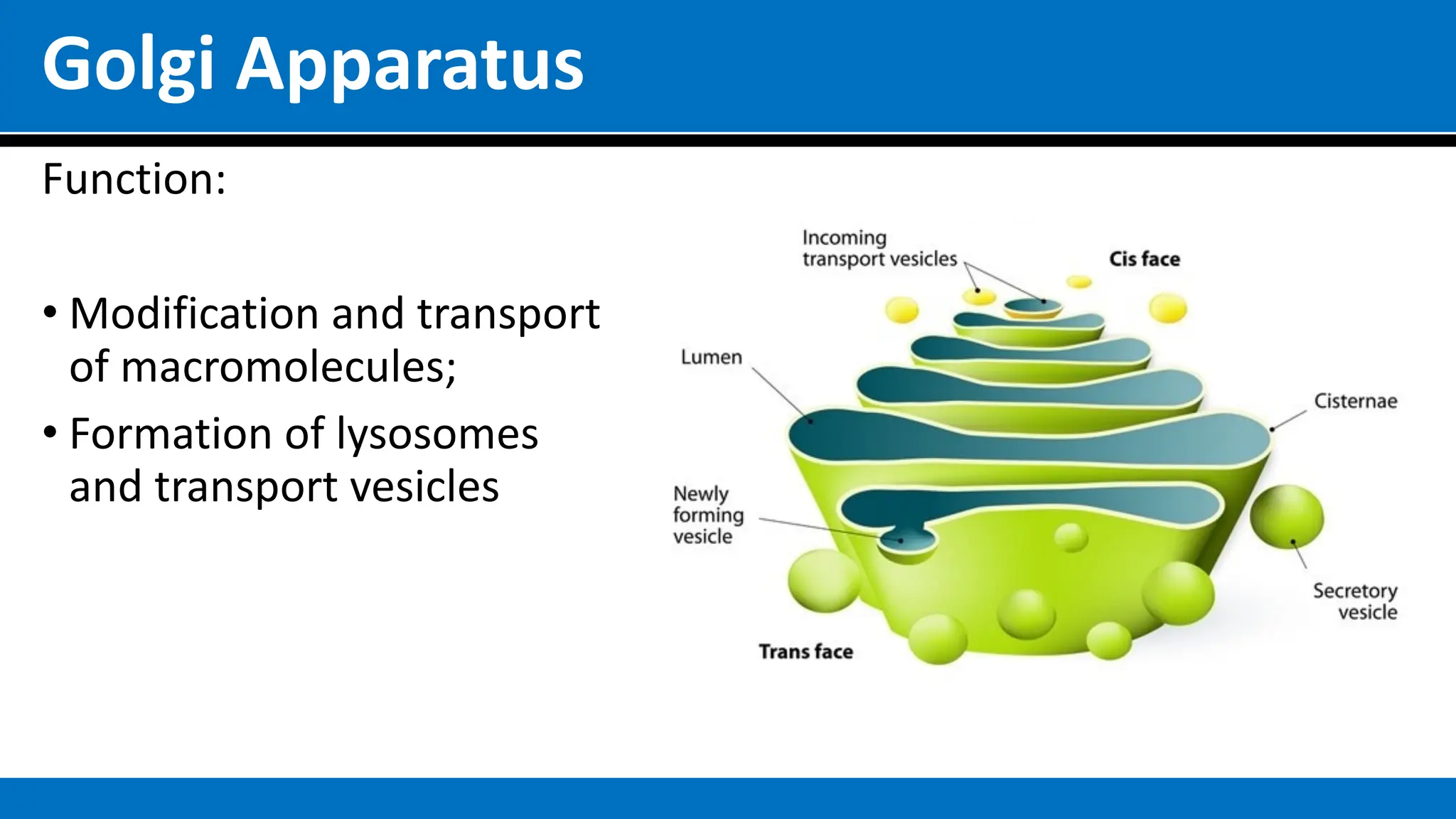
Golgi Apparatus
Function:
• Modification and transport
of macromolecules;
• Formation of lysosomes
and transport vesicles
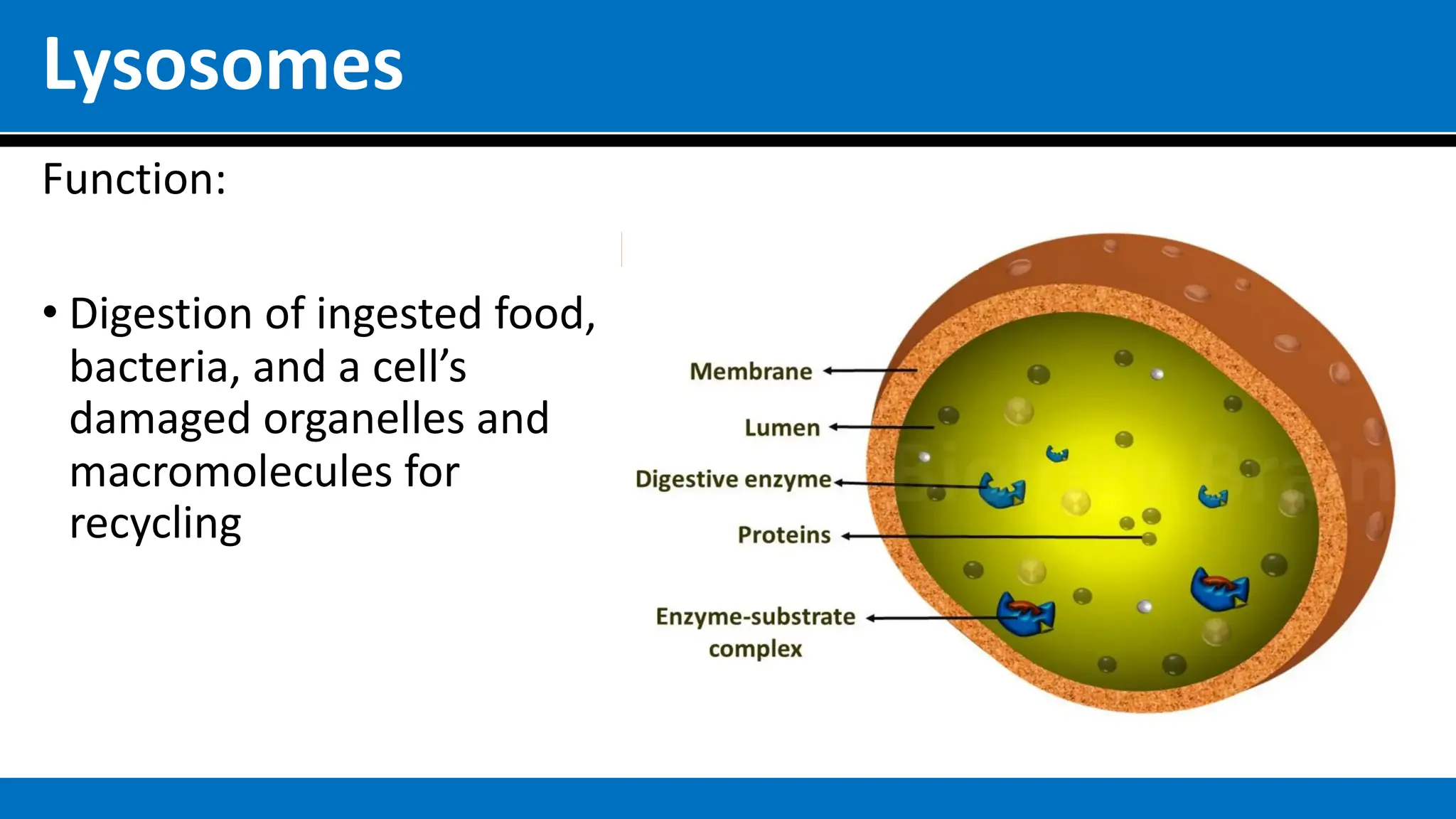
Lysosomes
Function:
• Digestion of ingested food,
bacteria, and a cell’s
damaged organelles and
macromolecules for
recycling
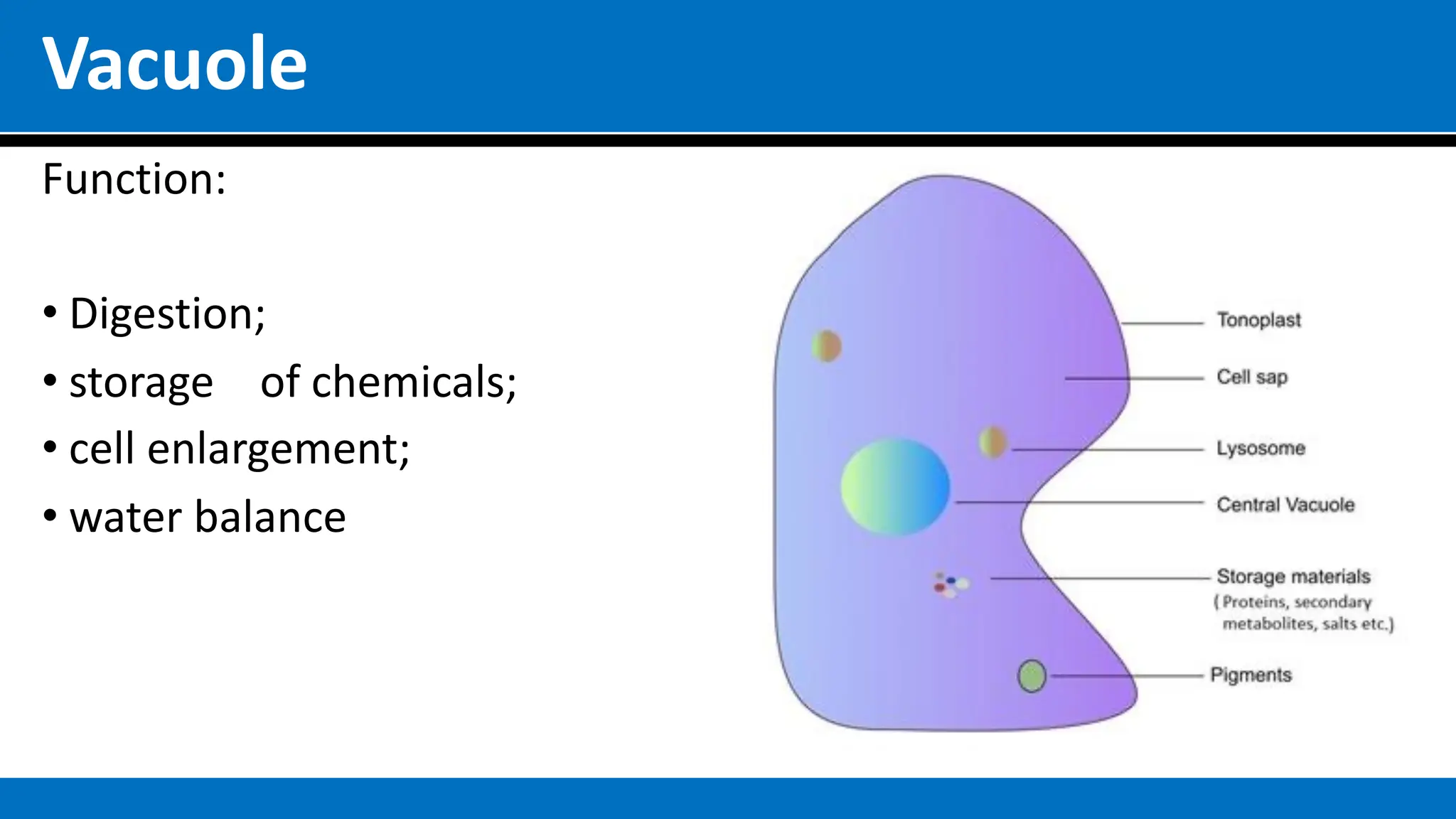
Vacuole
Function:
• Digestion;
• storage of chemicals;
• cell enlargement;
• water balance
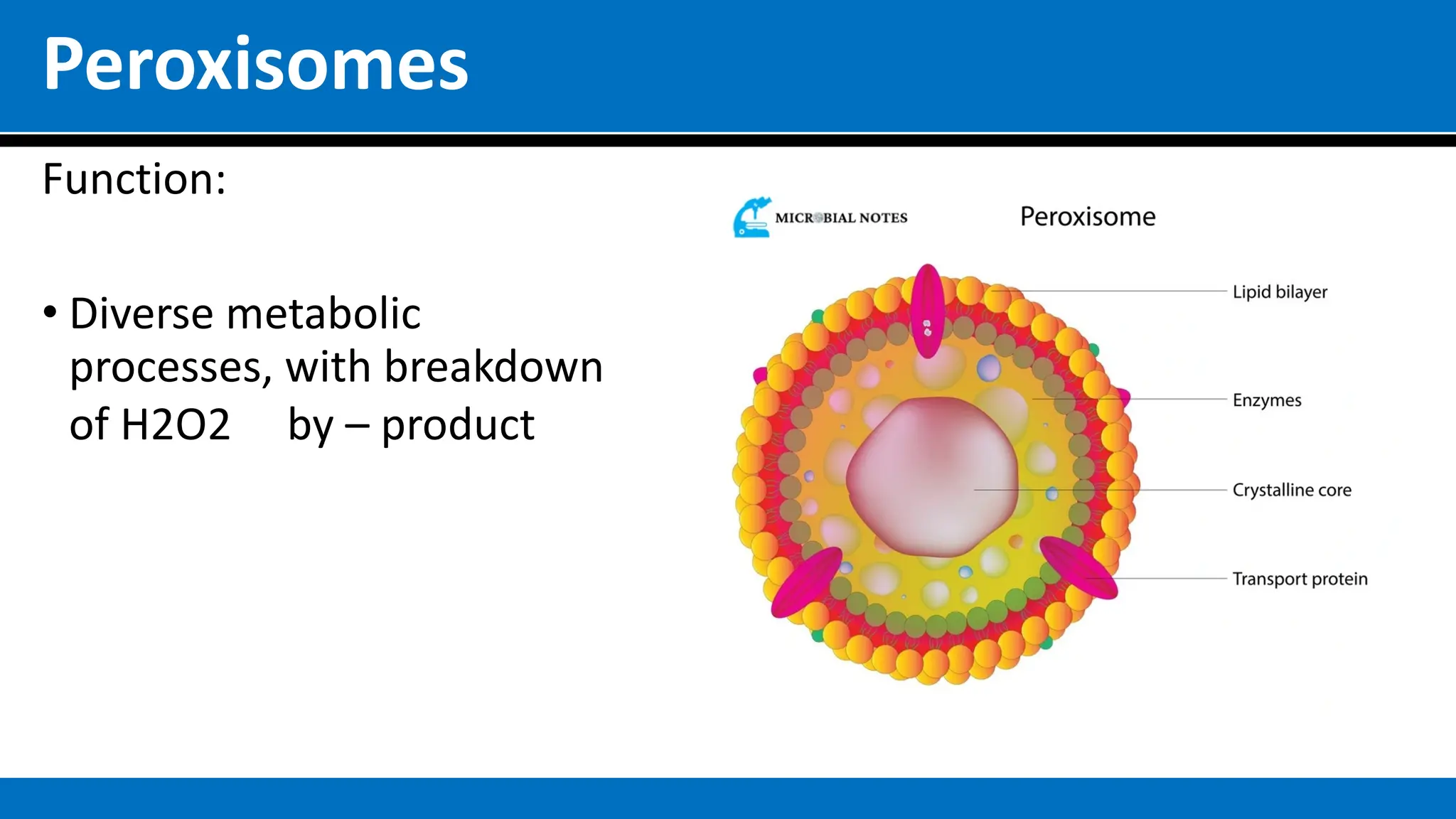
Peroxisomes
Function:
• Diverse metabolic
processes, with breakdown
of H2O2 by – product
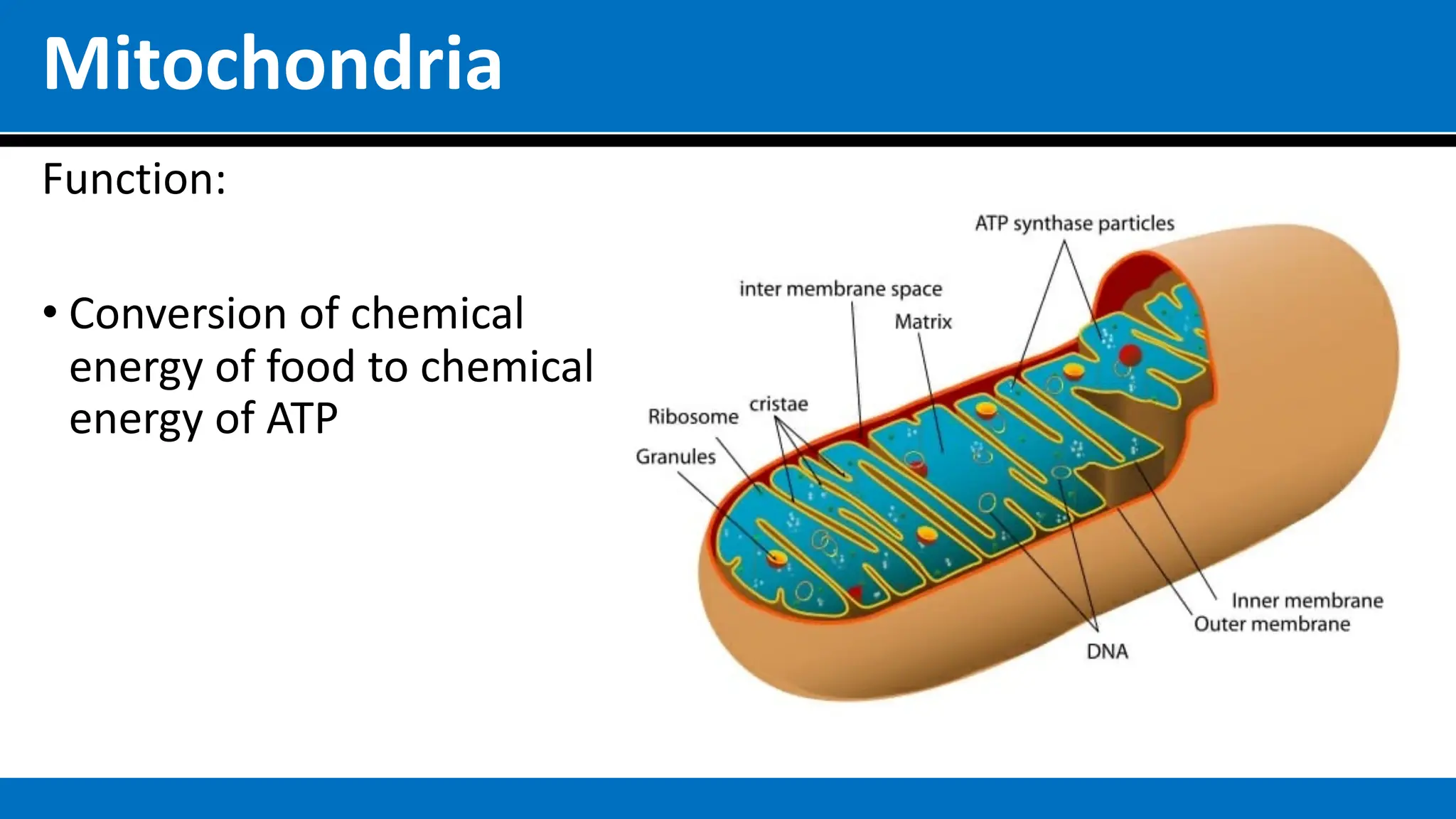
Mitochondria
Function:
• Conversion of chemical
energy of food to chemical
energy of ATP
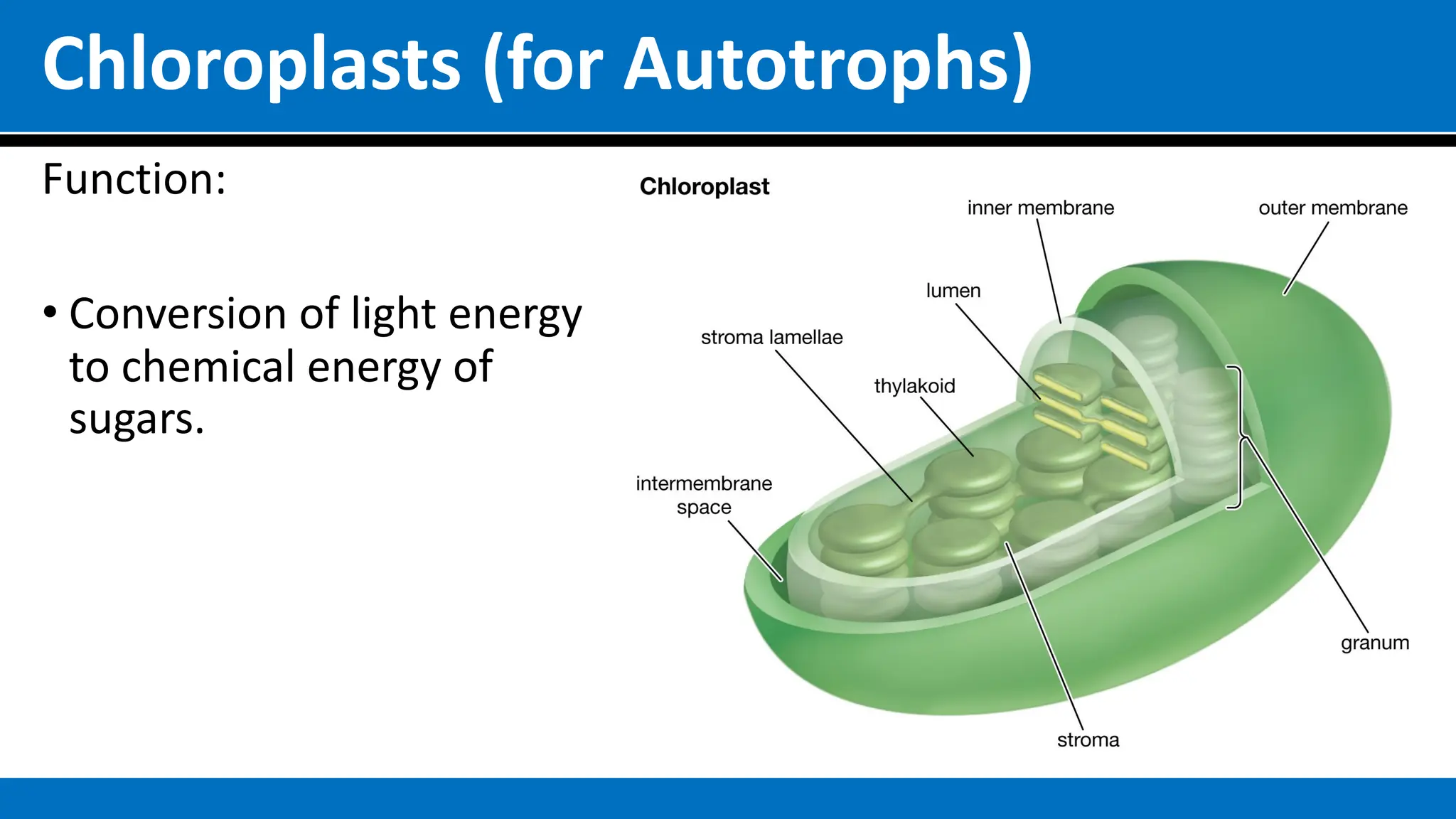
Chloroplasts (for Autotrophs)
Function:
• Conversion of light energy
to chemical energy of
sugars.
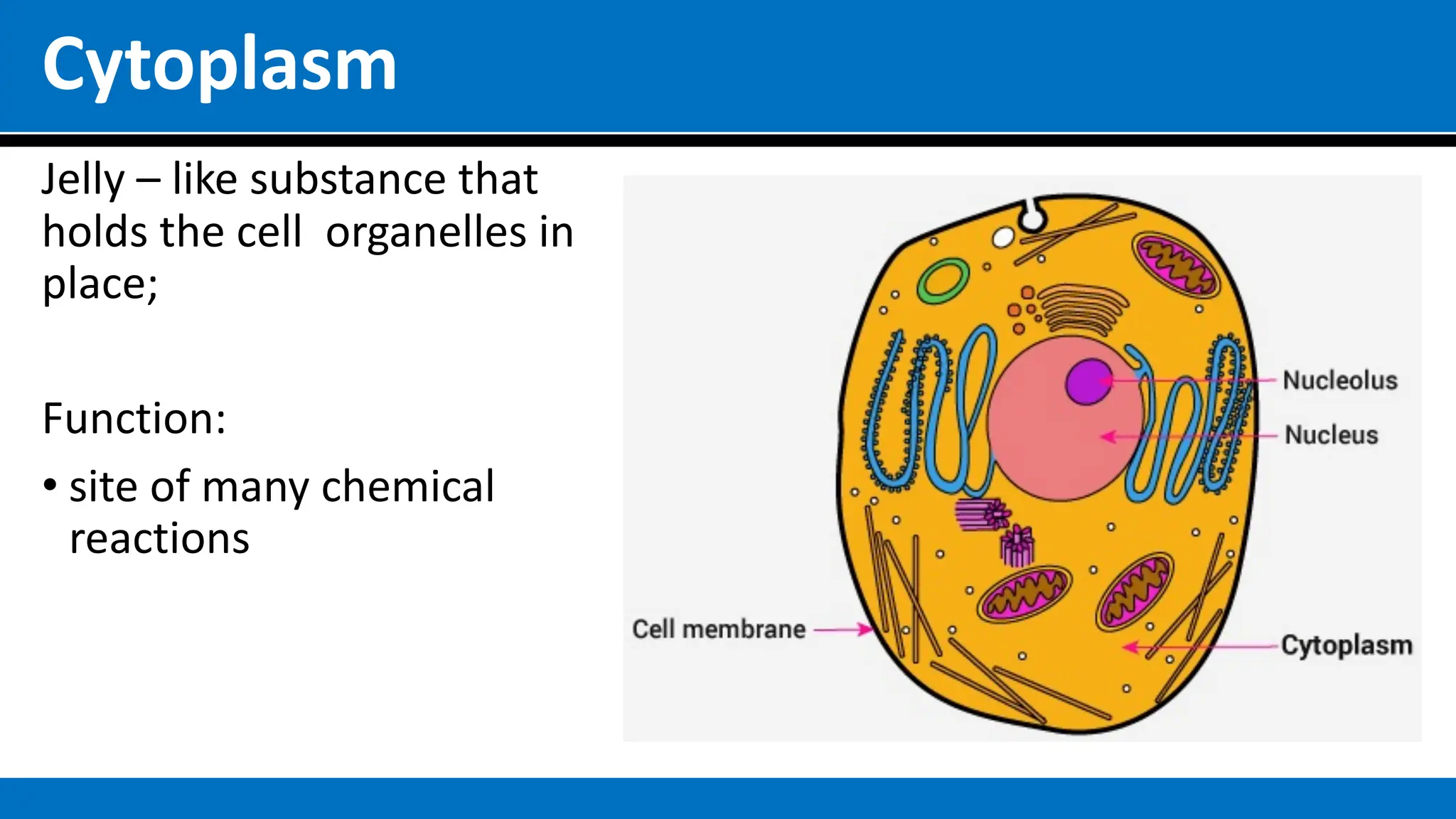
Cytoplasm
Jelly – like substance that
holds the cell organelles in
place;
Function:
• site of many chemical
reactions
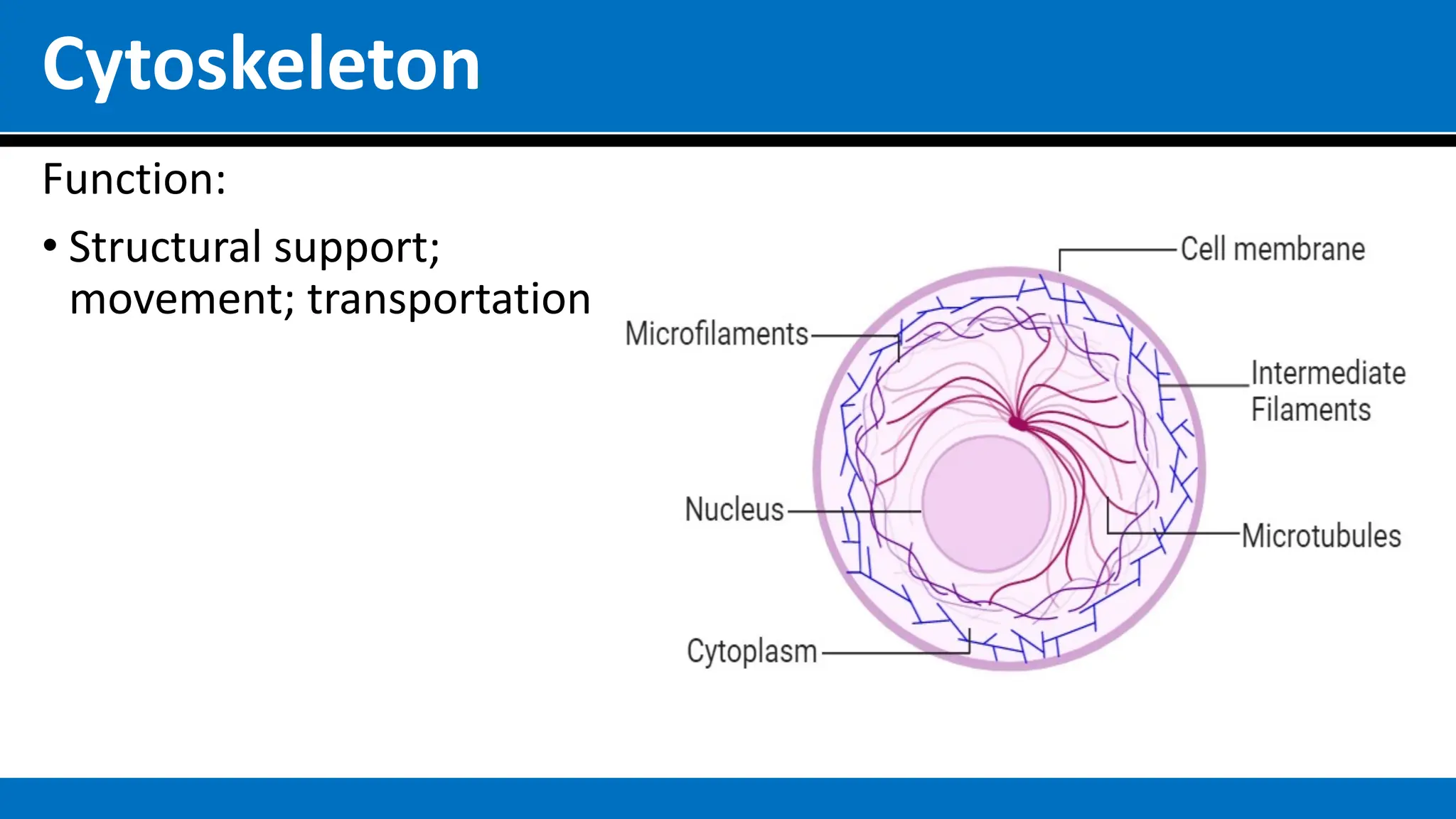
Cytoskeleton
Function:
• Structural support;
movement; transportation
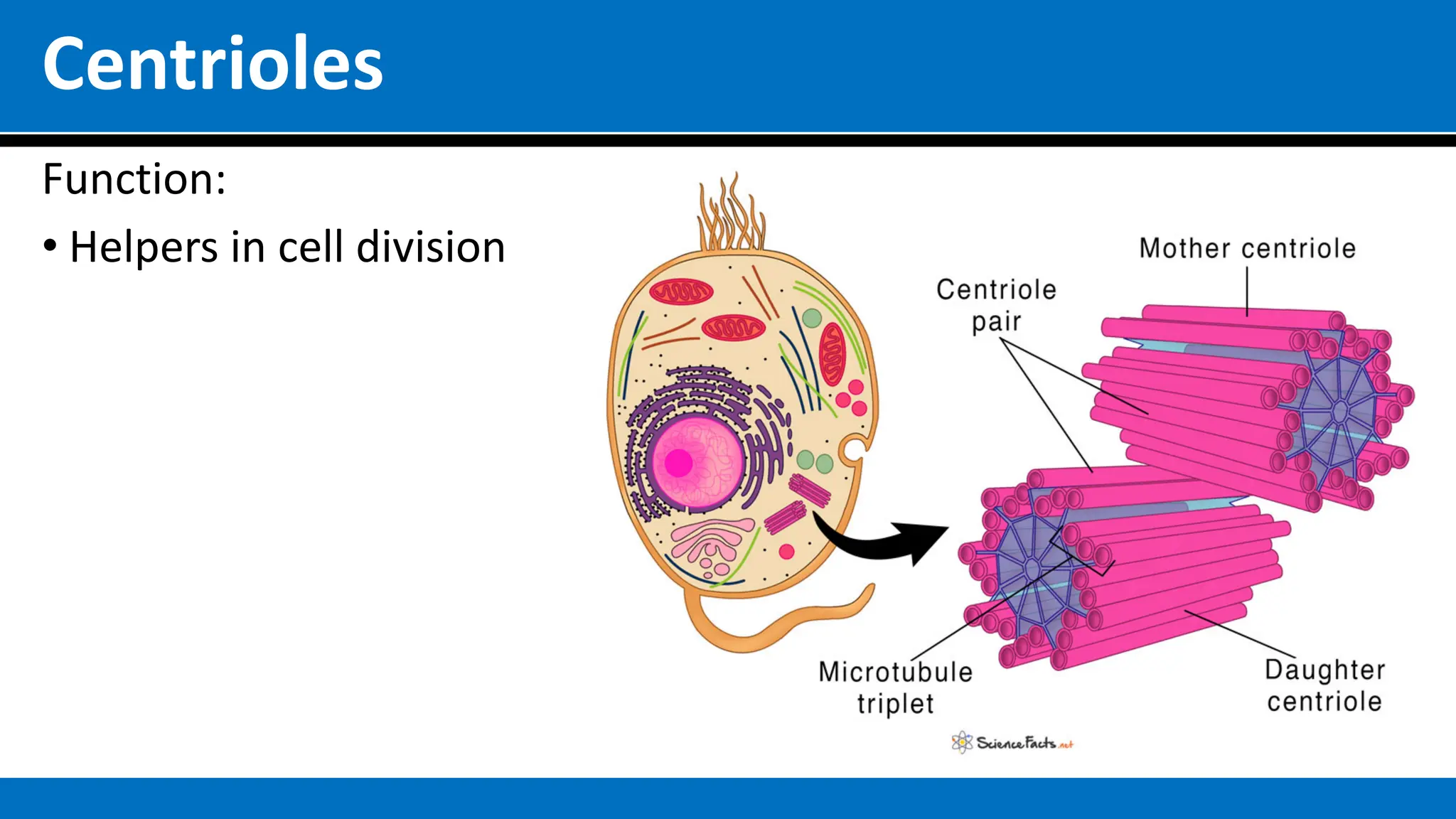
Centrioles
Function:
• Helpers in cell division
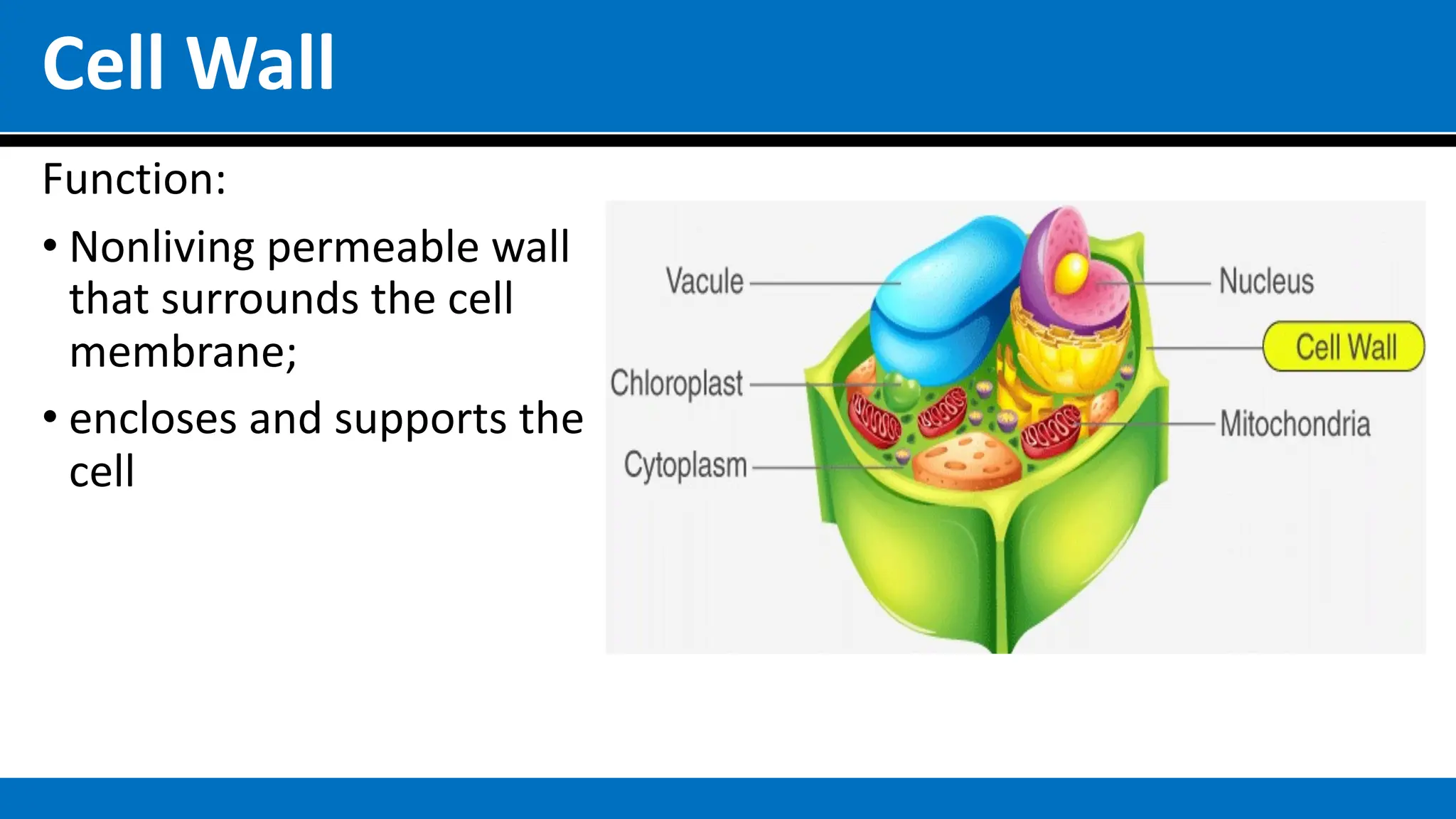
Cell Wall
Function:
• Nonliving permeable wall
that surrounds the cell
membrane;
• encloses and supports the
cell
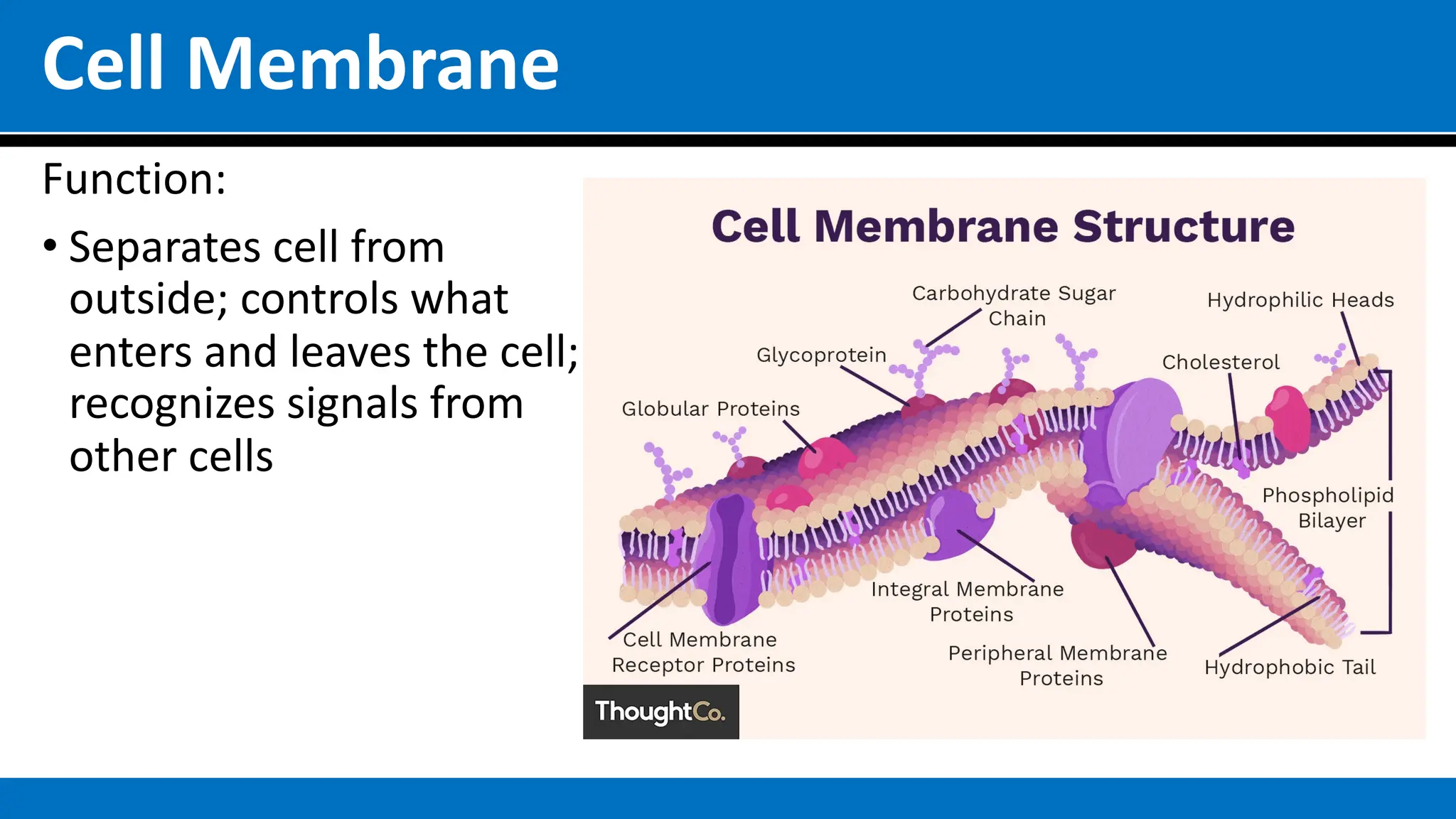
Cell Membrane
Function:
• Separates cell from
outside; controls what
enters and leaves the cell;
recognizes signals from
other cells
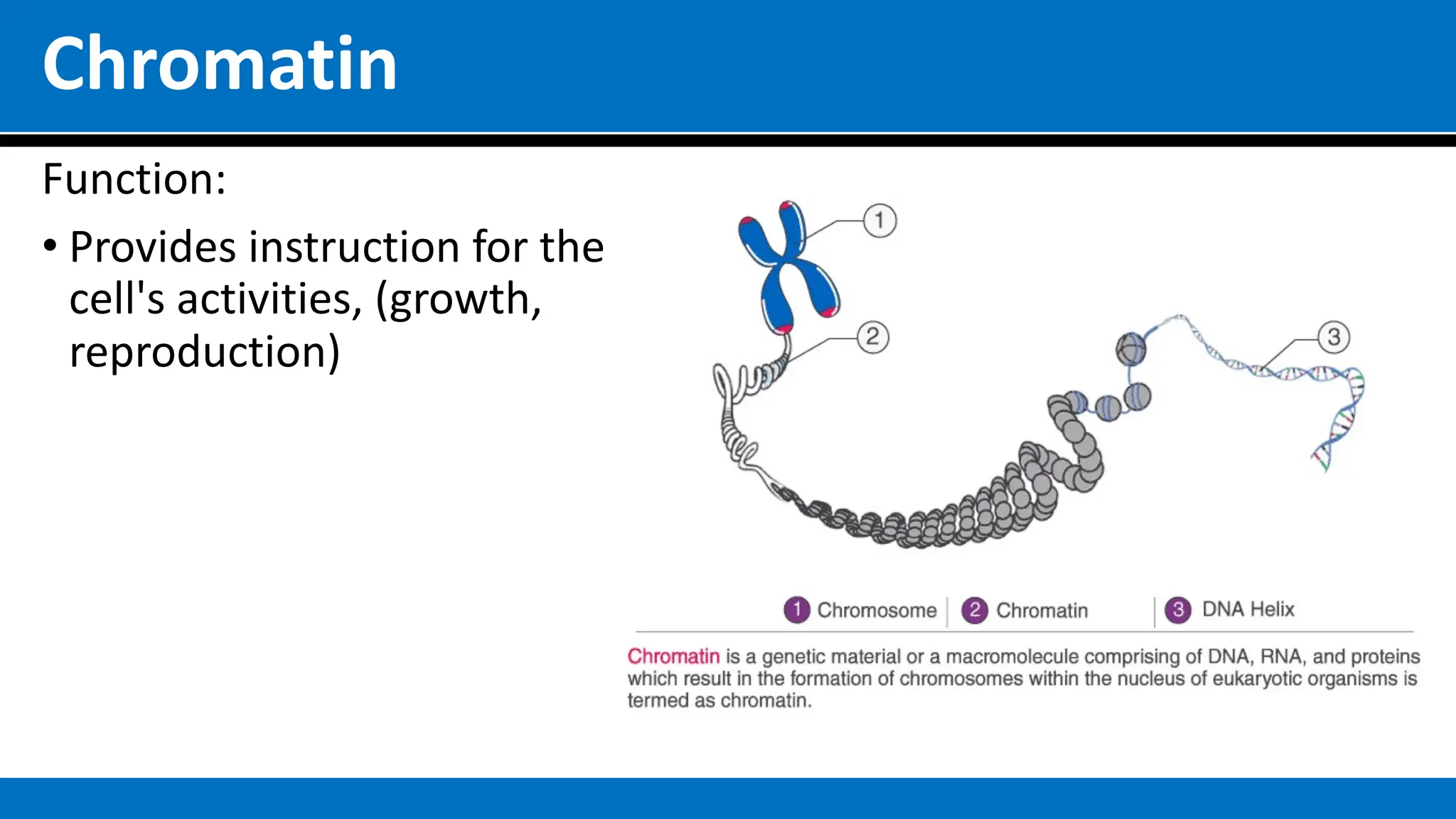
Chromatin
Function:
• Provides instruction for the
cell's activities, (growth,
reproduction)
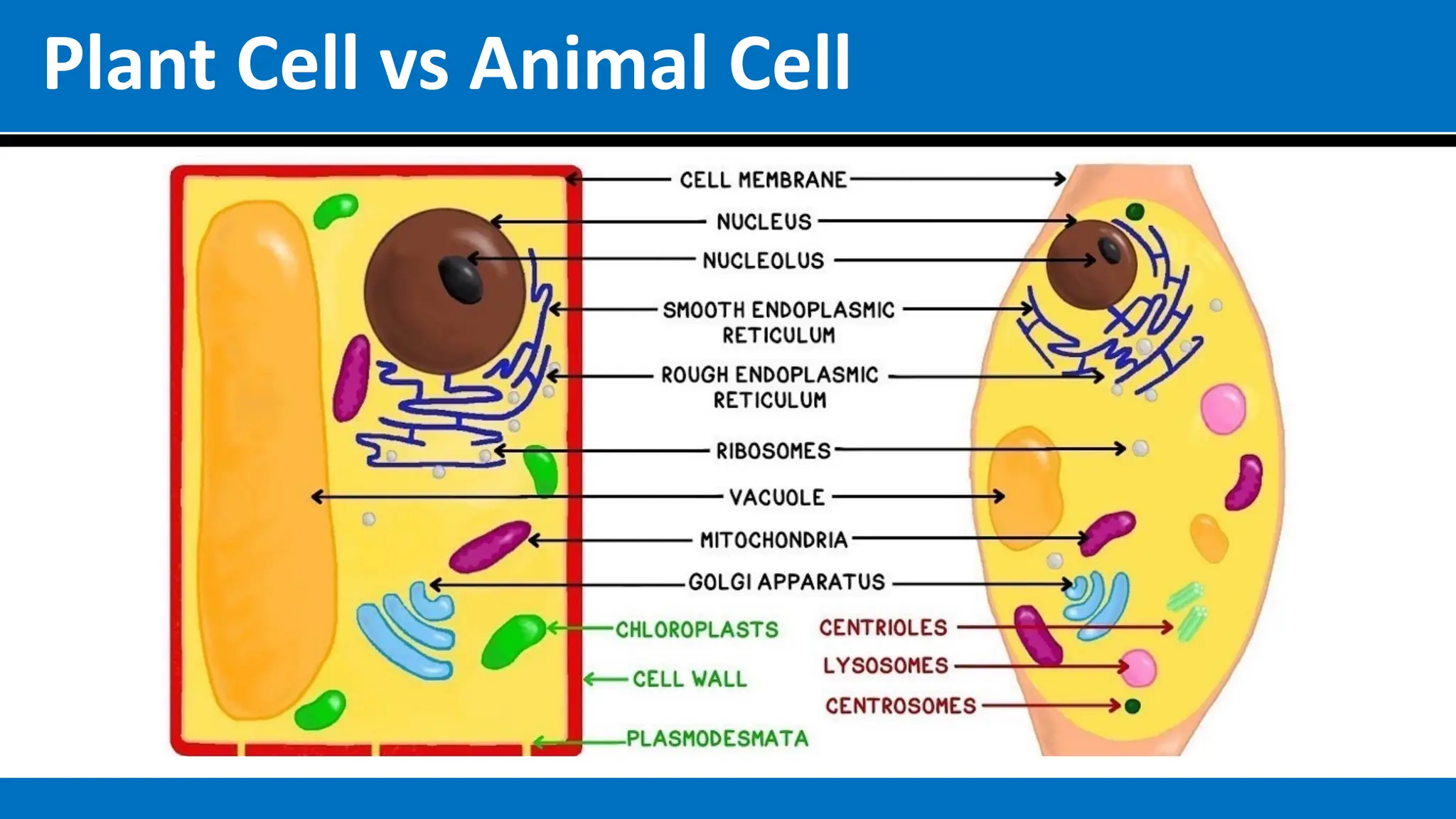
Plant Cell vs Animal Cell

PPT1 Cell Theory, Structure and Function.pdf

  • 2.
    Grading System General Biologyas a Specialized Subject: Written Works – 25% Performance Tasks – 45% Quarterly Assessment – 30% Total – 100%
  • 3.
    1st Quarter TOPICS •The Cell Ø Cell Theory Ø The structure and function of major and subcellular organelles Ø Prokaryotic and Eukaryotic cells Ø Cell types and their functions (Plant and Animal cell) Ø Cell modifications and their specialized functions
  • 4.
    1st Quarter TOPICS •The Cell Ø Cell Cycle v Mitosis v Meiosis v Disorders and diseases that result from the malfunction of the cell during the cell cycle Ø Transport Mechanisms v Simple Diffusion v Facilitated Transport v Active Transport v Bulk/Vesicular Transport
  • 5.
    1st Quarter TOPICS •Biological Molecules Ø Structures and Functions of Biological Molecules v Carbohydrates v Lipids v Proteins v Enzymes v Nucleic Acids
  • 6.
    2nd Quarter TOPICS •Energy Transformation Ø ATP- ADP Cycle Ø Photosynthesis Ø Respiration
  • 7.
    Subject Description • BiologyI is a Science, Technology, Engineering and Mathematics (STEM) Specialized Subject taken in the first half of Grade 11. • Learners go on a journey geared toward the deeper understanding and appreciation of life processes at the cellular and molecular levels previously introduced in Grades 7-10. They will also apply basic chemistry and physics principles as they examine the transformation of energy in organisms.
  • 8.
    Let’s Revisit BIOLOGYas a subject • Reflect upon your past experiences during your junior high school years when you were exposed to lessons focused on biology. • On a 1 whole yellow paper, compile a comprehensive list of the biology topics that you can still recall from your junior high school education.
  • 9.
    CELL: THEORY, STRUCTUREAND FUNCTION MELC’s 1. Explain the postulates of the cell theory. (STEM_BIO11/12-Ia-c-1) 2. Describe the structure and function of major and subcellular organelles. (STEM_BIO11/12-Ia-c-2)
  • 10.
    What are CELLS? •Cells are the basic building blocks of all living things. • The human body is composed of trillions of cells. They provide structure for the body, take in nutrients from food, convert those nutrients into energy, and carry out specialized functions. • Cells also contain the body’s hereditary material and can make copies of themselves.
  • 11.
    The CELL Theory •How/in what way can we observe cells? Advanced Compound Microscope Magnification of up to 1000x
  • 12.
    The CELL Theory •Who invented the first microscope? Zacharias Janssen – 1600 -Dutch spectacle maker
  • 13.
    The Scientists behindthe CELL Theory • Robert Hooke • Antonie van Leeuwenhoek • Robert Brown • Matthias Schleiden • Theodor Schwann • Rudolph Virchow
  • 14.
    Robert Hooke • Advancementsin the microscope were crucial for the discovery of cells. • Robert Hooke improved the compound microscope in 1665. • Hooke's microscope had three lenses and a stage light for illumination and magnification. Robert Hooke
  • 15.
    Robert Hooke • Hookeobserved something fascinating when he examined cork under the microscope. • Hooke documented his observations in his book, Micrographia. • He referred to the structures in cork as "cells" due to their resemblance to monastery cells. Robert Hooke’s Microscope
  • 16.
    Antonie van Leeuwenhoek •In 1674 Dutch scientist Antonie van Leeuwenhoek published his observations on tiny living organisms which he named animalcules.
  • 17.
    Antonie van Leeuwenhoek •It was believed that Leeuwenhoek was the first to observe under his microscope the structure of an Erythrocyte of different animals as well as a sperm cell.
  • 18.
    Robert Brown • Oneof the leading botanists in his time, Robert Brown in 1831 was able to compare diverse kinds of plant specimens under the microscope. • He markedly indicated that there is a common thing about them- they are all composed of cells, and inside the cell is a dark dense spot which he termed as the nucleus.
  • 19.
    Matthias Schleiden • Heis a German botanist who in 1838 concluded that all plant parts are made of cells.
  • 20.
    Theodor Schwann • Heis a physiologist and histologist and a close friend of Schleiden. • In 1839, he stated that all animal tissues are composed of cells, too.
  • 21.
    Rudolf Virchow • In1855, the third tenet of Schwann were replaced by the Rudolph Virchow’s powerful dictum, Omnis cellula e cellula, “All cells only arise from pre- existing cells”.
  • 22.
    The CELL Theory •The discoveries made by Hooke, Leeuwenhoek, Schleiden, Schwann, Virchow, and others led to the formulation of the cell theory. • This theory can be summed up into three basic components: (1) all living things are composed of one or more cells; (2) the cell is the basic unit of life; and (3) all cells arise from preexisting cells.
  • 23.
    The CELL Structuresand Functions • The cells are the building blocks of life just as atoms are the basic building blocks of all matter. • Each cell contains materials that carry out basic life processes. • Cell structures can only be observed under high magnification electron microscope.
  • 24.
    The CELL Structuresand Functions
  • 25.
    The CELL Structuresand Functions • A cell consists of three parts: • the cell membrane, • the nucleus, and, between the two, • the cytoplasm. • Within the cytoplasm lie intricate arrangements of fine fibers and hundreds or even thousands of miniscule but distinct structures called organelles.
  • 26.
    The CELL Structuresand Functions These organelles perform a variety of functions like: • production of proteins, • storage of important materials, • harvesting energy, • repairing cell parts, • digestion of substances, and • maintaining the shape and structure of the cell.
  • 27.
    The CELL Structuresand Functions The structures and functions of the cell organelles are categorized into four: • Manufacturing (Nucleus, Ribosome, Rough and Smooth ER, Golgi apparatus) • Breakdown (Lysosomes, Vacuoles, Peroxisomes) • Energy Processing (Mitochondria, Chloroplasts) • Structural Support, Movement, and Communication (Cytoplasm, Cytoskeleton, Centrioles, Cell Membrane, Cell Wall, Chromatin)
  • 28.
    The CELL Structuresand Functions
  • 29.
    The CELL Structuresand Functions
  • 30.
    Nucleus Function: • DNA synthesis (Replication); •RNA synthesis (Transcription); • Assembly of ribosomes (Ribosome Biogenesis)
  • 31.
    Ribosome Function: • Protein synthesis •This process involves decoding the sequence of nucleotides in mRNA and assembling the corresponding amino acids in the correct order to form a polypeptide chain, which ultimately folds into a functional protein.
  • 32.
    Rough Endoplasmic Reticulum(RER) Surrounded by ribosomes Function: • synthesis of membrane lipids and proteins, secretory proteins, and hydrolytic enzymes; • formation of transport vesicles
  • 33.
    Smooth Endoplasmic Reticulum(SER) Surrounded by ribosomes Function: • Lipid synthesis; detoxification in liver cells
  • 34.
    Golgi Apparatus Function: • Modificationand transport of macromolecules; • Formation of lysosomes and transport vesicles
  • 35.
    Lysosomes Function: • Digestion ofingested food, bacteria, and a cell’s damaged organelles and macromolecules for recycling
  • 36.
    Vacuole Function: • Digestion; • storageof chemicals; • cell enlargement; • water balance
  • 37.
    Peroxisomes Function: • Diverse metabolic processes,with breakdown of H2O2 by – product
  • 38.
    Mitochondria Function: • Conversion ofchemical energy of food to chemical energy of ATP
  • 39.
    Chloroplasts (for Autotrophs) Function: •Conversion of light energy to chemical energy of sugars.
  • 40.
    Cytoplasm Jelly – likesubstance that holds the cell organelles in place; Function: • site of many chemical reactions
  • 41.
  • 42.
  • 43.
    Cell Wall Function: • Nonlivingpermeable wall that surrounds the cell membrane; • encloses and supports the cell
  • 44.
    Cell Membrane Function: • Separatescell from outside; controls what enters and leaves the cell; recognizes signals from other cells
  • 45.
    Chromatin Function: • Provides instructionfor the cell's activities, (growth, reproduction)
  • 46.
    Plant Cell vsAnimal Cell