DAILY LESSON
LOG
School SCHOOL Grade Level
Teacher
SHS Teacher II
Learning Area INTRODUCTION TO THE PHILOSOPHY OF THE
HUMAN PERSON
Teaching Dates
and Time
SEPTEMBER 11- SEPt 15 SEMESTER 1ST
SEMESTER / WEEK 3
Checked by: Master Teacher
Noted by:
SHS ASSISTANT SCHOOL PRINCIPAL II
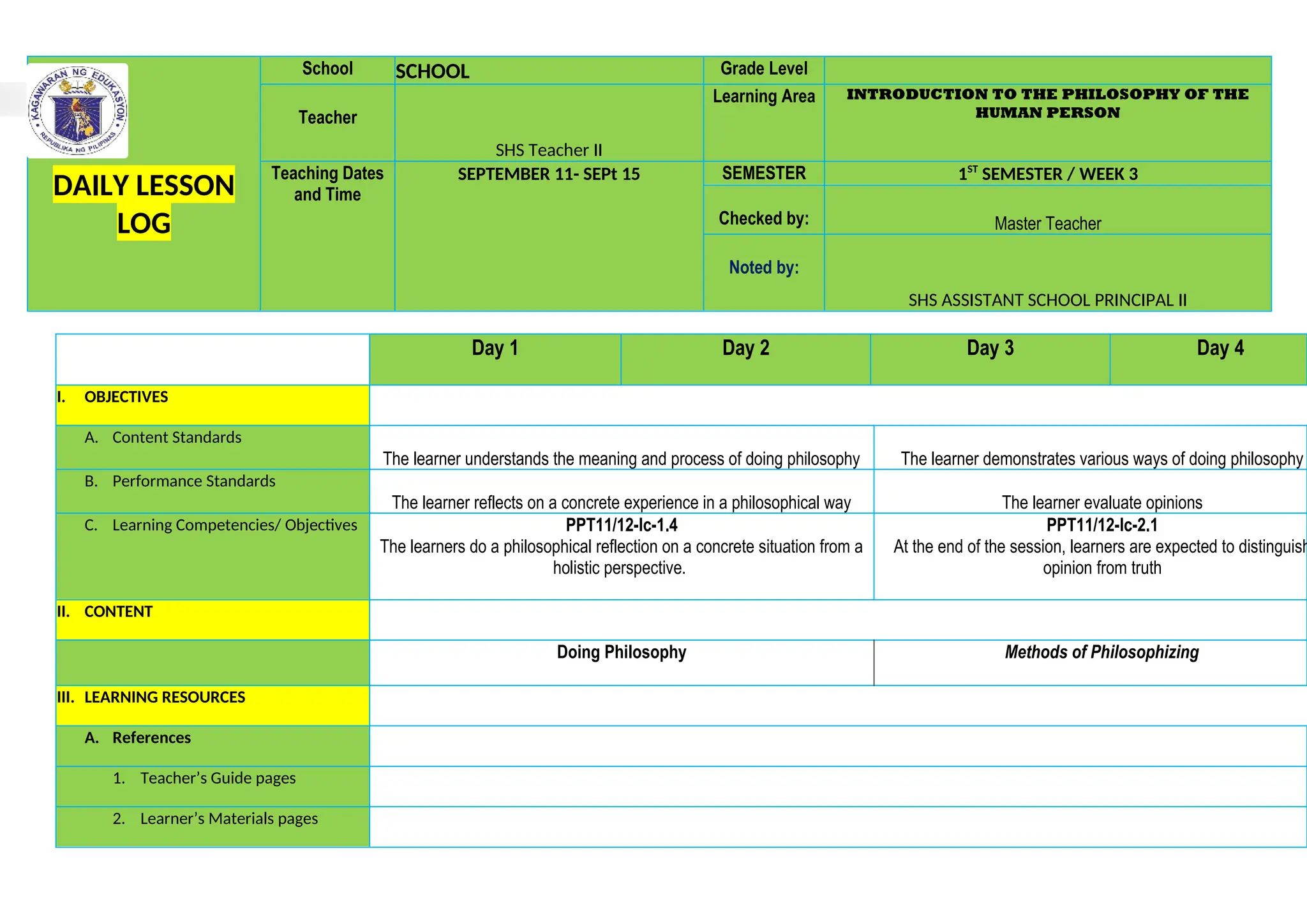
Day 1 Day 2 Day 3 Day 4
I. OBJECTIVES
A. Content Standards
The learner understands the meaning and process of doing philosophy The learner demonstrates various ways of doing philosophy
B. Performance Standards
The learner reflects on a concrete experience in a philosophical way The learner evaluate opinions
C. Learning Competencies/ Objectives PPT11/12-Ic-1.4
The learners do a philosophical reflection on a concrete situation from a
holistic perspective.
PPT11/12-Ic-2.1
At the end of the session, learners are expected to distinguish
opinion from truth
II. CONTENT
Doing Philosophy Methods of Philosophizing
III. LEARNING RESOURCES
A. References
1. Teacher’s Guide pages
2. Learner’s Materials pages
Day 1 Day 2 Day 3 Day 4
3. Textbook pages
4. Additional Materials from
Learning Resource (LR) portal
B. Other Learning Resources Introduction to the Philosophy of the Human Person, Brenda B. Corpuz, BSE, MAEd,
PhD, et.al.
Intro. To the Philosophy of a Human Person slide 115-136
Pambungad sa Pilosopiya, pages 60-65
http://www.youtube.com/watch?v=fnFnWWAnlkw
IV. PROCEDURES
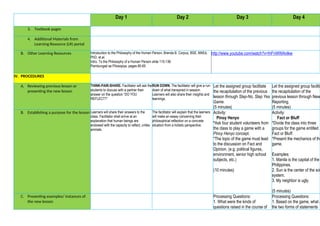
A. Reviewing previous lesson or
presenting the new lesson
THINK-PAIR-SHARE. Facilitator will ask the
students to discuss with a partner their
answer on the question “DO YOU
REFLECT?”
RUN DOWN. The facilitator will give a run-
down of what transpired in session.
Learners will also share their insights and
learnings.
Let the assigned group facilitate
the recapitulation of the previous
lesson through Step-No, Step Yes
Game.
(5 minutes)
Let the assigned group facilita
the recapitulation of the
previous lesson through New
Reporting.
(5 minutes)
B. Establishing a purpose for the lesson Learners will share their answers to the
class. Facilitator shall arrive at an
explanation that human beings are
endowed with the capacity to reflect, unlike
animals.
The facilitator will explain that the learners
will make an essay concerning their
philosophical reflection on a concrete
situation from a holistic perspective.
Activity:
Pinoy Henyo
*Ask four student volunteers from
the class to play a game with a
Pinoy Henyo concept.
*The topic of the game must lead
to the discussion on Fact and
Opinion. (e.g. political figures,
environment, senior high school
subjects, etc.)
(10 minutes)
Activity:
Fact or Bluff
*Divide the class into three
groups for the game entitled
Fact or Bluff.
*Present the mechanics of the
game.
Examples:
1. Manila is the capital of the
Philippines.
2. Sun is the center of the sol
system.
3. My neighbor is ugly.
(5 minutes)
C. Presenting examples/ instances of
the new lesson
Processing Questions:
1. What were the kinds of
questions raised in the course of
Processing Questions:
1. Based on the game, what a
the two forms of statements
Day 1 Day 2 Day 3 Day 4
guessing the answer?
2. Is there any question raised
which you consider as evidence-
based? Cite examples.
3. Is there any question raised
which you think is opinion-based?
Give examples.
(10 minutes)
given? What examples were
given for each?
2. What examples of fact and
opinion can you give based o
your real-life experiences?
(5 minutes
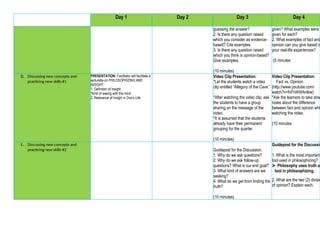
D. Discussing new concepts and
practicing new skills #1
PRESENTATION: Facilitator will facilitate a
lecturette on PHILOSOPHIZING AND
INSIGHT.
1. Definition of Insight
*Kind of seeing with the mind
2. Relevance of Insight in One’s Life
Video Clip Presentation:
*Let the students watch a video
clip entitled “Allegory of the Cave.”
*After watching the video clip, ask
the students to have a group
sharing on the message of the
video.
*It is assumed that the students
already have their permanent
grouping for the quarter.
(10 minutes)
Video Clip Presentation:
Fact vs. Opinion
(http://www.youtube.com/
watch?v=fnFnWWAnlkw)
*Ask the learners to take dow
notes about the difference
between fact and opinion whi
watching the video.
(10 minutes
E. Discussing new concepts and
practicing new skills #2 Guidepost for the Discussion:
1. Why do we ask questions?
2. Why do we ask follow-up
questions? What is our end goal?
3. What kind of answers are we
seeking?
4. What do we get from finding the
truth?
(10 minutes)
Guidepost for the Discussio
1. What is the most important
tool used in philosophizing?
 Philosophy uses truth as
tool in philosophizing.
2. What are the two (2) divisio
of opinion? Explain each.
Opinion
Illusion
Belief
Reason
Understanding
KNOWLEDG
Day 1 Day 2 Day 3 Day 4
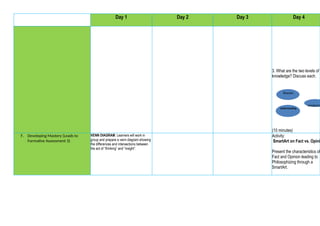
3. What are the two levels of
knowledge? Discuss each.
(10 minutes)
F. Developing Mastery (Leads to
Formative Assessment 3)
VENN DIAGRAM. Learners will work in
group and prepare a venn diagram showing
the differences and intersections between
the act of “thinking” and “insight”.
Activity:
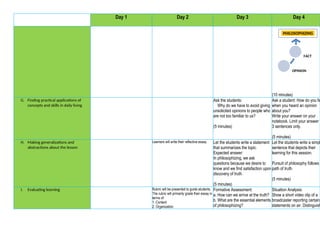
SmartArt on Fact vs. Opini
Present the characteristics of
Fact and Opinion leading to
Philosophizing through a
SmartArt.
OPINION
FACT
Day 1 Day 2 Day 3 Day 4
(10 minutes)
G. Finding practical applications of
concepts and skills in daily living
Ask the students:
Why do we have to avoid giving
unsolicited opinions to people who
are not too familiar to us?
(5 minutes)
Ask a student: How do you fe
when you heard an opinion
about you?
Write your answer on your
notebook. Limit your answer t
3 sentences only.
(5 minutes)
H. Making generalizations and
abstractions about the lesson
Learners will write their reflective essay. Let the students write a statement
that summarizes the topic.
Expected answer:
In philosophizing, we ask
questions because we desire to
know and we find satisfaction upon
discovery of truth.
(5 minutes)
Let the students write a simpl
sentence that depicts their
learning for this session.
Pursuit of philosophy follows
path of truth.
(5 minutes)
I. Evaluating learning Rubric will be presented to guide students.
The rubric will primarily grade their essay in
terms of:
1. Content
2. Organization
Formative Assessment:
a. How can we arrive at the truth?
b. What are the essential elements
of philosophizing?
Situation Analysis:
Show a short video clip of a
broadcaster reporting certain
statements on air. Distinguish
PHILOSOPHIZING
Day 1 Day 2 Day 3 Day 4
3. Presentation
(5 minutes)
whether the statements are
opinionated or facts. Justify
(5 minutes)
J. Additional activities for application
or remediation
V. REMARKS
VI. REFLECTION
A. No. of learners who earned 80% in
the evaluation.
B. No. of learner who require
additional activities for remediation
C. Did the remedial lessons work? No.
of learners who have caught up with
the lesson.
D. No. of learners who continue to
require remediation
E. Which of my teaching strategies
worked well? Why did these work?
Localized materials used in the activity work well. Most of the materials used are seen in the community. Students are so familiar with
these contextualized materials
F. What difficulties did I encounter
which my principal or supervisor can
help me solve?
Some of the students do not bring materials for the activity.
G. What innovation or localized
materials did I use/discover which I
wish to share with other teachers?
PREPARED BY: NOTED BY:
TEACHER II SHS ASSISTANT PRINCIPAL II
CHECKED BY:
MASTER TEACHER I

PHILO-Daily Lesson Log-WEEK-3.docx,,,...........,..............,,...

  • 1.
    DAILY LESSON LOG School SCHOOLGrade Level Teacher SHS Teacher II Learning Area INTRODUCTION TO THE PHILOSOPHY OF THE HUMAN PERSON Teaching Dates and Time SEPTEMBER 11- SEPt 15 SEMESTER 1ST SEMESTER / WEEK 3 Checked by: Master Teacher Noted by: SHS ASSISTANT SCHOOL PRINCIPAL II Day 1 Day 2 Day 3 Day 4 I. OBJECTIVES A. Content Standards The learner understands the meaning and process of doing philosophy The learner demonstrates various ways of doing philosophy B. Performance Standards The learner reflects on a concrete experience in a philosophical way The learner evaluate opinions C. Learning Competencies/ Objectives PPT11/12-Ic-1.4 The learners do a philosophical reflection on a concrete situation from a holistic perspective. PPT11/12-Ic-2.1 At the end of the session, learners are expected to distinguish opinion from truth II. CONTENT Doing Philosophy Methods of Philosophizing III. LEARNING RESOURCES A. References 1. Teacher’s Guide pages 2. Learner’s Materials pages
  • 2.
    Day 1 Day2 Day 3 Day 4 3. Textbook pages 4. Additional Materials from Learning Resource (LR) portal B. Other Learning Resources Introduction to the Philosophy of the Human Person, Brenda B. Corpuz, BSE, MAEd, PhD, et.al. Intro. To the Philosophy of a Human Person slide 115-136 Pambungad sa Pilosopiya, pages 60-65 http://www.youtube.com/watch?v=fnFnWWAnlkw IV. PROCEDURES A. Reviewing previous lesson or presenting the new lesson THINK-PAIR-SHARE. Facilitator will ask the students to discuss with a partner their answer on the question “DO YOU REFLECT?” RUN DOWN. The facilitator will give a run- down of what transpired in session. Learners will also share their insights and learnings. Let the assigned group facilitate the recapitulation of the previous lesson through Step-No, Step Yes Game. (5 minutes) Let the assigned group facilita the recapitulation of the previous lesson through New Reporting. (5 minutes) B. Establishing a purpose for the lesson Learners will share their answers to the class. Facilitator shall arrive at an explanation that human beings are endowed with the capacity to reflect, unlike animals. The facilitator will explain that the learners will make an essay concerning their philosophical reflection on a concrete situation from a holistic perspective. Activity: Pinoy Henyo *Ask four student volunteers from the class to play a game with a Pinoy Henyo concept. *The topic of the game must lead to the discussion on Fact and Opinion. (e.g. political figures, environment, senior high school subjects, etc.) (10 minutes) Activity: Fact or Bluff *Divide the class into three groups for the game entitled Fact or Bluff. *Present the mechanics of the game. Examples: 1. Manila is the capital of the Philippines. 2. Sun is the center of the sol system. 3. My neighbor is ugly. (5 minutes) C. Presenting examples/ instances of the new lesson Processing Questions: 1. What were the kinds of questions raised in the course of Processing Questions: 1. Based on the game, what a the two forms of statements
  • 3.
    Day 1 Day2 Day 3 Day 4 guessing the answer? 2. Is there any question raised which you consider as evidence- based? Cite examples. 3. Is there any question raised which you think is opinion-based? Give examples. (10 minutes) given? What examples were given for each? 2. What examples of fact and opinion can you give based o your real-life experiences? (5 minutes D. Discussing new concepts and practicing new skills #1 PRESENTATION: Facilitator will facilitate a lecturette on PHILOSOPHIZING AND INSIGHT. 1. Definition of Insight *Kind of seeing with the mind 2. Relevance of Insight in One’s Life Video Clip Presentation: *Let the students watch a video clip entitled “Allegory of the Cave.” *After watching the video clip, ask the students to have a group sharing on the message of the video. *It is assumed that the students already have their permanent grouping for the quarter. (10 minutes) Video Clip Presentation: Fact vs. Opinion (http://www.youtube.com/ watch?v=fnFnWWAnlkw) *Ask the learners to take dow notes about the difference between fact and opinion whi watching the video. (10 minutes E. Discussing new concepts and practicing new skills #2 Guidepost for the Discussion: 1. Why do we ask questions? 2. Why do we ask follow-up questions? What is our end goal? 3. What kind of answers are we seeking? 4. What do we get from finding the truth? (10 minutes) Guidepost for the Discussio 1. What is the most important tool used in philosophizing?  Philosophy uses truth as tool in philosophizing. 2. What are the two (2) divisio of opinion? Explain each.
  • 4.
    Opinion Illusion Belief Reason Understanding KNOWLEDG Day 1 Day2 Day 3 Day 4 3. What are the two levels of knowledge? Discuss each. (10 minutes) F. Developing Mastery (Leads to Formative Assessment 3) VENN DIAGRAM. Learners will work in group and prepare a venn diagram showing the differences and intersections between the act of “thinking” and “insight”. Activity: SmartArt on Fact vs. Opini Present the characteristics of Fact and Opinion leading to Philosophizing through a SmartArt.
  • 5.
    OPINION FACT Day 1 Day2 Day 3 Day 4 (10 minutes) G. Finding practical applications of concepts and skills in daily living Ask the students: Why do we have to avoid giving unsolicited opinions to people who are not too familiar to us? (5 minutes) Ask a student: How do you fe when you heard an opinion about you? Write your answer on your notebook. Limit your answer t 3 sentences only. (5 minutes) H. Making generalizations and abstractions about the lesson Learners will write their reflective essay. Let the students write a statement that summarizes the topic. Expected answer: In philosophizing, we ask questions because we desire to know and we find satisfaction upon discovery of truth. (5 minutes) Let the students write a simpl sentence that depicts their learning for this session. Pursuit of philosophy follows path of truth. (5 minutes) I. Evaluating learning Rubric will be presented to guide students. The rubric will primarily grade their essay in terms of: 1. Content 2. Organization Formative Assessment: a. How can we arrive at the truth? b. What are the essential elements of philosophizing? Situation Analysis: Show a short video clip of a broadcaster reporting certain statements on air. Distinguish PHILOSOPHIZING
  • 6.
    Day 1 Day2 Day 3 Day 4 3. Presentation (5 minutes) whether the statements are opinionated or facts. Justify (5 minutes) J. Additional activities for application or remediation V. REMARKS VI. REFLECTION A. No. of learners who earned 80% in the evaluation. B. No. of learner who require additional activities for remediation C. Did the remedial lessons work? No. of learners who have caught up with the lesson. D. No. of learners who continue to require remediation E. Which of my teaching strategies worked well? Why did these work? Localized materials used in the activity work well. Most of the materials used are seen in the community. Students are so familiar with these contextualized materials F. What difficulties did I encounter which my principal or supervisor can help me solve? Some of the students do not bring materials for the activity. G. What innovation or localized materials did I use/discover which I wish to share with other teachers? PREPARED BY: NOTED BY:
  • 7.
    TEACHER II SHSASSISTANT PRINCIPAL II CHECKED BY: MASTER TEACHER I