Solar Power!
Determining the amount of solar
energy we can capture
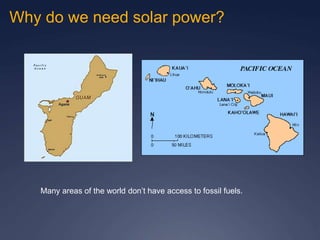
Why do we need solar power?
Many areas of the world don’t have access to fossil fuels.
Problems with fossil fuels
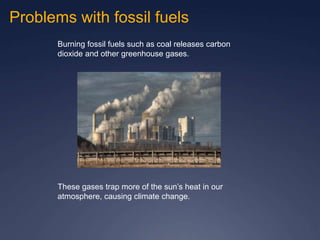
Burning fossil fuels such as coal releases carbon
dioxide and other greenhouse gases.
These gases trap more of the sun’s heat in our
atmosphere, causing climate change.
Climate change consequences
Climate change is responsible for . . .
More frequent flooding
More frequent severe storms Rising sea levels
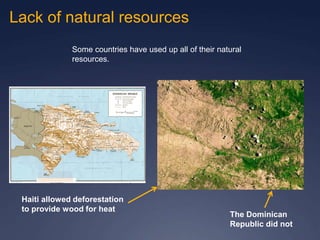
Lack of natural resources
Some countries have used up all of their natural
resources.
Haiti allowed deforestation
to provide wood for heat
The Dominican
Republic did not
Potential dangers of deforestation
The loss of forests causes . . .
Erosion Mudslides
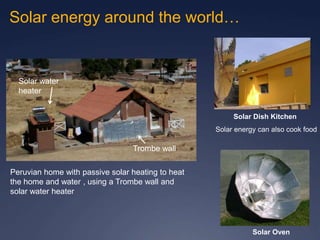
Solar energy around the world…
Solar Dish Kitchen
Solar energy can also cook food
Peruvian home with passive solar heating to heat
the home and water , using a Trombe wall and
solar water heater
Trombe wall
Solar water
heater
Solar Oven
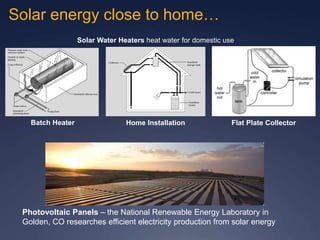
Solar energy close to home…
Solar Water Heaters heat water for domestic use
Photovoltaic Panels – the National Renewable Energy Laboratory in
Golden, CO researches efficient electricity production from solar energy
Batch Heater Flat Plate Collector
Home Installation
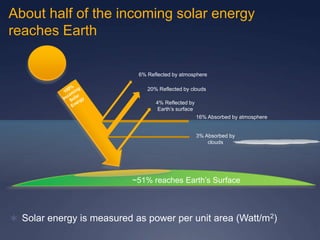
About half of the incoming solar energy
reaches Earth
 Solar energy is measured as power per unit area (Watt/m2)
~51% reaches Earth’s Surface
6% Reflected by atmosphere
20% Reflected by clouds
4% Reflected by
Earth’s surface
16% Absorbed by atmosphere
3% Absorbed by
clouds
The amount of solar energy changes with
location…
Latitude
Longitude
Temperature
(in Kelvins)
…and time
 The location of the sun in the sky changes with the time o day
AND the time of year
South
East
West
North
June 21
December 21
How much solar energy do we have
access to?
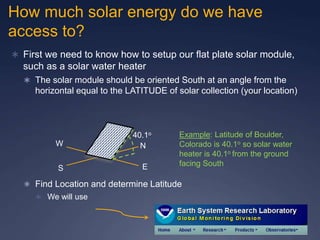
 First we need to know how to setup our flat plate solar module,
such as a solar water heater
 The solar module should be oriented South at an angle from the
horizontal equal to the LATITUDE of solar collection (your location)
 Find Location and determine Latitude
 We will use
N
S E
W
40.1o Example: Latitude of Boulder,
Colorado is 40.1o so solar water
heater is 40.1o from the ground
facing South
How much solar energy do we have
access to?
 We need to know:
 Location: Latitude
 Find this here:
http://www.esrl.noaa.gov/g
md/grad/solcalc/
Red
balloon
How much solar energy do we have
access to?
 We need to know:
 Location: Latitude
 Time of year
 Time collecting sun per day
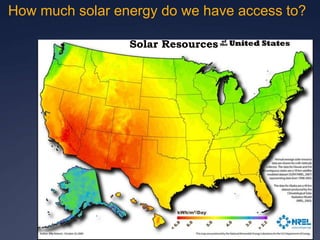
How much solar energy do we have access to?
Solar Resources
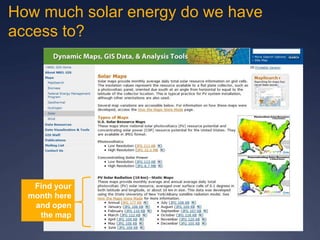
How much solar energy do we have
access to?
Find your
month here
and open
the map
How much solar energy do we have access to?
How much solar energy do we have
access to?
 Fill out worksheet to find out how much solar energy
we have for our solar modules.

ppt solar energy.ppt

  • 1.
    Solar Power! Determining theamount of solar energy we can capture
  • 2.
    Why do weneed solar power? Many areas of the world don’t have access to fossil fuels.
  • 3.
    Problems with fossilfuels Burning fossil fuels such as coal releases carbon dioxide and other greenhouse gases. These gases trap more of the sun’s heat in our atmosphere, causing climate change.
  • 4.
    Climate change consequences Climatechange is responsible for . . . More frequent flooding More frequent severe storms Rising sea levels
  • 5.
    Lack of naturalresources Some countries have used up all of their natural resources. Haiti allowed deforestation to provide wood for heat The Dominican Republic did not
  • 6.
    Potential dangers ofdeforestation The loss of forests causes . . . Erosion Mudslides
  • 7.
    Solar energy aroundthe world… Solar Dish Kitchen Solar energy can also cook food Peruvian home with passive solar heating to heat the home and water , using a Trombe wall and solar water heater Trombe wall Solar water heater Solar Oven
  • 8.
    Solar energy closeto home… Solar Water Heaters heat water for domestic use Photovoltaic Panels – the National Renewable Energy Laboratory in Golden, CO researches efficient electricity production from solar energy Batch Heater Flat Plate Collector Home Installation
  • 9.
    About half ofthe incoming solar energy reaches Earth  Solar energy is measured as power per unit area (Watt/m2) ~51% reaches Earth’s Surface 6% Reflected by atmosphere 20% Reflected by clouds 4% Reflected by Earth’s surface 16% Absorbed by atmosphere 3% Absorbed by clouds
  • 10.
    The amount ofsolar energy changes with location… Latitude Longitude Temperature (in Kelvins)
  • 11.
    …and time  Thelocation of the sun in the sky changes with the time o day AND the time of year South East West North June 21 December 21
  • 12.
    How much solarenergy do we have access to?  First we need to know how to setup our flat plate solar module, such as a solar water heater  The solar module should be oriented South at an angle from the horizontal equal to the LATITUDE of solar collection (your location)  Find Location and determine Latitude  We will use N S E W 40.1o Example: Latitude of Boulder, Colorado is 40.1o so solar water heater is 40.1o from the ground facing South
  • 13.
    How much solarenergy do we have access to?  We need to know:  Location: Latitude  Find this here: http://www.esrl.noaa.gov/g md/grad/solcalc/ Red balloon
  • 14.
    How much solarenergy do we have access to?  We need to know:  Location: Latitude  Time of year  Time collecting sun per day
  • 15.
    How much solarenergy do we have access to? Solar Resources
  • 16.
    How much solarenergy do we have access to? Find your month here and open the map
  • 17.
    How much solarenergy do we have access to?
  • 18.
    How much solarenergy do we have access to?  Fill out worksheet to find out how much solar energy we have for our solar modules.

Editor's Notes

  • #3 Guam map: http://wwwnc.cdc.gov/travel/destinations/traveler/none/guam Hawaii map: http://hvo.wr.usgs.gov/volcanoes/
  • #4 Coal-fired power plant: http://climatekids.nasa.gov/review/sun-people/
  • #5 Superstorm Sandy image: http://nnlm.gov/mar/sandy.html Flooding image: http://gohsep.la.gov/flood.aspx Rising sea levels image: http://www.dnrec.delaware.gov/ClimateChange/Pages/ClimateChangeDelawareSeaLevelRise.aspx
  • #6 Image of Haiti/Dominican Republic border: http://www.cpc.ncep.noaa.gov/products/fews/central_america/briefing.html Haiti/Dominican Republic map: http://svs.gsfc.nasa.gov/vis/a000000/a002600/a002640/
  • #7 Erosion image: http://www.epa.gov/climatechange/impacts-adaptation/alaska.html Mudslide image: http://clubs.calvin.edu/chimes/article.php?id=10180
  • #8 Solar Dish Kitchen image: Design for the Other 90% (http://archive.cooperhewitt.org/other90/other90.cooperhewitt.org/Design/solar-dish-kitchen.html) Peruvian home photo: Odessa Gomez 2010 Solar oven: http://solarcooking.wikia.com/wiki/Category:Solar_cooker_plans
  • #9 Batch water heater and home installation images: http://www.nrel.gov/docs/legosti/fy96/17459.pdf Flat plate solar water heater: http://www.energystar.gov/index.cfm?fuseaction=find_a_product.showProductGroup&pgw_code=WSE PV image: http://www.nrel.gov/pv/
  • #10 Image created by Odessa Gomez 2012
  • #11 Image credit: http://education.gsfc.nasa.gov/experimental/all98invProject.Site/Pages/trl/inv2-1.abstract.html
  • #12 Image by Odessa Gomez 2012
  • #16 Map NREL: http://www.esrl.noaa.gov/gmd/grad/solcalc/
  • #17 http://www.esrl.noaa.gov/gmd/grad/solcalc/
  • #18 Map NREL: http://www.esrl.noaa.gov/gmd/grad/solcalc/