Teacher
By Naman Verma
Class IX B
Content :
• Duties and Functions
• Competences and qualities required by teachers
1. Competences
2. Qualities
– Enthusiasm
– Interaction with Learners
• Teaching around the world.
• Occupational Hazards.
• Krist Jayanti Staff.
Duties and Functions
• A teacher's role may vary among cultures.
• Teachers may provide instruction
in literacy and numeracy, craftsmanship or vocational training, the
arts, religion, civics, community roles, or life skills.
• Formal teaching tasks include preparing lessons according to agreed
curricula, giving lessons, and assessing pupil progress.
• A teacher's professional duties may extend beyond formal teaching. Outside
of the classroom teachers may accompany students on field trips,
supervise study halls, help with the organization of school functions, and
serve as supervisors for extracurricular activities. In some education systems,
teachers may have responsibility for student discipline.
Competences and qualities required by
teachers
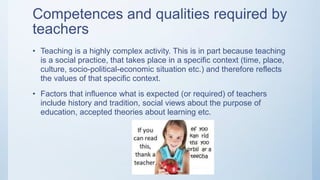
• Teaching is a highly complex activity. This is in part because teaching
is a social practice, that takes place in a specific context (time, place,
culture, socio-political-economic situation etc.) and therefore reflects
the values of that specific context.
• Factors that influence what is expected (or required) of teachers
include history and tradition, social views about the purpose of
education, accepted theories about learning etc.
Competences
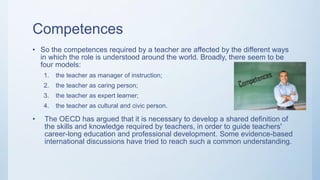
• So the competences required by a teacher are affected by the different ways
in which the role is understood around the world. Broadly, there seem to be
four models:
1. the teacher as manager of instruction;
2. the teacher as caring person;
3. the teacher as expert learner;
4. the teacher as cultural and civic person.
• The OECD has argued that it is necessary to develop a shared definition of
the skills and knowledge required by teachers, in order to guide teachers'
career-long education and professional development. Some evidence-based
international discussions have tried to reach such a common understanding.
Qualities
• Enthusiasm
1. It has been found that teachers who showed enthusiasm towards the course
materials and students can create a positive learning experience. These
teachers do not teach by rote but attempt to find new invigoration for the course
materials on a daily basis. One of the challenges facing teachers is that they
may have repeatedly covered a curriculum until they begin to feel bored with the
subject, and their attitude may in turn bore the students. Students who had
enthusiastic teachers tend to rate them higher than teachers who didn't show
much enthusiasm for the course materials.
2. Teachers that exhibit enthusiasm can lead to students who are more likely to be
engaged, interested, energetic, and curious about learning the subject matter.
Recent research has found a correlation between teacher enthusiasm and
students' intrinsic motivation to learn and vitality in the classroom.
Qualities
• Interaction with learners
1. Research shows that student motivation and attitudes towards school are
closely linked to student-teacher relationships. Enthusiastic teachers are
particularly good at creating beneficial relations with their students. Their ability
to create effective learning environments that foster student achievement
depends on the kind of relationship they build with their students. Useful
teacher-to-student interactions are crucial in linking academic success with
personal achievement. Here, personal success is a student's internal goal of
improving himself, whereas academic success includes the goals he receives
from his superior. A teacher must guide her student in aligning her personal
goals with her academic goals. Students who receive this positive influence
show stronger self-confidence and greater personal and academic success than
those without these teacher interactions.
Teaching around the world
• Teaching in Australia
1. Education in Australia is primarily the responsibility of the individual states and
territories. Generally, education in Australia follows the three-tier model which
includes primary education (primary schools), followed by secondary
education (secondary schools/high schools) and tertiary education(universities
or TAFE colleges).
• Teaching in Canada
1. Teaching in Canada requires a post-secondary degree Bachelor's Degree. In
most provinces a second Bachelor's Degree such as a Bachelor of Education is
required to become a qualified teacher. Salary ranges from $40,000/year to
$90,000/yr. Teachers have the option to teach for a public school which is
funded by the provincial government or teaching in a private school which is
funded by the private sector, businesses and sponsors.
Occupational Hazards
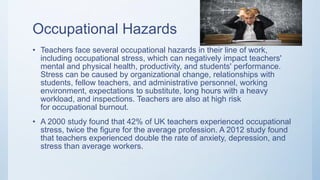
• Teachers face several occupational hazards in their line of work,
including occupational stress, which can negatively impact teachers'
mental and physical health, productivity, and students' performance.
Stress can be caused by organizational change, relationships with
students, fellow teachers, and administrative personnel, working
environment, expectations to substitute, long hours with a heavy
workload, and inspections. Teachers are also at high risk
for occupational burnout.
• A 2000 study found that 42% of UK teachers experienced occupational
stress, twice the figure for the average profession. A 2012 study found
that teachers experienced double the rate of anxiety, depression, and
stress than average workers.
Thanx for Watching
• Hope you’ve liked it

PPT on Teacher

  • 1.
  • 2.
    Content : • Dutiesand Functions • Competences and qualities required by teachers 1. Competences 2. Qualities – Enthusiasm – Interaction with Learners • Teaching around the world. • Occupational Hazards. • Krist Jayanti Staff.
  • 3.
    Duties and Functions •A teacher's role may vary among cultures. • Teachers may provide instruction in literacy and numeracy, craftsmanship or vocational training, the arts, religion, civics, community roles, or life skills. • Formal teaching tasks include preparing lessons according to agreed curricula, giving lessons, and assessing pupil progress. • A teacher's professional duties may extend beyond formal teaching. Outside of the classroom teachers may accompany students on field trips, supervise study halls, help with the organization of school functions, and serve as supervisors for extracurricular activities. In some education systems, teachers may have responsibility for student discipline.
  • 4.
    Competences and qualitiesrequired by teachers • Teaching is a highly complex activity. This is in part because teaching is a social practice, that takes place in a specific context (time, place, culture, socio-political-economic situation etc.) and therefore reflects the values of that specific context. • Factors that influence what is expected (or required) of teachers include history and tradition, social views about the purpose of education, accepted theories about learning etc.
  • 5.
    Competences • So thecompetences required by a teacher are affected by the different ways in which the role is understood around the world. Broadly, there seem to be four models: 1. the teacher as manager of instruction; 2. the teacher as caring person; 3. the teacher as expert learner; 4. the teacher as cultural and civic person. • The OECD has argued that it is necessary to develop a shared definition of the skills and knowledge required by teachers, in order to guide teachers' career-long education and professional development. Some evidence-based international discussions have tried to reach such a common understanding.
  • 6.
    Qualities • Enthusiasm 1. Ithas been found that teachers who showed enthusiasm towards the course materials and students can create a positive learning experience. These teachers do not teach by rote but attempt to find new invigoration for the course materials on a daily basis. One of the challenges facing teachers is that they may have repeatedly covered a curriculum until they begin to feel bored with the subject, and their attitude may in turn bore the students. Students who had enthusiastic teachers tend to rate them higher than teachers who didn't show much enthusiasm for the course materials. 2. Teachers that exhibit enthusiasm can lead to students who are more likely to be engaged, interested, energetic, and curious about learning the subject matter. Recent research has found a correlation between teacher enthusiasm and students' intrinsic motivation to learn and vitality in the classroom.
  • 7.
    Qualities • Interaction withlearners 1. Research shows that student motivation and attitudes towards school are closely linked to student-teacher relationships. Enthusiastic teachers are particularly good at creating beneficial relations with their students. Their ability to create effective learning environments that foster student achievement depends on the kind of relationship they build with their students. Useful teacher-to-student interactions are crucial in linking academic success with personal achievement. Here, personal success is a student's internal goal of improving himself, whereas academic success includes the goals he receives from his superior. A teacher must guide her student in aligning her personal goals with her academic goals. Students who receive this positive influence show stronger self-confidence and greater personal and academic success than those without these teacher interactions.
  • 8.
    Teaching around theworld • Teaching in Australia 1. Education in Australia is primarily the responsibility of the individual states and territories. Generally, education in Australia follows the three-tier model which includes primary education (primary schools), followed by secondary education (secondary schools/high schools) and tertiary education(universities or TAFE colleges). • Teaching in Canada 1. Teaching in Canada requires a post-secondary degree Bachelor's Degree. In most provinces a second Bachelor's Degree such as a Bachelor of Education is required to become a qualified teacher. Salary ranges from $40,000/year to $90,000/yr. Teachers have the option to teach for a public school which is funded by the provincial government or teaching in a private school which is funded by the private sector, businesses and sponsors.
  • 9.
    Occupational Hazards • Teachersface several occupational hazards in their line of work, including occupational stress, which can negatively impact teachers' mental and physical health, productivity, and students' performance. Stress can be caused by organizational change, relationships with students, fellow teachers, and administrative personnel, working environment, expectations to substitute, long hours with a heavy workload, and inspections. Teachers are also at high risk for occupational burnout. • A 2000 study found that 42% of UK teachers experienced occupational stress, twice the figure for the average profession. A 2012 study found that teachers experienced double the rate of anxiety, depression, and stress than average workers.
  • 10.
    Thanx for Watching •Hope you’ve liked it