PRESENTED BY-
NAMAN RAJ
CUSB2013125074
V SEMESTER, B.A.LL.B(H)
PRESENTED TO-
Dr. DEO NARAYAN SINGH
(ASSISTANT PROFESSOR)
SCHOOL OF LAW AND GOVERNANCE
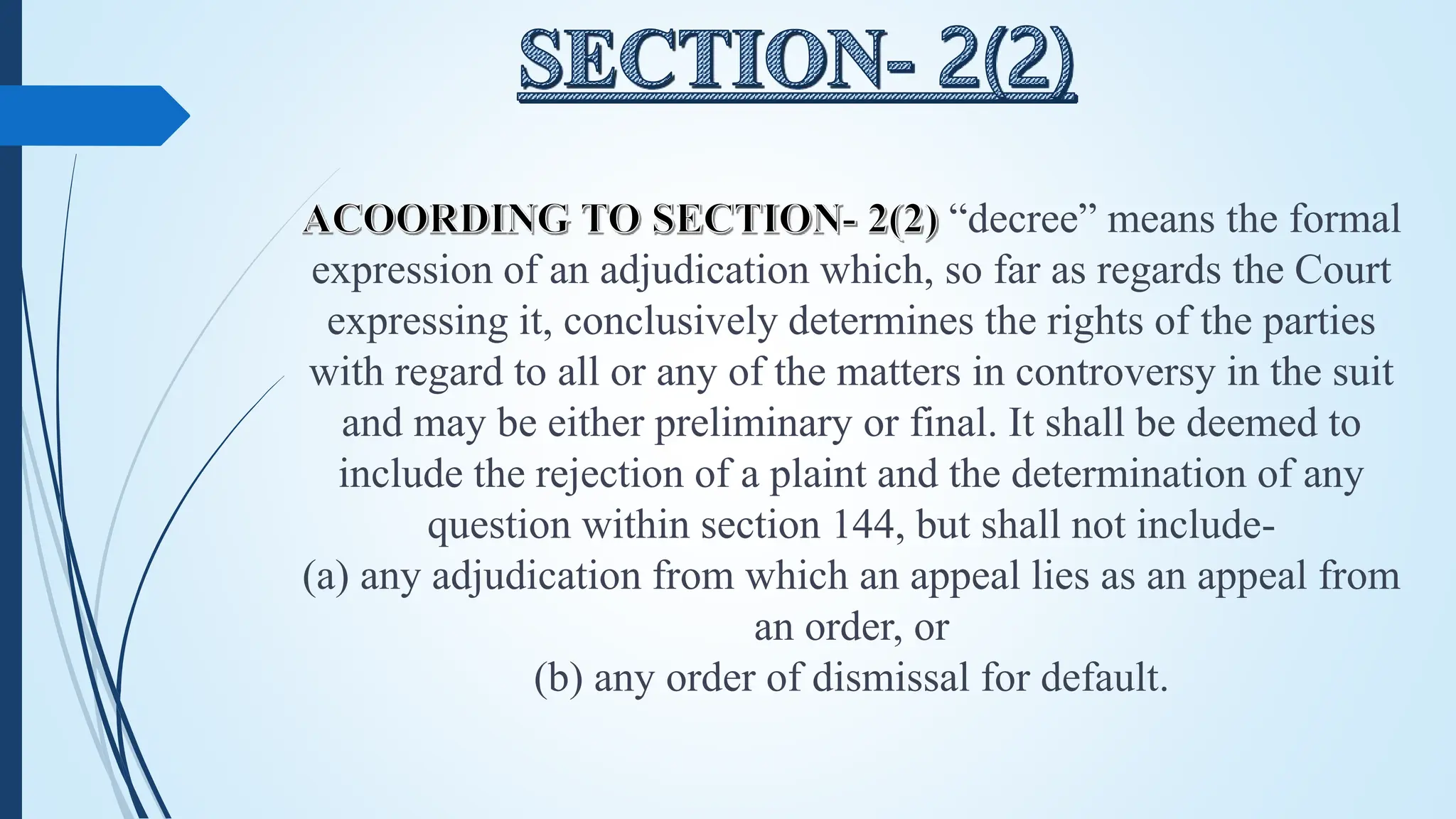
“decree” means the formal
expression of an adjudication which, so far as regards the Court
expressing it, conclusively determines the rights of the parties
with regard to all or any of the matters in controversy in the suit
and may be either preliminary or final. It shall be deemed to
include the rejection of a plaint and the determination of any
question within section 144, but shall not include-
(a) any adjudication from which an appeal lies as an appeal from
an order, or
(b) any order of dismissal for default.
Adjudication–
Adjudication means
judicial determination of
matter in dispute.
Suit-
Suit is a civil proceeding
instituted by the
presentation of the
plaint. The adjudication
must have been done in
a suit.
Rights of parties in
controversy-
This means that the rights
of the parties must be
determined by
adjudication. By rights
here means substantive
rights of parties and not
merely the procedural
rights.
Conclusive
Determination-
The determination
must be conclusive le
it must be final and
conclusive regarding
the court passing it.
Formal Expression
expression -
The formal expression
must be deliberate and
given in the manner
provided by a law.
ESSENTIALS
OF
DECREE
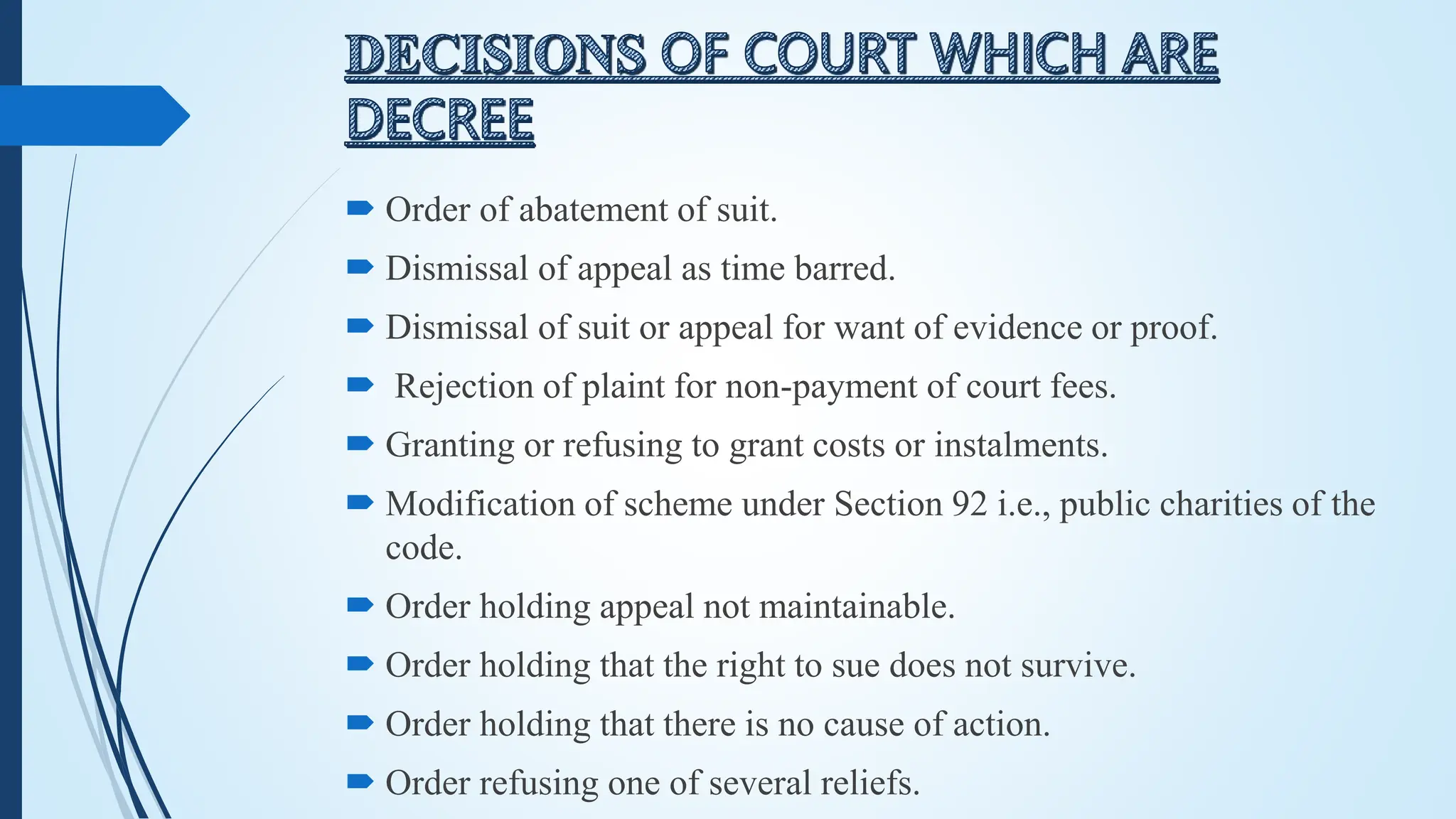
 Order of abatement of suit.
 Dismissal of appeal as time barred.
 Dismissal of suit or appeal for want of evidence or proof.
 Rejection of plaint for non-payment of court fees.
 Granting or refusing to grant costs or instalments.
 Modification of scheme under Section 92 i.e., public charities of the
code.
 Order holding appeal not maintainable.
 Order holding that the right to sue does not survive.
 Order holding that there is no cause of action.
 Order refusing one of several reliefs.
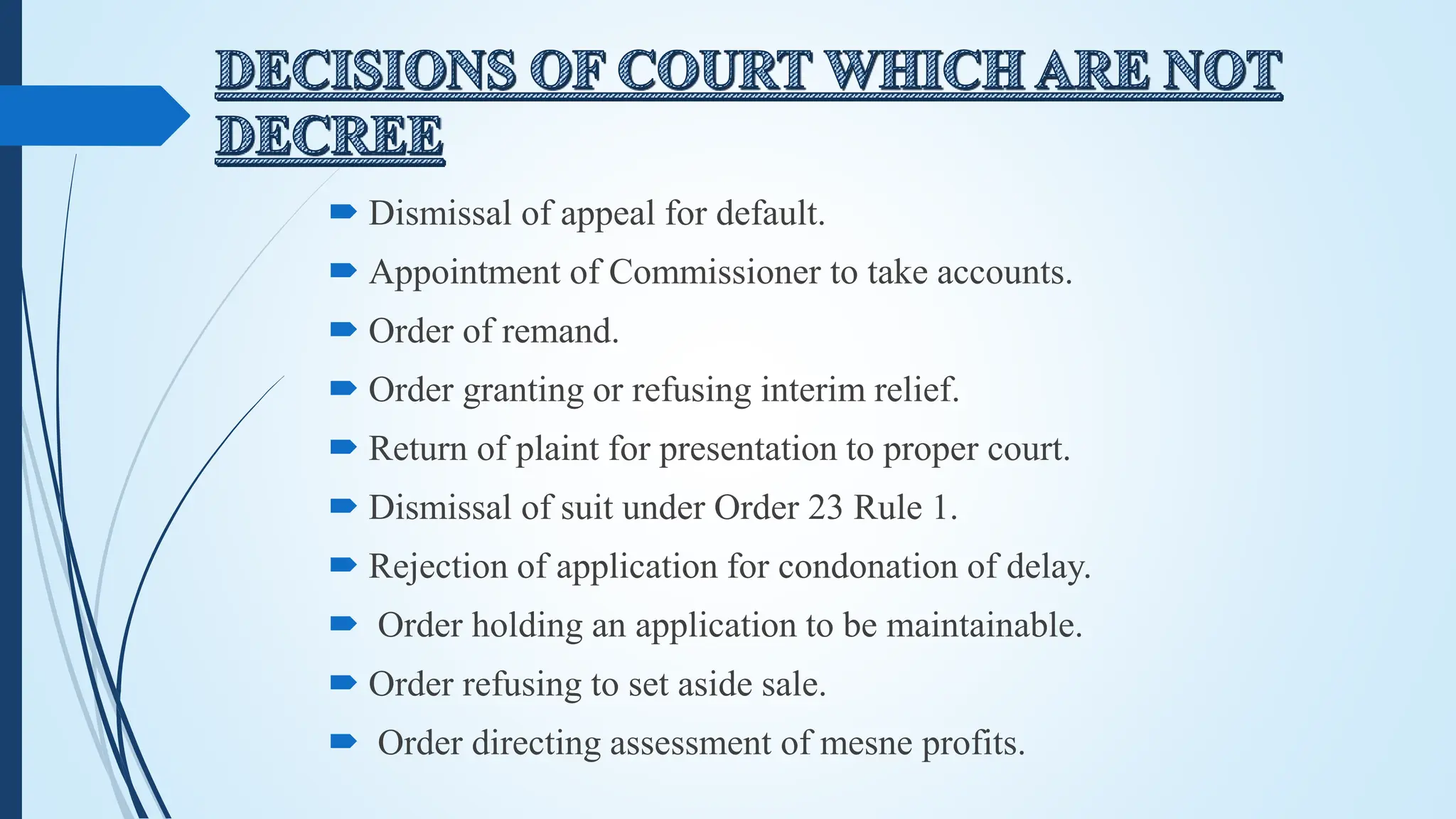
 Dismissal of appeal for default.
 Appointment of Commissioner to take accounts.
 Order of remand.
 Order granting or refusing interim relief.
 Return of plaint for presentation to proper court.
 Dismissal of suit under Order 23 Rule 1.
 Rejection of application for condonation of delay.
 Order holding an application to be maintainable.
 Order refusing to set aside sale.
 Order directing assessment of mesne profits.
 Where adjudication decides the rights of parties with regard to all matters in controversy
in suit but does not dispose suit completely, will be 'preliminary decree'.[ Venkat Reddy v.
Petho Reddy, AIR 1963 S.C. 992.]
 A Court may pass preliminary decree as to rights of parties but wait to pass final decree
until it reach to such position. In preliminary decree rights and liabilities of parties are
declared while other matters to be worked out with final decree.
 For example,
• In suit for possession of immovable property with mesne profit, the Court decree for
possession of the property and directs an enquiry into the mesne profit. Here for
possession it is final decree and for mesne profit it is preliminary decree.
• In suit for dissolution for partnership and settlement of account; court may pass
preliminary decree for dissolution and may continue trial for settlement of account.
Preliminary decree
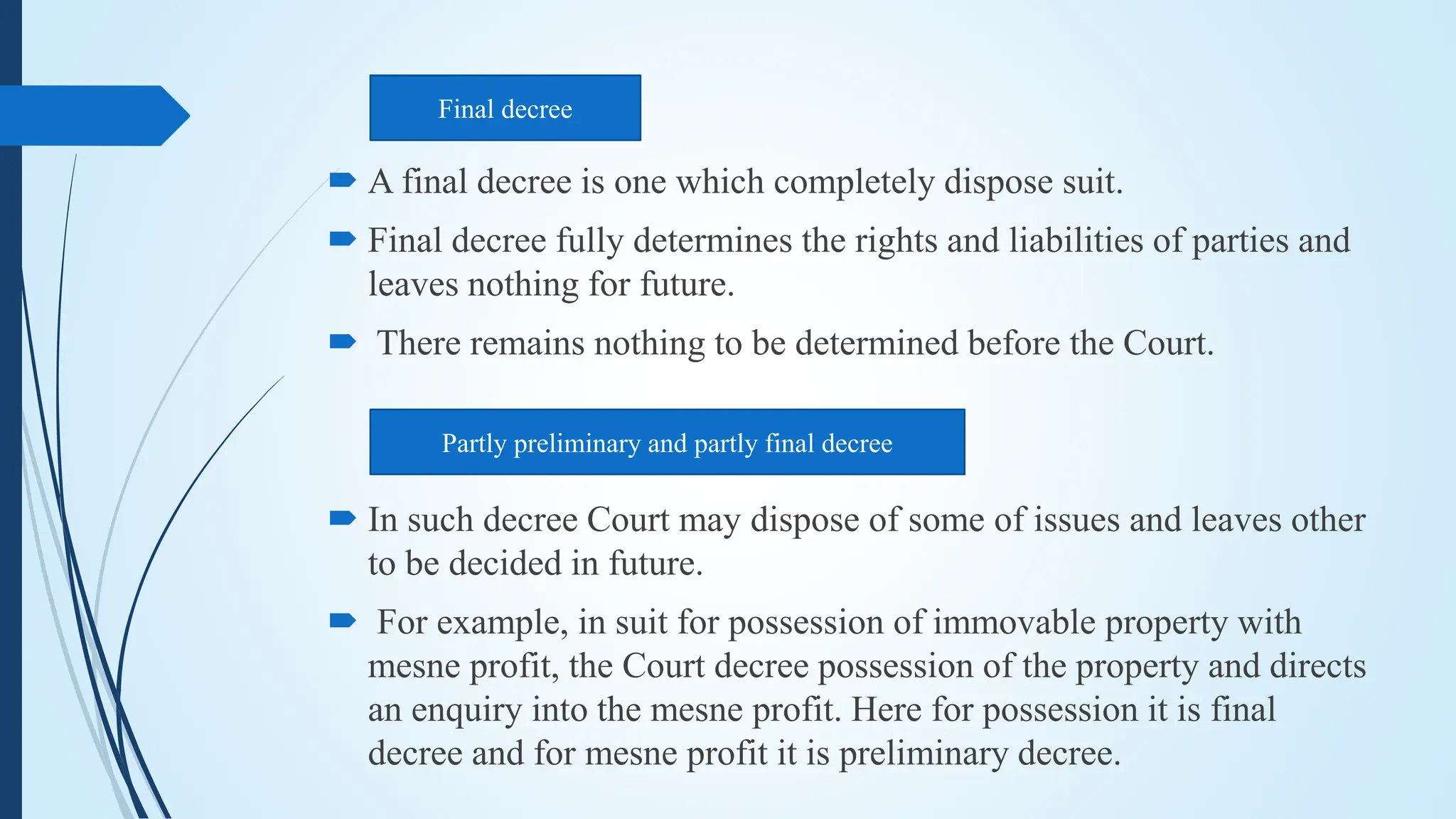
 A final decree is one which completely dispose suit.
 Final decree fully determines the rights and liabilities of parties and
leaves nothing for future.
 There remains nothing to be determined before the Court.
 In such decree Court may dispose of some of issues and leaves other
to be decided in future.
 For example, in suit for possession of immovable property with
mesne profit, the Court decree possession of the property and directs
an enquiry into the mesne profit. Here for possession it is final
decree and for mesne profit it is preliminary decree.
Final decree
Partly preliminary and partly final decree
 A Deemed decree is one which, though not fulfilling the essential features of a
decree as required by the Code has been expressly categorized as a decree by the
legislature.
 The rejection of the plaint, determination of the questions under section 144
(Restitution), adjudications under Order 21 Rule 58, Rule 98 or 100 are said to be
deemed decree.
 Case Law:- CIT vs. Bombay Trust Corporation AIR 1930 PC 54"Whenever the
legislature uses the word "deemed" in any statue in relation to a person or thing, it
implies that the Legislature, after due consideration, conferred a particular status
on a particular person or thing."
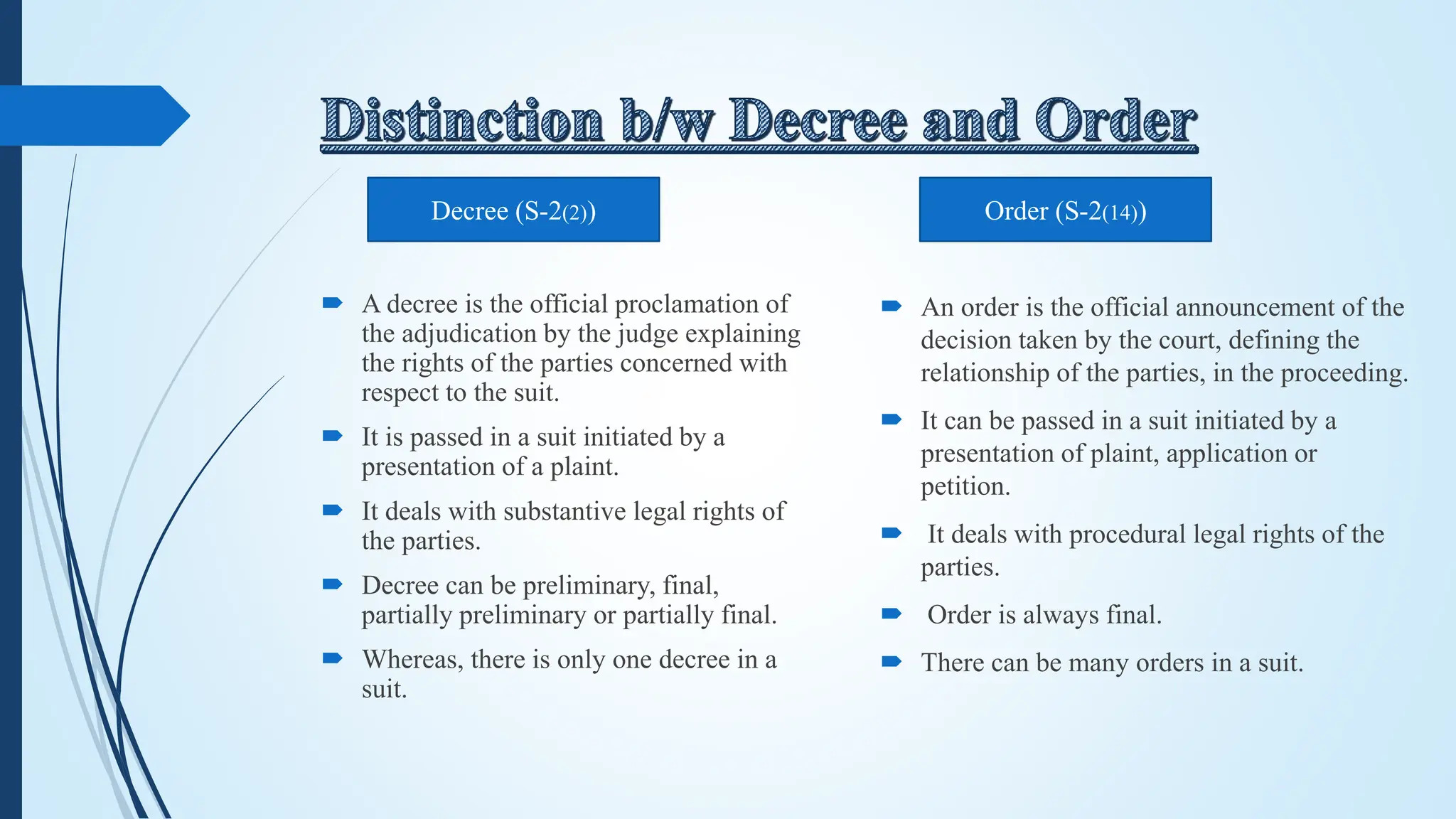
 A decree is the official proclamation of
the adjudication by the judge explaining
the rights of the parties concerned with
respect to the suit.
 It is passed in a suit initiated by a
presentation of a plaint.
 It deals with substantive legal rights of
the parties.
 Decree can be preliminary, final,
partially preliminary or partially final.
 Whereas, there is only one decree in a
suit.
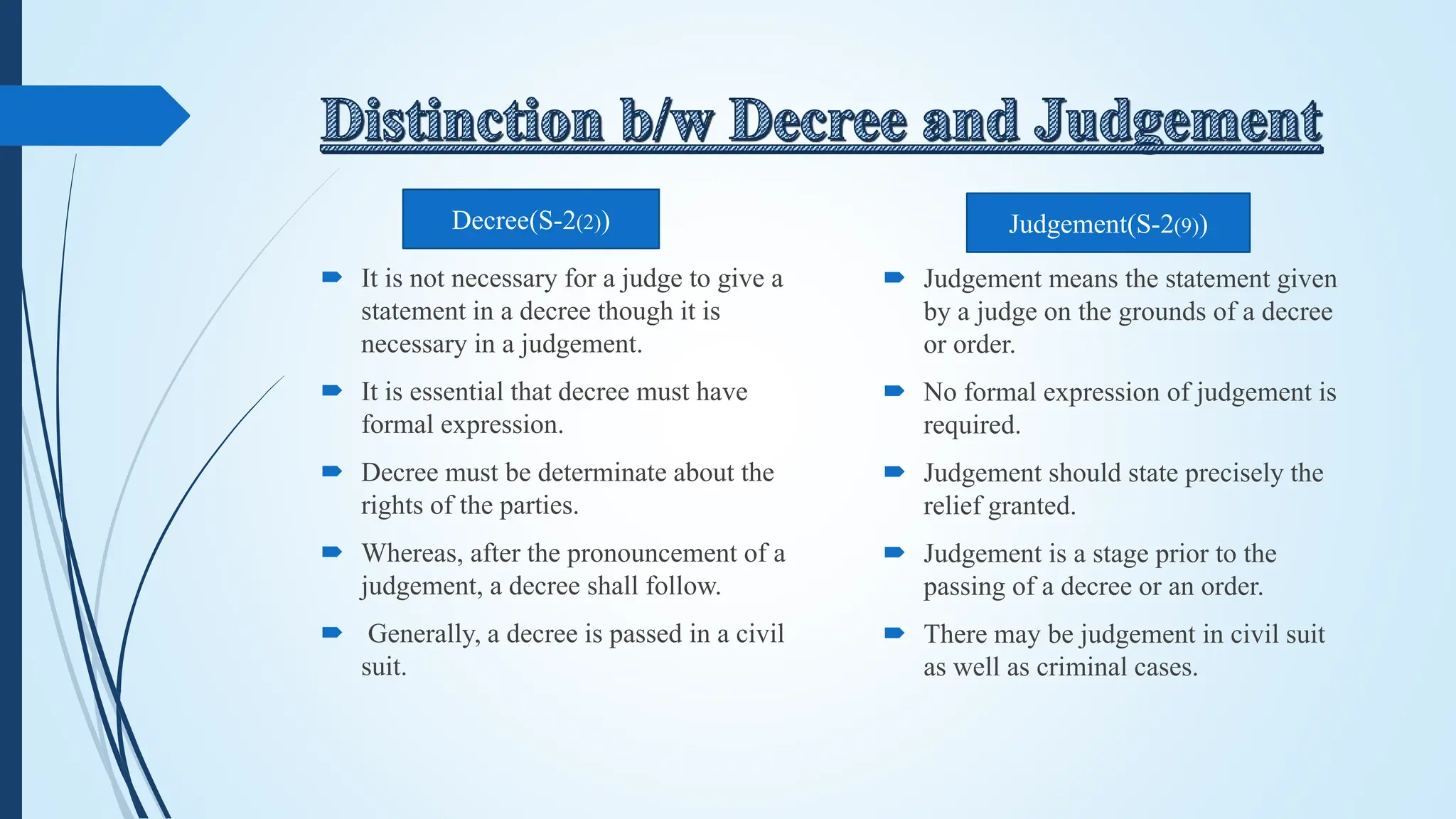
Decree (S-2(2)) Order (S-2(14))
 An order is the official announcement of the
decision taken by the court, defining the
relationship of the parties, in the proceeding.
 It can be passed in a suit initiated by a
presentation of plaint, application or
petition.
 It deals with procedural legal rights of the
parties.
 Order is always final.
 There can be many orders in a suit.
 It is not necessary for a judge to give a
statement in a decree though it is
necessary in a judgement.
 It is essential that decree must have
formal expression.
 Decree must be determinate about the
rights of the parties.
 Whereas, after the pronouncement of a
judgement, a decree shall follow.
 Generally, a decree is passed in a civil
suit.
 Judgement means the statement given
by a judge on the grounds of a decree
or order.
 No formal expression of judgement is
required.
 Judgement should state precisely the
relief granted.
 Judgement is a stage prior to the
passing of a decree or an order.
 There may be judgement in civil suit
as well as criminal cases.
Decree(S-2(2)) Judgement(S-2(9))
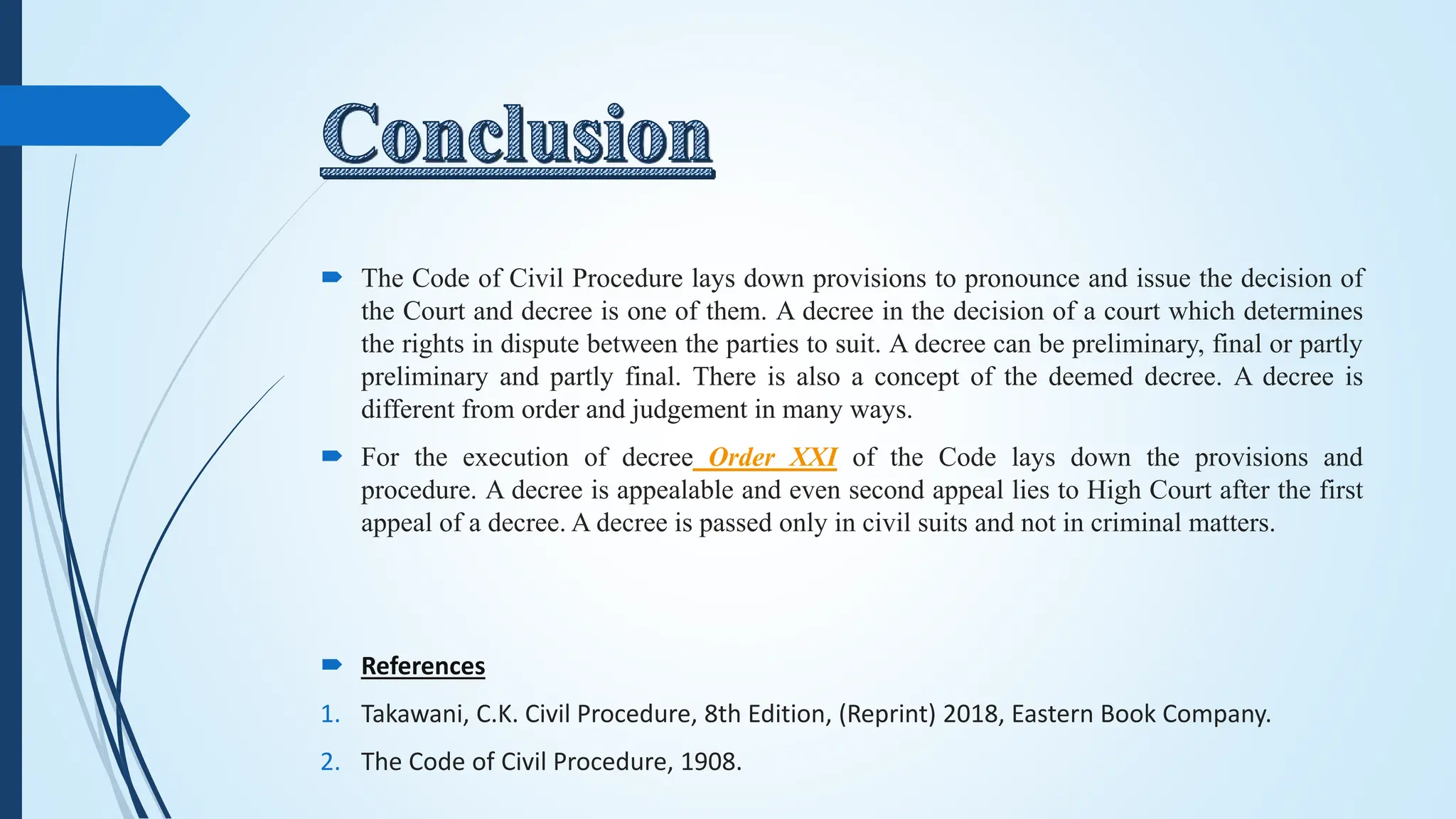
 The Code of Civil Procedure lays down provisions to pronounce and issue the decision of
the Court and decree is one of them. A decree in the decision of a court which determines
the rights in dispute between the parties to suit. A decree can be preliminary, final or partly
preliminary and partly final. There is also a concept of the deemed decree. A decree is
different from order and judgement in many ways.
 For the execution of decree Order XXI of the Code lays down the provisions and
procedure. A decree is appealable and even second appeal lies to High Court after the first
appeal of a decree. A decree is passed only in civil suits and not in criminal matters.
 References
1. Takawani, C.K. Civil Procedure, 8th Edition, (Reprint) 2018, Eastern Book Company.
2. The Code of Civil Procedure, 1908.
PPT on "Decree", under Code of Civil Procedure (CPC).

PPT on "Decree", under Code of Civil Procedure (CPC).

  • 1.
    PRESENTED BY- NAMAN RAJ CUSB2013125074 VSEMESTER, B.A.LL.B(H) PRESENTED TO- Dr. DEO NARAYAN SINGH (ASSISTANT PROFESSOR) SCHOOL OF LAW AND GOVERNANCE
  • 2.
    “decree” means theformal expression of an adjudication which, so far as regards the Court expressing it, conclusively determines the rights of the parties with regard to all or any of the matters in controversy in the suit and may be either preliminary or final. It shall be deemed to include the rejection of a plaint and the determination of any question within section 144, but shall not include- (a) any adjudication from which an appeal lies as an appeal from an order, or (b) any order of dismissal for default.
  • 3.
    Adjudication– Adjudication means judicial determinationof matter in dispute. Suit- Suit is a civil proceeding instituted by the presentation of the plaint. The adjudication must have been done in a suit. Rights of parties in controversy- This means that the rights of the parties must be determined by adjudication. By rights here means substantive rights of parties and not merely the procedural rights. Conclusive Determination- The determination must be conclusive le it must be final and conclusive regarding the court passing it. Formal Expression expression - The formal expression must be deliberate and given in the manner provided by a law. ESSENTIALS OF DECREE
  • 4.
     Order ofabatement of suit.  Dismissal of appeal as time barred.  Dismissal of suit or appeal for want of evidence or proof.  Rejection of plaint for non-payment of court fees.  Granting or refusing to grant costs or instalments.  Modification of scheme under Section 92 i.e., public charities of the code.  Order holding appeal not maintainable.  Order holding that the right to sue does not survive.  Order holding that there is no cause of action.  Order refusing one of several reliefs.
  • 5.
     Dismissal ofappeal for default.  Appointment of Commissioner to take accounts.  Order of remand.  Order granting or refusing interim relief.  Return of plaint for presentation to proper court.  Dismissal of suit under Order 23 Rule 1.  Rejection of application for condonation of delay.  Order holding an application to be maintainable.  Order refusing to set aside sale.  Order directing assessment of mesne profits.
  • 6.
     Where adjudicationdecides the rights of parties with regard to all matters in controversy in suit but does not dispose suit completely, will be 'preliminary decree'.[ Venkat Reddy v. Petho Reddy, AIR 1963 S.C. 992.]  A Court may pass preliminary decree as to rights of parties but wait to pass final decree until it reach to such position. In preliminary decree rights and liabilities of parties are declared while other matters to be worked out with final decree.  For example, • In suit for possession of immovable property with mesne profit, the Court decree for possession of the property and directs an enquiry into the mesne profit. Here for possession it is final decree and for mesne profit it is preliminary decree. • In suit for dissolution for partnership and settlement of account; court may pass preliminary decree for dissolution and may continue trial for settlement of account. Preliminary decree
  • 7.
     A finaldecree is one which completely dispose suit.  Final decree fully determines the rights and liabilities of parties and leaves nothing for future.  There remains nothing to be determined before the Court.  In such decree Court may dispose of some of issues and leaves other to be decided in future.  For example, in suit for possession of immovable property with mesne profit, the Court decree possession of the property and directs an enquiry into the mesne profit. Here for possession it is final decree and for mesne profit it is preliminary decree. Final decree Partly preliminary and partly final decree
  • 8.
     A Deemeddecree is one which, though not fulfilling the essential features of a decree as required by the Code has been expressly categorized as a decree by the legislature.  The rejection of the plaint, determination of the questions under section 144 (Restitution), adjudications under Order 21 Rule 58, Rule 98 or 100 are said to be deemed decree.  Case Law:- CIT vs. Bombay Trust Corporation AIR 1930 PC 54"Whenever the legislature uses the word "deemed" in any statue in relation to a person or thing, it implies that the Legislature, after due consideration, conferred a particular status on a particular person or thing."
  • 9.
     A decreeis the official proclamation of the adjudication by the judge explaining the rights of the parties concerned with respect to the suit.  It is passed in a suit initiated by a presentation of a plaint.  It deals with substantive legal rights of the parties.  Decree can be preliminary, final, partially preliminary or partially final.  Whereas, there is only one decree in a suit. Decree (S-2(2)) Order (S-2(14))  An order is the official announcement of the decision taken by the court, defining the relationship of the parties, in the proceeding.  It can be passed in a suit initiated by a presentation of plaint, application or petition.  It deals with procedural legal rights of the parties.  Order is always final.  There can be many orders in a suit.
  • 10.
     It isnot necessary for a judge to give a statement in a decree though it is necessary in a judgement.  It is essential that decree must have formal expression.  Decree must be determinate about the rights of the parties.  Whereas, after the pronouncement of a judgement, a decree shall follow.  Generally, a decree is passed in a civil suit.  Judgement means the statement given by a judge on the grounds of a decree or order.  No formal expression of judgement is required.  Judgement should state precisely the relief granted.  Judgement is a stage prior to the passing of a decree or an order.  There may be judgement in civil suit as well as criminal cases. Decree(S-2(2)) Judgement(S-2(9))
  • 11.
     The Codeof Civil Procedure lays down provisions to pronounce and issue the decision of the Court and decree is one of them. A decree in the decision of a court which determines the rights in dispute between the parties to suit. A decree can be preliminary, final or partly preliminary and partly final. There is also a concept of the deemed decree. A decree is different from order and judgement in many ways.  For the execution of decree Order XXI of the Code lays down the provisions and procedure. A decree is appealable and even second appeal lies to High Court after the first appeal of a decree. A decree is passed only in civil suits and not in criminal matters.  References 1. Takawani, C.K. Civil Procedure, 8th Edition, (Reprint) 2018, Eastern Book Company. 2. The Code of Civil Procedure, 1908.