Appeals in Crpc
Sections 372 to 405
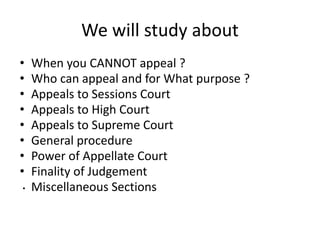
We will study about
• When you CANNOT appeal ?
• Who can appeal and for What purpose ?
• Appeals to Sessions Court
• Appeals to High Court
• Appeals to Supreme Court
• General procedure
• Power of Appellate Court
• Finality of Judgement
• Miscellaneous Sections
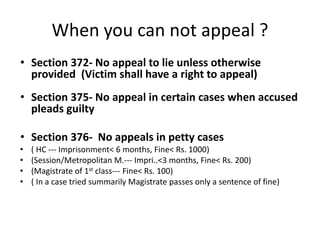
When you can not appeal ?
• Section 372- No appeal to lie unless otherwise
provided (Victim shall have a right to appeal)
• Section 375- No appeal in certain cases when accused
pleads guilty
• Section 376- No appeals in petty cases
• ( HC --- Imprisonment< 6 months, Fine< Rs. 1000)
• (Session/Metropolitan M.--- Impri..<3 months, Fine< Rs. 200)
• (Magistrate of 1st class--- Fine< Rs. 100)
• ( In a case tried summarily Magistrate passes only a sentence of fine)
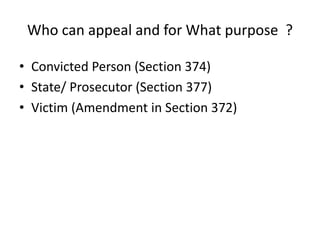
Who can appeal and for What purpose ?
• Convicted Person (Section 374)
• State/ Prosecutor (Section 377)
• Victim (Amendment in Section 372)
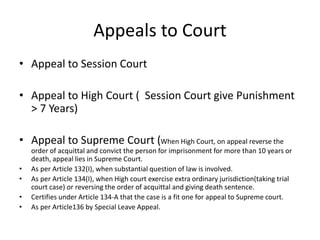
Appeals to Court
• Appeal to Session Court
• Appeal to High Court ( Session Court give Punishment
> 7 Years)
• Appeal to Supreme Court (When High Court, on appeal reverse the
order of acquittal and convict the person for imprisonment for more than 10 years or
death, appeal lies in Supreme Court.
• As per Article 132(I), when substantial question of law is involved.
• As per Article 134(I), when High court exercise extra ordinary jurisdiction(taking trial
court case) or reversing the order of acquittal and giving death sentence.
• Certifies under Article 134-A that the case is a fit one for appeal to Supreme court.
• As per Article136 by Special Leave Appeal.
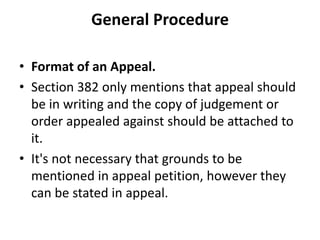
General Procedure
• Format of an Appeal.
• Section 382 only mentions that appeal should
be in writing and the copy of judgement or
order appealed against should be attached to
it.
• It's not necessary that grounds to be
mentioned in appeal petition, however they
can be stated in appeal.
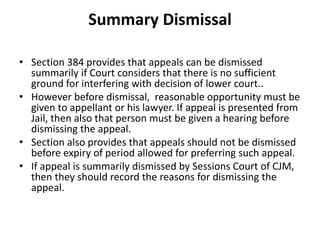
Summary Dismissal
• Section 384 provides that appeals can be dismissed
summarily if Court considers that there is no sufficient
ground for interfering with decision of lower court..
• However before dismissal, reasonable opportunity must be
given to appellant or his lawyer. If appeal is presented from
Jail, then also that person must be given a hearing before
dismissing the appeal.
• Section also provides that appeals should not be dismissed
before expiry of period allowed for preferring such appeal.
• If appeal is summarily dismissed by Sessions Court of CJM,
then they should record the reasons for dismissing the
appeal.
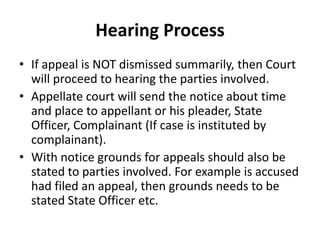
Hearing Process
• If appeal is NOT dismissed summarily, then Court
will proceed to hearing the parties involved.
• Appellate court will send the notice about time
and place to appellant or his pleader, State
Officer, Complainant (If case is instituted by
complainant).
• With notice grounds for appeals should also be
stated to parties involved. For example is accused
had filed an appeal, then grounds needs to be
stated State Officer etc.
Judgment
• After hearing the appeal, Court shall deliver a
judgment.
•
• So this is how normal procedure will be
carried out. First filing, then dismissal if court
think so, then hearing process if not dismissed
and then judgement.!
Power of Appellate Court
• Section 386 contains provisions related to Power of Appellate Court.
• Appellate court may
• Dismiss the appeal
• In an appeal against acquittal, may direct the lower court for retrial or
further inquiry.
• In an appeal against conviction
– May reverse the finding and discharge or acquit the accused, or order him to
be re tried by lower court
– alter the finding maintaining the sentence
– Alter the sentence or nature of sentence.
• In an appeal for enhancement of sentence
– Reverse the finding and may even discharge or acquit the accused, or order
the court for retrial
– Alter the sentence (Enhance the sentence)
Finality of Judgement and Orders on
Appeal
• Section 393 categorically states that judgement and orders on
appeals are final. However there are certain exception. They are
• When appeal is under Section 377(an appeal against inadequacy of
sentence)
• Section 378 (an appeal against acquittal)
• Section 384(4) - Regular appeal after dismissal of Jail appeal
• Chapter 30(an application for reference and revision)
• Apart from disposal of appeals on convictions, court can dispose of
appeal under 377 and 378 in Same cases.
• For example, Convict files an appeal against conviction. In the same
case State may file for enhancement. In that case Court can give
judgement and orders which would be final.
•

Appeals in Crpc.pptx

  • 2.
  • 3.
    We will studyabout • When you CANNOT appeal ? • Who can appeal and for What purpose ? • Appeals to Sessions Court • Appeals to High Court • Appeals to Supreme Court • General procedure • Power of Appellate Court • Finality of Judgement • Miscellaneous Sections
  • 4.
    When you cannot appeal ? • Section 372- No appeal to lie unless otherwise provided (Victim shall have a right to appeal) • Section 375- No appeal in certain cases when accused pleads guilty • Section 376- No appeals in petty cases • ( HC --- Imprisonment< 6 months, Fine< Rs. 1000) • (Session/Metropolitan M.--- Impri..<3 months, Fine< Rs. 200) • (Magistrate of 1st class--- Fine< Rs. 100) • ( In a case tried summarily Magistrate passes only a sentence of fine)
  • 5.
    Who can appealand for What purpose ? • Convicted Person (Section 374) • State/ Prosecutor (Section 377) • Victim (Amendment in Section 372)
  • 6.
    Appeals to Court •Appeal to Session Court • Appeal to High Court ( Session Court give Punishment > 7 Years) • Appeal to Supreme Court (When High Court, on appeal reverse the order of acquittal and convict the person for imprisonment for more than 10 years or death, appeal lies in Supreme Court. • As per Article 132(I), when substantial question of law is involved. • As per Article 134(I), when High court exercise extra ordinary jurisdiction(taking trial court case) or reversing the order of acquittal and giving death sentence. • Certifies under Article 134-A that the case is a fit one for appeal to Supreme court. • As per Article136 by Special Leave Appeal.
  • 7.
    General Procedure • Formatof an Appeal. • Section 382 only mentions that appeal should be in writing and the copy of judgement or order appealed against should be attached to it. • It's not necessary that grounds to be mentioned in appeal petition, however they can be stated in appeal.
  • 8.
    Summary Dismissal • Section384 provides that appeals can be dismissed summarily if Court considers that there is no sufficient ground for interfering with decision of lower court.. • However before dismissal, reasonable opportunity must be given to appellant or his lawyer. If appeal is presented from Jail, then also that person must be given a hearing before dismissing the appeal. • Section also provides that appeals should not be dismissed before expiry of period allowed for preferring such appeal. • If appeal is summarily dismissed by Sessions Court of CJM, then they should record the reasons for dismissing the appeal.
  • 9.
    Hearing Process • Ifappeal is NOT dismissed summarily, then Court will proceed to hearing the parties involved. • Appellate court will send the notice about time and place to appellant or his pleader, State Officer, Complainant (If case is instituted by complainant). • With notice grounds for appeals should also be stated to parties involved. For example is accused had filed an appeal, then grounds needs to be stated State Officer etc.
  • 10.
    Judgment • After hearingthe appeal, Court shall deliver a judgment. • • So this is how normal procedure will be carried out. First filing, then dismissal if court think so, then hearing process if not dismissed and then judgement.!
  • 11.
    Power of AppellateCourt • Section 386 contains provisions related to Power of Appellate Court. • Appellate court may • Dismiss the appeal • In an appeal against acquittal, may direct the lower court for retrial or further inquiry. • In an appeal against conviction – May reverse the finding and discharge or acquit the accused, or order him to be re tried by lower court – alter the finding maintaining the sentence – Alter the sentence or nature of sentence. • In an appeal for enhancement of sentence – Reverse the finding and may even discharge or acquit the accused, or order the court for retrial – Alter the sentence (Enhance the sentence)
  • 12.
    Finality of Judgementand Orders on Appeal • Section 393 categorically states that judgement and orders on appeals are final. However there are certain exception. They are • When appeal is under Section 377(an appeal against inadequacy of sentence) • Section 378 (an appeal against acquittal) • Section 384(4) - Regular appeal after dismissal of Jail appeal • Chapter 30(an application for reference and revision) • Apart from disposal of appeals on convictions, court can dispose of appeal under 377 and 378 in Same cases. • For example, Convict files an appeal against conviction. In the same case State may file for enhancement. In that case Court can give judgement and orders which would be final. •