Presented by:
Rakesh kumar
CUSB2213125076
Section: B
B.A.LL.B
5th
semester
Purpose of
judgement,
order and
decree in civil
cases
Judgment, Order, and Decree:
In civil cases, these terms define the outcomes of judicial
proceedings and clarify the rights and obligations of the parties
involved. Each term has a specific role:
• Judgment provides the reasoning and conclusion of the court on
the issues of law and fact.
• Decree is the formal expression of the court’s decision, stating
the relief granted or denied, making it an enforceable outcome.
• Order addresses procedural or interim matters within the case,
ensuring the case moves forward effectively.
Legal Impact:
These terms have a significant impact on the enforceability of court
decisions.
• Decree can be executed, meaning it can be enforced through
legal channels.
• Order and judgment guide the legal rights and steps the parties
may take, shaping the case’s progress and the final resolution.
Definition
of
Judgement
 The term judgement is defined in section 2(9) of the
code of the civil procedure, 1908
 “ Judgement” means the statement given by the judge
of the ground of a decree or order.
 A judgement contain facts of the case, the issues
involved, the evidence brought by the parties, finding
on the issues based on evidence and argument.
 According to justice Vivian Bose, A judgement is the
final decision of the court initimated to the parties
and to the world at large by formal ‘pronouncement’
or ‘delivery’ in open court”.
 Rules 1 to 5 of Order 20 deals with judgement.
ESSENTIAL
OF
JUDGEMENT
Every judgment other than that of a Court of Small
Causes should contain:
(i) a concise statement of the case,
(ii) the points for determination,
(iii) the decision thereon, and
(iv) the reasons for such decision A judgment of a Court
of Small Causes may contain only points (ii) and (iii).
STRUCTURE OF
JUDGEMENT
•Introduction: Names of the parties, case number.
•Facts: A summary of material facts.
•Issues: Legal questions the court needs to answer.
•Reasoning: The court’s application of law to facts.
•Decision: The final conclusion or outcome.
•Example: Judgment in a divorce case.
DEFINITION OF
DECREE
A decree as defined under Section 2(2) of
Civil Procedure Code, is a formal expression which
determines the interest of both the parties in a conclusive
manner, with regards to any disputed matter in a civil suit.
A decree is a formal expression of adjudication by which
the court determines the rights of parties regarding the
matter in a controversy or a dispute. A set-off or a
counterclaim can be obtained on the decree.
A decree shall be deemed to include
 Rejection of a plaint
 Determination of any question under Section 144 of the
Act.
The decree might not include
 Any adjudication from which an appeal lies as an appeal
from an order
 Any order of dismissal for default
TYPES OF DECREE
The Civil procedure code recognises three kinds of decrees
a) Preliminary decree
A decree is identified as a preliminary decree when an
adjudication decides the rights of parties regarding all or any of
the matter in dispute but it does not dispose of the suit
completely.
b) Final decree
A final decree settles all the issues and controversies between the
parties to the suit by the court of law.
c) Partially preliminary and partially final decree
A decree shall be held as partly preliminary and partly final, when
it determines certain disputes but leaves the rest open for further
decision. What is executable is a final decree and the one which is
not executable is a preliminary decree, unless it merges with the
final one.
Essential of decree
The decree is a decision of the court. For any decision of the court to be a decree, the
following essentials are required:
1.There must be an adjudication.
2.The adjudication must be done in a suit.
3.The adjudication must be determining the rights of the parties concerning all or any of the
matter at issue.
4.Such determination must be conclusive in nature.
5.There must be a formal expression of such adjudication
ILLUSTRATION
OF DECREE
 In a suit between A and B wherein A claims that a particular
property ‘P’ belongs him while B claims that the said property
belongs to him. After hearing all the arguments, the court will rule
in the favor of either A or B. The final decision of the court
regarding the above claim i.e. whether the property belongs to A or
B, is a decree.
 A files a partition suit against B. During the proceedings, the Court
passes a preliminary decree on the share of A and B. Subsequently,
after hearing both the parties and the arguments contended by
both, the court passes a final decree adjudicating upon the said
partition.
 ‘A’ filed a suit for the recovery of possession of a property from B.
The court passed a partly preliminary and partly final decree. So far
as final decree is concerned if the court granted possession of the
suit property to A; and it was preliminary as even though mesne
profits were awarded. In this case, only the granting of possession of
property to A will be executable; however, preliminary decree will be
executable only after the amount due is determined.
CONTENT OF
DECREE
Order XX Rule 6 of CPC provides that the decree shall agree with the
judgment and shall contain:
 The name of the suit
 The name and description of parties
 Their registered addresses
 Particulars of the claim
 Specify the relief granted or other determination of the suit
Order XX Rule 6A provides that the decree shall be drawn up within
15 days from the date judgment is pronounced.
Order XX Rule 7 provides that the decree shall bear the date on
which the judgment was pronounced.
DEFINITION OF ORDER
An Order is defined under Section 2(14) of the CPC as the formal expression of any
decision of a civil court which is not a decree.
Orders are issued by courts in response to applications made by parties during the
course of a suit or proceeding.
Unlike decrees, which conclusively determine the substantive rights of parties, orders
typically deal with procedural matters or interlocutory decisions.
TYPES OF
ORDER
Orders can be broadly categorised into two types:
 Appealable Orders: Certain orders are appealable and parties
can challenge them before a higher court. Section 104
and Order 43 Rule 1 of the CPC enumerate the orders that are
appealable.
 Non-Appealable Orders: Orders that cannot be appealed
unless specifically provided for in the CPC. These are
generally interlocutory orders that do not finally determine the
rights of the parties.
Final and Interlocutory Orders
 Final Orders: A final order conclusively determines the rights
of the parties on a particular issue or stage of the
proceedings. It settles the matter completely with no further
issues left for adjudication.
 Interlocutory Orders: These are temporary orders passed by
the court during the pendency of a suit. They do not determine
the final outcome but are issued to address procedural
matters or provide interim relief to the parties. For example, an
order granting or refusing an injunction is an interlocutory
order.
ESSENTIAL OF ORDER
Essential elements of order are as follows:
• It should be a formal expression of any decision.
• The formal expression should not be a decree.
• The decision to be pronounced by a civil court.
Case laws
Balraj Taneja vs Sunil Madan (1999): The
Supreme Court emphasized that
judgments must be reasoned, detailing
facts, issues, and rationale, ensuring
transparency and enabling appellate
review, thus reinforcing judicial
accountability and fair justice.
The Shub Karan Bubna vs Sita Saran
Bubna (2009) case clarified the
distinction between preliminary and final
decrees, emphasizing efficient
execution to ensure effective relief in
partition suits.
Ganga Bai v. Vijay Kumar (1974) 2
SCC 393. This case clarified the
meaning of a "decree" under
Section 2(2) of the CPC and
emphasized the finality
of such decrees.
V.G. Row v. State of Madras (1952).
This case is crucial in
understanding the nature of orders
under the CPC and the distinction
between "orders" and "decrees."
In State of U.P. vs C. Tobit
(1958), the Supreme Court
clarified the distinction
between an "order" and a
"decree" under the CPC,
impacting the appealability
of judicial decisions.
K.K. Verma v. Union of India
(1954), where the Supreme
Court clarified the meaning and
scope of a judgment. The case
defined a judgment as a formal
expression of the court's
decision, determining the rights
of the parties in a case.
DIFFERENCE
BETWEEN
JUDGEMENT
AND
DECREE
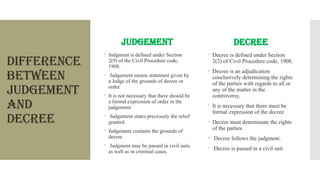
JUDGEMENT
 Judgment is defined under Section
2(9) of the Civil Procedure code,
1908.
 Judgement means statement given by
a Judge of the grounds of decree or
order.
 It is not necessary that there should be
a formal expression of order in the
judgement
 Judgement states preciously the relief
granted.
 Judgement contains the grounds of
decree.
 Judgment may be passed in civil suits
as well as in criminal cases.
DECREE
 Decree is defined under Section
2(2) of Civil Procedure code, 1908.
 Decree is an adjudication
conclusively determining the rights
of the parties with regards to all or
any of the matter in the
controversy.
 It is necessary that there must be
formal expression of the decree.
 Decree must determinate the rights
of the parties.
 Decree follows the judgment.
 Decree is passed in a civil suit.
DIFFERENCE
BETWEEN
DECREE
AND ORDER
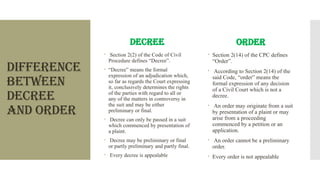
DECREE
 Section 2(2) of the Code of Civil
Procedure defines “Decree”.
 “Decree” means the formal
expression of an adjudication which,
so far as regards the Court expressing
it, conclusively determines the rights
of the parties with regard to all or
any of the matters in controversy in
the suit and may be either
preliminary or final.
 Decree can only be passed in a suit
which commenced by presentation of
a plaint.
 Decree may be preliminary or final
or partly preliminary and partly final.
 Every decree is appealable
ORDER
 Section 2(14) of the CPC defines
“Order”.
 According to Section 2(14) of the
said Code, “order” means the
formal expression of any decision
of a Civil Court which is not a
decree.
 An order may originate from a suit
by presentation of a plaint or may
arise from a proceeding
commenced by a petition or an
application.
 An order cannot be a preliminary
order.
 Every order is not appealable
CONCLUSION
•A civil suit is instituted by presentation of a plaint and ends with a judgment followed
by a decree.
•While judgment provides for grounds of a decree, decree is a formal expression of
adjudication which conclusively determines the rights of the parties.
•Formal expression of any decision which is not a decree is order.
•Thus, all three are very important in a civil suit and have their own significance.
THANK
YOU

Differences between ORDER DECREE AND JUDGEMENT.pptx

  • 1.
  • 2.
    Purpose of judgement, order and decreein civil cases Judgment, Order, and Decree: In civil cases, these terms define the outcomes of judicial proceedings and clarify the rights and obligations of the parties involved. Each term has a specific role: • Judgment provides the reasoning and conclusion of the court on the issues of law and fact. • Decree is the formal expression of the court’s decision, stating the relief granted or denied, making it an enforceable outcome. • Order addresses procedural or interim matters within the case, ensuring the case moves forward effectively. Legal Impact: These terms have a significant impact on the enforceability of court decisions. • Decree can be executed, meaning it can be enforced through legal channels. • Order and judgment guide the legal rights and steps the parties may take, shaping the case’s progress and the final resolution.
  • 3.
    Definition of Judgement  The termjudgement is defined in section 2(9) of the code of the civil procedure, 1908  “ Judgement” means the statement given by the judge of the ground of a decree or order.  A judgement contain facts of the case, the issues involved, the evidence brought by the parties, finding on the issues based on evidence and argument.  According to justice Vivian Bose, A judgement is the final decision of the court initimated to the parties and to the world at large by formal ‘pronouncement’ or ‘delivery’ in open court”.  Rules 1 to 5 of Order 20 deals with judgement.
  • 4.
    ESSENTIAL OF JUDGEMENT Every judgment otherthan that of a Court of Small Causes should contain: (i) a concise statement of the case, (ii) the points for determination, (iii) the decision thereon, and (iv) the reasons for such decision A judgment of a Court of Small Causes may contain only points (ii) and (iii).
  • 5.
    STRUCTURE OF JUDGEMENT •Introduction: Namesof the parties, case number. •Facts: A summary of material facts. •Issues: Legal questions the court needs to answer. •Reasoning: The court’s application of law to facts. •Decision: The final conclusion or outcome. •Example: Judgment in a divorce case.
  • 6.
    DEFINITION OF DECREE A decreeas defined under Section 2(2) of Civil Procedure Code, is a formal expression which determines the interest of both the parties in a conclusive manner, with regards to any disputed matter in a civil suit. A decree is a formal expression of adjudication by which the court determines the rights of parties regarding the matter in a controversy or a dispute. A set-off or a counterclaim can be obtained on the decree. A decree shall be deemed to include  Rejection of a plaint  Determination of any question under Section 144 of the Act. The decree might not include  Any adjudication from which an appeal lies as an appeal from an order  Any order of dismissal for default
  • 7.
    TYPES OF DECREE TheCivil procedure code recognises three kinds of decrees a) Preliminary decree A decree is identified as a preliminary decree when an adjudication decides the rights of parties regarding all or any of the matter in dispute but it does not dispose of the suit completely. b) Final decree A final decree settles all the issues and controversies between the parties to the suit by the court of law. c) Partially preliminary and partially final decree A decree shall be held as partly preliminary and partly final, when it determines certain disputes but leaves the rest open for further decision. What is executable is a final decree and the one which is not executable is a preliminary decree, unless it merges with the final one.
  • 8.
    Essential of decree Thedecree is a decision of the court. For any decision of the court to be a decree, the following essentials are required: 1.There must be an adjudication. 2.The adjudication must be done in a suit. 3.The adjudication must be determining the rights of the parties concerning all or any of the matter at issue. 4.Such determination must be conclusive in nature. 5.There must be a formal expression of such adjudication
  • 9.
    ILLUSTRATION OF DECREE  Ina suit between A and B wherein A claims that a particular property ‘P’ belongs him while B claims that the said property belongs to him. After hearing all the arguments, the court will rule in the favor of either A or B. The final decision of the court regarding the above claim i.e. whether the property belongs to A or B, is a decree.  A files a partition suit against B. During the proceedings, the Court passes a preliminary decree on the share of A and B. Subsequently, after hearing both the parties and the arguments contended by both, the court passes a final decree adjudicating upon the said partition.  ‘A’ filed a suit for the recovery of possession of a property from B. The court passed a partly preliminary and partly final decree. So far as final decree is concerned if the court granted possession of the suit property to A; and it was preliminary as even though mesne profits were awarded. In this case, only the granting of possession of property to A will be executable; however, preliminary decree will be executable only after the amount due is determined.
  • 10.
    CONTENT OF DECREE Order XXRule 6 of CPC provides that the decree shall agree with the judgment and shall contain:  The name of the suit  The name and description of parties  Their registered addresses  Particulars of the claim  Specify the relief granted or other determination of the suit Order XX Rule 6A provides that the decree shall be drawn up within 15 days from the date judgment is pronounced. Order XX Rule 7 provides that the decree shall bear the date on which the judgment was pronounced.
  • 11.
    DEFINITION OF ORDER AnOrder is defined under Section 2(14) of the CPC as the formal expression of any decision of a civil court which is not a decree. Orders are issued by courts in response to applications made by parties during the course of a suit or proceeding. Unlike decrees, which conclusively determine the substantive rights of parties, orders typically deal with procedural matters or interlocutory decisions.
  • 12.
    TYPES OF ORDER Orders canbe broadly categorised into two types:  Appealable Orders: Certain orders are appealable and parties can challenge them before a higher court. Section 104 and Order 43 Rule 1 of the CPC enumerate the orders that are appealable.  Non-Appealable Orders: Orders that cannot be appealed unless specifically provided for in the CPC. These are generally interlocutory orders that do not finally determine the rights of the parties. Final and Interlocutory Orders  Final Orders: A final order conclusively determines the rights of the parties on a particular issue or stage of the proceedings. It settles the matter completely with no further issues left for adjudication.  Interlocutory Orders: These are temporary orders passed by the court during the pendency of a suit. They do not determine the final outcome but are issued to address procedural matters or provide interim relief to the parties. For example, an order granting or refusing an injunction is an interlocutory order.
  • 13.
    ESSENTIAL OF ORDER Essentialelements of order are as follows: • It should be a formal expression of any decision. • The formal expression should not be a decree. • The decision to be pronounced by a civil court.
  • 14.
    Case laws Balraj Tanejavs Sunil Madan (1999): The Supreme Court emphasized that judgments must be reasoned, detailing facts, issues, and rationale, ensuring transparency and enabling appellate review, thus reinforcing judicial accountability and fair justice. The Shub Karan Bubna vs Sita Saran Bubna (2009) case clarified the distinction between preliminary and final decrees, emphasizing efficient execution to ensure effective relief in partition suits.
  • 15.
    Ganga Bai v.Vijay Kumar (1974) 2 SCC 393. This case clarified the meaning of a "decree" under Section 2(2) of the CPC and emphasized the finality of such decrees. V.G. Row v. State of Madras (1952). This case is crucial in understanding the nature of orders under the CPC and the distinction between "orders" and "decrees." In State of U.P. vs C. Tobit (1958), the Supreme Court clarified the distinction between an "order" and a "decree" under the CPC, impacting the appealability of judicial decisions. K.K. Verma v. Union of India (1954), where the Supreme Court clarified the meaning and scope of a judgment. The case defined a judgment as a formal expression of the court's decision, determining the rights of the parties in a case.
  • 16.
    DIFFERENCE BETWEEN JUDGEMENT AND DECREE JUDGEMENT  Judgment isdefined under Section 2(9) of the Civil Procedure code, 1908.  Judgement means statement given by a Judge of the grounds of decree or order.  It is not necessary that there should be a formal expression of order in the judgement  Judgement states preciously the relief granted.  Judgement contains the grounds of decree.  Judgment may be passed in civil suits as well as in criminal cases. DECREE  Decree is defined under Section 2(2) of Civil Procedure code, 1908.  Decree is an adjudication conclusively determining the rights of the parties with regards to all or any of the matter in the controversy.  It is necessary that there must be formal expression of the decree.  Decree must determinate the rights of the parties.  Decree follows the judgment.  Decree is passed in a civil suit.
  • 17.
    DIFFERENCE BETWEEN DECREE AND ORDER DECREE  Section2(2) of the Code of Civil Procedure defines “Decree”.  “Decree” means the formal expression of an adjudication which, so far as regards the Court expressing it, conclusively determines the rights of the parties with regard to all or any of the matters in controversy in the suit and may be either preliminary or final.  Decree can only be passed in a suit which commenced by presentation of a plaint.  Decree may be preliminary or final or partly preliminary and partly final.  Every decree is appealable ORDER  Section 2(14) of the CPC defines “Order”.  According to Section 2(14) of the said Code, “order” means the formal expression of any decision of a Civil Court which is not a decree.  An order may originate from a suit by presentation of a plaint or may arise from a proceeding commenced by a petition or an application.  An order cannot be a preliminary order.  Every order is not appealable
  • 18.
    CONCLUSION •A civil suitis instituted by presentation of a plaint and ends with a judgment followed by a decree. •While judgment provides for grounds of a decree, decree is a formal expression of adjudication which conclusively determines the rights of the parties. •Formal expression of any decision which is not a decree is order. •Thus, all three are very important in a civil suit and have their own significance.
  • 19.