INTRODUCTION TO COMPUTER
FORENSIC
Computer Forensics is a scientific method of
investigation and analysis in order to gather
evidence from digital devices or computer
networks and components which is suitable for
presentation in a court of law or legal body. It
involves performing a structured investigation
while maintaining a documented chain of evidence
to find out exactly what happened on a computer
and who was responsible for it.
4.
IMPORTANCE OF
COMPUTER FORENSIC
Addingthe ability to practice sound computer forensics will help you
ensure the overall integrity and survivability of your network
infrastructure. You can help your organization if you consider
computer forensics as a new basic element in what is known as a
“defense-in-depth”1 1 “Defense in depth is designed on the principle
that multiple layers of different types of protection from different
vendors provide substantially better protection” . approach to
network and computer security. For instance, understanding the
legal and technical aspects of computer forensics will help you
capture vital information if your network is compromised and will help
you prosecute the case if the intruder is caught
5.
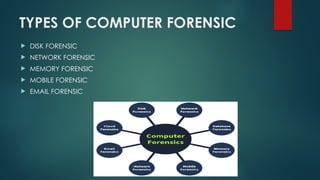
TYPES OF COMPUTERFORENSIC
DISK FORENSIC
NETWORK FORENSIC
MEMORY FORENSIC
MOBILE FORENSIC
EMAIL FORENSIC
6.
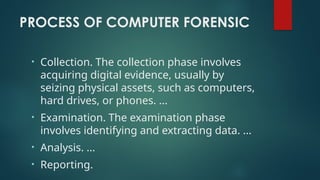
PROCESS OF COMPUTERFORENSIC
• Collection. The collection phase involves
acquiring digital evidence, usually by
seizing physical assets, such as computers,
hard drives, or phones. ...
• Examination. The examination phase
involves identifying and extracting data. ...
• Analysis. ...
• Reporting.
7.
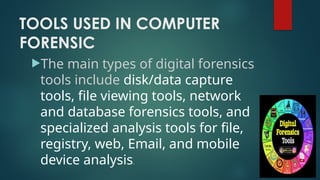
TOOLS USED INCOMPUTER
FORENSIC
The main types of digital forensics
tools include disk/data capture
tools, file viewing tools, network
and database forensics tools, and
specialized analysis tools for file,
registry, web, Email, and mobile
device analysis.
8.
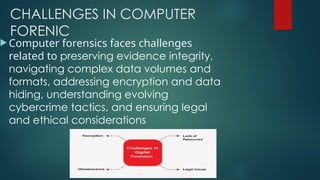
CHALLENGES IN COMPUTER
FORENIC
Computer forensics faces challenges
related to preserving evidence integrity,
navigating complex data volumes and
formats, addressing encryption and data
hiding, understanding evolving
cybercrime tactics, and ensuring legal
and ethical considerations
9.
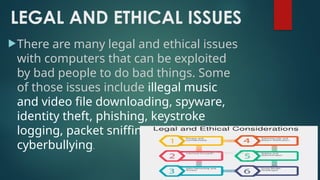
LEGAL AND ETHICALISSUES
There are many legal and ethical issues
with computers that can be exploited
by bad people to do bad things. Some
of those issues include illegal music
and video file downloading, spyware,
identity theft, phishing, keystroke
logging, packet sniffing and
cyberbullying.
10.
REAL WORLD EXAMPLES
FBI SOLVING CYBERCRIMES
COPORATE DATA BREACHES
TACKING HACKING GROUPS
CONCLUSION
In conclusion, computerforensics is a
vital field for identifying, collecting, and
analyzing digital evidence to solve
crimes and ensure cybersecurity,
requiring specialized skills and ethical
considerations to ensure the integrity
and admissibility of evidence