T O P I C : - O R G A N I Z A T I O N A L S T R U C T U R E A N D
D E L E G A T I O N O F A U T H O R I T Y .
P R E S E N T E D B Y : - A N U R A G K A S H Y A P
A N U R A G S H A R M A
C H E T N A R A N A
D E V G U P T A
G A U R A V K U M A R
DR. BHIMRAO AMBEDKAR UNIVERSITY
INTRODUCTION
WHAT IS AN ORGANIZATIONAL
STRUCTURE?
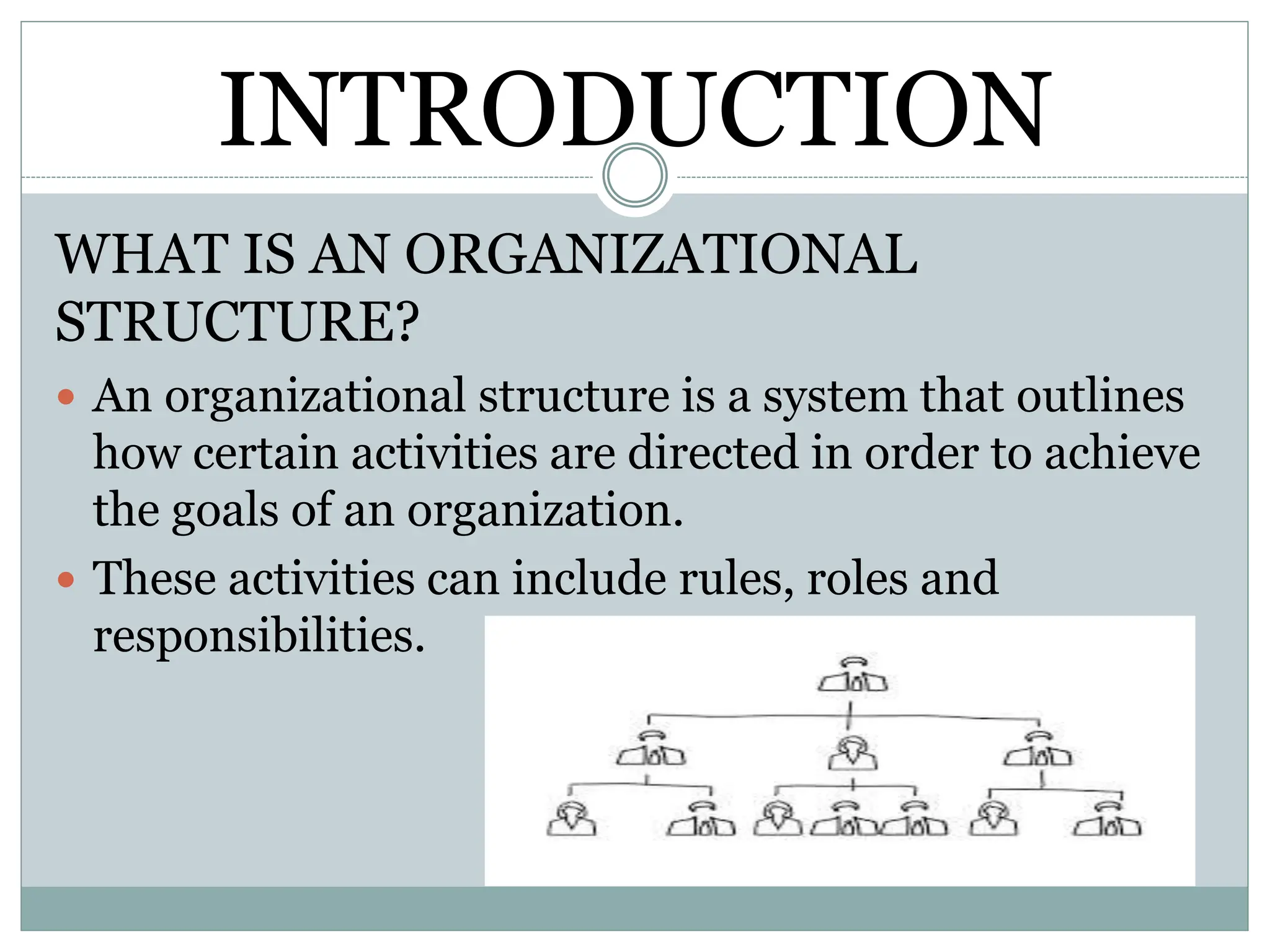
 An organizational structure is a system that outlines
how certain activities are directed in order to achieve
the goals of an organization.
 These activities can include rules, roles and
responsibilities.
IMPORTANCE OF ORGANIZATIONAL
STRUCTURE
 Efficient coordination: It ensures tasks are
distributed, roles are defined, and resources are
allocated effectively.
 Clear communication: A well-defined structure
facilitates communication flow, both vertically and
horizontally.
 Decision-making: It is the process of making choice
between two or more options.
 Adaptability: It allows organizations to adapt to
changes in the environment more effectively.
TYPES OF ORGANIZATIONAL STRUCTURE
1.Functional Structure
 Organized by specific functions or departments (e.g., marketing, finance, operations).
 Promotes specialization and efficiency within each function.
 Suitable for small to medium-sized organizations with a narrow product line.
2.Divisional Structure
 Organized by divisions, each responsible for a distinct product, service, or geographic area.
 Allows for greater flexibility and responsiveness to local needs.
 Common in larger organizations with diverse product lines or geographic spread.
3.Matrix Structure
 Combines elements of both functional and divisional structures.
 Employees report to both functional managers and project managers simultaneously.
 Enhances coordination and expertise sharing but can lead to power struggles and role
ambiguity.
4.Network Structure
 Emphasizes collaboration with external partners, outsourcing non-core activities.
 Focuses on core competencies while leveraging external expertise and resources.
 Particularly suitable for knowledge-based industries and virtual organizations.
FACTORS INFLUENCING ORGANIZATIONAL
STRUCTURE
 Size of the organization: Larger organizations tend to
adopt more complex structures to manage diverse
operations.
 Strategy: Different strategies require different
structures (e.g., innovation-focused organizations
may prefer flatter structures).
 Environment: Organizations operating in dynamic
environments may opt for more flexible structures.
 Technology: Advanced technologies may necessitate
flatter structures to facilitate quick decision-making
and innovation.
 DEFINITION:- Delegation of authority is the process
of assigning responsibilities and authority to another
person to carry out specific tasks or make decisions
on behalf of a manager or leader.
IMPORTANCE OF DELEGATION
 Empowers employees: Delegation gives individuals
autonomy and fosters a sense of ownership over their
work.
 Develops skills: Delegating tasks provides
opportunities for learning and skill development.
 Increases efficiency: Allows leaders to focus on high-
priority tasks while distributing workload effectively.
 Builds trust: Delegating demonstrates trust in team
members' abilities, enhancing morale and
motivation.
BARRIERS TO EFFECTIVE DELEGATION
 Fear of losing control: Leaders may hesitate to
delegate due to concerns about losing control over
tasks or outcomes.
 Lack of trust: Inadequate trust in team members'
capabilities can hinder delegation efforts.
 Perfectionism: Some leaders may struggle to
delegate as they feel only they can complete tasks to
their standards.
 Time constraints: Busy schedules may lead to
reluctance to invest time in training others or
monitoring delegated tasks.
PRINCIPLES OF DELEGATION
 Reduces manager’s workload:- Delegating task allows
managers to focus on higher-level responsibilities.
 Fosters employee development:- Delegation provides
opportunities for employees to learn skills, gain
experience and grow professionally.
 Increases efficiency and productivity:- Distributing tasks
among team members ensures that work is completed in
a timely manner.
 Encourage teamwork:- Delegation promotes
collaboration among team members, leading to better
problem-solving.
ppt of organisation structure and delegation of authority.pptx

ppt of organisation structure and delegation of authority.pptx

  • 1.
    T O PI C : - O R G A N I Z A T I O N A L S T R U C T U R E A N D D E L E G A T I O N O F A U T H O R I T Y . P R E S E N T E D B Y : - A N U R A G K A S H Y A P A N U R A G S H A R M A C H E T N A R A N A D E V G U P T A G A U R A V K U M A R DR. BHIMRAO AMBEDKAR UNIVERSITY
  • 2.
    INTRODUCTION WHAT IS ANORGANIZATIONAL STRUCTURE?  An organizational structure is a system that outlines how certain activities are directed in order to achieve the goals of an organization.  These activities can include rules, roles and responsibilities.
  • 3.
    IMPORTANCE OF ORGANIZATIONAL STRUCTURE Efficient coordination: It ensures tasks are distributed, roles are defined, and resources are allocated effectively.  Clear communication: A well-defined structure facilitates communication flow, both vertically and horizontally.  Decision-making: It is the process of making choice between two or more options.  Adaptability: It allows organizations to adapt to changes in the environment more effectively.
  • 4.
    TYPES OF ORGANIZATIONALSTRUCTURE 1.Functional Structure  Organized by specific functions or departments (e.g., marketing, finance, operations).  Promotes specialization and efficiency within each function.  Suitable for small to medium-sized organizations with a narrow product line. 2.Divisional Structure  Organized by divisions, each responsible for a distinct product, service, or geographic area.  Allows for greater flexibility and responsiveness to local needs.  Common in larger organizations with diverse product lines or geographic spread. 3.Matrix Structure  Combines elements of both functional and divisional structures.  Employees report to both functional managers and project managers simultaneously.  Enhances coordination and expertise sharing but can lead to power struggles and role ambiguity. 4.Network Structure  Emphasizes collaboration with external partners, outsourcing non-core activities.  Focuses on core competencies while leveraging external expertise and resources.  Particularly suitable for knowledge-based industries and virtual organizations.
  • 5.
    FACTORS INFLUENCING ORGANIZATIONAL STRUCTURE Size of the organization: Larger organizations tend to adopt more complex structures to manage diverse operations.  Strategy: Different strategies require different structures (e.g., innovation-focused organizations may prefer flatter structures).  Environment: Organizations operating in dynamic environments may opt for more flexible structures.  Technology: Advanced technologies may necessitate flatter structures to facilitate quick decision-making and innovation.
  • 7.
     DEFINITION:- Delegationof authority is the process of assigning responsibilities and authority to another person to carry out specific tasks or make decisions on behalf of a manager or leader.
  • 8.
    IMPORTANCE OF DELEGATION Empowers employees: Delegation gives individuals autonomy and fosters a sense of ownership over their work.  Develops skills: Delegating tasks provides opportunities for learning and skill development.  Increases efficiency: Allows leaders to focus on high- priority tasks while distributing workload effectively.  Builds trust: Delegating demonstrates trust in team members' abilities, enhancing morale and motivation.
  • 9.
    BARRIERS TO EFFECTIVEDELEGATION  Fear of losing control: Leaders may hesitate to delegate due to concerns about losing control over tasks or outcomes.  Lack of trust: Inadequate trust in team members' capabilities can hinder delegation efforts.  Perfectionism: Some leaders may struggle to delegate as they feel only they can complete tasks to their standards.  Time constraints: Busy schedules may lead to reluctance to invest time in training others or monitoring delegated tasks.
  • 10.
    PRINCIPLES OF DELEGATION Reduces manager’s workload:- Delegating task allows managers to focus on higher-level responsibilities.  Fosters employee development:- Delegation provides opportunities for employees to learn skills, gain experience and grow professionally.  Increases efficiency and productivity:- Distributing tasks among team members ensures that work is completed in a timely manner.  Encourage teamwork:- Delegation promotes collaboration among team members, leading to better problem-solving.