LOCOMOTIVE DIESEL SHED,
PHULERA
SUBMITTED TO :
SUBMITTED BY :
DEPARTMENT OF MECHANICAL ENGINEERING
GOVIND RAM KUMAWAT
SKIT,M&G,JAIPUR
(15ESKME062)
 Indian Railways has one of the largest & busiest rail networks in the
world.
 It comes under the Ministry of Railways.
 It is the world’s largest commercial employer, with more than
 105 million employees.
 The fleet of includes over 200,000 wagons, 50,000 coaches, 8,000
locomotives.
 It also owns locomotives & coaches production facilities.
 Indian Railways transporting over 20 million passengers.
 Indian Railways are divided into 16 zones. & each zones is made up
of a certain no. of divisions. There are 67 divisions.
 The total length of the track used by Indian Railways is about 108,805
KM (67,608miles.)
 About 50% of the total track KM is Diesel .
 It also operates the Kolkata, Delhi metro.
ABOUT INDIAN RAILWAY
Diesel shed, Phulera was established in the year 1965 as a
satellite shed to attend trip and fortnightly schedule of
MG locomotives of SBI, BGKT and ABR diesel sheds. In
1996 Phulera shed was converted into a homing shed.
The shed is currently headed by Lt. Shashank DME/Dsl/FL,
who is assisted by ADME (Diesel) and AMM. The senior
supervisory cadre of shed includes 5 SSE (Diesel), 2 SSE
(Diesel-Electric) and 2 Chemist and Metallurgical
Superintendent.
About Diesel LOCO Shed, Phulera
Classification of Locos
The first digit [gauge]
W= Broad Gauge
Y= Meter Gauge
Z= Narrow Gauge
The second digit
D= Diesel
C= DC traction
A= AC traction
CA= Dual-power AC/DC traction
B= Battery electric (rare)
The third digit [load]
M= Mixed Traffic
P= Passenger
G= Goods
U= Multiple Unit ( EMU/ DEMU)
R= Railcar
WDM3
YDM3
ZDM3
[Power]
Locomotive – A vehicle that outputs energy and powers a train along
the rails, the only “live” part of the train.
Engine – Locomotives are popularly called “Engines”, though the
engine is only a part of the (diesel) locomotive, while electric
locomotives do not have engines at all.
Bogie –A bogie is a unit under a coach or a locomotive body which
houses the wheels, suspension etc.
Transmission – The medium used to send the power generated by the
diesel engine to the wheels. In modern locomotives, the diesel engine
produces electric (AC) current used to power traction motors which
turn the wheels.
Traction Motors – Electric motors that “actually” drive the wheels of
the locomotive and hence the train. These motors are directly
connected to axles of the locomotive, usually one per axle.
Locomotive terminology
Continued ……
Diesel Engine
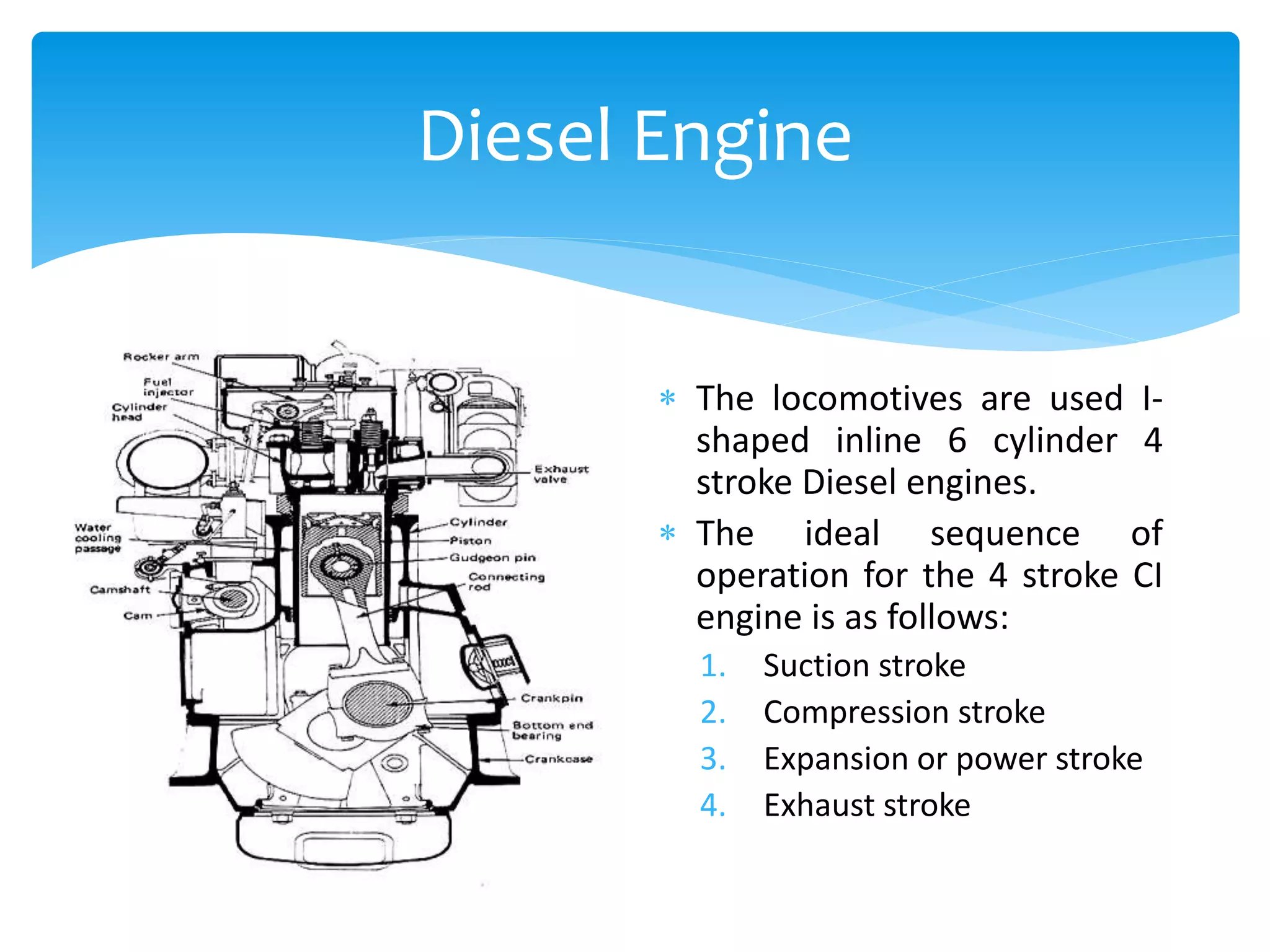
 The locomotives are used I-
shaped inline 6 cylinder 4
stroke Diesel engines.
 The ideal sequence of
operation for the 4 stroke CI
engine is as follows:
1. Suction stroke
2. Compression stroke
3. Expansion or power stroke
4. Exhaust stroke
Expressor
EXhauster
ComPRESSOR
Expressor
Continued ……
 The expressor is located at the free end of the engine
block and driven through the extension shaft attached
to the engine crank shaft.
 Four Nos. of exhauster cylinders with cylinder heads
 One low pressure compressor cylinder with cylinder
head
 One high pressure cylinder with cylinder head
Continued ……
 5 type of braking system used in locos:-
1. A-9 brake:- Brake application for Loco as well as formations.
2. SA-9 brake:- Brake Application for Loco alone.
3. Dynamic brake:- To decrease the speed of loco and train on
sloping path.
4. Hand brake:- It consists of a gear and handle arrangement
directly connected to the brake cylinder to push the horse
shoe onto the wheel when encountering slipping surfaces.
5. Emergency brake
Braking system in Locos
 A bogie is a structure underneath a railway vehicle body to
which axles and wheels are attached through bearings.
 Bogie serves a number of purposes:-
 Support of the rail vehicle body.
 Stability on both straight and curved tracks.
 Providing ride comfort by absorbing vibration, and minimizing
centrifugal forces when the train runs on curves at high-speed.
 Minimizing generation of track irregularities and rail abrasion
Bogie
The fuel oil system is designed to supply fuel to the engine
in correct quantity and at the right time according to the
engine requirements. The fuel oil system draws fuel from
fuel tank, filter the fuel, pressurise the fuel, and inject the
fuel into the engine in correct quantity in atomised
condition.
Fuel oil system
Engine cooling water system is a closed loop pressurized
water cooling system. The water cooling system cools – All
the engine cylinder liners, cylinder heads, after cooler,
lube oil cooler and compressor.
Water cooling system
Continued ……
Thanking you for carefully
listening ……

ppt for training in locomotive

  • 1.
    LOCOMOTIVE DIESEL SHED, PHULERA SUBMITTEDTO : SUBMITTED BY : DEPARTMENT OF MECHANICAL ENGINEERING GOVIND RAM KUMAWAT SKIT,M&G,JAIPUR (15ESKME062)
  • 2.
     Indian Railwayshas one of the largest & busiest rail networks in the world.  It comes under the Ministry of Railways.  It is the world’s largest commercial employer, with more than  105 million employees.  The fleet of includes over 200,000 wagons, 50,000 coaches, 8,000 locomotives.  It also owns locomotives & coaches production facilities.  Indian Railways transporting over 20 million passengers.  Indian Railways are divided into 16 zones. & each zones is made up of a certain no. of divisions. There are 67 divisions.  The total length of the track used by Indian Railways is about 108,805 KM (67,608miles.)  About 50% of the total track KM is Diesel .  It also operates the Kolkata, Delhi metro. ABOUT INDIAN RAILWAY
  • 3.
    Diesel shed, Phulerawas established in the year 1965 as a satellite shed to attend trip and fortnightly schedule of MG locomotives of SBI, BGKT and ABR diesel sheds. In 1996 Phulera shed was converted into a homing shed. The shed is currently headed by Lt. Shashank DME/Dsl/FL, who is assisted by ADME (Diesel) and AMM. The senior supervisory cadre of shed includes 5 SSE (Diesel), 2 SSE (Diesel-Electric) and 2 Chemist and Metallurgical Superintendent. About Diesel LOCO Shed, Phulera
  • 4.
    Classification of Locos Thefirst digit [gauge] W= Broad Gauge Y= Meter Gauge Z= Narrow Gauge The second digit D= Diesel C= DC traction A= AC traction CA= Dual-power AC/DC traction B= Battery electric (rare) The third digit [load] M= Mixed Traffic P= Passenger G= Goods U= Multiple Unit ( EMU/ DEMU) R= Railcar WDM3 YDM3 ZDM3 [Power]
  • 5.
    Locomotive – Avehicle that outputs energy and powers a train along the rails, the only “live” part of the train. Engine – Locomotives are popularly called “Engines”, though the engine is only a part of the (diesel) locomotive, while electric locomotives do not have engines at all. Bogie –A bogie is a unit under a coach or a locomotive body which houses the wheels, suspension etc. Transmission – The medium used to send the power generated by the diesel engine to the wheels. In modern locomotives, the diesel engine produces electric (AC) current used to power traction motors which turn the wheels. Traction Motors – Electric motors that “actually” drive the wheels of the locomotive and hence the train. These motors are directly connected to axles of the locomotive, usually one per axle. Locomotive terminology
  • 6.
  • 7.
    Diesel Engine  Thelocomotives are used I- shaped inline 6 cylinder 4 stroke Diesel engines.  The ideal sequence of operation for the 4 stroke CI engine is as follows: 1. Suction stroke 2. Compression stroke 3. Expansion or power stroke 4. Exhaust stroke
  • 8.
  • 9.
  • 10.
     The expressoris located at the free end of the engine block and driven through the extension shaft attached to the engine crank shaft.  Four Nos. of exhauster cylinders with cylinder heads  One low pressure compressor cylinder with cylinder head  One high pressure cylinder with cylinder head Continued ……
  • 11.
     5 typeof braking system used in locos:- 1. A-9 brake:- Brake application for Loco as well as formations. 2. SA-9 brake:- Brake Application for Loco alone. 3. Dynamic brake:- To decrease the speed of loco and train on sloping path. 4. Hand brake:- It consists of a gear and handle arrangement directly connected to the brake cylinder to push the horse shoe onto the wheel when encountering slipping surfaces. 5. Emergency brake Braking system in Locos
  • 12.
     A bogieis a structure underneath a railway vehicle body to which axles and wheels are attached through bearings.  Bogie serves a number of purposes:-  Support of the rail vehicle body.  Stability on both straight and curved tracks.  Providing ride comfort by absorbing vibration, and minimizing centrifugal forces when the train runs on curves at high-speed.  Minimizing generation of track irregularities and rail abrasion Bogie
  • 13.
    The fuel oilsystem is designed to supply fuel to the engine in correct quantity and at the right time according to the engine requirements. The fuel oil system draws fuel from fuel tank, filter the fuel, pressurise the fuel, and inject the fuel into the engine in correct quantity in atomised condition. Fuel oil system
  • 14.
    Engine cooling watersystem is a closed loop pressurized water cooling system. The water cooling system cools – All the engine cylinder liners, cylinder heads, after cooler, lube oil cooler and compressor. Water cooling system
  • 15.
  • 16.
    Thanking you forcarefully listening ……