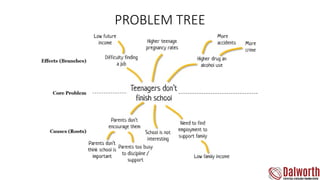
PROBLEM TREE
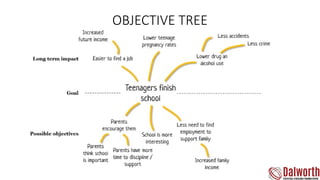
OBJECTIVE TREE
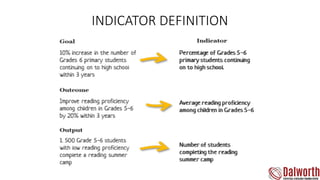
INDICATOR DEFINITION
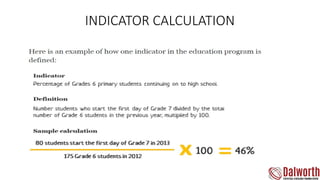
INDICATOR CALCULATION
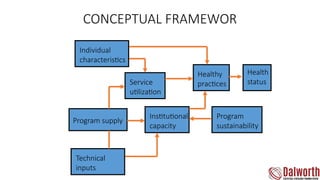
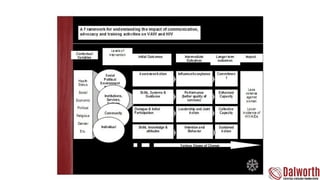
CONCEPTUAL FRAMEWOR
Individual
characteristics
Technical
inputs
Program supply
Institutional
capacity
Program
sustainability
Health
status
Healthy
practices
Service
utilization
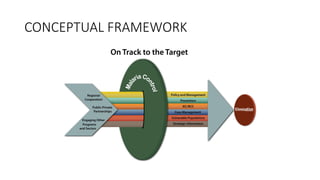
CONCEPTUAL FRAMEWORK
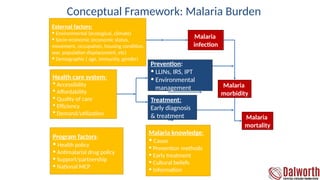
Conceptual Framework: Malaria Burden
Malaria
mortality
Malaria
infection
Malaria
morbidity
Treatment:
Early diagnosis
& treatment
Health care system:
 Accessibility
 Affordability
 Quality of care
 Efficiency
 Demand/utilization
Prevention:
• LLINs, IRS, IPT
• Environmental
management
Malaria knowledge:
• Cause
• Prevention methods
• Early treatment
• Cultural beliefs
• Information
Program factors:
• Health policy
• Antimalarial drug policy
• Support/partnership
• National MCP
External factors:
• Environmental (ecological, climate)
• Socio-economic (economic status,
movement, occupation, housing condition,
war, population displacement, etc)
• Demographic ( age, immunity, gender)
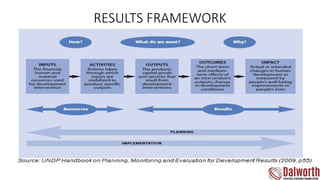
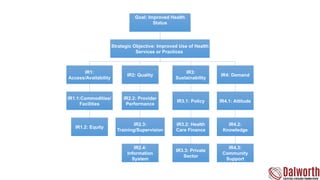
RESULTS FRAMEWORK
Goal: Improved Health
Status
Strategic Objective: Improved Use of Health
Services or Practices
IR1:
Access/Availability
IR1.1:Commodities/
Facilities
IR1.2: Equity
IR2: Quality
IR2.2: Provider
Performance
IR2.3:
Training/Supervision
IR2.4:
Information
System
IR3:
Sustainability
IR3.1: Policy
IR3.2: Health
Care Finance
IR3.3: Private
Sector
IR4: Demand
IR4.1: Attitude
IR4.2:
Knowledge
IR4.3:
Community
Support
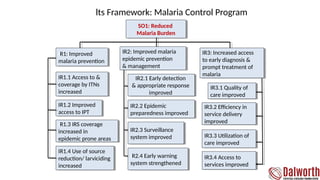
SO1: Reduced
Malaria Burden
IR2: Improved malaria
epidemic prevention
& management
IR3: Increased access
to early diagnosis &
prompt treatment of
malaria
IR1.1 Access to &
coverage by ITNs
increased
IR1.2 Improved
access to IPT
IR1.3 IRS coverage
increased in
epidemic prone areas
IR1.4 Use of source
reduction/ larviciding
increased
IR3.4 Access to
services improved
IR1: Improved
malaria prevention
IR2.1 Early detection
& appropriate response
improved
IR2.2 Epidemic
preparedness improved
IR2.3 Surveillance
system improved
IR2.4 Early warning
system strengthened
IR3.1 Quality of
care improved
IR3.2 Efficiency in
service delivery
improved
IR3.3 Utilization of
care improved
Results Framework: Malaria Control Program
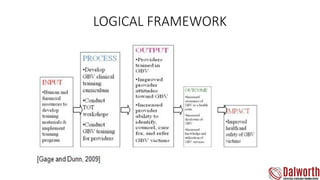
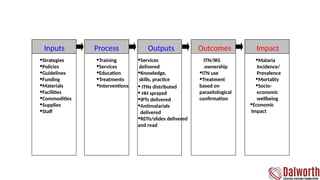
LOGICAL FRAMEWORK
Inputs Process Outputs Outcomes Impact
•Strategies
•Policies
•Guidelines
•Funding
•Materials
•Facilities
•Commodities
•Supplies
•Staff
•Training
•Services
•Education
•Treatments
•Interventions
•Services
delivered
•Knowledge,
skills, practice
• ITNs distributed
• HH sprayed
•IPTs delivered
•Antimalarials
delivered
•RDTs/slides delivered
and reads
taken
•IITN/IRS
ownership
•ITN use
•Treatment
based on
parasitological
confirmation
•Malaria
Incidence/
Prevalence
•Mortality
•Socio-
economic
wellbeing
•Economic
Impact
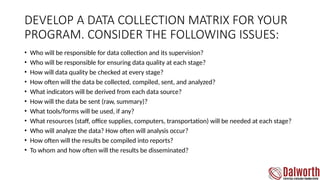
DEVELOP A DATA COLLECTION MATRIX FOR YOUR
PROGRAM. CONSIDER THE FOLLOWING ISSUES:
• Who will be responsible for data collection and its supervision?
• Who will be responsible for ensuring data quality at each stage?
• How will data quality be checked at every stage?
• How often will the data be collected, compiled, sent, and analyzed?
• What indicators will be derived from each data source?
• How will the data be sent (raw, summary)?
• What tools/forms will be used, if any?
• What resources (staff, office supplies, computers, transportation) will be needed at each stage?
• Who will analyze the data? How often will analysis occur?
• How often will the results be compiled into reports?
• To whom and how often will the results be disseminated?
PPT FOR ILLUSTRATIONS.pptx which will be benefit humanitarian workers

PPT FOR ILLUSTRATIONS.pptx which will be benefit humanitarian workers

  • 2.
  • 3.
  • 4.
  • 5.
  • 6.
  • 7.
  • 8.
    Conceptual Framework: MalariaBurden Malaria mortality Malaria infection Malaria morbidity Treatment: Early diagnosis & treatment Health care system:  Accessibility  Affordability  Quality of care  Efficiency  Demand/utilization Prevention: • LLINs, IRS, IPT • Environmental management Malaria knowledge: • Cause • Prevention methods • Early treatment • Cultural beliefs • Information Program factors: • Health policy • Antimalarial drug policy • Support/partnership • National MCP External factors: • Environmental (ecological, climate) • Socio-economic (economic status, movement, occupation, housing condition, war, population displacement, etc) • Demographic ( age, immunity, gender)
  • 9.
  • 11.
    Goal: Improved Health Status StrategicObjective: Improved Use of Health Services or Practices IR1: Access/Availability IR1.1:Commodities/ Facilities IR1.2: Equity IR2: Quality IR2.2: Provider Performance IR2.3: Training/Supervision IR2.4: Information System IR3: Sustainability IR3.1: Policy IR3.2: Health Care Finance IR3.3: Private Sector IR4: Demand IR4.1: Attitude IR4.2: Knowledge IR4.3: Community Support
  • 12.
    SO1: Reduced Malaria Burden IR2:Improved malaria epidemic prevention & management IR3: Increased access to early diagnosis & prompt treatment of malaria IR1.1 Access to & coverage by ITNs increased IR1.2 Improved access to IPT IR1.3 IRS coverage increased in epidemic prone areas IR1.4 Use of source reduction/ larviciding increased IR3.4 Access to services improved IR1: Improved malaria prevention IR2.1 Early detection & appropriate response improved IR2.2 Epidemic preparedness improved IR2.3 Surveillance system improved IR2.4 Early warning system strengthened IR3.1 Quality of care improved IR3.2 Efficiency in service delivery improved IR3.3 Utilization of care improved Results Framework: Malaria Control Program
  • 13.
  • 15.
    Inputs Process OutputsOutcomes Impact •Strategies •Policies •Guidelines •Funding •Materials •Facilities •Commodities •Supplies •Staff •Training •Services •Education •Treatments •Interventions •Services delivered •Knowledge, skills, practice • ITNs distributed • HH sprayed •IPTs delivered •Antimalarials delivered •RDTs/slides delivered and reads taken •IITN/IRS ownership •ITN use •Treatment based on parasitological confirmation •Malaria Incidence/ Prevalence •Mortality •Socio- economic wellbeing •Economic Impact
  • 16.
    DEVELOP A DATACOLLECTION MATRIX FOR YOUR PROGRAM. CONSIDER THE FOLLOWING ISSUES: • Who will be responsible for data collection and its supervision? • Who will be responsible for ensuring data quality at each stage? • How will data quality be checked at every stage? • How often will the data be collected, compiled, sent, and analyzed? • What indicators will be derived from each data source? • How will the data be sent (raw, summary)? • What tools/forms will be used, if any? • What resources (staff, office supplies, computers, transportation) will be needed at each stage? • Who will analyze the data? How often will analysis occur? • How often will the results be compiled into reports? • To whom and how often will the results be disseminated?

Editor's Notes

  • #8 Speaker Notes: Depending on the epidemiology of malaria, people are at risk of acquiring infection due to factors related to environment, demographic and socio-economic status. Strong health care system (and malaria control program (MCP)) with adequate global and national support, prevention and control of malaria using early diagnosis & prompt treatment, and vector-control strategies have a significant impact on reducing malaria morbidity and mortality. Prevention methods inhibit the establishment of infection or suppress the progression of the parasite after infection. Access to early diagnosis and prompt treatment with effective antimalarial drug significantly reduce the severity of the illness, which will ultimately affect malaria mortality. A related factor is the perception of people about what causes malaria, their understanding of early treatment with appropriate antimalarials, the use of personal preventive methods and participation in disease prevention.
  • #12 Speaker Notes: The above framework shows the main critical areas for monitoring and evaluation of RBM control interventions. The ultimate objective of RBM is to reduce the burden of malaria (i.e. mortality, morbidity and economic losses). The reduction in burden will be achieved through control interventions undertaken by the National Malaria Control Programs. The actual interventions, according to malaria epidemiology, will include the critical areas of: Prevention (e.g. use of ITNs, indoor residual spraying, prevention of malaria during pregnancy); early diagnosis and effective treatment of the disease, and prevention and control of epidemics in epidemic-prone areas). Utilization of ITNs, application of indoor residual spraying (IRS), environmental management and improved access to Intermittent Presumptive Treatment (IPT) will improve malaria prevention. Strong surveillance system with appropriate early warning system to early detect and contain epidemics alleviate mortality and morbidity associated with malaria epidemics. Quality of adequate care (technical and perceived quality), efficiency in providing services, utilization of adequate care (prompt access and early treatment seeking) and access to health care services are the critical areas that should be given attention with regard to malaria treatment.