




4th Group
Point of Tile’s
 Definition of Cooperative Learning
 Implementing Cooperative Learning in The Class
 Promoting positive interdependence
 Help students develop teamwork skills
 General Suggestions
 Part of Questions
 Summary
What is Cooperative Learning?
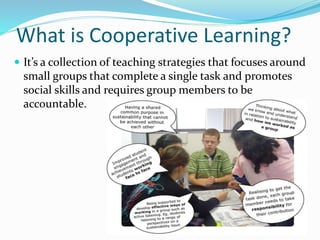
 It’s a collection of teaching strategies that focuses around
small groups that complete a single task and promotes
social skills and requires group members to be
accountable.
Robert Slavin
 Pioneer of cooperative learning
techniques, developed student
team learning methods in which
a team’s work is not completed
until all students on the team
understand the material being
studied.
Five Basic Elements of Cooperative Learning
1. Positive Interdependence
2. Individual Accountability
3. Face-To-Face Interaction
4. Appropriate use of collaborative skills
5. Group Processing
Is it safe???
 How to Implementing
Cooperative Learning
in the Class??
Promoting positive interdepen
dence
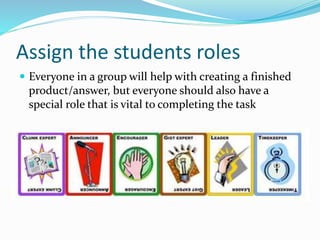
 Assign different roles to team members
 Use Jigsaw to set up specialized expertise within each team
 Give a bonus on tests
 Report is part of the team project
Assign the students roles
 Everyone in a group will help with creating a finished
product/answer, but everyone should also have a
special role that is vital to completing the task
Jigsaw
 Each student (or group) learns about a topic (or part of
a topic)
 It is then each student (or groups) job to teach
everyone else in the class about their topic
 When you have to teach about something your brain is
forced to critically think about it so you can present it
to others
Help students develop team
work skills
 Establish team policies and expectations
 Keep groups intact for at least a month
 Provide for periodic self-assessment of team functioning
 Give students tools for managing conflict
 Use crisis clinics to equip students to deal with difficult team
General Suggestions
 Start small and build
 At the start of the course, explain to students what you’re doing, why you’re
doing it, and what’s in it for them
 Make team assignments more challenging than traditional individual
assignments
 Don’t curve course grades
 Conduct a midterm assessment to find out how students feel about teamwork
 Expect initial resistance from students
Part of Questions !
SUMMARY
 Cooperative learning refers to work done by student teams producing a
product of some sort (such as a set of problem solutions, a laboratory or
project report, or the design of a product or a process), under conditions
that satisfy five criteria: (1) positive interdependence, (2) individual accou
-ntability, (3) face-toface interaction for at least part of the work, (4) appr-
opriate use of interpersonal skills, and (5) regular self-assessment of team
functioning
Thank You !

Cooperative Learning for ELS in the Classroom

  • 2.
  • 3.
    Point of Tile’s Definition of Cooperative Learning  Implementing Cooperative Learning in The Class  Promoting positive interdependence  Help students develop teamwork skills  General Suggestions  Part of Questions  Summary
  • 4.
    What is CooperativeLearning?  It’s a collection of teaching strategies that focuses around small groups that complete a single task and promotes social skills and requires group members to be accountable.
  • 5.
    Robert Slavin  Pioneerof cooperative learning techniques, developed student team learning methods in which a team’s work is not completed until all students on the team understand the material being studied.
  • 6.
    Five Basic Elementsof Cooperative Learning 1. Positive Interdependence 2. Individual Accountability 3. Face-To-Face Interaction 4. Appropriate use of collaborative skills 5. Group Processing
  • 7.
    Is it safe??? How to Implementing Cooperative Learning in the Class??
  • 8.
    Promoting positive interdepen dence Assign different roles to team members  Use Jigsaw to set up specialized expertise within each team  Give a bonus on tests  Report is part of the team project
  • 9.
    Assign the studentsroles  Everyone in a group will help with creating a finished product/answer, but everyone should also have a special role that is vital to completing the task
  • 10.
    Jigsaw  Each student(or group) learns about a topic (or part of a topic)  It is then each student (or groups) job to teach everyone else in the class about their topic  When you have to teach about something your brain is forced to critically think about it so you can present it to others
  • 11.
    Help students developteam work skills  Establish team policies and expectations  Keep groups intact for at least a month  Provide for periodic self-assessment of team functioning  Give students tools for managing conflict  Use crisis clinics to equip students to deal with difficult team
  • 12.
    General Suggestions  Startsmall and build  At the start of the course, explain to students what you’re doing, why you’re doing it, and what’s in it for them  Make team assignments more challenging than traditional individual assignments  Don’t curve course grades  Conduct a midterm assessment to find out how students feel about teamwork  Expect initial resistance from students
  • 13.
  • 14.
    SUMMARY  Cooperative learningrefers to work done by student teams producing a product of some sort (such as a set of problem solutions, a laboratory or project report, or the design of a product or a process), under conditions that satisfy five criteria: (1) positive interdependence, (2) individual accou -ntability, (3) face-toface interaction for at least part of the work, (4) appr- opriate use of interpersonal skills, and (5) regular self-assessment of team functioning
  • 15.