Click to edit Master title style
1
Demand
B y :
A r e l l i a S a n a n t h a 2 1 0 8 0 5 7 4 0 7 7
N a u f a l A c h m a d 2 1 0 8 0 5 7 4 0 7 8
F e r d i n a n Ti t u s 2 1 0 8 0 5 7 4 0 8 7
Ya s i n t a R a c h m i 2 1 0 8 0 5 7 4 1 4 3
Click to edit Master title style
2
What is Demand ?
2
Click to edit Master title style
3
Definition of Demand
3
Demand (permintaan) is a term for the amount
of goods and services that are desired and needed to
be purchased at a certain price level and time
according to the market.
Click to edit Master title style
4
What is Law of Demand ?
4
Click to edit Master title style
5 5
Law of Demand (Hukum Permintaan) is a
fundamental principle of economics that states that at
higher price consumers will demand a lower quantity of
good.
Shortly, Law of Demand said “when the price
goes up, the demand from consumer will be lower. And
if the price goes down, the demand from customer will
be high.”
Click to edit Master title style
6
Demand Curve (Kurva Permintaan)
6
Click to edit Master title style
7 7
It can be seen from
this curve. That, when
the price goes up, the
lower the level of
demand from
consumers.
Click to edit Master title style
8
Shifting in Demand Curve
(Pergeseran Kurva Permintaan)
8
Click to edit Master title style
9 9
The change in the curve is called a curve shift,
which is a condition when the demand curve shifts to the
left or to the right. Usually it is due tochanges in income
from the customers.
This change in the curve is called a curve shift,
which is a condition when the demand curve shifts to the
left or to the right
Click to edit Master title style
10
10
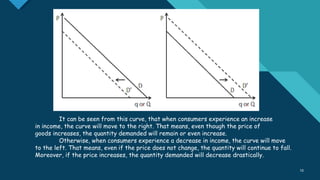
It can be seen from this curve, that when consumers experience an increase
in income, the curve will move to the right. That means, even though the price of
goods increases, the quantity demanded will remain or even increase.
Otherwise, when consumers experience a decrease in income, the curve will move
to the left. That means, even if the price does not change, the quantity will continue to fall.
Moreover, if the price increases, the quantity demanded will decrease drastically.
Click to edit Master title style
11
Example
11
Click to edit Master title style
12
12
Shop A sells item X for Rp 5.000,00 per unit. Then,
because there is an price increase in materials that they use, the
price of item X increases to Rp 10.000,00 per unit. Of course, this
will have an impact on the level of demand from their customers. It
can be presented as a table like this
Price Quantity
5.000 30
10.000 25
15.000 20
20.000 15
25.000 10
From this table, Can be concluded that the higher the price (P),
the lower the demand (Q). This applies not only in this store, but also in
other stores, even in a large market.
Click to edit Master title style
13
Demand Function (Fungsi Permintaan)
13
Click to edit Master title style
14
14
Demand function form is P=a-bQ, or Q=a-bP.
To calculate and determine the demand function, use the formula
𝐏−𝐏𝟏=𝐐−𝐐𝟏
𝑷𝟐−𝑷𝟏=𝑸𝟐−𝑸𝟏
P : price of goods per unit
Q : quantity of goods demanded
a : constant number
b : slope/gradient
P : price
P1 : starting price
P2 : final price
Q : demand
Q1 : starting demand
Q2 : final demand
Click to edit Master title style
15
Example
15
Click to edit Master title style
16
16
If the price of an item is Rp 60,00 per unit, then
the quantity of demand is 20 units. And if the price is Rp
40,00 per unit, the quantity of demand is 30 units. So to find
the equation of the demand function we use the formula
before. So it will become like this.
𝐏 − 𝐏𝟏 = 𝐐 − 𝐐𝟏
𝑷𝟐 − 𝑷𝟏 = 𝑸𝟐 − 𝑸𝟏
𝐏 − 𝟔𝟎 = 𝐐 − 𝟐𝟎
𝟒𝟎 − 𝟔𝟎 = 𝟑𝟎 − 𝟐𝟎
𝐏 − 𝟔𝟎 = 𝐐 − 𝟐𝟎
−𝟐𝟎 = 𝟏𝟎
𝟏𝟎𝐏 − 𝟔𝟎𝟎 = −𝟐𝟎𝐐 + 𝟒𝟎𝟎
𝟏𝟎𝐏 = −𝟐𝟎𝐐 + 𝟒𝟎𝟎 + 𝟔𝟎𝟎
𝟏𝟎𝐏 = −𝟐𝟎𝐐 + 𝟏𝟎𝟎𝟎
𝐏 = −𝟐𝟎𝐐 + 𝟏𝟎𝟎
or
𝐏 = 𝟏𝟎𝟎 − 𝟐𝟎𝐐
After calculating with the formula, it can be known that the demand function is P = 100 - 20Q.
Click to edit Master title style
17
Factors that Affecting Demand
17
Click to edit Master title style
18
18
1. Price of the goods and services
2. Consumer’s income
3. Consumer’s taste
4. Number of consumer
5. Consumer prediction about conditions in the future
6. Intensity of consumer needs
Click to edit Master title style
19
Thank You

PPT Demand

  • 1.
    Click to editMaster title style 1 Demand B y : A r e l l i a S a n a n t h a 2 1 0 8 0 5 7 4 0 7 7 N a u f a l A c h m a d 2 1 0 8 0 5 7 4 0 7 8 F e r d i n a n Ti t u s 2 1 0 8 0 5 7 4 0 8 7 Ya s i n t a R a c h m i 2 1 0 8 0 5 7 4 1 4 3
  • 2.
    Click to editMaster title style 2 What is Demand ? 2
  • 3.
    Click to editMaster title style 3 Definition of Demand 3 Demand (permintaan) is a term for the amount of goods and services that are desired and needed to be purchased at a certain price level and time according to the market.
  • 4.
    Click to editMaster title style 4 What is Law of Demand ? 4
  • 5.
    Click to editMaster title style 5 5 Law of Demand (Hukum Permintaan) is a fundamental principle of economics that states that at higher price consumers will demand a lower quantity of good. Shortly, Law of Demand said “when the price goes up, the demand from consumer will be lower. And if the price goes down, the demand from customer will be high.”
  • 6.
    Click to editMaster title style 6 Demand Curve (Kurva Permintaan) 6
  • 7.
    Click to editMaster title style 7 7 It can be seen from this curve. That, when the price goes up, the lower the level of demand from consumers.
  • 8.
    Click to editMaster title style 8 Shifting in Demand Curve (Pergeseran Kurva Permintaan) 8
  • 9.
    Click to editMaster title style 9 9 The change in the curve is called a curve shift, which is a condition when the demand curve shifts to the left or to the right. Usually it is due tochanges in income from the customers. This change in the curve is called a curve shift, which is a condition when the demand curve shifts to the left or to the right
  • 10.
    Click to editMaster title style 10 10 It can be seen from this curve, that when consumers experience an increase in income, the curve will move to the right. That means, even though the price of goods increases, the quantity demanded will remain or even increase. Otherwise, when consumers experience a decrease in income, the curve will move to the left. That means, even if the price does not change, the quantity will continue to fall. Moreover, if the price increases, the quantity demanded will decrease drastically.
  • 11.
    Click to editMaster title style 11 Example 11
  • 12.
    Click to editMaster title style 12 12 Shop A sells item X for Rp 5.000,00 per unit. Then, because there is an price increase in materials that they use, the price of item X increases to Rp 10.000,00 per unit. Of course, this will have an impact on the level of demand from their customers. It can be presented as a table like this Price Quantity 5.000 30 10.000 25 15.000 20 20.000 15 25.000 10 From this table, Can be concluded that the higher the price (P), the lower the demand (Q). This applies not only in this store, but also in other stores, even in a large market.
  • 13.
    Click to editMaster title style 13 Demand Function (Fungsi Permintaan) 13
  • 14.
    Click to editMaster title style 14 14 Demand function form is P=a-bQ, or Q=a-bP. To calculate and determine the demand function, use the formula 𝐏−𝐏𝟏=𝐐−𝐐𝟏 𝑷𝟐−𝑷𝟏=𝑸𝟐−𝑸𝟏 P : price of goods per unit Q : quantity of goods demanded a : constant number b : slope/gradient P : price P1 : starting price P2 : final price Q : demand Q1 : starting demand Q2 : final demand
  • 15.
    Click to editMaster title style 15 Example 15
  • 16.
    Click to editMaster title style 16 16 If the price of an item is Rp 60,00 per unit, then the quantity of demand is 20 units. And if the price is Rp 40,00 per unit, the quantity of demand is 30 units. So to find the equation of the demand function we use the formula before. So it will become like this. 𝐏 − 𝐏𝟏 = 𝐐 − 𝐐𝟏 𝑷𝟐 − 𝑷𝟏 = 𝑸𝟐 − 𝑸𝟏 𝐏 − 𝟔𝟎 = 𝐐 − 𝟐𝟎 𝟒𝟎 − 𝟔𝟎 = 𝟑𝟎 − 𝟐𝟎 𝐏 − 𝟔𝟎 = 𝐐 − 𝟐𝟎 −𝟐𝟎 = 𝟏𝟎 𝟏𝟎𝐏 − 𝟔𝟎𝟎 = −𝟐𝟎𝐐 + 𝟒𝟎𝟎 𝟏𝟎𝐏 = −𝟐𝟎𝐐 + 𝟒𝟎𝟎 + 𝟔𝟎𝟎 𝟏𝟎𝐏 = −𝟐𝟎𝐐 + 𝟏𝟎𝟎𝟎 𝐏 = −𝟐𝟎𝐐 + 𝟏𝟎𝟎 or 𝐏 = 𝟏𝟎𝟎 − 𝟐𝟎𝐐 After calculating with the formula, it can be known that the demand function is P = 100 - 20Q.
  • 17.
    Click to editMaster title style 17 Factors that Affecting Demand 17
  • 18.
    Click to editMaster title style 18 18 1. Price of the goods and services 2. Consumer’s income 3. Consumer’s taste 4. Number of consumer 5. Consumer prediction about conditions in the future 6. Intensity of consumer needs
  • 19.
    Click to editMaster title style 19 Thank You