Module 1. Principles of High Quality Assessment 1
Principles of High
Quality Assessment
As future teachers, it is a must for you to be guided with sound ideas on
how you should assess the performance of your students. Throughout the
duration of our course, you will be introduced to several principles in assessing
Module 1. Principles of High Quality Assessment 2
the student’s performance. In this section, we will try to explore several principles
that you can apply in assessing student’s performance.
SELF-CHECK!!!
After finishing this module, you are expected to achieve the following
intended learning outcomes
1. Create a high quality learning outcome.
2. Decide on what particular kind of test is appropriate in a given situation or
purpose of the teacher.
3. Reflect on the properties of measuring instrument
LEARNING RESOURCES
For further readings, you may refer to the following books;
Student Workbook and Portfolio in Assessment of Student Learning 1 by;
Stimson T. Camano
Or you may visit.
https://www.slideshare.net/rocelaalegado/classroom-assessment-29900285?qid=d8741730-
b1ff-44e8-9519-57bf60cd2cca&v=&b=&from_search=3
http://search.shamaa.org/PDF/Articles/EGJes/JesVol22No1P2Y2014/9JesVol22
No1P2Y2014.pdf
Module 1. Principles of High Quality Assessment 3
EXPLORE!!!!
We will now try to build up our understanding about
assessment in learning. Let us start learning the basic principles of
high quality assessment which is our course of study.
PRINCIPLES OF HIGH QUALITY ASSESSMENT
In our current setting, Philippine educational system has an established
various educational levels with corresponding recommended curricula (plural
form of curriculum). In turn, there should be a well-established system for
assessing student learning at each level. With the advent of K to 12 Basic
Education Curriculum and Outcomes-Based Education (OBE), assessment of
students’ learning had become a more or less challenging task for teachers. In
this particular portion of our lesson, we will adopt the discussion made by
Camano (2018) in his Student Workbook and Portfolio in Assessment of
Student Learning 1. According to him, generally there are three (3) Principles of
High Quality Assessment namely; 1. Clarity of Learning Outcomes, 2.
Appropriateness of Assessment Instrument and, 3. Properties of Assessment
Method.
CLARITY OF LEARNING OUTCOMES
One important principle of high quality assessment is the clarity of learning
outcomes. Due to recent development in educational system globally, learning
outcomes had been the central focus of learning. With the introduction of new
framework in education, OBE, learning objectives were modified into learning
Module 1. Principles of High Quality Assessment 4
outcomes. Learning outcomes were viewed to be more specific and more
focused version of learning objectives. Here are some reminders that you should
take into account as far as learning outcomes were concerned.
Educational program should have a clear statement of objectives aligned
to the mission and core values of the institution.
Expected learning outcomes should be formulated based from the
objective of the course (subject) with three domains of educational
activities.
The design of all assessment activities should be SMART (Specific,
Measureable, Attainable, Result-Oriented or Result-Based and Time-
Bound or Terminal) demonstrable and verifiable.
Educational programs and expected learning outcomes concentrate not
only to the cognitive knowledge and outputs but rather to the real life
activities and experiences of the students along the way, taking into
account the process in performing a task.
Skills, competencies and abilities of the students should be considered in
formulating learning outcomes and in designing a lesson.
Expected outcomes for product, output or project and for the other
creative work samples should be formulated where you can classify the
expected levels of workmanship of students as to expert level, skilled level
or novice.
APPROPRIATENESS OF ASSESSMENT INSTRUMENTS
Module 1. Principles of High Quality Assessment 5
Another important principle in assessment was the appropriateness of
assessment instrument. As future teacher, you should bear in mind that
assessment of learning was not implemented to weed out slow learners.
Instruments in assessment should fit with the ability of learners and the objective
of assessment itself. We will mention some of the assessment instrument that
you can choose in assessing student’s learning.
A. Written Response Instrument
It is an assessment instrument where response/s were written either by the
student or by the teacher.
1. Objective Tests – appropriate for assessing the various levels of hierarchy
of educational objectives. This is a test that yields similar results no matter
who scores it.
 Multiple Choice – use to test HOTS
 True or False – use to test knowledge and comprehension of
students.
 Matching Type – use to test the ability to classify.
 Short Answer Test – use to test knowledge
 Analogy Type – use to test the ability of the students to pair
relationships.
2. Essay – if properly planned, it is best to use in measuring the skills in
higher cognitive levels such as in application, analysis, synthesis and
judgement.
Module 1. Principles of High Quality Assessment 6
3. Checklist – best to use to determine the presence or absence of student
behaviours expected to be measured by the teacher.
4. Examination – best to use to measure the summative understanding of the
learner.
5. Written Works and Work Samples (e.g., journals, reaction paper,
reflections, research projects and other creative works) are best to use to
develop the ability of the students in quality paper works, creativity,
perseverance and industry.
For additional information about written response test, you may visit the link
http://www.geoolympiad.org/fass/geoolympiad/2012/2012WRTQandA.pdf
B. Rating Scale
Rating scale is defined as a closed-ended survey question used to
represent respondent feedback in a comparative form for specific particular
features/products/services. It is one of the most established question types for
online and offline surveys where survey respondents are expected to rate an
attribute or feature. Rating scale is a variant of the popular multiple-choice
question which is widely used to gather information that provides relative
information about a specific topic. Products which are frequently rated in
education includes:
 Book Reports
 Maps
 Charts
 Diagrams
Module 1. Principles of High Quality Assessment 7
 Portfolio
 Essay
 Journals
 Other creative Works
Rating product is appropriate if you want to determine the creativity,
industry, level of workmanship and achievement of the students. To rate various
types of product in education, the teacher should have the prototype projects of
students over his/her years of experience as model or by preparing a rating scale
or rubric. For additional information regarding rating scale, you may visit
https://www.questionpro.com/blog/rating-scale/
C. Performance Test
Performance test is appropriate if the teacher wants to measure whether
or not an individual behaves in a certain way when asked to accomplish a
particular task. Performance checklist was needed in conducting performance
test. It is a list of behaviour that makes up a certain type of performance (e.g.,
using a telescope, typing a letter, solving mathematics problem, etc.)
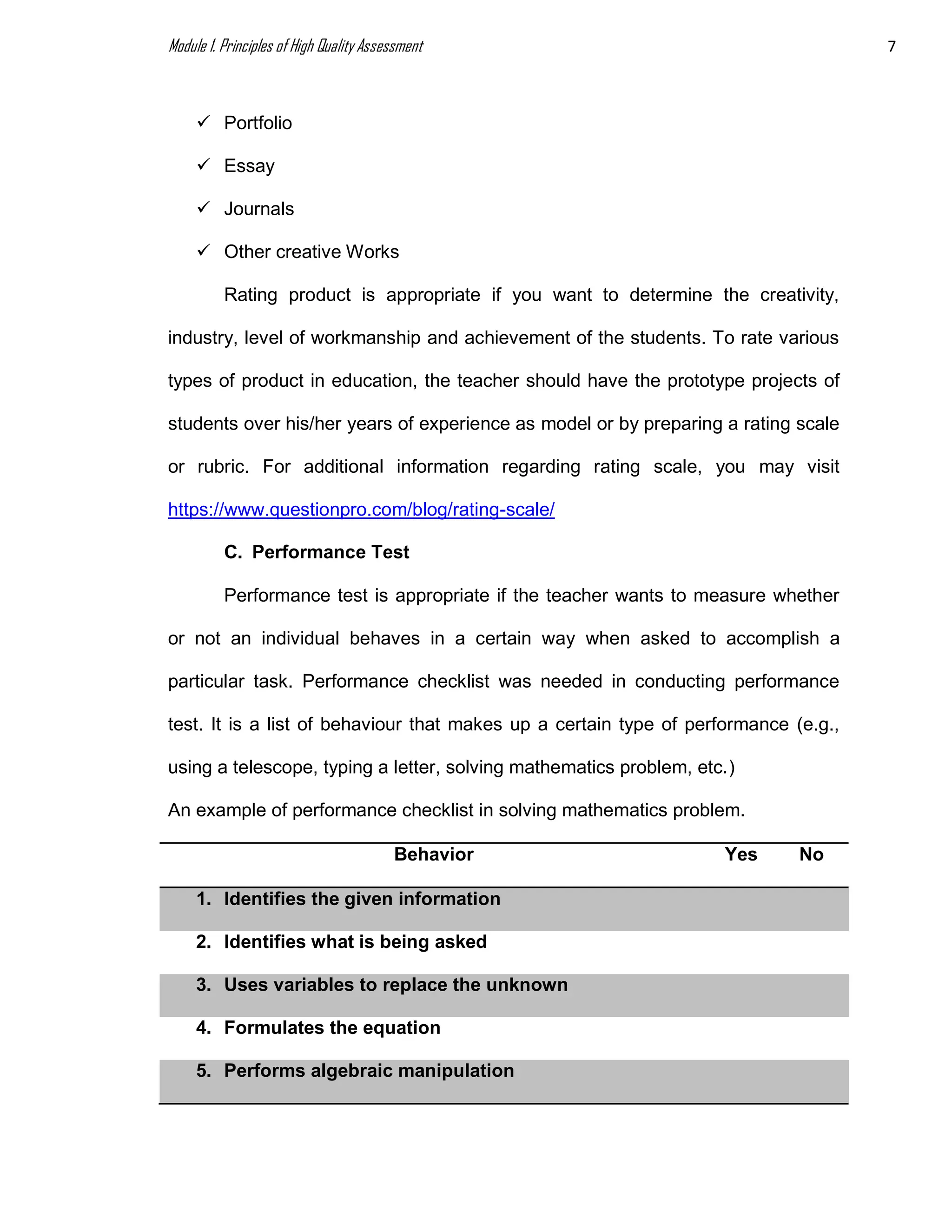
An example of performance checklist in solving mathematics problem.
Behavior Yes No
1. Identifies the given information
2. Identifies what is being asked
3. Uses variables to replace the unknown
4. Formulates the equation
5. Performs algebraic manipulation
Module 1. Principles of High Quality Assessment 8
6. Obtains an answer
7. Checks if the answer makes sense
For additional information regarding performance test, you may visit
https://www.edweek.org/teaching-learning/what-is-performance-
assessment/2019/02
D. Oral Questioning
It is also known as Socratic Method. It is an appropriate assessment method
when the objectives are:
1. To assess students stock knowledge
2. To determine the students ability to communicate ideas in coherent verbal
sentences.
There are several factors to consider when conducting oral questioning, these
includes;
Student’s state of mind
Feelings
Anxiety
Nervousness
For additional information regarding oral questioning, you may visit the link below
http://search.shamaa.org/PDF/Articles/EGJes/JesVol22No1P2Y2014/9JesVol22
No1P2Y2014.pdf
E. Observation and Self-Report
Module 1. Principles of High Quality Assessment 9
Observation report is appropriate method in support to oral questioning
and performance test to consider student’s unenthusiastic attitude or state due to
their fears, anxiety and other negative attitudes. Self –Report is appropriate in
support to observation for sometimes we underestimate or overestimate
student’s capability. This is to weigh down information or have some self-
assessment. These two reports are useful supplementary assessment methods
when used in conjunction with oral questioning and performance test.
Self – checklist is also used by teacher when the purpose is to diagnose
or to assess the performance of students from their point of view. Self – checklist
is a list of several characteristics or activities presented to the subject of study.
The individual is asked to study the list and then to place a mark opposite the
characteristics which they possess or the activities which they have engaged in
for particular length of time. For more information about observation and self-
report, you may visit https://www.sciencedirect.com/topics/psychology/self-report
.
PROPERTIES OF ASSESSMENT METHOD
Assessment method in education should be in proper order to achieve a
good quality. There are several properties of assessment method that should be
observed in order to achieve such high quality. Properties of assessment
methods include validity, reliability, fairness, ethics in assessment and
practicability.
A. Validity
Module 1. Principles of High Quality Assessment 10
It refers to instrument’s ability to measure what it intends to measure.
Validity is the appropriateness, correctness, meaningfulness and usefulness
arrived at after teaching and learning process.
The focus of validity is:
What to measure?
How will it does?
There are four types of validity, namely content validity, face validity criterion
related validity and construct validity.
1. Content Validity – the method is used to assess the quality of the content
and format of the instrument. The test should be representative of the
content of the course. It is focused on how appropriate is the content?
How comprehensive? Is the format accurate?
2. Face Validity – refers to the outward appearance of the test. It is done by
examining the appearance of the test.
3. Criterion Related Validity – in this validity, the test item is judged against a
specific criterion. It is done by correlating set of scores of the measuring
instrument to some external measure.
4. Construct Validity – an item possess construct validity if group of variables
correlates highly with each other. It is established by comparing
statistically the psychological traits to some theoretical factors that
influence scores in a test.
For additional information on validity, you may visit
http://www.ibe.unesco.org/en/glossary-curriculum-terminology/v/validity-
Module 1. Principles of High Quality Assessment 11
assessment and https://sites.education.miami.edu/statsu/2020/09/27/how-do-
we-assess-reliability-and-validity/
B. Reliability
Another important property of assessment method is the reliability. It
refers to the consistency, stability and dependability of the instrument. Test is
reliable if there is consistency of results even if it is administered at two or more
different time periods. The following are methods for estimating the reliability of
measuring instrument.
1. Test-retest Method – the same measuring instrument is administered
twice to same group of learners or subjects and the scores of the first and
second administration of the test are correlated. This can be done by
Spearman Rho or Spearman Rank Coefficient Correlation.
2. Parallel-form Method – two tests which are made with similar content,
types of test, difficulty, and standard are administered to the same group
of learners or subjects and the paired observations are correlated. This
can be solved by finding the correlation coefficient of the paired
observations.
3. Split-half Method – the test in this method is administered once but the
lists of items are divided into two halves. The two halves must be similar
but not identical in content, and the scores obtained in the two halves of
tests are correlated. This can be solved by Spearman –Brown formula.
Module 1. Principles of High Quality Assessment 12
4. Internal-consistency Method – this refers to the homogeneity of the
measuring instrument. This is solved by using the Kuder-Richardson
formula 20.
For more information on reliability, you may visit
https://sites.education.miami.edu/statsu/2020/09/27/how-do-we-assess-reliability-
and-validity/
C. Fairness
Assessment methods and procedure needs to be fair. With this, a high
quality assessment would be assured. It refers to the consideration of learner’s
needs and characteristics, and any reasonable adjustments that need to be
applied to take account of them. We can practice fairness in assessment by way
of:
Informing the students what exactly the expected learning outcomes are.
Informing the student what method of assessment to be used.
Informing the students how their progress will be assessed or rated.
Viewing assessment as an opportunity to learn.
Viewing assessment as free from teacher stereotyped images and
thinking.
For additional information on fairness in assessment, you may visit
http://www.ibe.unesco.org/en/glossary-curriculum-terminology/f/fairness-
assessment
D. Ethics in Assessment
Module 1. Principles of High Quality Assessment 13
Assessment techniques and procedures must conform to the standard of
conduct. All participants in an assessment program are protected from physical
or psychological harm. Test result should be confidential. Language to be used
should follow a norm and within the understanding and general acceptability of
the society. For additional information on ethics in assessment, you may visit
https://www.slideshare.net/JanJanPina/ethics-in-assessment
E. Practicability
This is also known as usability. This is the property of assessment
instrument in which it can be used by students, teachers, and policy makers
without undue expenditures of time, money and effort. It means that instrument
can be easily administered, scored, interpreted, made of low-cost materials, and
without error or erasures. For additional information on practicability, you may
visit https://www.igi-global.com/dictionary/conceptual-framework-assessment-
higher-education/33546
DISCUSSION BOARD
We will now try to interact with each other in a two way
process at a least possible way! I will post a question/s and try to answer it on
your own.
1. When do we say that there is clarity in the expected learning outcomes?
2. How can we say that the assessment instrument is appropriate?
3. What properties of assessment method should we consider to ensure that
there is a high quality assessment of student’s learning?
Module 1. Principles of High Quality Assessment 14
POST COMPETENCY CHECKLISTS
Let us try to determine if you learned something from our topic. Answer the
following Self-Assessment Question.
SELF – ASSESSMENT QUESTION 1
1. Name other variety of assessment instrument or tool in assessing student
learning outcomes and write the advantages in using this type of test.
2. Test the reliability of an achievement test in English which was given in two
test administrations to the same group of pilot class of 10 students. The
following are the scores of students in the first and second administrations.
Student 1 2 3 4 5 6 7 8 9 10
1st
admin
89 85 77 80 83 87 90 73 85 80
2nd
admin
90 85 76 81 83 85 90 72 85 83
3. Illustrate by examples the 4 methods of estimating reliability of an
instrument.
4. Explain by illustration the four levels of learning outcomes in the K to 12
Education Curriculum.
5. Write your reflection about the topic covered in this module by completing
the following statement.
As a future teacher, I need to learn how to prepare,
a. High quality student learning outcomes because __________
b. Appropriate assessment instrument in a given situation so that ______
c. Valid, reliable, practical and ethical measuring instruments to ______

Module 1_a1c851d70ca3852a3f74e71b7ec82d87.pdf

  • 1.
    Module 1. Principlesof High Quality Assessment 1 Principles of High Quality Assessment As future teachers, it is a must for you to be guided with sound ideas on how you should assess the performance of your students. Throughout the duration of our course, you will be introduced to several principles in assessing
  • 2.
    Module 1. Principlesof High Quality Assessment 2 the student’s performance. In this section, we will try to explore several principles that you can apply in assessing student’s performance. SELF-CHECK!!! After finishing this module, you are expected to achieve the following intended learning outcomes 1. Create a high quality learning outcome. 2. Decide on what particular kind of test is appropriate in a given situation or purpose of the teacher. 3. Reflect on the properties of measuring instrument LEARNING RESOURCES For further readings, you may refer to the following books; Student Workbook and Portfolio in Assessment of Student Learning 1 by; Stimson T. Camano Or you may visit. https://www.slideshare.net/rocelaalegado/classroom-assessment-29900285?qid=d8741730- b1ff-44e8-9519-57bf60cd2cca&v=&b=&from_search=3 http://search.shamaa.org/PDF/Articles/EGJes/JesVol22No1P2Y2014/9JesVol22 No1P2Y2014.pdf
  • 3.
    Module 1. Principlesof High Quality Assessment 3 EXPLORE!!!! We will now try to build up our understanding about assessment in learning. Let us start learning the basic principles of high quality assessment which is our course of study. PRINCIPLES OF HIGH QUALITY ASSESSMENT In our current setting, Philippine educational system has an established various educational levels with corresponding recommended curricula (plural form of curriculum). In turn, there should be a well-established system for assessing student learning at each level. With the advent of K to 12 Basic Education Curriculum and Outcomes-Based Education (OBE), assessment of students’ learning had become a more or less challenging task for teachers. In this particular portion of our lesson, we will adopt the discussion made by Camano (2018) in his Student Workbook and Portfolio in Assessment of Student Learning 1. According to him, generally there are three (3) Principles of High Quality Assessment namely; 1. Clarity of Learning Outcomes, 2. Appropriateness of Assessment Instrument and, 3. Properties of Assessment Method. CLARITY OF LEARNING OUTCOMES One important principle of high quality assessment is the clarity of learning outcomes. Due to recent development in educational system globally, learning outcomes had been the central focus of learning. With the introduction of new framework in education, OBE, learning objectives were modified into learning
  • 4.
    Module 1. Principlesof High Quality Assessment 4 outcomes. Learning outcomes were viewed to be more specific and more focused version of learning objectives. Here are some reminders that you should take into account as far as learning outcomes were concerned. Educational program should have a clear statement of objectives aligned to the mission and core values of the institution. Expected learning outcomes should be formulated based from the objective of the course (subject) with three domains of educational activities. The design of all assessment activities should be SMART (Specific, Measureable, Attainable, Result-Oriented or Result-Based and Time- Bound or Terminal) demonstrable and verifiable. Educational programs and expected learning outcomes concentrate not only to the cognitive knowledge and outputs but rather to the real life activities and experiences of the students along the way, taking into account the process in performing a task. Skills, competencies and abilities of the students should be considered in formulating learning outcomes and in designing a lesson. Expected outcomes for product, output or project and for the other creative work samples should be formulated where you can classify the expected levels of workmanship of students as to expert level, skilled level or novice. APPROPRIATENESS OF ASSESSMENT INSTRUMENTS
  • 5.
    Module 1. Principlesof High Quality Assessment 5 Another important principle in assessment was the appropriateness of assessment instrument. As future teacher, you should bear in mind that assessment of learning was not implemented to weed out slow learners. Instruments in assessment should fit with the ability of learners and the objective of assessment itself. We will mention some of the assessment instrument that you can choose in assessing student’s learning. A. Written Response Instrument It is an assessment instrument where response/s were written either by the student or by the teacher. 1. Objective Tests – appropriate for assessing the various levels of hierarchy of educational objectives. This is a test that yields similar results no matter who scores it.  Multiple Choice – use to test HOTS  True or False – use to test knowledge and comprehension of students.  Matching Type – use to test the ability to classify.  Short Answer Test – use to test knowledge  Analogy Type – use to test the ability of the students to pair relationships. 2. Essay – if properly planned, it is best to use in measuring the skills in higher cognitive levels such as in application, analysis, synthesis and judgement.
  • 6.
    Module 1. Principlesof High Quality Assessment 6 3. Checklist – best to use to determine the presence or absence of student behaviours expected to be measured by the teacher. 4. Examination – best to use to measure the summative understanding of the learner. 5. Written Works and Work Samples (e.g., journals, reaction paper, reflections, research projects and other creative works) are best to use to develop the ability of the students in quality paper works, creativity, perseverance and industry. For additional information about written response test, you may visit the link http://www.geoolympiad.org/fass/geoolympiad/2012/2012WRTQandA.pdf B. Rating Scale Rating scale is defined as a closed-ended survey question used to represent respondent feedback in a comparative form for specific particular features/products/services. It is one of the most established question types for online and offline surveys where survey respondents are expected to rate an attribute or feature. Rating scale is a variant of the popular multiple-choice question which is widely used to gather information that provides relative information about a specific topic. Products which are frequently rated in education includes:  Book Reports  Maps  Charts  Diagrams
  • 7.
    Module 1. Principlesof High Quality Assessment 7  Portfolio  Essay  Journals  Other creative Works Rating product is appropriate if you want to determine the creativity, industry, level of workmanship and achievement of the students. To rate various types of product in education, the teacher should have the prototype projects of students over his/her years of experience as model or by preparing a rating scale or rubric. For additional information regarding rating scale, you may visit https://www.questionpro.com/blog/rating-scale/ C. Performance Test Performance test is appropriate if the teacher wants to measure whether or not an individual behaves in a certain way when asked to accomplish a particular task. Performance checklist was needed in conducting performance test. It is a list of behaviour that makes up a certain type of performance (e.g., using a telescope, typing a letter, solving mathematics problem, etc.) An example of performance checklist in solving mathematics problem. Behavior Yes No 1. Identifies the given information 2. Identifies what is being asked 3. Uses variables to replace the unknown 4. Formulates the equation 5. Performs algebraic manipulation
  • 8.
    Module 1. Principlesof High Quality Assessment 8 6. Obtains an answer 7. Checks if the answer makes sense For additional information regarding performance test, you may visit https://www.edweek.org/teaching-learning/what-is-performance- assessment/2019/02 D. Oral Questioning It is also known as Socratic Method. It is an appropriate assessment method when the objectives are: 1. To assess students stock knowledge 2. To determine the students ability to communicate ideas in coherent verbal sentences. There are several factors to consider when conducting oral questioning, these includes; Student’s state of mind Feelings Anxiety Nervousness For additional information regarding oral questioning, you may visit the link below http://search.shamaa.org/PDF/Articles/EGJes/JesVol22No1P2Y2014/9JesVol22 No1P2Y2014.pdf E. Observation and Self-Report
  • 9.
    Module 1. Principlesof High Quality Assessment 9 Observation report is appropriate method in support to oral questioning and performance test to consider student’s unenthusiastic attitude or state due to their fears, anxiety and other negative attitudes. Self –Report is appropriate in support to observation for sometimes we underestimate or overestimate student’s capability. This is to weigh down information or have some self- assessment. These two reports are useful supplementary assessment methods when used in conjunction with oral questioning and performance test. Self – checklist is also used by teacher when the purpose is to diagnose or to assess the performance of students from their point of view. Self – checklist is a list of several characteristics or activities presented to the subject of study. The individual is asked to study the list and then to place a mark opposite the characteristics which they possess or the activities which they have engaged in for particular length of time. For more information about observation and self- report, you may visit https://www.sciencedirect.com/topics/psychology/self-report . PROPERTIES OF ASSESSMENT METHOD Assessment method in education should be in proper order to achieve a good quality. There are several properties of assessment method that should be observed in order to achieve such high quality. Properties of assessment methods include validity, reliability, fairness, ethics in assessment and practicability. A. Validity
  • 10.
    Module 1. Principlesof High Quality Assessment 10 It refers to instrument’s ability to measure what it intends to measure. Validity is the appropriateness, correctness, meaningfulness and usefulness arrived at after teaching and learning process. The focus of validity is: What to measure? How will it does? There are four types of validity, namely content validity, face validity criterion related validity and construct validity. 1. Content Validity – the method is used to assess the quality of the content and format of the instrument. The test should be representative of the content of the course. It is focused on how appropriate is the content? How comprehensive? Is the format accurate? 2. Face Validity – refers to the outward appearance of the test. It is done by examining the appearance of the test. 3. Criterion Related Validity – in this validity, the test item is judged against a specific criterion. It is done by correlating set of scores of the measuring instrument to some external measure. 4. Construct Validity – an item possess construct validity if group of variables correlates highly with each other. It is established by comparing statistically the psychological traits to some theoretical factors that influence scores in a test. For additional information on validity, you may visit http://www.ibe.unesco.org/en/glossary-curriculum-terminology/v/validity-
  • 11.
    Module 1. Principlesof High Quality Assessment 11 assessment and https://sites.education.miami.edu/statsu/2020/09/27/how-do- we-assess-reliability-and-validity/ B. Reliability Another important property of assessment method is the reliability. It refers to the consistency, stability and dependability of the instrument. Test is reliable if there is consistency of results even if it is administered at two or more different time periods. The following are methods for estimating the reliability of measuring instrument. 1. Test-retest Method – the same measuring instrument is administered twice to same group of learners or subjects and the scores of the first and second administration of the test are correlated. This can be done by Spearman Rho or Spearman Rank Coefficient Correlation. 2. Parallel-form Method – two tests which are made with similar content, types of test, difficulty, and standard are administered to the same group of learners or subjects and the paired observations are correlated. This can be solved by finding the correlation coefficient of the paired observations. 3. Split-half Method – the test in this method is administered once but the lists of items are divided into two halves. The two halves must be similar but not identical in content, and the scores obtained in the two halves of tests are correlated. This can be solved by Spearman –Brown formula.
  • 12.
    Module 1. Principlesof High Quality Assessment 12 4. Internal-consistency Method – this refers to the homogeneity of the measuring instrument. This is solved by using the Kuder-Richardson formula 20. For more information on reliability, you may visit https://sites.education.miami.edu/statsu/2020/09/27/how-do-we-assess-reliability- and-validity/ C. Fairness Assessment methods and procedure needs to be fair. With this, a high quality assessment would be assured. It refers to the consideration of learner’s needs and characteristics, and any reasonable adjustments that need to be applied to take account of them. We can practice fairness in assessment by way of: Informing the students what exactly the expected learning outcomes are. Informing the student what method of assessment to be used. Informing the students how their progress will be assessed or rated. Viewing assessment as an opportunity to learn. Viewing assessment as free from teacher stereotyped images and thinking. For additional information on fairness in assessment, you may visit http://www.ibe.unesco.org/en/glossary-curriculum-terminology/f/fairness- assessment D. Ethics in Assessment
  • 13.
    Module 1. Principlesof High Quality Assessment 13 Assessment techniques and procedures must conform to the standard of conduct. All participants in an assessment program are protected from physical or psychological harm. Test result should be confidential. Language to be used should follow a norm and within the understanding and general acceptability of the society. For additional information on ethics in assessment, you may visit https://www.slideshare.net/JanJanPina/ethics-in-assessment E. Practicability This is also known as usability. This is the property of assessment instrument in which it can be used by students, teachers, and policy makers without undue expenditures of time, money and effort. It means that instrument can be easily administered, scored, interpreted, made of low-cost materials, and without error or erasures. For additional information on practicability, you may visit https://www.igi-global.com/dictionary/conceptual-framework-assessment- higher-education/33546 DISCUSSION BOARD We will now try to interact with each other in a two way process at a least possible way! I will post a question/s and try to answer it on your own. 1. When do we say that there is clarity in the expected learning outcomes? 2. How can we say that the assessment instrument is appropriate? 3. What properties of assessment method should we consider to ensure that there is a high quality assessment of student’s learning?
  • 14.
    Module 1. Principlesof High Quality Assessment 14 POST COMPETENCY CHECKLISTS Let us try to determine if you learned something from our topic. Answer the following Self-Assessment Question. SELF – ASSESSMENT QUESTION 1 1. Name other variety of assessment instrument or tool in assessing student learning outcomes and write the advantages in using this type of test. 2. Test the reliability of an achievement test in English which was given in two test administrations to the same group of pilot class of 10 students. The following are the scores of students in the first and second administrations. Student 1 2 3 4 5 6 7 8 9 10 1st admin 89 85 77 80 83 87 90 73 85 80 2nd admin 90 85 76 81 83 85 90 72 85 83 3. Illustrate by examples the 4 methods of estimating reliability of an instrument. 4. Explain by illustration the four levels of learning outcomes in the K to 12 Education Curriculum. 5. Write your reflection about the topic covered in this module by completing the following statement. As a future teacher, I need to learn how to prepare, a. High quality student learning outcomes because __________ b. Appropriate assessment instrument in a given situation so that ______ c. Valid, reliable, practical and ethical measuring instruments to ______