What do you know about
 the Rigor/Relevance
      framework?
  Edited from a PLS presentation for Middle School in Vinton, Iowa
Why Rigor & Relevance?
   Many Iowa schools have adopted this
    model as a tool to improve instruction
    because it . . .
       Engages all teachers in school-wide efforts,
       Focuses on instruction,
       Provides a common vocabulary with which to
        discuss teaching and learning.
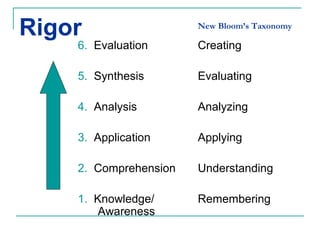
Rigor                  New Bloom’s Taxonomy

    6. Evaluation      Creating

    5. Synthesis       Evaluating

    4. Analysis        Analyzing

    3. Application     Applying

    2. Comprehension   Understanding

    1. Knowledge/      Remembering
        Awareness
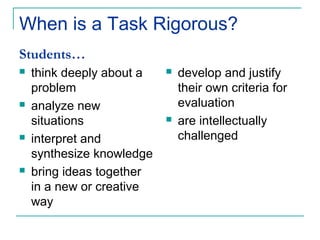
When is a Task Rigorous?
Students…
   think deeply about a      develop and justify
    problem                    their own criteria for
   analyze new                evaluation
    situations                are intellectually
   interpret and              challenged
    synthesize knowledge
   bring ideas together
    in a new or creative
    way
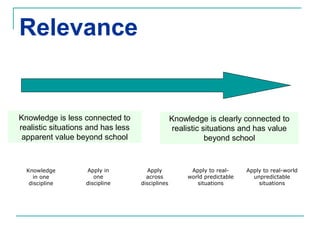
Relevance


Knowledge is less connected to                    Knowledge is clearly connected to
realistic situations and has less                  realistic situations and has value
 apparent value beyond school                                 beyond school


  Knowledge        Apply in            Apply            Apply to real-     Apply to real-world
    in one            one             across           world predictable     unpredictable
   discipline      discipline       disciplines           situations           situations
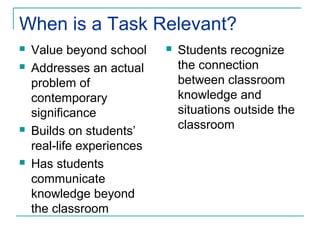
When is a Task Relevant?
   Value beyond school        Students recognize
   Addresses an actual         the connection
    problem of                  between classroom
    contemporary                knowledge and
    significance                situations outside the
                                classroom
   Builds on students’
    real-life experiences
   Has students
    communicate
    knowledge beyond
    the classroom
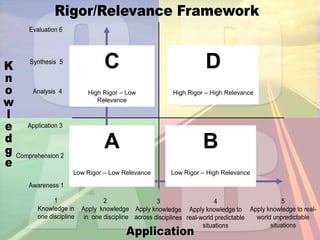
C                            DAdaptation


    High Rigor – Low        High Rigor – High Relevance
       Relevance


          A                           B
Low Rigor – Low Relevance   Low Rigor – High Relevance
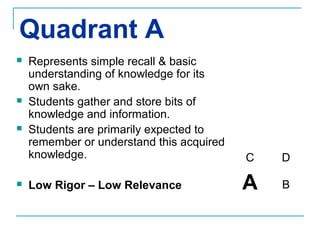
Quadrant A
   Represents simple recall & basic
    understanding of knowledge for its
    own sake.
   Students gather and store bits of
    knowledge and information.
   Students are primarily expected to
    remember or understand this acquired
    knowledge.                             C   D

   Low Rigor – Low Relevance              A   B
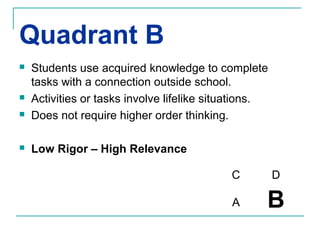
Quadrant B
   Students use acquired knowledge to complete
    tasks with a connection outside school.
   Activities or tasks involve lifelike situations.
   Does not require higher order thinking.

   Low Rigor – High Relevance

                                            C          D

                                            A      B
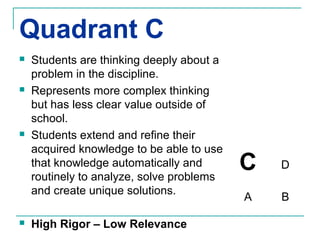
Quadrant C
   Students are thinking deeply about a
    problem in the discipline.
   Represents more complex thinking
    but has less clear value outside of
    school.
   Students extend and refine their
    acquired knowledge to be able to use
    that knowledge automatically and
    routinely to analyze, solve problems
                                           C   D

    and create unique solutions.
                                           A   B

   High Rigor – Low Relevance
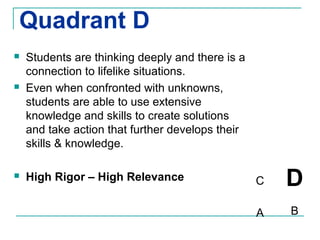
Quadrant D
   Students are thinking deeply and there is a
    connection to lifelike situations.
   Even when confronted with unknowns,
    students are able to use extensive
    knowledge and skills to create solutions
    and take action that further develops their
    skills & knowledge.

   High Rigor – High Relevance                   C   D
                                                  A   B
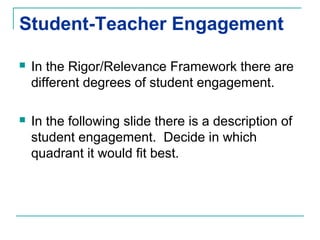
Student-Teacher Engagement

   In the Rigor/Relevance Framework there are
    different degrees of student engagement.

   In the following slide there is a description of
    student engagement. Decide in which
    quadrant it would fit best.
Students are thinking deeply about
teacher-directed questions. Which
quadrant?


         C    D

1.   A
         A    B
2.   B
3.   C
4.   D                   0%   0%   0%   0%
                     A


                              B


                                   C


                                        D
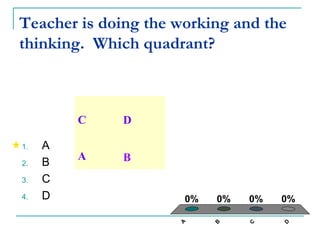
Teacher is doing the working and the
thinking. Which quadrant?


         C   D

1.   A
         A   B
2.   B
3.   C
4.   D                   0%   0%   0%   0%
                     A


                              B


                                   C


                                        D
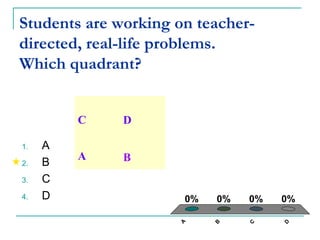
Students are working on teacher-
directed, real-life problems.
Which quadrant?


         C    D

1.   A
         A    B
2.   B
3.   C
4.   D                   0%   0%   0%   0%
                     A


                              B


                                   C


                                        D
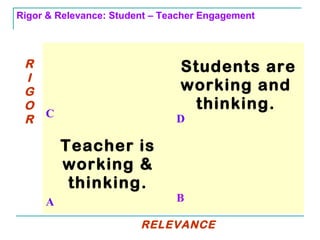
Rigor & Relevance: Student – Teacher Engagement


 R                              Students are
 I
 G                              working and
 O                               thinking.
     C
 R                             D

         Teacher is
         working &
          thinking.
     A                         B

                        RELEVANCE

Powerpoint re rigor relevance and quadrants

  • 1.
    What do youknow about the Rigor/Relevance framework? Edited from a PLS presentation for Middle School in Vinton, Iowa
  • 2.
    Why Rigor &Relevance?  Many Iowa schools have adopted this model as a tool to improve instruction because it . . .  Engages all teachers in school-wide efforts,  Focuses on instruction,  Provides a common vocabulary with which to discuss teaching and learning.
  • 3.
    Rigor New Bloom’s Taxonomy 6. Evaluation Creating 5. Synthesis Evaluating 4. Analysis Analyzing 3. Application Applying 2. Comprehension Understanding 1. Knowledge/ Remembering Awareness
  • 4.
    When is aTask Rigorous? Students…  think deeply about a  develop and justify problem their own criteria for  analyze new evaluation situations  are intellectually  interpret and challenged synthesize knowledge  bring ideas together in a new or creative way
  • 5.
    Relevance Knowledge is lessconnected to Knowledge is clearly connected to realistic situations and has less realistic situations and has value apparent value beyond school beyond school Knowledge Apply in Apply Apply to real- Apply to real-world in one one across world predictable unpredictable discipline discipline disciplines situations situations
  • 6.
    When is aTask Relevant?  Value beyond school  Students recognize  Addresses an actual the connection problem of between classroom contemporary knowledge and significance situations outside the classroom  Builds on students’ real-life experiences  Has students communicate knowledge beyond the classroom
  • 7.
    C DAdaptation High Rigor – Low High Rigor – High Relevance Relevance A B Low Rigor – Low Relevance Low Rigor – High Relevance
  • 8.
    Quadrant A  Represents simple recall & basic understanding of knowledge for its own sake.  Students gather and store bits of knowledge and information.  Students are primarily expected to remember or understand this acquired knowledge. C D  Low Rigor – Low Relevance A B
  • 9.
    Quadrant B  Students use acquired knowledge to complete tasks with a connection outside school.  Activities or tasks involve lifelike situations.  Does not require higher order thinking.  Low Rigor – High Relevance C D A B
  • 10.
    Quadrant C  Students are thinking deeply about a problem in the discipline.  Represents more complex thinking but has less clear value outside of school.  Students extend and refine their acquired knowledge to be able to use that knowledge automatically and routinely to analyze, solve problems C D and create unique solutions. A B  High Rigor – Low Relevance
  • 11.
    Quadrant D  Students are thinking deeply and there is a connection to lifelike situations.  Even when confronted with unknowns, students are able to use extensive knowledge and skills to create solutions and take action that further develops their skills & knowledge.  High Rigor – High Relevance C D A B
  • 12.
    Student-Teacher Engagement  In the Rigor/Relevance Framework there are different degrees of student engagement.  In the following slide there is a description of student engagement. Decide in which quadrant it would fit best.
  • 13.
    Students are thinkingdeeply about teacher-directed questions. Which quadrant? C D 1. A A B 2. B 3. C 4. D 0% 0% 0% 0% A B C D
  • 14.
    Teacher is doingthe working and the thinking. Which quadrant? C D 1. A A B 2. B 3. C 4. D 0% 0% 0% 0% A B C D
  • 15.
    Students are workingon teacher- directed, real-life problems. Which quadrant? C D 1. A A B 2. B 3. C 4. D 0% 0% 0% 0% A B C D
  • 16.
    Rigor & Relevance:Student – Teacher Engagement R Students are I G working and O thinking. C R D Teacher is working & thinking. A B RELEVANCE