THE THREE ABRAHAMIC
RELIGIONS
•The three Abrahamic religions—Judaism,
Christianity, and Islam—share a common origin
in the Middle East and certain theological
beliefs, but they also have significant
differences.
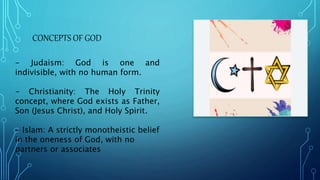
CONCEPTS OF GOD
- Judaism: God is one and
indivisible, with no human form.
- Christianity: The Holy Trinity
concept, where God exists as Father,
Son (Jesus Christ), and Holy Spirit.
- Islam: A strictly monotheistic belief
in the oneness of God, with no
partners or associates
CENTRAL FIGURES
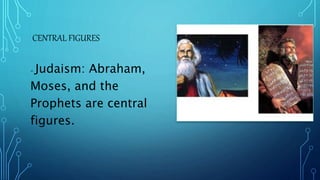
- Judaism: Abraham,
Moses, and the
Prophets are central
figures.
CENTRAL FIGURES
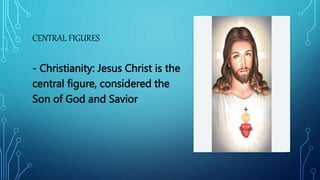
- Christianity: Jesus Christ is the
central figure, considered the
Son of God and Savior.
CENTRAL FIGURES
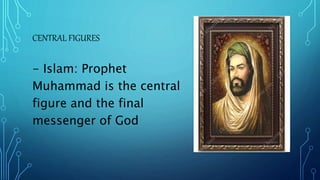
- Islam: Prophet
Muhammad is the central
figure and the final
messenger of God
VIEWS ON JESUS
-Judaism: Jesus is not regarded as the Messiah, and his divinity is not
acknowledged.
-- Christianity: Jesus is the Son of God and the central figure of
salvation.
- Islam: Jesus (Isa in Arabic) is a revered prophet but not divine; his
role differs from the Christian perspective
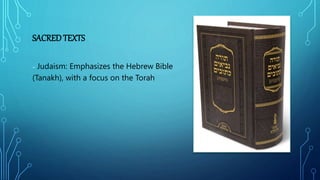
SACREDTEXTS
- Judaism: Emphasizes the Hebrew Bible
(Tanakh), with a focus on the Torah
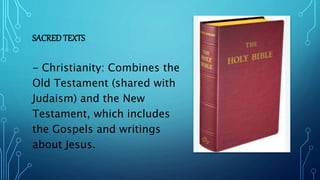
SACRED TEXTS
- Christianity: Combines the
Old Testament (shared with
Judaism) and the New
Testament, which includes
the Gospels and writings
about Jesus.
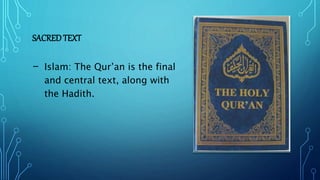
SACREDTEXT
- Islam: The Qur’an is the final
and central text, along with
the Hadith.
RELIGIOUS PRACTICES (JUDAISM)
• [1.] Sabbath Observance (Shabbat): The observance of the Sabbath,
from Friday evening to Saturday evening, is a core Jewish practice.
• [2.] Kashrut (Dietary Laws): Jewish dietary laws, known as Kashrut,
dictate what is considered kosher (fit and proper) to eat.
• [3.] Brit Milah (Circumcision): Circumcision of male infants on the
eighth day after birth is a significant Jewish religious practice. It is a
covenant and a sign of the Abrahamic promise.
RELIGIOUS PRACTICES (CHRISTIANITY)
• [1.] Baptism: Baptism is a central Christian sacrament that symbolizes
purification, rebirth, and initiation into the Christian faith.
• [2.] Eucharist (Holy Communion or Mass): The Eucharist is a Christian
practice involving the consumption of bread and wine, symbolizing
the body and blood of Jesus Christ.
• [3.] Prayer: Prayer is an essential Christian practice. It can take various
forms, including personal, communal, and liturgical prayer. The Lord's
Prayer is a well-known Christian prayer.
RELIGIOUS PRACTICES (ISLAM)
• [1.] Salat (Prayer): Muslims are required to perform five daily prayers,
known as Salat, facing the Kaaba in Mecca.
• [2.] Sawm (Fasting during Ramadan): During the month of Ramadan,
Muslims fast from dawn until sunset. Fasting includes abstaining
from food, drink, and other physical needs, as well as focusing on
spiritual reflection and self-discipline.
• [3.] **Hajj (Pilgrimage to Mecca):** Muslims who are physically and
financially able are required to make a pilgrimage to Mecca at least
once in their lifetime.
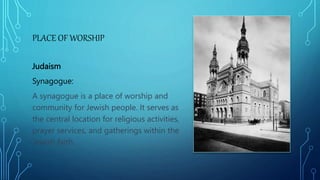
PLACE OF WORSHIP
Judaism
Synagogue:
A synagogue is a place of worship and
community for Jewish people. It serves as
the central location for religious activities,
prayer services, and gatherings within the
Jewish faith.
PLACE OF WORSHIP
Christianity
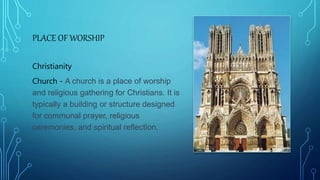
Church - A church is a place of worship
and religious gathering for Christians. It is
typically a building or structure designed
for communal prayer, religious
ceremonies, and spiritual reflection.
PLACE OF WORSHIP
Islam
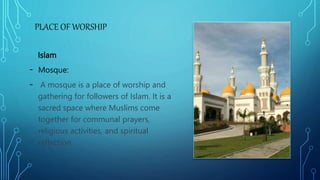
- Mosque:
- A mosque is a place of worship and
gathering for followers of Islam. It is a
sacred space where Muslims come
together for communal prayers,
religious activities, and spiritual
reflection.
RELIGIOUS AUTHORITIES
[1.] **Rabbi:**
- A rabbi is a Jewish religious leader and scholar who plays a
central role in Jewish community life.
- Rabbis are often responsible for leading synagogue services,
delivering sermons, providing religious guidance, and teaching
Jewish law and traditions.
- They may also officiate at life-cycle events such as weddings,
funerals, and bar and bat mitzvahs.
- Rabbis are typically well-versed in Jewish scripture and
tradition and are respected figures within the Jewish community.
RELIGIOUS AUTHORITIES
[2.] **Priest:**
- A priest is a Christian religious leader who represents a
particular religious tradition or denomination, such as Catholic,
Orthodox, or Anglican.
- Priests often lead worship services, administer sacraments, and
provide spiritual counseling to members of their congregations.
- They play a vital role in the Eucharist (Holy Communion or
Mass) and can officiate at weddings, baptisms, and funerals.
- Catholic priests, in particular, are celibate and may also hold
additional responsibilities within their religious orders.
RELIGIOUS AUTHORITIES
[3.] **Imam:**
- An imam is a religious leader in Islam, specifically in the Sunni
and Shia branches of the faith.
- Imams lead congregational prayers at mosques and often
deliver sermons (khutbah) on Fridays, the Islamic holy day.
- They are responsible for guiding the community in matters of
religious practice, interpretation of the Quran, and Islamic law
(sharia).
- In Shia Islam, the term "imam" holds additional significance,
referring to a series of spiritual and temporal leaders who are
believed to be divinely appointed.
SIMILARITIES
• Even though they have a lot of differences, they still have a lot in
common. Here are the commonalities between the three Abrahamic
Religions:
• 1. **Monotheism:** All three religions believe in the existence of one
God, who is the ultimate and only deity.
• 2. **Prophets:** They share some common prophets, such as
Abraham, Moses, and many others, who are revered figures in their
respective religious texts.
• 3. **Holy Scriptures:** Each religion has its sacred texts:
- Judaism: The Hebrew Bible (Tanakh), which includes the Torah (the first
five books).
- Christianity: The Old Testament, which is shared with Judaism, and the
New Testament.
- Islam: The Quran, which is believed to be the final revelation, along
with the Hadith (sayings and actions of Prophet Muhammad).
• 4. **Moral and Ethical Guidelines:** These religions provide guidelines
for moral and ethical conduct, including the Ten Commandments in
Judaism and similar principles in Christianity and Islam.
• 5. **Place of Worship:** Synagogues, churches, and mosques serve as
places of worship for the respective faiths
• 6. **Faith in Afterlife:** All three religions teach the belief in an
afterlife, where individuals are judged based on their earthly deeds

Powerpoint Presentation- The Three Abrahamic Religions (Group 3).pptx

  • 1.
  • 2.
    •The three Abrahamicreligions—Judaism, Christianity, and Islam—share a common origin in the Middle East and certain theological beliefs, but they also have significant differences.
  • 3.
    CONCEPTS OF GOD -Judaism: God is one and indivisible, with no human form. - Christianity: The Holy Trinity concept, where God exists as Father, Son (Jesus Christ), and Holy Spirit. - Islam: A strictly monotheistic belief in the oneness of God, with no partners or associates
  • 4.
    CENTRAL FIGURES - Judaism:Abraham, Moses, and the Prophets are central figures.
  • 5.
    CENTRAL FIGURES - Christianity:Jesus Christ is the central figure, considered the Son of God and Savior.
  • 6.
    CENTRAL FIGURES - Islam:Prophet Muhammad is the central figure and the final messenger of God
  • 7.
    VIEWS ON JESUS -Judaism:Jesus is not regarded as the Messiah, and his divinity is not acknowledged. -- Christianity: Jesus is the Son of God and the central figure of salvation. - Islam: Jesus (Isa in Arabic) is a revered prophet but not divine; his role differs from the Christian perspective
  • 8.
    SACREDTEXTS - Judaism: Emphasizesthe Hebrew Bible (Tanakh), with a focus on the Torah
  • 9.
    SACRED TEXTS - Christianity:Combines the Old Testament (shared with Judaism) and the New Testament, which includes the Gospels and writings about Jesus.
  • 10.
    SACREDTEXT - Islam: TheQur’an is the final and central text, along with the Hadith.
  • 11.
    RELIGIOUS PRACTICES (JUDAISM) •[1.] Sabbath Observance (Shabbat): The observance of the Sabbath, from Friday evening to Saturday evening, is a core Jewish practice. • [2.] Kashrut (Dietary Laws): Jewish dietary laws, known as Kashrut, dictate what is considered kosher (fit and proper) to eat. • [3.] Brit Milah (Circumcision): Circumcision of male infants on the eighth day after birth is a significant Jewish religious practice. It is a covenant and a sign of the Abrahamic promise.
  • 12.
    RELIGIOUS PRACTICES (CHRISTIANITY) •[1.] Baptism: Baptism is a central Christian sacrament that symbolizes purification, rebirth, and initiation into the Christian faith. • [2.] Eucharist (Holy Communion or Mass): The Eucharist is a Christian practice involving the consumption of bread and wine, symbolizing the body and blood of Jesus Christ. • [3.] Prayer: Prayer is an essential Christian practice. It can take various forms, including personal, communal, and liturgical prayer. The Lord's Prayer is a well-known Christian prayer.
  • 13.
    RELIGIOUS PRACTICES (ISLAM) •[1.] Salat (Prayer): Muslims are required to perform five daily prayers, known as Salat, facing the Kaaba in Mecca. • [2.] Sawm (Fasting during Ramadan): During the month of Ramadan, Muslims fast from dawn until sunset. Fasting includes abstaining from food, drink, and other physical needs, as well as focusing on spiritual reflection and self-discipline. • [3.] **Hajj (Pilgrimage to Mecca):** Muslims who are physically and financially able are required to make a pilgrimage to Mecca at least once in their lifetime.
  • 14.
    PLACE OF WORSHIP Judaism Synagogue: Asynagogue is a place of worship and community for Jewish people. It serves as the central location for religious activities, prayer services, and gatherings within the Jewish faith.
  • 15.
    PLACE OF WORSHIP Christianity Church- A church is a place of worship and religious gathering for Christians. It is typically a building or structure designed for communal prayer, religious ceremonies, and spiritual reflection.
  • 16.
    PLACE OF WORSHIP Islam -Mosque: - A mosque is a place of worship and gathering for followers of Islam. It is a sacred space where Muslims come together for communal prayers, religious activities, and spiritual reflection.
  • 17.
    RELIGIOUS AUTHORITIES [1.] **Rabbi:** -A rabbi is a Jewish religious leader and scholar who plays a central role in Jewish community life. - Rabbis are often responsible for leading synagogue services, delivering sermons, providing religious guidance, and teaching Jewish law and traditions. - They may also officiate at life-cycle events such as weddings, funerals, and bar and bat mitzvahs. - Rabbis are typically well-versed in Jewish scripture and tradition and are respected figures within the Jewish community.
  • 18.
    RELIGIOUS AUTHORITIES [2.] **Priest:** -A priest is a Christian religious leader who represents a particular religious tradition or denomination, such as Catholic, Orthodox, or Anglican. - Priests often lead worship services, administer sacraments, and provide spiritual counseling to members of their congregations. - They play a vital role in the Eucharist (Holy Communion or Mass) and can officiate at weddings, baptisms, and funerals. - Catholic priests, in particular, are celibate and may also hold additional responsibilities within their religious orders.
  • 19.
    RELIGIOUS AUTHORITIES [3.] **Imam:** -An imam is a religious leader in Islam, specifically in the Sunni and Shia branches of the faith. - Imams lead congregational prayers at mosques and often deliver sermons (khutbah) on Fridays, the Islamic holy day. - They are responsible for guiding the community in matters of religious practice, interpretation of the Quran, and Islamic law (sharia). - In Shia Islam, the term "imam" holds additional significance, referring to a series of spiritual and temporal leaders who are believed to be divinely appointed.
  • 20.
  • 21.
    • Even thoughthey have a lot of differences, they still have a lot in common. Here are the commonalities between the three Abrahamic Religions:
  • 22.
    • 1. **Monotheism:**All three religions believe in the existence of one God, who is the ultimate and only deity. • 2. **Prophets:** They share some common prophets, such as Abraham, Moses, and many others, who are revered figures in their respective religious texts.
  • 23.
    • 3. **HolyScriptures:** Each religion has its sacred texts: - Judaism: The Hebrew Bible (Tanakh), which includes the Torah (the first five books). - Christianity: The Old Testament, which is shared with Judaism, and the New Testament. - Islam: The Quran, which is believed to be the final revelation, along with the Hadith (sayings and actions of Prophet Muhammad).
  • 24.
    • 4. **Moraland Ethical Guidelines:** These religions provide guidelines for moral and ethical conduct, including the Ten Commandments in Judaism and similar principles in Christianity and Islam. • 5. **Place of Worship:** Synagogues, churches, and mosques serve as places of worship for the respective faiths • 6. **Faith in Afterlife:** All three religions teach the belief in an afterlife, where individuals are judged based on their earthly deeds