FOOD DESSERT
• A Food Desert is a community where
there is no access to healthy food
options.
• Where they do not have supermarkets
or grocery stores
• Food Insecurity- When people do not
have enough money to buy food for
the week or month.
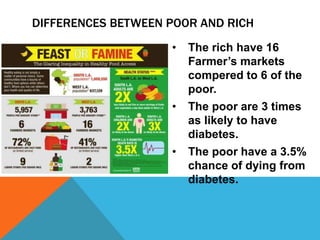
• The rich have 16
Farmer’s markets
compered to 6 of the
poor.
• The poor are 3 times
as likely to have
diabetes.
• The poor have a 3.5%
chance of dying from
diabetes.
DIFFERENCES BETWEEN POOR AND RICH
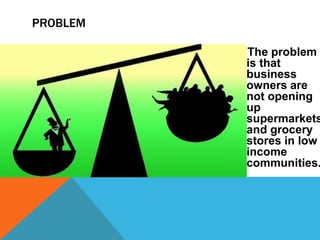
The problem
is that
business
owners are
not opening
up
supermarkets
and grocery
stores in low
income
communities.
PROBLEM
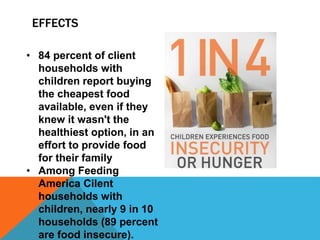
EFFECTS
• 84 percent of client
households with
children report buying
the cheapest food
available, even if they
knew it wasn't the
healthiest option, in an
effort to provide food
for their family
• Among Feeding
America Cilent
households with
children, nearly 9 in 10
households (89 percent
are food insecure).
• First lady Michelle Obama has a
campaign to fight obesity called
Let’s Move.
• There is a $400 million
investment by the government
towards the problem which will
help get rid of food deserts.
THINGS BEING DONE!
• You can join and support the “Let’s
Move” Campaign.
• You can find food deserts around you
with the USDA’s Food dessert locator
map. (You can find out if you live in a
food desert.)
• You can sign up for Supermarket
Stakeout.
• You can Spread the word.
WHAT CAN YOU DO?
https://youtu.be/Jp4jUg9nJcU
VIDEO
CITATION PAGE
Citation page
Harris-Dawson, Marqueece. "Feast or Famine: Food Inequality in America." The Huffington Post. TheHuffingtonPost.com, 15 July 2013. Web. 13 May 2015
White House Task Force on Childhood Obesity. "Solving the Problem of Childhood Obesity in a Generation." 2010. Web Accessed February 23, 2015.
Curry, Andrew. “Bringing Healthy Fare to Big-City ‘Food Deserts.'” Diabetes Forecast, 2009. Web Accessed February 23, 2015.
United States Department of Agriculture Economic Research Service. "Food Access Research Atlas.” United States Department of Agriculture, 2010. Web Accessed February 23, 2015.
United States Department of Agriculture Economic Research Service. “Access to Affordable and Nutritious Food: Measuring and Understanding Food Deserts and Their Consequences.” United
States Department of Agriculture, 2009. Web Accessed February 23, 2015.
United States Department of Agriculture Economic Research Service. “Access to Affordable and Nutritious Food: Measuring and Understanding Food Deserts and Their Consequences.” United
States Department of Agriculture, 2009. Web Accessed February 23, 2015.
"Child Hunger." Feeding America. 7 Apr. 2013. Web. 13 May 2015.
"Definition." Food Inequity. Web. 13 May 2015.

Food deserts

  • 2.
    FOOD DESSERT • AFood Desert is a community where there is no access to healthy food options. • Where they do not have supermarkets or grocery stores • Food Insecurity- When people do not have enough money to buy food for the week or month.
  • 3.
    • The richhave 16 Farmer’s markets compered to 6 of the poor. • The poor are 3 times as likely to have diabetes. • The poor have a 3.5% chance of dying from diabetes. DIFFERENCES BETWEEN POOR AND RICH
  • 4.
    The problem is that business ownersare not opening up supermarkets and grocery stores in low income communities. PROBLEM
  • 5.
    EFFECTS • 84 percentof client households with children report buying the cheapest food available, even if they knew it wasn't the healthiest option, in an effort to provide food for their family • Among Feeding America Cilent households with children, nearly 9 in 10 households (89 percent are food insecure).
  • 6.
    • First ladyMichelle Obama has a campaign to fight obesity called Let’s Move. • There is a $400 million investment by the government towards the problem which will help get rid of food deserts. THINGS BEING DONE!
  • 7.
    • You canjoin and support the “Let’s Move” Campaign. • You can find food deserts around you with the USDA’s Food dessert locator map. (You can find out if you live in a food desert.) • You can sign up for Supermarket Stakeout. • You can Spread the word. WHAT CAN YOU DO?
  • 8.
  • 9.
    CITATION PAGE Citation page Harris-Dawson,Marqueece. "Feast or Famine: Food Inequality in America." The Huffington Post. TheHuffingtonPost.com, 15 July 2013. Web. 13 May 2015 White House Task Force on Childhood Obesity. "Solving the Problem of Childhood Obesity in a Generation." 2010. Web Accessed February 23, 2015. Curry, Andrew. “Bringing Healthy Fare to Big-City ‘Food Deserts.'” Diabetes Forecast, 2009. Web Accessed February 23, 2015. United States Department of Agriculture Economic Research Service. "Food Access Research Atlas.” United States Department of Agriculture, 2010. Web Accessed February 23, 2015. United States Department of Agriculture Economic Research Service. “Access to Affordable and Nutritious Food: Measuring and Understanding Food Deserts and Their Consequences.” United States Department of Agriculture, 2009. Web Accessed February 23, 2015. United States Department of Agriculture Economic Research Service. “Access to Affordable and Nutritious Food: Measuring and Understanding Food Deserts and Their Consequences.” United States Department of Agriculture, 2009. Web Accessed February 23, 2015. "Child Hunger." Feeding America. 7 Apr. 2013. Web. 13 May 2015. "Definition." Food Inequity. Web. 13 May 2015.