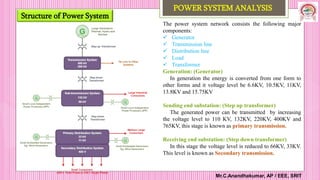
The power system network consists the following major
components:
 Generator
 Transmission line
 Distribution line
 Load
 Transformer
Generation: (Generator)
In generation the energy is converted from one form to
other forms and it voltage level be 6.6KV, 10.5KV, 11KV,
13.8KV and 15.75KV
Sending end substation: (Step up transformer)
The generated power can be transmitted by increasing
the voltage level to 110 KV, 132KV, 220KV, 400KV and
765KV, this stage is known as primary transmission.
Receiving end substation: (Step down transformer)
In this stage the voltage level is reduced to 66KV, 33KV.
This level is known as Secondary transmission.
Structure of Power System
Mr.C.Anandhakumar, AP / EEE, SRIT
POWER SYSTEM ANALYSIS
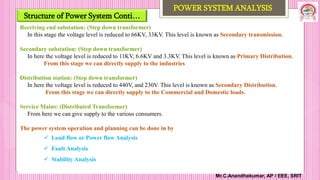
Receiving end substation: (Step down transformer)
In this stage the voltage level is reduced to 66KV, 33KV. This level is known as Secondary transmission.
Secondary substation: (Step down transformer)
In here the voltage level is reduced to 11KV, 6.6KV and 3.3KV. This level is known as Primary Distribution.
From this stage we can directly supply to the industries
Distribution station: (Step down transformer)
In here the voltage level is reduced to 440V, and 230V. This level is known as Secondary Distribution.
From this stage we can directly supply to the Commercial and Domestic loads.
Service Mains: (Distributed Transformer)
From here we can give supply to the various consumers.
The power system operation and planning can be done in by
 Load flow or Power flow Analysis
 Fault Analysis
 Stability Analysis
Structure of Power System Conti…
Mr.C.Anandhakumar, AP / EEE, SRIT
POWER SYSTEM ANALYSIS
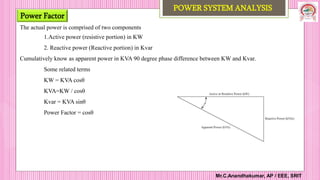
The actual power is comprised of two components
1.Active power (resistive portion) in KW
2. Reactive power (Reactive portion) in Kvar
Cumulatively know as apparent power in KVA 90 degree phase difference between KW and Kvar.
Some related terms
KW = KVA cosθ
KVA=KW / cosθ
Kvar = KVA sinθ
Power Factor = cosθ
Power Factor
Mr.C.Anandhakumar, AP / EEE, SRIT
POWER SYSTEM ANALYSIS
Per Unit System
Mr.C.Anandhakumar, AP / EEE, SRIT
POWER SYSTEM ANALYSIS
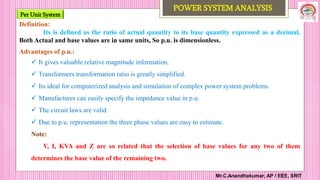
Definition:
Its is defined as the ratio of actual quantity to its base quantity expressed as a decimal.
Both Actual and base values are in same units, So p.u. is dimensionless.
Advantages of p.u.:
 It gives valuable relative magnitude information.
 Transformers transformation ratio is greatly simplified.
 Its ideal for computerized analysis and simulation of complex power system problems.
 Manufactures can easily specify the impedance value in p.u.
 The circuit laws are valid
 Due to p.u. representation the three phase values are easy to estimate.
Note:
V, I, KVA and Z are so related that the selection of base values for any two of them
determines the base value of the remaining two.
POWER SYSTEM ANALYSIS
Steps to draw the p.u. Impedance Diagram
Mr.C.Anandhakumar, AP / EEE, SRIT
POWER SYSTEM ANALYSIS



















given
b
new
b
new
b
given
b
given
u
p
new
u
p
MVA
MVA
KV
KV
Z
Z
,
,
2
,
,
,
.
,
.
  b
b
actual
base
actual
new
u
p MVA
KV
Z
Z
Z
Z 

 2
,
.
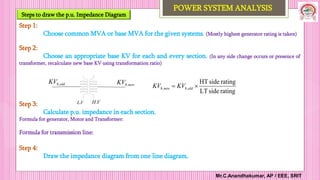
Step 1:
Choose common MVA or base MVA for the given systems. (Mostly highest generator rating is taken)
Step 2:
Choose an appropriate base KV for each and every section. (In any side change occurs or presence of
transformer, recalculate new base KV using transformation ratio)
Step 3:
Calculate p.u. impedance in each section.
Formula for generator, Motor and Transformer:
Formula for transmission line:
Step 4:
Draw the impedance diagram from one line diagram.
old
b
KV , new
b
KV ,
V
L. V
H.
rating
side
LT
rating
side
HT
,
, 
 old
b
new
b KV
KV
Impedance Diagram
Mr.C.Anandhakumar, AP / EEE, SRIT
6/14/2024
POWER SYSTEM ANALYSIS
The impedance diagram on single phase basis under balanced operating conditions can be drawn from
one line diagram.
1
E 3
E
2
E
1
Z
1
T
Z
1
T
Z
l
Z
l
Z
2
T
Z
2
T
Z
2
Z 3
Z L
Z
Reactance Diagram
1
E 3
E
2
E
1
X
1
T
X l
X 2
T
X
2
X L
X
1
T
X l
X 2
T
X 3
X
Formation of Y-Bus by Two rule method or
Inspection Method
Mr.C.Anandhakumar, AP / EEE, SRIT
POWER SYSTEM ANALYSIS
Introduction:
 An interconnected power system represents an electric network with a multitude of branches and nodes.
 The transmission lines constitute the branches.
 In some of the buses power being injected into the network (Generator Bus)
 Other buses power being tapped for loads (Load Bus)
Bus Matrix Classification:
 Admittance Bus ( Y Bus) - Applications in Load flow and stability analysis.
 Impedance Bus (Z bus) – Applications in Short Circuit analysis
The above said two bus matrix find the applications in power system planning and operational studies.
The injected bus currents and bus voltages of a power system under steady state condition can be regulated through
these matrices as
[V]
[Z][I]
[I]
[Y][V]


Power Flow Analysis
Mr.C.Anandhakumar, AP / EEE, SRIT
6/14/2024
POWER SYSTEM ANALYSIS
Classification of buses:
 Slack Bus or Ref Bus
 P-V Bus or Generator Bus
 P-Q Bus or Load Bus
S.No Bus Quantities
Specified
Quantities to be
specified
1. Slack bus or Ref Bus V, δ P, Q
2. P-V Bus or Generator Bus P, V Q, δ
3. P-Q Bus or Load Bus P, Q V, δ
Where,
P = PG - PL
Q = QG – QL
PG = Real power generated by generator connected to the bus.
QG = Reactive power generated by generator connected to the bus.
PL = Real power drawn by the load.
QL = Reactive power drawn by the load.

Power System Analysis introductionslide.pptx

  • 1.
    The power systemnetwork consists the following major components:  Generator  Transmission line  Distribution line  Load  Transformer Generation: (Generator) In generation the energy is converted from one form to other forms and it voltage level be 6.6KV, 10.5KV, 11KV, 13.8KV and 15.75KV Sending end substation: (Step up transformer) The generated power can be transmitted by increasing the voltage level to 110 KV, 132KV, 220KV, 400KV and 765KV, this stage is known as primary transmission. Receiving end substation: (Step down transformer) In this stage the voltage level is reduced to 66KV, 33KV. This level is known as Secondary transmission. Structure of Power System Mr.C.Anandhakumar, AP / EEE, SRIT POWER SYSTEM ANALYSIS
  • 2.
    Receiving end substation:(Step down transformer) In this stage the voltage level is reduced to 66KV, 33KV. This level is known as Secondary transmission. Secondary substation: (Step down transformer) In here the voltage level is reduced to 11KV, 6.6KV and 3.3KV. This level is known as Primary Distribution. From this stage we can directly supply to the industries Distribution station: (Step down transformer) In here the voltage level is reduced to 440V, and 230V. This level is known as Secondary Distribution. From this stage we can directly supply to the Commercial and Domestic loads. Service Mains: (Distributed Transformer) From here we can give supply to the various consumers. The power system operation and planning can be done in by  Load flow or Power flow Analysis  Fault Analysis  Stability Analysis Structure of Power System Conti… Mr.C.Anandhakumar, AP / EEE, SRIT POWER SYSTEM ANALYSIS
  • 3.
    The actual poweris comprised of two components 1.Active power (resistive portion) in KW 2. Reactive power (Reactive portion) in Kvar Cumulatively know as apparent power in KVA 90 degree phase difference between KW and Kvar. Some related terms KW = KVA cosθ KVA=KW / cosθ Kvar = KVA sinθ Power Factor = cosθ Power Factor Mr.C.Anandhakumar, AP / EEE, SRIT POWER SYSTEM ANALYSIS
  • 4.
    Per Unit System Mr.C.Anandhakumar,AP / EEE, SRIT POWER SYSTEM ANALYSIS Definition: Its is defined as the ratio of actual quantity to its base quantity expressed as a decimal. Both Actual and base values are in same units, So p.u. is dimensionless. Advantages of p.u.:  It gives valuable relative magnitude information.  Transformers transformation ratio is greatly simplified.  Its ideal for computerized analysis and simulation of complex power system problems.  Manufactures can easily specify the impedance value in p.u.  The circuit laws are valid  Due to p.u. representation the three phase values are easy to estimate. Note: V, I, KVA and Z are so related that the selection of base values for any two of them determines the base value of the remaining two.
  • 5.
  • 6.
  • 7.
  • 8.
  • 9.
  • 10.
  • 11.
    Steps to drawthe p.u. Impedance Diagram Mr.C.Anandhakumar, AP / EEE, SRIT POWER SYSTEM ANALYSIS                    given b new b new b given b given u p new u p MVA MVA KV KV Z Z , , 2 , , , . , .   b b actual base actual new u p MVA KV Z Z Z Z    2 , . Step 1: Choose common MVA or base MVA for the given systems. (Mostly highest generator rating is taken) Step 2: Choose an appropriate base KV for each and every section. (In any side change occurs or presence of transformer, recalculate new base KV using transformation ratio) Step 3: Calculate p.u. impedance in each section. Formula for generator, Motor and Transformer: Formula for transmission line: Step 4: Draw the impedance diagram from one line diagram. old b KV , new b KV , V L. V H. rating side LT rating side HT , ,   old b new b KV KV
  • 12.
    Impedance Diagram Mr.C.Anandhakumar, AP/ EEE, SRIT 6/14/2024 POWER SYSTEM ANALYSIS The impedance diagram on single phase basis under balanced operating conditions can be drawn from one line diagram. 1 E 3 E 2 E 1 Z 1 T Z 1 T Z l Z l Z 2 T Z 2 T Z 2 Z 3 Z L Z Reactance Diagram 1 E 3 E 2 E 1 X 1 T X l X 2 T X 2 X L X 1 T X l X 2 T X 3 X
  • 13.
    Formation of Y-Busby Two rule method or Inspection Method Mr.C.Anandhakumar, AP / EEE, SRIT POWER SYSTEM ANALYSIS Introduction:  An interconnected power system represents an electric network with a multitude of branches and nodes.  The transmission lines constitute the branches.  In some of the buses power being injected into the network (Generator Bus)  Other buses power being tapped for loads (Load Bus) Bus Matrix Classification:  Admittance Bus ( Y Bus) - Applications in Load flow and stability analysis.  Impedance Bus (Z bus) – Applications in Short Circuit analysis The above said two bus matrix find the applications in power system planning and operational studies. The injected bus currents and bus voltages of a power system under steady state condition can be regulated through these matrices as [V] [Z][I] [I] [Y][V]  
  • 14.
    Power Flow Analysis Mr.C.Anandhakumar,AP / EEE, SRIT 6/14/2024 POWER SYSTEM ANALYSIS Classification of buses:  Slack Bus or Ref Bus  P-V Bus or Generator Bus  P-Q Bus or Load Bus S.No Bus Quantities Specified Quantities to be specified 1. Slack bus or Ref Bus V, δ P, Q 2. P-V Bus or Generator Bus P, V Q, δ 3. P-Q Bus or Load Bus P, Q V, δ Where, P = PG - PL Q = QG – QL PG = Real power generated by generator connected to the bus. QG = Reactive power generated by generator connected to the bus. PL = Real power drawn by the load. QL = Reactive power drawn by the load.