1
University of Cambodia
Course: Effective Academic Writing 1
Room: 411
Instructor: Kit Reahul
“Process Paragraph”
( )
2
Content
1. What Is a Process Paragraph?
2. Structure of Process Paragraph
3. Grammar: Process Paragraph
3
I. What is a Process Paragraph?
• A Process Paragraph describes the steps necessary to perform a process
or task.
What is the purpose?
It explains HOW to do something in chronological order or logical steps.
• There are three important parts.
1. Clear topic sentence
2. Steps to complete process (at least four steps)
3. Concluding sentence
4
II. Structure of a Process Paragraph
• Tell the reader what you will be
teaching about.
• Give clear, simple instructions one
at a time. Tell the reader what to
do, then explain it a bit more
• Restate your topic sentence
What is the structure?
Topic sentence
Supporting sentences
step 1
step 2
step 3
step 4
Concluding sentences
5
II. Structure of a Process Paragraph (Con’t)
A. Topic Sentence
• Topic Sentence is the FIRST sentence in the paragraph. It tells the
reader what you will be explaining or what directions you will give. It
needs to tell the process that will be explained in the paragraph and
make a point.
• This is how you need to write your topic sentence.
Example:
Topic Sentence: If you want to give a successful presentation, make
sure you follow these steps.
6
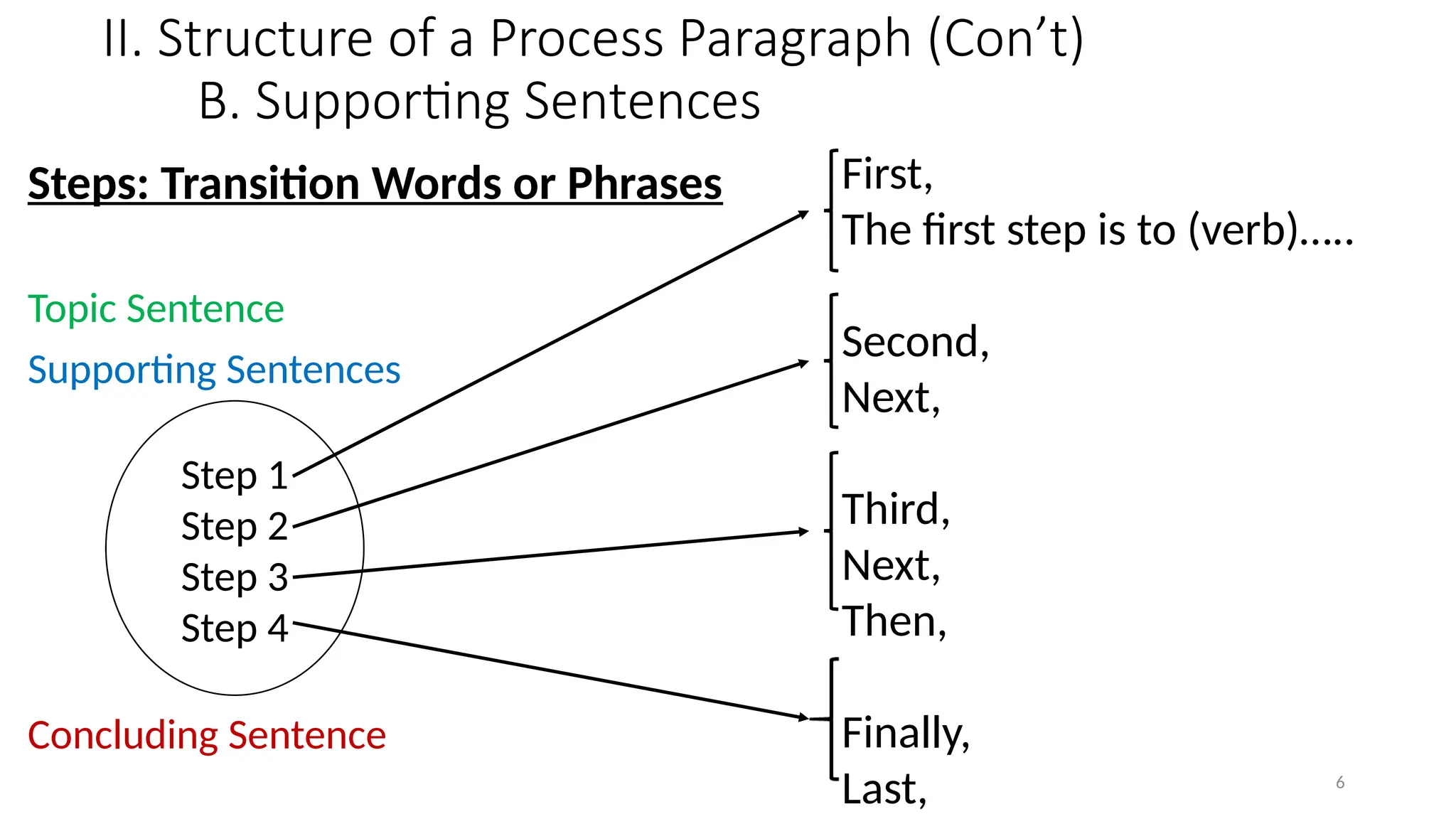
II. Structure of a Process Paragraph (Con’t)
B. Supporting Sentences
First,
The first step is to (verb)…..
Second,
Next,
Third,
Next,
Then,
Finally,
Last,
Steps: Transition Words or Phrases
Topic Sentence
Supporting Sentences
Concluding Sentence
Step 1
Step 2
Step 3
Step 4
7
II. Structure of a Process Paragraph (Con’t)
C. Concluding Sentence
• This is the LAST sentence of your paragraph. It RESTATES the topic
sentence and wraps up the paragraph.
• Make sure to use a transition to begin the sentence such as:
To sum up, In short, To conclude, or In conclusion
Topic Sentence
If you want to give a successful presentation, make sure you follow these
steps.
Concluding Sentence
To sum up, when you follow these specific steps, you will have an
incredible presentation.
8
III. Grammar: Process Paragraph
1. Imperative
• The imperative is used to give commands, orders, directions,
instructions, to tell steps in process.
• The form of the verb used for the imperative is the base form of the
main verb. This is used without the subject, but the subject you is
always implied.
Examples:
Walk to the end of the block, turn left, and cross the street.
Hold the fishing rod gently in your right hand.
9
III. Grammar: Process Paragraph (Con’t)
1. Imperative
• For negative imperative, use do not.
(Do not + base form of main verb)
Examples:
Do not drink water while eating rice.
Do not eat too sweet foods.
10
III. Grammar: Process Paragraph (Con’t)
2. Modals of Advice, Necessity, Prohibition
• Should and must are modal verbs. You may use modals to express
advice, necessity and prohibition. Modal verbs come before the base
form of main verb.
Examples:
You should eat more vegetables.
You must arrive by eight o’clock.
11
III. Grammar: Process Paragraph (Con’t)
2. Modals of Advice, Necessity, Prohibition
A. Advice
(should + base form of main verb) => to do
Ex: You should remove all jewelry before working with the clay.
(should not + base form of verb) => not to do
Ex: You should not eat too much sugar.
B. Necessity (rules or laws)
(must + base form of main verb)
Ex: You must wear protective headgear when you compete.
12
III. Grammar: Process Paragraph (Con’t)
2. Modals of Advice, Necessity, Prohibition
C. Prohibition
(must not + base form of main verb)
Ex: You must not drink alcohol while driving.
Note:
Use (do not have to) to say that something is not necessary. (optional)
(do not have to + base form of main verb)
Ex: You do not have to pay a fee to enter the museum.
13
14

Power Point Slides on Writing a Process Paragraph

  • 1.
    1 University of Cambodia Course:Effective Academic Writing 1 Room: 411 Instructor: Kit Reahul “Process Paragraph” ( )
  • 2.
    2 Content 1. What Isa Process Paragraph? 2. Structure of Process Paragraph 3. Grammar: Process Paragraph
  • 3.
    3 I. What isa Process Paragraph? • A Process Paragraph describes the steps necessary to perform a process or task. What is the purpose? It explains HOW to do something in chronological order or logical steps. • There are three important parts. 1. Clear topic sentence 2. Steps to complete process (at least four steps) 3. Concluding sentence
  • 4.
    4 II. Structure ofa Process Paragraph • Tell the reader what you will be teaching about. • Give clear, simple instructions one at a time. Tell the reader what to do, then explain it a bit more • Restate your topic sentence What is the structure? Topic sentence Supporting sentences step 1 step 2 step 3 step 4 Concluding sentences
  • 5.
    5 II. Structure ofa Process Paragraph (Con’t) A. Topic Sentence • Topic Sentence is the FIRST sentence in the paragraph. It tells the reader what you will be explaining or what directions you will give. It needs to tell the process that will be explained in the paragraph and make a point. • This is how you need to write your topic sentence. Example: Topic Sentence: If you want to give a successful presentation, make sure you follow these steps.
  • 6.
    6 II. Structure ofa Process Paragraph (Con’t) B. Supporting Sentences First, The first step is to (verb)….. Second, Next, Third, Next, Then, Finally, Last, Steps: Transition Words or Phrases Topic Sentence Supporting Sentences Concluding Sentence Step 1 Step 2 Step 3 Step 4
  • 7.
    7 II. Structure ofa Process Paragraph (Con’t) C. Concluding Sentence • This is the LAST sentence of your paragraph. It RESTATES the topic sentence and wraps up the paragraph. • Make sure to use a transition to begin the sentence such as: To sum up, In short, To conclude, or In conclusion Topic Sentence If you want to give a successful presentation, make sure you follow these steps. Concluding Sentence To sum up, when you follow these specific steps, you will have an incredible presentation.
  • 8.
    8 III. Grammar: ProcessParagraph 1. Imperative • The imperative is used to give commands, orders, directions, instructions, to tell steps in process. • The form of the verb used for the imperative is the base form of the main verb. This is used without the subject, but the subject you is always implied. Examples: Walk to the end of the block, turn left, and cross the street. Hold the fishing rod gently in your right hand.
  • 9.
    9 III. Grammar: ProcessParagraph (Con’t) 1. Imperative • For negative imperative, use do not. (Do not + base form of main verb) Examples: Do not drink water while eating rice. Do not eat too sweet foods.
  • 10.
    10 III. Grammar: ProcessParagraph (Con’t) 2. Modals of Advice, Necessity, Prohibition • Should and must are modal verbs. You may use modals to express advice, necessity and prohibition. Modal verbs come before the base form of main verb. Examples: You should eat more vegetables. You must arrive by eight o’clock.
  • 11.
    11 III. Grammar: ProcessParagraph (Con’t) 2. Modals of Advice, Necessity, Prohibition A. Advice (should + base form of main verb) => to do Ex: You should remove all jewelry before working with the clay. (should not + base form of verb) => not to do Ex: You should not eat too much sugar. B. Necessity (rules or laws) (must + base form of main verb) Ex: You must wear protective headgear when you compete.
  • 12.
    12 III. Grammar: ProcessParagraph (Con’t) 2. Modals of Advice, Necessity, Prohibition C. Prohibition (must not + base form of main verb) Ex: You must not drink alcohol while driving. Note: Use (do not have to) to say that something is not necessary. (optional) (do not have to + base form of main verb) Ex: You do not have to pay a fee to enter the museum.
  • 13.
  • 14.