CORRUPTION: PROOF
Graduate Conference on Corruption and Anti-Corruption
Brighton, BN1 9SP, UK University of Sussex
12th -13th January 2015
AIGBOKHAN EWEMADE PRESIDENT
LLB (Hons) AAU 2007; BL (Lagos) 2009, ACI.Arb (Lagos)
Post Graduate Student
Public Law Department
Ambrose Alli University, Ekpoma, Edo State, Nigeria
kpresident@yahoo.com
ABSTRACT
The word “corruption” carries opprobrium of ubiquitous definition. There is
nothing as disturbing as having toothless plait of account not just in vulgar
parlance but in scholarly literature and statutes. The family tree of corrupt
practices is perennial but widely ramified. It grows with other vegetation such
as fraud, theft, extortion, breach of trust and abuse of office. The approach of
this paper is guided by pre-existing statutory enactments governing the
offence of corruption in Nigeria. Poor feature outline of the definition of
corruption in cocktail legislations decrease awareness along with inadequate
and cumbersome conviction in the face of court technicalities. The practical
implication is a leading in cynicism and increase in the incidence of
corruption. The concluding part of the paper argues that the main feature of
corruption is public function of one of the agents and demonstrates that it is
not all forms of abuse of office that constitutes corruption. While of course
this is relevant in other to analyze how corruption works and to construe the
intendment of the law makers, the ontological survey will no doubt legitimize
the fight against corruption and help in the prosecution of same.
When the negotiations of international and regional organizations against corruption
began in late 1990’s; one of the questions under consideration was not to define
corruption, but to list acts that are conduit pipes of corruption and giving guidelines
to legislating on all of them.
Every definition in description of corruption may be queried or require modification
as this paper will illustrate.
There is a correlation between the definition of corruption and its control
There is apathy and confusion over what we should understand corruption to be.
That the standard of proof of corruption is slightly different from that of theft,
extortion, fraud or other economic crimes
BACKGROUND TO THE STUDY
OBJECTIVE OF THE STUDY
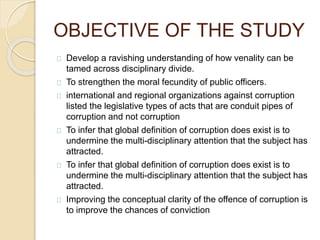
Develop a ravishing understanding of how venality can be
tamed across disciplinary divide.
To strengthen the moral fecundity of public officers.
international and regional organizations against corruption
listed the legislative types of acts that are conduit pipes of
corruption and not corruption
To infer that global definition of corruption does exist is to
undermine the multi-disciplinary attention that the subject has
attracted.
To infer that global definition of corruption does exist is to
undermine the multi-disciplinary attention that the subject has
attracted.
Improving the conceptual clarity of the offence of corruption is
to improve the chances of conviction
RESEARCH METHODOLOGY
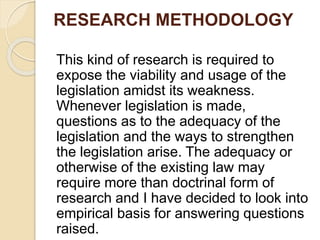
This kind of research is required to
expose the viability and usage of the
legislation amidst its weakness.
Whenever legislation is made,
questions as to the adequacy of the
legislation and the ways to strengthen
the legislation arise. The adequacy or
otherwise of the existing law may
require more than doctrinal form of
research and I have decided to look into
empirical basis for answering questions
raised.
EXPECTED CONTRIBUTION
TO KNOWLEDGE
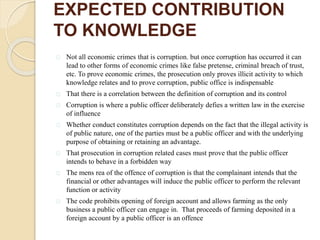
Not all economic crimes that is corruption. but once corruption has occurred it can
lead to other forms of economic crimes like false pretense, criminal breach of trust,
etc. To prove economic crimes, the prosecution only proves illicit activity to which
knowledge relates and to prove corruption, public office is indispensable
That there is a correlation between the definition of corruption and its control
Corruption is where a public officer deliberately defies a written law in the exercise
of influence
Whether conduct constitutes corruption depends on the fact that the illegal activity is
of public nature, one of the parties must be a public officer and with the underlying
purpose of obtaining or retaining an advantage.
That prosecution in corruption related cases must prove that the public officer
intends to behave in a forbidden way
The mens rea of the offence of corruption is that the complainant intends that the
financial or other advantages will induce the public officer to perform the relevant
function or activity
The code prohibits opening of foreign account and allows farming as the only
business a public officer can engage in. That proceeds of farming deposited in a
foreign account by a public officer is an offence
BIBLIOGRAPHY
Aghayere, V.O and Idada, W, “Governance and Corruption in Nigeria” in Cost of Governance in Nigeria, Faculty of Social
Science Journal, Ambrose Alli University, Ekpoma, 2007
Banfield, C.E; “Corruption is a Feature of Government Organization”, Journal of Law and Economics, 1975, vol. 18, issue 3
Gambeta, D; “Corruption: An Analytical Map” in Kotkin, S and Sajo, A; (Eds) Political Corruption in Transition: A skeptics
Handbook, 2002, CEU: Budapest
Gardner, J.A “Defining Corruption”, Corruption and Reform, 7 (1992)
Langseth; P, “Measuring Corruption” in Sampford, C; Shacklock, A; Connors, C; and Galtung, F; (Eds); Measuring Corruption,
2006, Ashgate Publishing Limited: England
Mc Kittrick, E.L; “The Study of Corruption” in Sociology and History: Methods. Lipset, S.M and Hofstader, R (Eds). New York,
1968.
Naylor, R.T. (1998) Corruption in the modern arms business: Lessons from the pentagon scandals in Jain (ed) (1998), Economic
of Corruption: Mass Kluwer Academic Publishers.
Nye, J; “Corruption and Political Development: A Cost-Benefit Analysis” in Political Corruption: A Handbook; Heidenheimer,
A.J; Johnston, M and Levine, V.T; (Eds), New Brunswick, Nova Scotia. 1967.
Noonan, J.T; (1984), Bribes, Berkeley: Calif, 1984
Oyebode, K; ‘The Anti -Corruption Act: A Necessary Instrument For Growth of our Nascent Democracy’. Essay in Honour of
O.C. J. Okocha (SAN), NBA Ilorin Biennial Law Week 2002
Ormerod, D and Rudi, F “Serious Crime Act 2007: The Part 2 Offences” [2009] Crim. L.R. 389
Okogbule, N.S. (2006), “An appraisal of the legal and institutional framework for combating corruption in Nigeria”, Journal of
Financial Crime, Vol. 13 No. 1.
Ormerod, D and Rudi, F “Serious Crime Act 2007: The Part 2 Offences” [2009] Crim. L.R. 389
Rose-Ackerman, S; (1975), Corruption: A Study in Political Economy, Oxford
Shleifer, A and Vishny, R.W; “Corruption”, Quarterly Journal of Economic, August 1993
Tanzi, V; ‘Corruption around the World: Causes, Consequences, Scope and Cures’ IMF Staff paper 45(4) 1998
Waldman, J. (1974), “Overseas corruption of business – a philosophical perspective”, Business and Society, Vol. 15 No. 1

Poster PRESENTATION

  • 1.
    CORRUPTION: PROOF Graduate Conferenceon Corruption and Anti-Corruption Brighton, BN1 9SP, UK University of Sussex 12th -13th January 2015
  • 2.
    AIGBOKHAN EWEMADE PRESIDENT LLB(Hons) AAU 2007; BL (Lagos) 2009, ACI.Arb (Lagos) Post Graduate Student Public Law Department Ambrose Alli University, Ekpoma, Edo State, Nigeria kpresident@yahoo.com
  • 3.
    ABSTRACT The word “corruption”carries opprobrium of ubiquitous definition. There is nothing as disturbing as having toothless plait of account not just in vulgar parlance but in scholarly literature and statutes. The family tree of corrupt practices is perennial but widely ramified. It grows with other vegetation such as fraud, theft, extortion, breach of trust and abuse of office. The approach of this paper is guided by pre-existing statutory enactments governing the offence of corruption in Nigeria. Poor feature outline of the definition of corruption in cocktail legislations decrease awareness along with inadequate and cumbersome conviction in the face of court technicalities. The practical implication is a leading in cynicism and increase in the incidence of corruption. The concluding part of the paper argues that the main feature of corruption is public function of one of the agents and demonstrates that it is not all forms of abuse of office that constitutes corruption. While of course this is relevant in other to analyze how corruption works and to construe the intendment of the law makers, the ontological survey will no doubt legitimize the fight against corruption and help in the prosecution of same.
  • 4.
    When the negotiationsof international and regional organizations against corruption began in late 1990’s; one of the questions under consideration was not to define corruption, but to list acts that are conduit pipes of corruption and giving guidelines to legislating on all of them. Every definition in description of corruption may be queried or require modification as this paper will illustrate. There is a correlation between the definition of corruption and its control There is apathy and confusion over what we should understand corruption to be. That the standard of proof of corruption is slightly different from that of theft, extortion, fraud or other economic crimes BACKGROUND TO THE STUDY
  • 5.
    OBJECTIVE OF THESTUDY Develop a ravishing understanding of how venality can be tamed across disciplinary divide. To strengthen the moral fecundity of public officers. international and regional organizations against corruption listed the legislative types of acts that are conduit pipes of corruption and not corruption To infer that global definition of corruption does exist is to undermine the multi-disciplinary attention that the subject has attracted. To infer that global definition of corruption does exist is to undermine the multi-disciplinary attention that the subject has attracted. Improving the conceptual clarity of the offence of corruption is to improve the chances of conviction
  • 6.
    RESEARCH METHODOLOGY This kindof research is required to expose the viability and usage of the legislation amidst its weakness. Whenever legislation is made, questions as to the adequacy of the legislation and the ways to strengthen the legislation arise. The adequacy or otherwise of the existing law may require more than doctrinal form of research and I have decided to look into empirical basis for answering questions raised.
  • 7.
    EXPECTED CONTRIBUTION TO KNOWLEDGE Notall economic crimes that is corruption. but once corruption has occurred it can lead to other forms of economic crimes like false pretense, criminal breach of trust, etc. To prove economic crimes, the prosecution only proves illicit activity to which knowledge relates and to prove corruption, public office is indispensable That there is a correlation between the definition of corruption and its control Corruption is where a public officer deliberately defies a written law in the exercise of influence Whether conduct constitutes corruption depends on the fact that the illegal activity is of public nature, one of the parties must be a public officer and with the underlying purpose of obtaining or retaining an advantage. That prosecution in corruption related cases must prove that the public officer intends to behave in a forbidden way The mens rea of the offence of corruption is that the complainant intends that the financial or other advantages will induce the public officer to perform the relevant function or activity The code prohibits opening of foreign account and allows farming as the only business a public officer can engage in. That proceeds of farming deposited in a foreign account by a public officer is an offence
  • 8.
    BIBLIOGRAPHY Aghayere, V.O andIdada, W, “Governance and Corruption in Nigeria” in Cost of Governance in Nigeria, Faculty of Social Science Journal, Ambrose Alli University, Ekpoma, 2007 Banfield, C.E; “Corruption is a Feature of Government Organization”, Journal of Law and Economics, 1975, vol. 18, issue 3 Gambeta, D; “Corruption: An Analytical Map” in Kotkin, S and Sajo, A; (Eds) Political Corruption in Transition: A skeptics Handbook, 2002, CEU: Budapest Gardner, J.A “Defining Corruption”, Corruption and Reform, 7 (1992) Langseth; P, “Measuring Corruption” in Sampford, C; Shacklock, A; Connors, C; and Galtung, F; (Eds); Measuring Corruption, 2006, Ashgate Publishing Limited: England Mc Kittrick, E.L; “The Study of Corruption” in Sociology and History: Methods. Lipset, S.M and Hofstader, R (Eds). New York, 1968. Naylor, R.T. (1998) Corruption in the modern arms business: Lessons from the pentagon scandals in Jain (ed) (1998), Economic of Corruption: Mass Kluwer Academic Publishers. Nye, J; “Corruption and Political Development: A Cost-Benefit Analysis” in Political Corruption: A Handbook; Heidenheimer, A.J; Johnston, M and Levine, V.T; (Eds), New Brunswick, Nova Scotia. 1967. Noonan, J.T; (1984), Bribes, Berkeley: Calif, 1984 Oyebode, K; ‘The Anti -Corruption Act: A Necessary Instrument For Growth of our Nascent Democracy’. Essay in Honour of O.C. J. Okocha (SAN), NBA Ilorin Biennial Law Week 2002 Ormerod, D and Rudi, F “Serious Crime Act 2007: The Part 2 Offences” [2009] Crim. L.R. 389 Okogbule, N.S. (2006), “An appraisal of the legal and institutional framework for combating corruption in Nigeria”, Journal of Financial Crime, Vol. 13 No. 1. Ormerod, D and Rudi, F “Serious Crime Act 2007: The Part 2 Offences” [2009] Crim. L.R. 389 Rose-Ackerman, S; (1975), Corruption: A Study in Political Economy, Oxford Shleifer, A and Vishny, R.W; “Corruption”, Quarterly Journal of Economic, August 1993 Tanzi, V; ‘Corruption around the World: Causes, Consequences, Scope and Cures’ IMF Staff paper 45(4) 1998 Waldman, J. (1974), “Overseas corruption of business – a philosophical perspective”, Business and Society, Vol. 15 No. 1