printed by
www.postersession.com
Impact of Integrating Service Learning and Spanish-Speaking
Community Health Programs
Bridgette Bernier
Spanish & Nursing
Minnesota State University, Mankato
bridgette.bernier@mnsu.edu
WITH
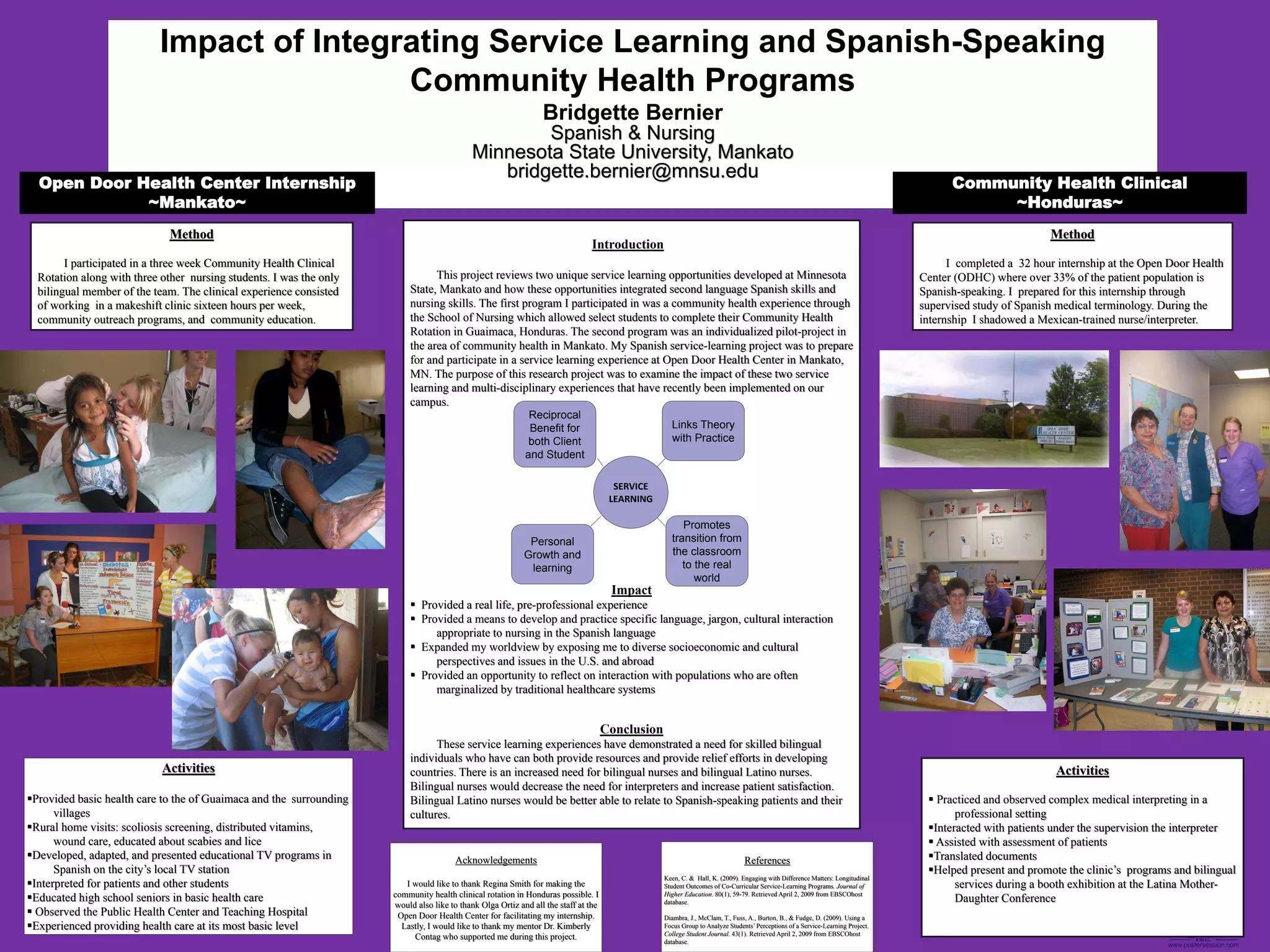
Method
I participated in a three week Community Health Clinical
Rotation along with three other nursing students. I was the only
bilingual member of the team. The clinical experience consisted
of working in a makeshift clinic sixteen hours per week,
community outreach programs, and community education.
Method
I completed a 32 hour internship at the Open Door Health
Center (ODHC) where over 33% of the patient population is
Spanish-speaking. I prepared for this internship through
supervised study of Spanish medical terminology. During the
internship I shadowed a Mexican-trained nurse/interpreter.
Introduction
This project reviews two unique service learning opportunities developed at Minnesota
State, Mankato and how these opportunities integrated second language Spanish skills and
nursing skills. The first program I participated in was a community health experience through
the School of Nursing which allowed select students to complete their Community Health
Rotation in Guaimaca, Honduras. The second program was an individualized pilot-project in
the area of community health in Mankato. My Spanish service-learning project was to prepare
for and participate in a service learning experience at Open Door Health Center in Mankato,
MN. The purpose of this research project was to examine the impact of these two service
learning and multi-disciplinary experiences that have recently been implemented on our
campus.
Impact
 Provided a real life, pre-professional experience
 Provided a means to develop and practice specific language, jargon, cultural interaction
appropriate to nursing in the Spanish language
 Expanded my worldview by exposing me to diverse socioeconomic and cultural
perspectives and issues in the U.S. and abroad
 Provided an opportunity to reflect on interaction with populations who are often
marginalized by traditional healthcare systems
Conclusion
These service learning experiences have demonstrated a need for skilled bilingual
individuals who have can both provide resources and provide relief efforts in developing
countries. There is an increased need for bilingual nurses and bilingual Latino nurses.
Bilingual nurses would decrease the need for interpreters and increase patient satisfaction.
Bilingual Latino nurses would be better able to relate to Spanish-speaking patients and their
cultures.
Activities
 Practiced and observed complex medical interpreting in a
professional setting
Interacted with patients under the supervision the interpreter
 Assisted with assessment of patients
Translated documents
Helped present and promote the clinic’s programs and bilingual
services during a booth exhibition at the Latina Mother-
Daughter Conference
Activities
Provided basic health care to the of Guaimaca and the surrounding
villages
Rural home visits: scoliosis screening, distributed vitamins,
wound care, educated about scabies and lice
Developed, adapted, and presented educational TV programs in
Spanish on the city’s local TV station
Interpreted for patients and other students
Educated high school seniors in basic health care
 Observed the Public Health Center and Teaching Hospital
Experienced providing health care at its most basic level
Acknowledgements
I would like to thank Regina Smith for making the
community health clinical rotation in Honduras possible. I
would also like to thank Olga Ortiz and all the staff at the
Open Door Health Center for facilitating my internship.
Lastly, I would like to thank my mentor Dr. Kimberly
Contag who supported me during this project.
References
Keen, C. & Hall, K. (2009). Engaging with Difference Matters: Longitudinal
Student Outcomes of Co-Curricular Service-Learning Programs. Journal of
Higher Education. 80(1), 59-79. Retrieved April 2, 2009 from EBSCOhost
database.
Diambra, J., McClam, T., Fuss, A., Burton, B., & Fudge, D. (2009). Using a
Focus Group to Analyze Students’ Perceptions of a Service-Learning Project.
College Student Journal. 43(1). Retrieved April 2, 2009 from EBSCOhost
database.
Community Health Clinical
~Honduras~
Open Door Health Center Internship
~Mankato~
SERVICE
LEARNING
Promotes
transition from
the classroom
to the real
world
Reciprocal
Benefit for
both Client
and Student
Links Theory
with Practice
Personal
Growth and
learning

Poster bb

  • 1.
    printed by www.postersession.com Impact ofIntegrating Service Learning and Spanish-Speaking Community Health Programs Bridgette Bernier Spanish & Nursing Minnesota State University, Mankato bridgette.bernier@mnsu.edu WITH Method I participated in a three week Community Health Clinical Rotation along with three other nursing students. I was the only bilingual member of the team. The clinical experience consisted of working in a makeshift clinic sixteen hours per week, community outreach programs, and community education. Method I completed a 32 hour internship at the Open Door Health Center (ODHC) where over 33% of the patient population is Spanish-speaking. I prepared for this internship through supervised study of Spanish medical terminology. During the internship I shadowed a Mexican-trained nurse/interpreter. Introduction This project reviews two unique service learning opportunities developed at Minnesota State, Mankato and how these opportunities integrated second language Spanish skills and nursing skills. The first program I participated in was a community health experience through the School of Nursing which allowed select students to complete their Community Health Rotation in Guaimaca, Honduras. The second program was an individualized pilot-project in the area of community health in Mankato. My Spanish service-learning project was to prepare for and participate in a service learning experience at Open Door Health Center in Mankato, MN. The purpose of this research project was to examine the impact of these two service learning and multi-disciplinary experiences that have recently been implemented on our campus. Impact  Provided a real life, pre-professional experience  Provided a means to develop and practice specific language, jargon, cultural interaction appropriate to nursing in the Spanish language  Expanded my worldview by exposing me to diverse socioeconomic and cultural perspectives and issues in the U.S. and abroad  Provided an opportunity to reflect on interaction with populations who are often marginalized by traditional healthcare systems Conclusion These service learning experiences have demonstrated a need for skilled bilingual individuals who have can both provide resources and provide relief efforts in developing countries. There is an increased need for bilingual nurses and bilingual Latino nurses. Bilingual nurses would decrease the need for interpreters and increase patient satisfaction. Bilingual Latino nurses would be better able to relate to Spanish-speaking patients and their cultures. Activities  Practiced and observed complex medical interpreting in a professional setting Interacted with patients under the supervision the interpreter  Assisted with assessment of patients Translated documents Helped present and promote the clinic’s programs and bilingual services during a booth exhibition at the Latina Mother- Daughter Conference Activities Provided basic health care to the of Guaimaca and the surrounding villages Rural home visits: scoliosis screening, distributed vitamins, wound care, educated about scabies and lice Developed, adapted, and presented educational TV programs in Spanish on the city’s local TV station Interpreted for patients and other students Educated high school seniors in basic health care  Observed the Public Health Center and Teaching Hospital Experienced providing health care at its most basic level Acknowledgements I would like to thank Regina Smith for making the community health clinical rotation in Honduras possible. I would also like to thank Olga Ortiz and all the staff at the Open Door Health Center for facilitating my internship. Lastly, I would like to thank my mentor Dr. Kimberly Contag who supported me during this project. References Keen, C. & Hall, K. (2009). Engaging with Difference Matters: Longitudinal Student Outcomes of Co-Curricular Service-Learning Programs. Journal of Higher Education. 80(1), 59-79. Retrieved April 2, 2009 from EBSCOhost database. Diambra, J., McClam, T., Fuss, A., Burton, B., & Fudge, D. (2009). Using a Focus Group to Analyze Students’ Perceptions of a Service-Learning Project. College Student Journal. 43(1). Retrieved April 2, 2009 from EBSCOhost database. Community Health Clinical ~Honduras~ Open Door Health Center Internship ~Mankato~ SERVICE LEARNING Promotes transition from the classroom to the real world Reciprocal Benefit for both Client and Student Links Theory with Practice Personal Growth and learning