The financial support by NSERC Canada in the frame of Discov-
ery Grant ’Modeling of Phase Change Phenomena in Particulate
Flows’ is gratefully acknowledged
References
1. BANSAL, H. AND NIKRITYUK, P. A Submodel for spherical particles undergoing phase change under the influence of
convection, Can. J. Chem. Eng., in press, 2016.
2. JOEL H FERZIGER, MILOVAN PERIC. Computational methods for fluid dynamics, Spr. Sci. and Business Media, 2012.
3. SHUKLA, A, RYABOV, D, VOLKOVA, O, SCHELLER, P, DEO B.. Metal. Mater. Trans. B, Vol. 42B, pp. 224-235, 2011.
Canadian Applied and Industrial Mathematics Society 2016 Annual Meeting
University of Alberta, Edmonton, Canada June, 2016
CFD-based modeling of ice particles melting under
the influence of natural convection
H. BANSAL, P.A. NIKRITYUK
Department of Chemical and Materials Engineering, University of Alberta, Edmonton, Canada
1) Problem Definition...........................................
Euler−Euler models fail to correctlyPhase change due to convection
Multiphase flows
with phase change
Physical Problem Numerical model
Euler−Lagange
(Unresolved discrete
particle model)
predict solidification phenomena
(Direct Numerical
Simulations)
Fully−resolved solid particle
undergoing phase change
Major challenge
bulk phase and solid−fluid interface
Relate transport processes between
(Scale−bridge relations)
Formulation of submodels
Subgrid models DNS
CV
Lagrangian particles
Euler grid
Euler−Lagrange model Subgrid model DNS model
T
8
Tp
Ste
Nu
Pr
Re
Particle
CV
Particle
• Aim: To develop subgrid model through DNS modeling to express heat transfer between fluid and
solid particles.
2) Model Formulation...........................................
Submodel1
:
ρphsf
drp
dt
=
Nudp
k∞
2rp
(Tm − T∞) +
kp(Tm − Tp)rt
rp(rp − rt)
; ρpvpcp
dTp
dt
=
4πkp(Tm − Tp)rtrp
rp − rt
DNS Model2
:
∇ · u = 0; ρ
∂u
∂t
+ ρ u · ∇u = −∇p + ∇ · µ · ∇u + (∇u)T
+ FB + FIB
ρ cp
∂T
∂t
+ ρ cp ∇ · (u T) = ∇ · (λ∇T) − ρhsf
∂ε
∂t
; ε = MIN 1, MAX 0,
T − Tm
δT
Key terms:
δT : Phase change thickness parameter
FIB: Fictitious boundary forcing term
FIB =
−µ (u) cu · min 1, (1−ε)2
ε3 0 ≤ ε < 1
0, ε = 1
(1)
Key numerical techniques:
• Discretization scheme: QUICK for temperature equation and Deferred Correction for momentum
equation
• Matrix solver: Stone’s strongly implicit procedure (SIP)
• Pressure-velocity coupling: SIMPLE algorithm with Rhie and Chow stabilization
• Grid resolution: 450x900 = 405000 cells
• Time step: 0.005 second, δT = 0.1 K
3) Validation.........................................................
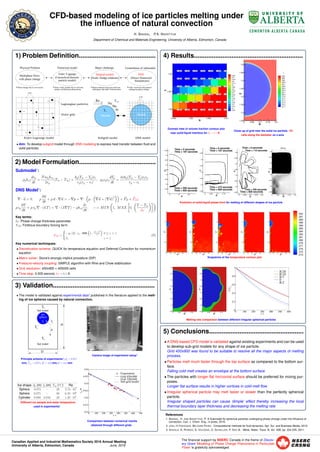
• The model is validated against experimental data3
published in the literature applied to the melt-
ing of ice spheres caused by natural convection.
T
T
Tm
g
rp
H
D
T
hot water
hot water
8
p
sphere
ice
8
Principle scheme of experiments3
; dp = 0.073
mm, T∞ = 20o
C, H = 440 mm,D = 445 mm
Camera image of experiment setup3
Ice shape dp (m) lp (m) T∞ (o
C) Ra
Sphere 0.073 - 20 3.74 · 107
Sphere 0.075 - 60 6.33 · 108
Cylinder 0.080 0.050 20 1.20 · 107
Different ice sample and water temperature
used in experiments3
0 100 200 300 400 500 600 700
t, s
0.01
0.015
0.02
0.025
0.03
0.035
0.04
rp
,m
Experiment
Grid 450x900
Grid 320x640
Sub-grid model
Comparison between numerical results
obtained through different grids
4) Results.............................................................
1.000
0.631
0.266
0.000
0.000
0.000
1.000
0.8 32
0.38 7
0.000
0.000
0.000
1.000
1.000
0.453
0.014
0.000
0.000
1.000
1.000
0.698
0.214
0.000
0.000
1.000
1.000
1.000
0.266
0.000
0.000
1.000
1.000
1.000
0.8 8 7
0.07 0
0.000
1.00
1.00
1.00
1.00
0.17
0.00
R
Z
0.055 0.06 0.065 0.07
1.28
1.28 5
1.29
0.95
0.9
0.8 5
0.8
0.7 5
0.7
0.65
0.6
0.55
0.5
0.45
0.4
0.35
0.3
0.25
0.2
0.15
0.1
0.05
Zoomed view of volume fraction contour plot
near solid-liquid interface for δT = 0.1 K
R*
Z*
0 0.05 0.1 0.15 0.2
1.25
1.3
1.35
1.4
1.45
1.5
1.55
1.6
T
293
292
290
28 9
28 7
28 6
28 4
28 3
28 1
28 0
27 8
27 7
27 5
27 4
27 2
27 1
Close up of grid near the solid ice particle; 151
cells along the diameter on z-axis
Evolution of solid-liquid phase front for melting of different shapes of ice particle
Snapshots of the temperature contour plot
0 100 200 300 400 500 600
t, s
0
0.2
0.4
0.6
0.8
1
V/Vo
R/20
R/10
R/7
0
R/2
Melting rate comparison between different irregular spherical particles
5) Conclusions.....................................................
• A DNS-based CFD model is validated against existing experiments and can be used
to develop sub-grid models for any shape of ice particle.
Grid 450x900 was found to be suitable to resolve all the major aspects of melting
process.
• Particles melt much faster through the top surface as compared to the bottom sur-
face.
Falling cold melt creates an envelope at the bottom surface.
• The particles with longer flat horizontal surface should be preferred for mixing pur-
poses.
Longer flat surface results in higher vortices in cold melt flow
• Irregular spherical particle may melt faster or slower than the perfectly spherical
particle.
Irregular shaped particles can cause ’dimple’ effect thereby increasing the local
thermal boundary layer thickness and decreasing the melting rate

Poster

  • 1.
    The financial supportby NSERC Canada in the frame of Discov- ery Grant ’Modeling of Phase Change Phenomena in Particulate Flows’ is gratefully acknowledged References 1. BANSAL, H. AND NIKRITYUK, P. A Submodel for spherical particles undergoing phase change under the influence of convection, Can. J. Chem. Eng., in press, 2016. 2. JOEL H FERZIGER, MILOVAN PERIC. Computational methods for fluid dynamics, Spr. Sci. and Business Media, 2012. 3. SHUKLA, A, RYABOV, D, VOLKOVA, O, SCHELLER, P, DEO B.. Metal. Mater. Trans. B, Vol. 42B, pp. 224-235, 2011. Canadian Applied and Industrial Mathematics Society 2016 Annual Meeting University of Alberta, Edmonton, Canada June, 2016 CFD-based modeling of ice particles melting under the influence of natural convection H. BANSAL, P.A. NIKRITYUK Department of Chemical and Materials Engineering, University of Alberta, Edmonton, Canada 1) Problem Definition........................................... Euler−Euler models fail to correctlyPhase change due to convection Multiphase flows with phase change Physical Problem Numerical model Euler−Lagange (Unresolved discrete particle model) predict solidification phenomena (Direct Numerical Simulations) Fully−resolved solid particle undergoing phase change Major challenge bulk phase and solid−fluid interface Relate transport processes between (Scale−bridge relations) Formulation of submodels Subgrid models DNS CV Lagrangian particles Euler grid Euler−Lagrange model Subgrid model DNS model T 8 Tp Ste Nu Pr Re Particle CV Particle • Aim: To develop subgrid model through DNS modeling to express heat transfer between fluid and solid particles. 2) Model Formulation........................................... Submodel1 : ρphsf drp dt = Nudp k∞ 2rp (Tm − T∞) + kp(Tm − Tp)rt rp(rp − rt) ; ρpvpcp dTp dt = 4πkp(Tm − Tp)rtrp rp − rt DNS Model2 : ∇ · u = 0; ρ ∂u ∂t + ρ u · ∇u = −∇p + ∇ · µ · ∇u + (∇u)T + FB + FIB ρ cp ∂T ∂t + ρ cp ∇ · (u T) = ∇ · (λ∇T) − ρhsf ∂ε ∂t ; ε = MIN 1, MAX 0, T − Tm δT Key terms: δT : Phase change thickness parameter FIB: Fictitious boundary forcing term FIB = −µ (u) cu · min 1, (1−ε)2 ε3 0 ≤ ε < 1 0, ε = 1 (1) Key numerical techniques: • Discretization scheme: QUICK for temperature equation and Deferred Correction for momentum equation • Matrix solver: Stone’s strongly implicit procedure (SIP) • Pressure-velocity coupling: SIMPLE algorithm with Rhie and Chow stabilization • Grid resolution: 450x900 = 405000 cells • Time step: 0.005 second, δT = 0.1 K 3) Validation......................................................... • The model is validated against experimental data3 published in the literature applied to the melt- ing of ice spheres caused by natural convection. T T Tm g rp H D T hot water hot water 8 p sphere ice 8 Principle scheme of experiments3 ; dp = 0.073 mm, T∞ = 20o C, H = 440 mm,D = 445 mm Camera image of experiment setup3 Ice shape dp (m) lp (m) T∞ (o C) Ra Sphere 0.073 - 20 3.74 · 107 Sphere 0.075 - 60 6.33 · 108 Cylinder 0.080 0.050 20 1.20 · 107 Different ice sample and water temperature used in experiments3 0 100 200 300 400 500 600 700 t, s 0.01 0.015 0.02 0.025 0.03 0.035 0.04 rp ,m Experiment Grid 450x900 Grid 320x640 Sub-grid model Comparison between numerical results obtained through different grids 4) Results............................................................. 1.000 0.631 0.266 0.000 0.000 0.000 1.000 0.8 32 0.38 7 0.000 0.000 0.000 1.000 1.000 0.453 0.014 0.000 0.000 1.000 1.000 0.698 0.214 0.000 0.000 1.000 1.000 1.000 0.266 0.000 0.000 1.000 1.000 1.000 0.8 8 7 0.07 0 0.000 1.00 1.00 1.00 1.00 0.17 0.00 R Z 0.055 0.06 0.065 0.07 1.28 1.28 5 1.29 0.95 0.9 0.8 5 0.8 0.7 5 0.7 0.65 0.6 0.55 0.5 0.45 0.4 0.35 0.3 0.25 0.2 0.15 0.1 0.05 Zoomed view of volume fraction contour plot near solid-liquid interface for δT = 0.1 K R* Z* 0 0.05 0.1 0.15 0.2 1.25 1.3 1.35 1.4 1.45 1.5 1.55 1.6 T 293 292 290 28 9 28 7 28 6 28 4 28 3 28 1 28 0 27 8 27 7 27 5 27 4 27 2 27 1 Close up of grid near the solid ice particle; 151 cells along the diameter on z-axis Evolution of solid-liquid phase front for melting of different shapes of ice particle Snapshots of the temperature contour plot 0 100 200 300 400 500 600 t, s 0 0.2 0.4 0.6 0.8 1 V/Vo R/20 R/10 R/7 0 R/2 Melting rate comparison between different irregular spherical particles 5) Conclusions..................................................... • A DNS-based CFD model is validated against existing experiments and can be used to develop sub-grid models for any shape of ice particle. Grid 450x900 was found to be suitable to resolve all the major aspects of melting process. • Particles melt much faster through the top surface as compared to the bottom sur- face. Falling cold melt creates an envelope at the bottom surface. • The particles with longer flat horizontal surface should be preferred for mixing pur- poses. Longer flat surface results in higher vortices in cold melt flow • Irregular spherical particle may melt faster or slower than the perfectly spherical particle. Irregular shaped particles can cause ’dimple’ effect thereby increasing the local thermal boundary layer thickness and decreasing the melting rate