Baltimore, Maryland
Society of Women Engineers Annual Conference
WE 13 October 24-26, 2013
A Post-Fukushima Look at
Assessing Flood Hazards
by
Kit Y. Ng
October 24 Lightning Talk Session
CIVIL
GOVERNMENT SERVICES
MINING & METALS
OIL, GAS & CHEMICALS
POWER
Overview
 Fukushima Nuclear Accident - A Few Key Facts
 Fukushima Lesson Learned and NTTF Recommendations
 US Regulatory Actions
 Impact to US Nuclear Fleet
 Status of Flooding Reevaluation
 Flooding Reevaluation Expectations
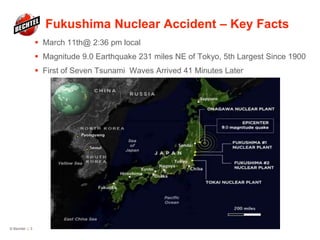
Fukushima Nuclear Accident – Key Facts
 March 11th@ 2:36 pm local
 Magnitude 9.0 Earthquake 231 miles NE of Tokyo, 5th Largest Since 1900
 First of Seven Tsunami Waves Arrived 41 Minutes Later
© Bechtel | 3
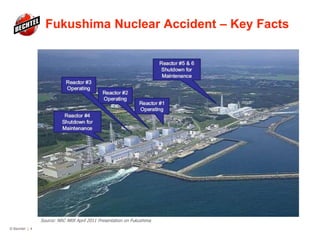
Fukushima Nuclear Accident – Key Facts
© Bechtel | 4
Source: NRC NRR April 2011 Presentation on Fukushima
Fukushima Nuclear Accident – Key Facts
Plant Response - Earthquake
© Bechtel | 5
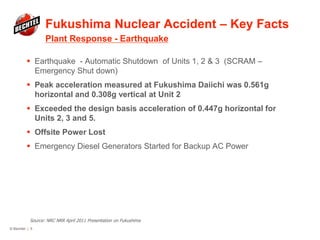
 Earthquake - Automatic Shutdown of Units 1, 2 & 3 (SCRAM –
Emergency Shut down)
 Peak acceleration measured at Fukushima Daiichi was 0.561g
horizontal and 0.308g vertical at Unit 2
 Exceeded the design basis acceleration of 0.447g horizontal for
Units 2, 3 and 5.
 Offsite Power Lost
 Emergency Diesel Generators Started for Backup AC Power
Source: NRC NRR April 2011 Presentation on Fukushima
Fukushima Nuclear Accident – Key Facts
Plant Response – Tsunami (41 minutes Later)
© Bechtel | 6
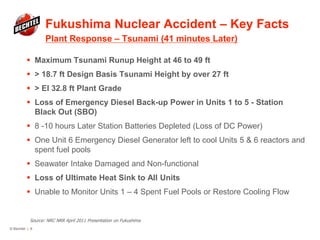
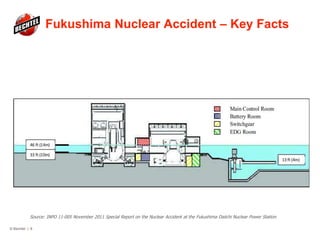
 Maximum Tsunami Runup Height at 46 to 49 ft
 > 18.7 ft Design Basis Tsunami Height by over 27 ft
 > El 32.8 ft Plant Grade
 Loss of Emergency Diesel Back-up Power in Units 1 to 5 - Station
Black Out (SBO)
 8 -10 hours Later Station Batteries Depleted (Loss of DC Power)
 One Unit 6 Emergency Diesel Generator left to cool Units 5 & 6 reactors and
spent fuel pools
 Seawater Intake Damaged and Non-functional
 Loss of Ultimate Heat Sink to All Units
 Unable to Monitor Units 1 – 4 Spent Fuel Pools or Restore Cooling Flow
Source: NRC NRR April 2011 Presentation on Fukushima
Fukushima Nuclear Accident – Key Facts
Plant Response – Tsunami (41 minutes Later)
© Bechtel | 7
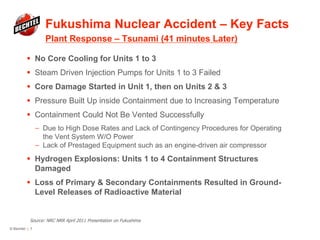
 No Core Cooling for Units 1 to 3
 Steam Driven Injection Pumps for Units 1 to 3 Failed
 Core Damage Started in Unit 1, then on Units 2 & 3
 Pressure Built Up inside Containment due to Increasing Temperature
 Containment Could Not Be Vented Successfully
— Due to High Dose Rates and Lack of Contingency Procedures for Operating
the Vent System W/O Power
— Lack of Prestaged Equipment such as an engine-driven air compressor
 Hydrogen Explosions: Units 1 to 4 Containment Structures
Damaged
 Loss of Primary & Secondary Containments Resulted in Ground-
Level Releases of Radioactive Material
Source: NRC NRR April 2011 Presentation on Fukushima
Fukushima Nuclear Accident – Key Facts
© Bechtel | 8
Source: INPO 11-005 November 2011 Special Report on the Nuclear Accident at the Fukushima Daiichi Nuclear Power Station
Post Fukushima Regulatory Actions - 2011
 March 11 – NRC Operations Center to Monitor Tsunami Risk in US
and Support Response Efforts
 March 18 – NRC reminded Post-9/11 additional emergency equipment
 March 23 – Resident inspectors re-examine Post-9/11 emergency
equipment
 April 1 – NRC Appointed Near Term Task Force (NTTF) on Fukushima
Lessons Learned
 April 29 - Resident inspectors examine severe accident management
procedures and training at U.S. nuclear power plants per TI2515/184
 May 11 - NRC requires nuclear power plants to provide information on
post-9/11 emergency equipment, as well as how the plants ensure
strategies to use the equipment remain effective over time (Bulletin 2011-
01)
 June 6 - NRC reports on areas for improvement regarding U.S. nuclear
power plants’ Severe Accident Management Guidelines (SAMG)
© Bechtel | 9
Post Fukushima Regulatory Actions - 2011
 July 12 – NRC NTTF Report on Lessons Learned from Fukushima
Issued. Concluded that U.S. Plants are Operating Safely and
Provided 12 Broad Recommendations for Enhancing Reactor Safety
(SECY–11-093)
— Clarifying the Regulatory Framework - Defense-in-depth & Risk Considerations
— Ensuring Protection – Reevaluate/Upgrade Design-basis Seismic & Flooding
— Enhancing Mitigation –
— SBO Mitigation; Reliable Hardened Vent
— Hydrogen Control & Mitigation; SPF Makeup & Instrumentation
— Onsite emergency response Capabilities
— Emergency Operating Procedures, Severe Accident Management Guidelines,
Extensive Damage Mitigation Guidelines
— Strengthening Emergency Preparedness -
— Emergency plans Address Prolonged SBO & Multi-unit Events
— Improving the Efficiency of NRC Programs - Reactor Oversight Process
© Bechtel | 10
Post Fukushima Regulatory Actions - 2011
 September 9 - NRC staff presented 6 NTTF Recommendations that
should be Initiated Without Delay (SECY–11-0124)
 October 3 - NRC staff proposed three tiers of prioritization for the
NTTF recommendations (SECY-11-0137)
 October 18 - The Commission approved the NRC staff’s proposal to
implement recommendations described in SECY-11-0124 within five
years, by 2016
 December 15 - The Commission approves the staff’s proposed
prioritization of the Near-Term Task Force recommendations
described in SECY-11-0137
© Bechtel | 11
Post Fukushima Regulatory Actions - 2011
Tier 1 Recommendations
 2.1 Seismic and flood hazard reevaluations
 2.3 Seismic and flood walkdowns
 4.1 Station blackout (SBO) regulatory actions
 4.2 Equipment covered under Title 10 of the Code of Federal Regulations
(10 CFR) 50.54(hh)(2)
 5.1 Reliable hardened vents for Mark I and Mark II containments
 7.1 SFP instrumentation
 8 Strengthening & integration of emergency operating procedures, severe
accident management guidelines, extensive damage mitigation guidelines
 9.3 Emergency preparedness (EP) regulatory actions
© Bechtel | 12
Post Fukushima Regulatory Actions - 2011
Tier 2 Recommendations
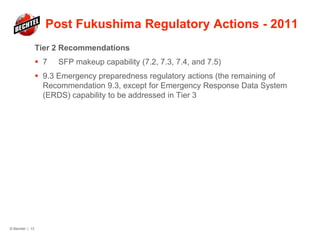
 7 SFP makeup capability (7.2, 7.3, 7.4, and 7.5)
 9.3 Emergency preparedness regulatory actions (the remaining of
Recommendation 9.3, except for Emergency Response Data System
(ERDS) capability to be addressed in Tier 3
© Bechtel | 13
Post Fukushima Regulatory Actions - 2012
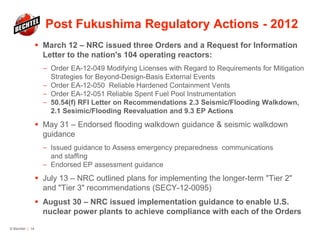
 March 12 – NRC issued three Orders and a Request for Information
Letter to the nation's 104 operating reactors:
— Order EA-12-049 Modifying Licenses with Regard to Requirements for Mitigation
Strategies for Beyond-Design-Basis External Events
— Order EA-12-050 Reliable Hardened Containment Vents
— Order EA-12-051 Reliable Spent Fuel Pool Instrumentation
— 50.54(f) RFI Letter on Recommendations 2.3 Seismic/Flooding Walkdown,
2.1 Sesimic/Flooding Reevaluation and 9.3 EP Actions
 May 31 – Endorsed flooding walkdown guidance & seismic walkdown
guidance
— Issued guidance to Assess emergency preparedness communications
and staffing
— Endorsed EP assessment guidance
 July 13 – NRC outlined plans for implementing the longer-term "Tier 2"
and "Tier 3" recommendations (SECY-12-0095)
 August 30 – NRC issued implementation guidance to enable U.S.
nuclear power plants to achieve compliance with each of the Orders
© Bechtel | 14
Impact to United States Nuclear Fleet
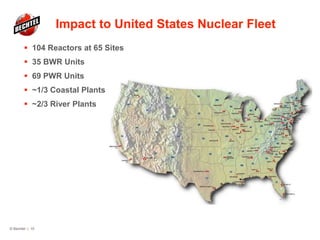
 104 Reactors at 65 Sites
 35 BWR Units
 69 PWR Units
 ~1/3 Coastal Plants
 ~2/3 River Plants
© Bechtel | 15
NTTF 2.1 Flooding Hazard Reevaluation
Scope
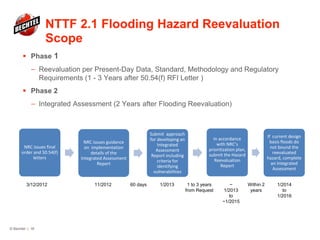
 Phase 1
— Reevaluation per Present-Day Data, Standard, Methodology and Regulatory
Requirements (1 - 3 Years after 50.54(f) RFI Letter )
 Phase 2
— Integrated Assessment (2 Years after Flooding Reevaluation)
© Bechtel | 16
NRC issues final
order and 50.54(f)
letters
NRC issues guidance
on implementation
details of the
Integrated Assessment
Report
Submit approach
for developing an
Integrated
Assessment
Report including
criteria for
identifying
vulnerabilities
In accordance
with NRC’s
prioritization plan,
submit the Hazard
Reevaluation
Report
If current design
basis floods do
not bound the
reevaluated
hazard, complete
an Integrated
Assessment
1/201311/2012 ~
1/2013
to
~1/2015
1/2014
to
1/2016
1 to 3 years
from Request
Within 2
years
60 days3/12/2012
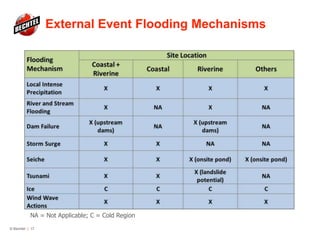
External Event Flooding Mechanisms
© Bechtel | 17
NA = Not Applicable; C = Cold Region
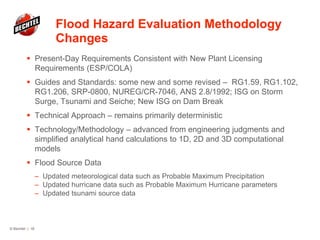
Flood Hazard Evaluation Methodology
Changes
 Present-Day Requirements Consistent with New Plant Licensing
Requirements (ESP/COLA)
 Guides and Standards: some new and some revised – RG1.59, RG1.102,
RG1.206, SRP-0800, NUREG/CR-7046, ANS 2.8/1992; ISG on Storm
Surge, Tsunami and Seiche; New ISG on Dam Break
 Technical Approach – remains primarily deterministic
 Technology/Methodology – advanced from engineering judgments and
simplified analytical hand calculations to 1D, 2D and 3D computational
models
 Flood Source Data
– Updated meteorological data such as Probable Maximum Precipitation
– Updated hurricane data such as Probable Maximum Hurricane parameters
– Updated tsunami source data
© Bechtel | 18
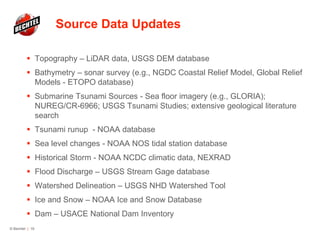
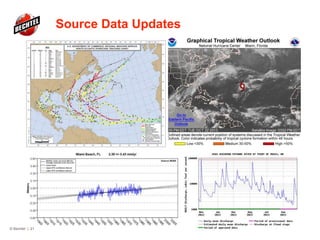
Source Data Updates
 Topography – LiDAR data, USGS DEM database
 Bathymetry – sonar survey (e.g., NGDC Coastal Relief Model, Global Relief
Models - ETOPO database)
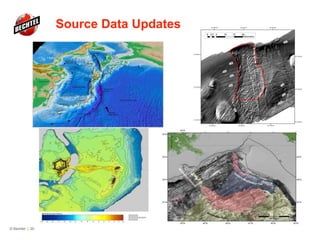
 Submarine Tsunami Sources - Sea floor imagery (e.g., GLORIA);
NUREG/CR-6966; USGS Tsunami Studies; extensive geological literature
search
 Tsunami runup - NOAA database
 Sea level changes - NOAA NOS tidal station database
 Historical Storm - NOAA NCDC climatic data, NEXRAD
 Flood Discharge – USGS Stream Gage database
 Watershed Delineation – USGS NHD Watershed Tool
 Ice and Snow – NOAA Ice and Snow Database
 Dam – USACE National Dam Inventory
© Bechtel | 19
Source Data Updates
© Bechtel | 20
Source Data Updates
© Bechtel | 21
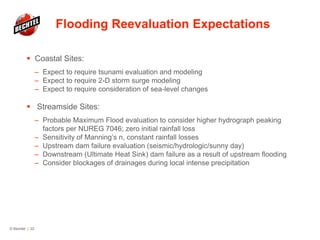
Flooding Reevaluation Expectations
 Coastal Sites:
– Expect to require tsunami evaluation and modeling
– Expect to require 2-D storm surge modeling
– Expect to require consideration of sea-level changes
 Streamside Sites:
– Probable Maximum Flood evaluation to consider higher hydrograph peaking
factors per NUREG 7046; zero initial rainfall loss
– Sensitivity of Manning’s n, constant rainfall losses
– Upstream dam failure evaluation (seismic/hydrologic/sunny day)
– Downstream (Ultimate Heat Sink) dam failure as a result of upstream flooding
– Consider blockages of drainages during local intense precipitation
© Bechtel | 22
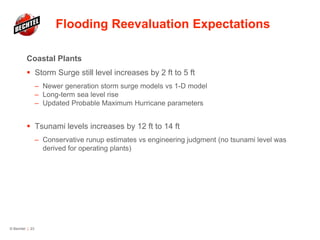
Flooding Reevaluation Expectations
Coastal Plants
 Storm Surge still level increases by 2 ft to 5 ft
– Newer generation storm surge models vs 1-D model
– Long-term sea level rise
– Updated Probable Maximum Hurricane parameters
 Tsunami levels increases by 12 ft to 14 ft
– Conservative runup estimates vs engineering judgment (no tsunami level was
derived for operating plants)
© Bechtel | 23
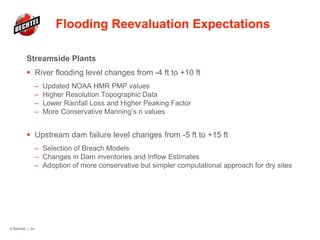
Flooding Reevaluation Expectations
Streamside Plants
 River flooding level changes from -4 ft to +10 ft
– Updated NOAA HMR PMP values
– Higher Resolution Topographic Data
– Lower Rainfall Loss and Higher Peaking Factor
– More Conservative Manning’s n values
 Upstream dam failure level changes from -5 ft to +15 ft
– Selection of Breach Models
– Changes in Dam inventories and Inflow Estimates
– Adoption of more conservative but simpler computational approach for dry sites
© Bechtel | 24
Next Phase - Interim Measures and
Integrated Assessments
 Apply when Reevaluated Flood Hazards Exceed Current Design Basis
 Need to Consider Other Associated Flood Hazards
– Hydrostatic and Hydrodynamic Forces
– Debris Loading; Sediment; Erosion
– Flood Duration; Warning Time
– Combined Effects of Multiple Flood Mechanisms
 Higher Flooding Hazards Expected for Most Plants
– Options: Protection vs Mitigation
 Integrated Assessment
– A New Process - Regulatory/Industry Guidance is being developed
 Industry Group Task Force Involvement – NEI/EPRI/INPO/Utilities/Vendor
 Peer Review Requirements; Human Performance Factor
 3 Approaches:
– Scenario Based; Margin Based; Probabilistic Risk Assessment
© Bechtel | 25
Questions?
Email for Further Questions
KYNG@BECHTEL.COM
© Bechtel | 26

A Post-Fukushima Look at Assessing Flood Hazards

  • 1.
    Baltimore, Maryland Society ofWomen Engineers Annual Conference WE 13 October 24-26, 2013 A Post-Fukushima Look at Assessing Flood Hazards by Kit Y. Ng October 24 Lightning Talk Session CIVIL GOVERNMENT SERVICES MINING & METALS OIL, GAS & CHEMICALS POWER
  • 2.
    Overview  Fukushima NuclearAccident - A Few Key Facts  Fukushima Lesson Learned and NTTF Recommendations  US Regulatory Actions  Impact to US Nuclear Fleet  Status of Flooding Reevaluation  Flooding Reevaluation Expectations
  • 3.
    Fukushima Nuclear Accident– Key Facts  March 11th@ 2:36 pm local  Magnitude 9.0 Earthquake 231 miles NE of Tokyo, 5th Largest Since 1900  First of Seven Tsunami Waves Arrived 41 Minutes Later © Bechtel | 3
  • 4.
    Fukushima Nuclear Accident– Key Facts © Bechtel | 4 Source: NRC NRR April 2011 Presentation on Fukushima
  • 5.
    Fukushima Nuclear Accident– Key Facts Plant Response - Earthquake © Bechtel | 5  Earthquake - Automatic Shutdown of Units 1, 2 & 3 (SCRAM – Emergency Shut down)  Peak acceleration measured at Fukushima Daiichi was 0.561g horizontal and 0.308g vertical at Unit 2  Exceeded the design basis acceleration of 0.447g horizontal for Units 2, 3 and 5.  Offsite Power Lost  Emergency Diesel Generators Started for Backup AC Power Source: NRC NRR April 2011 Presentation on Fukushima
  • 6.
    Fukushima Nuclear Accident– Key Facts Plant Response – Tsunami (41 minutes Later) © Bechtel | 6  Maximum Tsunami Runup Height at 46 to 49 ft  > 18.7 ft Design Basis Tsunami Height by over 27 ft  > El 32.8 ft Plant Grade  Loss of Emergency Diesel Back-up Power in Units 1 to 5 - Station Black Out (SBO)  8 -10 hours Later Station Batteries Depleted (Loss of DC Power)  One Unit 6 Emergency Diesel Generator left to cool Units 5 & 6 reactors and spent fuel pools  Seawater Intake Damaged and Non-functional  Loss of Ultimate Heat Sink to All Units  Unable to Monitor Units 1 – 4 Spent Fuel Pools or Restore Cooling Flow Source: NRC NRR April 2011 Presentation on Fukushima
  • 7.
    Fukushima Nuclear Accident– Key Facts Plant Response – Tsunami (41 minutes Later) © Bechtel | 7  No Core Cooling for Units 1 to 3  Steam Driven Injection Pumps for Units 1 to 3 Failed  Core Damage Started in Unit 1, then on Units 2 & 3  Pressure Built Up inside Containment due to Increasing Temperature  Containment Could Not Be Vented Successfully — Due to High Dose Rates and Lack of Contingency Procedures for Operating the Vent System W/O Power — Lack of Prestaged Equipment such as an engine-driven air compressor  Hydrogen Explosions: Units 1 to 4 Containment Structures Damaged  Loss of Primary & Secondary Containments Resulted in Ground- Level Releases of Radioactive Material Source: NRC NRR April 2011 Presentation on Fukushima
  • 8.
    Fukushima Nuclear Accident– Key Facts © Bechtel | 8 Source: INPO 11-005 November 2011 Special Report on the Nuclear Accident at the Fukushima Daiichi Nuclear Power Station
  • 9.
    Post Fukushima RegulatoryActions - 2011  March 11 – NRC Operations Center to Monitor Tsunami Risk in US and Support Response Efforts  March 18 – NRC reminded Post-9/11 additional emergency equipment  March 23 – Resident inspectors re-examine Post-9/11 emergency equipment  April 1 – NRC Appointed Near Term Task Force (NTTF) on Fukushima Lessons Learned  April 29 - Resident inspectors examine severe accident management procedures and training at U.S. nuclear power plants per TI2515/184  May 11 - NRC requires nuclear power plants to provide information on post-9/11 emergency equipment, as well as how the plants ensure strategies to use the equipment remain effective over time (Bulletin 2011- 01)  June 6 - NRC reports on areas for improvement regarding U.S. nuclear power plants’ Severe Accident Management Guidelines (SAMG) © Bechtel | 9
  • 10.
    Post Fukushima RegulatoryActions - 2011  July 12 – NRC NTTF Report on Lessons Learned from Fukushima Issued. Concluded that U.S. Plants are Operating Safely and Provided 12 Broad Recommendations for Enhancing Reactor Safety (SECY–11-093) — Clarifying the Regulatory Framework - Defense-in-depth & Risk Considerations — Ensuring Protection – Reevaluate/Upgrade Design-basis Seismic & Flooding — Enhancing Mitigation – — SBO Mitigation; Reliable Hardened Vent — Hydrogen Control & Mitigation; SPF Makeup & Instrumentation — Onsite emergency response Capabilities — Emergency Operating Procedures, Severe Accident Management Guidelines, Extensive Damage Mitigation Guidelines — Strengthening Emergency Preparedness - — Emergency plans Address Prolonged SBO & Multi-unit Events — Improving the Efficiency of NRC Programs - Reactor Oversight Process © Bechtel | 10
  • 11.
    Post Fukushima RegulatoryActions - 2011  September 9 - NRC staff presented 6 NTTF Recommendations that should be Initiated Without Delay (SECY–11-0124)  October 3 - NRC staff proposed three tiers of prioritization for the NTTF recommendations (SECY-11-0137)  October 18 - The Commission approved the NRC staff’s proposal to implement recommendations described in SECY-11-0124 within five years, by 2016  December 15 - The Commission approves the staff’s proposed prioritization of the Near-Term Task Force recommendations described in SECY-11-0137 © Bechtel | 11
  • 12.
    Post Fukushima RegulatoryActions - 2011 Tier 1 Recommendations  2.1 Seismic and flood hazard reevaluations  2.3 Seismic and flood walkdowns  4.1 Station blackout (SBO) regulatory actions  4.2 Equipment covered under Title 10 of the Code of Federal Regulations (10 CFR) 50.54(hh)(2)  5.1 Reliable hardened vents for Mark I and Mark II containments  7.1 SFP instrumentation  8 Strengthening & integration of emergency operating procedures, severe accident management guidelines, extensive damage mitigation guidelines  9.3 Emergency preparedness (EP) regulatory actions © Bechtel | 12
  • 13.
    Post Fukushima RegulatoryActions - 2011 Tier 2 Recommendations  7 SFP makeup capability (7.2, 7.3, 7.4, and 7.5)  9.3 Emergency preparedness regulatory actions (the remaining of Recommendation 9.3, except for Emergency Response Data System (ERDS) capability to be addressed in Tier 3 © Bechtel | 13
  • 14.
    Post Fukushima RegulatoryActions - 2012  March 12 – NRC issued three Orders and a Request for Information Letter to the nation's 104 operating reactors: — Order EA-12-049 Modifying Licenses with Regard to Requirements for Mitigation Strategies for Beyond-Design-Basis External Events — Order EA-12-050 Reliable Hardened Containment Vents — Order EA-12-051 Reliable Spent Fuel Pool Instrumentation — 50.54(f) RFI Letter on Recommendations 2.3 Seismic/Flooding Walkdown, 2.1 Sesimic/Flooding Reevaluation and 9.3 EP Actions  May 31 – Endorsed flooding walkdown guidance & seismic walkdown guidance — Issued guidance to Assess emergency preparedness communications and staffing — Endorsed EP assessment guidance  July 13 – NRC outlined plans for implementing the longer-term "Tier 2" and "Tier 3" recommendations (SECY-12-0095)  August 30 – NRC issued implementation guidance to enable U.S. nuclear power plants to achieve compliance with each of the Orders © Bechtel | 14
  • 15.
    Impact to UnitedStates Nuclear Fleet  104 Reactors at 65 Sites  35 BWR Units  69 PWR Units  ~1/3 Coastal Plants  ~2/3 River Plants © Bechtel | 15
  • 16.
    NTTF 2.1 FloodingHazard Reevaluation Scope  Phase 1 — Reevaluation per Present-Day Data, Standard, Methodology and Regulatory Requirements (1 - 3 Years after 50.54(f) RFI Letter )  Phase 2 — Integrated Assessment (2 Years after Flooding Reevaluation) © Bechtel | 16 NRC issues final order and 50.54(f) letters NRC issues guidance on implementation details of the Integrated Assessment Report Submit approach for developing an Integrated Assessment Report including criteria for identifying vulnerabilities In accordance with NRC’s prioritization plan, submit the Hazard Reevaluation Report If current design basis floods do not bound the reevaluated hazard, complete an Integrated Assessment 1/201311/2012 ~ 1/2013 to ~1/2015 1/2014 to 1/2016 1 to 3 years from Request Within 2 years 60 days3/12/2012
  • 17.
    External Event FloodingMechanisms © Bechtel | 17 NA = Not Applicable; C = Cold Region
  • 18.
    Flood Hazard EvaluationMethodology Changes  Present-Day Requirements Consistent with New Plant Licensing Requirements (ESP/COLA)  Guides and Standards: some new and some revised – RG1.59, RG1.102, RG1.206, SRP-0800, NUREG/CR-7046, ANS 2.8/1992; ISG on Storm Surge, Tsunami and Seiche; New ISG on Dam Break  Technical Approach – remains primarily deterministic  Technology/Methodology – advanced from engineering judgments and simplified analytical hand calculations to 1D, 2D and 3D computational models  Flood Source Data – Updated meteorological data such as Probable Maximum Precipitation – Updated hurricane data such as Probable Maximum Hurricane parameters – Updated tsunami source data © Bechtel | 18
  • 19.
    Source Data Updates Topography – LiDAR data, USGS DEM database  Bathymetry – sonar survey (e.g., NGDC Coastal Relief Model, Global Relief Models - ETOPO database)  Submarine Tsunami Sources - Sea floor imagery (e.g., GLORIA); NUREG/CR-6966; USGS Tsunami Studies; extensive geological literature search  Tsunami runup - NOAA database  Sea level changes - NOAA NOS tidal station database  Historical Storm - NOAA NCDC climatic data, NEXRAD  Flood Discharge – USGS Stream Gage database  Watershed Delineation – USGS NHD Watershed Tool  Ice and Snow – NOAA Ice and Snow Database  Dam – USACE National Dam Inventory © Bechtel | 19
  • 20.
  • 21.
  • 22.
    Flooding Reevaluation Expectations Coastal Sites: – Expect to require tsunami evaluation and modeling – Expect to require 2-D storm surge modeling – Expect to require consideration of sea-level changes  Streamside Sites: – Probable Maximum Flood evaluation to consider higher hydrograph peaking factors per NUREG 7046; zero initial rainfall loss – Sensitivity of Manning’s n, constant rainfall losses – Upstream dam failure evaluation (seismic/hydrologic/sunny day) – Downstream (Ultimate Heat Sink) dam failure as a result of upstream flooding – Consider blockages of drainages during local intense precipitation © Bechtel | 22
  • 23.
    Flooding Reevaluation Expectations CoastalPlants  Storm Surge still level increases by 2 ft to 5 ft – Newer generation storm surge models vs 1-D model – Long-term sea level rise – Updated Probable Maximum Hurricane parameters  Tsunami levels increases by 12 ft to 14 ft – Conservative runup estimates vs engineering judgment (no tsunami level was derived for operating plants) © Bechtel | 23
  • 24.
    Flooding Reevaluation Expectations StreamsidePlants  River flooding level changes from -4 ft to +10 ft – Updated NOAA HMR PMP values – Higher Resolution Topographic Data – Lower Rainfall Loss and Higher Peaking Factor – More Conservative Manning’s n values  Upstream dam failure level changes from -5 ft to +15 ft – Selection of Breach Models – Changes in Dam inventories and Inflow Estimates – Adoption of more conservative but simpler computational approach for dry sites © Bechtel | 24
  • 25.
    Next Phase -Interim Measures and Integrated Assessments  Apply when Reevaluated Flood Hazards Exceed Current Design Basis  Need to Consider Other Associated Flood Hazards – Hydrostatic and Hydrodynamic Forces – Debris Loading; Sediment; Erosion – Flood Duration; Warning Time – Combined Effects of Multiple Flood Mechanisms  Higher Flooding Hazards Expected for Most Plants – Options: Protection vs Mitigation  Integrated Assessment – A New Process - Regulatory/Industry Guidance is being developed  Industry Group Task Force Involvement – NEI/EPRI/INPO/Utilities/Vendor  Peer Review Requirements; Human Performance Factor  3 Approaches: – Scenario Based; Margin Based; Probabilistic Risk Assessment © Bechtel | 25
  • 26.
    Questions? Email for FurtherQuestions KYNG@BECHTEL.COM © Bechtel | 26