1
Position Estimation in Kalman Filter
Presented By
David Sestak, Zhang zhen bing,
Ahmed Mohamed Reda & Mohamed Freeshah
January, 2018
2
Position Estimation in Kalman Filter
Zhang zhen bing
Presented By
Ahmed Mohamed
Reda
Mohamed Ahmed FreeshahDavid Sestak
3
▪ Introduction
▪ Motivation
▪ Equipment
▪ Methodology
➢ Data source
➢ KF Processing
▪ Results
Project Schedule
4
▪ Precise position estimation is one of the fundamental
technical dependencies in our society today. It has
influenced our lives in countless ways most people do
not think about.
▪ It is used in a variety of applications including:
▪ GNSS (and all its varying applications)
▪ Self driving vehicles
▪ Mobile robots
▪ Internet of Things (IoT) and many others
Introduction
5
▪ Indoor positioning has become an area of increasing
interest utilizing the various signals that our devices
use such as Bluetooth and WiFi.
▪ People spend about 80% of their time indoors, so it is
of great significant to achieve precise indoor position
estimation.
▪ This is why we are using a smartphone, a device
everyone carries, for real time position estimation only
using its inertial sensors.
Motivation
6
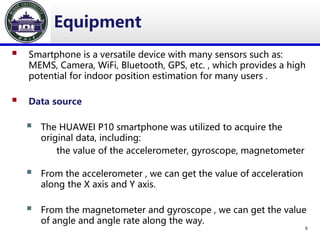
▪ Smartphone is a versatile device with many sensors such as:
MEMS, Camera, WiFi, Bluetooth, GPS, etc. , which provides a high
potential for indoor position estimation for many users .
▪ Data source
▪ The HUAWEI P10 smartphone was utilized to acquire the
original data, including:
the value of the accelerometer, gyroscope, magnetometer
▪ From the accelerometer , we can get the value of acceleration
along the X axis and Y axis.
▪ From the magnetometer and gyroscope , we can get the value
of angle and angle rate along the way.
Equipment
7
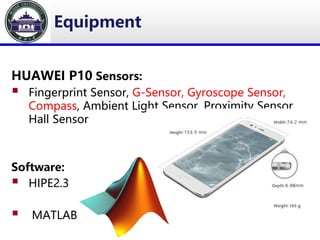
HUAWEI P10 Sensors:
▪ Fingerprint Sensor, G-Sensor, Gyroscope Sensor,
Compass, Ambient Light Sensor, Proximity Sensor,
Hall Sensor
Software:
▪ HIPE2.3
▪ MATLAB
Equipment
8
▪ The Kalman Filter (KF) is a time-varying linear optimal
estimation algorithm , which is ideally suited for
position estimation in modern multi-sensor systems.
▪ An important aspect of KF is its recursive nature.
The position estimation is only based on the
previously calculated state and current input.
▪ This makes it ideal for real time application
▪ KF puts more weight on higher certainty values
improving its estimation precision.
Why KF ?
9
▪ Our Observation Variables:
▪ ax = x-direction acceleration
▪ ay = y-direction acceleration
▪ θ = direction
▪ ω = angular rate
▪ These are the observation values that our
smartphone inertial sensors provides.
Methodology
10
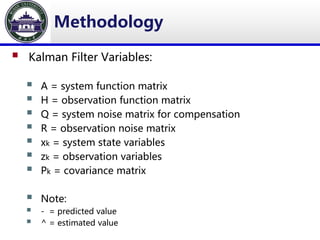
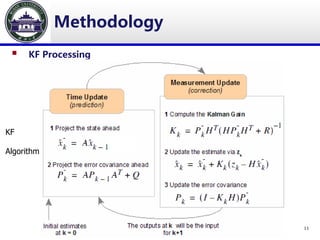
▪ Kalman Filter Variables:
▪ A = system function matrix
▪ H = observation function matrix
▪ Q = system noise matrix for compensation
▪ R = observation noise matrix
▪ xk = system state variables
▪ zk = observation variables
▪ Pk = covariance matrix
▪ Note:
▪ - = predicted value
▪ ^ = estimated value
Methodology
11
▪ KF Processing
Methodology
KF
Algorithm
12
Methodology
0
1
2
3
4
5
6
类别 1 类别 2 类别 3 类别 4
13
▪ KF Processing
In our project:
Assumption:(Gaussian distribution)
First: define the state variables
Second: confirm the system function according to the physic
principle.
Third: given the observation equation.
Fourth: confirm the matrix of Q, R, and P according to the
experience.
Methodology
14
Methodology
K+1 K
0 0 t 0 0 0 0 0
0 0 0 t 0 0 0 0
0 0 1 0 t 0 0 0
0 0 0 1 0 t 0 0
0 0 0 0 1 0 0 0
0 0 0 0 0 1 0 0
0 0 0 0 0 0 1 t
0 0 0 0 0 0 0 1
θ
ω
θ
ω
=
System function
15
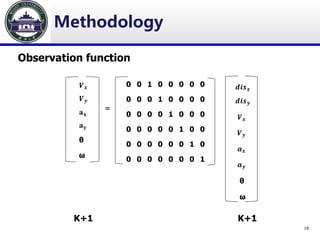
Methodology
K+1 K+1
θ
ω
0 0 0 0 1 0 0 0
0 0 0 0 0 1 0 0
0 0 0 0 0 0 1 0
0 0 0 0 0 0 0 1
θ
ω
=
Observation function
16
Methodology
K+1 K+1
θ
ω
0 0 1 0 0 0 0 0
0 0 0 1 0 0 0 0
0 0 0 0 1 0 0 0
0 0 0 0 0 1 0 0
0 0 0 0 0 0 1 0
0 0 0 0 0 0 0 1
θ
ω
=
Observation function
17
Methodology
0.3 0 0 0 0 0 0 0
0 0.3 0 0 0 0 0 0
0 0 0.01 0 0 0 0 0
0 0 0 0.01 0 0 0 0
0 0 0 0 0.01 0 0 0
0 0 0 0 0 0.01 0 0
0 0 0 0 0 0 16 0
0 0 0 0 0 0 0 16
Q =
Covariance matrix of the system noise
18
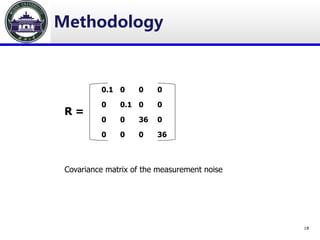
Methodology
0.1 0 0 0
0 0.1 0 0
0 0 36 0
0 0 0 36
R =
Covariance matrix of the measurement noise
19
Methodology
0.01 0 0 0 0 0
0 0.01 0 0 0 0
0 0 0.1 0 0 0
0 0 0 0.1 0 0
0 0 0 0 36 0
0 0 0 0 0 36
R =
Covariance matrix of the measurement noise
20
Methodology
1 0 0 0 0 0 0 0
0 1 0 0 0 0 0 0
0 0 0.1 0 0 0 0 0
0 0 0 0.1 0 0 0 0
0 0 0 0 0.1 0 0 0
0 0 0 0 0 0.1 0 0
0 0 0 0 0 0 36 0
0 0 0 0 0 0 0 36
P =
Error covariance matrix of the estimation of the state variables
21
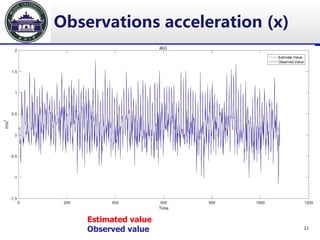
Observations acceleration (x)
Estimated value
Observed value
22
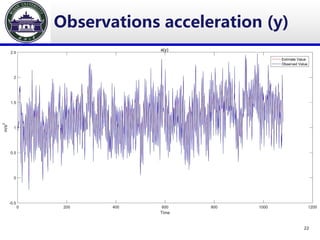
Observations acceleration (y)
23
Observations yaw angle
24
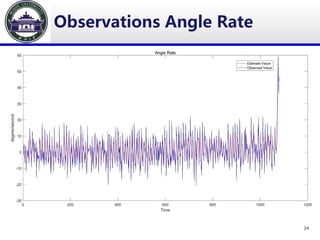
Observations Angle Rate
25
Observations Velocity (x , y)
26
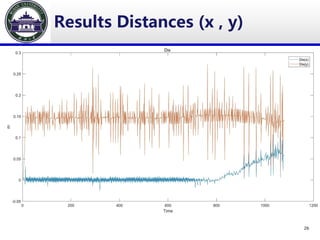
Results Distances (x , y)
27
Results Sys. Variables Variance
28
Results Final Track
Part of play ground in front of LIESMARS
(Straight line = 100 m, Curve = 50 m)
29
▪ Errors:
▪ Unreasonable velocity increase
▪ Improvement used:
▪ Counteracting unreasonable velocity increase
▪ Ways to Improve:
▪ Ground Truth
▪ Inertial sensor position update
Discussion
30
Conclusion
Availability
Continuity
Accuracy
Integrity
(Ways to Improve by four criteria)
31
▪ Leick, A. L. Rapoport, D. Tatarnikov., 2016, GPS
Satellite Surveying, 4th Edition, New York: John
Wiley and Sons
▪ G. Welch, G. Bishop., 2001, An Introduction to the
Kalman Filter, University of North Carolina at Chapel
Hill, Department of Computer Science, Chapel Hill,
NC 27599-3175 ( http://www.cs.unc.edu )
▪ Kalman, R.E. Trans ASME. 1960; 82:35–45. Crossref |
Scopus (12465)
▪ http://consumer.huawei.com/en/phones/p10/specs/
Major References:
32
Thank You !

Position estimation in kalman filter

  • 1.
    1 Position Estimation inKalman Filter Presented By David Sestak, Zhang zhen bing, Ahmed Mohamed Reda & Mohamed Freeshah January, 2018
  • 2.
    2 Position Estimation inKalman Filter Zhang zhen bing Presented By Ahmed Mohamed Reda Mohamed Ahmed FreeshahDavid Sestak
  • 3.
    3 ▪ Introduction ▪ Motivation ▪Equipment ▪ Methodology ➢ Data source ➢ KF Processing ▪ Results Project Schedule
  • 4.
    4 ▪ Precise positionestimation is one of the fundamental technical dependencies in our society today. It has influenced our lives in countless ways most people do not think about. ▪ It is used in a variety of applications including: ▪ GNSS (and all its varying applications) ▪ Self driving vehicles ▪ Mobile robots ▪ Internet of Things (IoT) and many others Introduction
  • 5.
    5 ▪ Indoor positioninghas become an area of increasing interest utilizing the various signals that our devices use such as Bluetooth and WiFi. ▪ People spend about 80% of their time indoors, so it is of great significant to achieve precise indoor position estimation. ▪ This is why we are using a smartphone, a device everyone carries, for real time position estimation only using its inertial sensors. Motivation
  • 6.
    6 ▪ Smartphone isa versatile device with many sensors such as: MEMS, Camera, WiFi, Bluetooth, GPS, etc. , which provides a high potential for indoor position estimation for many users . ▪ Data source ▪ The HUAWEI P10 smartphone was utilized to acquire the original data, including: the value of the accelerometer, gyroscope, magnetometer ▪ From the accelerometer , we can get the value of acceleration along the X axis and Y axis. ▪ From the magnetometer and gyroscope , we can get the value of angle and angle rate along the way. Equipment
  • 7.
    7 HUAWEI P10 Sensors: ▪Fingerprint Sensor, G-Sensor, Gyroscope Sensor, Compass, Ambient Light Sensor, Proximity Sensor, Hall Sensor Software: ▪ HIPE2.3 ▪ MATLAB Equipment
  • 8.
    8 ▪ The KalmanFilter (KF) is a time-varying linear optimal estimation algorithm , which is ideally suited for position estimation in modern multi-sensor systems. ▪ An important aspect of KF is its recursive nature. The position estimation is only based on the previously calculated state and current input. ▪ This makes it ideal for real time application ▪ KF puts more weight on higher certainty values improving its estimation precision. Why KF ?
  • 9.
    9 ▪ Our ObservationVariables: ▪ ax = x-direction acceleration ▪ ay = y-direction acceleration ▪ θ = direction ▪ ω = angular rate ▪ These are the observation values that our smartphone inertial sensors provides. Methodology
  • 10.
    10 ▪ Kalman FilterVariables: ▪ A = system function matrix ▪ H = observation function matrix ▪ Q = system noise matrix for compensation ▪ R = observation noise matrix ▪ xk = system state variables ▪ zk = observation variables ▪ Pk = covariance matrix ▪ Note: ▪ - = predicted value ▪ ^ = estimated value Methodology
  • 11.
  • 12.
  • 13.
    13 ▪ KF Processing Inour project: Assumption:(Gaussian distribution) First: define the state variables Second: confirm the system function according to the physic principle. Third: given the observation equation. Fourth: confirm the matrix of Q, R, and P according to the experience. Methodology
  • 14.
    14 Methodology K+1 K 0 0t 0 0 0 0 0 0 0 0 t 0 0 0 0 0 0 1 0 t 0 0 0 0 0 0 1 0 t 0 0 0 0 0 0 1 0 0 0 0 0 0 0 0 1 0 0 0 0 0 0 0 0 1 t 0 0 0 0 0 0 0 1 θ ω θ ω = System function
  • 15.
    15 Methodology K+1 K+1 θ ω 0 00 0 1 0 0 0 0 0 0 0 0 1 0 0 0 0 0 0 0 0 1 0 0 0 0 0 0 0 0 1 θ ω = Observation function
  • 16.
    16 Methodology K+1 K+1 θ ω 0 01 0 0 0 0 0 0 0 0 1 0 0 0 0 0 0 0 0 1 0 0 0 0 0 0 0 0 1 0 0 0 0 0 0 0 0 1 0 0 0 0 0 0 0 0 1 θ ω = Observation function
  • 17.
    17 Methodology 0.3 0 00 0 0 0 0 0 0.3 0 0 0 0 0 0 0 0 0.01 0 0 0 0 0 0 0 0 0.01 0 0 0 0 0 0 0 0 0.01 0 0 0 0 0 0 0 0 0.01 0 0 0 0 0 0 0 0 16 0 0 0 0 0 0 0 0 16 Q = Covariance matrix of the system noise
  • 18.
    18 Methodology 0.1 0 00 0 0.1 0 0 0 0 36 0 0 0 0 36 R = Covariance matrix of the measurement noise
  • 19.
    19 Methodology 0.01 0 00 0 0 0 0.01 0 0 0 0 0 0 0.1 0 0 0 0 0 0 0.1 0 0 0 0 0 0 36 0 0 0 0 0 0 36 R = Covariance matrix of the measurement noise
  • 20.
    20 Methodology 1 0 00 0 0 0 0 0 1 0 0 0 0 0 0 0 0 0.1 0 0 0 0 0 0 0 0 0.1 0 0 0 0 0 0 0 0 0.1 0 0 0 0 0 0 0 0 0.1 0 0 0 0 0 0 0 0 36 0 0 0 0 0 0 0 0 36 P = Error covariance matrix of the estimation of the state variables
  • 21.
  • 22.
  • 23.
  • 24.
  • 25.
  • 26.
  • 27.
  • 28.
    28 Results Final Track Partof play ground in front of LIESMARS (Straight line = 100 m, Curve = 50 m)
  • 29.
    29 ▪ Errors: ▪ Unreasonablevelocity increase ▪ Improvement used: ▪ Counteracting unreasonable velocity increase ▪ Ways to Improve: ▪ Ground Truth ▪ Inertial sensor position update Discussion
  • 30.
  • 31.
    31 ▪ Leick, A.L. Rapoport, D. Tatarnikov., 2016, GPS Satellite Surveying, 4th Edition, New York: John Wiley and Sons ▪ G. Welch, G. Bishop., 2001, An Introduction to the Kalman Filter, University of North Carolina at Chapel Hill, Department of Computer Science, Chapel Hill, NC 27599-3175 ( http://www.cs.unc.edu ) ▪ Kalman, R.E. Trans ASME. 1960; 82:35–45. Crossref | Scopus (12465) ▪ http://consumer.huawei.com/en/phones/p10/specs/ Major References:
  • 32.