architectural portfolio - b. arch 2016
Matías Bervejillo
[LEFT] A Mayan ruin found in
Tulum Mexico. The identity of this
architecture is strongly associated
with materiality, space, place and
time. Shot during my travels in
August of 2014
[LEFT]: Walking through central park
(August, 2013) I encountered two
musicians playing classical tunes
in the Bethesda Terrace Arcade.
The audience was mainly on their
cellphone. I thought to myself “what
a well-designed place! Contingency
thrives here”
table of content
a bath house
an incubator
a winery
a tower
a wave
leather notebooks
a luminaire
resume and contact
page 03 |
page 12 |
page 22 |
page 30 |
page 36 |
page 38 |
page 40 |
page 42 |
introduction
Architecture is beautiful when time, space,
and place work together in a harmonizing
way to create a location for people. I see the
architect’s job as a steward of materiality and
light, someone to curate their environment
with what is available. In my work I try to do
exactly this. I see each project as a new and
unique way to explore different languages
and aspects of architecture. I take on each
project enthusiastically with a goal of learning
something new each step of the way.
The following works are examples of my
understanding of architecture thus far. I enjoy
exploring different methods of representation;
you will see a wide variety styles, colors, texture
and approaches to a design. This is in part by
my continual effort to learning more.
a bath house,
Winter & Spring 2016
Rome, Italy
Jim Tice
Historical Restoration
Exploration of water
Interpretaion of Roman traditions
This project was an attempt to giving new life to an
abandon fortress located 5 km away from Rome.
With the freedom to choose a program I decided
that a bath house could bring an abandon tradition
to an abandon building and together bring a site
back to life. There was a cautious interpretation of
the ancient roman bathing tradition to derived the
design
The Revit, Rhino, Photoshop, Illustrator, Sefaira, V-ray
Hand cut bass wood, Rockite
date:
location:
instructors:
main ideas:
description:
media:
model:
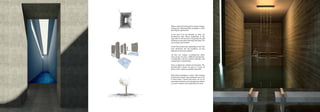
[RIGHT]: The main pool, or
caldarium, traditionaly had
representations of the sky on
its ceiling; in this interpretation
the glazed ceiling gives a pure
connection
PortlandCaracalla
Vals The Original Bravetta
PreservationCirculation
Pools
Temperatures
The Bravetta Thermae
Landmarks
Future Development
PortlandCaracalla
Vals The Original Bravetta
PreservationCirculation
Pools
Temperatures
The Bravetta Thermae
Landmarks
Future Development
CaracallaLandmarks
PortlandCaracalla
Vals The Original Bravetta
Pools
Temperatures
Landmarks
Future Development
The main challenge of this project was
to work with the existing fortress and
make conscious changes that would not
harm the genius loci of the fortress itself,
yet would give new life to the site. The
fortress also presented challenges because
of its immense size (750,000 sq ft), earth
mounds originally used for protection, and
its general geometry. I used landmarks,
in the form of oval courtyards with have
tall enclosing walls, which pierce through
earth mounds. These landmarks are visible
from the inter courtyard as well as the
exterior of the fortress, and also serve as
points to organize the circulation.
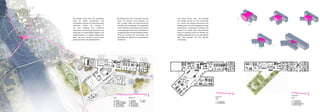
[RIGHT]: Starting witht the top left column
there diagrams show the original plan of
the fortress, the preserved features, and the
location of the landmarks. The right column
shows the circulation (under mound in darker
color), organization of program around plan,
and temperatures and locations of pools.
Vals
Circulation
Future Development
PortlandCaracalla
Vals The Original Bravetta
PreservationCirculation
Pools
Temperatures
The Bravetta Thermae
Landmarks
Future Development
N
10m 30m
2m 4m
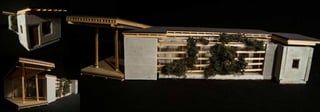
[LEFT]: Images of my final model which I made
out of hydraulic type cement compound
(Rockite).
[RIGHT]:Initialsketchoftheentrancesequence
[BOTTOM]: A section of the main hall. There
are many different ways of interacting with
the water and the old fortress.
[LEFT]: Enlarged plan of the entrance
sequence. This space presented a lot of
difficulties in terms of circulation of people
and dealing with the existing site.
[RIGHT]: The first interaction with water after
the entrance is in the first landmark of the site.
This courtyard serves to organize circulation
as well as a place of refuge.
0.5 2 5m
Floor Plan North
The original fortress had a tough
geometry to work with. There were
many strong regulating lines that did not
align properly or in simple locations. This
made the circulation through the fortress
discontinued and simply odd. My solution
was to add joints to circulation which also
acted as courtyard and landmarks through
to site. Inspired by the existing 1m thick
walls my additions to the fortress played
with the thickness of walls and took
advantage of the poche space.
When I started thinking of the design I began
writing the following little passages to start
deriving the genius loci.
To be slow is to be leisurely, to relax. An
architecture that allows forgetting of the
busy time in the present and giving the gift
of being in one place and only one place. Let
one escape into comfort.
Enrich the present by expanding it into the
past. Reminisce the old traditions. Let the
experience become wisdom.
All lives are unique; contingencies allow
each person to have a different perspective.
Communities will die without diversity and
complexity in relationships.
Peace is gifted by comfort and freedom. The
greatest gift a space can give is a sense of
peace, thus a space to ponder about life.
With these passages in mind I start making
architectural spaces that I believed were true
to these ideas. I found that water can be an
amazing material to use in designing, it allows
so much variation and exploration of sense
an incubator,
Fall, 2015
Portland, Oregon
Marsha Maytum, Bill Leddy, Roger Ota
Matias Bervejillo, Matt Decker, Lenore Wan
COTE top 10 for Students
Development of one main central space
Achieving Net-Zero
Understanding CLT construction
Envisioned as a precedent that will contribute and
guide the carbon-neutral economy of the coming
years. The center will be an icon that inspires and
provides the public a demonstration of how net zero-
energy/low-carbon living, working and making, can
happen all under one roof.
Revit, Rhino, Photoshop, Illustrator, Sefaira, V-ray
date:
location:
instructors:
project team:
competition:
main ideas:
description:
media:
[RIGHT]: The design opened
out the Willamette River,
allowing anyone that is
walking along the river to
experience the building
UP
UP
UP
DN
REF.
REF.
DN
DN
DN
REF.REF.
UP
1
7
3
2
D
6
C
20 100
N
E
4
5
Site
A. park
B. amphitheater
C. urban garden
D. art display
E. aquaculture
Site
1. incubator
2. residential
Floor 02
Floor 03
Site
1. incubator
2. residential
3. administration
4. Tech shop
Floor 01
1. lecture
2. gallery
3. tech shop
4. incubator
5. residential
6. retail
7. cafe
20 50
N
20 50
N
W
illametteriver
1
1
1 1 1 4 32 22
A
B
This design stems from the immediate
need for public involvement and
contribution towards an environmentally
conscious culture. By creating a
net zero building that combines
researchers and young practitioners and
businesses of sustainability together, the
implementation of a highly collaborative
space becomes pivotal to foster these
passionate ideas and developments.
By treating the core as not only a private
space for research and business but
also a public space for demonstrations,
learning and socializing, the integration
of the external community to the internal
community generates and contributes to
anopportunistic,forwardthinkingculture.
Only by involving the community and
spreading the appeal for environmental
awareness,
may action ensue. Thus, this building
and design focuses on the community
as a source for program placement and
building form. By also integrating energy
performance, construction methods and
analyses of climate and environmental
factors as primary sources for design, the
building ultimately acts as an educational
tool and example for the greater
community.
.5’ 1’ 2’
The building is mostly made of Cross
Laminated Timber sourced and produced
locally in Oregon. CLT was chosen
becauseitsimmensestrength,versatilityof
use, ease of construction, and the beauty
and poetry of a material being used in
such a simple and effective way. CLT not
only drastically cuts cost of construction,
it reduces the embodied energy of the
design and the construction process.
10.75”x12”Heavytimbercolumn
Solarban 60 Low E 2 pane window
2” x 6” Stud Trim Wall
Tongue & Groove eve
Rigid Insulation
CLT ceiling panel
12” x 12” Timber Beam
4” x 4” L Bracket
2” LW Concrete floor slab
CLT Interior wall
Weather Barrier
Vapor Barrier
ViewGlass Dynamic insulating glass
Horizontal shading
Wood flashing
Rigid insulation
36” Glue laminated Beam
CLT roof panel
root barrier
Aeration fabric layer
Delta-floraxx water retention layer
Vegetation layer
Ventilation Vent w/ Active open/close
Vertical lapped shading
steel column support
Curtain wall shim and sealant
[RIGHT]: The heart of the building is located
both literally and metaphorically in the center
of the building as well as the center of the site
Our design takes advantage of the high rainfall
in Portland by catching and storing water. The
site provides 857,090 gallons of water per year,
whereas the estimated amount of water used
by the building is 233,945 gallons per year.
This makes for a completely independent and
sustainable water system. The storage cisterns
are large enough to accommodate for months
with less rainfall. The total runoff calculated
is 6989 cubic feet of water. The water runoff
and overflow is directed to strategically placed
bioswalesaswellasurbanfarmspaces,gardens,
and interactive playgrounds for the public.
Reducing the amount of energy used was the main
goal of this project, as a result we used powerful energy
analysis tools such as Sefaira to calculate our plug
loads and energy production. This allowed us to fine
tune our passive systems and test the theories behind
our design. Our plan is to utilize the strong winds
coming from the river for effective cross ventilation
and our large roof system allows us to use a large area
for photovoltaic energy production. The photovoltaic
panels produce 28 kBTU/ square foot. We’ve calculated
that the building uses 23 EUI, therefore the resulting
EUI is +5. Having a positive building contributes to our
overall goal of creating a sustainable precedent for the
broader community. [RIGHT]: PV placement,
oriented towards south with
array at 30 degree tilt
[LEFT]: Cistern location and
drainage paths
[Down]:Sitesectionrevealing
the context of the site.
a winery,
Fall, 2014
Carlton, Oregon
Don Corner
Exploration of time and architecture
Experimentation with collage
Connection with grapes
A design for a tasting room and production hall in
Carlton, Oregon. The client wanted a very intimate
tasting room for his visitors, with strong connections
to the grape vines. Since there was limit to eight
people per visit to the winery, the client wanted the
visitors to feel like they are in his home.
Revit, Rhino, Photoshop, Illustrator, Pastel
Hand cut bass wood, Rockite
date:
location:
instructor:
main ideas:
description:
media:
model:
[RIGHT]: My initial sketches of
configurations of masses and
light. I wanted the design to
come out of the landscape.
I approached this design by thinking
of what the building could look like in
a thousand years. Influenced by my
trip to Mayan ruins, I try to understand
what makes a ruin beautiful. An old ruin
tells of the culture and traditions of the
past, what a society did for enjoyment
and how they ate, drank and enjoyed
each other’s company. I was focused on
carefully placing thicknesses of walls and
when light was allowed to penetrate
through this ruin. This allowed me to
understand where lighter materials
could be used and where openings for
views could happen.
[LEFT]: The hallway leading up
to the tasting room was carefully
designed to be a procession
through a juxtaposition of the
two leading concepts of the
entire design: connecting to
the grapes and the old masonry
walls.
[RIGHT]: The tasting room
located on a hill, overlooked a
vast valley. The tasting occurred
in a space that opened up to this
and allowed the visitor to feel
immersed in the landscape and
culture.
WH
N
10’5’
[PREVIOUS PAGE]: Images of my
final model which I made out of
hydraulic type cement compound
(Rockite). I enjoy making models out
of realistic materials instead of mat
board or other paper base materials.
[LEFT]: The programmatic
requirements where relatively
simple. I organized the service
portions away from the views to
the south, giving better views to the
visitors.
[RIGHT]: I experimented with collage
to create the idea of passage of time.
Since I wanted this project to be tied
so much to the future, I thought I
would be fitting to use images from
our past. The lattice that covers the
hall way is meant for grape wines to
grow on.
a tower,
Summer, 2014
Portland, Oregon
Jim Cutler
Understanding high-rise design
Connection with water
Blending public space with urban setting.
This studio was meant to re activate a
block in Portland. The proposed building
had to incorporate 60 dwelling units
40,000 sq-ft of office space, in addition to
20,000 sq-ft of retail and a health center.
Revit, Photoshop, Illustrator
date:
location:
instructor:
main ideas:
description:
media:
[RIGHT]: West elevation,
the roof form was dictated
by the need to gather all
of the rain water to one
point.
Typical residential
floor 01
Typical residential
floor 02
N
10’5’
The tower was meant to activate its
previously unused site with a diverse
and sympathetic approach. The
design process incorporated an in-
depth research of forecast housing
needs for the following 30 years; this
was done with the City of Portland
Bureau of Planning and Sustainability.
The research guided which housing
types, in regard to household size
and economic status, were going to
be incorporated in the tower. This
allowed the tower to welcome a wide
variety of users, overall enriching the
neighborhood.
[LEFT]: I decided to make two
story dwelling units to maximize
view (green & blue) and minimize
hallways (red).
[RIGHT]: Floor plans of a typical
dwelling unit. I watned to explore
having two story dewllings to give
daylight to all rooms.
Another requirement for the studio
was to aim for a sustainability ranking.
The design was very cautious in
terms of energy and water usage, to
such extent that it achieved the Petal
Certification from the Living Building
Challenge.
The Petal Certification was achieved by
implementing water filtration systems,
solar panels and an overall conscious
effort throughout the entire design
to make a sustainable building –
orientation, setbacks, general massing,
materiality choices, and studies of
casted shadows on neighbors.
[LEFT]: The building is set back at the
busiest corner of the site to provide
a small plaza, this is also where the
water conduit meets the ground; this
is a node of activities.
8” Round Steel Column
8” x 4” HSS cross beam
L 4x4x7/16” connection
L 3x3x1/4” connection Hex
Curtain wall System
Gravity connection
8” x 4” HSS outriger
Metal Canopy
4’ Catwalk
W18 wide Flange
Curtain Wall
Solid curtain panel
where HSS penetrates
Vierendeel truss made
w/ 8”x4” HSS web 4’ o.c.
10’ Nanawall
1” x 9” reclaimed cedar siding
3” concrete slab on
3 1/2” metal decking
6” Rigid insulation
6” Metal stud w/ insulation
Thermal break on HSS
w/ 1/2” steel plate
L 4x4x7/16” lateral wind
connection
Section C6x8.2
Moisture Barrier
USGDensglasexterior
gypsum sheathing
Siding Clips
Flashing
Cedar Trim
Sealant & backer rod
L 1/2x2x3/8” connetcion
WRB
Detail of window
head
2” 1’ 2’
Detail of canopy at
entrance
2” 1’ 2’
a wave,
Spring, 2015
Eugene, Oregon
Mark Donofrio
Matias Bervejillo, Bonnie Dominguez, Eric Schmidt, Kyle
Willis
Complexity in a single concrete pour
Form follows efficiency
Exploration of efficient structures thought the use
of Millipede for Grasshoper. Through iterations, we
created a geometry that had the least amount of
material and still can resist relatively high loads.
Rhino, Grasshoper, Millipede, V-ray
date:
location:
instructor:
project
team:
main ideas:
description:
media:
[BOTTOM]: From the results of
Milipede (left) we cleaned the
geometry until we had an form we
liked (right).
[RIGHT]: The formwork was made
with a CNC machine. The concrete
mix had to have a high water
content to fill all the hard to get
areas.
leather notebooks
When I have free time I and it is not pretty
outside, I like to make leather notebooks. I
make the designs or find art pieces that are
important to me or to whoever I am making
the notebook for. I then use Illustrator and a
laser cutter to make the final product. I also
use leather from my home, Uruguay , to
make them a little more special.
Leather, Chicago screws
main ideas:
material:
[LEFT]: This was my first
notebook, I used Joaquín
Torres García as my cover,
he is one of my favorite
artists.
front
2
6
10
14
18
22
26
30
2
6
10
14
18
22
26
30
side
2
2
6
6
10
10
14
14
18
18
22
22
175165
155
145
135
125
115
105
95
90
85
75
65
55
45
35
25
15 5 0
180
175 180165
155
145
135
125
115
105
95
90
85
75
65
55
45
35
25
15 5 0
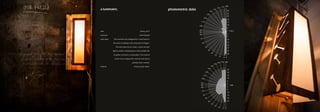
photometric dataa luminaire,
Spring, 2014
Ihab Elzeyadi
This luminaire was designed for a small niche in
the science building in the University of Oregon.
The main idea was to create a warm and dim
light to create a relaxing space where people like
to gather and have a conversation. The material
choice was to support the warmth and natural
aesthetic that I wanted.
Cherry wood, Velum
date:
instructor:
main ideas:
material
Assistant Director of Summer Architecture Academy // Eugene, Oregon 2015
Co-taught an introductory summer studio and a media class at the University of Oregon with Jim
Givens. I gave lectures on hand drafting, model building, digital representation, and basic spatial
composition and design.
Mills International Center // Eugene, Oregon 2012 - 2016
• Art curator July 2013 - June 2016
Curated an art show every term with the goal of introducing people to new types of art and ways
of expression from different parts of the world. I decide on promotion strategies and manage a
budget.
• Program Manager September 2012 - July 2013
Created and hosted different events with the goal to create inter-cultural relationships. This required
a lot of team work, completing a lot of tasks with short deadlines, and public speaking.
• Resource Consultant April 2012 - September 2012
As a receptionist at a multicultural lounge, library, and event spaces; I dealt with customer service
and general receptionist tasks.
Rockclimbing-wall setter// Eugene, Oregon 2014 - 2016
This was a great creative and physical outlet. It allowed me to explore the human body and its
movements from a unique perspective.
Event Photographer // Eugene, Oregon, 2011
Photographer for weddings and events on campus. Became proficient in digital and film cameras
as well as post editing.
Metropol Bakery Croissant Barker // Eugene, Oregon, 2011
Made the dough, prepped, shaped, and cooked croissants, in addition to other pastries and cakes. I
had to multi task and work independently for many hours.
• University of Oregon, Eugene, Oregon. B. Arch expected June 2016
• University of the Republic of Uruguay, Architecture Department. Montevideo, Uruguay 2010
• BIOS, an Autodesk authorized training center. Montevideo, Uruguay 2010
• Aquelarre school of photography. Montevideo, Uruguay, 2009
• In 2009 I was part of the Uruguayan un Techo Para Mi Pais, a nonprofit organization that helps
underprivileged families by constructing humble houses.
• From 2006 to 2008 I volunteered in Jovenes Misioneros Salesianos in Uruguay; a student run
group that participated developing rundown neighborhoods by fixing parks and schools and
setting up day-care centers.
work
experience
education
community
service
media
skills
proficient: Revit, Rhino, Google Sketch-up, AutoCad, Photoshop, InDesign
good: Illustrator, Grasshoper, V-ray
learning: 3Ds Max
resume contact
email:
telephone:
matiasb@uoregon.edu
(503) 810-6346
[RIGHT]: My first visit to a
Frank Lloyd Wright house was
exciting; the Gordon House in
Oregon, although it was moved
from its original location, it sat
in the landscape with such
harmony.
Thank you for your time and for reviewing my
work. Have a nice day!

Portfolio_Matias_Bervejilo

  • 1.
    architectural portfolio -b. arch 2016 Matías Bervejillo
  • 2.
    [LEFT] A Mayanruin found in Tulum Mexico. The identity of this architecture is strongly associated with materiality, space, place and time. Shot during my travels in August of 2014 [LEFT]: Walking through central park (August, 2013) I encountered two musicians playing classical tunes in the Bethesda Terrace Arcade. The audience was mainly on their cellphone. I thought to myself “what a well-designed place! Contingency thrives here” table of content a bath house an incubator a winery a tower a wave leather notebooks a luminaire resume and contact page 03 | page 12 | page 22 | page 30 | page 36 | page 38 | page 40 | page 42 | introduction Architecture is beautiful when time, space, and place work together in a harmonizing way to create a location for people. I see the architect’s job as a steward of materiality and light, someone to curate their environment with what is available. In my work I try to do exactly this. I see each project as a new and unique way to explore different languages and aspects of architecture. I take on each project enthusiastically with a goal of learning something new each step of the way. The following works are examples of my understanding of architecture thus far. I enjoy exploring different methods of representation; you will see a wide variety styles, colors, texture and approaches to a design. This is in part by my continual effort to learning more.
  • 3.
    a bath house, Winter& Spring 2016 Rome, Italy Jim Tice Historical Restoration Exploration of water Interpretaion of Roman traditions This project was an attempt to giving new life to an abandon fortress located 5 km away from Rome. With the freedom to choose a program I decided that a bath house could bring an abandon tradition to an abandon building and together bring a site back to life. There was a cautious interpretation of the ancient roman bathing tradition to derived the design The Revit, Rhino, Photoshop, Illustrator, Sefaira, V-ray Hand cut bass wood, Rockite date: location: instructors: main ideas: description: media: model: [RIGHT]: The main pool, or caldarium, traditionaly had representations of the sky on its ceiling; in this interpretation the glazed ceiling gives a pure connection
  • 4.
    PortlandCaracalla Vals The OriginalBravetta PreservationCirculation Pools Temperatures The Bravetta Thermae Landmarks Future Development PortlandCaracalla Vals The Original Bravetta PreservationCirculation Pools Temperatures The Bravetta Thermae Landmarks Future Development CaracallaLandmarks PortlandCaracalla Vals The Original Bravetta Pools Temperatures Landmarks Future Development The main challenge of this project was to work with the existing fortress and make conscious changes that would not harm the genius loci of the fortress itself, yet would give new life to the site. The fortress also presented challenges because of its immense size (750,000 sq ft), earth mounds originally used for protection, and its general geometry. I used landmarks, in the form of oval courtyards with have tall enclosing walls, which pierce through earth mounds. These landmarks are visible from the inter courtyard as well as the exterior of the fortress, and also serve as points to organize the circulation. [RIGHT]: Starting witht the top left column there diagrams show the original plan of the fortress, the preserved features, and the location of the landmarks. The right column shows the circulation (under mound in darker color), organization of program around plan, and temperatures and locations of pools. Vals Circulation Future Development PortlandCaracalla Vals The Original Bravetta PreservationCirculation Pools Temperatures The Bravetta Thermae Landmarks Future Development N 10m 30m
  • 5.
    2m 4m [LEFT]: Imagesof my final model which I made out of hydraulic type cement compound (Rockite). [RIGHT]:Initialsketchoftheentrancesequence [BOTTOM]: A section of the main hall. There are many different ways of interacting with the water and the old fortress.
  • 6.
    [LEFT]: Enlarged planof the entrance sequence. This space presented a lot of difficulties in terms of circulation of people and dealing with the existing site. [RIGHT]: The first interaction with water after the entrance is in the first landmark of the site. This courtyard serves to organize circulation as well as a place of refuge. 0.5 2 5m Floor Plan North The original fortress had a tough geometry to work with. There were many strong regulating lines that did not align properly or in simple locations. This made the circulation through the fortress discontinued and simply odd. My solution was to add joints to circulation which also acted as courtyard and landmarks through to site. Inspired by the existing 1m thick walls my additions to the fortress played with the thickness of walls and took advantage of the poche space.
  • 7.
    When I startedthinking of the design I began writing the following little passages to start deriving the genius loci. To be slow is to be leisurely, to relax. An architecture that allows forgetting of the busy time in the present and giving the gift of being in one place and only one place. Let one escape into comfort. Enrich the present by expanding it into the past. Reminisce the old traditions. Let the experience become wisdom. All lives are unique; contingencies allow each person to have a different perspective. Communities will die without diversity and complexity in relationships. Peace is gifted by comfort and freedom. The greatest gift a space can give is a sense of peace, thus a space to ponder about life. With these passages in mind I start making architectural spaces that I believed were true to these ideas. I found that water can be an amazing material to use in designing, it allows so much variation and exploration of sense
  • 8.
    an incubator, Fall, 2015 Portland,Oregon Marsha Maytum, Bill Leddy, Roger Ota Matias Bervejillo, Matt Decker, Lenore Wan COTE top 10 for Students Development of one main central space Achieving Net-Zero Understanding CLT construction Envisioned as a precedent that will contribute and guide the carbon-neutral economy of the coming years. The center will be an icon that inspires and provides the public a demonstration of how net zero- energy/low-carbon living, working and making, can happen all under one roof. Revit, Rhino, Photoshop, Illustrator, Sefaira, V-ray date: location: instructors: project team: competition: main ideas: description: media: [RIGHT]: The design opened out the Willamette River, allowing anyone that is walking along the river to experience the building
  • 9.
    UP UP UP DN REF. REF. DN DN DN REF.REF. UP 1 7 3 2 D 6 C 20 100 N E 4 5 Site A. park B.amphitheater C. urban garden D. art display E. aquaculture Site 1. incubator 2. residential Floor 02 Floor 03 Site 1. incubator 2. residential 3. administration 4. Tech shop Floor 01 1. lecture 2. gallery 3. tech shop 4. incubator 5. residential 6. retail 7. cafe 20 50 N 20 50 N W illametteriver 1 1 1 1 1 4 32 22 A B This design stems from the immediate need for public involvement and contribution towards an environmentally conscious culture. By creating a net zero building that combines researchers and young practitioners and businesses of sustainability together, the implementation of a highly collaborative space becomes pivotal to foster these passionate ideas and developments. By treating the core as not only a private space for research and business but also a public space for demonstrations, learning and socializing, the integration of the external community to the internal community generates and contributes to anopportunistic,forwardthinkingculture. Only by involving the community and spreading the appeal for environmental awareness, may action ensue. Thus, this building and design focuses on the community as a source for program placement and building form. By also integrating energy performance, construction methods and analyses of climate and environmental factors as primary sources for design, the building ultimately acts as an educational tool and example for the greater community.
  • 10.
    .5’ 1’ 2’ Thebuilding is mostly made of Cross Laminated Timber sourced and produced locally in Oregon. CLT was chosen becauseitsimmensestrength,versatilityof use, ease of construction, and the beauty and poetry of a material being used in such a simple and effective way. CLT not only drastically cuts cost of construction, it reduces the embodied energy of the design and the construction process. 10.75”x12”Heavytimbercolumn Solarban 60 Low E 2 pane window 2” x 6” Stud Trim Wall Tongue & Groove eve Rigid Insulation CLT ceiling panel 12” x 12” Timber Beam 4” x 4” L Bracket 2” LW Concrete floor slab CLT Interior wall Weather Barrier Vapor Barrier ViewGlass Dynamic insulating glass Horizontal shading Wood flashing Rigid insulation 36” Glue laminated Beam CLT roof panel root barrier Aeration fabric layer Aeration fabric layer Delta-floraxx water retention layer Vegetation layer Ventilation Vent w/ Active open/close Vertical lapped shading steel column support Curtain wall shim and sealant [RIGHT]: The heart of the building is located both literally and metaphorically in the center of the building as well as the center of the site
  • 11.
    Our design takesadvantage of the high rainfall in Portland by catching and storing water. The site provides 857,090 gallons of water per year, whereas the estimated amount of water used by the building is 233,945 gallons per year. This makes for a completely independent and sustainable water system. The storage cisterns are large enough to accommodate for months with less rainfall. The total runoff calculated is 6989 cubic feet of water. The water runoff and overflow is directed to strategically placed bioswalesaswellasurbanfarmspaces,gardens, and interactive playgrounds for the public. Reducing the amount of energy used was the main goal of this project, as a result we used powerful energy analysis tools such as Sefaira to calculate our plug loads and energy production. This allowed us to fine tune our passive systems and test the theories behind our design. Our plan is to utilize the strong winds coming from the river for effective cross ventilation and our large roof system allows us to use a large area for photovoltaic energy production. The photovoltaic panels produce 28 kBTU/ square foot. We’ve calculated that the building uses 23 EUI, therefore the resulting EUI is +5. Having a positive building contributes to our overall goal of creating a sustainable precedent for the broader community. [RIGHT]: PV placement, oriented towards south with array at 30 degree tilt [LEFT]: Cistern location and drainage paths [Down]:Sitesectionrevealing the context of the site.
  • 12.
    a winery, Fall, 2014 Carlton,Oregon Don Corner Exploration of time and architecture Experimentation with collage Connection with grapes A design for a tasting room and production hall in Carlton, Oregon. The client wanted a very intimate tasting room for his visitors, with strong connections to the grape vines. Since there was limit to eight people per visit to the winery, the client wanted the visitors to feel like they are in his home. Revit, Rhino, Photoshop, Illustrator, Pastel Hand cut bass wood, Rockite date: location: instructor: main ideas: description: media: model: [RIGHT]: My initial sketches of configurations of masses and light. I wanted the design to come out of the landscape.
  • 13.
    I approached thisdesign by thinking of what the building could look like in a thousand years. Influenced by my trip to Mayan ruins, I try to understand what makes a ruin beautiful. An old ruin tells of the culture and traditions of the past, what a society did for enjoyment and how they ate, drank and enjoyed each other’s company. I was focused on carefully placing thicknesses of walls and when light was allowed to penetrate through this ruin. This allowed me to understand where lighter materials could be used and where openings for views could happen. [LEFT]: The hallway leading up to the tasting room was carefully designed to be a procession through a juxtaposition of the two leading concepts of the entire design: connecting to the grapes and the old masonry walls. [RIGHT]: The tasting room located on a hill, overlooked a vast valley. The tasting occurred in a space that opened up to this and allowed the visitor to feel immersed in the landscape and culture.
  • 15.
    WH N 10’5’ [PREVIOUS PAGE]: Imagesof my final model which I made out of hydraulic type cement compound (Rockite). I enjoy making models out of realistic materials instead of mat board or other paper base materials. [LEFT]: The programmatic requirements where relatively simple. I organized the service portions away from the views to the south, giving better views to the visitors. [RIGHT]: I experimented with collage to create the idea of passage of time. Since I wanted this project to be tied so much to the future, I thought I would be fitting to use images from our past. The lattice that covers the hall way is meant for grape wines to grow on.
  • 16.
    a tower, Summer, 2014 Portland,Oregon Jim Cutler Understanding high-rise design Connection with water Blending public space with urban setting. This studio was meant to re activate a block in Portland. The proposed building had to incorporate 60 dwelling units 40,000 sq-ft of office space, in addition to 20,000 sq-ft of retail and a health center. Revit, Photoshop, Illustrator date: location: instructor: main ideas: description: media: [RIGHT]: West elevation, the roof form was dictated by the need to gather all of the rain water to one point.
  • 17.
    Typical residential floor 01 Typicalresidential floor 02 N 10’5’ The tower was meant to activate its previously unused site with a diverse and sympathetic approach. The design process incorporated an in- depth research of forecast housing needs for the following 30 years; this was done with the City of Portland Bureau of Planning and Sustainability. The research guided which housing types, in regard to household size and economic status, were going to be incorporated in the tower. This allowed the tower to welcome a wide variety of users, overall enriching the neighborhood. [LEFT]: I decided to make two story dwelling units to maximize view (green & blue) and minimize hallways (red). [RIGHT]: Floor plans of a typical dwelling unit. I watned to explore having two story dewllings to give daylight to all rooms.
  • 18.
    Another requirement forthe studio was to aim for a sustainability ranking. The design was very cautious in terms of energy and water usage, to such extent that it achieved the Petal Certification from the Living Building Challenge. The Petal Certification was achieved by implementing water filtration systems, solar panels and an overall conscious effort throughout the entire design to make a sustainable building – orientation, setbacks, general massing, materiality choices, and studies of casted shadows on neighbors. [LEFT]: The building is set back at the busiest corner of the site to provide a small plaza, this is also where the water conduit meets the ground; this is a node of activities. 8” Round Steel Column 8” x 4” HSS cross beam L 4x4x7/16” connection L 3x3x1/4” connection Hex Curtain wall System Gravity connection 8” x 4” HSS outriger Metal Canopy 4’ Catwalk W18 wide Flange Curtain Wall Solid curtain panel where HSS penetrates Vierendeel truss made w/ 8”x4” HSS web 4’ o.c. 10’ Nanawall 1” x 9” reclaimed cedar siding 3” concrete slab on 3 1/2” metal decking 6” Rigid insulation 6” Metal stud w/ insulation Thermal break on HSS w/ 1/2” steel plate L 4x4x7/16” lateral wind connection Section C6x8.2 Moisture Barrier USGDensglasexterior gypsum sheathing Siding Clips Flashing Cedar Trim Sealant & backer rod L 1/2x2x3/8” connetcion WRB Detail of window head 2” 1’ 2’ Detail of canopy at entrance 2” 1’ 2’
  • 19.
    a wave, Spring, 2015 Eugene,Oregon Mark Donofrio Matias Bervejillo, Bonnie Dominguez, Eric Schmidt, Kyle Willis Complexity in a single concrete pour Form follows efficiency Exploration of efficient structures thought the use of Millipede for Grasshoper. Through iterations, we created a geometry that had the least amount of material and still can resist relatively high loads. Rhino, Grasshoper, Millipede, V-ray date: location: instructor: project team: main ideas: description: media: [BOTTOM]: From the results of Milipede (left) we cleaned the geometry until we had an form we liked (right). [RIGHT]: The formwork was made with a CNC machine. The concrete mix had to have a high water content to fill all the hard to get areas.
  • 20.
    leather notebooks When Ihave free time I and it is not pretty outside, I like to make leather notebooks. I make the designs or find art pieces that are important to me or to whoever I am making the notebook for. I then use Illustrator and a laser cutter to make the final product. I also use leather from my home, Uruguay , to make them a little more special. Leather, Chicago screws main ideas: material: [LEFT]: This was my first notebook, I used Joaquín Torres García as my cover, he is one of my favorite artists.
  • 21.
    front 2 6 10 14 18 22 26 30 2 6 10 14 18 22 26 30 side 2 2 6 6 10 10 14 14 18 18 22 22 175165 155 145 135 125 115 105 95 90 85 75 65 55 45 35 25 15 5 0 180 175180165 155 145 135 125 115 105 95 90 85 75 65 55 45 35 25 15 5 0 photometric dataa luminaire, Spring, 2014 Ihab Elzeyadi This luminaire was designed for a small niche in the science building in the University of Oregon. The main idea was to create a warm and dim light to create a relaxing space where people like to gather and have a conversation. The material choice was to support the warmth and natural aesthetic that I wanted. Cherry wood, Velum date: instructor: main ideas: material
  • 22.
    Assistant Director ofSummer Architecture Academy // Eugene, Oregon 2015 Co-taught an introductory summer studio and a media class at the University of Oregon with Jim Givens. I gave lectures on hand drafting, model building, digital representation, and basic spatial composition and design. Mills International Center // Eugene, Oregon 2012 - 2016 • Art curator July 2013 - June 2016 Curated an art show every term with the goal of introducing people to new types of art and ways of expression from different parts of the world. I decide on promotion strategies and manage a budget. • Program Manager September 2012 - July 2013 Created and hosted different events with the goal to create inter-cultural relationships. This required a lot of team work, completing a lot of tasks with short deadlines, and public speaking. • Resource Consultant April 2012 - September 2012 As a receptionist at a multicultural lounge, library, and event spaces; I dealt with customer service and general receptionist tasks. Rockclimbing-wall setter// Eugene, Oregon 2014 - 2016 This was a great creative and physical outlet. It allowed me to explore the human body and its movements from a unique perspective. Event Photographer // Eugene, Oregon, 2011 Photographer for weddings and events on campus. Became proficient in digital and film cameras as well as post editing. Metropol Bakery Croissant Barker // Eugene, Oregon, 2011 Made the dough, prepped, shaped, and cooked croissants, in addition to other pastries and cakes. I had to multi task and work independently for many hours. • University of Oregon, Eugene, Oregon. B. Arch expected June 2016 • University of the Republic of Uruguay, Architecture Department. Montevideo, Uruguay 2010 • BIOS, an Autodesk authorized training center. Montevideo, Uruguay 2010 • Aquelarre school of photography. Montevideo, Uruguay, 2009 • In 2009 I was part of the Uruguayan un Techo Para Mi Pais, a nonprofit organization that helps underprivileged families by constructing humble houses. • From 2006 to 2008 I volunteered in Jovenes Misioneros Salesianos in Uruguay; a student run group that participated developing rundown neighborhoods by fixing parks and schools and setting up day-care centers. work experience education community service media skills proficient: Revit, Rhino, Google Sketch-up, AutoCad, Photoshop, InDesign good: Illustrator, Grasshoper, V-ray learning: 3Ds Max resume contact email: telephone: matiasb@uoregon.edu (503) 810-6346 [RIGHT]: My first visit to a Frank Lloyd Wright house was exciting; the Gordon House in Oregon, although it was moved from its original location, it sat in the landscape with such harmony. Thank you for your time and for reviewing my work. Have a nice day!