
Popular places
in Lithuania
COMENIUS MULTILATERAL PARTNERSHIP PROJECT
LET ME KNOW YOU: UNITED IN DIVERSITY
Made by Gabrielė Gudlenkytė,
Justina Vasiliauskaitė and Gabija Žukauskaitė
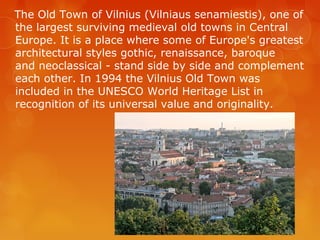
The Old Town of Vilnius (Vilniaus senamiestis), one of
the largest surviving medieval old towns in Central
Europe. It is a place where some of Europe's greatest
architectural styles gothic, renaissance, baroque
and neoclassical - stand side by side and complement
each other. In 1994 the Vilnius Old Town was
included in the UNESCO World Heritage List in
recognition of its universal value and originality.
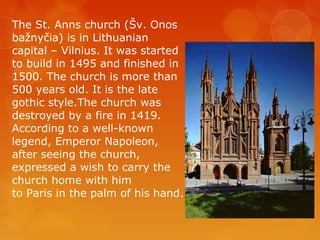
The St. Anns church (Šv. Onos
bažnyčia) is in Lithuanian
capital – Vilnius. It was started
to build in 1495 and finished in
1500. The church is more than
500 years old. It is the late
gothic style.The church was
destroyed by a fire in 1419.
According to a well-known
legend, Emperor Napoleon,
after seeing the church,
expressed a wish to carry the
church home with him
to Paris in the palm of his hand.
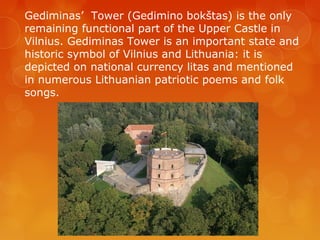
Gediminas’ Tower (Gedimino bokštas) is the only
remaining functional part of the Upper Castle in
Vilnius. Gediminas Tower is an important state and
historic symbol of Vilnius and Lithuania: it is
depicted on national currency litas and mentioned
in numerous Lithuanian patriotic poems and folk
songs.
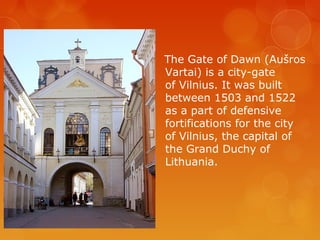
The Gate of Dawn (Aušros
Vartai) is a city-gate
of Vilnius. It was built
between 1503 and 1522
as a part of defensive
fortifications for the city
of Vilnius, the capital of
the Grand Duchy of
Lithuania.
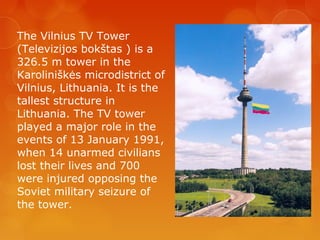
The Vilnius TV Tower
(Televizijos bokštas ) is a
326.5 m tower in the
Karoliniškės microdistrict of
Vilnius, Lithuania. It is the
tallest structure in
Lithuania. The TV tower
played a major role in the
events of 13 January 1991,
when 14 unarmed civilians
lost their lives and 700
were injured opposing the
Soviet military seizure of
the tower.
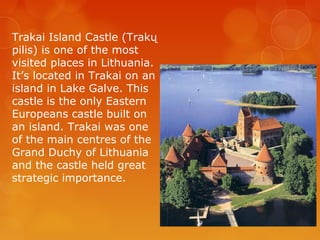
Trakai Island Castle (Trakų
pilis) is one of the most
visited places in Lithuania.
It’s located in Trakai on an
island in Lake Galve. This
castle is the only Eastern
Europeans castle built on
an island. Trakai was one
of the main centres of the
Grand Duchy of Lithuania
and the castle held great
strategic importance.
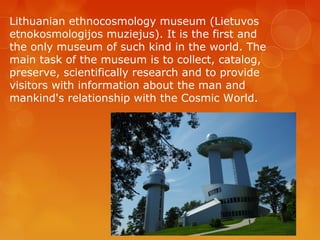
Lithuanian ethnocosmology museum (Lietuvos
etnokosmologijos muziejus). It is the first and
the only museum of such kind in the world. The
main task of the museum is to collect, catalog,
preserve, scientifically research and to provide
visitors with information about the man and
mankind's relationship with the Cosmic World.
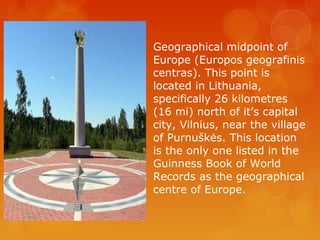
Geographical midpoint of
Europe (Europos geografinis
centras). This point is
located in Lithuania,
specifically 26 kilometres
(16 mi) north of it’s capital
city, Vilnius, near the village
of Purnuškės. This location
is the only one listed in the
Guinness Book of World
Records as the geographical
centre of Europe.
The Hill Of Crosses (Kryžių kalnas). On the hill there
are more than 100000 of crosses. They were started
to build in XIX century. The hill of crosses was used
as a place for Lithuanians to pray for peace, for their
country, and for the loved ones they had lost during
the Wars of Independence. Lithuanians used it to
demonstrate their allegiance to their original
identity, religion and heritage.
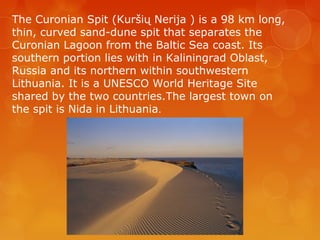
The Curonian Spit (Kuršių Nerija ) is a 98 km long,
thin, curved sand-dune spit that separates the
Curonian Lagoon from the Baltic Sea coast. Its
southern portion lies with in Kaliningrad Oblast,
Russia and its northern within southwestern
Lithuania. It is a UNESCO World Heritage Site
shared by the two countries.The largest town on
the spit is Nida in Lithuania.
Thank you for your
attention 

Popular places in lithuania

  • 1.
    Popular places in Lithuania COMENIUSMULTILATERAL PARTNERSHIP PROJECT LET ME KNOW YOU: UNITED IN DIVERSITY Made by Gabrielė Gudlenkytė, Justina Vasiliauskaitė and Gabija Žukauskaitė
  • 2.
    The Old Townof Vilnius (Vilniaus senamiestis), one of the largest surviving medieval old towns in Central Europe. It is a place where some of Europe's greatest architectural styles gothic, renaissance, baroque and neoclassical - stand side by side and complement each other. In 1994 the Vilnius Old Town was included in the UNESCO World Heritage List in recognition of its universal value and originality.
  • 3.
    The St. Annschurch (Šv. Onos bažnyčia) is in Lithuanian capital – Vilnius. It was started to build in 1495 and finished in 1500. The church is more than 500 years old. It is the late gothic style.The church was destroyed by a fire in 1419. According to a well-known legend, Emperor Napoleon, after seeing the church, expressed a wish to carry the church home with him to Paris in the palm of his hand.
  • 4.
    Gediminas’ Tower (Gediminobokštas) is the only remaining functional part of the Upper Castle in Vilnius. Gediminas Tower is an important state and historic symbol of Vilnius and Lithuania: it is depicted on national currency litas and mentioned in numerous Lithuanian patriotic poems and folk songs.
  • 5.
    The Gate ofDawn (Aušros Vartai) is a city-gate of Vilnius. It was built between 1503 and 1522 as a part of defensive fortifications for the city of Vilnius, the capital of the Grand Duchy of Lithuania.
  • 6.
    The Vilnius TVTower (Televizijos bokštas ) is a 326.5 m tower in the Karoliniškės microdistrict of Vilnius, Lithuania. It is the tallest structure in Lithuania. The TV tower played a major role in the events of 13 January 1991, when 14 unarmed civilians lost their lives and 700 were injured opposing the Soviet military seizure of the tower.
  • 7.
    Trakai Island Castle(Trakų pilis) is one of the most visited places in Lithuania. It’s located in Trakai on an island in Lake Galve. This castle is the only Eastern Europeans castle built on an island. Trakai was one of the main centres of the Grand Duchy of Lithuania and the castle held great strategic importance.
  • 8.
    Lithuanian ethnocosmology museum(Lietuvos etnokosmologijos muziejus). It is the first and the only museum of such kind in the world. The main task of the museum is to collect, catalog, preserve, scientifically research and to provide visitors with information about the man and mankind's relationship with the Cosmic World.
  • 9.
    Geographical midpoint of Europe(Europos geografinis centras). This point is located in Lithuania, specifically 26 kilometres (16 mi) north of it’s capital city, Vilnius, near the village of Purnuškės. This location is the only one listed in the Guinness Book of World Records as the geographical centre of Europe.
  • 10.
    The Hill OfCrosses (Kryžių kalnas). On the hill there are more than 100000 of crosses. They were started to build in XIX century. The hill of crosses was used as a place for Lithuanians to pray for peace, for their country, and for the loved ones they had lost during the Wars of Independence. Lithuanians used it to demonstrate their allegiance to their original identity, religion and heritage.
  • 11.
    The Curonian Spit(Kuršių Nerija ) is a 98 km long, thin, curved sand-dune spit that separates the Curonian Lagoon from the Baltic Sea coast. Its southern portion lies with in Kaliningrad Oblast, Russia and its northern within southwestern Lithuania. It is a UNESCO World Heritage Site shared by the two countries.The largest town on the spit is Nida in Lithuania.
  • 12.
    Thank you foryour attention 