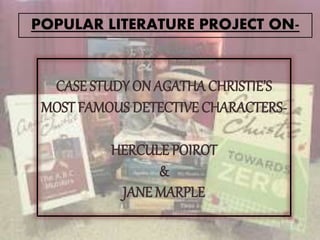
CASE STUDY ON AGATHA CHRISTIE’S
MOST FAMOUS DETECTIVE CHARACTERS-
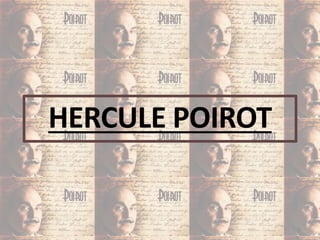
HERCULE POIROT
&
JANE MARPLE
POPULAR LITERATURE PROJECT ON-
2
Agatha Christie's first novel The
Mysterious Affair at Styles was
published in 1920 and introduced the
long-running character
detective HERCULE POIROT, who
appeared in 33 of Christie's novels and
54 short stories.
JANE MARPLE was introduced in The
Thirteen Problems in 1927 (short stories)
and was based on Christie's
grandmother and her "Ealing
cronies". Miss Marple appeared in 12 of
Christie's novels.
3
All over the world, in almost every modern language, mystery
fans know the familiar figures of Agatha Christie's famous
sleuths Miss Jane Marple and detective Hercule Poirot. Close
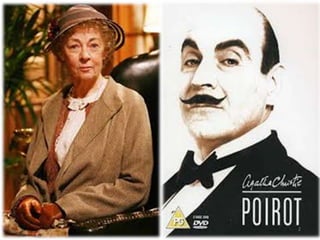
to eighty, tall and thin with "china-blue eyes," Miss Marple is
the proper English gentlewoman, but with a penchant for
gossip. Poirot, on the other hand, is a short, little man with a
waxed and twirled moustache who fled to England from his
native Belgium during the World War I. Apart from physical
appearance and nationality, Christie's two sleuths have much
in common: both are exceptions, detectives sharing an acute
sense of human nature and remarkable power of reasoning.
These traits contribute to their unfailing success in unraveling
one complex mystery case after another. The exploits of these
two detectives have not been confined to novels alone. Their
popularity has led to the filming, broadcasting, and staging of
their pursuits.
4
HERCULE POIROT
5
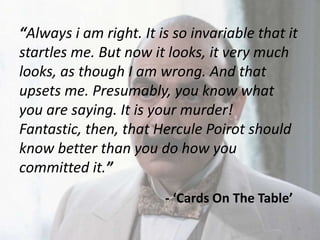
“Always i am right. It is so invariable that it
startles me. But now it looks, it very much
looks, as though I am wrong. And that
upsets me. Presumably, you know what
you are saying. It is your murder!
Fantastic, then, that Hercule Poirot should
know better than you do how you
committed it.”
- ‘Cards On The Table’
6
HERCULE POIROT
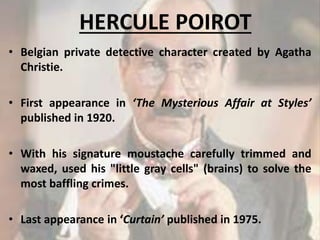
• Belgian private detective character created by Agatha
Christie.
• First appearance in ‘The Mysterious Affair at Styles’
published in 1920.
• With his signature moustache carefully trimmed and
waxed, used his "little gray cells" (brains) to solve the
most baffling crimes.
• Last appearance in ‘Curtain’ published in 1975.
7
• He doesn't have any disorders to speak of, but
demands order. He likes things in an orderly manner
and approves of symmetry everywhere.
• Poirot also values method--to him the greatest
method or tool in solving crime is using the "gray cells"
of the brain.
• The English actor David Suchet has been portraying
Hercule Poirot on television for 19 years.
• First fictional character ever to receive front page
news coverage in the New York Times (in this case, it
happened to be his obituary).
8
• He derides such methods as examining footprints,
collecting cigarette ash, searching for clues with a
magnifying glass, or taking fingerprints. He says any
crime can be solved with simply placing the puzzle
pieces correctly. He is an armchair detective-- he has
to simply "sit still in an armchair and think".
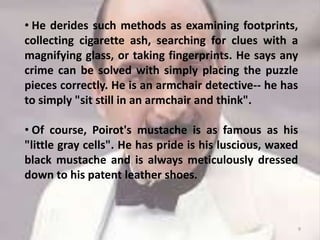
• Of course, Poirot's mustache is as famous as his
"little gray cells". He has pride is his luscious, waxed
black mustache and is always meticulously dressed
down to his patent leather shoes.
9
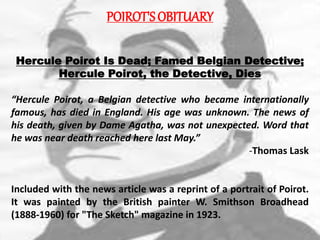
POIROT'SOBITUARY
Hercule Poirot Is Dead; Famed Belgian Detective;
Hercule Poirot, the Detective, Dies
“Hercule Poirot, a Belgian detective who became internationally
famous, has died in England. His age was unknown. The news of
his death, given by Dame Agatha, was not unexpected. Word that
he was near death reached here last May.”
-Thomas Lask
Included with the news article was a reprint of a portrait of Poirot.
It was painted by the British painter W. Smithson Broadhead
(1888-1960) for "The Sketch" magazine in 1923.
10
JANE MARPLE
11
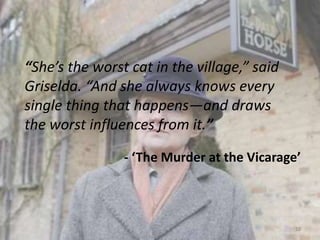
“She’s the worst cat in the village,” said
Griselda. “And she always knows every
single thing that happens—and draws
the worst influences from it.”
- ‘The Murder at the Vicarage’
12
JANE MARPLE
• British amateur detective character created by Agatha
Christie.
• First appearance in ‘The Tuesday Night Club’ (short story)
published in 1926. First appearance in a full-length novel
in ’The Murder at the Vicarage’ in 1930.
• Character of Miss Marple based on Christie's step
grandmother, or her Aunt (Margaret West), and her
cronies.
• Last appearance in ‘Sleeping Murder’ published in 1976.13
• The elderly spinster from the fictitious village of St.
Mary Mead, Miss Marple (as she is affectionately known)
is a tall, thin woman of between 65 and 70 years of age.
• She has white snowy hair, pale blue eyes, and a pinkish
wrinkled face. Two of her hobbies (and subjects of
conversation) are bird watching and gardening, and she is
often seen carrying knitting needles and yarn.
•Her methods of crime-solving are based on the belief
that "human nature is much the same everywhere"--and
certainly easy to study people in a small village such as
St. Mary Mead. In her stories, Marple draws parallels
with someone she knows in the village to someone
involved with the crime. 14
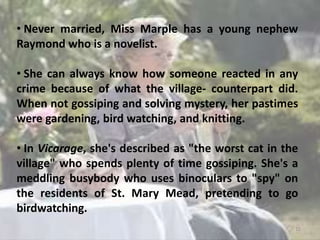
• Never married, Miss Marple has a young nephew
Raymond who is a novelist.
• She can always know how someone reacted in any
crime because of what the village- counterpart did.
When not gossiping and solving mystery, her pastimes
were gardening, bird watching, and knitting.
• In Vicarage, she's described as "the worst cat in the
village" who spends plenty of time gossiping. She's a
meddling busybody who uses binoculars to "spy" on
the residents of St. Mary Mead, pretending to go
birdwatching.
15
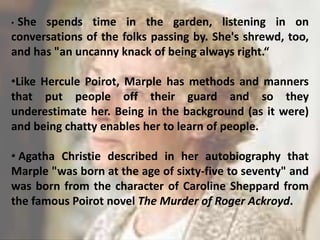
• She spends time in the garden, listening in on
conversations of the folks passing by. She's shrewd, too,
and has "an uncanny knack of being always right.“
•Like Hercule Poirot, Marple has methods and manners
that put people off their guard and so they
underestimate her. Being in the background (as it were)
and being chatty enables her to learn of people.
• Agatha Christie described in her autobiography that
Marple "was born at the age of sixty-five to seventy" and
was born from the character of Caroline Sheppard from
the famous Poirot novel The Murder of Roger Ackroyd.
16
Poirot and Miss Marple wouldn't entertain our
lives without the life of Agatha Christie.
Hailed as the "Queen of Crime", Agatha
Christie has been only sold out by William
Shakespeare and the Holy Bible. With billions
of her books in print the world over, many
critics regard her as the principal author of
the Golden Age of Mystery. She seems to be
the only mystery writer that is read in high
schools throughout the United States, thanks
to her spectacular novel And Then There
Were None/Ten Little Indians. She is the
creator of The Mousetrap, the longest-
running play of modern theatre.
17
Agatha Christie has contributed more than just
Hercule Poirot and Jane Marple to literature. She
has allowed us to enjoy the exploits of young and
adventurous women, a stolid Scotland Yard man,
a mystery writer in the self-image of Christie
herself, and other colorful and memorable
characters. She has also given us some terrific
plays, most notably The Mousetrap, Ten Little
Indians, and Witness for the Prosecution. She has
fascinated us with her bestselling novel not
starring Poirot nor Marple: And Then There Were
None, the world's best-selling mystery ever. We
get to see Agatha the person through such works
as her poetry, her romance novels, and her
autobiographies.
18
THE END
19
CREDITS TO:
All group members. 
SPECIAL THANKS TO:
Dr. Gauri Misra for giving us this project.
We learnt a lot through it. 
20

Hercule Poirot Vs. Jane Marple

  • 1.
    CASE STUDY ONAGATHA CHRISTIE’S MOST FAMOUS DETECTIVE CHARACTERS- HERCULE POIROT & JANE MARPLE POPULAR LITERATURE PROJECT ON-
  • 2.
  • 3.
    Agatha Christie's firstnovel The Mysterious Affair at Styles was published in 1920 and introduced the long-running character detective HERCULE POIROT, who appeared in 33 of Christie's novels and 54 short stories. JANE MARPLE was introduced in The Thirteen Problems in 1927 (short stories) and was based on Christie's grandmother and her "Ealing cronies". Miss Marple appeared in 12 of Christie's novels. 3
  • 4.
    All over theworld, in almost every modern language, mystery fans know the familiar figures of Agatha Christie's famous sleuths Miss Jane Marple and detective Hercule Poirot. Close to eighty, tall and thin with "china-blue eyes," Miss Marple is the proper English gentlewoman, but with a penchant for gossip. Poirot, on the other hand, is a short, little man with a waxed and twirled moustache who fled to England from his native Belgium during the World War I. Apart from physical appearance and nationality, Christie's two sleuths have much in common: both are exceptions, detectives sharing an acute sense of human nature and remarkable power of reasoning. These traits contribute to their unfailing success in unraveling one complex mystery case after another. The exploits of these two detectives have not been confined to novels alone. Their popularity has led to the filming, broadcasting, and staging of their pursuits. 4
  • 5.
  • 6.
    “Always i amright. It is so invariable that it startles me. But now it looks, it very much looks, as though I am wrong. And that upsets me. Presumably, you know what you are saying. It is your murder! Fantastic, then, that Hercule Poirot should know better than you do how you committed it.” - ‘Cards On The Table’ 6
  • 7.
    HERCULE POIROT • Belgianprivate detective character created by Agatha Christie. • First appearance in ‘The Mysterious Affair at Styles’ published in 1920. • With his signature moustache carefully trimmed and waxed, used his "little gray cells" (brains) to solve the most baffling crimes. • Last appearance in ‘Curtain’ published in 1975. 7
  • 8.
    • He doesn'thave any disorders to speak of, but demands order. He likes things in an orderly manner and approves of symmetry everywhere. • Poirot also values method--to him the greatest method or tool in solving crime is using the "gray cells" of the brain. • The English actor David Suchet has been portraying Hercule Poirot on television for 19 years. • First fictional character ever to receive front page news coverage in the New York Times (in this case, it happened to be his obituary). 8
  • 9.
    • He deridessuch methods as examining footprints, collecting cigarette ash, searching for clues with a magnifying glass, or taking fingerprints. He says any crime can be solved with simply placing the puzzle pieces correctly. He is an armchair detective-- he has to simply "sit still in an armchair and think". • Of course, Poirot's mustache is as famous as his "little gray cells". He has pride is his luscious, waxed black mustache and is always meticulously dressed down to his patent leather shoes. 9
  • 10.
    POIROT'SOBITUARY Hercule Poirot IsDead; Famed Belgian Detective; Hercule Poirot, the Detective, Dies “Hercule Poirot, a Belgian detective who became internationally famous, has died in England. His age was unknown. The news of his death, given by Dame Agatha, was not unexpected. Word that he was near death reached here last May.” -Thomas Lask Included with the news article was a reprint of a portrait of Poirot. It was painted by the British painter W. Smithson Broadhead (1888-1960) for "The Sketch" magazine in 1923. 10
  • 11.
  • 12.
    “She’s the worstcat in the village,” said Griselda. “And she always knows every single thing that happens—and draws the worst influences from it.” - ‘The Murder at the Vicarage’ 12
  • 13.
    JANE MARPLE • Britishamateur detective character created by Agatha Christie. • First appearance in ‘The Tuesday Night Club’ (short story) published in 1926. First appearance in a full-length novel in ’The Murder at the Vicarage’ in 1930. • Character of Miss Marple based on Christie's step grandmother, or her Aunt (Margaret West), and her cronies. • Last appearance in ‘Sleeping Murder’ published in 1976.13
  • 14.
    • The elderlyspinster from the fictitious village of St. Mary Mead, Miss Marple (as she is affectionately known) is a tall, thin woman of between 65 and 70 years of age. • She has white snowy hair, pale blue eyes, and a pinkish wrinkled face. Two of her hobbies (and subjects of conversation) are bird watching and gardening, and she is often seen carrying knitting needles and yarn. •Her methods of crime-solving are based on the belief that "human nature is much the same everywhere"--and certainly easy to study people in a small village such as St. Mary Mead. In her stories, Marple draws parallels with someone she knows in the village to someone involved with the crime. 14
  • 15.
    • Never married,Miss Marple has a young nephew Raymond who is a novelist. • She can always know how someone reacted in any crime because of what the village- counterpart did. When not gossiping and solving mystery, her pastimes were gardening, bird watching, and knitting. • In Vicarage, she's described as "the worst cat in the village" who spends plenty of time gossiping. She's a meddling busybody who uses binoculars to "spy" on the residents of St. Mary Mead, pretending to go birdwatching. 15
  • 16.
    • She spendstime in the garden, listening in on conversations of the folks passing by. She's shrewd, too, and has "an uncanny knack of being always right.“ •Like Hercule Poirot, Marple has methods and manners that put people off their guard and so they underestimate her. Being in the background (as it were) and being chatty enables her to learn of people. • Agatha Christie described in her autobiography that Marple "was born at the age of sixty-five to seventy" and was born from the character of Caroline Sheppard from the famous Poirot novel The Murder of Roger Ackroyd. 16
  • 17.
    Poirot and MissMarple wouldn't entertain our lives without the life of Agatha Christie. Hailed as the "Queen of Crime", Agatha Christie has been only sold out by William Shakespeare and the Holy Bible. With billions of her books in print the world over, many critics regard her as the principal author of the Golden Age of Mystery. She seems to be the only mystery writer that is read in high schools throughout the United States, thanks to her spectacular novel And Then There Were None/Ten Little Indians. She is the creator of The Mousetrap, the longest- running play of modern theatre. 17
  • 18.
    Agatha Christie hascontributed more than just Hercule Poirot and Jane Marple to literature. She has allowed us to enjoy the exploits of young and adventurous women, a stolid Scotland Yard man, a mystery writer in the self-image of Christie herself, and other colorful and memorable characters. She has also given us some terrific plays, most notably The Mousetrap, Ten Little Indians, and Witness for the Prosecution. She has fascinated us with her bestselling novel not starring Poirot nor Marple: And Then There Were None, the world's best-selling mystery ever. We get to see Agatha the person through such works as her poetry, her romance novels, and her autobiographies. 18
  • 19.
  • 20.
    CREDITS TO: All groupmembers.  SPECIAL THANKS TO: Dr. Gauri Misra for giving us this project. We learnt a lot through it.  20