version 1.0 and beyond
Serge Stinckwich, Oleksandr Zaytsev
HemalVarambhia, Konrad Hinsen
Atharva Khare, Nikhil Pinnaparaju
Werner Kassens
le logotype : les différentes formes en couleur
version verticale
version compacte
2
3
I’m not
a mathematician !
4
Current Status
of PolyMath
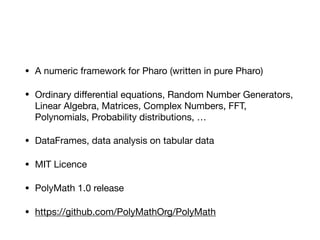
• A numeric framework for Pharo (written in pure Pharo)

• Ordinary differential equations, Random Number Generators,
Linear Algebra, Matrices, Complex Numbers, FFT,
Polynomials, Probability distributions, …

• DataFrames, data analysis on tabular data

• MIT Licence

• PolyMath 1.0 release

• https://github.com/PolyMathOrg/PolyMath
Contributors
• Thank you all !

• All contributions are valuable (code&documentation)

• Regular meeting on Discord (#polymath channel)
Hemal
Varambhia
Konrad
Hinsen
Atharva
Khare
Oleksandr
Zaytsev
Nikhil
Pinnaparaju
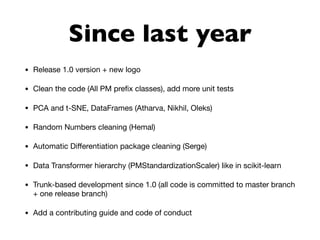
Since last year
• Release 1.0 version + new logo

• Clean the code (All PM prefix classes), add more unit tests

• PCA and t-SNE, DataFrames (Atharva, Nikhil, Oleks)

• Random Numbers cleaning (Hemal)

• Automatic Differentiation package cleaning (Serge)

• Data Transformer hierarchy (PMStandardizationScaler) like in scikit-learn

• Trunk-based development since 1.0 (all code is committed to master branch
+ one release branch)

• Add a contributing guide and code of conduct
Metrics
• 300 classes, 59 packages, 24K LOC

• 806 green unit tests, 1034 commits, 100 stars on github
(9th Pharo project on github)
designed by Lusy Dolia
14
DEMO
Differentiation
Derivatives
• The derivatives f’(x) of a function of a single variable x is
the rate at which the value of f changes at x.

• How to compute derivatives numerically ?
Numerical differentiation
by using finite difference
• Theoretically, the smaller the h is, the better the derivative
estimates

• Practically very small value of h can result in numerical
cancellation errors …
:= [ :x| x sin ].
:= 1/2.
iffForward := [:h| (((f value: (x+h)) - (f value: x)) / h)].
rror := [:h| ((diffForward value: h) - x cos) abs].
rror value: 0.1
Numerical differentiation by
the Complex Step Method
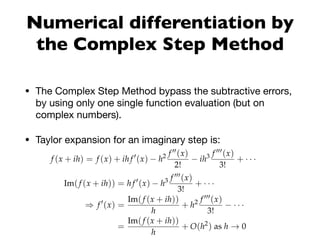
• The Complex Step Method bypass the subtractive errors,
by using only one single function evaluation (but on
complex numbers).

• Taylor expansion for an imaginary step is:
f := [ :x| (x*x) sin ].
pi := Float pi.
x := pi /2.
h := 0.001.
((f value: (h*1i +x )) imaginary) / h.
pi * ((pi*pi/4) cos)
Automatic
Differentiation
• Automatic Differentiation is a generalisation of derivatives
on general programs.
Dimensionality
reduction
What is dimensionality
reduction ?
• Process of reducing the number of variables
under consideration by obtaining a set of
principal variables
Principal Component
Analysis (PCA)
• Used in machine learning, statistics to solve the
dimensionality curse.

• Dimension reductionality approach that perform a linear
mapping of the data to a lower-dimensional space, in
such a way that the variance of the data in low-
dimensional representation is maximised.
t-SNE
• t-SNE short story: The goal is to take a set of points in a
high-dimensional space and find a faithful representation
of those points in a lower-dimensional space, typically the
2D plane.

• Probabilistic non-linear algorithm

• Demo of Atharva Kharve
29
Future of PolyMath
ActivePapers Pharo
• Work of Konrad Hinsen

• Pharo + GToolkit + ActivePapers + PolyMath = Scientific
Workbench

• Presented at IWST 2019 (Tuesday)
ActivePapers Demo
Port of Domains
to Pharo
• Work of Luciano Notarfrancesco

• Computational algebra system in Smalltalk (Group,
Morphism, Monoids, Elliptic curves, …)

• Ongoing port to Pharo : https://github.com/PolyMathOrg/
Domains
Support PolyMath
• You can contribute code and documentation. Pull
requests are welcome

• Please contribute fundings for PolyMath.

• BountySource: https://www.bountysource.com/teams/
polymath

• Ask to be funded by NumFocus (Numpy, Matplotlib,
pandas …)

Polymath: Version 1.0 and Beyond

  • 1.
    version 1.0 andbeyond Serge Stinckwich, Oleksandr Zaytsev HemalVarambhia, Konrad Hinsen Atharva Khare, Nikhil Pinnaparaju Werner Kassens le logotype : les différentes formes en couleur version verticale version compacte
  • 2.
  • 3.
  • 4.
  • 5.
    • A numericframework for Pharo (written in pure Pharo) • Ordinary differential equations, Random Number Generators, Linear Algebra, Matrices, Complex Numbers, FFT, Polynomials, Probability distributions, … • DataFrames, data analysis on tabular data • MIT Licence • PolyMath 1.0 release • https://github.com/PolyMathOrg/PolyMath
  • 6.
    Contributors • Thank youall ! • All contributions are valuable (code&documentation) • Regular meeting on Discord (#polymath channel) Hemal Varambhia Konrad Hinsen Atharva Khare Oleksandr Zaytsev Nikhil Pinnaparaju
  • 7.
    Since last year •Release 1.0 version + new logo • Clean the code (All PM prefix classes), add more unit tests • PCA and t-SNE, DataFrames (Atharva, Nikhil, Oleks) • Random Numbers cleaning (Hemal) • Automatic Differentiation package cleaning (Serge) • Data Transformer hierarchy (PMStandardizationScaler) like in scikit-learn • Trunk-based development since 1.0 (all code is committed to master branch + one release branch) • Add a contributing guide and code of conduct
  • 8.
    Metrics • 300 classes,59 packages, 24K LOC • 806 green unit tests, 1034 commits, 100 stars on github (9th Pharo project on github)
  • 13.
  • 14.
  • 15.
  • 16.
    Derivatives • The derivativesf’(x) of a function of a single variable x is the rate at which the value of f changes at x. • How to compute derivatives numerically ?
  • 17.
    Numerical differentiation by usingfinite difference • Theoretically, the smaller the h is, the better the derivative estimates • Practically very small value of h can result in numerical cancellation errors …
  • 18.
    := [ :x|x sin ]. := 1/2. iffForward := [:h| (((f value: (x+h)) - (f value: x)) / h)]. rror := [:h| ((diffForward value: h) - x cos) abs]. rror value: 0.1
  • 19.
    Numerical differentiation by theComplex Step Method • The Complex Step Method bypass the subtractive errors, by using only one single function evaluation (but on complex numbers). • Taylor expansion for an imaginary step is:
  • 20.
    f := [:x| (x*x) sin ]. pi := Float pi. x := pi /2. h := 0.001. ((f value: (h*1i +x )) imaginary) / h. pi * ((pi*pi/4) cos)
  • 22.
    Automatic Differentiation • Automatic Differentiationis a generalisation of derivatives on general programs.
  • 24.
  • 25.
    What is dimensionality reduction? • Process of reducing the number of variables under consideration by obtaining a set of principal variables
  • 26.
    Principal Component Analysis (PCA) •Used in machine learning, statistics to solve the dimensionality curse. • Dimension reductionality approach that perform a linear mapping of the data to a lower-dimensional space, in such a way that the variance of the data in low- dimensional representation is maximised.
  • 28.
    t-SNE • t-SNE shortstory: The goal is to take a set of points in a high-dimensional space and find a faithful representation of those points in a lower-dimensional space, typically the 2D plane. • Probabilistic non-linear algorithm • Demo of Atharva Kharve
  • 29.
  • 30.
    ActivePapers Pharo • Workof Konrad Hinsen • Pharo + GToolkit + ActivePapers + PolyMath = Scientific Workbench • Presented at IWST 2019 (Tuesday)
  • 31.
  • 32.
    Port of Domains toPharo • Work of Luciano Notarfrancesco • Computational algebra system in Smalltalk (Group, Morphism, Monoids, Elliptic curves, …) • Ongoing port to Pharo : https://github.com/PolyMathOrg/ Domains
  • 34.
    Support PolyMath • Youcan contribute code and documentation. Pull requests are welcome • Please contribute fundings for PolyMath. • BountySource: https://www.bountysource.com/teams/ polymath • Ask to be funded by NumFocus (Numpy, Matplotlib, pandas …)