Informal Political Conversations, Social Networks and Participation in Public Life Sebasti án Valenzuela School of Journalism Jesse Jones Fellowship Presentation October 2008
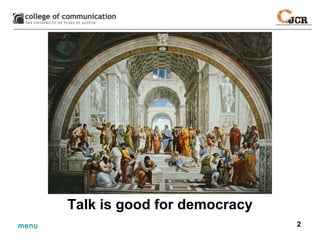
Talk is good for democracy
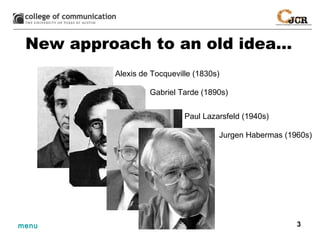
New approach to an old idea… Gabriel Tarde (1890s) Alexis de Tocqueville (1830s) Paul Lazarsfeld (1940s) Jurgen Habermas (1960s)
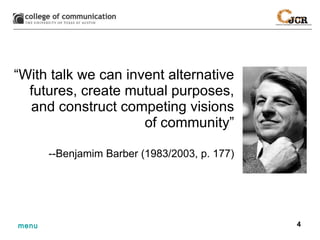
“ With talk we can invent alternative futures, create mutual purposes, and construct competing visions of community” --Benjamim Barber (1983/2003, p. 177)
But what kind of talk? Formal vs. Informal Interpersonal vs. Computer-Mediated Family vs. Strangers Public issues vs. Private issues
What I study The effects of informal conversations about public affairs between non-elite members of a political community on their knowledge, efficacy and participation Online and offline public talk Public talk within social networks
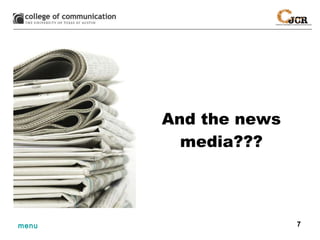
And the news media???
My Research Talk as moderator of news use effects New online platforms for talk Social network attributes  (e.g., diversity, ties)
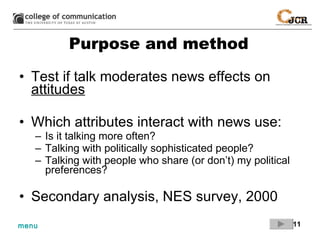
Talk as Moderator Moderator :  A variable that changes the impact of one variable on another.
Previous Research Talking amplifies the positive effects of news use Compensates for news shortcomings (cognitive) Provides mobilizing information (behavioral gaps) Talking can be detrimental to the positive effects of news use: Interference or distortion (cognitive)
Purpose and method Test if talk moderates news effects on  attitudes Which attributes interact with news use: Is it talking more often? Talking with politically sophisticated people? Talking with people who share (or don’t) my political preferences? Secondary analysis, NES survey, 2000
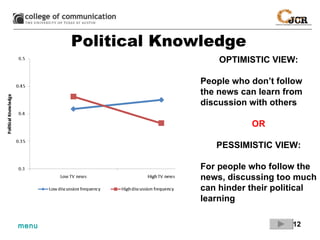
Political Knowledge OPTIMISTIC VIEW: People who don’t follow the news can learn from discussion with others OR PESSIMISTIC VIEW: For people who follow the news, discussing too much can hinder their political learning
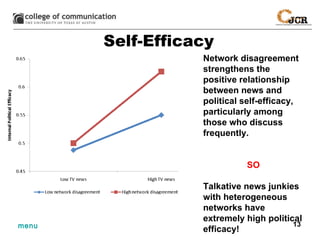
Self-Efficacy Network disagreement strengthens the positive relationship between news and political self-efficacy, particularly among those who discuss frequently. SO Talkative news junkies with heterogeneous networks have extremely high political efficacy!
New online platforms for talk Virtual forums E-mail threads Blogs Chatrooms IM Social network sites
and civic/political life Not SNS  per se , but specific uses what matter Informational vs. recreational uses of SNS Own online survey, college students, 2007
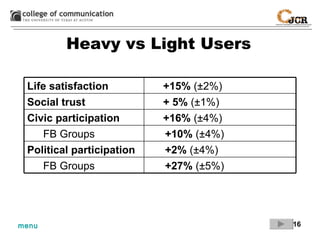
Heavy vs Light Users +27%  (±5%) FB Groups +2%  (±4%) Political participation  +10%  (±4%) FB Groups +16%  (±4%) Civic participation + 5%  (±1%) Social trust +15%  (±2%) Life satisfaction
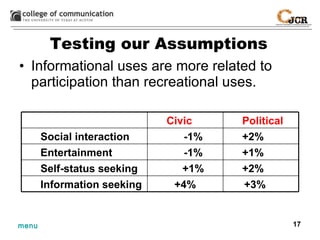
Informational uses are more related to participation than recreational uses. Testing our Assumptions Political Civic +4% +1% -1% -1% +3% Information seeking +2% Self-status seeking +1% Entertainment +2% Social interaction
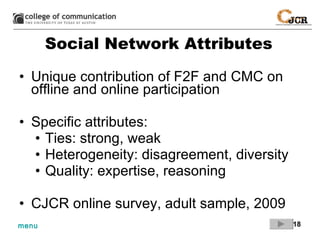
Social Network Attributes Unique contribution of F2F and CMC on offline and online participation Specific attributes: Ties: strong, weak Heterogeneity: disagreement, diversity Quality: expertise, reasoning CJCR online survey, adult sample, 2009
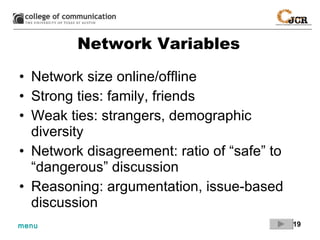
Network Variables Network size online/offline Strong ties: family, friends Weak ties: strangers, demographic diversity Network disagreement: ratio of “safe” to “dangerous” discussion Reasoning: argumentation, issue-based discussion
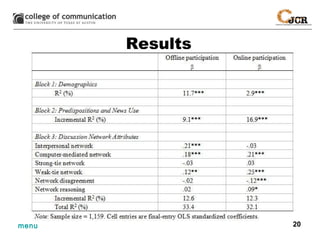
Results
Some lessons… Talk is good for democracy Talk and news: a complex relationship Cyberoptimism AND cyberpessimism We’re only starting to scratch the surface!
Future Research Theoretical synthesis Connection to existing theories From deliberation to communication Methodological challenges Experiments Observations
Thanks to… My co-authors : Homero Gil de  Z úñiga, Kerk Kee, Namsu Park and Yonghwan Kim All my colleagues at the Maxwell McCombs, Talia Stroud, Sharon Strover, Teresa Correa and all the other people who directly or indirectly contributed to my research The J-School and the College of Comm for the $$$!

Political Discussion

  • 1.
    Informal Political Conversations,Social Networks and Participation in Public Life Sebasti án Valenzuela School of Journalism Jesse Jones Fellowship Presentation October 2008
  • 2.
    Talk is goodfor democracy
  • 3.
    New approach toan old idea… Gabriel Tarde (1890s) Alexis de Tocqueville (1830s) Paul Lazarsfeld (1940s) Jurgen Habermas (1960s)
  • 4.
    “ With talkwe can invent alternative futures, create mutual purposes, and construct competing visions of community” --Benjamim Barber (1983/2003, p. 177)
  • 5.
    But what kindof talk? Formal vs. Informal Interpersonal vs. Computer-Mediated Family vs. Strangers Public issues vs. Private issues
  • 6.
    What I studyThe effects of informal conversations about public affairs between non-elite members of a political community on their knowledge, efficacy and participation Online and offline public talk Public talk within social networks
  • 7.
    And the newsmedia???
  • 8.
    My Research Talkas moderator of news use effects New online platforms for talk Social network attributes (e.g., diversity, ties)
  • 9.
    Talk as ModeratorModerator : A variable that changes the impact of one variable on another.
  • 10.
    Previous Research Talkingamplifies the positive effects of news use Compensates for news shortcomings (cognitive) Provides mobilizing information (behavioral gaps) Talking can be detrimental to the positive effects of news use: Interference or distortion (cognitive)
  • 11.
    Purpose and methodTest if talk moderates news effects on attitudes Which attributes interact with news use: Is it talking more often? Talking with politically sophisticated people? Talking with people who share (or don’t) my political preferences? Secondary analysis, NES survey, 2000
  • 12.
    Political Knowledge OPTIMISTICVIEW: People who don’t follow the news can learn from discussion with others OR PESSIMISTIC VIEW: For people who follow the news, discussing too much can hinder their political learning
  • 13.
    Self-Efficacy Network disagreementstrengthens the positive relationship between news and political self-efficacy, particularly among those who discuss frequently. SO Talkative news junkies with heterogeneous networks have extremely high political efficacy!
  • 14.
    New online platformsfor talk Virtual forums E-mail threads Blogs Chatrooms IM Social network sites
  • 15.
    and civic/political lifeNot SNS per se , but specific uses what matter Informational vs. recreational uses of SNS Own online survey, college students, 2007
  • 16.
    Heavy vs LightUsers +27% (±5%) FB Groups +2% (±4%) Political participation +10% (±4%) FB Groups +16% (±4%) Civic participation + 5% (±1%) Social trust +15% (±2%) Life satisfaction
  • 17.
    Informational uses aremore related to participation than recreational uses. Testing our Assumptions Political Civic +4% +1% -1% -1% +3% Information seeking +2% Self-status seeking +1% Entertainment +2% Social interaction
  • 18.
    Social Network AttributesUnique contribution of F2F and CMC on offline and online participation Specific attributes: Ties: strong, weak Heterogeneity: disagreement, diversity Quality: expertise, reasoning CJCR online survey, adult sample, 2009
  • 19.
    Network Variables Networksize online/offline Strong ties: family, friends Weak ties: strangers, demographic diversity Network disagreement: ratio of “safe” to “dangerous” discussion Reasoning: argumentation, issue-based discussion
  • 20.
  • 21.
    Some lessons… Talkis good for democracy Talk and news: a complex relationship Cyberoptimism AND cyberpessimism We’re only starting to scratch the surface!
  • 22.
    Future Research Theoreticalsynthesis Connection to existing theories From deliberation to communication Methodological challenges Experiments Observations
  • 23.
    Thanks to… Myco-authors : Homero Gil de Z úñiga, Kerk Kee, Namsu Park and Yonghwan Kim All my colleagues at the Maxwell McCombs, Talia Stroud, Sharon Strover, Teresa Correa and all the other people who directly or indirectly contributed to my research The J-School and the College of Comm for the $$$!

Editor's Notes

  • #3 Citizens’ discussions are a central tenet of democracy Communication theory supports the link between discussion and participation. E.g.,: Two step flow of information (Katz & Lazarsfeld, 1955) Communication mediation model (Shah et al., 2001, 2005)
  • #6 Formal vs. Informal: Structured deliberation: formal, with rules, in public settings. E.g., Congress, juries, deliberative polls  elites Informal public discussion: informal, unstructured, in public settings. E.g., parties, interest groups, work, churches, school boards, town hall  elites and some citizens Casual political talk: informal, unstructured, in private settings. E.g., family dinner, friends  citizens’ modal form of political talk Interpersonal vs. CMC: Internet has opened new venues for discussion (e.g., blogs, SNS, chatrooms) What we talk to: Quality argumentation and level of information (Gastil, 2008) Who we talk to: Heterogeneity of discussants (Mutz, 2006)
  • #8 News as antecedent of talk News as a consequence of talk Talk is more persuasive than news, but news is more informative Talk is an amplifier and/or mediator of news effects