Topic : Nature of Current Local Reform
Course Title: Policy Studies
Course Code: EDU-508
Submitted To: Mam Sherbano
Submitted By: Aleena Mumtaz (505)
Hifza Zahid (524)
Iqra Rafiq (528)
Syeda Amna Batool (548)
Department : Education
Program:. B.ED (HONS) Elementary Education
Semester : 6th (Morning)
GOVERNMENT COLLEGE WOMEN UNIVERSITY FAISALABAD
Topic: Nature of Current Local Reforms
Content :
Introduction
Definition of reforms
Types of reforms
Introduction to local government reforms
Ayub period
local government reforms 1979-85
INTRODUCTION:
The phrase ‘local government reform’ describes a wide
variety of inquiries, reviews and change processes, proposed and
implemented. Local Government reform is the process by which
control over locally provided services is devolved to locally
accountable, democratically elected Councils.
While all of these processes share an intention to improve
some aspect of the structure, performance or accountability of
local government, they can take different and sometimes even
contradictory directions.
Definition of reforms
Furthermore, the definition of ‘reform’ is often assumed rather than
stated in the aims and objectives set out for these processes.
Alternatively, reform is defined in the context in which it is initiated,
referencing the specific problems and issues the agency or
organisation undertaking the reform is seeking to address. It make
changes in (something, especially an institution or practice) in order
to improve it.
Even if the diversity of approaches makes reform difficult to define,
it is still useful to categorise these processes in some way.
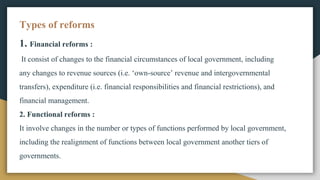
Types of reforms
1. Financial reforms :
It consist of changes to the financial circumstances of local government, including
any changes to revenue sources (i.e. ‘own-source’ revenue and intergovernmental
transfers), expenditure (i.e. financial responsibilities and financial restrictions), and
financial management.
2. Functional reforms :
It involve changes in the number or types of functions performed by local government,
including the realignment of functions between local government another tiers of
governments.
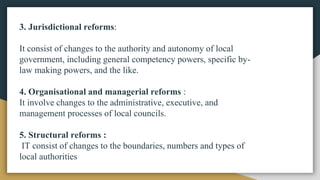
3. Jurisdictional reforms:
It consist of changes to the authority and autonomy of local
government, including general competency powers, specific by-
law making powers, and the like.
4. Organisational and managerial reforms :
It involve changes to the administrative, executive, and
management processes of local councils.
5. Structural reforms :
IT consist of changes to the boundaries, numbers and types of
local authorities
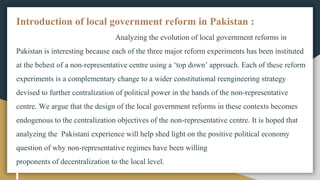
Introduction of local government reform in Pakistan :
Analyzing the evolution of local government reforms in
Pakistan is interesting because each of the three major reform experiments has been instituted
at the behest of a non-representative centre using a ‘top down’ approach. Each of these reform
experiments is a complementary change to a wider constitutional reengineering strategy
devised to further centralization of political power in the hands of the non-representative
centre. We argue that the design of the local government reforms in these contexts becomes
endogenous to the centralization objectives of the non-representative centre. It is hoped that
analyzing the Pakistani experience will help shed light on the positive political economy
question of why non-representative regimes have been willing
proponents of decentralization to the local level.
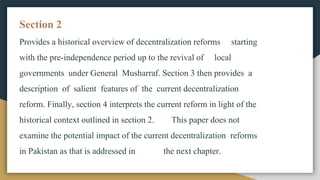
Section 2
Provides a historical overview of decentralization reforms starting
with the pre-independence period up to the revival of local
governments under General Musharraf. Section 3 then provides a
description of salient features of the current decentralization
reform. Finally, section 4 interprets the current reform in light of the
historical context outlined in section 2. This paper does not
examine the potential impact of the current decentralization reforms
in Pakistan as that is addressed in the next chapter.
Continue….
While providing a detailed history of local governments is beyond the scope of this paper, it is
instructive to mention aspects of this history that shed light in understanding the current
decentralization. After briefly examining the pre and post independence period, we looking at the two
most significant decentralization reforms prior to the current one, both interestingly also at the behest of
non-representative military regimesunder Generals Zia-ul-Haq and Ayub Khan respectively
The Punjab tradition of establishing patron-client relationships between the central bureaucracy and the
local elite resulted in a rural-urban division, which restricted politics away from the urban middle
classes. Safeguarding the loyall and owning classes from economic and political domination by the
urban elites became colonial policy . The dominance of the Unionist Party(representing large
landowners of all religions) in Punjab’s politics during the early decades of this century was a direct
manifestation of this phenomenon.
The Ayub Period: Decentralization and the Politics of Legitimacy
Pakistan’s first bold experiment with local governments occurred under the 1958
Martial Law, which set back representative politics at the central and provincial level by
disbanding national and provincial assemblies. Following the dissolution of the higher-
tier elected governments, General Ayub like the British colonialists revived local
governments as the only representative tier of government. The new local governments,
established under the Basic Democracies Ordinance, 1959 and the Municipal
Administration Ordinance 1960, comprised a hierarchical system of four linked tiers.
Local Government Reforms 1979-85:
After a nascent period under PrimeMinister Zulfiqar Ali Bhutto (1971-77),
local governments were revived under General Zia ul Haq’s military regime.
Like Ayub, Zia ul Haq combined political centralization at the federal and
provincial levels with a legitimization strategy that instituted electoral
representation only at the local level. Political centralization was achieved
during the early years (1977-85) .
Conti.......
Of the regime through the imposition of Martial Law, which held the 1973
Constitution inabeyance, and was followed in 1985 by the 8th Constitutional
Amendment that established indirect military rule through a quasi-
Presidential form of government (Noman 1988). Local governments were
revived through the promulgation of Local government ordinances (LGOs)
and local bodies were elected in all four provinces during 1979 and 1980. In
essence, the army sought to use its old strategy of ‘divide and rule’ by
creating a new and competing class of ‘collaborative’ local-level politicians
(Jalal 1995).
References:
https://www.brainkart.com/article/Meaning,-Nature-and-Importance-
of-Local-Government
https://www.slideshare.net/pariibhutto/local-government-system-in-
pakistan
https://www.slideshare.net/03222230/local-government-under-what-
conditions-local-governments-are-successful-when-they-are-not-
successful
David Norman Executive Advisor- Economics, GHD David.
norman@ghd.com
Cheema, A. and S. K. Mohmand (2003). “Local Government Reforms in
Pakistan: Legitimising Centralization or a Driver for Pro-Poor Change?,” Paper
written for the “Pakistan Drivers of Pro-Poor Change Study conducted by
Institute of Development Studies UK, Collective for Social Science Research,
Karachi. DFID, UK.
Policy Studies

Policy Studies

  • 1.
    Topic : Natureof Current Local Reform Course Title: Policy Studies Course Code: EDU-508 Submitted To: Mam Sherbano Submitted By: Aleena Mumtaz (505) Hifza Zahid (524) Iqra Rafiq (528) Syeda Amna Batool (548) Department : Education Program:. B.ED (HONS) Elementary Education Semester : 6th (Morning) GOVERNMENT COLLEGE WOMEN UNIVERSITY FAISALABAD
  • 2.
    Topic: Nature ofCurrent Local Reforms Content : Introduction Definition of reforms Types of reforms Introduction to local government reforms Ayub period local government reforms 1979-85
  • 3.
    INTRODUCTION: The phrase ‘localgovernment reform’ describes a wide variety of inquiries, reviews and change processes, proposed and implemented. Local Government reform is the process by which control over locally provided services is devolved to locally accountable, democratically elected Councils. While all of these processes share an intention to improve some aspect of the structure, performance or accountability of local government, they can take different and sometimes even contradictory directions.
  • 4.
    Definition of reforms Furthermore,the definition of ‘reform’ is often assumed rather than stated in the aims and objectives set out for these processes. Alternatively, reform is defined in the context in which it is initiated, referencing the specific problems and issues the agency or organisation undertaking the reform is seeking to address. It make changes in (something, especially an institution or practice) in order to improve it. Even if the diversity of approaches makes reform difficult to define, it is still useful to categorise these processes in some way.
  • 5.
    Types of reforms 1.Financial reforms : It consist of changes to the financial circumstances of local government, including any changes to revenue sources (i.e. ‘own-source’ revenue and intergovernmental transfers), expenditure (i.e. financial responsibilities and financial restrictions), and financial management. 2. Functional reforms : It involve changes in the number or types of functions performed by local government, including the realignment of functions between local government another tiers of governments.
  • 6.
    3. Jurisdictional reforms: Itconsist of changes to the authority and autonomy of local government, including general competency powers, specific by- law making powers, and the like. 4. Organisational and managerial reforms : It involve changes to the administrative, executive, and management processes of local councils. 5. Structural reforms : IT consist of changes to the boundaries, numbers and types of local authorities
  • 7.
    Introduction of localgovernment reform in Pakistan : Analyzing the evolution of local government reforms in Pakistan is interesting because each of the three major reform experiments has been instituted at the behest of a non-representative centre using a ‘top down’ approach. Each of these reform experiments is a complementary change to a wider constitutional reengineering strategy devised to further centralization of political power in the hands of the non-representative centre. We argue that the design of the local government reforms in these contexts becomes endogenous to the centralization objectives of the non-representative centre. It is hoped that analyzing the Pakistani experience will help shed light on the positive political economy question of why non-representative regimes have been willing proponents of decentralization to the local level.
  • 8.
    Section 2 Provides ahistorical overview of decentralization reforms starting with the pre-independence period up to the revival of local governments under General Musharraf. Section 3 then provides a description of salient features of the current decentralization reform. Finally, section 4 interprets the current reform in light of the historical context outlined in section 2. This paper does not examine the potential impact of the current decentralization reforms in Pakistan as that is addressed in the next chapter.
  • 9.
    Continue…. While providing adetailed history of local governments is beyond the scope of this paper, it is instructive to mention aspects of this history that shed light in understanding the current decentralization. After briefly examining the pre and post independence period, we looking at the two most significant decentralization reforms prior to the current one, both interestingly also at the behest of non-representative military regimesunder Generals Zia-ul-Haq and Ayub Khan respectively The Punjab tradition of establishing patron-client relationships between the central bureaucracy and the local elite resulted in a rural-urban division, which restricted politics away from the urban middle classes. Safeguarding the loyall and owning classes from economic and political domination by the urban elites became colonial policy . The dominance of the Unionist Party(representing large landowners of all religions) in Punjab’s politics during the early decades of this century was a direct manifestation of this phenomenon.
  • 10.
    The Ayub Period:Decentralization and the Politics of Legitimacy Pakistan’s first bold experiment with local governments occurred under the 1958 Martial Law, which set back representative politics at the central and provincial level by disbanding national and provincial assemblies. Following the dissolution of the higher- tier elected governments, General Ayub like the British colonialists revived local governments as the only representative tier of government. The new local governments, established under the Basic Democracies Ordinance, 1959 and the Municipal Administration Ordinance 1960, comprised a hierarchical system of four linked tiers.
  • 11.
    Local Government Reforms1979-85: After a nascent period under PrimeMinister Zulfiqar Ali Bhutto (1971-77), local governments were revived under General Zia ul Haq’s military regime. Like Ayub, Zia ul Haq combined political centralization at the federal and provincial levels with a legitimization strategy that instituted electoral representation only at the local level. Political centralization was achieved during the early years (1977-85) .
  • 12.
    Conti....... Of the regimethrough the imposition of Martial Law, which held the 1973 Constitution inabeyance, and was followed in 1985 by the 8th Constitutional Amendment that established indirect military rule through a quasi- Presidential form of government (Noman 1988). Local governments were revived through the promulgation of Local government ordinances (LGOs) and local bodies were elected in all four provinces during 1979 and 1980. In essence, the army sought to use its old strategy of ‘divide and rule’ by creating a new and competing class of ‘collaborative’ local-level politicians (Jalal 1995).
  • 13.
    References: https://www.brainkart.com/article/Meaning,-Nature-and-Importance- of-Local-Government https://www.slideshare.net/pariibhutto/local-government-system-in- pakistan https://www.slideshare.net/03222230/local-government-under-what- conditions-local-governments-are-successful-when-they-are-not- successful David Norman ExecutiveAdvisor- Economics, GHD David. norman@ghd.com Cheema, A. and S. K. Mohmand (2003). “Local Government Reforms in Pakistan: Legitimising Centralization or a Driver for Pro-Poor Change?,” Paper written for the “Pakistan Drivers of Pro-Poor Change Study conducted by Institute of Development Studies UK, Collective for Social Science Research, Karachi. DFID, UK.