The State of
Democracy & Economy
in Malaysia
Wan Saiful Wan Jan
Presented at the Rotary Club of Taguig Fort Bonifacio
RI District 3830
Metro Club, Rockwell, Makati City
Monday, 9 September 2013
www.IDEAS.org.my
About IDEAS
• Launched on 8 February 2010
• The only independent free market think tank in
Malaysia
• Key aim: “making markets work for the poor”
• Key principles:
o Rule of law
o Limited government
o Free market
o Individual liberty and responsibility
www.IDEAS.org.my
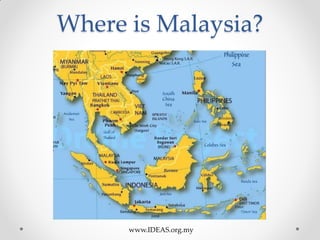
Where is Malaysia?
www.IDEAS.org.my
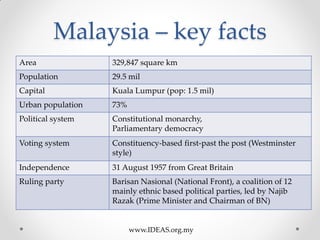
Malaysia – key facts
Area 329,847 square km
Population 29.5 mil
Capital Kuala Lumpur (pop: 1.5 mil)
Urban population 73%
Political system Constitutional monarchy,
Parliamentary democracy
Voting system Constituency-based first-past the post (Westminster
style)
Independence 31 August 1957 from Great Britain
Ruling party Barisan Nasional (National Front), a coalition of 12
mainly ethnic based political parties, led by Najib
Razak (Prime Minister and Chairman of BN)
www.IDEAS.org.my
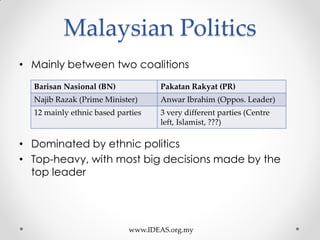
Malaysian Politics
• Mainly between two coalitions
• Dominated by ethnic politics
• Top-heavy, with most big decisions made by the
top leader
Barisan Nasional (BN) Pakatan Rakyat (PR)
Najib Razak (Prime Minister) Anwar Ibrahim (Oppos. Leader)
12 mainly ethnic based parties 3 very different parties (Centre
left, Islamist, ???)
www.IDEAS.org.my
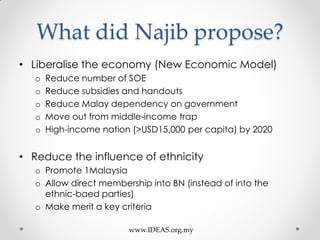
What did Najib propose?
• Liberalise the economy (New Economic Model)
o Reduce number of SOE
o Reduce subsidies and handouts
o Reduce Malay dependency on government
o Move out from middle-income trap
o High-income nation (>USD15,000 per capita) by 2020
• Reduce the influence of ethnicity
o Promote 1Malaysia
o Allow direct membership into BN (instead of into the
ethnic-baed parties)
o Make merit a key criteria
www.IDEAS.org.my
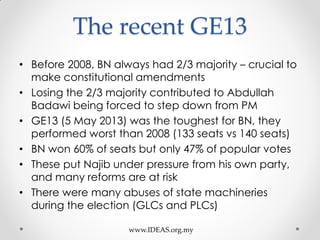
The recent GE13
• Before 2008, BN always had 2/3 majority – crucial to
make constitutional amendments
• Losing the 2/3 majority contributed to Abdullah
Badawi being forced to step down from PM
• GE13 (5 May 2013) was the toughest for BN, they
performed worst than 2008 (133 seats vs 140 seats)
• BN won 60% of seats but only 47% of popular votes
• These put Najib under pressure from his own party,
and many reforms are at risk
• There were many abuses of state machineries
during the election (GLCs and PLCs)
www.IDEAS.org.my
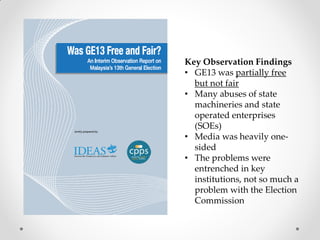
Key Observation Findings
• GE13 was partially free
but not fair
• Many abuses of state
machineries and state
operated enterprises
(SOEs)
• Media was heavily one-
sided
• The problems were
entrenched in key
institutions, not so much a
problem with the Election
Commission
Has Najib succeeded?
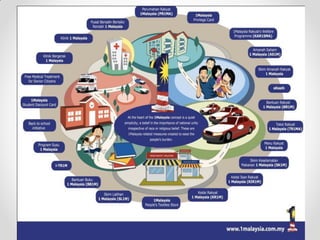
• 1Malaysia has become a welfare programme
• Subsidy costs 16% of total annual budget (MYR 14bn
from USD 85bn)
• Govt debt is higher than ever (54% of GDP in 2011)
• Continuous budget deficit since 1997
• Malay business lobby has become stronger
• Government continues to intervene in the economy
• Ethnic relation is not improving
 All due to the ethnic structure of our political parties,
especially in BN, and the desire to win GE13
 Ethnic politics is disrupting reform, and strengthening
dependency
www.IDEAS.org.my
What alternative does Anwar
offer?
• Free university education
• Higher minimum wage
• “Bonus” for senior citizens above 60
• Greater control on price of fuel, electricity and
water
• Legally mandated payment from husband to wife
• Many more redistribution programmes by creating
a welfare benefit system
 In other words, Anwar will take Malaysia firmly to the
left
www.IDEAS.org.my
What does the future look like?
• Najib may be forced to step down by 2016 by his
own party
• To reduce pressure, Najib will have to slow down the
pace of reform
• Who replaces Najib is unclear, but likely to be less
liberal
• Anwar will not be Prime Minister
• But if Anwar can hold PR together, PR could
become government in GE14 (2018)
 The challenge is therefore to embed sustainable
and competitive policies now, before Najib goes
www.IDEAS.org.my
Key lessons
• Ethnic-based politics is very difficult to end
o Hence better not to allow ethnic-based politics to gain
ground
• Welfarist policies are very difficult to stop once
started
o Hence better not to start one in the first place
www.IDEAS.org.my

The State of Democracy and Economy in Malaysia

  • 1.
    The State of Democracy& Economy in Malaysia Wan Saiful Wan Jan Presented at the Rotary Club of Taguig Fort Bonifacio RI District 3830 Metro Club, Rockwell, Makati City Monday, 9 September 2013 www.IDEAS.org.my
  • 2.
    About IDEAS • Launchedon 8 February 2010 • The only independent free market think tank in Malaysia • Key aim: “making markets work for the poor” • Key principles: o Rule of law o Limited government o Free market o Individual liberty and responsibility www.IDEAS.org.my
  • 3.
  • 4.
    Malaysia – keyfacts Area 329,847 square km Population 29.5 mil Capital Kuala Lumpur (pop: 1.5 mil) Urban population 73% Political system Constitutional monarchy, Parliamentary democracy Voting system Constituency-based first-past the post (Westminster style) Independence 31 August 1957 from Great Britain Ruling party Barisan Nasional (National Front), a coalition of 12 mainly ethnic based political parties, led by Najib Razak (Prime Minister and Chairman of BN) www.IDEAS.org.my
  • 5.
    Malaysian Politics • Mainlybetween two coalitions • Dominated by ethnic politics • Top-heavy, with most big decisions made by the top leader Barisan Nasional (BN) Pakatan Rakyat (PR) Najib Razak (Prime Minister) Anwar Ibrahim (Oppos. Leader) 12 mainly ethnic based parties 3 very different parties (Centre left, Islamist, ???) www.IDEAS.org.my
  • 6.
    What did Najibpropose? • Liberalise the economy (New Economic Model) o Reduce number of SOE o Reduce subsidies and handouts o Reduce Malay dependency on government o Move out from middle-income trap o High-income nation (>USD15,000 per capita) by 2020 • Reduce the influence of ethnicity o Promote 1Malaysia o Allow direct membership into BN (instead of into the ethnic-baed parties) o Make merit a key criteria www.IDEAS.org.my
  • 7.
    The recent GE13 •Before 2008, BN always had 2/3 majority – crucial to make constitutional amendments • Losing the 2/3 majority contributed to Abdullah Badawi being forced to step down from PM • GE13 (5 May 2013) was the toughest for BN, they performed worst than 2008 (133 seats vs 140 seats) • BN won 60% of seats but only 47% of popular votes • These put Najib under pressure from his own party, and many reforms are at risk • There were many abuses of state machineries during the election (GLCs and PLCs) www.IDEAS.org.my
  • 8.
    Key Observation Findings •GE13 was partially free but not fair • Many abuses of state machineries and state operated enterprises (SOEs) • Media was heavily one- sided • The problems were entrenched in key institutions, not so much a problem with the Election Commission
  • 9.
    Has Najib succeeded? •1Malaysia has become a welfare programme • Subsidy costs 16% of total annual budget (MYR 14bn from USD 85bn) • Govt debt is higher than ever (54% of GDP in 2011) • Continuous budget deficit since 1997 • Malay business lobby has become stronger • Government continues to intervene in the economy • Ethnic relation is not improving  All due to the ethnic structure of our political parties, especially in BN, and the desire to win GE13  Ethnic politics is disrupting reform, and strengthening dependency www.IDEAS.org.my
  • 11.
    What alternative doesAnwar offer? • Free university education • Higher minimum wage • “Bonus” for senior citizens above 60 • Greater control on price of fuel, electricity and water • Legally mandated payment from husband to wife • Many more redistribution programmes by creating a welfare benefit system  In other words, Anwar will take Malaysia firmly to the left www.IDEAS.org.my
  • 12.
    What does thefuture look like? • Najib may be forced to step down by 2016 by his own party • To reduce pressure, Najib will have to slow down the pace of reform • Who replaces Najib is unclear, but likely to be less liberal • Anwar will not be Prime Minister • But if Anwar can hold PR together, PR could become government in GE14 (2018)  The challenge is therefore to embed sustainable and competitive policies now, before Najib goes www.IDEAS.org.my
  • 13.
    Key lessons • Ethnic-basedpolitics is very difficult to end o Hence better not to allow ethnic-based politics to gain ground • Welfarist policies are very difficult to stop once started o Hence better not to start one in the first place www.IDEAS.org.my