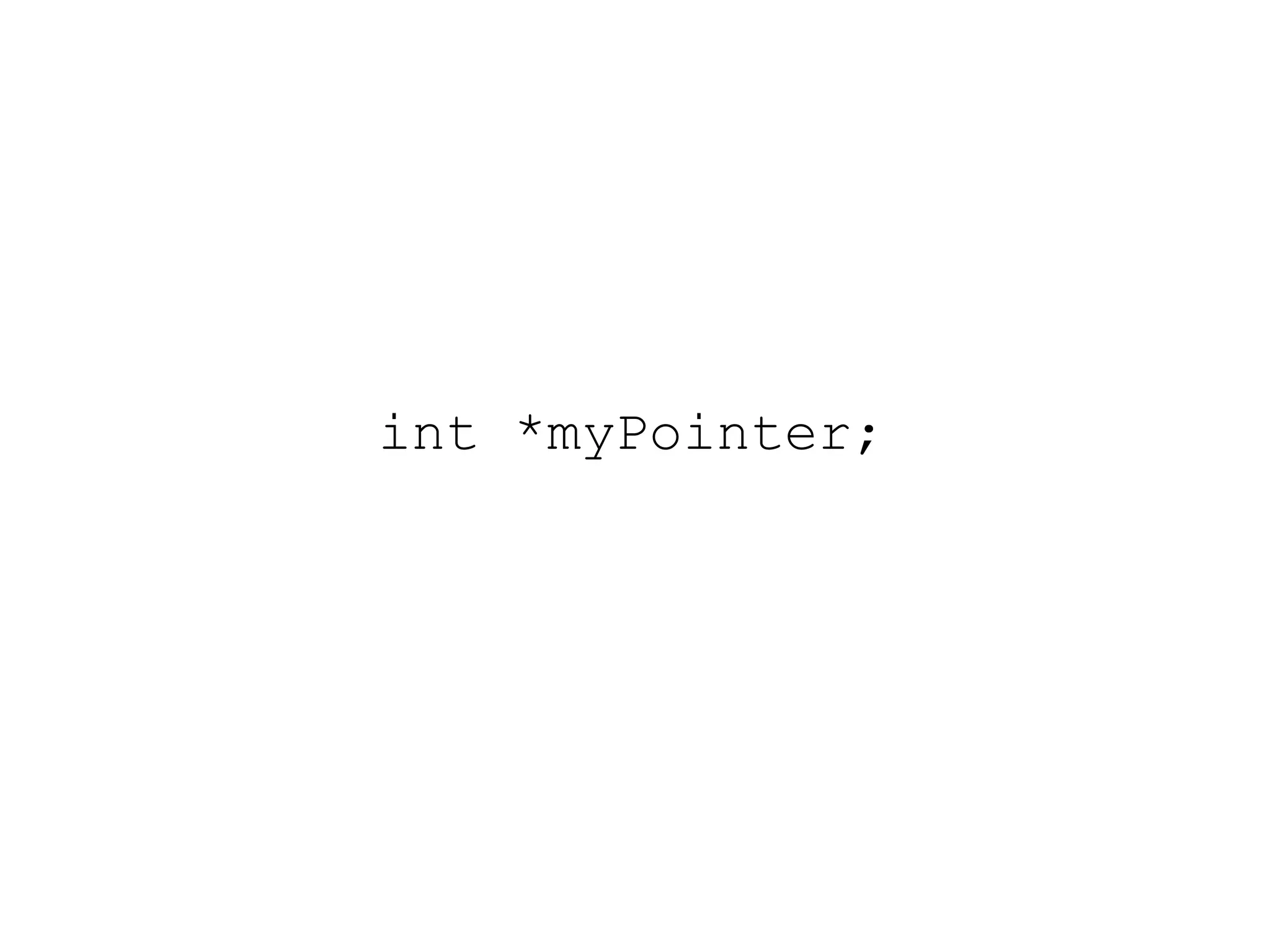
int *myPointer;
int *myPointer;
Declare a variable
called myPointer
int *myPointer;
The * means it
will be a pointer to
something
int *myPointer;
This pointer will
point to data of
type int
int *myPointer;
int myInt = 5;
myPointer = &myInt;
int *myPointer;
int myInt = 5;
myPointer = &myInt;
This regular int
variable is located at
a particular location
in memory
int *myPointer;
int myInt = 5;
myPointer = &myInt;
The & grabs the
location of the
integer to store in
the pointer
int *myPointer;
int myInt = 5;
myPointer = &myInt;
Now myPointer
is storing the
location of myInt
int *myPointer;
int myInt = 5;
myPointer = &myInt;
cout << *myPointer << endl;
cout << myInt << endl;
int *myPointer;
int myInt = 5;
myPointer = &myInt;
cout << *myPointer << endl;
cout << myInt << endl;After a pointer has
been declared, * lets
you access its contents
(if there are any!)
int *myPointer;
int myInt = 5;
myPointer = &myInt;
cout << *myPointer << endl;
cout << myInt << endl;
myPointer is
pointing to myInt, so
this will print the same
thing as *myPointer
int *myPointer;
int myInt = 5;
myPointer = &myInt;
int *anotherPointer
= myPointer;
int *myPointer;
int myInt = 5;
myPointer = &myInt;
int *anotherPointer
= myPointer;
Another variable
that will store the
memory location of
an int
int *myPointer;
int myInt = 5;
myPointer = &myInt;
int *anotherPointer
= myPointer;
Now anotherPointer and
myPointer both point to myInt’s
memory location
int *myPointer;
int myInt = 5;
myPointer = &myInt;
int *anotherPointer
= myPointer;
Same result:
anotherPointer = &myInt;

Pointers