Pl@ntGhats
Linking HIFP, KBSP, and ETS databases
to common reference tables
French Institute of Pondicherry (IFP)
July 2013
Rainer Zaiss
IRD UMR AMAP
1. Create links between different ecological databases that are in
use at IFP
2. Develop a data management system to
1. display,
2. query,
3. manage and
4. share
the information
Pl@ntGhats
1. IFP herbarium database
 17000 observations
 24000 sheets (3400 are scanned)
 Spread over around 2000 locations
 4700 taxons
Pl@ntGhats HIFP database
OBSERVATION
DETERMINATION
SHEET
IMAGE1 : N
1 : N
1 : N
2. Endemic tree species database
 12000 observations
 356 taxons
 Spread over around 2500 locations
http://www.ifpindia.org/ecrire/upload/digital_database/Site/Endemic_Tree_Species/html/main.htm
Pl@ntGhats ETS database
Observation … … … … …
2. Endemic tree species database compiled from different sources
Pl@ntGhats ETS database
REFERENCE ENDEMIC TREE SPECIES DATABASE NBR
IFP HIFP herbarium database 1158
Blater Herbarium, St. Xaviers' College, Mumbai, Maharashtra, India. 132
Botanical Survey of India, Southern Circle, Coimbatore, Tamil Nadu, India. 2354
Botanical Survey of India, Western Circle, Pune, Maharashtra, India. 894
Central National Herbarium, Howrah, West Bengal, India. 117
Centre for Taxonomic Studies, Bangalore, Karnataka, India. 627
Forest College, Coimbatore, Tamil Nadu India. 16
Kerala Forest Research Institute, Pechi, Kerala, India. 284
Rapinat Herbarium, Tiruchirapali, Tamil Nadu, India. 102
Royal Botanic Gardens, Kew, United Kingdom. 156
Tropical Botanic Garden and Research Institute, Palode, Kerala, India. 173
Herbarium
UNKNOWN 9
Induchoodan field work 1071
Literature 884
Literature unprecise 47
Map field work 2328
Others field work 20
Pascal field work 932
Uppangala field work 32
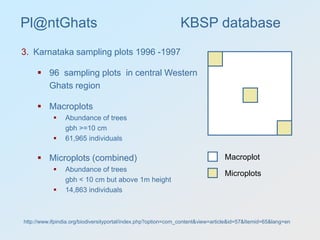
3. Karnataka sampling plots 1996 -1997
 96 sampling plots in central Western
Ghats region
 Macroplots
 Abundance of trees
gbh >=10 cm
 61,965 individuals
 Microplots (combined)
 Abundance of trees
gbh < 10 cm but above 1m height
 14,863 individuals
Pl@ntGhats KBSP database
Macroplot
Microplots
http://www.ifpindia.org/biodiversityportal/index.php?option=com_content&view=article&id=57&Itemid=65&lang=en
Three databases with a completely different database structure
Pl@ntGhats database link
HIFP
KBSP
ETS
…
How to
proceed to
link the
databases ?
Three databases with a completely different database structure
Pl@ntGhats database link
HIFP
KBSP
ETS
…
TAXONOMY
REFERENCEDATABASE
Three databases with a completely different database structure
Pl@ntGhats database link
HIFP
KBSP
ETS
…
TAXONOMY
REFERENCEDATABASE
GEOGRAPHY
REFERENCEDATABASE
Pl@ntGhats Taxonomy reference database
APGiii familiesIFP classification (Cronquist)
Acorus
Cronquist system: Araceae
APG3 : Acoraceae
Example GENUS
Persons : Author(s), collector(s), determiner(s)
Pl@ntGhats Taxonomy reference database
Person groups
Abbreviation Groups
Standard Abbreviation
Person
1. From Brahms
2. New persons from HIFP
3. New persons from ETS
One line for each botanists
Persons : Author(s), collector(s), determiner(s)
Pl@ntGhats Taxonomy reference database
Author abbreviation : Gmelina arborea Roxb.
Author abbreviation groups Gomphandra tetrandra (Wall. ex Roxb.) Sleumer
Persons : Author(s), collector(s), determiner(s)
Pl@ntGhats Taxonomy reference database
Author abbreviation : Gmelina arborea Roxb.
Author abbreviation groups Gomphandra tetrandra (Wall. ex Roxb.) Sleumer
Collector Ramesh, B.R.
Collector groups Ramesh, B.R., Ayyappan, N., Aravajy, S.
Determiner Ramesh, B.R.
Determiner groups Ramesh, B.R., Zaiss, R.
Pl@ntGhats Geography reference table
I’am located ?
here
3. What is a location?
 A point
 Fixed on the earth surface by it’s geographical
coordinates
45°05'00''E -23°12'00''S
 Based on the datum WGS84
 The point has a certain horizontal precision
30 meters, 5 km, …
Is this a good idea ?????
Pl@ntGhats Geography reference table
Is this a good idea ?????
YES if we use a GPS receiver to locate the sample !!!
BUT IN OUR CASE WE HAVE MAINLY HISTORICAL DATA
Pl@ntGhats Geography reference table
+ =
3. What are the problems?
 Same locations (Lon./Lat.) carrying
different names ?
 Different locations carrying different
names
 We just have the name but not the
geographical coordinates of the
location
 We just have the coordinates of the
location but we do not know the
name of the location
 + all other combinations that you
can imagine…..
Pl@ntGhats Geography reference table
We have location names that designate geographical regions…
We have location names that designate ????
We do not know the source of the coordinates ?
3. What are the problems?
 Same locations (Lon./Lat.) carrying
different names ?
 Different locations carrying the same
name
 We just have the name of the
location but not the geographical
coordinates
 We just have the coordinates of the
location but we do not know the
name
 …
Pl@ntGhats Geography reference table
We have location names that designates geographical regions…
We have location names that designates ????
We do not know the source of the coordinates ?
3. What are the advantages to work with point locations
Pl@ntGhats Geography reference table
POINT INSIDE POLYGON
We can use geographical joins to relate
the points with all kind of geographical
subdivisions
Administrative subdivision
Forest division
Biodiversity hot spots
It looks very easy, where are the problems ?
Pl@ntGhats database link
HIFP
KBSP
ETS
…
TAXONOMY
REFERENCEDATABASE
GEOGRAPHY
REFERENCEDATABASE
The three databases are available at the IFP server
http://182.72.114.106:5984/_start
The herbarium database is not up to date
The main challenge is to build up a localities reference table
THANK YOU
Pl@ntGhats Where do we stand ?
It looks very easy, where are the problems ?
In order to create the links we have
to define and follow standards !!!
Standards are necessary in order to go ahead !!!!!!
Pl@ntGhats database link

Pl@ntghats IFP

  • 1.
    Pl@ntGhats Linking HIFP, KBSP,and ETS databases to common reference tables French Institute of Pondicherry (IFP) July 2013 Rainer Zaiss IRD UMR AMAP
  • 2.
    1. Create linksbetween different ecological databases that are in use at IFP 2. Develop a data management system to 1. display, 2. query, 3. manage and 4. share the information Pl@ntGhats
  • 3.
    1. IFP herbariumdatabase  17000 observations  24000 sheets (3400 are scanned)  Spread over around 2000 locations  4700 taxons Pl@ntGhats HIFP database OBSERVATION DETERMINATION SHEET IMAGE1 : N 1 : N 1 : N
  • 4.
    2. Endemic treespecies database  12000 observations  356 taxons  Spread over around 2500 locations http://www.ifpindia.org/ecrire/upload/digital_database/Site/Endemic_Tree_Species/html/main.htm Pl@ntGhats ETS database Observation … … … … …
  • 5.
    2. Endemic treespecies database compiled from different sources Pl@ntGhats ETS database REFERENCE ENDEMIC TREE SPECIES DATABASE NBR IFP HIFP herbarium database 1158 Blater Herbarium, St. Xaviers' College, Mumbai, Maharashtra, India. 132 Botanical Survey of India, Southern Circle, Coimbatore, Tamil Nadu, India. 2354 Botanical Survey of India, Western Circle, Pune, Maharashtra, India. 894 Central National Herbarium, Howrah, West Bengal, India. 117 Centre for Taxonomic Studies, Bangalore, Karnataka, India. 627 Forest College, Coimbatore, Tamil Nadu India. 16 Kerala Forest Research Institute, Pechi, Kerala, India. 284 Rapinat Herbarium, Tiruchirapali, Tamil Nadu, India. 102 Royal Botanic Gardens, Kew, United Kingdom. 156 Tropical Botanic Garden and Research Institute, Palode, Kerala, India. 173 Herbarium UNKNOWN 9 Induchoodan field work 1071 Literature 884 Literature unprecise 47 Map field work 2328 Others field work 20 Pascal field work 932 Uppangala field work 32
  • 6.
    3. Karnataka samplingplots 1996 -1997  96 sampling plots in central Western Ghats region  Macroplots  Abundance of trees gbh >=10 cm  61,965 individuals  Microplots (combined)  Abundance of trees gbh < 10 cm but above 1m height  14,863 individuals Pl@ntGhats KBSP database Macroplot Microplots http://www.ifpindia.org/biodiversityportal/index.php?option=com_content&view=article&id=57&Itemid=65&lang=en
  • 7.
    Three databases witha completely different database structure Pl@ntGhats database link HIFP KBSP ETS … How to proceed to link the databases ?
  • 8.
    Three databases witha completely different database structure Pl@ntGhats database link HIFP KBSP ETS … TAXONOMY REFERENCEDATABASE
  • 9.
    Three databases witha completely different database structure Pl@ntGhats database link HIFP KBSP ETS … TAXONOMY REFERENCEDATABASE GEOGRAPHY REFERENCEDATABASE
  • 10.
    Pl@ntGhats Taxonomy referencedatabase APGiii familiesIFP classification (Cronquist) Acorus Cronquist system: Araceae APG3 : Acoraceae Example GENUS
  • 11.
    Persons : Author(s),collector(s), determiner(s) Pl@ntGhats Taxonomy reference database Person groups Abbreviation Groups Standard Abbreviation Person 1. From Brahms 2. New persons from HIFP 3. New persons from ETS One line for each botanists
  • 12.
    Persons : Author(s),collector(s), determiner(s) Pl@ntGhats Taxonomy reference database Author abbreviation : Gmelina arborea Roxb. Author abbreviation groups Gomphandra tetrandra (Wall. ex Roxb.) Sleumer
  • 13.
    Persons : Author(s),collector(s), determiner(s) Pl@ntGhats Taxonomy reference database Author abbreviation : Gmelina arborea Roxb. Author abbreviation groups Gomphandra tetrandra (Wall. ex Roxb.) Sleumer Collector Ramesh, B.R. Collector groups Ramesh, B.R., Ayyappan, N., Aravajy, S. Determiner Ramesh, B.R. Determiner groups Ramesh, B.R., Zaiss, R.
  • 14.
    Pl@ntGhats Geography referencetable I’am located ? here
  • 15.
    3. What isa location?  A point  Fixed on the earth surface by it’s geographical coordinates 45°05'00''E -23°12'00''S  Based on the datum WGS84  The point has a certain horizontal precision 30 meters, 5 km, … Is this a good idea ????? Pl@ntGhats Geography reference table
  • 16.
    Is this agood idea ????? YES if we use a GPS receiver to locate the sample !!! BUT IN OUR CASE WE HAVE MAINLY HISTORICAL DATA Pl@ntGhats Geography reference table + =
  • 17.
    3. What arethe problems?  Same locations (Lon./Lat.) carrying different names ?  Different locations carrying different names  We just have the name but not the geographical coordinates of the location  We just have the coordinates of the location but we do not know the name of the location  + all other combinations that you can imagine….. Pl@ntGhats Geography reference table We have location names that designate geographical regions… We have location names that designate ???? We do not know the source of the coordinates ?
  • 18.
    3. What arethe problems?  Same locations (Lon./Lat.) carrying different names ?  Different locations carrying the same name  We just have the name of the location but not the geographical coordinates  We just have the coordinates of the location but we do not know the name  … Pl@ntGhats Geography reference table We have location names that designates geographical regions… We have location names that designates ???? We do not know the source of the coordinates ?
  • 19.
    3. What arethe advantages to work with point locations Pl@ntGhats Geography reference table POINT INSIDE POLYGON We can use geographical joins to relate the points with all kind of geographical subdivisions Administrative subdivision Forest division Biodiversity hot spots
  • 20.
    It looks veryeasy, where are the problems ? Pl@ntGhats database link HIFP KBSP ETS … TAXONOMY REFERENCEDATABASE GEOGRAPHY REFERENCEDATABASE
  • 21.
    The three databasesare available at the IFP server http://182.72.114.106:5984/_start The herbarium database is not up to date The main challenge is to build up a localities reference table THANK YOU Pl@ntGhats Where do we stand ?
  • 22.
    It looks veryeasy, where are the problems ? In order to create the links we have to define and follow standards !!! Standards are necessary in order to go ahead !!!!!! Pl@ntGhats database link