Jagan Thiruvazhi                      Marcel Croonen
                      Presents
        “A PLM Bite Before Lunch”
                   with Jos Voskuil
                      Mar 29, 2012
                                          Jos Voskuil
Agenda
 Welcome & Introduction by Marcel Croonen   5 min


 “PLM Bite Before Lunch” by Jos Voskuil     25 min


 About BWIR-Korade partnership by Jagan     5 min


 Q&A                                        10 min
Welcome & Introduction
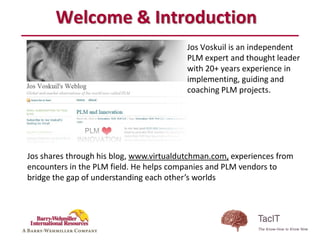
                                          Jos Voskuil is an independent
                                          PLM expert and thought leader
                                          with 20+ years experience in
                                          implementing, guiding and
                                          coaching PLM projects.


Jos shares through his blog, www.virtualdutchman.com, experiences from
encounters in the PLM field. He helps companies and PLM vendors to
bridge the gap of understanding each other’s worlds
A PLM Bite Before Lunch - Jos Voskuil


   Making the case for PLM
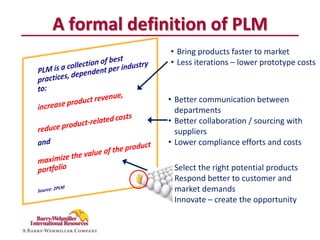
A formal definition of PLM
              • Bring products faster to market
              • Less iterations – lower prototype costs


             • Better communication between
               departments
             • Better collaboration / sourcing with
               suppliers
             • Lower compliance efforts and costs

             • Select the right potential products
             • Respond better to customer and
               market demands
             • Innovate – create the opportunity
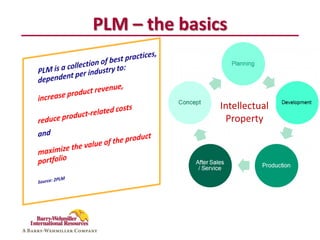
PLM – the basics


               Intellectual
                Property
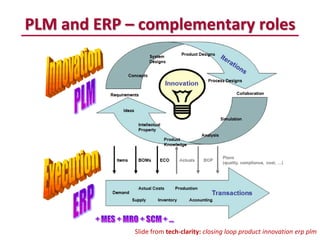
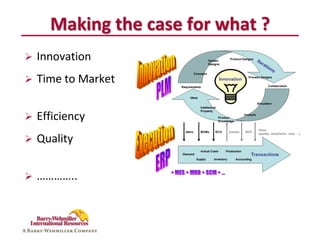
PLM and ERP – complementary roles


             Slide from tech-clarity: closing loop product innovation erp plm
PDM versus PLM – PDM characteristics

Product Data Management

    Boosted by 3D CAD


    Departmental solution


    ‘Easy’ to implement
PDM versus PLM – PLM characteristics

Product Lifecycle Management

    IT and Business Strategy

    Connecting and sharing


    Requires change  difficult to implement
Making the case for what ?
   Innovation
   Time to Market


   Efficiency
   Quality


   …………..
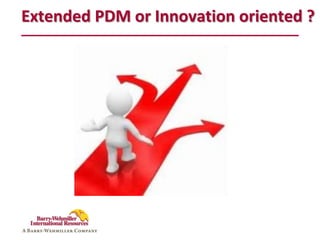
Extended PDM or Innovation oriented ?
Making the case for “Efficiency”

   PLM reduces manual processes


   Visibility of data across the enterprise


   Reduce errors and design iterations
Making the case for “Quality”

   Assure standard processes

   Work with the right data

   Integrate requirements

   Connect field / customer data
Making the case for “Innovation”


   Identify opportunities in an early stage

   Connect to the customer

   Spend time and energy in early development
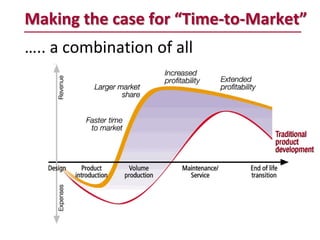
Making the case for “Time-to-Market”
….. a combination of all
And upcoming cases for PLM…..


   Knowledge capturing: aging workforce


   Managing the digital explosion
Intermediate summary
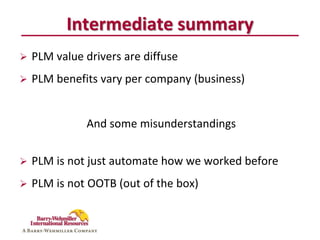
   PLM value drivers are diffuse
   PLM benefits vary per company (business)


              And some misunderstandings


   PLM is not just automate how we worked before
   PLM is not OOTB (out of the box)
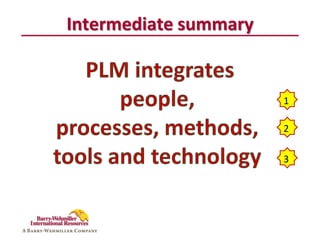
Intermediate summary


                       1

                       2

                       3
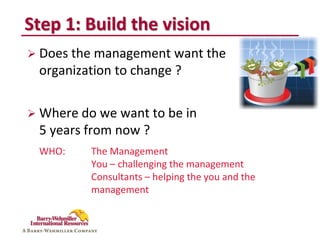
Step 1: Build the vision
 Does the management want the
 organization to change ?

 Where do we want to be in
 5 years from now ?
 WHO:     The Management
          You – challenging the management
          Consultants – helping the you and the
          management
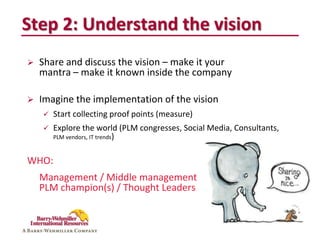
Step 2: Understand the vision
   Share and discuss the vision – make it your
    mantra – make it known inside the company

   Imagine the implementation of the vision
       Start collecting proof points (measure)
       Explore the world (PLM congresses, Social Media, Consultants,
        PLM vendors, IT trends)


WHO:
    Management / Middle management
    PLM champion(s) / Thought Leaders
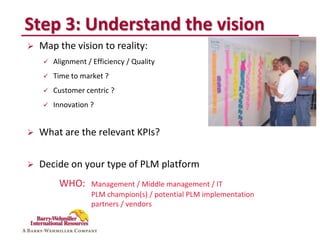
Step 3: Understand the vision
   Map the vision to reality:
       Alignment / Efficiency / Quality
       Time to market ?
       Customer centric ?
       Innovation ?


   What are the relevant KPIs?


   Decide on your type of PLM platform
         WHO:      Management / Middle management / IT
                   PLM champion(s) / potential PLM implementation
                   partners / vendors
Can you make the case ?
 Step 1 to 3 are mandatory steps for
    success, but ….


Now it is time for commitment !


   Will there be active executive sponsorship ?

   Will there be a champion / project team ?
Next steps
After


 you cannot fail,                                            if you do not respect the do’s and don’t s from a regular implementation, which with a lot of technology, products, politics,
 financial impact, outside intervention and vision storing can become a huge effort for an implementation team to maintain but at the end it is a rewarding job to implement PLM and
 bring a company to the next stage Most product companies begin with a manual paper-based engineering change process. In these configuration management (i.e., "document control")
 systems, change forms are documents that describe the change, list the items that are affected by the change, and provide for authorized people to approve the change. In a PLM software
 system, these functions are still important. In addition, the automated system will actually release or cancel items as directed by the change's contents and perform cost estimates. The
 PLM software also provides convenient real-time links to the affected items, their parent assemblies, and attached electronic data files such as CAD drawings, specifications and budget
 worksheets. Engineering change process overview The purpose of any change control process is to manage the evolution of a product from the current approved configuration to a new
 approved configuration. And, by definition, an "approved configuration" includes all of the product data necessary to reliably create the product. The Institute of Configuration
 Management defines its change process (CMII1) as a means to accommodate change accommodate the reuse of standards and best practices ensure that all requirements (all released
 information) remain clear, concise and valid communicate (1), (2) and (3) to each user promptly and precisely ensure that results conform to the requirements in each case. Engineering
 change process forms A change form describes an intended or actual action affecting a product's documentation and/or parts. You can specify related information, such as Whether a
 change affects the actual release or cancellation of an item The disposition of the affected items Who will be reviewing and approving the change, and who will be notified after the
 change has been approved A cross-reference to preceding or related changes Electronic file attachments that describe rework instructions, cost impact or other information necessary to
 ensure that the change is adequately reviewed and implemented. Implementing and non-implementing changes An implementing change form (sometimes called a "permanent change"
 form) is the vehicle for executing the release and/or cancellation of a set of affected items.
Step 4: Securing the change – Do’s / Don’ts
 Do’s :

   Keep the vision all time in the picture


   Small steps – give the organization time to
    adjust

   Involve the users, but lead the change


   Communicate and sell internal
Step 4: Securing the change – Do’s / Don’ts
 Don’ts:

   Think PLM is an IT project


   Think a PLM product feature is a solution


   Believe customization is solving the change


   Believe it is easy and in the cloud
Conclusions

   Build the vision and motivation
   Realize PLM is change – create the enthusiasm
    and support but do not undermine company culture
   Select a partner, somebody who understands your
    business needs and has a proven track record
   Scope should be well defined and understood
   Use pilot projects – step by step
About BWIR-Korade partnership


      Jagan Thiruvazhi
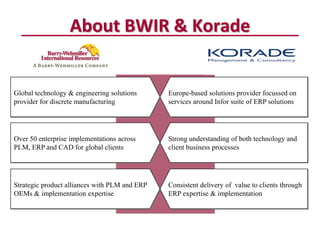
About BWIR & Korade


Global technology & engineering solutions      Europe-based solutions provider focussed on
provider for discrete manufacturing            services around Infor suite of ERP solutions


Over 50 enterprise implementations across      Strong understanding of both technology and
                                   .....
PLM, ERP and CAD for global clients            client business processes


Strategic product alliances with PLM and ERP   Consistent delivery of value to clients through
OEMs & implementation expertise                ERP expertise & implementation
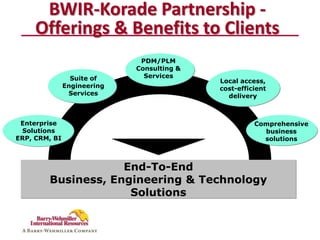
BWIR-Korade Partnership -
     Offerings & Benefits to Clients
                              PDM/PLM
                             Consulting &
                 Suite of      Services
                                            Local access,
               Engineering                  cost-efficient
                Services                      delivery


 Enterprise                                           Comprehensive
 Solutions                                              business
ERP, CRM, BI                                            solutions


                    End-To-End
        Business, Engineering & Technology
                     Solutions
Understanding PLM & Its Relevance for your Business

Understanding PLM & Its Relevance for your Business

  • 1.
    Jagan Thiruvazhi Marcel Croonen Presents “A PLM Bite Before Lunch” with Jos Voskuil Mar 29, 2012 Jos Voskuil
  • 2.
    Agenda  Welcome &Introduction by Marcel Croonen 5 min  “PLM Bite Before Lunch” by Jos Voskuil 25 min  About BWIR-Korade partnership by Jagan 5 min  Q&A 10 min
  • 3.
    Welcome & Introduction Jos Voskuil is an independent PLM expert and thought leader with 20+ years experience in implementing, guiding and coaching PLM projects. Jos shares through his blog, www.virtualdutchman.com, experiences from encounters in the PLM field. He helps companies and PLM vendors to bridge the gap of understanding each other’s worlds
  • 4.
    A PLM BiteBefore Lunch - Jos Voskuil Making the case for PLM
  • 5.
    A formal definitionof PLM • Bring products faster to market • Less iterations – lower prototype costs • Better communication between departments • Better collaboration / sourcing with suppliers • Lower compliance efforts and costs • Select the right potential products • Respond better to customer and market demands • Innovate – create the opportunity
  • 6.
    PLM – thebasics Intellectual Property
  • 7.
    PLM and ERP– complementary roles Slide from tech-clarity: closing loop product innovation erp plm
  • 8.
    PDM versus PLM– PDM characteristics Product Data Management  Boosted by 3D CAD  Departmental solution  ‘Easy’ to implement
  • 9.
    PDM versus PLM– PLM characteristics Product Lifecycle Management  IT and Business Strategy  Connecting and sharing  Requires change  difficult to implement
  • 10.
    Making the casefor what ?  Innovation  Time to Market  Efficiency  Quality  …………..
  • 11.
    Extended PDM orInnovation oriented ?
  • 12.
    Making the casefor “Efficiency”  PLM reduces manual processes  Visibility of data across the enterprise  Reduce errors and design iterations
  • 13.
    Making the casefor “Quality”  Assure standard processes  Work with the right data  Integrate requirements  Connect field / customer data
  • 14.
    Making the casefor “Innovation”  Identify opportunities in an early stage  Connect to the customer  Spend time and energy in early development
  • 15.
    Making the casefor “Time-to-Market” ….. a combination of all
  • 16.
    And upcoming casesfor PLM…..  Knowledge capturing: aging workforce  Managing the digital explosion
  • 17.
    Intermediate summary  PLM value drivers are diffuse  PLM benefits vary per company (business) And some misunderstandings  PLM is not just automate how we worked before  PLM is not OOTB (out of the box)
  • 18.
  • 19.
    Step 1: Buildthe vision  Does the management want the organization to change ?  Where do we want to be in 5 years from now ? WHO: The Management You – challenging the management Consultants – helping the you and the management
  • 20.
    Step 2: Understandthe vision  Share and discuss the vision – make it your mantra – make it known inside the company  Imagine the implementation of the vision  Start collecting proof points (measure)  Explore the world (PLM congresses, Social Media, Consultants, PLM vendors, IT trends) WHO: Management / Middle management PLM champion(s) / Thought Leaders
  • 21.
    Step 3: Understandthe vision  Map the vision to reality:  Alignment / Efficiency / Quality  Time to market ?  Customer centric ?  Innovation ?  What are the relevant KPIs?  Decide on your type of PLM platform WHO: Management / Middle management / IT PLM champion(s) / potential PLM implementation partners / vendors
  • 22.
    Can you makethe case ?  Step 1 to 3 are mandatory steps for success, but …. Now it is time for commitment !  Will there be active executive sponsorship ?  Will there be a champion / project team ?
  • 23.
    Next steps After youcannot fail, if you do not respect the do’s and don’t s from a regular implementation, which with a lot of technology, products, politics, financial impact, outside intervention and vision storing can become a huge effort for an implementation team to maintain but at the end it is a rewarding job to implement PLM and bring a company to the next stage Most product companies begin with a manual paper-based engineering change process. In these configuration management (i.e., "document control") systems, change forms are documents that describe the change, list the items that are affected by the change, and provide for authorized people to approve the change. In a PLM software system, these functions are still important. In addition, the automated system will actually release or cancel items as directed by the change's contents and perform cost estimates. The PLM software also provides convenient real-time links to the affected items, their parent assemblies, and attached electronic data files such as CAD drawings, specifications and budget worksheets. Engineering change process overview The purpose of any change control process is to manage the evolution of a product from the current approved configuration to a new approved configuration. And, by definition, an "approved configuration" includes all of the product data necessary to reliably create the product. The Institute of Configuration Management defines its change process (CMII1) as a means to accommodate change accommodate the reuse of standards and best practices ensure that all requirements (all released information) remain clear, concise and valid communicate (1), (2) and (3) to each user promptly and precisely ensure that results conform to the requirements in each case. Engineering change process forms A change form describes an intended or actual action affecting a product's documentation and/or parts. You can specify related information, such as Whether a change affects the actual release or cancellation of an item The disposition of the affected items Who will be reviewing and approving the change, and who will be notified after the change has been approved A cross-reference to preceding or related changes Electronic file attachments that describe rework instructions, cost impact or other information necessary to ensure that the change is adequately reviewed and implemented. Implementing and non-implementing changes An implementing change form (sometimes called a "permanent change" form) is the vehicle for executing the release and/or cancellation of a set of affected items.
  • 24.
    Step 4: Securingthe change – Do’s / Don’ts  Do’s :  Keep the vision all time in the picture  Small steps – give the organization time to adjust  Involve the users, but lead the change  Communicate and sell internal
  • 25.
    Step 4: Securingthe change – Do’s / Don’ts  Don’ts:  Think PLM is an IT project  Think a PLM product feature is a solution  Believe customization is solving the change  Believe it is easy and in the cloud
  • 26.
    Conclusions  Build the vision and motivation  Realize PLM is change – create the enthusiasm and support but do not undermine company culture  Select a partner, somebody who understands your business needs and has a proven track record  Scope should be well defined and understood  Use pilot projects – step by step
  • 27.
  • 28.
    About BWIR &Korade Global technology & engineering solutions Europe-based solutions provider focussed on provider for discrete manufacturing services around Infor suite of ERP solutions Over 50 enterprise implementations across Strong understanding of both technology and ..... PLM, ERP and CAD for global clients client business processes Strategic product alliances with PLM and ERP Consistent delivery of value to clients through OEMs & implementation expertise ERP expertise & implementation
  • 29.
    BWIR-Korade Partnership - Offerings & Benefits to Clients PDM/PLM Consulting & Suite of Services Local access, Engineering cost-efficient Services delivery Enterprise Comprehensive Solutions business ERP, CRM, BI solutions End-To-End Business, Engineering & Technology Solutions