PLC
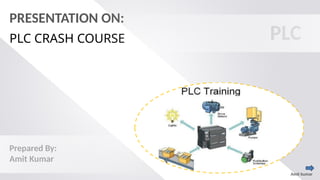
PRESENTATION ON:
PLC CRASH COURSE
Amit kumar
Prepared By:
Amit Kumar
TECHNICAL CONTENT
Amit kumar
Sem: 4th Course: CP23 Sub: PLC
 Define PLC.
 What are main parts of PLC?
 What are the advantages of PLC over conventional hardware circuit?
 Which PLC have you used in your institute?
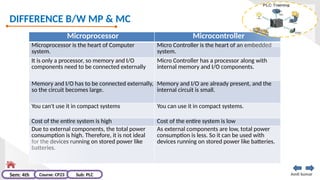
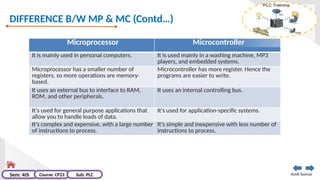
 What are the differences between micro processor and micro controller?
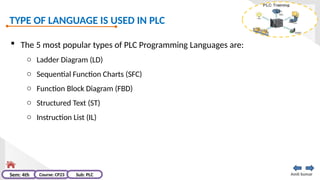
 In PLC programming, which type of language is used?
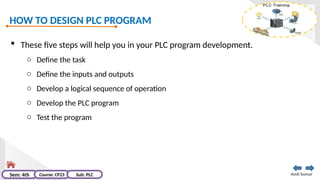
 How to design PLC program?
 Difference between sensor and transducer?
 Count binary no. from 1 to 10.
 How will you select PLC?
DEFINE PLC
Amit kumar
Sem: 4th Course: CP23 Sub: PLC
 A digital electronic device that uses a programmable memory to store
instructions and to implement specific functions such as logic, sequence,
timing, counting and arithmetic operation, to control machines and process.
 It uses a programmable memory to store the instructions and specific
functions that include On/Off control, timing counting, sequencing,
arithmetic and data handling.
 A PLC is a computer designed
to work in an industrial environment.
DEFINE PLC (Contd…)
Amit kumar
Sem: 4th Course: CP23 Sub: PLC
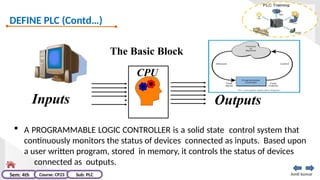
 A PROGRAMMABLE LOGIC CONTROLLER is a solid state control system that
continuously monitors the status of devices connected as inputs. Based upon
a user written program, stored in memory, it controls the status of devices
connected as outputs.
Inputs Outputs
The Basic Block
CPU
DEFINE PLC (Contd…)
Amit kumar
Sem: 4th Course: CP23 Sub: PLC
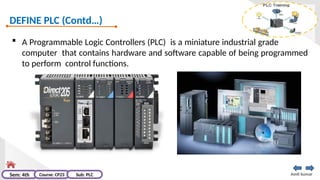
 A Programmable Logic Controllers (PLC) is a miniature industrial grade
computer that contains hardware and software capable of being programmed
to perform control functions.
MAIN PARTS OF PLC
Amit kumar
Sem: 4th Course: CP23 Sub: PLC
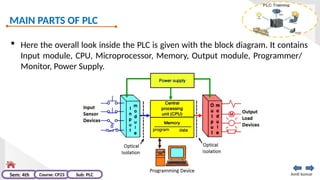
 Here the overall look inside the PLC is given with the block diagram. It contains
Input module, CPU, Microprocessor, Memory, Output module, Programmer/
Monitor, Power Supply.
MAIN PARTS OF PLC (Contd…)
Amit kumar
Sem: 4th Course: CP23 Sub: PLC
 CPU- it will work as brain of the computer and will supply and store all the
commands and the data given to the computer. The brain of the system which
is having three parts:
 Microprocessor: The computer centre that carries out mathematics and logical
operations.
 Memory: The area of the CPU in which the data and information are stored
and retrieved. Holds the system software and user program.
 Power supply: The electrical supply that converts AC to various operational DC
voltages.
MAIN PARTS OF PLC (Contd…)
Amit kumar
Sem: 4th Course: CP23 Sub: PLC
 Input Module- are basically the modules, which depend on the input
commands given by the user.
 Used to communicate with circuit of PLC,
 Input modules has terminals into which outside process electrical signals
generated by sensor or transducer are entered,
 An electronic system for connecting I/O modules to remote locations can be
added.
MAIN PARTS OF PLC (Contd…)
Amit kumar
Sem: 4th Course: CP23 Sub: PLC
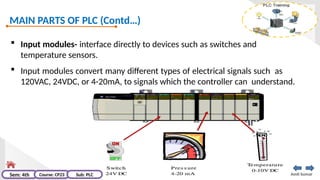
 Input modules- interface directly to devices such as switches and
temperature sensors.
 Input modules convert many different types of electrical signals such as
120VAC, 24VDC, or 4-20mA, to signals which the controller can understand.
MAIN PARTS OF PLC (Contd…)
Amit kumar
Sem: 4th Course: CP23 Sub: PLC
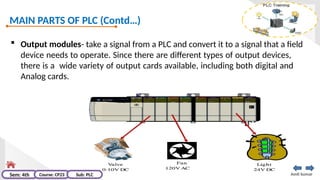
 Output modules- take a signal from a PLC and convert it to a signal that a field
device needs to operate. Since there are different types of output devices,
there is a wide variety of output cards available, including both digital and
Analog cards.
BEFORE THE PLC
Amit kumar
Sem: 4th Course: CP23 Sub: PLC
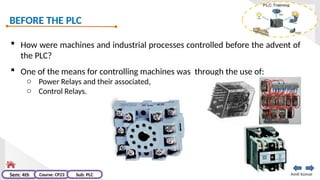
 How were machines and industrial processes controlled before the advent of
the PLC?
 One of the means for controlling machines was through the use of:
o Power Relays and their associated,
o Control Relays.
BEFORE THE PLC (Contd…)
Amit kumar
Sem: 4th Course: CP23 Sub: PLC
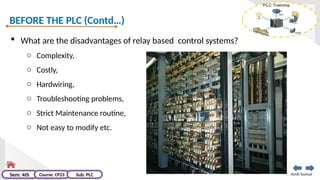
 What are the disadvantages of relay based control systems?
o Complexity,
o Costly,
o Hardwiring,
o Troubleshooting problems,
o Strict Maintenance routine,
o Not easy to modify etc.
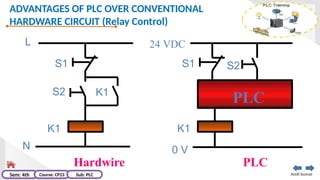
ADVANTAGES OF PLC OVER CONVENTIONAL
HARDWARE CIRCUIT (Relay Control)
Amit kumar
Sem: 4th Course: CP23 Sub: PLC
L
N
S1
S2
K1
S1 S2
PLC
K1
0 V
Hardwire PLC
24 VDC
K1
ADVANTAGES OF PLC OVER CONVENTIONAL
HARDWARE CIRCUIT (Relay Control)
Amit kumar
Sem: 4th Course: CP23 Sub: PLC
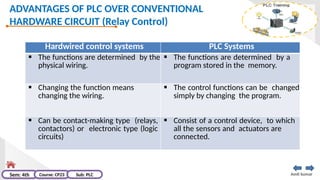
Hardwired control systems PLC Systems
 The functions are determined by the
physical wiring.
 The functions are determined by a
program stored in the memory.
 Changing the function means
changing the wiring.
 The control functions can be changed
simply by changing the program.
 Can be contact-making type (relays,
contactors) or electronic type (logic
circuits)
 Consist of a control device, to which
all the sensors and actuators are
connected.
ADVANTAGES OF PLC OVER CONVENTIONAL
HARDWARE CIRCUIT (Relay Control)
Amit kumar
Sem: 4th Course: CP23 Sub: PLC
 PLC is smaller and more reliable than Relay.
 For change in logic the Relay panel must be rewired whereas the PLC is
quickly reprogrammed for any changes.
 Control panel with Relay for a process control is large in size and contains lots
of wiring, interconnections and relays which has a maintenance problem.
 Ease of maintenance with PLC.
 Trouble shooting with PLC is very easy, fast and has minimal down time.
 Trouble shooting with Relay logic is time consuming and has more down time.
 Process control with PLC has lower cost compared to Relay.
WHICH PLC HAVE YOU USED IN YOUR INSTITUTE
Amit kumar
Sem: 4th Course: CP23 Sub: PLC
Microprocessor Microcontroller
Microprocessor is the heart of Computer
system.
Micro Controller is the heart of an embedded
system.
It is only a processor, so memory and I/O
components need to be connected externally
Micro Controller has a processor along with
internal memory and I/O components.
Memory and I/O has to be connected externally,
so the circuit becomes large.
Memory and I/O are already present, and the
internal circuit is small.
You can't use it in compact systems You can use it in compact systems.
Cost of the entire system is high Cost of the entire system is low
Due to external components, the total power
consumption is high. Therefore, it is not ideal
for the devices running on stored power like
batteries.
As external components are low, total power
consumption is less. So it can be used with
devices running on stored power like batteries.
DIFFERENCE B/W MP & MC
Amit kumar
Sem: 4th Course: CP23 Sub: PLC
Microprocessor Microcontroller
It is mainly used in personal computers. It is used mainly in a washing machine, MP3
players, and embedded systems.
Microprocessor has a smaller number of
registers, so more operations are memory-
based.
Microcontroller has more register. Hence the
programs are easier to write.
It uses an external bus to interface to RAM,
ROM, and other peripherals.
It uses an internal controlling bus.
It's used for general purpose applications that
allow you to handle loads of data.
It's used for application-specific systems.
It's complex and expensive, with a large number
of instructions to process.
It's simple and inexpensive with less number of
instructions to process.
DIFFERENCE B/W MP & MC (Contd…)
Amit kumar
Sem: 4th Course: CP23 Sub: PLC
TYPE OF LANGUAGE IS USED IN PLC
Amit kumar
Sem: 4th Course: CP23 Sub: PLC
 The 5 most popular types of PLC Programming Languages are:
o Ladder Diagram (LD)
o Sequential Function Charts (SFC)
o Function Block Diagram (FBD)
o Structured Text (ST)
o Instruction List (IL)
HOW TO DESIGN PLC PROGRAM
Amit kumar
Sem: 4th Course: CP23 Sub: PLC
 These five steps will help you in your PLC program development.
o Define the task
o Define the inputs and outputs
o Develop a logical sequence of operation
o Develop the PLC program
o Test the program
DIFFERENCE BETWEEN SENSOR AND TRANSDUCER
Amit kumar
Sem: 4th Course: CP23 Sub: PLC
 A transducer is a device that is used to convert a non-electrical signal into an
electrical signal whereas the sensor is used to measure the physical changes
that occur in the surroundings like temperature, light, etc., and convert it into
a readable signal.
 Examples of sensors are:
o Barometer
o Accelerometer
 Example of transducers are:
o Thermocouple
o Microphones
DIFFERENCE BETWEEN SENSOR AND TRANSDUCER
Amit kumar
Sem: 4th Course: CP23 Sub: PLC
Difference Between Transducer and Sensor
Transducer Sensor
It helps in converting one form of energy
into another form.
It senses physical quantities and converts
into signals which are read by an instrument
The antenna is one type of transducer.
Microphones and loudspeakers are also
of one type.
One type of Sensor is LED. Sensors used in
automobiles to detect touch and activate
the siren.
It converts the measured quantity into a
standard electrical signal like -10 to +10V
DC
It is used to measure voltage, capacitance,
inductance, ohmic resistance.
COUNT BINARY NO FROM 1 TO 10
Amit kumar
Sem: 4th Course: CP23 Sub: PLC
 We can now go ahead and follow these steps to turn our
decimal 10 into a binary 10.
 Step 1: Start counting in binary.
 To find what the number ten in binary is, we first start
counting in binary. To count in binary, you start with 0, then
you go to 1. Then you add another digit, like you do in decimal
counting when you go from 9 to 10. You add another digit, so
you have two digits now.
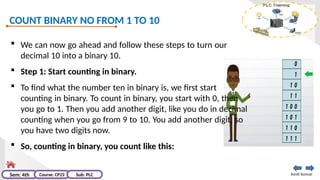
 So, counting in binary, you count like this:
COUNT BINARY NO FROM 1 TO 10 (Contd…)
Amit kumar
Sem: 4th Course: CP23 Sub: PLC
 Step 2: Keep counting until you reach ten.
Binary Decimal
0 0
1 1
10 2
11 3
100 4
101 5
110 6
111 7
1000 8
1001 9
1010 10
HOW WILL YOU SELECT PLC
Amit kumar
Sem: 4th Course: CP23 Sub: PLC
 PLC selection criteria consists of:
o System (task) requirements.
o Application requirements.
o What input/output capacity is required?
o What type of inputs/outputs are required?
o What size of memory is required?
o What speed is required of the CPU?
o Electrical requirements.
o Speed of operation.
o Communication requirements.
o Software.
o Operator interface.
o Physical environments.
PLC TROUBLESHOOTING
Amit kumar
Sem: 4th Course: CP23 Sub: PLC
 Troubleshooting is a form of problem solving processes on a machine or a
system, and make the product or process operational again.
Troubleshooting is needed to identify the symptoms.
 PLC troubleshooting can be performed in many different ways and as the
engineer’s experience always plays the major role in successful resolving
of such issues.
 Program troubleshooting
 Hardware troubleshooting
o Troubleshooting Controller
o Troubleshooting Input modules
o Troubleshooting Output modules
PLC TROUBLESHOOTING (Contd…)
Amit kumar
Sem: 4th Course: CP23 Sub: PLC
 Program troubleshooting:
o There are several causes off alteration to the user program:
o Extreme environmental conditions,
o Electromagnetic Interference (EMI),
o Improper wiring connections,
o Unauthorized tampering.
 If you suspect the memory has been altered, check the program against a
previously saved program on an EEPROM or flash EPROM module.
PLC TROUBLESHOOTING (Contd…)
Amit kumar
Sem: 4th Course: CP23 Sub: PLC
 Troubleshooting Controller
 To receive the maximum benefit, follow these steps:
o Identify Power Supply and CPU LED status indicators,
o Match processor LEDs with the status LEDs located in troubleshooting tables,
o Follow the recommended action steps for each probable cause until the cause
is identified.
 If recommended actions do not identify the cause, contact manufacturer or
distributor for assistance.
PLC TROUBLESHOOTING (Contd…)
Amit kumar
Sem: 4th Course: CP23 Sub: PLC
 Troubleshooting Input modules:
 An input circuit responds to an input signal in the following manner:
o Logic circuits process the signal,
o An input LED turns on or off indicating the status of the corresponding input
device.
 Troubleshooting Output modules:
 An output circuit controls the output signal in the following manner:
o The processor determines the output status,
o An output LED indicates the status of the output signal,
o The output driver turns the corresponding output on or off.
Thank You
Amit kumar
Sem: 4th Course: CP23 Sub: PLC
Amit k. kumar
+91-9479905274
amitk@nttf.co.in

PLC Crash Course_Updated ppt for presentation

  • 1.
    PLC PRESENTATION ON: PLC CRASHCOURSE Amit kumar Prepared By: Amit Kumar
  • 2.
    TECHNICAL CONTENT Amit kumar Sem:4th Course: CP23 Sub: PLC  Define PLC.  What are main parts of PLC?  What are the advantages of PLC over conventional hardware circuit?  Which PLC have you used in your institute?  What are the differences between micro processor and micro controller?  In PLC programming, which type of language is used?  How to design PLC program?  Difference between sensor and transducer?  Count binary no. from 1 to 10.  How will you select PLC?
  • 3.
    DEFINE PLC Amit kumar Sem:4th Course: CP23 Sub: PLC  A digital electronic device that uses a programmable memory to store instructions and to implement specific functions such as logic, sequence, timing, counting and arithmetic operation, to control machines and process.  It uses a programmable memory to store the instructions and specific functions that include On/Off control, timing counting, sequencing, arithmetic and data handling.  A PLC is a computer designed to work in an industrial environment.
  • 4.
    DEFINE PLC (Contd…) Amitkumar Sem: 4th Course: CP23 Sub: PLC  A PROGRAMMABLE LOGIC CONTROLLER is a solid state control system that continuously monitors the status of devices connected as inputs. Based upon a user written program, stored in memory, it controls the status of devices connected as outputs. Inputs Outputs The Basic Block CPU
  • 5.
    DEFINE PLC (Contd…) Amitkumar Sem: 4th Course: CP23 Sub: PLC  A Programmable Logic Controllers (PLC) is a miniature industrial grade computer that contains hardware and software capable of being programmed to perform control functions.
  • 6.
    MAIN PARTS OFPLC Amit kumar Sem: 4th Course: CP23 Sub: PLC  Here the overall look inside the PLC is given with the block diagram. It contains Input module, CPU, Microprocessor, Memory, Output module, Programmer/ Monitor, Power Supply.
  • 7.
    MAIN PARTS OFPLC (Contd…) Amit kumar Sem: 4th Course: CP23 Sub: PLC  CPU- it will work as brain of the computer and will supply and store all the commands and the data given to the computer. The brain of the system which is having three parts:  Microprocessor: The computer centre that carries out mathematics and logical operations.  Memory: The area of the CPU in which the data and information are stored and retrieved. Holds the system software and user program.  Power supply: The electrical supply that converts AC to various operational DC voltages.
  • 8.
    MAIN PARTS OFPLC (Contd…) Amit kumar Sem: 4th Course: CP23 Sub: PLC  Input Module- are basically the modules, which depend on the input commands given by the user.  Used to communicate with circuit of PLC,  Input modules has terminals into which outside process electrical signals generated by sensor or transducer are entered,  An electronic system for connecting I/O modules to remote locations can be added.
  • 9.
    MAIN PARTS OFPLC (Contd…) Amit kumar Sem: 4th Course: CP23 Sub: PLC  Input modules- interface directly to devices such as switches and temperature sensors.  Input modules convert many different types of electrical signals such as 120VAC, 24VDC, or 4-20mA, to signals which the controller can understand.
  • 10.
    MAIN PARTS OFPLC (Contd…) Amit kumar Sem: 4th Course: CP23 Sub: PLC  Output modules- take a signal from a PLC and convert it to a signal that a field device needs to operate. Since there are different types of output devices, there is a wide variety of output cards available, including both digital and Analog cards.
  • 11.
    BEFORE THE PLC Amitkumar Sem: 4th Course: CP23 Sub: PLC  How were machines and industrial processes controlled before the advent of the PLC?  One of the means for controlling machines was through the use of: o Power Relays and their associated, o Control Relays.
  • 12.
    BEFORE THE PLC(Contd…) Amit kumar Sem: 4th Course: CP23 Sub: PLC  What are the disadvantages of relay based control systems? o Complexity, o Costly, o Hardwiring, o Troubleshooting problems, o Strict Maintenance routine, o Not easy to modify etc.
  • 13.
    ADVANTAGES OF PLCOVER CONVENTIONAL HARDWARE CIRCUIT (Relay Control) Amit kumar Sem: 4th Course: CP23 Sub: PLC L N S1 S2 K1 S1 S2 PLC K1 0 V Hardwire PLC 24 VDC K1
  • 14.
    ADVANTAGES OF PLCOVER CONVENTIONAL HARDWARE CIRCUIT (Relay Control) Amit kumar Sem: 4th Course: CP23 Sub: PLC Hardwired control systems PLC Systems  The functions are determined by the physical wiring.  The functions are determined by a program stored in the memory.  Changing the function means changing the wiring.  The control functions can be changed simply by changing the program.  Can be contact-making type (relays, contactors) or electronic type (logic circuits)  Consist of a control device, to which all the sensors and actuators are connected.
  • 15.
    ADVANTAGES OF PLCOVER CONVENTIONAL HARDWARE CIRCUIT (Relay Control) Amit kumar Sem: 4th Course: CP23 Sub: PLC  PLC is smaller and more reliable than Relay.  For change in logic the Relay panel must be rewired whereas the PLC is quickly reprogrammed for any changes.  Control panel with Relay for a process control is large in size and contains lots of wiring, interconnections and relays which has a maintenance problem.  Ease of maintenance with PLC.  Trouble shooting with PLC is very easy, fast and has minimal down time.  Trouble shooting with Relay logic is time consuming and has more down time.  Process control with PLC has lower cost compared to Relay.
  • 16.
    WHICH PLC HAVEYOU USED IN YOUR INSTITUTE Amit kumar Sem: 4th Course: CP23 Sub: PLC
  • 17.
    Microprocessor Microcontroller Microprocessor isthe heart of Computer system. Micro Controller is the heart of an embedded system. It is only a processor, so memory and I/O components need to be connected externally Micro Controller has a processor along with internal memory and I/O components. Memory and I/O has to be connected externally, so the circuit becomes large. Memory and I/O are already present, and the internal circuit is small. You can't use it in compact systems You can use it in compact systems. Cost of the entire system is high Cost of the entire system is low Due to external components, the total power consumption is high. Therefore, it is not ideal for the devices running on stored power like batteries. As external components are low, total power consumption is less. So it can be used with devices running on stored power like batteries. DIFFERENCE B/W MP & MC Amit kumar Sem: 4th Course: CP23 Sub: PLC
  • 18.
    Microprocessor Microcontroller It ismainly used in personal computers. It is used mainly in a washing machine, MP3 players, and embedded systems. Microprocessor has a smaller number of registers, so more operations are memory- based. Microcontroller has more register. Hence the programs are easier to write. It uses an external bus to interface to RAM, ROM, and other peripherals. It uses an internal controlling bus. It's used for general purpose applications that allow you to handle loads of data. It's used for application-specific systems. It's complex and expensive, with a large number of instructions to process. It's simple and inexpensive with less number of instructions to process. DIFFERENCE B/W MP & MC (Contd…) Amit kumar Sem: 4th Course: CP23 Sub: PLC
  • 19.
    TYPE OF LANGUAGEIS USED IN PLC Amit kumar Sem: 4th Course: CP23 Sub: PLC  The 5 most popular types of PLC Programming Languages are: o Ladder Diagram (LD) o Sequential Function Charts (SFC) o Function Block Diagram (FBD) o Structured Text (ST) o Instruction List (IL)
  • 20.
    HOW TO DESIGNPLC PROGRAM Amit kumar Sem: 4th Course: CP23 Sub: PLC  These five steps will help you in your PLC program development. o Define the task o Define the inputs and outputs o Develop a logical sequence of operation o Develop the PLC program o Test the program
  • 21.
    DIFFERENCE BETWEEN SENSORAND TRANSDUCER Amit kumar Sem: 4th Course: CP23 Sub: PLC  A transducer is a device that is used to convert a non-electrical signal into an electrical signal whereas the sensor is used to measure the physical changes that occur in the surroundings like temperature, light, etc., and convert it into a readable signal.  Examples of sensors are: o Barometer o Accelerometer  Example of transducers are: o Thermocouple o Microphones
  • 22.
    DIFFERENCE BETWEEN SENSORAND TRANSDUCER Amit kumar Sem: 4th Course: CP23 Sub: PLC Difference Between Transducer and Sensor Transducer Sensor It helps in converting one form of energy into another form. It senses physical quantities and converts into signals which are read by an instrument The antenna is one type of transducer. Microphones and loudspeakers are also of one type. One type of Sensor is LED. Sensors used in automobiles to detect touch and activate the siren. It converts the measured quantity into a standard electrical signal like -10 to +10V DC It is used to measure voltage, capacitance, inductance, ohmic resistance.
  • 23.
    COUNT BINARY NOFROM 1 TO 10 Amit kumar Sem: 4th Course: CP23 Sub: PLC  We can now go ahead and follow these steps to turn our decimal 10 into a binary 10.  Step 1: Start counting in binary.  To find what the number ten in binary is, we first start counting in binary. To count in binary, you start with 0, then you go to 1. Then you add another digit, like you do in decimal counting when you go from 9 to 10. You add another digit, so you have two digits now.  So, counting in binary, you count like this:
  • 24.
    COUNT BINARY NOFROM 1 TO 10 (Contd…) Amit kumar Sem: 4th Course: CP23 Sub: PLC  Step 2: Keep counting until you reach ten. Binary Decimal 0 0 1 1 10 2 11 3 100 4 101 5 110 6 111 7 1000 8 1001 9 1010 10
  • 25.
    HOW WILL YOUSELECT PLC Amit kumar Sem: 4th Course: CP23 Sub: PLC  PLC selection criteria consists of: o System (task) requirements. o Application requirements. o What input/output capacity is required? o What type of inputs/outputs are required? o What size of memory is required? o What speed is required of the CPU? o Electrical requirements. o Speed of operation. o Communication requirements. o Software. o Operator interface. o Physical environments.
  • 26.
    PLC TROUBLESHOOTING Amit kumar Sem:4th Course: CP23 Sub: PLC  Troubleshooting is a form of problem solving processes on a machine or a system, and make the product or process operational again. Troubleshooting is needed to identify the symptoms.  PLC troubleshooting can be performed in many different ways and as the engineer’s experience always plays the major role in successful resolving of such issues.  Program troubleshooting  Hardware troubleshooting o Troubleshooting Controller o Troubleshooting Input modules o Troubleshooting Output modules
  • 27.
    PLC TROUBLESHOOTING (Contd…) Amitkumar Sem: 4th Course: CP23 Sub: PLC  Program troubleshooting: o There are several causes off alteration to the user program: o Extreme environmental conditions, o Electromagnetic Interference (EMI), o Improper wiring connections, o Unauthorized tampering.  If you suspect the memory has been altered, check the program against a previously saved program on an EEPROM or flash EPROM module.
  • 28.
    PLC TROUBLESHOOTING (Contd…) Amitkumar Sem: 4th Course: CP23 Sub: PLC  Troubleshooting Controller  To receive the maximum benefit, follow these steps: o Identify Power Supply and CPU LED status indicators, o Match processor LEDs with the status LEDs located in troubleshooting tables, o Follow the recommended action steps for each probable cause until the cause is identified.  If recommended actions do not identify the cause, contact manufacturer or distributor for assistance.
  • 29.
    PLC TROUBLESHOOTING (Contd…) Amitkumar Sem: 4th Course: CP23 Sub: PLC  Troubleshooting Input modules:  An input circuit responds to an input signal in the following manner: o Logic circuits process the signal, o An input LED turns on or off indicating the status of the corresponding input device.  Troubleshooting Output modules:  An output circuit controls the output signal in the following manner: o The processor determines the output status, o An output LED indicates the status of the output signal, o The output driver turns the corresponding output on or off.
  • 30.
    Thank You Amit kumar Sem:4th Course: CP23 Sub: PLC Amit k. kumar +91-9479905274 amitk@nttf.co.in