the future of the energy industry, (3) measure the
steps utility companies are taking to prepare for
the future, and (4) gauge perceptions about the
Obama administration’s impact on the industry.
Based on the study data, the key findings are
revealed below.
Key Findings
I Eighty percent of the survey respondents
said they are not satisfied with the Obama
administration’s performance in the area of
energy policy over the last year.
I The five most critical issues facing the energy
industry today are regulation, the environment,
technology, finance and end users.
Eight out of ten North American utility executives
are not satisfied with President Obama’s first-year
performance on energy issues, according to a new
utility industry survey. Findings also reveal that
executives believe the industry’s greatest challenges
are uncertain legislation, the environment,
incorporating new technology, finance and variable
consumer demand.
Although these are similar to the issues that the
executives have identified in the past several years
of the study, the latest Platts/Capgemini Utilities
Executive Study finds that because of their
continued uncertainty about the global economy,
the executives are more focused than ever before
on meeting the challenges.
Completed in March 2010, the study of over 100
senior utility executives from the North American
electric and natural gas industry was developed by
Platts and Capgemini to (1) identify and prioritize
current industry trends, (2) assess opinions about
Platts/Capgemini
Utilities Executive Study
Executive Summary
2009/2010
of respondents
have a smart
grid strategy in place now,
and 52 percent said one is
under development. Over
two-thirds of participants
also said they expect their
smart grid strategies will
change over the next five
years as a result of evolving
technologies.
2
I Over the past year, executives
increased their focus on
regulation, the environment
and technology. In the coming
year, they expect their attention
to increase especially around
governmental/regulatory affairs.
I Most utility executives
anticipate an increase in
electricity prices for end users,
as well as increasing
environmental regulation over
the next five years to 10 years.
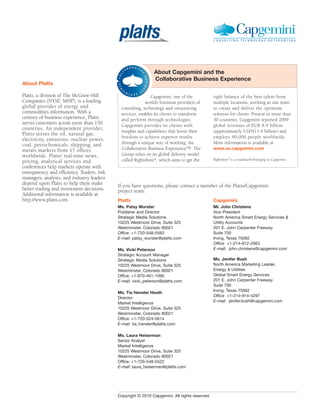
I Nearly half (45 percent) of
respondents have a smart grid
strategy in place now, and 52
percent said one is under
development. Over two-thirds
of participants also said they
expect their smart grid
strategies will change over the
next five years as a result of
evolving technologies.
I Over one third of the industry
currently reports having full
implementation of smart meters
(37 percent) and AMI
technology (35 percent). The
leading focus within smart grid
projects surrounds upgrading
security and the deployment of
Intelligent Electronic Devices
(IEDs).
I Executives predict an increase
in wind, solar, and biomass in
the overall fuel mix within the
next one year to two years.
I Over the next two years,
executives anticipate an
increase in focus in the areas
of government/regulatory
affairs, customer self-service,
risk management, customer
satisfaction and capital
expenditures.
The Obama Administration:
The First Year
Industry leaders indicated
dissatisfaction with the Obama
administration’s accomplishments
on energy policy over the past year.
Their frustration focuses on the
amount of discussion relative to
tangible and actionable solutions.
Few see the current solutions as
being satisfactory, either in scale
or feasibility. However, utility
executives did note that the
administration has succeeded in
stimulating conversation about the
energy industry in general and
sustainable solutions in particular.
They also cited the administration’s
stimulus package as a positive
accomplishment.
Top Five Industry Issues
Regulatory Uncertainty
Continues to Keep the Utility
Industry Up At Night
Executives cite uncertainty,
specifically around emissions and
carbon regulation, as the leading
issue within current regulation
concerns (75 percent of the
respondents rate the issue as either
a 9 or 10 on a 10-point scale where
10 means “Very Important” and
1 means “Not At All Important”).
Following this are concerns around
the lack of an adequate national
energy policy (52 percent) and
uncertainty about transmission
regulation (50 percent).
Concerns around the Environment
Remain of High Importance
Focus on the environment
continues to be a leading issue for
utility executives, as it has been a
concern throughout the history of
this study. Executives said building
new generation and transmission
for renewables, along with
increasing energy efficiency and
conservation programs, are the
leading current issues, (42 percent
of the respondents rate both issues
as either a 9 or 10).
Incorporation of Technology
is a Priority
The importance of incorporating
technology into utility business
operations is a leading concern for
executives. Focus on these key
current industry issues centers
around automated metering
infrastructure (47 percent rating
9 or 10), smart grid technology
(43 percent) and smart meters
(42 percent). Most participants
said their organization either has
a smart grid strategy in place (45
percent) or is currently developing
a strategy (52 percent). Over a
third of participating companies
have full implementation of smart
meters (37 percent) and AMI
systems (35 percent).
45%
Executive Summary
2009/2010Over a third of the industry has
already implemented smart meters
(37 percent) or AMI (35 percent).
Of the participating organizations,
33 percent indicated they are
in partial implementation of
additional back office systems.
Future Industry Issues:
Leaders’ Pedictions
Utility executives offered varied
points of view about the future of
the energy industry. Based on their
feedback, there will be an increase
in electricity prices for end users
(70 percent rating 9 or 10),
increasing environmental regulation
(63 percent), and increased
implementation of AMI/AMR
technology (51 percent).
Yet, only 12 percent of responding
executives expressed the belief that
there will be greater collaboration
among utility industry leaders over
the next five years to 10 years.
The study was conducted in two
phases. Phase I was qualitative and
consisted of in-depth telephone
interviews. Data for the quantitative
Phase II was collected via online
survey. A report is available
summarizing the findings for both
Phase I and Phase II. To download
the full study results go to:
www.us.capgemini.com/Platts
Study
The Financial Picture –
Still Challenging
As North America continues to
climb out of the recent economic
downturn, utility executives cite
financial concerns focusing on
cost recovery (60 percent rating
9 or 10), access to capital (52
percent) and maintaining liquidity
(48 percent) as the leading
current financial issues.
End Users – Providing Satisfactory
Service for Cost and ‘Green’ Energy
In their responses about end-user
issues, the executives were most
concerned with maintaining
customer satisfaction (64 percent
rating 9 or 10), providing
consumer education about the
cost of ‘green’ energy (48 percent)
and end user’s expectations for
continued low energy costs (42
percent).
Smart Grid Technology
As the majority of the surveyed
executives incorporate smart grid
technology into their businesses,
their focus on specific smart grid
projects is most notably on
upgrading security (29 percent rate
this as a top issue) or deployment
of/upgrade to IEDs (27 percent).
Also receiving high priority
rankings are upgrading back office
systems and demand response
(both 17 percent). Over half of
executives indicated that distributed
generation is a lower-level smart-
grid priority (57 percent rating it
as a 6 or below in importance).
Platts/Capgemini Utilities Executive Study 3
Q4: Do you have a smart grid strategy?
Status of Smart Grid Strategy Expect Smart Grid Strategy to Change
Q5: Will your smart grid strategy change
over the next 5 years?
Yes
Don’t
know
No
Strategy under
development
Strategy
in place
No plans to
develop strategy
Copyright © 2010 Capgemini. All rights reserved.
If you have questions, please contact a member of the Platts/Capgemini
project team:
Platts
Ms. Patsy Wurster
Publisher and Director
Strategic Media Solutions
10225 Westmoor Drive, Suite 325
Westminster, Colorado 80021
Office: +1-720-548-5583
E-mail: patsy_wurster@platts.com
Ms. Vicki Peterson
Strategic Account Manager
Strategic Media Solutions
10225 Westmoor Drive, Suite 325
Westminster, Colorado 80021
Office: +1-970-461-1090
E-mail: vicki_peterson@platts.com
Ms. Tia Hensler Heath
Director
Market Intelligence
10225 Westmoor Drive, Suite 325
Westminster, Colorado 80021
Office: +1-720-524-5614
E-mail: tia_hensler@platts.com
Ms. Laura Heiserman
Senior Analyst
Market Intelligence
10225 Westmoor Drive, Suite 325
Westminster, Colorado 80021
Office: +1-720-548-5522
E-mail: laura_heiserman@platts.com
About Platts
Platts, a division of The McGraw-Hill
Companies (NYSE: MHP), is a leading
global provider of energy and
commodities information. With a
century of business experience, Platts
serves customers across more than 150
countries. An independent provider,
Platts serves the oil, natural gas,
electricity, emissions, nuclear power,
coal, petrochemicals, shipping, and
metals markets from 17 offices
worldwide. Platts' real-time news,
pricing, analytical services and
conferences help markets operate with
transparency and efficiency. Traders, risk
managers, analysts, and industry leaders
depend upon Platts to help them make
better trading and investment decisions.
Additional information is available at
http://www.platts.com. Capgemini
Mr. John Christens
Vice President
North America Smart Energy Services &
Utility Accounts
201 E. John Carpenter Freeway
Suite 700
Irving, Texas 75062
Office +1-214-812-2063
E-mail: john.christens@capgemini.com
Ms. Jenifer Bush
North America Marketing Leader,
Energy & Utilities
Global Smart Energy Services
201 E. John Carpenter Freeway
Suite 700
Irving, Texas 75062
Office +1-214-914-4297
E-mail: jenifer.bush@capgemini.com
Capgemini, one of the
world’s foremost providers of
consulting, technology and outsourcing
services, enables its clients to transform
and perform through technologies.
Capgemini provides its clients with
insights and capabilities that boost their
freedom to achieve superior results
through a unique way of working, the
Collaborative Business Experience™. The
Group relies on its global delivery model
called Rightshore®
, which aims to get the
right balance of the best talent from
multiple locations, working as one team
to create and deliver the optimum
solution for clients. Present in more than
30 countries, Capgemini reported 2009
global revenues of EUR 8.4 billion
(approximately USD$11.6 billion) and
employs 90,000 people worldwide.
More information is available at
www.us.capgemini.com
Rightshore®
is a trademark belonging to Capgemini.
About Capgemini and the
Collaborative Business Experience
®®

Platts_Capgemini_UtilityExecutiveStudy_ExecSummary_051810

  • 1.
    the future ofthe energy industry, (3) measure the steps utility companies are taking to prepare for the future, and (4) gauge perceptions about the Obama administration’s impact on the industry. Based on the study data, the key findings are revealed below. Key Findings I Eighty percent of the survey respondents said they are not satisfied with the Obama administration’s performance in the area of energy policy over the last year. I The five most critical issues facing the energy industry today are regulation, the environment, technology, finance and end users. Eight out of ten North American utility executives are not satisfied with President Obama’s first-year performance on energy issues, according to a new utility industry survey. Findings also reveal that executives believe the industry’s greatest challenges are uncertain legislation, the environment, incorporating new technology, finance and variable consumer demand. Although these are similar to the issues that the executives have identified in the past several years of the study, the latest Platts/Capgemini Utilities Executive Study finds that because of their continued uncertainty about the global economy, the executives are more focused than ever before on meeting the challenges. Completed in March 2010, the study of over 100 senior utility executives from the North American electric and natural gas industry was developed by Platts and Capgemini to (1) identify and prioritize current industry trends, (2) assess opinions about Platts/Capgemini Utilities Executive Study Executive Summary 2009/2010
  • 2.
    of respondents have asmart grid strategy in place now, and 52 percent said one is under development. Over two-thirds of participants also said they expect their smart grid strategies will change over the next five years as a result of evolving technologies. 2 I Over the past year, executives increased their focus on regulation, the environment and technology. In the coming year, they expect their attention to increase especially around governmental/regulatory affairs. I Most utility executives anticipate an increase in electricity prices for end users, as well as increasing environmental regulation over the next five years to 10 years. I Nearly half (45 percent) of respondents have a smart grid strategy in place now, and 52 percent said one is under development. Over two-thirds of participants also said they expect their smart grid strategies will change over the next five years as a result of evolving technologies. I Over one third of the industry currently reports having full implementation of smart meters (37 percent) and AMI technology (35 percent). The leading focus within smart grid projects surrounds upgrading security and the deployment of Intelligent Electronic Devices (IEDs). I Executives predict an increase in wind, solar, and biomass in the overall fuel mix within the next one year to two years. I Over the next two years, executives anticipate an increase in focus in the areas of government/regulatory affairs, customer self-service, risk management, customer satisfaction and capital expenditures. The Obama Administration: The First Year Industry leaders indicated dissatisfaction with the Obama administration’s accomplishments on energy policy over the past year. Their frustration focuses on the amount of discussion relative to tangible and actionable solutions. Few see the current solutions as being satisfactory, either in scale or feasibility. However, utility executives did note that the administration has succeeded in stimulating conversation about the energy industry in general and sustainable solutions in particular. They also cited the administration’s stimulus package as a positive accomplishment. Top Five Industry Issues Regulatory Uncertainty Continues to Keep the Utility Industry Up At Night Executives cite uncertainty, specifically around emissions and carbon regulation, as the leading issue within current regulation concerns (75 percent of the respondents rate the issue as either a 9 or 10 on a 10-point scale where 10 means “Very Important” and 1 means “Not At All Important”). Following this are concerns around the lack of an adequate national energy policy (52 percent) and uncertainty about transmission regulation (50 percent). Concerns around the Environment Remain of High Importance Focus on the environment continues to be a leading issue for utility executives, as it has been a concern throughout the history of this study. Executives said building new generation and transmission for renewables, along with increasing energy efficiency and conservation programs, are the leading current issues, (42 percent of the respondents rate both issues as either a 9 or 10). Incorporation of Technology is a Priority The importance of incorporating technology into utility business operations is a leading concern for executives. Focus on these key current industry issues centers around automated metering infrastructure (47 percent rating 9 or 10), smart grid technology (43 percent) and smart meters (42 percent). Most participants said their organization either has a smart grid strategy in place (45 percent) or is currently developing a strategy (52 percent). Over a third of participating companies have full implementation of smart meters (37 percent) and AMI systems (35 percent). 45%
  • 3.
    Executive Summary 2009/2010Over athird of the industry has already implemented smart meters (37 percent) or AMI (35 percent). Of the participating organizations, 33 percent indicated they are in partial implementation of additional back office systems. Future Industry Issues: Leaders’ Pedictions Utility executives offered varied points of view about the future of the energy industry. Based on their feedback, there will be an increase in electricity prices for end users (70 percent rating 9 or 10), increasing environmental regulation (63 percent), and increased implementation of AMI/AMR technology (51 percent). Yet, only 12 percent of responding executives expressed the belief that there will be greater collaboration among utility industry leaders over the next five years to 10 years. The study was conducted in two phases. Phase I was qualitative and consisted of in-depth telephone interviews. Data for the quantitative Phase II was collected via online survey. A report is available summarizing the findings for both Phase I and Phase II. To download the full study results go to: www.us.capgemini.com/Platts Study The Financial Picture – Still Challenging As North America continues to climb out of the recent economic downturn, utility executives cite financial concerns focusing on cost recovery (60 percent rating 9 or 10), access to capital (52 percent) and maintaining liquidity (48 percent) as the leading current financial issues. End Users – Providing Satisfactory Service for Cost and ‘Green’ Energy In their responses about end-user issues, the executives were most concerned with maintaining customer satisfaction (64 percent rating 9 or 10), providing consumer education about the cost of ‘green’ energy (48 percent) and end user’s expectations for continued low energy costs (42 percent). Smart Grid Technology As the majority of the surveyed executives incorporate smart grid technology into their businesses, their focus on specific smart grid projects is most notably on upgrading security (29 percent rate this as a top issue) or deployment of/upgrade to IEDs (27 percent). Also receiving high priority rankings are upgrading back office systems and demand response (both 17 percent). Over half of executives indicated that distributed generation is a lower-level smart- grid priority (57 percent rating it as a 6 or below in importance). Platts/Capgemini Utilities Executive Study 3 Q4: Do you have a smart grid strategy? Status of Smart Grid Strategy Expect Smart Grid Strategy to Change Q5: Will your smart grid strategy change over the next 5 years? Yes Don’t know No Strategy under development Strategy in place No plans to develop strategy
  • 4.
    Copyright © 2010Capgemini. All rights reserved. If you have questions, please contact a member of the Platts/Capgemini project team: Platts Ms. Patsy Wurster Publisher and Director Strategic Media Solutions 10225 Westmoor Drive, Suite 325 Westminster, Colorado 80021 Office: +1-720-548-5583 E-mail: patsy_wurster@platts.com Ms. Vicki Peterson Strategic Account Manager Strategic Media Solutions 10225 Westmoor Drive, Suite 325 Westminster, Colorado 80021 Office: +1-970-461-1090 E-mail: vicki_peterson@platts.com Ms. Tia Hensler Heath Director Market Intelligence 10225 Westmoor Drive, Suite 325 Westminster, Colorado 80021 Office: +1-720-524-5614 E-mail: tia_hensler@platts.com Ms. Laura Heiserman Senior Analyst Market Intelligence 10225 Westmoor Drive, Suite 325 Westminster, Colorado 80021 Office: +1-720-548-5522 E-mail: laura_heiserman@platts.com About Platts Platts, a division of The McGraw-Hill Companies (NYSE: MHP), is a leading global provider of energy and commodities information. With a century of business experience, Platts serves customers across more than 150 countries. An independent provider, Platts serves the oil, natural gas, electricity, emissions, nuclear power, coal, petrochemicals, shipping, and metals markets from 17 offices worldwide. Platts' real-time news, pricing, analytical services and conferences help markets operate with transparency and efficiency. Traders, risk managers, analysts, and industry leaders depend upon Platts to help them make better trading and investment decisions. Additional information is available at http://www.platts.com. Capgemini Mr. John Christens Vice President North America Smart Energy Services & Utility Accounts 201 E. John Carpenter Freeway Suite 700 Irving, Texas 75062 Office +1-214-812-2063 E-mail: john.christens@capgemini.com Ms. Jenifer Bush North America Marketing Leader, Energy & Utilities Global Smart Energy Services 201 E. John Carpenter Freeway Suite 700 Irving, Texas 75062 Office +1-214-914-4297 E-mail: jenifer.bush@capgemini.com Capgemini, one of the world’s foremost providers of consulting, technology and outsourcing services, enables its clients to transform and perform through technologies. Capgemini provides its clients with insights and capabilities that boost their freedom to achieve superior results through a unique way of working, the Collaborative Business Experience™. The Group relies on its global delivery model called Rightshore® , which aims to get the right balance of the best talent from multiple locations, working as one team to create and deliver the optimum solution for clients. Present in more than 30 countries, Capgemini reported 2009 global revenues of EUR 8.4 billion (approximately USD$11.6 billion) and employs 90,000 people worldwide. More information is available at www.us.capgemini.com Rightshore® is a trademark belonging to Capgemini. About Capgemini and the Collaborative Business Experience ®®