INTRODUCTION
• Plastics aresynthetic materials composed of polymers, which are large molecules made up of repeating units
called monomers.
• These subunits, called monomers, are chemically bonded together to form long chains or networks, resulting
in a wide range of plastic materials with diverse properties.
• These materials can be molded, shaped, or formed into various objects, offering versatility in applications
across industries.
• Plastics play a crucial role due to their lightweight nature, durability, and versatility.
• They are extensively used in aircraft construction, interiors, and components, contributing to fuel efficiency,
performance, and safety.
• Plastics can be molded, shaped, or extruded into various forms, including films, fibers, and solid objects.
3.
TYPES OF PLASTICS
THERMOPLASTIC
• Thermoplastics are plastics that soften when heated
and solidify when cooled, allowing them to be
reshaped and reused
• They offer flexibility and ease of processing,
making them suitable for various aviation
applications.
• Formed by additional polymerization.
• Have low molecular weight and are soft, weak,
brittle.
• Examples include Polycarbonate, Polyethylene,
Polypropylene etc.
THERMO SETTING PLASTIC
• Thermosetting plastics undergo a chemical reaction
during curing, irreversibly hardening into a rigid
form.
• They offer high strength, heat resistance, and
dimensional stability, making them ideal for
structural components in aircraft.
• Formed by condensation polymerization.
• Have high molecular weight and are hard, strong,
more brittle.
• Epoxy Resins, Phenolic Resins, Polyurethane.
4.
THERMOPLASTIC - POLYCARBONATE
•High Impact Resistance: Polycarbonate exhibits remarkable
toughness, making it capable of withstanding significant force
without breaking. This property is essential for ensuring the safety
and integrity of aircraft windows and windshields.
• Transparency: Polycarbonate offers exceptional clarity, allowing for
excellent visibility through windows and windshields.
• Lightweight Nature: Despite its strength, polycarbonate is
lightweight, contributing to fuel efficiency and overall weight
reduction in aircraft.
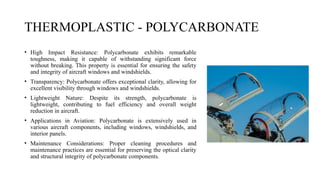
• Applications in Aviation: Polycarbonate is extensively used in
various aircraft components, including windows, windshields, and
interior panels.
• Maintenance Considerations: Proper cleaning procedures and
maintenance practices are essential for preserving the optical clarity
and structural integrity of polycarbonate components.
5.
POLYETHYLENE AND POLYPROPYLENE
•Lightweight Properties: Polyethylene and polypropylene are both
lightweight thermoplastics, contributing to fuel efficiency and
weight reduction in aircraft.
• Chemical Resistance: These plastics offer excellent resistance to
various chemicals, including aviation fuels, oils, and hydraulic
fluids.
• Applications: Used in a wide range of aircraft components,
including cable insulation, tubing, and containers. Their versatility
and resistance to corrosion make them suitable for diverse aviation
applications.
• Repair Techniques: Fusion welding techniques can be employed to
repair damaged polyethylene and polypropylene components,
ensuring structural integrity and performance.
• Maintenance: Proper storage and handling procedures are essential
to prevent degradation of polyethylene and polypropylene materials.
6.
EPOXY RESINS
• HighStrength: Epoxy resins offer exceptional strength and mechanical
properties, making them ideal for load-bearing applications in aircraft structures.
• Adhesion: Epoxy resins exhibit excellent adhesion to various substrates,
including metals, composites, and plastics. This adhesive property allows for
strong bonds between different materials, enhancing the reliability and durability
of bonded joints.
• Applications: Used in aircraft composite structures, such as fuselage panels,
wings, and interior components. They serve as matrix materials for reinforcing
fibers, providing strength, stiffness, and impact resistance to composite
laminates.
• Repair Procedures: Surface Preparation: Proper surface cleaning and roughening
are essential to ensure optimal adhesion of epoxy resin during repairs.
• Resin Application and Curing: Epoxy resin is applied to damaged areas,
followed by curing to achieve full strength and bonding.
7.
PHENOLIC RESINS
• FireResistance: Phenolic resins are known for their exceptional fire resistance, making them essential for
applications requiring compliance with stringent aviation safety regulations.
• High-Temperature Stability: These resins offer stability at high temperatures, making them suitable for use
in aircraft components exposed to elevated operating conditions.
• Insulation Properties: Phenolic resins exhibit excellent electrical insulation properties, making them ideal
for use in aircraft interior panels and electronic components.
• Lightweight Construction: Despite their high performance in fire resistance and thermal stability, phenolic
resins maintain a lightweight profile, contributing to overall fuel efficiency in aviation.
• Applications: Utilized in aircraft interior panels, insulation materials, and fire-resistant components,
ensuring safety and reliability in aircraft operation.
8.
POLYURETHANE
• Sealant Properties:Polyurethane is widely used as a sealant in aviation for its ability to create durable
and flexible seals, preventing water ingress and air leaks in aircraft structures.
• Adhesive Capabilities: Polyurethane adhesives offer strong bonding properties, allowing for reliable
adhesion of aircraft components and structures.
• Weather Resistance: Polyurethane exhibits excellent resistance to weathering, UV radiation, and
temperature fluctuations, ensuring long-term performance in diverse environmental conditions.
• Applications: Polyurethane is utilized in various aviation applications, including sealants, adhesives,
coatings, and insulation materials, due to its versatility and adaptability.
• Maintenance Advantages: Polyurethane-based products facilitate efficient maintenance and repair
operations in aviation, providing durable solutions for sealing, bonding, and protection of aircraft
components.
9.
MAINTAINANCE AND REPAIR
•Surface Inspection: Regularly inspect plastic components for signs of damage, wear, or degradation to
identify areas requiring maintenance or repair.
• Cleaning Procedures: Use appropriate cleaning agents and techniques to remove dirt, grease, or contaminants
from plastic surfaces before repair.
• Repair Materials: Ensure compatibility between repair materials and the type of plastic being repaired to
achieve optimal adhesion and performance.
• Proper Tools and Equipment: Utilize specialized tools and equipment designed for plastic maintenance and
repair to achieve precise and effective results.
• Quality Assurance: Implement quality control measures to verify the effectiveness of repairs and ensure that
repaired components meet safety and performance standards.
10.
INSPECTION METHODS
• VisualInspection: Conduct a visual examination of plastic components to identify surface defects,
discoloration, cracks, or other visible signs of damage.
• Ultrasonic Testing: Utilize ultrasonic waves to detect internal defects or delamination within plastic
structures, providing insights into their integrity without damaging the material.
• Dye Penetrant Inspection: Apply a dye penetrant to the surface of the plastic and observe for any indications
of surface cracks or defects after the excess penetrant is removed.
• Thermal Imaging: Use infrared thermography to detect variations in temperature across the surface of plastic
components, which can indicate areas of potential damage or degradation.
• Material Analysis: Perform material testing and analysis, such as spectroscopy or microscopy, to assess the
chemical composition and structural integrity of plastic materials, aiding in identifying potential issues and
determining appropriate repair methods.