 A new material developed by
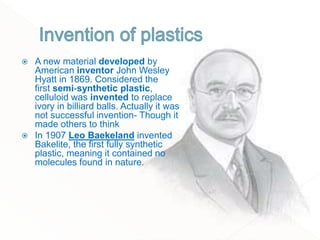
American inventor John Wesley
Hyatt in 1869. Considered the
first semi-synthetic plastic,
celluloid was invented to replace
ivory in billiard balls. Actually it was
not successful invention- Though it
made others to think
 In 1907 Leo Baekeland invented
Bakelite, the first fully synthetic
plastic, meaning it contained no
molecules found in nature.
 Plastics are a wide range of synthetic or semi-
synthetic organic compounds that are malleable
and so can be molded into solid objects.
 This plastic's melting point is 170 degrees
Celsius (338 degrees Fahrenheit).
 Plasticity is the general property of all materials
which can deform irreversibly without breaking
but, in the class of moldable polymers, this
occurs to such a degree that their actual name
derives from this specific ability.
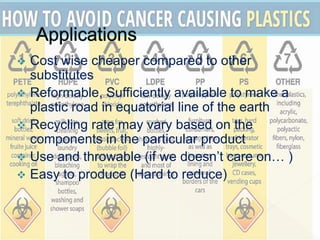
 Cost wise cheaper compared to other
substitutes
 Reformable, Sufficiently available to make a
plastic road in equatorial line of the earth
 Recycling rate may vary based on the
components in the particular product
 Use and throwable (if we doesn’t care on… )
 Easy to produce (Hard to reduce)
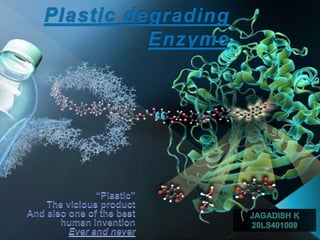
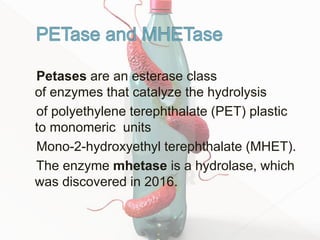
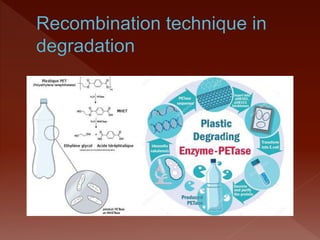
Petases are an esterase class
of enzymes that catalyze the hydrolysis
of polyethylene terephthalate (PET) plastic
to monomeric units
Mono-2-hydroxyethyl terephthalate (MHET).
The enzyme mhetase is a hydrolase, which
was discovered in 2016.
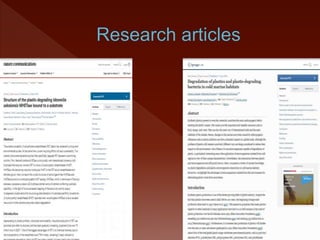
 www.pnas.org
 www.nature.com
 https://www.research-in-Germany.org
 https://www.sciencedirect.com
 https://www.uniprot.organization

Plastic degrading enzyme pet

  • 2.
     A newmaterial developed by American inventor John Wesley Hyatt in 1869. Considered the first semi-synthetic plastic, celluloid was invented to replace ivory in billiard balls. Actually it was not successful invention- Though it made others to think  In 1907 Leo Baekeland invented Bakelite, the first fully synthetic plastic, meaning it contained no molecules found in nature.
  • 3.
     Plastics area wide range of synthetic or semi- synthetic organic compounds that are malleable and so can be molded into solid objects.  This plastic's melting point is 170 degrees Celsius (338 degrees Fahrenheit).  Plasticity is the general property of all materials which can deform irreversibly without breaking but, in the class of moldable polymers, this occurs to such a degree that their actual name derives from this specific ability.
  • 6.
     Cost wisecheaper compared to other substitutes  Reformable, Sufficiently available to make a plastic road in equatorial line of the earth  Recycling rate may vary based on the components in the particular product  Use and throwable (if we doesn’t care on… )  Easy to produce (Hard to reduce)
  • 8.
    Petases are anesterase class of enzymes that catalyze the hydrolysis of polyethylene terephthalate (PET) plastic to monomeric units Mono-2-hydroxyethyl terephthalate (MHET). The enzyme mhetase is a hydrolase, which was discovered in 2016.
  • 13.
     www.pnas.org  www.nature.com https://www.research-in-Germany.org  https://www.sciencedirect.com  https://www.uniprot.organization