geetika.b.saluja@gmail.com
Rethinking a way to live responsibly in the modern world
using sustainable plastic technology in packaging industry
and to create demand for global regulation and
commercialization of end to life plastics making, it a
sustainable resource.
Different Approaches to the Flow of Plastic – A Sustainable Resource in the
Modern World
Dr. Geetika Saluja
Mr. Purvish Patel
geetika.b.saluja@gmail.com
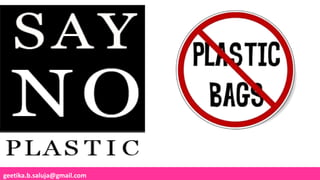
PLASTC BAG BAN MAP:
http://www.factorydirectpromos.com/plastic-bag-bans
geetika.b.saluja@gmail.com
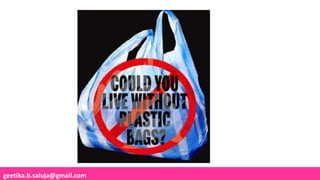
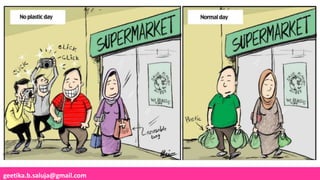
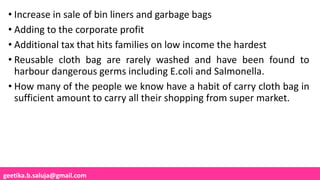
• Increase in sale of bin liners and garbage bags
• Adding to the corporate profit
• Additional tax that hits families on low income the hardest
• Reusable cloth bag are rarely washed and have been found to
harbour dangerous germs including E.coli and Salmonella.
• How many of the people we know have a habit of carry cloth bag in
sufficient amount to carry all their shopping from super market.
geetika.b.saluja@gmail.com
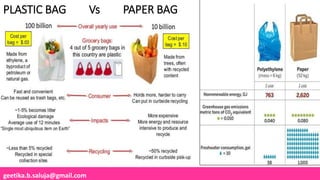
PLASTIC BAG Vs PAPER BAG
geetika.b.saluja@gmail.com
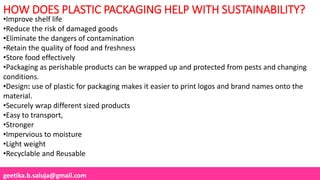
•Improve shelf life
•Reduce the risk of damaged goods
•Eliminate the dangers of contamination
•Retain the quality of food and freshness
•Store food effectively
•Packaging as perishable products can be wrapped up and protected from pests and changing
conditions.
•Design: use of plastic for packaging makes it easier to print logos and brand names onto the
material.
•Securely wrap different sized products
•Easy to transport,
•Stronger
•Impervious to moisture
•Light weight
•Recyclable and Reusable
HOW DOES PLASTIC PACKAGING HELP WITH SUSTAINABILITY?
geetika.b.saluja@gmail.com
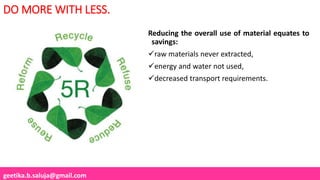
DO MORE WITH LESS.
Reducing the overall use of material equates to
savings:
raw materials never extracted,
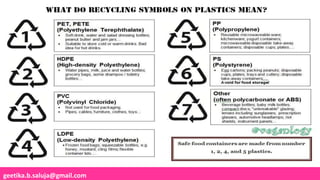
energy and water not used,
decreased transport requirements.
geetika.b.saluja@gmail.com
DO MORE WITH LESS.
• 2 pounds of plastics can deliver roughly 10 gallons of beverages...
compared to three pounds of aluminum,
eight pounds of steel
more than 40 pounds of glass.
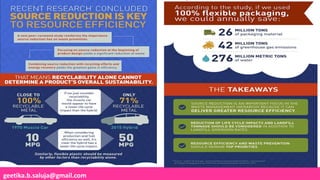
Lighter packaging means less fuel is used in shipping.
For example, plastic bags require less total energy to produce than paper bags and conserve
fuel in shipping (one truckload for plastic bags versus seven for paper).
geetika.b.saluja@gmail.com
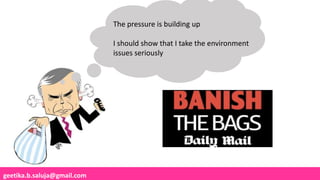
The pressure is building up
I should show that I take the environment
issues seriously
geetika.b.saluja@gmail.com
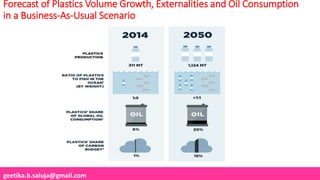
Forecast of Plastics Volume Growth, Externalities and Oil Consumption
in a Business-As-Usual Scenario
geetika.b.saluja@gmail.com
Need to break the “dispose, remove & forget,”
mindset and move to “capture, harness & re-
purpose”
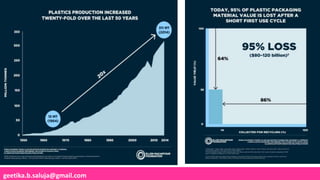
Virtually every piece of plastic has been touched
by a human hand, and this is not the case with
carbon or air pollution inputs.
geetika.b.saluja@gmail.com
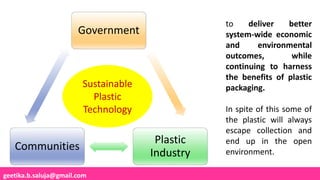
Government
Plastic
Industry
Communities
Sustainable
Plastic
Technology
to deliver better
system-wide economic
and environmental
outcomes, while
continuing to harness
the benefits of plastic
packaging.
In spite of this some of
the plastic will always
escape collection and
end up in the open
environment.
geetika.b.saluja@gmail.com
Sustainable plastic technologies broadly fall into four types
1. Biodegradable plastics made from traditional
petrochemicals, which are engineered to break down more
quickly.
2. Bioplastics made from natural materials such as corn
starch.
3. Design Eco/recycled plastics, which are simply plastics
made from recycled plastic materials rather than raw
petrochemicals.
4. Reform of plastic into liquid fuel
geetika.b.saluja@gmail.com
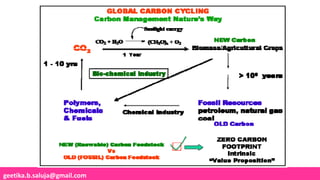
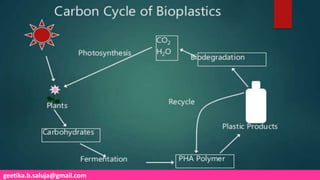
BIO PLASTICS FROM VEGETABLE BIOMASS
geetika.b.saluja@gmail.com
BIOPLASTICS CURRENT AREAS OF APPLICATION
• Compostable waste bags
• Biodegradable mulch film
• Catering products
• Film packaging for foods with short shelf life
• Rigid packaging such as containers and bottles
• In non-disposable applications including mobile phone casings, carpet fibers, insulation car interiors, fuel
lines, and plastic piping
• New electro active bioplastics are being developed that can be used to carry electric current.
• Medical implants made of PLA (polylactic acid), which dissolve in the body, can save patients a second
operation
• Modified soybean oil is used right now to make polyurethane foam for products like seating cushions and
memory foam pillows
• Many other products make use of their specific functionalities, such as tyres with starch materials
incorporated to reduce hysteresis and fuel consumption, diapers with silky soft touch, back sheet, urns
etc.
geetika.b.saluja@gmail.com
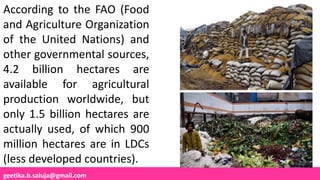
According to the FAO (Food
and Agriculture Organization
of the United Nations) and
other governmental sources,
4.2 billion hectares are
available for agricultural
production worldwide, but
only 1.5 billion hectares are
actually used, of which 900
million hectares are in LDCs
(less developed countries).
geetika.b.saluja@gmail.com
HOW ARE THE COST STRUCTURE AND COMPETITIVENESS OF
BIOPLASTICS
• High research and development costs
• High production costs caused by small scale production
• Optimisation potential of production facilities not exploited to the full
• Considerable price differential to conventional commodity products.
• Technical performance (e.g. longer product life)
• Image creation
• Reduced disposal costs in the composting of used products.
• They are less dependent on price movements in fossil resources (crude oil).
The price of bioplastics has continued to fall over the past ten years
geetika.b.saluja@gmail.com
WHY USE BIOPLASTIC OVER CONVENTIONAL PLASTIC
Growth in the market for products made from bioplastics can ensure
• the financing of the ecological advancement of the technology
• Setting up of optimized infrastructure
• more effective processes
• possible economies of scale and simultaneous increasing competition from
new market players.
geetika.b.saluja@gmail.com
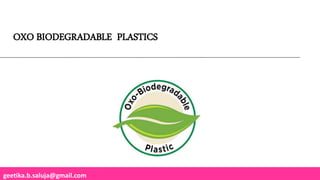
OXO BIODEGRADABLE PLASTICS
geetika.b.saluja@gmail.com
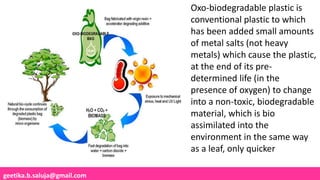
Oxo-biodegradable plastic is
conventional plastic to which
has been added small amounts
of metal salts (not heavy
metals) which cause the plastic,
at the end of its pre-
determined life (in the
presence of oxygen) to change
into a non-toxic, biodegradable
material, which is bio
assimilated into the
environment in the same way
as a leaf, only quicker
geetika.b.saluja@gmail.com
• It can be made using existing machinery and workforce
• Can be recycled into similar products if collected in a post-
consumer waste stream during its useful life.
This technology offers an insurance that if the item escapes collection, it
will degrade and biodegrade in the open environment, on land or sea,
in months rather than years.
Unlike “compostable” plastic it does not need to be taken to a
composting facility.
geetika.b.saluja@gmail.com
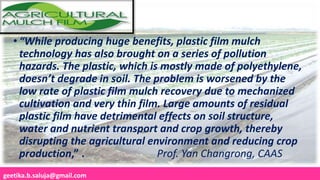
• “While producing huge benefits, plastic film mulch
technology has also brought on a series of pollution
hazards. The plastic, which is mostly made of polyethylene,
doesn’t degrade in soil. The problem is worsened by the
low rate of plastic film mulch recovery due to mechanized
cultivation and very thin film. Large amounts of residual
plastic film have detrimental effects on soil structure,
water and nutrient transport and crop growth, thereby
disrupting the agricultural environment and reducing crop
production,” . Prof. Yan Changrong, CAAS
geetika.b.saluja@gmail.com
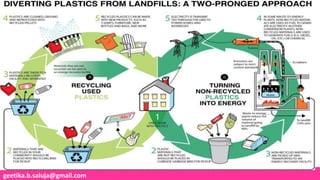
DIVERTING PLASTICS FROM LANDFILL
geetika.b.saluja@gmail.com
In its Green Paper published on 7th March 2013
the European Commission says
"From a resource efficiency perspective, it is
particularly important to prevent land filling of
plastic waste. Any land filling of plastic is an
obvious waste of resources which should be
avoided in favour of recycling, or of energy
recovery as the next best option."
geetika.b.saluja@gmail.com
ENVIRONMENTAL IMPORTANCE OF RECYCLING PLASTIC
• Harmful chemicals and greenhouse gasses are released from
rubbish in landfill sites. Recycling helps to reduce the pollution
caused by waste.
• Habitat destruction and global warming are some the effects
caused by deforestation. Recycling reduces the need for raw
materials so that the rainforests can be preserved.
• Huge amounts of energy are used when making products from
raw materials. Recycling requires much less energy and therefore
helps to preserve natural resources.
geetika.b.saluja@gmail.com
IMPORTANCE TO PEOPLE
•No space for waste. Our landfill sites are filling up fast. .
•Reduce financial expenditure in the economy. Making
products from raw materials costs much more than if
they were made from recycled products.
•Preserve natural resources for future generations.
Recycling reduces the need for raw materials; it also
uses less energy, therefore preserving natural resources
for the future.
geetika.b.saluja@gmail.com
SOME INTERESTING FACTS ABOUT RECYCLING
• Up to 60% of the rubbish that ends up in the dustbin could be
recycled.
• The unreleased energy contained in the average dustbin each
year could power a television for 5,000 hours.
• On average, 16% of the money you spend on a product pays for
the packaging, which ultimately ends up as rubbish.
• As much as 50% of waste in the average dustbin could be
composted.
• Up to 80% of a vehicle can be recycled.
geetika.b.saluja@gmail.com
SOME INTERESTING FACTS ABOUT RECYCLING
• 9 out of 10 people would recycle more if it were made easier.
• 1 recycled tin can would save enough energy to power a
television for 3 hours.
• 1 recycled glass bottle would save enough energy to power a
computer for 25 minutes.
• 1 recycled plastic bottle would save enough energy to power a
60-watt light bulb for 3 hours.
• 70% less energy is required to recycle paper compared with
making it from raw materials.
geetika.b.saluja@gmail.com
BENEFITS OF A BOTTLE REFUND SCHEME
• Due to their bulk, drink containers compromise about 30% of total landfill
litter. Reducing bottles from the litter stream saves on valuable landfill space.
• Reducing the number of drink bottles from household waste reduces the local
council’s pick up and disposal cost of trash. These savings can be invested in other
ways back into the community.
• Many consumers donate their bottles to community groups such as The Scouts or
sports organizations who can raise their cash fund through bottle refunds.
• Recycling bottles into new bottles avoids using new raw materials to make the new
bottles. There are less CO2 emissions and less water used to process them.
• There are few recycling containers for drinks consumed away from home. The
implementation of a refund scheme would make it worthwhile for businesses like cafes
and restaurants who sell a lot of these bottled drinks to collect the bottles and cash
them in for the refund.
• There are a number of new jobs that are created to run and administer the scheme.
geetika.b.saluja@gmail.com
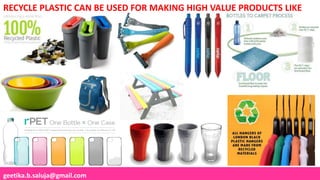
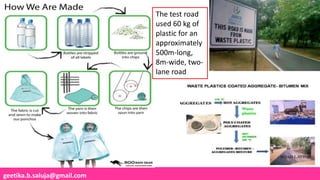
RECYCLE PLASTIC CAN BE USED FOR MAKING HIGH VALUE PRODUCTS LIKE
geetika.b.saluja@gmail.com
The test road
used 60 kg of
plastic for an
approximately
500m-long,
8m-wide, two-
lane road
geetika.b.saluja@gmail.com
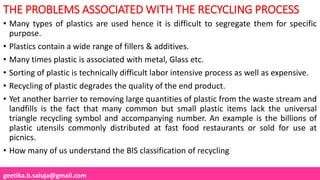
THE PROBLEMS ASSOCIATED WITH THE RECYCLING PROCESS
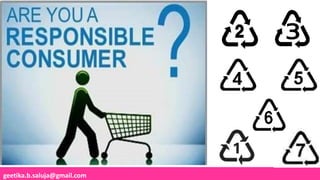
• Many types of plastics are used hence it is difficult to segregate them for specific
purpose.
• Plastics contain a wide range of fillers & additives.
• Many times plastic is associated with metal, Glass etc.
• Sorting of plastic is technically difficult labor intensive process as well as expensive.
• Recycling of plastic degrades the quality of the end product.
• Yet another barrier to removing large quantities of plastic from the waste stream and
landfills is the fact that many common but small plastic items lack the universal
triangle recycling symbol and accompanying number. An example is the billions of
plastic utensils commonly distributed at fast food restaurants or sold for use at
picnics.
• How many of us understand the BIS classification of recycling
geetika.b.saluja@gmail.com
“The MRF Material Flow Study”
• Five national trade associations representing a wide range of packaging types,
including the
1. American Chemistry Council (ACC) ,
2. Association of Postconsumer Plastics Recyclers (APR) ,
3. Carton Council of North America (CCNA) ,
4. Foodservice Packaging Institute (FPI)
5. National Association for PET Container Resources (NAPCOR) ,
joined together to commission a study to find ways to optimize the recycling of their
packaging after it goes into the bin or cart. The study specifically evaluated where
packages end up in a sorting facility, why packages flow in certain ways and what
potential changes to the sorting processes could improve recovery.
geetika.b.saluja@gmail.com
• "One such action is asking residents, and
other recycling customers, not to flatten
items before placing them in recycling
containers. The study found that three-
dimensional objects (packages in their
original form) versus two-dimensional
(flattened/crushed objects) have a higher
likelihood of making it through the system
to the appropriate container lines and
bales. This is not only a helpful finding but
an actionable one which illustrates that even
everyday actions in the home can help boost
recovery."Jim Frey, CEO of Resource
Recycling Systems (RRS)
geetika.b.saluja@gmail.com
“The MRF Material Flow Study”
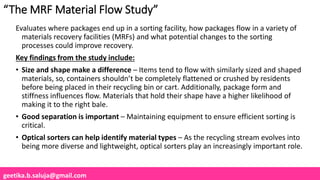
Evaluates where packages end up in a sorting facility, how packages flow in a variety of
materials recovery facilities (MRFs) and what potential changes to the sorting
processes could improve recovery.
Key findings from the study include:
• Size and shape make a difference – Items tend to flow with similarly sized and shaped
materials, so, containers shouldn’t be completely flattened or crushed by residents
before being placed in their recycling bin or cart. Additionally, package form and
stiffness influences flow. Materials that hold their shape have a higher likelihood of
making it to the right bale.
• Good separation is important – Maintaining equipment to ensure efficient sorting is
critical.
• Optical sorters can help identify material types – As the recycling stream evolves into
being more diverse and lightweight, optical sorters play an increasingly important role.
geetika.b.saluja@gmail.com
Many may not realize throwing away plastic is throwing away a ready fuel source
REFORM
geetika.b.saluja@gmail.com
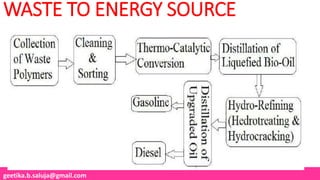
WASTE TO ENERGY SOURCE
geetika.b.saluja@gmail.com
Reform Plastic to Petrol
• Plastics get their variety and stability from strong continual, patterned
bonding of the carbon molecule. If this long chain is disrupted, they would
collapse and can be coaxed to their original form.
• Waste plastics are one of the most promising resources for fuel production
because of its high heat of combustion and due to the increasing availability
in local communities. Unlike paper and wood, plastics do not absorb much
moisture and the water content of plastics is far lower than the water content
of biomass such as crops and kitchen wastes.
• The aim of reforming is to introduce the technologies (methods) used to
convert waste plastic to fuels and to call researchers on production of fuels
from waste plastic and other related materials.
geetika.b.saluja@gmail.com
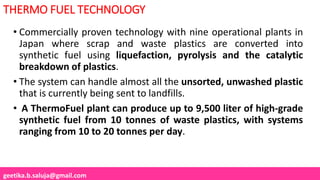
THERMO FUEL TECHNOLOGY
• Commercially proven technology with nine operational plants in
Japan where scrap and waste plastics are converted into
synthetic fuel using liquefaction, pyrolysis and the catalytic
breakdown of plastics.
• The system can handle almost all the unsorted, unwashed plastic
that is currently being sent to landfills.
• A ThermoFuel plant can produce up to 9,500 liter of high-grade
synthetic fuel from 10 tonnes of waste plastics, with systems
ranging from 10 to 20 tonnes per day.
geetika.b.saluja@gmail.com
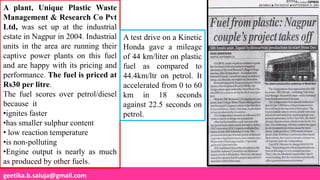
A plant, Unique Plastic Waste
Management & Research Co Pvt
Ltd, was set up at the industrial
estate in Nagpur in 2004. Industrial
units in the area are running their
captive power plants on this fuel
and are happy with its pricing and
performance. The fuel is priced at
Rs30 per litre.
The fuel scores over petrol/diesel
because it
•ignites faster
•has smaller sulphur content
• low reaction temperature
•is non-polluting
•Engine output is nearly as much
as produced by other fuels.
A test drive on a Kinetic
Honda gave a mileage
of 44 km/liter on plastic
fuel as compared to
44.4km/ltr on petrol. It
accelerated from 0 to 60
km in 18 seconds
against 22.5 seconds on
petrol.
geetika.b.saluja@gmail.com
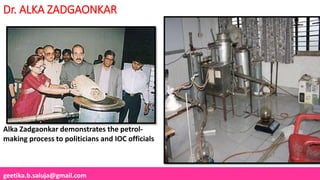
Dr. ALKA ZADGAONKAR
Alka Zadgaonkar demonstrates the petrol-
making process to politicians and IOC officials
geetika.b.saluja@gmail.com
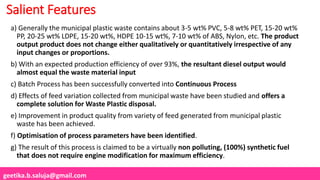
Salient Features
a) Generally the municipal plastic waste contains about 3-5 wt% PVC, 5-8 wt% PET, 15-20 wt%
PP, 20-25 wt% LDPE, 15-20 wt%, HDPE 10-15 wt%, 7-10 wt% of ABS, Nylon, etc. The product
output product does not change either qualitatively or quantitatively irrespective of any
input changes or proportions.
b) With an expected production efficiency of over 93%, the resultant diesel output would
almost equal the waste material input
c) Batch Process has been successfully converted into Continuous Process
d) Effects of feed variation collected from municipal waste have been studied and offers a
complete solution for Waste Plastic disposal.
e) Improvement in product quality from variety of feed generated from municipal plastic
waste has been achieved.
f) Optimisation of process parameters have been identified.
g) The result of this process is claimed to be a virtually non polluting, (100%) synthetic fuel
that does not require engine modification for maximum efficiency.
geetika.b.saluja@gmail.com
Benefits to the Nation
• The Thermo fuel system converts these waste plastics into high-
grade "green" distillate fuel.
• The developed technology will prove to be beneficial to the
country for the purpose of catering increasing demand of fuel /
energy and will save millions of foreign exchange.
• With the experience gained from the demonstration plant, full-
scale unit could be designed with confidence and it is expected
that such plant shall be self-sustaining without any penalty for
processing the hazardous plastic waste.
• This technology could be implemented in the various places of
our country especially in PURA (Provision of Urban Amenities to
Rural Areas )concept.
geetika.b.saluja@gmail.com
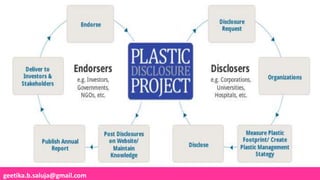
If you don't measure it, you can't manage it …
PLASTIC DISCLOSURE PROJECT
geetika.b.saluja@gmail.com
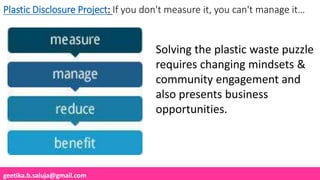
Plastic Disclosure Project: If you don't measure it, you can't manage it…
Solving the plastic waste puzzle
requires changing mindsets &
community engagement and
also presents business
opportunities.
geetika.b.saluja@gmail.com
“…enlightened buyers can make a big impact”
The costumer’s choice has shaped today's commercialized product
portfolio Their demand for high percentages of recycled content,
for example, coupled with economies of scale for resource
recovery, would mean that the circular economy can kick into gear,
creating jobs,
reducing waste,
improving brand value and reputation,
helping to stop the flow of material reaching our waters, which
today is a high percentage of plastic.
geetika.b.saluja@gmail.com
New Trends Development – PLA Packaging Films
• PLA is a new generation of Biodegradable Films made from renewable resources (PLA bio-based
resin). As an alternative to raw material based on crude oil, bio materials are increasingly being used
for the manufacturing of packaging films. Applications for PLA films will continue to increase
steadily, a fact which is especially convincing in view of the incomparably low carbon footprint.
• Advantages and Properties of PLA film:
• Made from Renewable Resources • Completely Biodegradable • High Stiffness • Resistance to Oil,
Fat & Alcohol • Impermeability to Moisture & Water Vapor • High Transparency • Exceptional
Surface Gloss • Twistable with Excellent Dead Fold • Both Sides Sealable • High Sealing Strength •
Excellent Thermoform ability & Printability, Adhesive to Paper and Board
• PLA Film Application:
• Bags for Bread & Bakeries • Packaging for Fresh Food, Cheese & Butter • Shrink Sleeve Film • High
Modulus Label Films • Twist Wrap • Envelope Windows • Plastic Folders • Packaging for Perfumes &
Cosmetics
geetika.b.saluja@gmail.com
New Trends Development – AMAF Packaging Films
• AMAF packaging, an active packaging concept, can be considered an extremely challenging
technology that could have a significant impact on shelf-life extension and product safety of various
products. Use of AMAF substances can control the microbial population and target specific
microorganisms to provide higher safety and quality products.
• Special features of AMAF:
• Unique Additive based on organic micro particles and other additives in polyethylene wax/ or as
powder.
• Imparts excellent bacterial and fungal-controlling properties on polymers surfaces.
• Human safe & Eco-friendly
• Compatible with most polymers
• Applications of AMAF:
• Plastic Industry, Food Industry & Pharmaceutical Industry
geetika.b.saluja@gmail.com
New Trends Development – VCI Films
• Vapor Corrosion Inhibitor (VCI) master batch can be blended with many polyethylene resins
(LLDPE/LDPE/HDPE/PP) to form a broad range of anti-corrosion packaging systems.
• How Does VCI Work:
• When VCI is incorporated into a polymer system or Kraft paper, the finished product offers
corrosion protection by releasing vapors which form a monomolecular protective layer on the
surface of the metal component to be protected. This protective layer remains until the package is
opened and then evaporates leaving a clean metal surface that is free of corrosion.
• Applications of VCI:
• To pack metal components like Fasteners, Bearings and other Automobile Parts
• Marine Vessels Parts & Equipment
• Pharmaceuticals & Medical Packaging
• Cover to pack Machinery for Exports
geetika.b.saluja@gmail.com
New Trends Development – Anti Ripening Films
• International organizations place food (including fruits and vegetables) loss at about 30% of
production globally. This amounts to a staggering 1.3 billion tons of food that is wasted annually
around the world. We can save this by wrapping the Fruits & Vegetables in AR Films.
• Features of AR Films:
• Superior shelf life
• Cheaper and quicker handling
• Optical Clarity
• Durability
• Printability & Form factor
• Applications of VCI:
• All types of Fruits, Vegetables & Cut Flowers
geetika.b.saluja@gmail.com
New Trends Development – Water Soluble Films
• Water soluble film is a wonder product, which looks like a normal plastic film but if we immerse it in
water, it will dissolve in that within few seconds leaving no residue behind.
• Features of Water Soluble Films:
• Safety
• Good Gas Barrier Properties
• Good Antistatic Properties
• Resistance to Oil and Chemicals
• Anti-Falsification
• Applications of VCI:
• Water Treatment Products Packaging, Biocides Packaging & Swimming Pool Chemicals Packaging
• Bathing Products Packaging & Laundry Bags For Hospitals
• Agriculture Products Packaging
geetika.b.saluja@gmail.com
TO CAPTURE MATERIAL VALUE OF UP TO $80-120BILLION IN
THE NEW PLASTIC ECOMNOMY
•Dialogue Mechanism
•Global Plastic Protocol
•Secondary market
•Technological Innovation
•Enabling Policy for global action
•Educating consumers with recycling labels and disposal
Fixing this can lead to a re-think of environmental
stewardship
geetika.b.saluja@gmail.com
Plastic Bag Ban Map
•http://www.factorydirectpromos.com/plastic-
bag-bans
geetika.b.saluja@gmail.com
Refuse… Reduce… Reform… Recycle… Upcycle
Make Plastic a sustainable resource
Thanking you
Dr Geetika Saluja

Plastic a sustianable resource

  • 1.
    geetika.b.saluja@gmail.com Rethinking a wayto live responsibly in the modern world using sustainable plastic technology in packaging industry and to create demand for global regulation and commercialization of end to life plastics making, it a sustainable resource. Different Approaches to the Flow of Plastic – A Sustainable Resource in the Modern World Dr. Geetika Saluja Mr. Purvish Patel
  • 2.
  • 3.
  • 4.
    geetika.b.saluja@gmail.com PLASTC BAG BANMAP: http://www.factorydirectpromos.com/plastic-bag-bans
  • 5.
  • 6.
  • 7.
  • 8.
    geetika.b.saluja@gmail.com • Increase insale of bin liners and garbage bags • Adding to the corporate profit • Additional tax that hits families on low income the hardest • Reusable cloth bag are rarely washed and have been found to harbour dangerous germs including E.coli and Salmonella. • How many of the people we know have a habit of carry cloth bag in sufficient amount to carry all their shopping from super market.
  • 9.
  • 10.
    geetika.b.saluja@gmail.com •Improve shelf life •Reducethe risk of damaged goods •Eliminate the dangers of contamination •Retain the quality of food and freshness •Store food effectively •Packaging as perishable products can be wrapped up and protected from pests and changing conditions. •Design: use of plastic for packaging makes it easier to print logos and brand names onto the material. •Securely wrap different sized products •Easy to transport, •Stronger •Impervious to moisture •Light weight •Recyclable and Reusable HOW DOES PLASTIC PACKAGING HELP WITH SUSTAINABILITY?
  • 11.
    geetika.b.saluja@gmail.com DO MORE WITHLESS. Reducing the overall use of material equates to savings: raw materials never extracted, energy and water not used, decreased transport requirements.
  • 12.
    geetika.b.saluja@gmail.com DO MORE WITHLESS. • 2 pounds of plastics can deliver roughly 10 gallons of beverages... compared to three pounds of aluminum, eight pounds of steel more than 40 pounds of glass. Lighter packaging means less fuel is used in shipping. For example, plastic bags require less total energy to produce than paper bags and conserve fuel in shipping (one truckload for plastic bags versus seven for paper).
  • 13.
  • 14.
  • 15.
    geetika.b.saluja@gmail.com The pressure isbuilding up I should show that I take the environment issues seriously
  • 16.
  • 17.
  • 18.
  • 19.
    geetika.b.saluja@gmail.com Forecast of PlasticsVolume Growth, Externalities and Oil Consumption in a Business-As-Usual Scenario
  • 20.
    geetika.b.saluja@gmail.com Need to breakthe “dispose, remove & forget,” mindset and move to “capture, harness & re- purpose” Virtually every piece of plastic has been touched by a human hand, and this is not the case with carbon or air pollution inputs.
  • 21.
    geetika.b.saluja@gmail.com Government Plastic Industry Communities Sustainable Plastic Technology to deliver better system-wideeconomic and environmental outcomes, while continuing to harness the benefits of plastic packaging. In spite of this some of the plastic will always escape collection and end up in the open environment.
  • 22.
    geetika.b.saluja@gmail.com Sustainable plastic technologiesbroadly fall into four types 1. Biodegradable plastics made from traditional petrochemicals, which are engineered to break down more quickly. 2. Bioplastics made from natural materials such as corn starch. 3. Design Eco/recycled plastics, which are simply plastics made from recycled plastic materials rather than raw petrochemicals. 4. Reform of plastic into liquid fuel
  • 23.
  • 24.
  • 25.
  • 26.
    geetika.b.saluja@gmail.com BIOPLASTICS CURRENT AREASOF APPLICATION • Compostable waste bags • Biodegradable mulch film • Catering products • Film packaging for foods with short shelf life • Rigid packaging such as containers and bottles • In non-disposable applications including mobile phone casings, carpet fibers, insulation car interiors, fuel lines, and plastic piping • New electro active bioplastics are being developed that can be used to carry electric current. • Medical implants made of PLA (polylactic acid), which dissolve in the body, can save patients a second operation • Modified soybean oil is used right now to make polyurethane foam for products like seating cushions and memory foam pillows • Many other products make use of their specific functionalities, such as tyres with starch materials incorporated to reduce hysteresis and fuel consumption, diapers with silky soft touch, back sheet, urns etc.
  • 27.
    geetika.b.saluja@gmail.com According to theFAO (Food and Agriculture Organization of the United Nations) and other governmental sources, 4.2 billion hectares are available for agricultural production worldwide, but only 1.5 billion hectares are actually used, of which 900 million hectares are in LDCs (less developed countries).
  • 28.
    geetika.b.saluja@gmail.com HOW ARE THECOST STRUCTURE AND COMPETITIVENESS OF BIOPLASTICS • High research and development costs • High production costs caused by small scale production • Optimisation potential of production facilities not exploited to the full • Considerable price differential to conventional commodity products. • Technical performance (e.g. longer product life) • Image creation • Reduced disposal costs in the composting of used products. • They are less dependent on price movements in fossil resources (crude oil). The price of bioplastics has continued to fall over the past ten years
  • 29.
    geetika.b.saluja@gmail.com WHY USE BIOPLASTICOVER CONVENTIONAL PLASTIC Growth in the market for products made from bioplastics can ensure • the financing of the ecological advancement of the technology • Setting up of optimized infrastructure • more effective processes • possible economies of scale and simultaneous increasing competition from new market players.
  • 30.
  • 31.
    geetika.b.saluja@gmail.com Oxo-biodegradable plastic is conventionalplastic to which has been added small amounts of metal salts (not heavy metals) which cause the plastic, at the end of its pre- determined life (in the presence of oxygen) to change into a non-toxic, biodegradable material, which is bio assimilated into the environment in the same way as a leaf, only quicker
  • 32.
    geetika.b.saluja@gmail.com • It canbe made using existing machinery and workforce • Can be recycled into similar products if collected in a post- consumer waste stream during its useful life. This technology offers an insurance that if the item escapes collection, it will degrade and biodegrade in the open environment, on land or sea, in months rather than years. Unlike “compostable” plastic it does not need to be taken to a composting facility.
  • 33.
    geetika.b.saluja@gmail.com • “While producinghuge benefits, plastic film mulch technology has also brought on a series of pollution hazards. The plastic, which is mostly made of polyethylene, doesn’t degrade in soil. The problem is worsened by the low rate of plastic film mulch recovery due to mechanized cultivation and very thin film. Large amounts of residual plastic film have detrimental effects on soil structure, water and nutrient transport and crop growth, thereby disrupting the agricultural environment and reducing crop production,” . Prof. Yan Changrong, CAAS
  • 34.
  • 35.
    geetika.b.saluja@gmail.com In its GreenPaper published on 7th March 2013 the European Commission says "From a resource efficiency perspective, it is particularly important to prevent land filling of plastic waste. Any land filling of plastic is an obvious waste of resources which should be avoided in favour of recycling, or of energy recovery as the next best option."
  • 36.
  • 37.
  • 38.
    geetika.b.saluja@gmail.com ENVIRONMENTAL IMPORTANCE OFRECYCLING PLASTIC • Harmful chemicals and greenhouse gasses are released from rubbish in landfill sites. Recycling helps to reduce the pollution caused by waste. • Habitat destruction and global warming are some the effects caused by deforestation. Recycling reduces the need for raw materials so that the rainforests can be preserved. • Huge amounts of energy are used when making products from raw materials. Recycling requires much less energy and therefore helps to preserve natural resources.
  • 39.
    geetika.b.saluja@gmail.com IMPORTANCE TO PEOPLE •Nospace for waste. Our landfill sites are filling up fast. . •Reduce financial expenditure in the economy. Making products from raw materials costs much more than if they were made from recycled products. •Preserve natural resources for future generations. Recycling reduces the need for raw materials; it also uses less energy, therefore preserving natural resources for the future.
  • 40.
    geetika.b.saluja@gmail.com SOME INTERESTING FACTSABOUT RECYCLING • Up to 60% of the rubbish that ends up in the dustbin could be recycled. • The unreleased energy contained in the average dustbin each year could power a television for 5,000 hours. • On average, 16% of the money you spend on a product pays for the packaging, which ultimately ends up as rubbish. • As much as 50% of waste in the average dustbin could be composted. • Up to 80% of a vehicle can be recycled.
  • 41.
    geetika.b.saluja@gmail.com SOME INTERESTING FACTSABOUT RECYCLING • 9 out of 10 people would recycle more if it were made easier. • 1 recycled tin can would save enough energy to power a television for 3 hours. • 1 recycled glass bottle would save enough energy to power a computer for 25 minutes. • 1 recycled plastic bottle would save enough energy to power a 60-watt light bulb for 3 hours. • 70% less energy is required to recycle paper compared with making it from raw materials.
  • 42.
    geetika.b.saluja@gmail.com BENEFITS OF ABOTTLE REFUND SCHEME • Due to their bulk, drink containers compromise about 30% of total landfill litter. Reducing bottles from the litter stream saves on valuable landfill space. • Reducing the number of drink bottles from household waste reduces the local council’s pick up and disposal cost of trash. These savings can be invested in other ways back into the community. • Many consumers donate their bottles to community groups such as The Scouts or sports organizations who can raise their cash fund through bottle refunds. • Recycling bottles into new bottles avoids using new raw materials to make the new bottles. There are less CO2 emissions and less water used to process them. • There are few recycling containers for drinks consumed away from home. The implementation of a refund scheme would make it worthwhile for businesses like cafes and restaurants who sell a lot of these bottled drinks to collect the bottles and cash them in for the refund. • There are a number of new jobs that are created to run and administer the scheme.
  • 43.
    geetika.b.saluja@gmail.com RECYCLE PLASTIC CANBE USED FOR MAKING HIGH VALUE PRODUCTS LIKE
  • 44.
    geetika.b.saluja@gmail.com The test road used60 kg of plastic for an approximately 500m-long, 8m-wide, two- lane road
  • 45.
    geetika.b.saluja@gmail.com THE PROBLEMS ASSOCIATEDWITH THE RECYCLING PROCESS • Many types of plastics are used hence it is difficult to segregate them for specific purpose. • Plastics contain a wide range of fillers & additives. • Many times plastic is associated with metal, Glass etc. • Sorting of plastic is technically difficult labor intensive process as well as expensive. • Recycling of plastic degrades the quality of the end product. • Yet another barrier to removing large quantities of plastic from the waste stream and landfills is the fact that many common but small plastic items lack the universal triangle recycling symbol and accompanying number. An example is the billions of plastic utensils commonly distributed at fast food restaurants or sold for use at picnics. • How many of us understand the BIS classification of recycling
  • 46.
    geetika.b.saluja@gmail.com “The MRF MaterialFlow Study” • Five national trade associations representing a wide range of packaging types, including the 1. American Chemistry Council (ACC) , 2. Association of Postconsumer Plastics Recyclers (APR) , 3. Carton Council of North America (CCNA) , 4. Foodservice Packaging Institute (FPI) 5. National Association for PET Container Resources (NAPCOR) , joined together to commission a study to find ways to optimize the recycling of their packaging after it goes into the bin or cart. The study specifically evaluated where packages end up in a sorting facility, why packages flow in certain ways and what potential changes to the sorting processes could improve recovery.
  • 47.
    geetika.b.saluja@gmail.com • "One suchaction is asking residents, and other recycling customers, not to flatten items before placing them in recycling containers. The study found that three- dimensional objects (packages in their original form) versus two-dimensional (flattened/crushed objects) have a higher likelihood of making it through the system to the appropriate container lines and bales. This is not only a helpful finding but an actionable one which illustrates that even everyday actions in the home can help boost recovery."Jim Frey, CEO of Resource Recycling Systems (RRS)
  • 48.
    geetika.b.saluja@gmail.com “The MRF MaterialFlow Study” Evaluates where packages end up in a sorting facility, how packages flow in a variety of materials recovery facilities (MRFs) and what potential changes to the sorting processes could improve recovery. Key findings from the study include: • Size and shape make a difference – Items tend to flow with similarly sized and shaped materials, so, containers shouldn’t be completely flattened or crushed by residents before being placed in their recycling bin or cart. Additionally, package form and stiffness influences flow. Materials that hold their shape have a higher likelihood of making it to the right bale. • Good separation is important – Maintaining equipment to ensure efficient sorting is critical. • Optical sorters can help identify material types – As the recycling stream evolves into being more diverse and lightweight, optical sorters play an increasingly important role.
  • 49.
    geetika.b.saluja@gmail.com Many may notrealize throwing away plastic is throwing away a ready fuel source REFORM
  • 50.
  • 51.
    geetika.b.saluja@gmail.com Reform Plastic toPetrol • Plastics get their variety and stability from strong continual, patterned bonding of the carbon molecule. If this long chain is disrupted, they would collapse and can be coaxed to their original form. • Waste plastics are one of the most promising resources for fuel production because of its high heat of combustion and due to the increasing availability in local communities. Unlike paper and wood, plastics do not absorb much moisture and the water content of plastics is far lower than the water content of biomass such as crops and kitchen wastes. • The aim of reforming is to introduce the technologies (methods) used to convert waste plastic to fuels and to call researchers on production of fuels from waste plastic and other related materials.
  • 52.
    geetika.b.saluja@gmail.com THERMO FUEL TECHNOLOGY •Commercially proven technology with nine operational plants in Japan where scrap and waste plastics are converted into synthetic fuel using liquefaction, pyrolysis and the catalytic breakdown of plastics. • The system can handle almost all the unsorted, unwashed plastic that is currently being sent to landfills. • A ThermoFuel plant can produce up to 9,500 liter of high-grade synthetic fuel from 10 tonnes of waste plastics, with systems ranging from 10 to 20 tonnes per day.
  • 53.
    geetika.b.saluja@gmail.com A plant, UniquePlastic Waste Management & Research Co Pvt Ltd, was set up at the industrial estate in Nagpur in 2004. Industrial units in the area are running their captive power plants on this fuel and are happy with its pricing and performance. The fuel is priced at Rs30 per litre. The fuel scores over petrol/diesel because it •ignites faster •has smaller sulphur content • low reaction temperature •is non-polluting •Engine output is nearly as much as produced by other fuels. A test drive on a Kinetic Honda gave a mileage of 44 km/liter on plastic fuel as compared to 44.4km/ltr on petrol. It accelerated from 0 to 60 km in 18 seconds against 22.5 seconds on petrol.
  • 54.
    geetika.b.saluja@gmail.com Dr. ALKA ZADGAONKAR AlkaZadgaonkar demonstrates the petrol- making process to politicians and IOC officials
  • 55.
    geetika.b.saluja@gmail.com Salient Features a) Generallythe municipal plastic waste contains about 3-5 wt% PVC, 5-8 wt% PET, 15-20 wt% PP, 20-25 wt% LDPE, 15-20 wt%, HDPE 10-15 wt%, 7-10 wt% of ABS, Nylon, etc. The product output product does not change either qualitatively or quantitatively irrespective of any input changes or proportions. b) With an expected production efficiency of over 93%, the resultant diesel output would almost equal the waste material input c) Batch Process has been successfully converted into Continuous Process d) Effects of feed variation collected from municipal waste have been studied and offers a complete solution for Waste Plastic disposal. e) Improvement in product quality from variety of feed generated from municipal plastic waste has been achieved. f) Optimisation of process parameters have been identified. g) The result of this process is claimed to be a virtually non polluting, (100%) synthetic fuel that does not require engine modification for maximum efficiency.
  • 56.
    geetika.b.saluja@gmail.com Benefits to theNation • The Thermo fuel system converts these waste plastics into high- grade "green" distillate fuel. • The developed technology will prove to be beneficial to the country for the purpose of catering increasing demand of fuel / energy and will save millions of foreign exchange. • With the experience gained from the demonstration plant, full- scale unit could be designed with confidence and it is expected that such plant shall be self-sustaining without any penalty for processing the hazardous plastic waste. • This technology could be implemented in the various places of our country especially in PURA (Provision of Urban Amenities to Rural Areas )concept.
  • 57.
    geetika.b.saluja@gmail.com If you don'tmeasure it, you can't manage it … PLASTIC DISCLOSURE PROJECT
  • 58.
    geetika.b.saluja@gmail.com Plastic Disclosure Project:If you don't measure it, you can't manage it… Solving the plastic waste puzzle requires changing mindsets & community engagement and also presents business opportunities.
  • 59.
  • 60.
  • 61.
    geetika.b.saluja@gmail.com “…enlightened buyers canmake a big impact” The costumer’s choice has shaped today's commercialized product portfolio Their demand for high percentages of recycled content, for example, coupled with economies of scale for resource recovery, would mean that the circular economy can kick into gear, creating jobs, reducing waste, improving brand value and reputation, helping to stop the flow of material reaching our waters, which today is a high percentage of plastic.
  • 62.
    geetika.b.saluja@gmail.com New Trends Development– PLA Packaging Films • PLA is a new generation of Biodegradable Films made from renewable resources (PLA bio-based resin). As an alternative to raw material based on crude oil, bio materials are increasingly being used for the manufacturing of packaging films. Applications for PLA films will continue to increase steadily, a fact which is especially convincing in view of the incomparably low carbon footprint. • Advantages and Properties of PLA film: • Made from Renewable Resources • Completely Biodegradable • High Stiffness • Resistance to Oil, Fat & Alcohol • Impermeability to Moisture & Water Vapor • High Transparency • Exceptional Surface Gloss • Twistable with Excellent Dead Fold • Both Sides Sealable • High Sealing Strength • Excellent Thermoform ability & Printability, Adhesive to Paper and Board • PLA Film Application: • Bags for Bread & Bakeries • Packaging for Fresh Food, Cheese & Butter • Shrink Sleeve Film • High Modulus Label Films • Twist Wrap • Envelope Windows • Plastic Folders • Packaging for Perfumes & Cosmetics
  • 63.
    geetika.b.saluja@gmail.com New Trends Development– AMAF Packaging Films • AMAF packaging, an active packaging concept, can be considered an extremely challenging technology that could have a significant impact on shelf-life extension and product safety of various products. Use of AMAF substances can control the microbial population and target specific microorganisms to provide higher safety and quality products. • Special features of AMAF: • Unique Additive based on organic micro particles and other additives in polyethylene wax/ or as powder. • Imparts excellent bacterial and fungal-controlling properties on polymers surfaces. • Human safe & Eco-friendly • Compatible with most polymers • Applications of AMAF: • Plastic Industry, Food Industry & Pharmaceutical Industry
  • 64.
    geetika.b.saluja@gmail.com New Trends Development– VCI Films • Vapor Corrosion Inhibitor (VCI) master batch can be blended with many polyethylene resins (LLDPE/LDPE/HDPE/PP) to form a broad range of anti-corrosion packaging systems. • How Does VCI Work: • When VCI is incorporated into a polymer system or Kraft paper, the finished product offers corrosion protection by releasing vapors which form a monomolecular protective layer on the surface of the metal component to be protected. This protective layer remains until the package is opened and then evaporates leaving a clean metal surface that is free of corrosion. • Applications of VCI: • To pack metal components like Fasteners, Bearings and other Automobile Parts • Marine Vessels Parts & Equipment • Pharmaceuticals & Medical Packaging • Cover to pack Machinery for Exports
  • 65.
    geetika.b.saluja@gmail.com New Trends Development– Anti Ripening Films • International organizations place food (including fruits and vegetables) loss at about 30% of production globally. This amounts to a staggering 1.3 billion tons of food that is wasted annually around the world. We can save this by wrapping the Fruits & Vegetables in AR Films. • Features of AR Films: • Superior shelf life • Cheaper and quicker handling • Optical Clarity • Durability • Printability & Form factor • Applications of VCI: • All types of Fruits, Vegetables & Cut Flowers
  • 66.
    geetika.b.saluja@gmail.com New Trends Development– Water Soluble Films • Water soluble film is a wonder product, which looks like a normal plastic film but if we immerse it in water, it will dissolve in that within few seconds leaving no residue behind. • Features of Water Soluble Films: • Safety • Good Gas Barrier Properties • Good Antistatic Properties • Resistance to Oil and Chemicals • Anti-Falsification • Applications of VCI: • Water Treatment Products Packaging, Biocides Packaging & Swimming Pool Chemicals Packaging • Bathing Products Packaging & Laundry Bags For Hospitals • Agriculture Products Packaging
  • 67.
    geetika.b.saluja@gmail.com TO CAPTURE MATERIALVALUE OF UP TO $80-120BILLION IN THE NEW PLASTIC ECOMNOMY •Dialogue Mechanism •Global Plastic Protocol •Secondary market •Technological Innovation •Enabling Policy for global action •Educating consumers with recycling labels and disposal Fixing this can lead to a re-think of environmental stewardship
  • 68.
    geetika.b.saluja@gmail.com Plastic Bag BanMap •http://www.factorydirectpromos.com/plastic- bag-bans
  • 69.
    geetika.b.saluja@gmail.com Refuse… Reduce… Reform…Recycle… Upcycle Make Plastic a sustainable resource Thanking you Dr Geetika Saluja