Department Of Chemical Engineering
DAYANANDA SAGAR COLLEGE OF ENGINEERING
(An Autonomous Institute Affiliated to VTU, Belagavi)
Shavige Malleshwara Hills, Kumaraswamy Layout, Bengaluru – 560078
Ishaan Sanehi
1DS15CH010
Technical seminar
on
Date:22-02-2019
GENERATING CURRENT FROM
PLANTS :
PLANT-E TECHNOLOGY
Contents
1. Introduction
2. Technological Process
3. Design Aspects
4. Projects
5. Applications
6. Comparison
7. Conclusion
8. References
DAYANANDA SAGAR COLLEGE OF ENGINEERING
(An Autonomous Institute Affiliated to VTU, Belagavi) Shavige Malleshwara Hills, Kumaraswamy Layout, Bengaluru – 560078 Accredited by National Assessment and Accreditation Council
(NAAC) with ‘A’ Grade
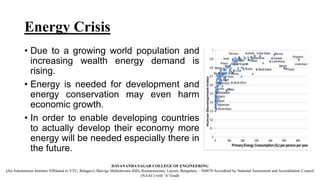
Energy Crisis
• Due to a growing world population and
increasing wealth energy demand is
rising.
• Energy is needed for development and
energy conservation may even harm
economic growth.
• In order to enable developing countries
to actually develop their economy more
energy will be needed especially there in
the future.
DAYANANDA SAGAR COLLEGE OF ENGINEERING
(An Autonomous Institute Affiliated to VTU, Belagavi) Shavige Malleshwara Hills, Kumaraswamy Layout, Bengaluru – 560078 Accredited by National Assessment and Accreditation Council
(NAAC) with ‘A’ Grade
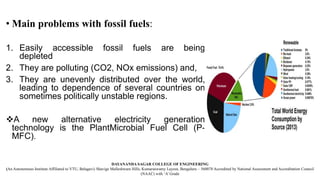
• Main problems with fossil fuels:
1. Easily accessible fossil fuels are being
depleted
2. They are polluting (CO2, NOx emissions) and,
3. They are unevenly distributed over the world,
leading to dependence of several countries on
sometimes politically unstable regions.
A new alternative electricity generation
technology is the PlantMicrobial Fuel Cell (P-
MFC).
DAYANANDA SAGAR COLLEGE OF ENGINEERING
(An Autonomous Institute Affiliated to VTU, Belagavi) Shavige Malleshwara Hills, Kumaraswamy Layout, Bengaluru – 560078 Accredited by National Assessment and Accreditation Council
(NAAC) with ‘A’ Grade
Solar Energy
• Two major technologies have been developed to harness it:
I. Photovoltaic solar technology, which directly converts sunlight
into electricity using panels.
II. Solar thermal technology, which captures the sun’s heat. This heat
is used directly or converted into mechanical energy and in turn
electricity.
• The 5 most common examples of solar power uses:
1. Solar Heating
2. Rooftop Solar
3. Solar cooker
4. Plants for the process of photosynthesis.
DAYANANDA SAGAR COLLEGE OF ENGINEERING
(An Autonomous Institute Affiliated to VTU, Belagavi) Shavige Malleshwara Hills, Kumaraswamy Layout, Bengaluru – 560078 Accredited by National Assessment and Accreditation Council
(NAAC) with ‘A’ Grade
BASIC
PHOTOSYNTHESIS
AND ITS TERMS
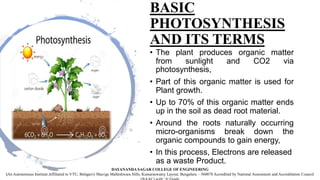
• The plant produces organic matter
from sunlight and CO2 via
photosynthesis,
• Part of this organic matter is used for
Plant growth.
• Up to 70% of this organic matter ends
up in the soil as dead root material.
• Around the roots naturally occurring
micro-organisms break down the
organic compounds to gain energy,
• In this process, Electrons are released
as a waste Product.
DAYANANDA SAGAR COLLEGE OF ENGINEERING
(An Autonomous Institute Affiliated to VTU, Belagavi) Shavige Malleshwara Hills, Kumaraswamy Layout, Bengaluru – 560078 Accredited by National Assessment and Accreditation Council
Electricity Production
Technology
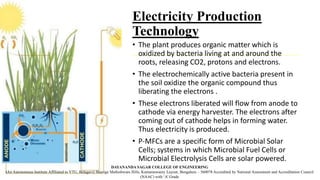
• The plant produces organic matter which is
oxidized by bacteria living at and around the
roots, releasing CO2, protons and electrons.
• The electrochemically active bacteria present in
the soil oxidize the organic compound thus
liberating the electrons .
• These electrons liberated will flow from anode to
cathode via energy harvester. The electrons after
coming out of cathode helps in forming water.
Thus electricity is produced.
• P-MFCs are a specific form of Microbial Solar
Cells; systems in which Microbial Fuel Cells or
Microbial Electrolysis Cells are solar powered.
DAYANANDA SAGAR COLLEGE OF ENGINEERING
(An Autonomous Institute Affiliated to VTU, Belagavi) Shavige Malleshwara Hills, Kumaraswamy Layout, Bengaluru – 560078 Accredited by National Assessment and Accreditation Council
(NAAC) with ‘A’ Grade
Plant-Microbial Fuel Cell (P-MFC) Technology
DEVELOPED BY A COMPANY CALLED PLANT- e.
DEVELOPED AT WAGENINGEN UNIVERSITY, NETHERLAND
PATENTED IN 2007
TECHNOLOGY ENABLES TO PRODUCE ELECTRICITY AT
PRACTICALLY EVERY SITE WHERE PLANTS CAN GROW
THE TECHNOLOGY IS BASED ON NATURAL PROCESSES
AND DOESN’T HARM THE PLANT OR ITS ENVIRONMENT
DAYANANDA SAGAR COLLEGE OF ENGINEERING
(An Autonomous Institute Affiliated to VTU, Belagavi) Shavige Malleshwara Hills, Kumaraswamy Layout, Bengaluru – 560078 Accredited by National Assessment and Accreditation Council
(NAAC) with ‘A’ Grade
Process of Electricity
Generation
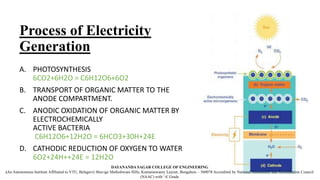
A. PHOTOSYNTHESIS
6CO2+6H2O = C6H12O6+6O2
B. TRANSPORT OF ORGANIC MATTER TO THE
ANODE COMPARTMENT.
C. ANODIC OXIDATION OF ORGANIC MATTER BY
ELECTROCHEMICALLY
ACTIVE BACTERIA
C6H12O6+12H2O = 6HCO3+30H+24E
D. CATHODIC REDUCTION OF OXYGEN TO WATER
6O2+24H++24E = 12H2O
DAYANANDA SAGAR COLLEGE OF ENGINEERING
(An Autonomous Institute Affiliated to VTU, Belagavi) Shavige Malleshwara Hills, Kumaraswamy Layout, Bengaluru – 560078 Accredited by National Assessment and Accreditation Council
(NAAC) with ‘A’ Grade
Important
Design
criteria for
the P-MFC
1.1 The Plant
• In the P-MFC typically plants that can
grow with their roots under waterlogged
conditions are used, to avoid oxygen
intrusion from the air into the anode.
• If oxygen would be available at the anode,
electrons would directly be used for
oxygen reduction and would be lost for
electricity production.
• Spartina anglica, Arundinella anomala and
Arundo donax are the plant species used.
DAYANANDA SAGAR COLLEGE OF ENGINEERING
(An Autonomous Institute Affiliated to VTU, Belagavi) Shavige Malleshwara Hills, Kumaraswamy Layout, Bengaluru – 560078 Accredited by National Assessment and Accreditation Council
(NAAC) with ‘A’ Grade
Types of
Electrodes
The best pair of electrodes that produces
highest power output has to be determined
prior to any further optimization effects.
In the present work, four different material
of electrodes have been
selected because they are locally available
and easily abundant. They
are Cu, Fe, Zn, Al.
The electrode with higher and lower
electrode potential E0 is selected as anode
and cathode, respectively.
DAYANANDA SAGAR COLLEGE OF ENGINEERING
(An Autonomous Institute Affiliated to VTU, Belagavi) Shavige Malleshwara Hills, Kumaraswamy Layout, Bengaluru – 560078 Accredited by National Assessment and Accreditation Council
(NAAC) with ‘A’ Grade
Plant-e Projects
1. Plant-e portfolio
• The very first version of a green roof
• It had been placed on the NIOO
building
DAYANANDA SAGAR COLLEGE OF ENGINEERING
(An Autonomous Institute Affiliated to VTU, Belagavi) Shavige Malleshwara Hills, Kumaraswamy Layout, Bengaluru – 560078 Accredited by National Assessment and Accreditation Council
(NAAC) with ‘A’ Grade
2.FOOD PARK - THE
HAGUE
• Latest Plant-e modules
• The moment someone
activate the hidden tile
when they walk past the
system, lights between the
plants will light up in
different places! DAYANANDA SAGAR COLLEGE OF ENGINEERING
(An Autonomous Institute Affiliated to VTU, Belagavi) Shavige Malleshwara Hills, Kumaraswamy Layout, Bengaluru – 560078 Accredited by National Assessment and Accreditation Council
(NAAC) with ‘A’ Grade
Social Advantages
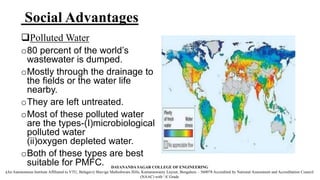
Polluted Water
o80 percent of the world’s
wastewater is dumped.
oMostly through the drainage to
the fields or the water life
nearby.
oThey are left untreated.
oMost of these polluted water
are the types-(I)microbiological
polluted water
(ii)oxygen depleted water.
oBoth of these types are best
suitable for PMFC. DAYANANDA SAGAR COLLEGE OF ENGINEERING
(An Autonomous Institute Affiliated to VTU, Belagavi) Shavige Malleshwara Hills, Kumaraswamy Layout, Bengaluru – 560078 Accredited by National Assessment and Accreditation Council
(NAAC) with ‘A’ Grade
Wetland
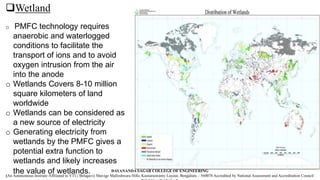
o PMFC technology requires
anaerobic and waterlogged
conditions to facilitate the
transport of ions and to avoid
oxygen intrusion from the air
into the anode
o Wetlands Covers 8-10 million
square kilometers of land
worldwide
o Wetlands can be considered as
a new source of electricity
o Generating electricity from
wetlands by the PMFC gives a
potential extra function to
wetlands and likely increases
the value of wetlands. DAYANANDA SAGAR COLLEGE OF ENGINEERING
(An Autonomous Institute Affiliated to VTU, Belagavi) Shavige Malleshwara Hills, Kumaraswamy Layout, Bengaluru – 560078 Accredited by National Assessment and Accreditation Council
Green Roofs
ONE OF THE MOST PROMISING
PMFC APPLICATIONS
• INCREASED BIODIVERSITY
• IMPROVEMENTS IN AIR QUALITY
• HIGH AESTHETIC VALUE
• BUILDING INSULATION AND
• DECREASE IN TEMPERATURE
WITHIN CITIES
DAYANANDA SAGAR COLLEGE OF ENGINEERING
(An Autonomous Institute Affiliated to VTU, Belagavi) Shavige Malleshwara Hills, Kumaraswamy Layout, Bengaluru – 560078 Accredited by National Assessment and Accreditation Council
(NAAC) with ‘A’ Grade
Benefits
Renewability: P-MFC makes use of solar power and
can be considered renewable
Availability:P-MFC is in theory not daylight dependent
and might produce electricity year-round, so weather
and daylight independent.
Efficiency: Direct electricity production,low costs
materials
Environmental performance: Encompasses all three
different aspects- People, planet, profit
Clean: No combustion gases, CO2 neutral
DAYANANDA SAGAR COLLEGE OF ENGINEERING
(An Autonomous Institute Affiliated to VTU, Belagavi) Shavige Malleshwara Hills, Kumaraswamy Layout, Bengaluru – 560078 Accredited by National Assessment and Accreditation Council
(NAAC) with ‘A’ Grade
Comparison
P-MFCs
• The Power Generation is approx.
1.6 MW/KM2 (still in developing
stage)
• Negligible installation cost, includes
in the total expense.
• Does not cause any environmental
pollution of any kind.
• P-MFC is in theory not daylight
dependent and might produce
electricity year-round, so weather
and daylight independent.
Solar Panels
• The Power Generation is
approx. 4.5-7.5 MW/KM2
• Installation typically makes up 60%
of the total price of the solar panel.
• Solar panels contain scarce metals
and causes environmental pollution.
• Solar panel performance depends
on light intensity. This makes them
both weather dependent and
daylight dependent.
NOTE: At this stage it is too early to compare the P-MFC with other (renewable) energy technologies
since the P-MFC is still under development.
DAYANANDA SAGAR COLLEGE OF ENGINEERING
(An Autonomous Institute Affiliated to VTU, Belagavi) Shavige Malleshwara Hills, Kumaraswamy Layout, Bengaluru – 560078 Accredited by National Assessment and Accreditation Council
(NAAC) with ‘A’ Grade
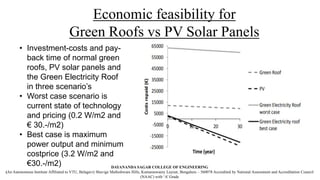
• Investment-costs and pay-
back time of normal green
roofs, PV solar panels and
the Green Electricity Roof
in three scenario’s
• Worst case scenario is
current state of technology
and pricing (0.2 W/m2 and
€ 30.-/m2)
• Best case is maximum
power output and minimum
costprice (3.2 W/m2 and
€30.-/m2)
Economic feasibility for
Green Roofs vs PV Solar Panels
DAYANANDA SAGAR COLLEGE OF ENGINEERING
(An Autonomous Institute Affiliated to VTU, Belagavi) Shavige Malleshwara Hills, Kumaraswamy Layout, Bengaluru – 560078 Accredited by National Assessment and Accreditation Council
(NAAC) with ‘A’ Grade
Conclusion
Increasing the power output of the
technology is foremost important.
Matching it with the efficiency and
economic aspect of solar panels, is
to be achieved. And
later, to achieve more than that.
Distribution and development of such
renewable
sustainable technologies should be
highly widespread.
Though there may be a lot of
benefits from the mentioned
technology, it is still under developing
stage.
DAYANANDA SAGAR COLLEGE OF ENGINEERING
(An Autonomous Institute Affiliated to VTU, Belagavi) Shavige Malleshwara Hills, Kumaraswamy Layout, Bengaluru – 560078 Accredited by National Assessment and Accreditation Council
(NAAC) with ‘A’ Grade
References:
• https://www.plant-e.com/en/informatie/ (Plant-e website)
• https://www.slideshare.net/szl/air-watersoundandlandpollution-and-its-
remedial-approach
• https://www.slideshare.net/bbsmsaikiran77/plant-e1?from_action=save
• http://edepot.wur.nl/379597 (DR. THESIS. IR. KOEN WETSER)
• https://www.slideshare.net/shivam_hayabusa/electricity-from-plants-a-
new-source-of-futuristic-energy
• http://edepot.wur.nl/239054 (DR. THESIS. IR. MARJOLEIN HELDER)
• https://external-
preview.redd.it/PmvDFMWAhDGxTDD29MoDskvvDcp8nkWlCU16BwSwiZU
.jpg?auto=webp&s=98214ff420a322c998f8fcc89bbaba9e5e09df86
DAYANANDA SAGAR COLLEGE OF ENGINEERING
(An Autonomous Institute Affiliated to VTU, Belagavi) Shavige Malleshwara Hills, Kumaraswamy Layout, Bengaluru – 560078 Accredited by National Assessment and Accreditation Council
(NAAC) with ‘A’ Grade
THANK YOU

Plant e Technology: Electricity from Plants

  • 1.
    Department Of ChemicalEngineering DAYANANDA SAGAR COLLEGE OF ENGINEERING (An Autonomous Institute Affiliated to VTU, Belagavi) Shavige Malleshwara Hills, Kumaraswamy Layout, Bengaluru – 560078 Ishaan Sanehi 1DS15CH010 Technical seminar on Date:22-02-2019 GENERATING CURRENT FROM PLANTS : PLANT-E TECHNOLOGY
  • 2.
    Contents 1. Introduction 2. TechnologicalProcess 3. Design Aspects 4. Projects 5. Applications 6. Comparison 7. Conclusion 8. References DAYANANDA SAGAR COLLEGE OF ENGINEERING (An Autonomous Institute Affiliated to VTU, Belagavi) Shavige Malleshwara Hills, Kumaraswamy Layout, Bengaluru – 560078 Accredited by National Assessment and Accreditation Council (NAAC) with ‘A’ Grade
  • 3.
    Energy Crisis • Dueto a growing world population and increasing wealth energy demand is rising. • Energy is needed for development and energy conservation may even harm economic growth. • In order to enable developing countries to actually develop their economy more energy will be needed especially there in the future. DAYANANDA SAGAR COLLEGE OF ENGINEERING (An Autonomous Institute Affiliated to VTU, Belagavi) Shavige Malleshwara Hills, Kumaraswamy Layout, Bengaluru – 560078 Accredited by National Assessment and Accreditation Council (NAAC) with ‘A’ Grade
  • 4.
    • Main problemswith fossil fuels: 1. Easily accessible fossil fuels are being depleted 2. They are polluting (CO2, NOx emissions) and, 3. They are unevenly distributed over the world, leading to dependence of several countries on sometimes politically unstable regions. A new alternative electricity generation technology is the PlantMicrobial Fuel Cell (P- MFC). DAYANANDA SAGAR COLLEGE OF ENGINEERING (An Autonomous Institute Affiliated to VTU, Belagavi) Shavige Malleshwara Hills, Kumaraswamy Layout, Bengaluru – 560078 Accredited by National Assessment and Accreditation Council (NAAC) with ‘A’ Grade
  • 5.
    Solar Energy • Twomajor technologies have been developed to harness it: I. Photovoltaic solar technology, which directly converts sunlight into electricity using panels. II. Solar thermal technology, which captures the sun’s heat. This heat is used directly or converted into mechanical energy and in turn electricity. • The 5 most common examples of solar power uses: 1. Solar Heating 2. Rooftop Solar 3. Solar cooker 4. Plants for the process of photosynthesis. DAYANANDA SAGAR COLLEGE OF ENGINEERING (An Autonomous Institute Affiliated to VTU, Belagavi) Shavige Malleshwara Hills, Kumaraswamy Layout, Bengaluru – 560078 Accredited by National Assessment and Accreditation Council (NAAC) with ‘A’ Grade
  • 6.
    BASIC PHOTOSYNTHESIS AND ITS TERMS •The plant produces organic matter from sunlight and CO2 via photosynthesis, • Part of this organic matter is used for Plant growth. • Up to 70% of this organic matter ends up in the soil as dead root material. • Around the roots naturally occurring micro-organisms break down the organic compounds to gain energy, • In this process, Electrons are released as a waste Product. DAYANANDA SAGAR COLLEGE OF ENGINEERING (An Autonomous Institute Affiliated to VTU, Belagavi) Shavige Malleshwara Hills, Kumaraswamy Layout, Bengaluru – 560078 Accredited by National Assessment and Accreditation Council
  • 7.
    Electricity Production Technology • Theplant produces organic matter which is oxidized by bacteria living at and around the roots, releasing CO2, protons and electrons. • The electrochemically active bacteria present in the soil oxidize the organic compound thus liberating the electrons . • These electrons liberated will flow from anode to cathode via energy harvester. The electrons after coming out of cathode helps in forming water. Thus electricity is produced. • P-MFCs are a specific form of Microbial Solar Cells; systems in which Microbial Fuel Cells or Microbial Electrolysis Cells are solar powered. DAYANANDA SAGAR COLLEGE OF ENGINEERING (An Autonomous Institute Affiliated to VTU, Belagavi) Shavige Malleshwara Hills, Kumaraswamy Layout, Bengaluru – 560078 Accredited by National Assessment and Accreditation Council (NAAC) with ‘A’ Grade
  • 8.
    Plant-Microbial Fuel Cell(P-MFC) Technology DEVELOPED BY A COMPANY CALLED PLANT- e. DEVELOPED AT WAGENINGEN UNIVERSITY, NETHERLAND PATENTED IN 2007 TECHNOLOGY ENABLES TO PRODUCE ELECTRICITY AT PRACTICALLY EVERY SITE WHERE PLANTS CAN GROW THE TECHNOLOGY IS BASED ON NATURAL PROCESSES AND DOESN’T HARM THE PLANT OR ITS ENVIRONMENT DAYANANDA SAGAR COLLEGE OF ENGINEERING (An Autonomous Institute Affiliated to VTU, Belagavi) Shavige Malleshwara Hills, Kumaraswamy Layout, Bengaluru – 560078 Accredited by National Assessment and Accreditation Council (NAAC) with ‘A’ Grade
  • 9.
    Process of Electricity Generation A.PHOTOSYNTHESIS 6CO2+6H2O = C6H12O6+6O2 B. TRANSPORT OF ORGANIC MATTER TO THE ANODE COMPARTMENT. C. ANODIC OXIDATION OF ORGANIC MATTER BY ELECTROCHEMICALLY ACTIVE BACTERIA C6H12O6+12H2O = 6HCO3+30H+24E D. CATHODIC REDUCTION OF OXYGEN TO WATER 6O2+24H++24E = 12H2O DAYANANDA SAGAR COLLEGE OF ENGINEERING (An Autonomous Institute Affiliated to VTU, Belagavi) Shavige Malleshwara Hills, Kumaraswamy Layout, Bengaluru – 560078 Accredited by National Assessment and Accreditation Council (NAAC) with ‘A’ Grade
  • 10.
    Important Design criteria for the P-MFC 1.1The Plant • In the P-MFC typically plants that can grow with their roots under waterlogged conditions are used, to avoid oxygen intrusion from the air into the anode. • If oxygen would be available at the anode, electrons would directly be used for oxygen reduction and would be lost for electricity production. • Spartina anglica, Arundinella anomala and Arundo donax are the plant species used. DAYANANDA SAGAR COLLEGE OF ENGINEERING (An Autonomous Institute Affiliated to VTU, Belagavi) Shavige Malleshwara Hills, Kumaraswamy Layout, Bengaluru – 560078 Accredited by National Assessment and Accreditation Council (NAAC) with ‘A’ Grade
  • 11.
    Types of Electrodes The bestpair of electrodes that produces highest power output has to be determined prior to any further optimization effects. In the present work, four different material of electrodes have been selected because they are locally available and easily abundant. They are Cu, Fe, Zn, Al. The electrode with higher and lower electrode potential E0 is selected as anode and cathode, respectively. DAYANANDA SAGAR COLLEGE OF ENGINEERING (An Autonomous Institute Affiliated to VTU, Belagavi) Shavige Malleshwara Hills, Kumaraswamy Layout, Bengaluru – 560078 Accredited by National Assessment and Accreditation Council (NAAC) with ‘A’ Grade
  • 12.
    Plant-e Projects 1. Plant-eportfolio • The very first version of a green roof • It had been placed on the NIOO building DAYANANDA SAGAR COLLEGE OF ENGINEERING (An Autonomous Institute Affiliated to VTU, Belagavi) Shavige Malleshwara Hills, Kumaraswamy Layout, Bengaluru – 560078 Accredited by National Assessment and Accreditation Council (NAAC) with ‘A’ Grade
  • 13.
    2.FOOD PARK -THE HAGUE • Latest Plant-e modules • The moment someone activate the hidden tile when they walk past the system, lights between the plants will light up in different places! DAYANANDA SAGAR COLLEGE OF ENGINEERING (An Autonomous Institute Affiliated to VTU, Belagavi) Shavige Malleshwara Hills, Kumaraswamy Layout, Bengaluru – 560078 Accredited by National Assessment and Accreditation Council (NAAC) with ‘A’ Grade
  • 14.
    Social Advantages Polluted Water o80percent of the world’s wastewater is dumped. oMostly through the drainage to the fields or the water life nearby. oThey are left untreated. oMost of these polluted water are the types-(I)microbiological polluted water (ii)oxygen depleted water. oBoth of these types are best suitable for PMFC. DAYANANDA SAGAR COLLEGE OF ENGINEERING (An Autonomous Institute Affiliated to VTU, Belagavi) Shavige Malleshwara Hills, Kumaraswamy Layout, Bengaluru – 560078 Accredited by National Assessment and Accreditation Council (NAAC) with ‘A’ Grade
  • 15.
    Wetland o PMFC technologyrequires anaerobic and waterlogged conditions to facilitate the transport of ions and to avoid oxygen intrusion from the air into the anode o Wetlands Covers 8-10 million square kilometers of land worldwide o Wetlands can be considered as a new source of electricity o Generating electricity from wetlands by the PMFC gives a potential extra function to wetlands and likely increases the value of wetlands. DAYANANDA SAGAR COLLEGE OF ENGINEERING (An Autonomous Institute Affiliated to VTU, Belagavi) Shavige Malleshwara Hills, Kumaraswamy Layout, Bengaluru – 560078 Accredited by National Assessment and Accreditation Council
  • 16.
    Green Roofs ONE OFTHE MOST PROMISING PMFC APPLICATIONS • INCREASED BIODIVERSITY • IMPROVEMENTS IN AIR QUALITY • HIGH AESTHETIC VALUE • BUILDING INSULATION AND • DECREASE IN TEMPERATURE WITHIN CITIES DAYANANDA SAGAR COLLEGE OF ENGINEERING (An Autonomous Institute Affiliated to VTU, Belagavi) Shavige Malleshwara Hills, Kumaraswamy Layout, Bengaluru – 560078 Accredited by National Assessment and Accreditation Council (NAAC) with ‘A’ Grade
  • 17.
    Benefits Renewability: P-MFC makesuse of solar power and can be considered renewable Availability:P-MFC is in theory not daylight dependent and might produce electricity year-round, so weather and daylight independent. Efficiency: Direct electricity production,low costs materials Environmental performance: Encompasses all three different aspects- People, planet, profit Clean: No combustion gases, CO2 neutral DAYANANDA SAGAR COLLEGE OF ENGINEERING (An Autonomous Institute Affiliated to VTU, Belagavi) Shavige Malleshwara Hills, Kumaraswamy Layout, Bengaluru – 560078 Accredited by National Assessment and Accreditation Council (NAAC) with ‘A’ Grade
  • 18.
    Comparison P-MFCs • The PowerGeneration is approx. 1.6 MW/KM2 (still in developing stage) • Negligible installation cost, includes in the total expense. • Does not cause any environmental pollution of any kind. • P-MFC is in theory not daylight dependent and might produce electricity year-round, so weather and daylight independent. Solar Panels • The Power Generation is approx. 4.5-7.5 MW/KM2 • Installation typically makes up 60% of the total price of the solar panel. • Solar panels contain scarce metals and causes environmental pollution. • Solar panel performance depends on light intensity. This makes them both weather dependent and daylight dependent. NOTE: At this stage it is too early to compare the P-MFC with other (renewable) energy technologies since the P-MFC is still under development. DAYANANDA SAGAR COLLEGE OF ENGINEERING (An Autonomous Institute Affiliated to VTU, Belagavi) Shavige Malleshwara Hills, Kumaraswamy Layout, Bengaluru – 560078 Accredited by National Assessment and Accreditation Council (NAAC) with ‘A’ Grade
  • 19.
    • Investment-costs andpay- back time of normal green roofs, PV solar panels and the Green Electricity Roof in three scenario’s • Worst case scenario is current state of technology and pricing (0.2 W/m2 and € 30.-/m2) • Best case is maximum power output and minimum costprice (3.2 W/m2 and €30.-/m2) Economic feasibility for Green Roofs vs PV Solar Panels DAYANANDA SAGAR COLLEGE OF ENGINEERING (An Autonomous Institute Affiliated to VTU, Belagavi) Shavige Malleshwara Hills, Kumaraswamy Layout, Bengaluru – 560078 Accredited by National Assessment and Accreditation Council (NAAC) with ‘A’ Grade
  • 20.
    Conclusion Increasing the poweroutput of the technology is foremost important. Matching it with the efficiency and economic aspect of solar panels, is to be achieved. And later, to achieve more than that. Distribution and development of such renewable sustainable technologies should be highly widespread. Though there may be a lot of benefits from the mentioned technology, it is still under developing stage. DAYANANDA SAGAR COLLEGE OF ENGINEERING (An Autonomous Institute Affiliated to VTU, Belagavi) Shavige Malleshwara Hills, Kumaraswamy Layout, Bengaluru – 560078 Accredited by National Assessment and Accreditation Council (NAAC) with ‘A’ Grade
  • 21.
    References: • https://www.plant-e.com/en/informatie/ (Plant-ewebsite) • https://www.slideshare.net/szl/air-watersoundandlandpollution-and-its- remedial-approach • https://www.slideshare.net/bbsmsaikiran77/plant-e1?from_action=save • http://edepot.wur.nl/379597 (DR. THESIS. IR. KOEN WETSER) • https://www.slideshare.net/shivam_hayabusa/electricity-from-plants-a- new-source-of-futuristic-energy • http://edepot.wur.nl/239054 (DR. THESIS. IR. MARJOLEIN HELDER) • https://external- preview.redd.it/PmvDFMWAhDGxTDD29MoDskvvDcp8nkWlCU16BwSwiZU .jpg?auto=webp&s=98214ff420a322c998f8fcc89bbaba9e5e09df86 DAYANANDA SAGAR COLLEGE OF ENGINEERING (An Autonomous Institute Affiliated to VTU, Belagavi) Shavige Malleshwara Hills, Kumaraswamy Layout, Bengaluru – 560078 Accredited by National Assessment and Accreditation Council (NAAC) with ‘A’ Grade
  • 22.