Plant Disease Detection using
Image Processing Techniques
Outline
 Motivation & objective
 Importance of image processing in agricultural research
 Literature survey
 Benefits
 Conclusion
 References
2
Motivation & Objective
 Agriculture acts as the major contributor of Indian economy which is enhanced by image
processing techniques and nearly 70% of people in our country depends on agriculture [3].
 Plant diseases due to their spreading nature is considered as major factor affecting
cultivation yield. These agricultural practices need to be transformed in order to overcome
future food scarcity.
 Image processing along with availability of communication network can increase the level
of adoption of technological based systems as it can contribute in many aspects of the
Agriculture sector [2].
 The objective of the project is to design a low-cost agriculture system for monitoring
agricultural field and to develop an efficient system to detect and classify the diseases of
different plants using image processing.
3
Importance of image processing in
agricultural research
 The rapid advancement of technology has made the future of agriculture a bright one.
 What with scientists discovering exciting new research in plant and animal sciences every
year [1].
 Image processing has been proved to be effective tool for analysis in various fields and
applications of an agriculture sector [3].
 The image processing can be used in agricultural applications for following purposes:
1. To detect diseased leaf, stem, fruit 2. To quantify affected area by disease. 3. To find
shape of affected area. 4. To determine color of affected area 5. To determine size & shape
of fruits [5].
 Our standard of living keeps improving every day through agricultural research.
4
Literature survey
Title Description Inference
1. Garg, Kanish, et al, (2021).
"Automatic Quantification of Plant
Disease from Field Image Data Using
Deep Learning." Proceedings of the
IEEE/CVF Winter Conference on
Applications of Computer Vision.
A deep framework for simultaneous
segmentation of individual leaf instances and
corresponding diseased region using a unified
feature map with a multi-task loss function for
an end-to-end training.
The experimental results
show:
Disease correlation = 73%,
Run-time efficiency = 5fps.
2. Zhu, J., Wu, A., Wang, X, et al,
(2020).“Identification of grape diseases
using image analysis and BP neural
networks”. Multimed Tools Appl 79,
14539–14551.
Based on image analysis and back–propagation
neural network (BPNN) an automatic
detection.
It has efficiently detected and recognized five
grape leaf diseases.
The methodology adopted
has a high classification
accuracy of 91%.
3. Cristin, R., Kumar, B.S., Priya, C. et
al, (2020).“Deep neural network based
Rider-Cuckoo Search Algorithm for
plant disease detection”. Artif Intell Rev
53, 4993–5018.
An efficient method for disease identification
using Rider-CSA by integrating the rider
optimization algorithm (ROA) and Cuckoo
Search (CS).
Deep Belief Network (DBN) is used for the
classification phase.
The experimental results
proved that the Rider-CSA-
DBN with maximal
accuracy of 0.877.
5
Literature survey
Title Description Inference
4. T. N. Pham, L, et al., (2020).
"Early Disease Classification of
Mango Leaves Using Feed-Forward
Neural Network and Hybrid
Metaheuristic Feature Selection," in
IEEE Access, vol. 8, pp. 189960-
189973.
A multi-class mango leaf disease
classification using deep neural networks
with a wrapper-based feature selection
approach using an Adaptive Particle-Grey
Wolf metaheuristic (APGWO).
Compared to the results of CNN
ANN's provides a better result with
a simpler network structure
89.41%.
5. Suma, V., Shetty, R.A., et al.,
(2019). “CNN based Leaf Disease
Identification and Remedy
Recommendation System”.
3rdInternational conference IEEE.
Plant disease detection using image
processing approach where convolution
system and semi supervised techniques are
used to characterize crop species and
detect the sickness status of 4 distinct
classes.
The classification accuracy from
the color images is better than the
gray scale with 88.20%.
6. P. Jiang, Y. Chen, et al, (2019).
"Real-Time Detection of Apple Leaf
Diseases Using Deep Learning
Approach Based on Improved
Convolutional Neural Networks,"
in IEEE Access.
A deep learning approach that is based on
improved convolutional neural networks
(CNNs) for the real-time detection of
apple leaf diseases by the GoogLeNet
Inception structure and Rainbow
concatenation.
The INAR-SSD model realizes a
detection performance of 78.80%
mAP on ALDD, with a high-
detection speed of 23.13 FPS.
6
Benefits
 Farmers no longer have to apply water, fertilizers, and pesticides uniformly across entire
fields.
 Instead, they can use the minimum quantities required and target very specific areas, or
even treat individual plants differently [4]. Benefits include:
• Higher crop productivity
• Decreased use of water, fertilizer, and pesticides, which in turn keeps food prices down
• Reduced impact on natural ecosystems
• Less runoff of chemicals into rivers and groundwater
• Increased worker safety
7
Conclusion
 It’s evident that the importance of agriculture cannot be overstated.
 As scientists continue to discover new procedures to increase crop and livestock yields,
increase overall food quality, and reduce loss due to insects and diseases [1].
 We can safely say that agricultural research still has a long way to go and image processing
was the non destructive and effective tool that can be applied for the agriculture sector with
great accuracy for analysis of agronomic parameters [2].
 Through continued studies and research on agriculture using image processing, our
standard of living can improve significantly.
 The greatest benefactor to all this will be everyone and everything that relies on
agriculture, including economies [1].
8
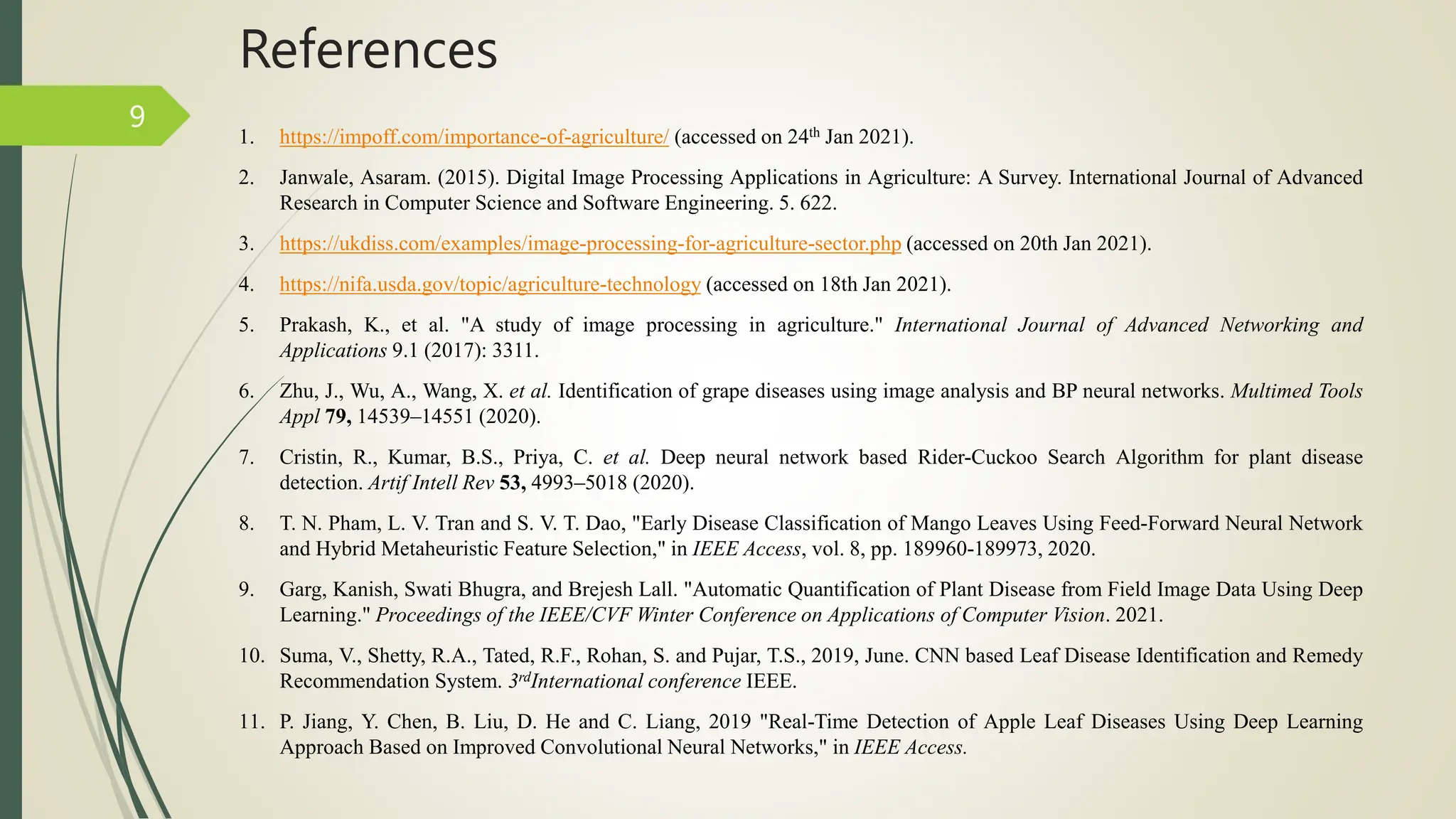
References
1. https://impoff.com/importance-of-agriculture/ (accessed on 24th Jan 2021).
2. Janwale, Asaram. (2015). Digital Image Processing Applications in Agriculture: A Survey. International Journal of Advanced
Research in Computer Science and Software Engineering. 5. 622.
3. https://ukdiss.com/examples/image-processing-for-agriculture-sector.php (accessed on 20th Jan 2021).
4. https://nifa.usda.gov/topic/agriculture-technology (accessed on 18th Jan 2021).
5. Prakash, K., et al. "A study of image processing in agriculture." International Journal of Advanced Networking and
Applications 9.1 (2017): 3311.
6. Zhu, J., Wu, A., Wang, X. et al. Identification of grape diseases using image analysis and BP neural networks. Multimed Tools
Appl 79, 14539–14551 (2020).
7. Cristin, R., Kumar, B.S., Priya, C. et al. Deep neural network based Rider-Cuckoo Search Algorithm for plant disease
detection. Artif Intell Rev 53, 4993–5018 (2020).
8. T. N. Pham, L. V. Tran and S. V. T. Dao, "Early Disease Classification of Mango Leaves Using Feed-Forward Neural Network
and Hybrid Metaheuristic Feature Selection," in IEEE Access, vol. 8, pp. 189960-189973, 2020.
9. Garg, Kanish, Swati Bhugra, and Brejesh Lall. "Automatic Quantification of Plant Disease from Field Image Data Using Deep
Learning." Proceedings of the IEEE/CVF Winter Conference on Applications of Computer Vision. 2021.
10. Suma, V., Shetty, R.A., Tated, R.F., Rohan, S. and Pujar, T.S., 2019, June. CNN based Leaf Disease Identification and Remedy
Recommendation System. 3rdInternational conference IEEE.
11. P. Jiang, Y. Chen, B. Liu, D. He and C. Liang, 2019 "Real-Time Detection of Apple Leaf Diseases Using Deep Learning
Approach Based on Improved Convolutional Neural Networks," in IEEE Access.
9
Thank you
10

Plant disease detection using image processing.pptx

  • 1.
    Plant Disease Detectionusing Image Processing Techniques
  • 2.
    Outline  Motivation &objective  Importance of image processing in agricultural research  Literature survey  Benefits  Conclusion  References 2
  • 3.
    Motivation & Objective Agriculture acts as the major contributor of Indian economy which is enhanced by image processing techniques and nearly 70% of people in our country depends on agriculture [3].  Plant diseases due to their spreading nature is considered as major factor affecting cultivation yield. These agricultural practices need to be transformed in order to overcome future food scarcity.  Image processing along with availability of communication network can increase the level of adoption of technological based systems as it can contribute in many aspects of the Agriculture sector [2].  The objective of the project is to design a low-cost agriculture system for monitoring agricultural field and to develop an efficient system to detect and classify the diseases of different plants using image processing. 3
  • 4.
    Importance of imageprocessing in agricultural research  The rapid advancement of technology has made the future of agriculture a bright one.  What with scientists discovering exciting new research in plant and animal sciences every year [1].  Image processing has been proved to be effective tool for analysis in various fields and applications of an agriculture sector [3].  The image processing can be used in agricultural applications for following purposes: 1. To detect diseased leaf, stem, fruit 2. To quantify affected area by disease. 3. To find shape of affected area. 4. To determine color of affected area 5. To determine size & shape of fruits [5].  Our standard of living keeps improving every day through agricultural research. 4
  • 5.
    Literature survey Title DescriptionInference 1. Garg, Kanish, et al, (2021). "Automatic Quantification of Plant Disease from Field Image Data Using Deep Learning." Proceedings of the IEEE/CVF Winter Conference on Applications of Computer Vision. A deep framework for simultaneous segmentation of individual leaf instances and corresponding diseased region using a unified feature map with a multi-task loss function for an end-to-end training. The experimental results show: Disease correlation = 73%, Run-time efficiency = 5fps. 2. Zhu, J., Wu, A., Wang, X, et al, (2020).“Identification of grape diseases using image analysis and BP neural networks”. Multimed Tools Appl 79, 14539–14551. Based on image analysis and back–propagation neural network (BPNN) an automatic detection. It has efficiently detected and recognized five grape leaf diseases. The methodology adopted has a high classification accuracy of 91%. 3. Cristin, R., Kumar, B.S., Priya, C. et al, (2020).“Deep neural network based Rider-Cuckoo Search Algorithm for plant disease detection”. Artif Intell Rev 53, 4993–5018. An efficient method for disease identification using Rider-CSA by integrating the rider optimization algorithm (ROA) and Cuckoo Search (CS). Deep Belief Network (DBN) is used for the classification phase. The experimental results proved that the Rider-CSA- DBN with maximal accuracy of 0.877. 5
  • 6.
    Literature survey Title DescriptionInference 4. T. N. Pham, L, et al., (2020). "Early Disease Classification of Mango Leaves Using Feed-Forward Neural Network and Hybrid Metaheuristic Feature Selection," in IEEE Access, vol. 8, pp. 189960- 189973. A multi-class mango leaf disease classification using deep neural networks with a wrapper-based feature selection approach using an Adaptive Particle-Grey Wolf metaheuristic (APGWO). Compared to the results of CNN ANN's provides a better result with a simpler network structure 89.41%. 5. Suma, V., Shetty, R.A., et al., (2019). “CNN based Leaf Disease Identification and Remedy Recommendation System”. 3rdInternational conference IEEE. Plant disease detection using image processing approach where convolution system and semi supervised techniques are used to characterize crop species and detect the sickness status of 4 distinct classes. The classification accuracy from the color images is better than the gray scale with 88.20%. 6. P. Jiang, Y. Chen, et al, (2019). "Real-Time Detection of Apple Leaf Diseases Using Deep Learning Approach Based on Improved Convolutional Neural Networks," in IEEE Access. A deep learning approach that is based on improved convolutional neural networks (CNNs) for the real-time detection of apple leaf diseases by the GoogLeNet Inception structure and Rainbow concatenation. The INAR-SSD model realizes a detection performance of 78.80% mAP on ALDD, with a high- detection speed of 23.13 FPS. 6
  • 7.
    Benefits  Farmers nolonger have to apply water, fertilizers, and pesticides uniformly across entire fields.  Instead, they can use the minimum quantities required and target very specific areas, or even treat individual plants differently [4]. Benefits include: • Higher crop productivity • Decreased use of water, fertilizer, and pesticides, which in turn keeps food prices down • Reduced impact on natural ecosystems • Less runoff of chemicals into rivers and groundwater • Increased worker safety 7
  • 8.
    Conclusion  It’s evidentthat the importance of agriculture cannot be overstated.  As scientists continue to discover new procedures to increase crop and livestock yields, increase overall food quality, and reduce loss due to insects and diseases [1].  We can safely say that agricultural research still has a long way to go and image processing was the non destructive and effective tool that can be applied for the agriculture sector with great accuracy for analysis of agronomic parameters [2].  Through continued studies and research on agriculture using image processing, our standard of living can improve significantly.  The greatest benefactor to all this will be everyone and everything that relies on agriculture, including economies [1]. 8
  • 9.
    References 1. https://impoff.com/importance-of-agriculture/ (accessedon 24th Jan 2021). 2. Janwale, Asaram. (2015). Digital Image Processing Applications in Agriculture: A Survey. International Journal of Advanced Research in Computer Science and Software Engineering. 5. 622. 3. https://ukdiss.com/examples/image-processing-for-agriculture-sector.php (accessed on 20th Jan 2021). 4. https://nifa.usda.gov/topic/agriculture-technology (accessed on 18th Jan 2021). 5. Prakash, K., et al. "A study of image processing in agriculture." International Journal of Advanced Networking and Applications 9.1 (2017): 3311. 6. Zhu, J., Wu, A., Wang, X. et al. Identification of grape diseases using image analysis and BP neural networks. Multimed Tools Appl 79, 14539–14551 (2020). 7. Cristin, R., Kumar, B.S., Priya, C. et al. Deep neural network based Rider-Cuckoo Search Algorithm for plant disease detection. Artif Intell Rev 53, 4993–5018 (2020). 8. T. N. Pham, L. V. Tran and S. V. T. Dao, "Early Disease Classification of Mango Leaves Using Feed-Forward Neural Network and Hybrid Metaheuristic Feature Selection," in IEEE Access, vol. 8, pp. 189960-189973, 2020. 9. Garg, Kanish, Swati Bhugra, and Brejesh Lall. "Automatic Quantification of Plant Disease from Field Image Data Using Deep Learning." Proceedings of the IEEE/CVF Winter Conference on Applications of Computer Vision. 2021. 10. Suma, V., Shetty, R.A., Tated, R.F., Rohan, S. and Pujar, T.S., 2019, June. CNN based Leaf Disease Identification and Remedy Recommendation System. 3rdInternational conference IEEE. 11. P. Jiang, Y. Chen, B. Liu, D. He and C. Liang, 2019 "Real-Time Detection of Apple Leaf Diseases Using Deep Learning Approach Based on Improved Convolutional Neural Networks," in IEEE Access. 9
  • 10.