1
Planning
2
Planning
•“The plan of action is at one and the same time result
envisaged, the line of action to be followed, stages to
go through, and method to use.” ------Henry
Fayol
•Planning is method or technique of looking ahead… a
“ constructive reviewing of future needs, so that
present actions can be adjusted in view of the
established goals”. -----
George R.Terry
• “Planning is deciding in advance what is to be done”.
-----Theo Haimann
•“Planning means the determination in advance, of a
line of action by which certain results are to be
achieved”. --------James L.Lundy
3
Planning – determining the organization’s
goals and the means for achieving them,
the most fundamental management function,
the most controversial management function.
Goal - A desired future state that the
organization attempts to realize.
Plan - A blueprint specifying the resource
allocations, schedules, and other actions
necessary for attaining goals.
4
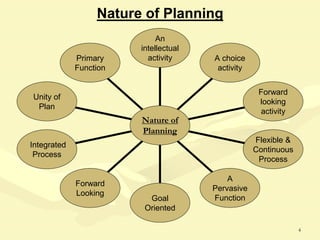
Nature of Planning
Primary
Function
Unity of
Plan
Integrated
Process
Forward
Looking
Goal
Oriented
A
Pervasive
Function
Flexible &
Continuous
Process
Forward
looking
activity
A choice
activity
An
intellectual
activity
Nature of
Planning
5
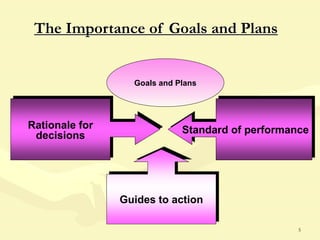
The Importance of Goals and Plans
Rationale for
decisions
Guides to action
Standard of performance
Goals and Plans
6
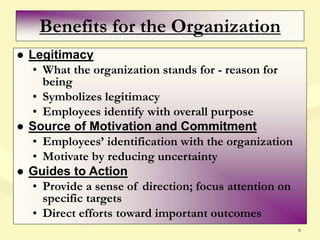
Benefits for the Organization
● Legitimacy
• What the organization stands for - reason for
being
• Symbolizes legitimacy
• Employees identify with overall purpose
● Source of Motivation and Commitment
• Employees’ identification with the organization
• Motivate by reducing uncertainty
● Guides to Action
• Provide a sense of direction; focus attention on
specific targets
• Direct efforts toward important outcomes
7
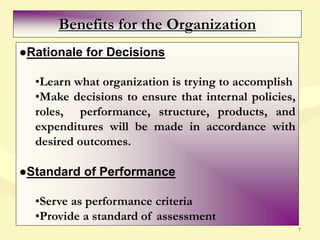
Benefits for the Organization
●Rationale for Decisions
•Learn what organization is trying to accomplish
•Make decisions to ensure that internal policies,
roles, performance, structure, products, and
expenditures will be made in accordance with
desired outcomes.
●Standard of Performance
•Serve as performance criteria
•Provide a standard of assessment
8
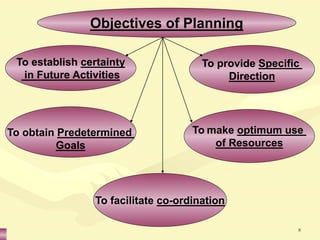
Objectives of Planning
To establish certainty
in Future Activities
To obtain Predetermined
Goals
To facilitate co-ordination
To provide Specific
Direction
To make optimum use
of Resources
9
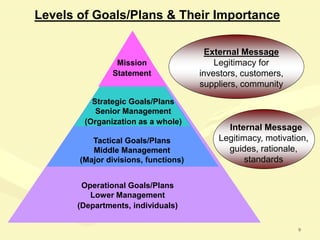
Levels of Goals/Plans & Their Importance
Mission
Statement
Strategic Goals/Plans
Senior Management
(Organization as a whole)
Tactical Goals/Plans
Middle Management
(Major divisions, functions)
Operational Goals/Plans
Lower Management
(Departments, individuals)
Internal Message
Legitimacy, motivation,
guides, rationale,
standards
External Message
Legitimacy for
investors, customers,
suppliers, community
10
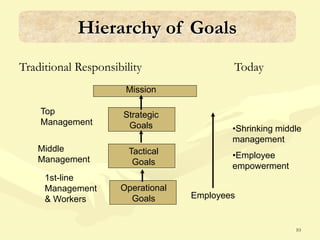
Traditional Responsibility Today
Hierarchy of Goals
Operational
Goals
Tactical
Goals
Strategic
Goals
Mission
Top
Management
Middle
Management
1st-line
Management
& Workers
•Shrinking middle
management
•Employee
empowerment
Employees
11
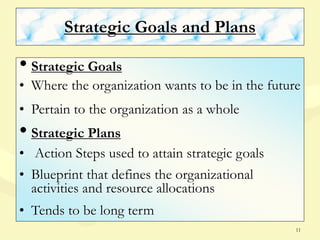
Strategic Goals and Plans
• Strategic Goals
• Where the organization wants to be in the future
• Pertain to the organization as a whole
• Strategic Plans
• Action Steps used to attain strategic goals
• Blueprint that defines the organizational
activities and resource allocations
• Tends to be long term
12
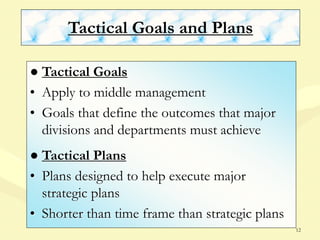
Tactical Goals and Plans
● Tactical Goals
• Apply to middle management
• Goals that define the outcomes that major
divisions and departments must achieve
● Tactical Plans
• Plans designed to help execute major
strategic plans
• Shorter than time frame than strategic plans
13
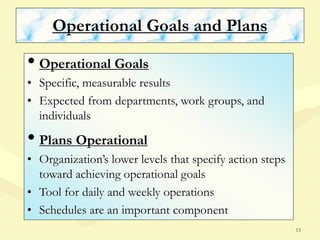
Operational Goals and Plans
• Operational Goals
• Specific, measurable results
• Expected from departments, work groups, and
individuals
• Plans Operational
• Organization’s lower levels that specify action steps
toward achieving operational goals
• Tool for daily and weekly operations
• Schedules are an important component
14
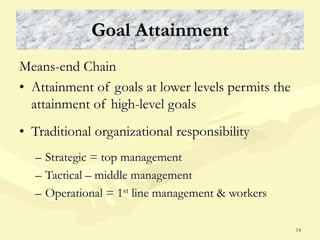
Goal Attainment
Means-end Chain
• Attainment of goals at lower levels permits the
attainment of high-level goals
• Traditional organizational responsibility
– Strategic = top management
– Tactical – middle management
– Operational = 1st line management & workers
15
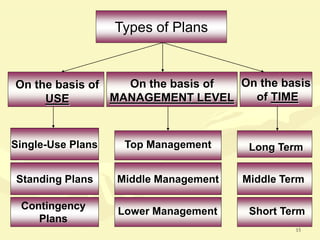
Types of Plans
Standing Plans
Contingency
Plans
On the basis of
USE
On the basis
of TIME
On the basis of
MANAGEMENT LEVEL
Top Management
Middle Management
Lower Management
Long Term
Middle Term
Short Term
Single-Use Plans
16
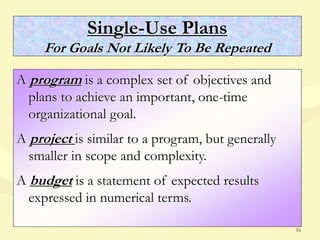
Single-Use Plans
For Goals Not Likely To Be Repeated
A program is a complex set of objectives and
plans to achieve an important, one-time
organizational goal.
A project is similar to a program, but generally
smaller in scope and complexity.
A budget is a statement of expected results
expressed in numerical terms.
17
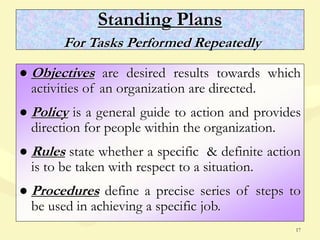
Standing Plans
For Tasks Performed Repeatedly
● Objectives are desired results towards which
activities of an organization are directed.
● Policy is a general guide to action and provides
direction for people within the organization.
● Rules state whether a specific & definite action
is to be taken with respect to a situation.
● Procedures define a precise series of steps to
be used in achieving a specific job.
18
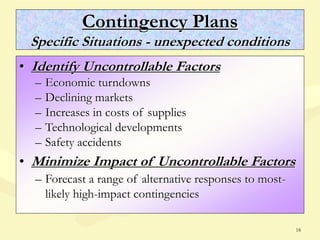
Contingency Plans
Specific Situations - unexpected conditions
• Identify Uncontrollable Factors
– Economic turndowns
– Declining markets
– Increases in costs of supplies
– Technological developments
– Safety accidents
• Minimize Impact of Uncontrollable Factors
– Forecast a range of alternative responses to most-
likely high-impact contingencies
19
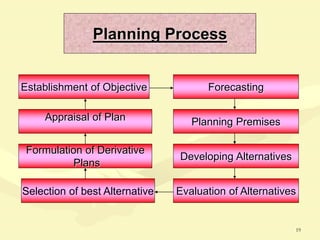
Establishment of Objective Forecasting
Planning Premises
Developing Alternatives
Evaluation of Alternatives
Selection of best Alternative
Appraisal of Plan
Formulation of Derivative
Plans
Planning Process
20
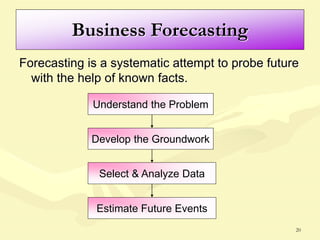
Business Forecasting
Forecasting is a systematic attempt to probe future
with the help of known facts.
Understand the Problem
Develop the Groundwork
Select & Analyze Data
Estimate Future Events
21
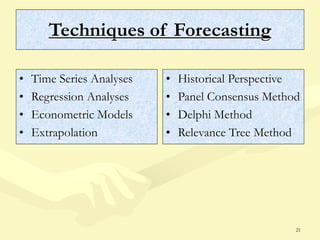
Techniques of Forecasting
• Time Series Analyses
• Regression Analyses
• Econometric Models
• Extrapolation
• Historical Perspective
• Panel Consensus Method
• Delphi Method
• Relevance Tree Method
22
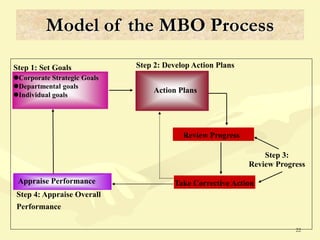
Model of the MBO Process
Step 1: Set Goals Step 2: Develop Action Plans
Step 3:
Review Progress
Corporate Strategic Goals
Departmental goals
Individual goals
Step 4: Appraise Overall
Performance
Appraise Performance Take Corrective Action
Review Progress
Action Plans
23
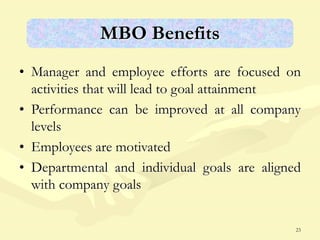
MBO Benefits
• Manager and employee efforts are focused on
activities that will lead to goal attainment
• Performance can be improved at all company
levels
• Employees are motivated
• Departmental and individual goals are aligned
with company goals
24
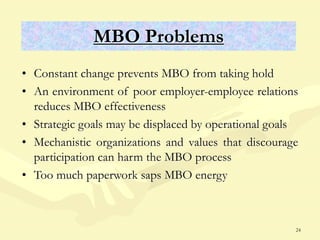
MBO Problems
• Constant change prevents MBO from taking hold
• An environment of poor employer-employee relations
reduces MBO effectiveness
• Strategic goals may be displaced by operational goals
• Mechanistic organizations and values that discourage
participation can harm the MBO process
• Too much paperwork saps MBO energy
25
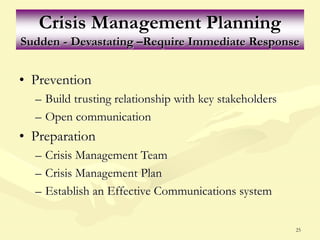
Crisis Management Planning
Sudden - Devastating –Require Immediate Response
• Prevention
– Build trusting relationship with key stakeholders
– Open communication
• Preparation
– Crisis Management Team
– Crisis Management Plan
– Establish an Effective Communications system
26
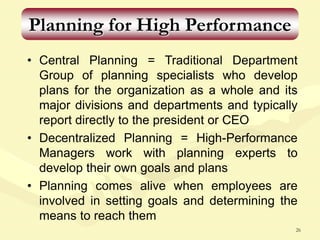
Planning for High Performance
• Central Planning = Traditional Department
Group of planning specialists who develop
plans for the organization as a whole and its
major divisions and departments and typically
report directly to the president or CEO
• Decentralized Planning = High-Performance
Managers work with planning experts to
develop their own goals and plans
• Planning comes alive when employees are
involved in setting goals and determining the
means to reach them

planning.ppt

  • 1.
  • 2.
    2 Planning •“The plan ofaction is at one and the same time result envisaged, the line of action to be followed, stages to go through, and method to use.” ------Henry Fayol •Planning is method or technique of looking ahead… a “ constructive reviewing of future needs, so that present actions can be adjusted in view of the established goals”. ----- George R.Terry • “Planning is deciding in advance what is to be done”. -----Theo Haimann •“Planning means the determination in advance, of a line of action by which certain results are to be achieved”. --------James L.Lundy
  • 3.
    3 Planning – determiningthe organization’s goals and the means for achieving them, the most fundamental management function, the most controversial management function. Goal - A desired future state that the organization attempts to realize. Plan - A blueprint specifying the resource allocations, schedules, and other actions necessary for attaining goals.
  • 4.
    4 Nature of Planning Primary Function Unityof Plan Integrated Process Forward Looking Goal Oriented A Pervasive Function Flexible & Continuous Process Forward looking activity A choice activity An intellectual activity Nature of Planning
  • 5.
    5 The Importance ofGoals and Plans Rationale for decisions Guides to action Standard of performance Goals and Plans
  • 6.
    6 Benefits for theOrganization ● Legitimacy • What the organization stands for - reason for being • Symbolizes legitimacy • Employees identify with overall purpose ● Source of Motivation and Commitment • Employees’ identification with the organization • Motivate by reducing uncertainty ● Guides to Action • Provide a sense of direction; focus attention on specific targets • Direct efforts toward important outcomes
  • 7.
    7 Benefits for theOrganization ●Rationale for Decisions •Learn what organization is trying to accomplish •Make decisions to ensure that internal policies, roles, performance, structure, products, and expenditures will be made in accordance with desired outcomes. ●Standard of Performance •Serve as performance criteria •Provide a standard of assessment
  • 8.
    8 Objectives of Planning Toestablish certainty in Future Activities To obtain Predetermined Goals To facilitate co-ordination To provide Specific Direction To make optimum use of Resources
  • 9.
    9 Levels of Goals/Plans& Their Importance Mission Statement Strategic Goals/Plans Senior Management (Organization as a whole) Tactical Goals/Plans Middle Management (Major divisions, functions) Operational Goals/Plans Lower Management (Departments, individuals) Internal Message Legitimacy, motivation, guides, rationale, standards External Message Legitimacy for investors, customers, suppliers, community
  • 10.
    10 Traditional Responsibility Today Hierarchyof Goals Operational Goals Tactical Goals Strategic Goals Mission Top Management Middle Management 1st-line Management & Workers •Shrinking middle management •Employee empowerment Employees
  • 11.
    11 Strategic Goals andPlans • Strategic Goals • Where the organization wants to be in the future • Pertain to the organization as a whole • Strategic Plans • Action Steps used to attain strategic goals • Blueprint that defines the organizational activities and resource allocations • Tends to be long term
  • 12.
    12 Tactical Goals andPlans ● Tactical Goals • Apply to middle management • Goals that define the outcomes that major divisions and departments must achieve ● Tactical Plans • Plans designed to help execute major strategic plans • Shorter than time frame than strategic plans
  • 13.
    13 Operational Goals andPlans • Operational Goals • Specific, measurable results • Expected from departments, work groups, and individuals • Plans Operational • Organization’s lower levels that specify action steps toward achieving operational goals • Tool for daily and weekly operations • Schedules are an important component
  • 14.
    14 Goal Attainment Means-end Chain •Attainment of goals at lower levels permits the attainment of high-level goals • Traditional organizational responsibility – Strategic = top management – Tactical – middle management – Operational = 1st line management & workers
  • 15.
    15 Types of Plans StandingPlans Contingency Plans On the basis of USE On the basis of TIME On the basis of MANAGEMENT LEVEL Top Management Middle Management Lower Management Long Term Middle Term Short Term Single-Use Plans
  • 16.
    16 Single-Use Plans For GoalsNot Likely To Be Repeated A program is a complex set of objectives and plans to achieve an important, one-time organizational goal. A project is similar to a program, but generally smaller in scope and complexity. A budget is a statement of expected results expressed in numerical terms.
  • 17.
    17 Standing Plans For TasksPerformed Repeatedly ● Objectives are desired results towards which activities of an organization are directed. ● Policy is a general guide to action and provides direction for people within the organization. ● Rules state whether a specific & definite action is to be taken with respect to a situation. ● Procedures define a precise series of steps to be used in achieving a specific job.
  • 18.
    18 Contingency Plans Specific Situations- unexpected conditions • Identify Uncontrollable Factors – Economic turndowns – Declining markets – Increases in costs of supplies – Technological developments – Safety accidents • Minimize Impact of Uncontrollable Factors – Forecast a range of alternative responses to most- likely high-impact contingencies
  • 19.
    19 Establishment of ObjectiveForecasting Planning Premises Developing Alternatives Evaluation of Alternatives Selection of best Alternative Appraisal of Plan Formulation of Derivative Plans Planning Process
  • 20.
    20 Business Forecasting Forecasting isa systematic attempt to probe future with the help of known facts. Understand the Problem Develop the Groundwork Select & Analyze Data Estimate Future Events
  • 21.
    21 Techniques of Forecasting •Time Series Analyses • Regression Analyses • Econometric Models • Extrapolation • Historical Perspective • Panel Consensus Method • Delphi Method • Relevance Tree Method
  • 22.
    22 Model of theMBO Process Step 1: Set Goals Step 2: Develop Action Plans Step 3: Review Progress Corporate Strategic Goals Departmental goals Individual goals Step 4: Appraise Overall Performance Appraise Performance Take Corrective Action Review Progress Action Plans
  • 23.
    23 MBO Benefits • Managerand employee efforts are focused on activities that will lead to goal attainment • Performance can be improved at all company levels • Employees are motivated • Departmental and individual goals are aligned with company goals
  • 24.
    24 MBO Problems • Constantchange prevents MBO from taking hold • An environment of poor employer-employee relations reduces MBO effectiveness • Strategic goals may be displaced by operational goals • Mechanistic organizations and values that discourage participation can harm the MBO process • Too much paperwork saps MBO energy
  • 25.
    25 Crisis Management Planning Sudden- Devastating –Require Immediate Response • Prevention – Build trusting relationship with key stakeholders – Open communication • Preparation – Crisis Management Team – Crisis Management Plan – Establish an Effective Communications system
  • 26.
    26 Planning for HighPerformance • Central Planning = Traditional Department Group of planning specialists who develop plans for the organization as a whole and its major divisions and departments and typically report directly to the president or CEO • Decentralized Planning = High-Performance Managers work with planning experts to develop their own goals and plans • Planning comes alive when employees are involved in setting goals and determining the means to reach them