ADVICES ON
ACADEMIC
WRITING
1. GENERAL ADVICE ON
ACADEMIC ESSAY-WRITING
• An essay should have an
argument.
• It should answer a question or a
few related questions.
• It should try to prove something,
developed a single thesis, by
reasoning and evidence
• First, you should formulate the
questions you will seek to answer in
your essay
• Next, develop by thinking, reading,
and jotting a provisional thesis or
hyphotesis
• An essay’s organization should be
design to present your argument
clearly and persuasively.
• Finally, revise extensively (draft and
redraft) and then, revise sentences,
with special attention to transitions.
UNIVERSITY EXPECTATIONS
ESSAY STRUCTURE
PARAGRAPHS
INTRODUCTION AND
CONCLUSION
• There is no
predetermined number
of points that your essay
must include.
• Essays have as many
paragraphs as needed.
• Paragraphs will be
clearer and more
coherent if they begin
with a topic sentence
that sums up the main
point of the paragraph.
• The introduction should
raise the essay topic or
WRITER´S BLOCK
Are you having trouble understanding the assignment?
Ask questions about anything that you found new or confusing.
Have you done enough research?
If you don’t know what to write about, you may need to do more research or
review the research you have already done.
Do you have a topic?
You must narrow down a topic or even create your own.
Are you worried about sounding smart enough?
Don´t try to use unfamiliar words to sound smart. Focus on getting your ideas
down simply and clear.
Do you find introductions difficult to write?
Write introduction last. Once you have written our papper you will have a
better sense of exactly what you need to introduce.
2.PLANNING AND ORGANIZING
a. Organizing and essay.
b. Using thesis statements
c. Introductions and conclusions.
d. Paragraphs.
e. Using topic sentences
a. Organizing and essay
The best thing to think how to organize your paper is
during the pre-writing stage. Ask the following questions:
What type of essay am I going to be writing? Does it
belong to a specific genre? It can help you to structure
your essay.
The earlier you begin planning, the best. As a potential
argument begins to take shape in your mind, you may
start to formalize your thoughts in the form of a tentative
plan. You will be much more eficcient in your reading and
your research if you have some idea of where your
argument is headed. You can then search for evidence for
the points in your tentative plan while you are reading
and researching.
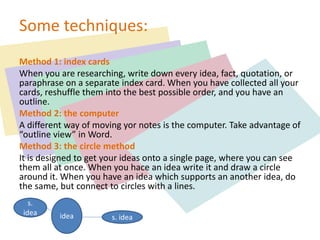
Some techniques:
Method 1: index cards
When you are researching, write down every idea, fact, quotation, or
paraphrase on a separate index card. When you have collected all your
cards, reshuffle them into the best possible order, and you have an
outline.
Method 2: the computer
A different way of moving yor notes is the computer. Take advantage of
“outline view” in Word.
Method 3: the circle method
It is designed to get your ideas onto a single page, where you can see
them all at once. When you hace an idea write it and draw a circle
around it. When you have an idea which supports an another idea, do
the same, but connect to circles with a lines.
s.
idea idea s. idea
Planning provides the following
advantages:
• Helps you to produce a logical and orderly
argument that you readers can follow.
• Helps you to produce an economical paper by
allowing you to spot repetition.
• Helps you to produce a thorough paper by
making it easier for you to notice whether you
have anything out.
• Makes drafting the paper easier by allowing you
to concentrate on writing issues such as
grammar, word choice and clarity.
b. Using thesis statements.
Your reader will probably expect a clear statement o
your position. Typically, this summary statement
comes in the first paragraph of the essay.
Characteristics:
1. It makes a definited and limited assertion that
needs to be explained and supported by further
discussion.
2. It shows the emphasis and indicates the
methodology of your argument.
3. It shows awareness of difficulties and
disagreements.
c. Introductions and conclusions.
A good introduction should identify your topic, provide
essential context, and indicate your particular focus in the
essay. It also helps to engage your reader´s interest.
General advices:
 If you write your introduction first, in order to explore your
own thinking on the topic, remember that you may, at a
later stage, need to compress your introduction.
 It can be fine to leave the writing of the introduction for a
later stage.
 It can be effectively written in one paragraph occupying
half to three-quarters of the first page.
 Get to the point as soon as possible. A comon error is to be
too broadly.
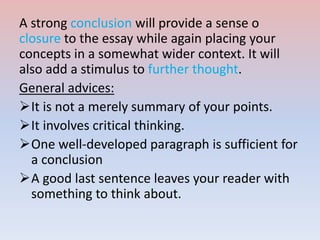
A strong conclusion will provide a sense o
closure to the essay while again placing your
concepts in a somewhat wider context. It will
also add a stimulus to further thought.
General advices:
It is not a merely summary of your points.
It involves critical thinking.
One well-developed paragraph is sufficient for
a conclusion
A good last sentence leaves your reader with
something to think about.
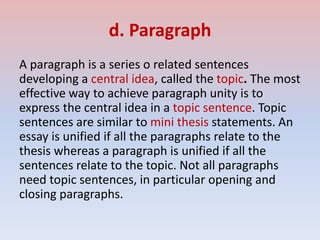
d. Paragraph
A paragraph is a series o related sentences
developing a central idea, called the topic. The most
effective way to achieve paragraph unity is to
express the central idea in a topic sentence. Topic
sentences are similar to mini thesis statements. An
essay is unified if all the paragraphs relate to the
thesis whereas a paragraph is unified if all the
sentences relate to the topic. Not all paragraphs
need topic sentences, in particular opening and
closing paragraphs.
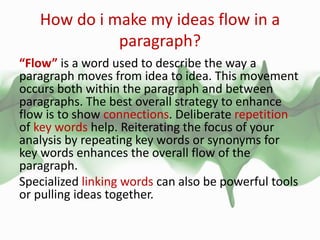
How do i make my ideas flow in a
paragraph?
“Flow” is a word used to describe the way a
paragraph moves from idea to idea. This movement
occurs both within the paragraph and between
paragraphs. The best overall strategy to enhance
flow is to show connections. Deliberate repetition
of key words help. Reiterating the focus of your
analysis by repeating key words or synonyms for
key words enhances the overall flow of the
paragraph.
Specialized linking words can also be powerful tools
or pulling ideas together.
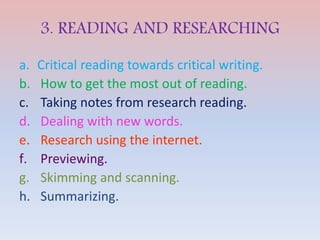
3. READING AND RESEARCHING
a. Critical reading towards critical writing.
b. How to get the most out of reading.
c. Taking notes from research reading.
d. Dealing with new words.
e. Research using the internet.
f. Previewing.
g. Skimming and scanning.
h. Summarizing.
a. Critical writing depends on critical reading. The
judgments and interpretations you make of the texts you
read are the first step towards formulating your own
approach.
HOW DO I READ LOOKING FOR WAYS OF THINKING?
 First determine the central claims or purpose of the text (its thesis).
 Begin to make some judgement about context. What audience is
the text written for? In what historical context is written?
 Distinguish the kinds of reasoning the text employs. What concepts
are defined and used? You might also examine how the text is
organized: how the author analyzed the material?
 Examine the evidence the text employs. Supporting evidence is
indispensable to an argument.
 Critical reading may involve evaluation. Your reading of a text is
already critical if it accounts for and makes a series of udgements
about how a text is argued.
b. A very important skill is to read with comprenhension
and memory.
Tips:
 Be aware of the structure of the text as you read: the
chapter titles, headings and subheadings will name the
main concepts to be covered.
 It is worthwhile to make brief summarizing notes in
your own words
 In going through sources for a research essay, you are
looking for facts to support or modify your original
view of the topic, and for other’s opinions to bolster
and to challenge your own.
 Write down bibiliographical information for each
source consulted.
c. Taking notes:
If you take notes efficiently you can read with more
understanding.
 Know what kind of ideas you need to record. Focus
your approach to the topic before you start detailed
research. Then you will read with a purpose in mind
and you will be able to sort out relevant ideas
 Don´t write down too much. Your note cards or note
sheets wil record only ideas that are relevant to your
focus on the topic; and they will mostly summarize
than quote.
 Label your notes intelligently. Take notes in a way that
allows for later use.
d. You don´t need to interrupt your
reading to look up every hard word
right away in the dictionary!
Experts say it is better to guess first. Mark unfamiliar words ,
but try these tactics and you will acquire some real
understanding of how words are used.
1. First, sound it out.
2. Next, examine the structure. Look for familiar word parts.
(prefixes, suffixes)
3. Then look at the context. Guess at the word meaning for
the way it is used in the sentence.
4. Only then, check the dictionary.
5. Then reinforce your understanding by writing a usable
brief definition or synonym in the margin of your reading.
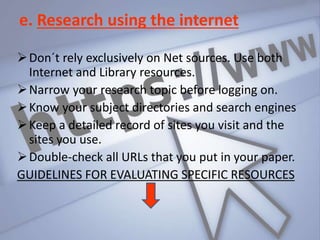
e. Research using the internet
Don´t rely exclusively on Net sources. Use both
Internet and Library resources.
Narrow your research topic before logging on.
Know your subject directories and search engines
Keep a detailed record of sites you visit and the
sites you use.
Double-check all URLs that you put in your paper.
GUIDELINES FOR EVALUATING SPECIFIC RESOURCES
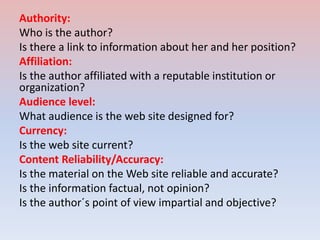
Authority:
Who is the author?
Is there a link to information about her and her position?
Affiliation:
Is the author affiliated with a reputable institution or
organization?
Audience level:
What audience is the web site designed for?
Currency:
Is the web site current?
Content Reliability/Accuracy:
Is the material on the Web site reliable and accurate?
Is the information factual, not opinion?
Is the author´s point of view impartial and objective?
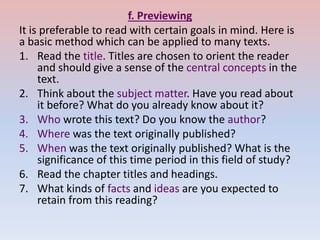
f. Previewing
It is preferable to read with certain goals in mind. Here is
a basic method which can be applied to many texts.
1. Read the title. Titles are chosen to orient the reader
and should give a sense of the central concepts in the
text.
2. Think about the subject matter. Have you read about
it before? What do you already know about it?
3. Who wrote this text? Do you know the author?
4. Where was the text originally published?
5. When was the text originally published? What is the
significance of this time period in this field of study?
6. Read the chapter titles and headings.
7. What kinds of facts and ideas are you expected to
retain from this reading?
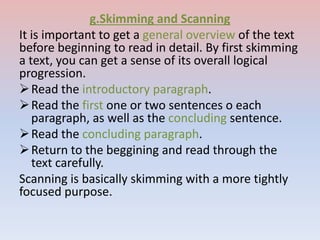
g.Skimming and Scanning
It is important to get a general overview of the text
before beginning to read in detail. By first skimming
a text, you can get a sense of its overall logical
progression.
Read the introductory paragraph.
Read the first one or two sentences o each
paragraph, as well as the concluding sentence.
Read the concluding paragraph.
Return to the beggining and read through the
text carefully.
Scanning is basically skimming with a more tightly
focused purpose.
h.Summarizing
Summarizing a text is a useful study tool as well as
good writing practice. A summary has two aims:
-to reproduce the overarching ideas in a text
identifying the general concepts that run through
the entire piece.
-to express these overarching ideas using precise,
specific language.
When you summarize you must make decisions
about which concepts to leave in and which to
omit, yaking into consideration your purposes and
your view o what is important in this text.
Bibliography
University of Toronto (n.d) Writing Advice
http://writing.utoronto.ca/

academic writing

  • 1.
  • 2.
    1. GENERAL ADVICEON ACADEMIC ESSAY-WRITING • An essay should have an argument. • It should answer a question or a few related questions. • It should try to prove something, developed a single thesis, by reasoning and evidence
  • 3.
    • First, youshould formulate the questions you will seek to answer in your essay • Next, develop by thinking, reading, and jotting a provisional thesis or hyphotesis • An essay’s organization should be design to present your argument clearly and persuasively. • Finally, revise extensively (draft and redraft) and then, revise sentences, with special attention to transitions.
  • 4.
    UNIVERSITY EXPECTATIONS ESSAY STRUCTURE PARAGRAPHS INTRODUCTIONAND CONCLUSION • There is no predetermined number of points that your essay must include. • Essays have as many paragraphs as needed. • Paragraphs will be clearer and more coherent if they begin with a topic sentence that sums up the main point of the paragraph. • The introduction should raise the essay topic or
  • 5.
    WRITER´S BLOCK Are youhaving trouble understanding the assignment? Ask questions about anything that you found new or confusing. Have you done enough research? If you don’t know what to write about, you may need to do more research or review the research you have already done. Do you have a topic? You must narrow down a topic or even create your own. Are you worried about sounding smart enough? Don´t try to use unfamiliar words to sound smart. Focus on getting your ideas down simply and clear. Do you find introductions difficult to write? Write introduction last. Once you have written our papper you will have a better sense of exactly what you need to introduce.
  • 6.
    2.PLANNING AND ORGANIZING a.Organizing and essay. b. Using thesis statements c. Introductions and conclusions. d. Paragraphs. e. Using topic sentences
  • 7.
    a. Organizing andessay The best thing to think how to organize your paper is during the pre-writing stage. Ask the following questions: What type of essay am I going to be writing? Does it belong to a specific genre? It can help you to structure your essay. The earlier you begin planning, the best. As a potential argument begins to take shape in your mind, you may start to formalize your thoughts in the form of a tentative plan. You will be much more eficcient in your reading and your research if you have some idea of where your argument is headed. You can then search for evidence for the points in your tentative plan while you are reading and researching.
  • 8.
    Some techniques: Method 1:index cards When you are researching, write down every idea, fact, quotation, or paraphrase on a separate index card. When you have collected all your cards, reshuffle them into the best possible order, and you have an outline. Method 2: the computer A different way of moving yor notes is the computer. Take advantage of “outline view” in Word. Method 3: the circle method It is designed to get your ideas onto a single page, where you can see them all at once. When you hace an idea write it and draw a circle around it. When you have an idea which supports an another idea, do the same, but connect to circles with a lines. s. idea idea s. idea
  • 9.
    Planning provides thefollowing advantages: • Helps you to produce a logical and orderly argument that you readers can follow. • Helps you to produce an economical paper by allowing you to spot repetition. • Helps you to produce a thorough paper by making it easier for you to notice whether you have anything out. • Makes drafting the paper easier by allowing you to concentrate on writing issues such as grammar, word choice and clarity.
  • 10.
    b. Using thesisstatements. Your reader will probably expect a clear statement o your position. Typically, this summary statement comes in the first paragraph of the essay. Characteristics: 1. It makes a definited and limited assertion that needs to be explained and supported by further discussion. 2. It shows the emphasis and indicates the methodology of your argument. 3. It shows awareness of difficulties and disagreements.
  • 11.
    c. Introductions andconclusions. A good introduction should identify your topic, provide essential context, and indicate your particular focus in the essay. It also helps to engage your reader´s interest. General advices:  If you write your introduction first, in order to explore your own thinking on the topic, remember that you may, at a later stage, need to compress your introduction.  It can be fine to leave the writing of the introduction for a later stage.  It can be effectively written in one paragraph occupying half to three-quarters of the first page.  Get to the point as soon as possible. A comon error is to be too broadly.
  • 12.
    A strong conclusionwill provide a sense o closure to the essay while again placing your concepts in a somewhat wider context. It will also add a stimulus to further thought. General advices: It is not a merely summary of your points. It involves critical thinking. One well-developed paragraph is sufficient for a conclusion A good last sentence leaves your reader with something to think about.
  • 13.
    d. Paragraph A paragraphis a series o related sentences developing a central idea, called the topic. The most effective way to achieve paragraph unity is to express the central idea in a topic sentence. Topic sentences are similar to mini thesis statements. An essay is unified if all the paragraphs relate to the thesis whereas a paragraph is unified if all the sentences relate to the topic. Not all paragraphs need topic sentences, in particular opening and closing paragraphs.
  • 14.
    How do imake my ideas flow in a paragraph? “Flow” is a word used to describe the way a paragraph moves from idea to idea. This movement occurs both within the paragraph and between paragraphs. The best overall strategy to enhance flow is to show connections. Deliberate repetition of key words help. Reiterating the focus of your analysis by repeating key words or synonyms for key words enhances the overall flow of the paragraph. Specialized linking words can also be powerful tools or pulling ideas together.
  • 15.
    3. READING ANDRESEARCHING a. Critical reading towards critical writing. b. How to get the most out of reading. c. Taking notes from research reading. d. Dealing with new words. e. Research using the internet. f. Previewing. g. Skimming and scanning. h. Summarizing.
  • 16.
    a. Critical writingdepends on critical reading. The judgments and interpretations you make of the texts you read are the first step towards formulating your own approach. HOW DO I READ LOOKING FOR WAYS OF THINKING?  First determine the central claims or purpose of the text (its thesis).  Begin to make some judgement about context. What audience is the text written for? In what historical context is written?  Distinguish the kinds of reasoning the text employs. What concepts are defined and used? You might also examine how the text is organized: how the author analyzed the material?  Examine the evidence the text employs. Supporting evidence is indispensable to an argument.  Critical reading may involve evaluation. Your reading of a text is already critical if it accounts for and makes a series of udgements about how a text is argued.
  • 17.
    b. A veryimportant skill is to read with comprenhension and memory. Tips:  Be aware of the structure of the text as you read: the chapter titles, headings and subheadings will name the main concepts to be covered.  It is worthwhile to make brief summarizing notes in your own words  In going through sources for a research essay, you are looking for facts to support or modify your original view of the topic, and for other’s opinions to bolster and to challenge your own.  Write down bibiliographical information for each source consulted.
  • 18.
    c. Taking notes: Ifyou take notes efficiently you can read with more understanding.  Know what kind of ideas you need to record. Focus your approach to the topic before you start detailed research. Then you will read with a purpose in mind and you will be able to sort out relevant ideas  Don´t write down too much. Your note cards or note sheets wil record only ideas that are relevant to your focus on the topic; and they will mostly summarize than quote.  Label your notes intelligently. Take notes in a way that allows for later use.
  • 19.
    d. You don´tneed to interrupt your reading to look up every hard word right away in the dictionary! Experts say it is better to guess first. Mark unfamiliar words , but try these tactics and you will acquire some real understanding of how words are used. 1. First, sound it out. 2. Next, examine the structure. Look for familiar word parts. (prefixes, suffixes) 3. Then look at the context. Guess at the word meaning for the way it is used in the sentence. 4. Only then, check the dictionary. 5. Then reinforce your understanding by writing a usable brief definition or synonym in the margin of your reading.
  • 20.
    e. Research usingthe internet Don´t rely exclusively on Net sources. Use both Internet and Library resources. Narrow your research topic before logging on. Know your subject directories and search engines Keep a detailed record of sites you visit and the sites you use. Double-check all URLs that you put in your paper. GUIDELINES FOR EVALUATING SPECIFIC RESOURCES
  • 21.
    Authority: Who is theauthor? Is there a link to information about her and her position? Affiliation: Is the author affiliated with a reputable institution or organization? Audience level: What audience is the web site designed for? Currency: Is the web site current? Content Reliability/Accuracy: Is the material on the Web site reliable and accurate? Is the information factual, not opinion? Is the author´s point of view impartial and objective?
  • 22.
    f. Previewing It ispreferable to read with certain goals in mind. Here is a basic method which can be applied to many texts. 1. Read the title. Titles are chosen to orient the reader and should give a sense of the central concepts in the text. 2. Think about the subject matter. Have you read about it before? What do you already know about it? 3. Who wrote this text? Do you know the author? 4. Where was the text originally published? 5. When was the text originally published? What is the significance of this time period in this field of study? 6. Read the chapter titles and headings. 7. What kinds of facts and ideas are you expected to retain from this reading?
  • 23.
    g.Skimming and Scanning Itis important to get a general overview of the text before beginning to read in detail. By first skimming a text, you can get a sense of its overall logical progression. Read the introductory paragraph. Read the first one or two sentences o each paragraph, as well as the concluding sentence. Read the concluding paragraph. Return to the beggining and read through the text carefully. Scanning is basically skimming with a more tightly focused purpose.
  • 24.
    h.Summarizing Summarizing a textis a useful study tool as well as good writing practice. A summary has two aims: -to reproduce the overarching ideas in a text identifying the general concepts that run through the entire piece. -to express these overarching ideas using precise, specific language. When you summarize you must make decisions about which concepts to leave in and which to omit, yaking into consideration your purposes and your view o what is important in this text.
  • 25.
    Bibliography University of Toronto(n.d) Writing Advice http://writing.utoronto.ca/